'How is it that one of Art Blakey’s greatest albums with the Jazz Messengers is so little known? The 1961 edition of the Messengers included Lee Morgan on trumpet, Wayne Shorter on tenor saxophone, Bobby Timmons on piano, and Jymie Merritt on bass. In February and May of 1961, this group (with pianist Walter Davis Jr sitting in on two tracks) entered Rudy Van Gelder’s studio in New Jersey and proceeded to lay down Roots & Herbs, a brilliant set of six Shorter compositions including the driving hard bop of the title track, the playful “Ping Pong,” and the clever “United.” The album was eventually released in 1970 and deserves a place among Blakey’s finest recordings.
Поиск:jazz messengers
Все
"Next up in Mr Bongo's Groove Merchant Records reissue series, we present the only solo album saxophonist Ramon Morris recorded as a bandleader. Having cut his teeth playing with the iconic band Art Blakey & The Jazz Messengers and working with other jazz greats, including Reuben Wilson, Shirley Scott, Rashied Ali Quintet, and Woody Shaw, 1973 saw Ramon take the step into solo territory. The resulting album Sweet Sister Funk became a certified classic and a landmark showcase of the cherished ‘70s jazz-funk sound, later sampled by the likes of DJ Premier, The Alchemist and DJ Shadow.
Originally released on Sonny Lester's iconic Groove Merchant record label and produced by Lester himself, Sweet Sister Funk is a jazz-funk masterclass. It features a slick line-up including Cecil Bridgewater on trumpet, Mickey Roker on drums, and Albert Dailey on electric piano. Rich and beautiful, the seven songs ebb and flow in energy, fusing jazz funk and soul jazz with style and swagger. There are bags of groove with Ramon and Cecil trading off on sax and trumpet in an effortless conversation throughout the LP, supplemented by brilliant solos from the rest of the players.
A gold mine of sampling material, the album includes a sublime cover version of The Stylistics' much-loved 'People Make The World Go Round', which was sampled by DJ Shadow on Blackalicious's 'Swan Lake' in 1994. Elsewhere, the percussion and bass intro of the opening track 'First Come, First Serve' is a sampler's delight - a deep, heavy groove with a fine saxophone workout by Ramon. Head to 'Don't Ask Me' and you’ll find the swinging horn intro that formed the basis of 'You Came Up' by Big Pun featuring Noreaga from 1998, whilst 'Wijinia' has echoes of ‘70s indie jazz by labels such as Strata East & Black Jazz.
Here at Mr Bongo, we are proud to be delving into the vaults of Groove Merchant Records once again, reissuing this iconic LP from Ramon Morris."
- A1: Mieko Hirota - Soul Lady
- A2: Shinji Maki &Amp; Black Jack - Nabeyoko Soul
- A3: Tan Tan - Happy Day
- A4: Kenji Niinuma - Airenki
- A5: Hatsumi Shibata - Furui Fuku Nanka
- B1: Strawberry Jam - Arimasen
- B2: Mieko Hirota - Anata Ga Inakute Mo
- B3: Akira Yasuda &Amp; Beat Folk - Kaeroka Kaeroka (Single Version)
- B4: Miki Hirayama - Hatachi No Koi
- B5: Masaaki Sakai - Baby, Yuki Wo Dashite
At the start of the 60s, a new wave of gospel-influenced jazz started to emerge, with hits such as Art Blakey & The Jazz Messengers' "Moanin'" and Cannonball Adderley's "Work Song" epitomizing this evolution in the genre. The terms "soul jazz" and "funky jazz" were coined as a way to describe this new sound that was making an impact in the US and also on the other sides of the Atlantic and Pacific oceans.
In 1964, Ray Charles made his first visit to Japan. Then, in 1968, Martha & The Vandellas and Stevie Wonder set foot in the country, followed by Sam & Dave in 1969, Ike & Tina Turner in 1970, and B.B. King in 1971. The TV show "Soul Train" also began airing in Japan in the early 1970s. A watershed moment happened in 1973 when Sammy Davis Jr. was cast in a TV commercial for Suntory whisky — and the influence of the US Black entertainment world had really landed, with soul, jazz, and funk artists becoming household names.
Nippon Columbia played a pivotal role during this turning point. The company had contracts with Buddah Records and Blue Thumb Records, releasing notable works by artists such as Gladys Knight & The Pips, Curtis Mayfield, The Crusaders, and The Pointer Sisters. At the same time, the label was also releasing several Japanese soul, jazz, and funk projects under the lead of music director Jiro Inagaki. Inagaki, a saxophonist who began his professional career in the early 1950s, honed his skills at U.S. military camps, where he shared his love of music with the Black servicemen. In the 1960s, he played with drummer Hideo Shiraki's band, which was widely considered to be Japan's representative group of the funky jazz movement. Later, Inagaki went on to pursue more cutting-edge sounds with his Soul Media project, including being a pioneering figure in the "jazz rock" genre. By working closely with Inagaki and his various musical projects, Nippon Columbia really placed the company at the center of an exciting and important period in Japanese music.
In 1965, Nippon Columbia opened a recording studio in Tokyo's Akasaka neighborhood. Akasaka was also home to the first ever discotheque in Japan, the legendary MUGEN, which ran from 1968 to 1987 and where many acts performed, including Con Funk Shun, the Bar-Kays, Ike & Tina Turner, B.B. King, Sam & Dave, Three Degrees, and Edwin Starr, as well as many local Japanese singers and musicians. This melting pot of creativity in the area led to the recording of many singles and albums by Japanese artists that were infused with the sounds of soul and funk. Most of these recordings were not available outside of Japan and remain rare and unknown musical gems. The selection you are holding in your hands is an explosive collection of 10 essential tracks released by the legendary Nippon Columbia label between 1969 and 1977, capturing the raw, unapparelled energy that was flowing through the air of the Akasaka streets at this electrifying time. Enjoy!
---
180GWALP07 - Manufactured and distributed by 180g.
This album was recorded September 15, 1957, in Hackensack, New Jersey. The personnel includes Coltrane's Miles Davis bandmates, Paul Chambers on bass and Philly Joe Jones on drums - both of whom had worked before with pianist Kenny Drew - and trumpeter Lee Morgan and trombonist Curtis Fuller, who were then up-and-coming jazz musicians and would go on to join Art Blakey's Jazz Messengers. All of the compositions were written by John Coltrane, with the exception of the standard "I'm Old Fashioned". The title track is a long, rhythmically variegated blues with a sentimental theme that gradually shows the major key during Coltrane's first chorus. "Locomotion" is also a blues riff tune, in forty-four-bar form.
New Parisian label, Disques Messager, presents its new and second release. As its name suggests, the label has a simple leitmotiv: to place itself among the best messengers for rarities and sought-after gems of the international rare groove. A mission which began like fire last year with a 7inch reissue release including two Brazilian Disco bangers by Cristina Camargo. For this second efforts, the label doesn’t deviate from the artistic and quality path taken, however also making quite a U-turn, this time presenting 2 underrated kind of musical UFO, both from the French scene.
Not many info can be found about Yoanson & Karamie, two young artists from the French African diaspora, who randomly met with Nessim Saroussi and his label Ness Music in the late 80s. Nessim himself doesn’t remind much about the 2 guys, except that he quickly offered to produce them, which resulted in their only EP release, Kalimba (1988). Part of this EP, “African Leaders” is a stunning track melting Afro-Tropical percussions, Disco bass, Early-Electro beats and Leftfield vocals in a way that could remind of Doctor L or Arthur Russel productions.
On the contrary, Philippe de Lacroix-Herpin (aka Prof Jah Pinpin) has a long musical career started in the mid-70s and became a renowned saxophonist playing and recording for many famous French acts such as Jean-Jacques Goldman, Alain Chamfort, FFF, or even rap band NTM. In 1994, he moved definitely to the Reunion Island where he quickly launched the Prof Jah Pinpin 4tet, in his own words willing to play “free/funk/jazz/rock/tropical” music… Quite a vast and large musical tag, but which immediately make sense when listening to the surprising “The Final Bird” track. Only released as CD in 1996, this instrumental production has indeed a unique sound and flavor mixing all kinds of elements together (even samples of Weather Report).
Well as you can understand, words are not the best way to describe these 2 hidden treasures, so we strongly recommend the spinning to make your own view!
Zwar nicht sieben auf einen Streich, aber immerhin sieben Alben in einem Jahr, das war die beeindruckende
Bilanz, die Hank Mobley, damals der führende Tenorsaxofonist des Hard-Bop, am Ende des Jahres 1957
vorweisen konnte. Und mehr noch als die Quantität überraschte die ungebrochen hohe Qualität seiner Alben. “Hank” war das letzte Album dieses Aufnahme-Marathons. Wie immer hatte das Gründungsmitglied
der Jazz Messengers es mit einigen der besten Hard-Bop-Musiker jener Zeit eingespielt, unter denen sich
drei weitere Jazz Messengers befanden
Nach einem kurzen Intermezzo bei Art Blakeys Jazz Messengers und einigen gemeinsamen Aufnahmen mit
dem Altsaxofonisten Gigi Gryce gründete Donald Byrd 1958 sein erstes eigenes Quintett, das er gelegentlich
auch zum Sextett erweiterte. In der Bläserfront stand dabei oft der Baritonsaxofonist Pepper Adams an der
Seite des Trompeters. Wie heiß diese Band zu swingen verstand, zeigte sie im November 1960 bei einem
zweistündigen Auftritt im New Yorker Half Note Café, der auf zwei separaten LPs veröffentlicht wurde.
Wayne Shorter war ein amerikanischer Jazz-Saxophonist, Komponist und Bandleader. Er wurde 1959 als
Mitglied von Art Blakey’s Jazz Messengers bekannt, für die er schließlich der Hauptkomponist wurde. Er
trat 1964 dem Second Great Quintet von Miles Davis bei und war 1970 Mitbegründer der Jazz-Fusion-Band
Weather Report. Als Bandleader nahm er mehr als 20 Alben auf. Viele Shorter-Kompositionen sind zu
Jazz-Standards geworden, darunter „E.S.P.“ und „Footprints“. Seine Musik wurde mit 12 Grammy Awards
ausgezeichnet. Der Musikkritiker der New York Times, Ben Ratliff, bezeichnete Shorter 2008 als „den
wahrscheinlich größten lebenden Small-Group-Komponisten des Jazz und einen Anwärter auf den größten
lebenden Improvisator“.
Das Debütalbum des legendären Jazz-Saxophonisten, Introducing Wayne Shorter, wurde ursprünglich 1960
auf Vee-Jay veröffentlicht. Es enthält 5 Shorter-Originale und eine Coverversion von „Mack The Knife“,
wobei Shorter von Lee Morgan (Trompete), Wynton Kelly (Klavier), Paul Chambers (Bass) und Jimmy
Cobb (Schlagzeug) begleitet wird. Diese Neuauflage des Albums erscheint als Teil der Original Jazz Classics
-Serie auf 180-Gramm-Vinyl, das bei RTI gepresst wurde, mit analogem Mastering von den Originalbändern
bei Cohearent Audio und einem Stoughton Tip-On Jacket.
Im September 1964 war es Miles Davis endlich gelungen, den Saxofonisten Wayne Shorter von Art Blakeys
Jazz Messengers abzuwerben und mit ihm sein Second Great Quintet zu vervollständigen. Shorters Solokarriere schien darunter nicht nur nicht zu leiden, sondern sogar noch beflügelt zu werden. Und zwar so sehr,
dass Blue Note mit dem Veröffentlichen seiner Soloalben kaum nachkam. Eines der Alben, die zunächst
archiviert wurden, war “The Soothsayer”. Es wurde im März 1965 mit einem Allstar-Sextett aufgenommen,
erschien aus unerklärlichen Gründen aber erst 1979. Denn laut AllMusic gehört es zu Shorters “besten
Werken aus dieser unglaublich fruchtbaren Zeit”.
Lee Morgan war ein amerikanischer Jazztrompeter und Komponist. Als einer der wichtigsten Hard BopMusiker der 1960er Jahre wurde Morgan bereits in seinen späten Teenagerjahren bekannt. Er nahm mit Bandleadern wie John Coltrane, Curtis Fuller, Dizzy Gillespie, Hank Mobley und Wayne Shorter auf und spielte in Art Blakeys Jazz Messengers. Morgan blieb bis 1961 bei Blakey und begann in den späten 50er Jahren, als Leader Platten aufzunehmen. Seine Komposition „The Sidewinder“, die auf dem gleichnamigen Album enthalten ist, wurde 1964 zu einem überraschenden Crossover-Hit in den Pop- und R&B-Charts. Nach einem zweiten Engagement in Blakeys Band arbeitete Morgan bis zu seinem Tod 1972 sowohl als Leader als auch als Sideman weiter. Ursprünglich 1960 auf dem Vee-Jay-Label veröffentlicht, ist ”Here’s Lee Morgan” Lee Morgans 10. Album. Auf der Sammlung von 6 Hard Bop-Stücken wird Morgan von Clifford Jordan (Tenorsaxophon), Wynton Kelly (Klavier), Paul Chambers (Bass) und Art Blakey (Schlagzeug) unterstützt. Diese Neuauflage des Albums erscheint als Teil der Original Jazz Classics Series auf 180-Gramm-Vinyl, das bei RTI gepresst wurde, mit analogem Mastering von den Originalbändern bei Cohearent Audio und einem Stoughton TipOn Jacket.
Mit seinem ersten Blue-Note-Album ”Blues In Trinty” erweiterte der aus Jamaika stammende und damals in England lebende Trompeter Dizzy Reece seine Fangemeinde um so berühmte Kollegen wie Miles Davis und Sonny Rollins. Und Art Blakey wollte ihn und den britischen Tenorsaxofonisten Tubby Hayes, der hier ebenfalls zu hören ist, sofort für seine Jazz Messengers verpflichten. Das Album, auf dem auch zwei prominente Gäste aus den USA mitwirkten, gilt noch heute als absoluter Bop-Klassiker.
Volume 2[22,48 €]
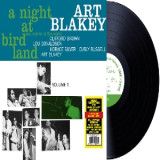
A Night at Birdland Volume 1 is a live album by drummer Art Blakey, recorded in 1954 at the famous Birdland club. This first volume highlights his quintet, featuring Clifford Brown on trumpet, Lou Donaldson on alto saxophone, Horace Silver on piano, and Curly Russell on bass. The album captures the raw energy of emerging hard bop, with intense tracks like “Split Kick” and “A Night in Tunisia.” Blakey asserts his explosive drumming style, foreshadowing the era of the Jazz Messengers.
Volume 1[22,48 €]
A Night at Birdland Volume 2 continues the energy of the first volume, capturing the essence of hard bop in its emergence. Recorded in 1954, it highlights the quintet led by Art Blakey, featuring Clifford Brown, Lou Donaldson, Horace Silver, and Curly Russell. This second volume delivers vibrant performances such as “Wee-Dot” and “Quicksilver”, where Brown and Silver’s virtuosity particularly shines. Blakey, through his rhythmic power, drives each track with unmatched intensity, foreshadowing the spirit of the Jazz Messengers.
The jazz saxophonist Wayne Shorter, released this "Wayning Moments” LP in 1962. It was recorded earlier, in 1961 during Shorter's early years as a
bandleader before his tenure with Art Blakey's Jazz Messengers and later Miles Davis' Second Great Quintet. This album showcases Shorter's early
compositional voice, blending intricate harmonies with expressive improvisation. His playing is energetic, and the interplay with Freddie Hubbard
creates a rich and engaging dialogue.
Soul Station is a masterpiece of melodic improvisation, rhythmic interplay, and emotional depth and showcases Hank Mobley's ability to create music that swings hard but remains accessible and lyrical
The album remains a classic in the jazz canon, essential not only for understanding Mobley's contribution to jazz but also for appreciating the broader hard bop movement of the late 1950s and early 1960s. Released in 1960 it is widely regarded as one of his finest works and a classic in the hard bop genre: Hank Mobley was part of the first wave of musicians who helped shape the hard bop sound, a style that blends bebop with blues, gospel, and R&B influences. Mobley was known for his smooth, melodic playing, and while he didn't receive the same level of fame as contemporaries like John Coltrane or Sonny Rollins, he was respected for his consistency and lyrical improvisation. The album features an exceptional quartet of jazz legends: Hank Mobley, Art Blakey, Wynton Kelly and Paul Chambers: this quartet is especially notable because Mobley recorded with Art Blakey's Jazz Messengers and the rhythm section (Kelly and Chambers) was a part of the classic Miles Davis quintet at the time. Their tight interplay and experience shine throughout the record. "Soul Station" stands out because it encapsulates Mobley's mature, melodic sound and his ability to craft memorable, emotionally resonant music without relying on flash or pyrotechnics. It's a must- listen for any jazz enthusiast, and it's often recommended as a starting point for those exploring Mobley's extensive discography.
Mit seinem ersten Blue-Note-Album ”Blues In Trinty” erweiterte der aus Jamaika stammende und damals
in England lebende Trompeter Dizzy Reece seine Fangemeinde um so berühmte Kollegen wie Miles Davis
und Sonny Rollins. Und Art Blakey wollte ihn und den britischen Tenorsaxofonisten Tubby Hayes, der
hier ebenfalls zu hören ist, sofort für seine Jazz Messengers verpflichten. Das Album, auf dem auch zwei
prominente Gäste aus den USA mitwirkten, gilt noch heute als absoluter Bop-Klassiker.
Comprising someof Denmark"s most prominent young musicians, Copenhagen"s trailblazing neo-jazz quintet OTOOTO refer to their innovative blend of jazz tradition and modern indie-pop as "homeshake meets the jazz messengers". Their third studio album"2nd Quake" is set to release on November 8th on April Records. OTOOTO, consisting of Jonas Due (trumpet and flugelhorn), Oilly Wallace (alto sax and flute), Calle Brickman (keys), Andreas Svendsen (drums and percussion), and Matthias Petri (bass), has been a fixture on both the Danish and international jazz scenes since their 2021 debut "This Love Is For You". Their new release marks a new chapter in their journey, reflecting a bold, mature artistic vision that promises to cement their place as leaders in Scandinavian contemporary jazz. "Our mission is to reflect the modern society and put a sound to its vibrations. And through this sound we seek to transmit purity, love, and joy." Navigating through a wide array of inspirations from 70"s rock and European church music, to the pioneering sounds of Jean-Michel Jarre and Vangelis, the five piece - led by trumpeter Jonas Due and saxophonist Oilly Wallace - self describe their sound as"a roaring sea of analogue synths and velvety horns". Featuring eight meticulously composed original pieces, 2nd Quakebalances strong memorable melodies with intricate orchestration, a continuous sense of groove, thick layers of texture and fearless, lyrical improvisations. A collaboration with electronic producer Sofie Birch, the record is an electro-organic sonic exploration of the union between acoustic instrumental timbres and electronic manipulation, spearheaded by the sound of the legendary Juno 106 synth alongside stellar jazz-informed musician-ship.
In the fall of 2022, celebrated UK chill-out institution Seahawks landed in Los Angeles for the first time in their 15-year history, with plans to record a sweeping new age downtempo "exploration of visionary California."
Instead, they immediately fell ill with flu (Fowler collapsed next to a taco truck; 911 was called), and were bedridden for the better part of a week. Upon recovering, they resituated at the synthesizer sanctuary of Brian Foote (Peak Oil, Kranky, Leech), channeling their post-sickness psychedelia into one of the band's lushest and most elevated creations to date: Time Enough For Love. Inspired by the "groove and mood" of Harry Nilsson demos, as well as its wider 70's wavelength - Rhodes, Wurlitzer, wood paneling - Seahawks transposed their classic post-rave ambient exotica onto a warm and woozy Golden State palette. Buoyed by the liquid touch of English maestro Kenny Dickenson on keys, the results rank high among the duo's smoothest and most multi-sensory voyages. "Sail Across The Moon" delivers on its title, a simmering, phaser-smeared cruise through the beauty of the night. "Messengers" echoes the cosmic lounge of Air's Moon Safari, shuffling, weightless, and ethereal, while "Falling Deep" reaches for the stars, pure cascading bliss, the ecstatic moment writ large.
The album skews steadily more astral as it progresses, drifting towards jazzy, galactic outer reaches. "Like A Grain Of Sand" opens with a spoken sample by the celebrated late American poet Rachel Sherwood ("The children watch, breathless / with the birds / They feel an emanation / from this shuddering place"), before taking flight on a Balearic trip through island house, PM Dawn gold dust, upright bass meditation, and kaleidoscopic light. A remix of the title track by Chicago trio Purelink closes the record in a suitably subdued and skittery state of mind. Time Enough For Love radiates color, complexity, and positivity, infused by the "life enhancing" nature of the band's time in Los Angeles - sunsets, sound systems, and sativa, framed by coastlines and cloudbanks, the city's mystic sprawl glittering beneath purple dusk.
- A1: Pharoah Sanders - Moonchild
- A2: Kirk Lightsey Trio Ft. Freddie Hubbard - Gibraltar (Alternate Take)
- B1: Carter Jefferson - Why
- B2: Tom Grant - No Me Esqueca
- B3: Eddie Harris - La Carnival
- C1: Rodney Jones - Articulation
- C2: Art Blakey & The Jazz Messengers - In Case You Missed It
- C3: Eastern Rebellion - Bolivia
- D1: Joanne Brackeen - Haïti B
- D2: Brian Melvin Feat. Jaco Pastorius - Zen Turtles
- D3: Timeless All Stars - World Peace
Influential DJ, producer, radio-presentator and founder of the Acid Jazz and Talkin’ Loud labels Gilles Peterson has handpicked his jazz favourites from the immense catalog of the Dutch jazz Timeless label. Included are Pharaoh Sanders’ cosmic jazz “Moonchild”, vocal-jazz from Carter Jefferson’s “Why”, danceable-jazz from Tom Grant “No Me Esqueca”, Art Blakey & The Jazz Messengers’ “In Case You Missed It”, making a total of 11 tracks.
In 2015, Peterson put together a Japan-only CD compilation of 10 of his favourite tracks, but for the vinyl version, the track list has been augmentend with the previously unreleased version of “Gibraltar (Alternate Take)” by Kirk Lightsey Trio feat. Freddie Hubbard, and “World Peace” by Timeless All Stars.
Timeless Jazz Classics Volume 1 is available on black vinyl and includes an insert with liner notes and track-by-track information by Gilles Peterson.
- A1: The Hub (Freddie Hubbard) 16’44
- A2: Blue Moon (Rogers/Hart) 7’44
- B1: Crisis (Freddie Hubbard) 24’46
Re-mastered from the original Mono Master Tapes. Limited repress 1000 copies.
180 gr vinyl pressed by Pallas in Germany.
Deluxe high-gloss flipback album jacket.
Essay written by Brian Priestley.
Double insert using an original photo by JP Leloir from the concert.
Artwork by Jean-Louis Duralek.
Each record has been visually checked to prevent defects.
A never-before released Art Blakey 1965 live recordings.
First official release with the full permission and cooperation of the Art Blakey Estate & INA (Institut National de l’Audiovisuel).
Art Blakey, Live in ’65 boasts an exceptional one-hour concert from Paris in 1965. This performance showcases one of the few undocumented Blakey bands, the New Jazzmen, featuring Freddie Hubbard on trumpet, Jaki Byard on piano, Reggie Workman on bass, Nathan Davis on sax, and, of course, Blakey on drums.
Freddie Hubbard’s incendiary playing on “Blue Moon” and the blistering 24-minute version of his own “Crisis” shows that he was one of the most innovative trumpeters in jazz history.
On this live session, the audiences seem to have been enthusiastic and appreciative. “Everywhere we’d go people would say, This is the best Jazz Messengers we’ve heard!”, according to Davis. “And because of the way Jaki would play and Reggie would go, it was like a semi-freedom thing – with Messengers heads, you know, but when we got to soloing…! And Blakey was ridin’ and floatin’ the time…but he would always be loose enough to follow, to keep it going. He’s one helluva musician.”
Recorded at Palais de la Mutualité, Paris, France, November 3, 1965.
Freddie Hubbard (Trumpet)
Nathan Davis (Tenor saxophone)
Jacki Byard (Piano)
Reggie Workman (Bass)
Art Blakey (Drums)
2024 Repress
Re-mastered from the original Mono Master Tapes. Limited repress 1000 copies.
180 gr vinyl pressed by Pallas in Germany.
Deluxe high-gloss flipback album jacket.
Essay written by Brian Priestley.
Double insert using an original photo by JP Leloir from the concert.
Artwork by Jean-Louis Duralek.
Each record has been visually checked to prevent defects.
A never-before released Art Blakey 1965 live recordings.
First official release with the full permission and cooperation of the Art Blakey Estate & INA (Institut National de l’Audiovisuel).
Art Blakey, Live in ’65 boasts an exceptional one-hour concert from Paris in 1965. This performance showcases one of the few undocumented Blakey bands, the New Jazzmen, featuring Freddie Hubbard on trumpet, Jaki Byard on piano, Reggie Workman on bass, Nathan Davis on sax, and, of course, Blakey on drums.
Freddie Hubbard’s incendiary playing on “Blue Moon” and the blistering 24-minute version of his own “Crisis” shows that he was one of the most innovative trumpeters in jazz history.
On this live session, the audiences seem to have been enthusiastic and appreciative. “Everywhere we’d go people would say, This is the best Jazz Messengers we’ve heard!”, according to Davis. “And because of the way Jaki would play and Reggie would go, it was like a semi-freedom thing – with Messengers heads, you know, but when we got to soloing…! And Blakey was ridin’ and floatin’ the time…but he would always be loose enough to follow, to keep it going. He’s one helluva musician.”
Recorded at Palais de la Mutualité, Paris, France, November 3, 1965.
Freddie Hubbard (Trumpet)
Nathan Davis (Tenor saxophone)
Jacki Byard (Piano)
Reggie Workman (Bass)
Art Blakey (Drums)
"Cedar Walton was one of the most influential hard bop pianists and became well known as the pianist with Art Blakey's Jazz Messengers. Bassist Ron Carter and drummer Jack DeJohnette both gained fame early in their careers for their associations with two different Miles Davis groups. This jazz album from 1984 was the only recording that these three jazz legends did together and was created on December 22-23 in 1983. The album is also known as The All American Trio. Cedar Walton / Ron Carter / Jack DeJohnette contains newly written liner-notes by jazz journalist/historian Scott Yanow."
Once billed as “Europe’s First Lady of Jazz,” Dutch singer Rita Reys (1924- 2013) was a legend overseas during the second half of the 20th century, and certainly one of the top European jazz singers. The LP The Cool Voice of Rita Reys (considered her best record ever) presents her backed on one side by a band led by her husband, drummer Wessel Ilcken, and on the other side by Art Blakey’s Jazz Messengers, featuring Donald Byrd, Hank Mobley and Horace Silver. 180-gram VIRGIN VINYL LIMITED EDITION of 750 COPIES. The Complete Album + 3 Bonus Tracks.
The latest release on Jai Alai follows the format of forgotten vinyl tracks never before released on 7” format, or previously CD only album tracks, and will raise some eyebrows in artist selection and pairing.
Donaldson Toussaint L’Ouverture Byrd II was one of the most significant jazz artists of all time having joined Art Blakey’s Jazz Messengers in the mid-50s and establishing himself as one of the best hard bop trumpeter/flugelhorn players. His progression was continuous through the 50s/60s working with John Coltrane, Gigi Gryce, Pepper Adams, Thelonius Monk, Sonny Rollins as sideman, and became one of Blue Note Records leading artists.
By the end of the 60s Byrd decided to move away from that idiom, experimenting with jazz fusion, African music and Rhythm & Blues. He worked hard to make jazz and its history part of the curriculum in US music colleges and he taught at many including Rutgers, Hampton, Howard, and Columbia, the latter from who he received his PhD in music.
Byrd took a great interest in how Miles Davis’ experimentation was resonating with a younger audience, and despite being castigated by his musical peers, his development of jazz fusion changed the jazz scene forever. His work with the Blackbyrds was a cornerstone for the progression of jazz funk in the UK.
The effect of his hook-up with brothers Larry & Fonce Mizell was immediate and his Blue Notes albums “Black Byrd” (1973), “Street Lady”, “Stepping Into Tomorrow” (1974), “Places & Spaces” (1975) and “Caricatures” (1976) became legendary on the newly evolving jazz funk scene with certain tracks such as “Change (Makes You Wanna Hustle)” normalising dance jazz on the disco floors, not to mention being a rich source for many hip-hop samples.
A slightly leaner period followed when he moved to Elektra Records and of the three albums with his new incarnation 125th Street NYC, a group of musicians he taught at North Carolina Central University, two were produced by Isaac Hayes including “Words”, “Sounds, Colors & Shapes” (1982) from which “Everyday”, a fabulous forgotten piece of mellow jazz funk derives.
By the end of the 80s he had returned to his harder straight-ahead jazz roots, but his place in history and the evolving of jazz as a dance culture in our clubs should never be forgotten.
Recorded in 1955 for Tom Wilson’s Transition label, Byrd’s Eye View was Donald Byrd’s first issued album as a leader featuring the trumpeter at the helm of the line-up of The Jazz Messengers with Hank Mobley, Horace Silver, Doug Watkins, and Art Blakey plus trumpeter Joe Gordon on several tracks. This mono Tone Poet Vinyl Edition was produced by Joe Harley, mastered by Kevin Gray from the original analog master tapes, pressed on 180g vinyl at RTI, and packaged in a deluxe tip-on jacket with an 8.5” x 5.5” booklet.
Don't judge a book by its cover. Judge a record by its cover.
And, perhaps, its title.
Cedar Walton's Mobius is as outrageously, disorientatingly brilliant as the stunning jacket design, featuring the legendary jazz pianist morphing into a mobius strip, set against a beautiful sky filled with cumulus clouds. A proper jazz-funk fusion slapfest, Mobius is a stellar electric set from - essentially - one *hell* of a SUPERBAND.
Yes, in addition to Walton's Fender Rhodes wizardry, Mobius is elevated by Ryo Kawasaki's stinging electric guitar, pristinely clear vocals by Adrienne Albert and Lani Groves, rootsy percussion by Ray Mantilla and Omar Clay, alto and baritone from Charles Davis, trumpet from Roy Burrowes, Gordon Edwards on bass and Frank Foster's tenor sax. Oh and did we mention STEVE GADD ON DRUMS?!?!
Gem after gem of looping, bliss-inducing gold, it's an incredibly revelatory album. It presents a thrilling synthesis of R&B, funk, blues and hard bop (with a hint of rock), all driven by an idiosyncratic electronic keyboard. Walton, a giant in the jazz world, got quite the workout every time he played, from piano to arp synthesizer to clarinet to electric piano to mini-moog and back again.
Mobius was Cedar Walton's debut for RCA in 1975. The versatile artist confirmed his abilities as a player, composer, interpreter and arranger with this stunning record, and his own bright compositions offered a springboard for the improvisations of the different soloists. Coltrane's "Blue Trane" is the first classic to be given the funkafied Mobius treatment, Ryo Kawasaki let loose all over neck-snapping Gadd-drum gold before the horns take a fiery turn and subsequently give way to Cedar's virtuosity. A sparkling b-boy break version of Thelonious Monk's "Off Minor" (featuring an absolutely *fire* solo from Walton) really sets proceedings alight. Of the three original pieces, the shuffling, percussive power of "Soho" is just absolutely mind bending Latin-influenced jazzy soul whilst the mellow vibes of "The Maestro" bring elegant, sumptuous soul. And then there's the effortlessly funky "Road Island Red". Just too, too good.
Cedar Walton was born in Dallas, Texas, on January 17, 1934 and began his professional career in 1959 when he began touring for several years with the J.J. Johnson Quintet. He later joined the Art Farmer-Benny Golson Jazztet and then Art Blakey's Jazz Messengers. Pretty solid credentials, right? While based in New York City, Cedar played with such luminaries as Donald Byrd, Eddie Harris, Blue Mitchell, Kenny Dorham, Lee Morgan, Freddie Hubbard, Jimmy Heath and Milt Jackson. Without question, he was one of the most complete and gifted musicians of his time and Mobius provides proof of that. The fresh, danceable tracks, all firmly rooted in the living tradition of blues and gospel, are skilfully presented by a master who enjoyed keeping abreast of contemporary tastes and was always keen to renew his language.
As the album notes state: “Mobius, which is the theoretical shape of the infinite universe, makes use of the most modern recording techniques and synthesizers. We mastered and mixed so that it’s hotter than the competition, which should help radio play and in-store demonstration.” Indeed. Mobius is really gorgeous mid-70s fusion, ranging from the funky to the ecstatic. It's an absolute MONSTER that will completely blow you away; and, yes, it's as wild and hypnotic as the cover. The audio for Mobius has been carefully remastered by Be With regular Simon Francis, ensuring it sounds better than ever. Cicely Balston's expert skills have made sure nothing is lost in the cut whilst the records have been pressed to the highest possible standard at Record Industry in Holland. The original, iconic sleeve has been restored here at Be With HQ as the finishing touch to this long overdue re-issue.
96kHz - 48-bit HD Audio with digital booklet including original photography by Christopher Kayfield and liner notes by Shaun Brady.
Pianist Kevin Hays, bassist Ben Street, and drummer Billy Hart reunite for a second, scintillating trio date, BRIDGES, featuring original compositions by Hays and Hart with classics by Wayne Shorter, Bill Frisell, The Beatles, and Milton Nascimento.
Hays Street Hart, the trio of pianist Kevin Hays, bassist Ben Street, and legendary drummer Billy Hart, recorded their acclaimed 2021 debut, ALL THINGS ARE, under less than optimal conditions. The album began life as a performance in honor of Hart’s 80th birthday in December 2020, live-streamed from an empty Smoke Jazz Club in the final weeks of that grueling pandemic year. Despite those adversities, the music they created that night was spectacular enough to convince all involved that it should be released.
Two years later, the trio has reconvened, this time fully cognizant that they were going to record an album at Sear Sound Studios in NYC. The captivating BRIDGES brilliantly spotlights the unique chemistry and shared spirit of exploration that emerged fully formed on that initial impromptu session. The title succinctly hints at some of the reasons why Hays, Street and Hart work so well together: this is a trio that bridges generations, certainly, as well as a wealth of diverse experience and inspiration. But it also sums up a mutual desire to bring people together through music.
“In this world that seems to be crumbling beneath our feet,” Hays explains, “we sense the need to make allies where there might be adversaries. On the most intimate level, interpersonally and inter-psychically we set out to overcome any number of misunderstandings and adversarial situations.”
Not that there was any antagonism to overcome within the trio itself. More than anything, Hays Street Hart is a mutual admiration society of the highest order. The esteem in which the pianist and bassist hold Billy Hart likely goes without saying. The drummer was ordained in 2022 as an NEA Jazz Master, just one of the many honors he has chalked up over a breathtaking career. He began his career with an apprenticeship under the revered vocalist Shirley Horn and went on to make notable music with such luminaries as Miles Davis, McCoy Tyner, Herbie Hancock, Wes Montgomery, Jimmy Smith, Stan Getz, and as part of the quartet Quest featuring David Liebman and Richie Beirach.
But Hart is if anything, even more laudatory toward his younger bandmates. Street has been a member of the drummer’s stellar quartet for two decades, alongside pianist Ethan Iverson and saxophonist Mark Turner, a tenure that speaks for itself. As for Hays, Hart is quick to place the pianist in the exalted company of some of his iconic former collaborators.
“I’ve been lucky enough to have the chance to perform with Herbie Hancock and McCoy Tyner,” says Hart modestly. “Each generation presents their own equivalent, and Kevin is an example of the latest innovations. There was Herbie and McCoy, then it was Chick Corea and Keith Jarrett, and then you have what's coming next. I think Kevin is definitely part of that continuum.”
Though Hays sticks strictly to the piano on BRIDGES, he is also an accomplished singer whose vocal instincts fuel his inventive and lyrical melodicism. Street points to those facets as key to the connection between the pianist and Hart, who has enjoyed several meaningful collaborations with vocalists.
“It always seems to me that Kevin has the capacity to sing in his mind and then accompany himself on the piano,” Street describes. “That makes for such a nice connection with Billy, who has played with and learned from so many singers. I don't even feel like we're playing as a piano trio most of the time; it feels more like a quartet.”
Those qualities are especially clear on Hays’ “Butterfly,” which opens the album. Though it’s performed here as an instrumental, the pianist has composed lyrics for the piece, and its gorgeous, song-like quality shines through. Hays also contributed the breathtaking ballad “Song for Peace,” highlighted by Hart’s gentle, embracing brushwork and Street’s sturdy, stentorian tone. The pianist’s third original, “Row Row Row,” is constructed on a twelve-tone row, but as the playful title suggests, it has none of the more stringent qualities of the serialist composers.
Hart’s stunning “Irah,” originally recorded on his quartet’s self-titled 2006 debut, is dedicated to the composer’s mother and was recorded at Street’s suggestion. The bassist also brought guitarist Bill Frisell’s reflective “Throughout” to the date, imagining Frisell’s Americana influences would resonate with the similarly inclined Hays, who approaches the tune with a harp-like beauty. Hays’ love of pop and rock music is also reflected by the inclusion of The Beatles classic “With a Little Help from My Friends.”
The trio pays tribute to the late, great Wayne Shorter with “Capricorn,” originally released on the composer’s 1969 Blue Note album SUPER NOVA and later included on the Miles Davis Quintet set WATER BABIES. Hart called Shorter one of a kind. I think of the many times I heard him excel – with the Maynard Ferguson Big Band, with Art Blakey's Jazz Messengers, with Weather Report. And in each case, he was innovative.”
BRIDGES closes with the title track, a dazzling piece by the great Brazilian singer and songwriter Milton Nascimento, which Hays calls “one of my favorite compositions ever, by anybody.”
BRIDGES was recorded under ideal studio conditions by a now-established trio with a weeks-long European tour under their belts. Perhaps what’s most remarkable about the album is not that Hays, Street, and Hart play so masterfully together – with three artists of their caliber, who could expect any less? – but that this second outing maintains the bold spirit of inquisitiveness and spontaneity that its predecessor naturally possessed. Credit that to a trio perpetually determined to discover new bridges worth building.
Holiday for Skins Vol. 1” by Art Blakey is a fascinating blend of percussion and jazz. Recorded in 1958, the album brings together talents like Ray Barretto, Sabu Martinez, and the Jazz Messengers. These exotic rhythms explore Afro-Cuban and Brazilian styles, delivering a vibrant musical experience. The versatility of percussion and mastery of jazz make this album a true rhythmic celebration, highlighting Art Blakey’s lasting impact in the world of jazz.
"Holiday For Skins Vol. 1" by Art Blakey includes the following tracks: "Lamento Africano" and more.
"Holiday for Skins Vol. 2" is a percussion-driven jazz album led by Art Blakey, recorded in 1958. Featuring master percussionists like Ray Barretto and Sabu Martinez, the album dives into Afro-Cuban and Brazilian rhythms, interwoven with the Jazz Messengers' expertise. This captivating collection highlights Blakey's innovative exploration of diverse beats, creating a rhythmic feast that showcases his profound influence on the fusion of percussion and jazz.
"Holiday For Skins Vol. 2" by Art Blakey includes the following tracks: "Dinga" and more.
When Billy Eckstine’s band dissolved in the mid-1940s, adventurous drummer Art Blakey spent two years in Africa, where he briefly converted to Islam; back in New York, he gigged with Miles and Monk, before fronting his own Jazz Messengers. 1957’s Orgy In Rhythm drew on the sounds of North Africa and the Middle East, Blakey’s unfettered drumming accompanied by Latin percussionists such as Potato Valdez and Evilio Quintero, with Herbie Mann on flute. The musical arrangement is stunning, at times melodic or primordially rhythmic, but never short of pure brilliance. Overall, an excellent and astounding release!
180g virgin vinyl limited edition of 750 copies only - the complete album + 3 bonus tracks Once billed as "Europe's First Lady of Jazz," Dutch singer Rita Reys (1924-2013) was a legend overseas during the second half of the 20th century, and certainly one of the top European jazz singers. The LP 'The Cool Voice of Rita Reys'(considered her best record ever) presents her backed on one side by a band led by her husband, drummer Wessel Ilcken, and on the other side by Art Blakey's Jazz Messengers in two manifestations of the band featuring Donald Byrd, Hank Mobley, Horace Silver, Kenny Drew, Wilbur Ware, and others.
The 1961 album Mosaic marked a pivotal moment in the story of Art Blakey & The Jazz Messengers with the arrival of Freddie Hubbard and Cedar Walton and the band’s expansion to a sextet with the addition of Curtis Fuller joining existing members Wayne Shorter and Jymie Merritt to establish a powerful new line-up on this hard bop classic. This Blue Note Classic Vinyl Edition is stereo, all-analog, mastered by Kevin Gray from the original master tapes, and pressed on 180g vinyl at Optimal.
- A1: Take Five - The Dave Brubeck Quartet
- A2: Moanin' - Art Blakey & The Jazz Messengers
- A3: Soul Bossa Nova - Quincy Jones & His Orchestra
- A4: Milestones - Miles Davis
- A5: My Bucket's Got A Hole In It - The Ramsey Lewis Trio
- B1: Watermelon Man - Herbie Hancock
- B2: Caravan - Duke Ellington
- B3: One Mint Julep - Ray Charles
- B4: Walk On The Wild Side - Jimmy Smith And The Big Band
- B5: Desafinado - Stan Getz & Charlie Byrd
- C1: So What - Miles Davis
- C2: Tuxedo Junction - Quincy Jones
- C3: Harlem Nocturne - King Curtis
- C4: Blues Walk - Herbie Mann
- C5: Unsquare Dance - The Dave Brubeck Quartet
- D1: Sing, Sing, Sing - Benny Goodman And His Orchestra
- D2: Love For Sale - Dexter Gordon
- D3: Take The "A" Train - Duke Ellington
- D4: Work Song - Cannonball Adderley & Ray Brown
- D5: I've Got A Woman (Part 1) - Jimmy Mcgriff
There are as many flavours of Jazz as there are pebbles on a
beach, but the majority combine rhythmic invention with
instrumental virtuosity to create a sound that can transport the
listener to a different plane. Our compilation features duos,
trios, bands and orchestras playing music inspired by Africa,
Brazil and all points in-between. Film themes, standards, charttoppers and relative obscurities have been carefully assembled
to provide a wide-ranging picture of the Jazz instrumental.
Classic Jazz Album from 1978.
Featuring an all-star line-up.
First ever vinyl reissue since 1986.
Released for the first time in the UK & North America.
180g BLACK vinyl limited to 500 copies (w/obi strip).
Curtis Fuller (December 15, 1932 – May 8, 2021) was an American jazz trombonist best known for being a member of several legendary jazz outfits, his impressive catalog of solo albums and a contributor to many classic jazz recordings.
Fuller was born in Detroit and lost both his parents at a very young age. He spent several years in an orphanage run by Jesuits where he developed a passion for jazz after one of the nuns there took him to see his first live performance. Curtis attended public school in his hometown (together with Donald Byrd and Milt Jackson) where he took up the trombone at the age of sixteen.
Curtis Fuller was a well-respected member of iconic outfits such as Art Blakey & The Jazz Messengers, Art Farmer’s Tentet, The Benny Golson Quintet and Eastern Rebellion. The list of his collaborations is impressive to say the least, Mr. Fuller recorded and performed with greats such as Quincy Jones, John Coltrane, Count Basie, Dizzy Gillespie, Freddie Hubbard, Roland Kirk Rashaan, Miles Davis…and many others.
Fuller was granted an honorary doctorate of music from Berklee College of Music in 1999 and eight years later he was honored as a NEA Jazz Master. Curtis Fuller’s performances were included on classic recordings released by prominent labels from the likes of Blue Note, Savoy, Prestige, Strata-East, Muse, Verve and Impulse!
On the album we are presenting you today: Four On The Outside (Recorded in 1978 at the famous New York CI Recording Studio and released on Timeless Records the same year) the listener is treated to six majestic tracks of the highest caliber and features a remarkable outing of advanced musicianship by jazz-giants in their prime, delivering an inspirational gem of an album.
The all-star line-up includes Pepper Adams (Oliver Nelson, Lalo Schifrin, Herbie Hancock) on saxophone, Dennis Irwin (The Jazz Messengers, Chet Baker) on bass and James Williams (Calvin Keys, Thelonious Monk) on piano.
Four On The Outside shows off Fuller’s mastery of the Trombone and this delightful set features him in a front line with Pepper Adams delivering a unique trombone-baritone saxophone combination (few others have followed this intriguing coupling). Curtis Fuller plays from the heart and is on top of his game. Expect sharp and elegant original compositions, machine gun-like spurts, angular boppish lines and top rhythm section work that never gets in the way of the horns spreading their wings. All of the above makes this record a must have for any self-respecting jazz fan or collector!
Brussels-based power trio Don Kapot are set to release their rousing new album 'I Love Tempo' on the 15th of September via W.E.R.F. Records - NEWS distribution.
A lifeboat of free jazz, afrobeat and krautpunk sailed by Giotis Damianidis (bass), Viktor Perdieus (baritone saxophone) and Jakob Warmenbol (drums), the album follows the release of their critically acclaimed 2022 album 'Un Peu Live' recorded with Dutch multi-instrumentalist, vocalist and composer Fulco Ottervanger, and described by Bandcamp Daily as a 'very fun mix of modern jazz and krautrock.'
Don Kapot strike hard with their fourth album, mixed and co-produced by Greg Saunier (Deerhoof). Using a wide range of instruments, they evolve their sound into a solid complex rhythmic wave, shaken by demented samples and punk attitude.
From the vibrant, pounding rhythms of opening track 'Me Pig' to the off-kilter, whimsical beats of 'Macarona' and 'Terryble,' Don Kapot integrate new instruments and sounds into their repertoire, including keyboards and sampling. The groove remains a central element to the sound as the trio deliver a palpable blend of high tension and joyous energy where genres are demolished.
Elsewhere, the funk-heavy 'Bernadette' allows the magical, freestyle sax work of Perdieus take centre stage while 'Don Be No' is an urgent, flippant blast of vigour and zest before the album title track 'I Love Tempo' is an exhilarating and hypnotic journey that combines the freedom and verve of free jazz with the trance-like zeal of artists such as Tony Allen, Fela Kuti and Kologbo
Releasing their self-titled debut album in 2018 via Mr. Nakayasi Records, in 2021 they signed to Flemish record label W.E.R.F. Records and have released three albums under the label and have performed sold-out shows across Belgium and the Netherlands.
The players in Don Kapot also extend their musical adventures to other projects. Damianidis leads Punk Kong and has performed with Akira Sakata, Sakis Papadimitriou, Oghene Kologbo, Tony Allen, Baba Ani, Balasz Pandi and Gonzalo Almeida among others. Warmenbol was a member of The Unrevealed Society, Robbing Millions and M(h)ysteria. He also performs with Ruth Tafebe & the Afrosoul Messengers (with Giotis), Under The Reefs Orchestra and Monolithe Noir. Perdieus performs in Punk Kong and with Pompelmoes and The Milk Factory and took part in Ifa y Xango, Laia Arkestra, Bolhaerd, Nest and VVolk. He has also recorded and played with Andrew Cyrille (Bambi Pang Pang).
"One of the more remarkable albums in Freddie Hubbard’s formidable Blue Note oeuvre, Breaking Point! was recorded in May 1964 shortly after the trumpeter left Art Blakey’s Jazz Messengers to form his own band. The quintet—with James Spaulding on alto saxophone and flute, Ronnie Mathews on piano, Eddie Khan on bass, and Joe Chambers on drums—moves assuredly from free-form playing and modal jazz to the blues and balladry on this five-song set of originals by Hubbard and Chambers.
This stereo Tone Poet Vinyl Edition was produced by Joe Harley, mastered by Kevin Gray from the original analog master tapes, pressed on 180g vinyl at RTI, and packaged in a deluxe gatefold tip-on jacket."