Spun Out Agency is honoured to present ‘More of that Frightful Oompty Boompty Music’, a compilation dedicated to the Guv’nor himself Mr Andrew Weatherall who should need no introduction on these pages. Released on vinyl in two beautiful parts, the first drops on April 15th with the second following two weeks after.
‘More of that Frightful Oompty Boompty Music’ (yes we are going to write that out every time we talk about it in this communique) showcases a selection of the shining greatness from the agency’s roster. Paranoid London, Fantastic Twins, Mehmet Aslan, Autarkic, Ruf Dug, Sean Johnston, and Manfredas gift exclusive tracks which highlight the sublime acid, techno and house sound that Weatherall would have described as “oopmty-boompty” music.
Spun Out is a London-based artist booking agency which has been run by Caroline Hayes for over 20 splendid years, that looked after the life and times of Andrew Weatherall alongside his partnership with Sean Johnston under their A Love From Outer Space moniker, and the likes of Optimo (Espacio), Ivan Smagghe, Josh Caffe, Man Power, Body Hammer, Kiara Scuro and many more artists, doing it differently.
Kicking off the A-side of the first record is Hardway Bros’ (aka Sean Johnston) previously unreleased remix of We Are The Axis by The Asphodells, the duo consisting of the Andrew Weatherall and former Battant member and Spun Out talent Timothy J. Fairplay. An energetic techno stomper with percussive rhythms, this exclusive remix offers the ideal tantalising dose to tease any dancefloor. The vocals and synth layers give it a punk rock approach, referencing the multi-genre essence of Weatherall’s taste in music.
Tel-Aviv-based Autarkic’s Sleepover closes the A-side with a chuggy lullaby, one that is certainly unsuitable for putting a baby to bed, given its intricate acid lines of total hypnosis. Following on the B-side is Manctalo Banger, a house bop by the Manchester-via-Ibiza computer game nerd and vinyl digger Ruf Dug, and Shizowaves, Turkish-born Basel-based Mehmet Aslan’s soulful touch to the compilation, bringing Middle-Eastern percussive melodies and catchy basslines.
The second record is introduced by Paranoid London, with a Spun Out dedicated acid techno banger appropriately titled Spinning Out and Fantastic Twins’ EBM track Kali’s Tongue Was A Weapon. On the B-side is Lithuanian chug legend Manfredas’ Hfuhruhurr, and Naum Gabo, who closes the compilation with the chaotic analogue-synth frenzy, Cold Sold. The name Naum Gabo may evoke the pioneer of Russian constructivism, who rose to fame thanks to his crazy kinetic sculptures. However, here it manifests as one half of Spun Out’s Optimo duo Jonnie Wilkes (JG Wikes) and James Savage. The duo’s impeccable manipulation of electronic hardware couldn’t give a better homage to him.
Some highlights for Spun Out artists this summer include 9 acts from the roster playing at Houghton Festival, Paranoid London’s show at Sonar Festival, Love International Festival and Ransom Note’s festival with Optimo Watching Trees.
quête:jg
Spun Out Agency is honoured to present ‘More of that Frightful Oompty Boompty Music’, a compilation dedicated to the Guv’nor himself Mr Andrew Weatherall who should need no introduction on these pages. Released on vinyl in two beautiful parts, the first drops on April 15th with the second following two weeks after.
‘More of that Frightful Oompty Boompty Music’ (yes we are going to write that out every time we talk about it in this communique) showcases a selection of the shining greatness from the agency’s roster. Paranoid London, Fantastic Twins, Mehmet Aslan, Autarkic, Ruf Dug, Sean Johnston, and Manfredas gift exclusive tracks which highlight the sublime acid, techno and house sound that Weatherall would have described as “oopmty-boompty” music.
Spun Out is a London-based artist booking agency which has been run by Caroline Hayes for over 20 splendid years, that looked after the life and times of Andrew Weatherall alongside his partnership with Sean Johnston under their A Love From Outer Space moniker, and the likes of Optimo (Espacio), Ivan Smagghe, Josh Caffe, Man Power, Body Hammer, Kiara Scuro and many more artists, doing it differently.
Kicking off the A-side of the first record is Hardway Bros’ (aka Sean Johnston) previously unreleased remix of We Are The Axis by The Asphodells, the duo consisting of the Andrew Weatherall and former Battant member and Spun Out talent Timothy J. Fairplay. An energetic techno stomper with percussive rhythms, this exclusive remix offers the ideal tantalising dose to tease any dancefloor. The vocals and synth layers give it a punk rock approach, referencing the multi-genre essence of Weatherall’s taste in music.
Tel-Aviv-based Autarkic’s Sleepover closes the A-side with a chuggy lullaby, one that is certainly unsuitable for putting a baby to bed, given its intricate acid lines of total hypnosis. Following on the B-side is Manctalo Banger, a house bop by the Manchester-via-Ibiza computer game nerd and vinyl digger Ruf Dug, and Shizowaves, Turkish-born Basel-based Mehmet Aslan’s soulful touch to the compilation, bringing Middle-Eastern percussive melodies and catchy basslines.
The second record is introduced by Paranoid London, with a Spun Out dedicated acid techno banger appropriately titled Spinning Out and Fantastic Twins’ EBM track Kali’s Tongue Was A Weapon. On the B-side is Lithuanian chug legend Manfredas’ Hfuhruhurr, and Naum Gabo, who closes the compilation with the chaotic analogue-synth frenzy, Cold Sold. The name Naum Gabo may evoke the pioneer of Russian constructivism, who rose to fame thanks to his crazy kinetic sculptures. However, here it manifests as one half of Spun Out’s Optimo duo Jonnie Wilkes (JG Wikes) and James Savage. The duo’s impeccable manipulation of electronic hardware couldn’t give a better homage to him.
Some highlights for Spun Out artists this summer include 9 acts from the roster playing at Houghton Festival, Paranoid London’s show at Sonar Festival, Love International Festival and Ransom Note’s festival with Optimo Watching Trees.
(MENDEL & JGS FYRAFTEN EDITS)
The A side is an edit of 'Jean-Paul Pognon's - Limie', (DJ/producer) Mendel works and slices the track's most vital parts - extending them into maximum dancefloor joy. On the flip 'David Et Corine's - Noir Sur Blanc' which JGS Fyraften Edits sliced and diced to keep the energy high.
Mike Pride was not a fan of legendary punk band MDC – a straight-edge hardcore devotee, you could even say he had a chip on his shoulder about this more mainstream, less disciplined form of punk – when he suddenly found himself on a tour of Europe as their drummer sometime in the early ‘00s. Twenty years later, now a longtime fan and friend of the band, Pride unexpectedly turns to the band’s raucous catalogue as a source for jazz standards on his warped new album, I Hate Work. I Hate Work draws its material exclusively from MDC’s iconic 1982 debut album, Millions of Dead Cops. Despite his long established passion for bringing the extremes of hardcore and heavy rock into the jazz and improvised music realm (and vice versa), Pride instead does the unexpected, transforming MDC’s pummeling punk into swinging acoustic jazz. For the occasion he enlisted pianist Jamie Saft and bassist Bradley Christopher Jones, both master re-interpreters of a wide swath of pop and rock music, as well as special guests Mick Barr (Ocrilim, Krallice), JG Thirlwell (Foetus), Sam Mickens (The Dead Science) and MDC frontman Dave Dictor.
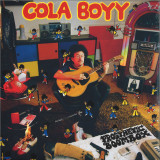
There’s liberation on the dance floor in the songs of Matthew Urango – glimpses of revolution that glimmer beneath the disco ball. “I want my music to bring people together,” says the Californian pop innovator, best known as Cola Boyy. “Because standing together is our best chance at fighting this shit show.” The shit show in question is a broken, brutal system the acclaimed multi-instrumentalist has witnessed up-close. Urango was born with spina bifida and scoliosis in Oxnard, California: a town in which almost 30,000 are estimated to live in poverty. Prosthetic Boombox, his eagerly awaited debut album, might at first glance seem a joyous confetti-burst of pop eclecticism, engineered to sound like “scanning between stations on a car radio, landing on all these different sounds and styles” as Urango puts it. Dig deeper, though, and you’ll discover a simmering sense of rebellion. “The working class are injured, struggling to pay rent and struggling to put food on the table,” he says. “I want to represent that.” Prosthetic Boombox
achieves that goal in a thrilling flurry of inventive indie, funk and soul: take Urango’s car radio analogy, place it in a time-travelling Delorean with Prince in the passenger seat, and you’re half-way there.
Look no closer than Prosthetic Boombox’s euphoric opener, the Avalanches-assisted ‘Don’t Forget Your Neighbourhood.’ The track – which Urango says mixes “the Beach Boys, French disco, house keys and ragtime piano, kinda like the Cheers soundtrack!” – ends with lyrics urging listeners to “fight for your town with your fist closed, strike it and make it more than just a memory.” It’s a reminder that the working classes need to “turn our fists against our oppressors instead of each other,” he explains. After that emphatic introduction comes a horn-laced funk wig-out titled ‘Mailbox’ – a song that gives Dua Lipa’s Future Nostalgia a run for its Studio 54-themed money, featuring rising Londoner JGrrey. Elsewhere, ‘Song for the Mister’ ventures into smooth R&B territory, before ‘Roses’ – a collaboration with Myd of Ed Banger fame – offers a bouquet of bustling disco guitars and infinite bisous of Connan Mockasin’s band drops in on the immaculate ‘Go the Mile’. Urango saves his most introspective moment for the album’s starry closer. ‘Kid Born in Space’, a cosmic collaboration with MGMT frontman Andrew VanWyngarden, sees the artist reflect on what he once had to overcome as a disabled person of colour. “I see them looking down on my dreams of being,” he sings tenderly. “I hear them making fun of my voice, but I keep on moving forward, I refuse to live in anyone else’s shadow.” Prosthetic Boombox, on this subject, is more than an album title – it’s a statement of intent.
“The message of my music is that our class is exploited, oppressed and murdered on the daily. That’s not right, and the system that enables that deserves to be wiped off the face of the earth,” he says. “The only way that happens is if we’re united. That’s the point of my music – to relate to people and unite them.” And what unites more than raucous, irresistibly danceable pop? Prosthetic Boombox is a riot of joyous grooves and catchy hooks for good reason. “I want to reach and spread my message to as many people as possible. You can’t do that if you’re some obscure motherfucker, you know?” he laughs. Don’t bet on him being an “obscure motherfucker” for long.
Throughout his vast career, the New York based Australian composer JG Thirlwell has adopted many masks as a means of infiltrating and subsequently subverting a wide range of pop cultural forms. His work under the Foetus moniker has taken on everything from big band to opera to noise-rock. Steroid Maximus embraced exotica and the world of soundtracks, while his Manorexia project continued his quest to the outer limits of contemporary composition and musique concrete. Thirlwell has also carved out a significant output in the field of the soundtrack via the large body of work created for the animated television shows Archer and The Venture Bros. In addition he has been commissioned to create compositions by such notables as Kronos Quartet, Bang On A Can, Alarm Will Sound, String Orchestra of Brooklyn and many others.
Now we have ‘Omniverse’, the second release under the moniker Xordox. Xordox is a synthesizer-based project, and on this evocative album we see the project branch into many new avenues. The science fiction element brushes up against crime noir, even veering into areas that could well fit in the video game soundtrack genre. With an audacious attitude and an arsenal of machines Thirlwell serves up a selection of thrilling retro-future mind capsules. This is music made from a life saturated in culture, both underground and mainstream, high and low. Tense sequencing and noir tinged keyboard lines invoke a powerful visual image of films and memory, of screens and speakers, of sound and space, all entering the cosmos and the subsequent galactic race. Thirlwell’s decades long exploration of sampling and sequencing, composing and ingesting a daunting amount of audio and visual artworks speaks volumes for the bold assimilations exposed here. ‘Between Dimensions’ lays out a tense theme which starts off like a score to a a crime thriller before morphing into a simulacra of Kraftwerk scoring a video game. The living ghosts of Giorgio Moroder and John Carpenter haunt ‘Oil Slick’ as it permeates wormholes, updating lifeforms with its stealth sequencing and tense momentum.
‘Omniverse' is a synthesised soundtrack journey, one which embraces past forms whilst reshaping them for the new unknown. ‘Omniverse' is a thrilling liquid ride through fear and hope, and like all the best of Thirlwell’s output, is simply one hell of an enjoyable journey to take.
Bobby Would LP#2. Wistful waltztime psychobeat for warding off / wallowing in the 2020-21 Weltschmerz. Swelling and smearing the vision of 2018’s skeletal rock’n’roll heartbreaker Baby, most of the songs here are ballads – minimalist, ultra-hypnotic but lavishly melodic space-punk lullabies and bright, bruised expressions of jingle-jangle mourning. Highs, lows and heavenly blows. BW’s guitar is, more than ever, a thing of fearsome and filigree beauty, moving effortlessly from misty, mellifluous DIY pop-dreams to wailing vertiginous whiplash leads and dazed, epiphanic, angels-wept metha-drone, ringing in infinity - and tethered to this earth only by his beloved monotone, numbed-out, serial-killer croon. Spinning in its own orbit, but with recognisable dabs - perhaps - of Phantom Payn / JG39, Les Rallizes Denudes, Gary War, Peter Gutteridge’s Pure...and of course Bobby’s own work in Heavy Metal and Itchy Bugger.
"I am sitting in a garden, I haven't left the property in weeks, someone is dropping off food once a week. I haven't seen a human being in ages, I feel like a reverse Schroedinger cat - do I exist when nobody sees me? I must be somewhere in France but I don't remember. I have lost my consciousness again. When I wake up I hear a broken record looping somewhere in the mansion. A washed-out opera. Behind the trees I see the dilapidated hermaphrodite sculpture in a field of verdant nettles and fern. I hear gunshots far afield, aeroplanes in the sky, sirens on the main road.
When unconscious I dreamt of sitting on the Concorde observing the scarab blue ocean and iridescent clouds from above, an erstwhile receding memory. Sometimes I hear the organ of the nearby Renaissance Cathedral merging with the Russian Church bells.
I am hallucinating again. Someone's humming in the kitchen? Singing? A Radio? I overhear two young women talking about art galleries in the neighbour's garden. Bees attack, again…..again and again. The hairspray finally intoxicates them. An amphoric japanese voice is whispering in my head saying I will die soon. Someone (something?) bangs on the vases. The fountain's water turns dark red.
Fleur calls and says mum died. The funeral will be televised on tuesday. We opt for the synthetic choir for the service. The call is suddenly interrupted. Mold is slowly taking over the house.
I go back inside."
Une Fille Pétrifiée is the debut album of new Black To Comm related entity Mouchoir Ètanche (after one recent 12" on Richter's own Dekorder label). Combining real and fake acoustic instrumentation, sampling, field recordings and excessive yet inaudible post production this is another sublime and ethereal statement. Influences are ranging from (French) Classical & Opera to the anecdotical compositions of Luc Ferrari, Chinese Opera, Chanson, Sacred Music / Church Music, JG Ballard and Surrealism.
Marc Richter records as Black To Comm for Thrill Jockey, Type and Dekorder and as Jemh Circs for his own Cellule 75 imprint. He also produces soundtracks and acousmatic multichannel installations for institutions such as INA GRM Paris, ZKM Karlsruhe and Kunstverein Hamburg.
Zodiak Commune Records presents the sixth and last release of the White Cyclus series: Called ZC-KORE003 - White Cyclus VI EP. This time Zodiak Commune Records zooms in on Italian producer Acidevice. He started out in 2012, since 2016 as Acidevice. His style is a mix of Acid Techno, Hardcore Techno and lo-fi elements. All content is produced by Acidevice. For the third track he joined forces with JM23, a close friend from Spain.
Acidevice (IT) - Smile Land
Meet his style: banging, sinister thus painting the atmosphere. Smiling like a Dark Acid Clown hahaha!
Acidevice (IT) - Fire Walk with me
More poweracid. Acidevice takes you by the hand bringing Fire. Better watch out and don't get burnt.
Acidevice (IT) & JM23 (ES) - Dissection of a Smile
Mental Acid tale from this excellent team. We know you Love it!!
Acidevice (IT) - Bloody Hit
Tasty closing tune. Bang bang! Think you just took a Bloody Hit.
- A1: Ruddy Thomas - Close To Me
- A2: George Nooks - The Creator
- A3: Dennis Brown - Vineyard
- A4: Cornell Campbell - Wise Bird
- A5: Ruddy Thomas - Memories
- B1: Dennis Brown - Hooligan
- B2: Afriques - Cool Mi Black Brother
- B3: Ferris Thomas - Set Up Yourself
- B4: Junior Byles - Heart And Soul
- B5: Marcia Atkens - My Man
After kicking off the year with releases by Wheelman and General Ludd, we're very pleased to announce that Naum Gabo completes our recent trilogy of releases from Glasgow based artists. Alongside Ivan Smagghe, it's no secret that Optimo have been a huge influence around these parts and having released Ivan's Smagghe & Cross project on Belters last year, it's a huge honour to work with Naum Gabo - the production partnership of Jonnie Wilkes (JG Wikes of Optimo) and James Savage (Mastering Engineer for Optimo Music).Fittingly enough, Naum Gabo played live at the first ever Optimo related parties we attended at the Sub Club back in 2005 and Jonnie's influential and supportive presence has been felt over the years as we started to become more involved in the Glasgow scene and as the label developed.
So it didn't require much thought to do this release before we had even heard these new Naum Gabo tracks...they are absolute slammers of the highest order! Really big release, bringing to our minds the likes of Errorsmith.Belters is a new club-focussed label brought to you by Huntleys + Palmers.
There are some records that manage to sound both of a time and utterly timeless and Bon Voyage Organisation's Jungle Quelle Jungle (a nod to Supertramp's Crisis What Crisis) is one of those albums. Its silken-smooth production, irresistible grooves, funk-tinged guitars, lush soundscapes and general glowing presence could easily lead one to believe that have dug up a lost disco gem from the 1970s. However, behind the disco-pop gleam lies eerie dystopian sci-fi ruminations of a futuristic bent and tones that can often feel as French as they do Asian or African.
This sort of cross-continental exploration is an expansion on BVO's previous two EPs, the man behind the Organisation, Adrien Durand, says. 'I tried to continue the musical expedition between dystopian Science-Fiction Haunted Africa - plus Haitian Vaudou on 'Soleil Dieu' - and futuristic Asia. Addressing, in a double entendre manner, some of the political issues that I am sensitive to.' In fact the jungle in question in the album's title is a metaphorical one and one that creates a vast series of environments for Durand to explore such subjects as world trade, utopian ideals and themes of idols, as well as of time and communication. However, one will need to speak French to decipher such explorations, as well as shake off the natural impulse to move with every glorious beat on its 13 tracks, of which are moved along by Maud Nadal and Agathe Bonitzer's golden vocals.
Durand is a full-time producer based in Paris, working with the likes of Amadou & Mariam, so it makes sense that this record would absolutely sparkle in this department. Durand feeds off the variety of musicians coming and going during recording sessions as well as the rotating members and numbers of people involved with the band but fundamentally he writes all songs on piano first before bringing them to record live. 'We recorded a rhythm section of five - drums, percussion, guitar and myself on bass/synth bass and keyboards - at La Frette which is a studio located in a mansion outside of Paris and fitted with a beautiful 1973 NEVE desk. We only used analogue gear, by taste really, and found it a pretty reliable way of doing things. This simply consists of putting good players together in a room and waiting for the right take to happen.' Two four-day sessions and a 'cooling off' period (to let the recordings settle) soon followed before Durand picked the material back up to give it a final polish.
The resulting album is one loaded with intricacies and idiosyncrasies, something that Durand puts down to his own unique approach. 'I don't consider myself much of a songwriter but I love arranging rhythm sections and I'm pretty proud of the ones on this record.' This applies when it comes to working with such musicians as Inor Sotolongo Zapata, who with Durand used traditional Cuban percussive instruments and explored Haitian rhythms. When Durand expands on some of the ideas and influences that were funnelled into the record, you begin to get a sense of the vastness of the sounds that fill his world, from Trevor Horn's production work on ABC's Lexicon of Love, to the literary work of JG Ballard to the visual flair of the original Blade Runner and even the Tuareg sounds of Tinariwen, due to the fact that his studio neighbours their manager's and he would hear their rhythms bleeding through the walls. You therefore end up with an album that offers tracks such as 'GOMA' that fuses Chinese and African rhythms as well as 'SI D'Adventure' a piece of pop music that is dazzlingly hook-laden.
As a result of this cooking pot of sounds, influences, thoughts and creations, Durand has more of a gumbo approach to making this music than a set-out scientific formula. 'There is no definite recipe for me to like the production of a record,' he says. 'Of course it really sticks out that my work is really influenced by the 1978-1983 period, the golden age and last stand of analogue studios and session musicians.' Whilst Durand adores the traditional and conventional music, he really views this as something bigger and wider. 'I have a taste for the otherworldly vibe from records coming from less sought-after musical scenes, particularly Poland, Haiti, Ethiopia, Somalia, Congo and early Cantonese pop. Languages and the rapport of the people involved in the making of those records really inspires me. I particularly hate the use of the word 'World Music' as a potpourri for everything that doesn't sound quite western enough.'