Tape / Cassette
As one half of Phantom Horse, his long-serving electronic duo with Ulf Schütte, Niklas Dommaschk co-produces beautifully muted, Kraut-inspired jams that seem to soundtrack fictitious TV ads for wondrous imaginary household appliances, e.g. a calmly efficient, if slightly unsettling kitchen robot with an integrated lava lamp feature.
In contrast, Shapes cuts tracks down to size – nothing here is longer than five-and-a-half minutes. Also, Dommaschk has turned up the treble, the prominence of the higher frequency spectrum adding bite and menace to these deceptively simple synth polyrhythms.
Whereas opening track “Benzin” (German for “Petrol”) manages to conjure the paradoxical image of something or someone meandering with urgency, “Einzeller” (German for “single-celled organism”) channels a John-Carpenter-style pulse, complete with horror sound effects. “Interference” is a truly effective representation of the term, with piercing, but quiet tinnitus frequencies set above a beat as sparse as it is crunchy. “Two Stones”, by contrast, offers a kind of robotic wistfulness whereas closing piece “Energies of the mind” fizzes out like a jumble of toy keyboards attempting to score a science programme - and failing, but instead revealing some much grander emotional truth.
This is the sound of breaking some kind of inner lockdown, of turning inwards and then projecting parts of murky inner shadows outward, as well-defined and sometimes lurid shapes, individually clear, but still in the process of becoming organized into a complete whole. The unfinished is what excites us the most. May the shapes never find their slot in the jigsaw puzzle.
All songs by Niklas Dommaschk
Recorded between 2017 and 2020 in Berlin and Nijmegen
Mastering by Edgar Medina
Artwork by Daniel Castrejón
Buscar:ji fi
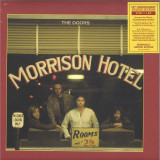
The Doors returned to their roots and were reborn a rock ’n’ roll band on Morrison Hotel, the group’s fifth studio album. Completed in only a few weeks and released in February 1970, the hard-charging album took its name from the Skid Row hotel in downtown Los Angeles that’s featured in the iconic cover photo taken by Henry Diltz.
Morrison Hotel: 50th Anniversary Deluxe Edition includes the original album newly remastered by The Doors’ longtime engineer and mixer Bruce Botnick, plus a bonus disc of unreleased studio outtakes, and the original album on 180-gram virgin vinyl. The music will also be available from digital and streaming services the same day.
For this new collection, the original album has been expanded with more than an hour of unreleased recordings taken from the sessions for Morrison Hotel. These 19 outtakes transport listeners into the studio with Jim Morrison, John Densmore, Robby Krieger, and Ray Manzarek for an unprecedented perspective on the making of the album. Botnick says: “There are many takes, different arrangements, false starts, and insightful studio conversations between the band – who were in the studio – and producer Paul Rothchild – who was in the control room. It’s like being a fly on the wall.”
Several of these unheard recordings spotlight how Queen Of The Highway and Roadhouse Blues evolved across multiple sessions. It’s especially interesting to hear how the band played with different bass players on Roadhouse Blues. Early versions include Harvey Brooks, who played on the band’s previous album, The Soft Parade. Later takes feature guitar legend Lonnie Mack on bass along with The Lovin’ Spoonful’s John Sebastian on harmonica who, due to contractual restrictions at the time, had to be credited as G. Puglese.
Among the treasure trove of unreleased outtakes are also rough versions of Morrison Hotel tracks Peace Frog and Blue Sunday, as well as The Doors rarity I Will Never Be Untrue. The collection also captures some incredible session outtakes of the band jamming on cover versions of the Motown classic Money (That’s What I Want) and B.B. King’s Rock Me.
"Vapor City" ist das gefeierte Debütalbum von Travis Stewart als Machinedrum welches erstmals 2013 erschien und seit einigen Jahren nicht mehr erhältlich ist. Anlässlich der Veröffentlichung seines neuen Albums “A View Of U” veröffentlicht Ninja Tune eine limitierte Neuauflage des Klassikers auf goldenem Doppelvinyl mit Artwork von Dom Flannigan and Eclair Fifi.
"Vapor City" ist ein Moloch, eine Metropole entstanden in Travis Stewarts Träumen, die ihn schon ein Leben lang verfolgen. Immer wiederkehrende Träume brachten ihn so oft in diese imaginäre Stadt, so dass er diese Viertel für Viertel beschreiben kann und das illusorische Metropolis auch für seine Hörer endlich erfahrbar macht. Das Album ist eine detaillierte Stadtkarte aus Sound-Landschaften, die es jedem ermöglichen sich in "Vapor City" zurechtzufinden - oder auch darin verloren zu gehen. Nach Veröffentlichungen auf LuckyMe, Planet Mu, und Hotflush Records und seinem hochgelobten Album "Room(s)" aus 2011 bastelte Stewart nicht nur an Nebenprojekten wie JETS (mit Jimmy Edgar) oder etlichen Remixen, sondern auch an der Vertonung seiner Vision.
Blue Vinyl
Steve Bicknell presents: 27
“Track 12” and Reinterpretations.
“Flame in Darkness” EP – Released 1993
It was back in 1993 when Steve Bicknell first resealed “Track 12” on Cosmic Records.
27 years later the veteran artist travels back in time and teams up with KR3 to re-issue this techno masterpiece, inclusive of the original re-edit plus three new interpretations by Jing, Metro Skim & Heartless.
Available from September 28th both on vinyl from Ready Made Distribution, 27 symbolises a meeting point between past, present and future of techno.
The music is there to remind us that time is circular, nothing is still and everything evolves.
- A1: Jingle Bells
- A2: The Christmas Song
- A3: Mistletoe And Holly
- A4: I'll Be Home For Christmas
- A5: The Christmas Waltz
- A6: Have Yourself A Merry Little Christmas
- B1: The First Noel
- B2: Hark! The Herald Angels Sing
- B3: O Little Town Of Bethlehem
- B4: Adeste Fidelis
- B5: It Came Upon A Midnight Clear
- B6: Silent Night
- A1: White Christmas
- A2: Adeste Fideles (Oh, Come, All Ye Faithful)
- A3: Rudolph The Red Nose Reindeer
- A4: Faith Of Our Fathers
- A5: I'll Be Home For Christmas (If Only In My Dreams)
- A6: Silver Bells
- A7: Mele Kalikimaka
- B1: Jingle Bells
- B2: Santa Claus Is Comin' To Town
- B4: The First Noel
- B3: Silent Night
- B5: It's Beginning To Look Like Christmas
- B6: Christmas In Killarney
- B7: God Rest Ye Merry Gentlemen
- B8: Sleigh Ride
Berlin techno luminary Jamaica Suk announces her most ambitious project yet: Uncertain Landscape.
This 17-track, 4x 12” vinyl release on her acclaimed Gradient label will be released in four installments from Autumn to Winter 2020 and brings together a host of diverse techno talent. She will release a DJ mix featuring all 17 tracks to complete the series accompanied by a film from Anthony Vouardoux. The project is made up of a wishlist of names whose music she has been heavily supporting in her sets over the last few years. “I wrote specific producers inquiring for tracks that would be fitting to the label and also fit the DJ mix that I’m recording from these tunes. I’m looking to promote music that shares the same vision as I do.”
It marks the first original releases on Gradient from producers other than herself, which is a change of tact from her original plan for her imprint. “Initially I wanted to only release my music on Gradient including remixes - but it doesn’t make sense as there’s so much inspiration out there. By expanding the label’s network we create our own tribe.”
Jittery rhythms with a touch of ‘Spastik’ about them propel BNJMN’s ‘Abyssal Surge’ into life, with a big riverbed sound abounding as the track builds through haunting sustained tones and glitching mechanics.
Arthur Kimskii thundering ‘Natasha’ pummels from the first moment, with shuddering sub bass carving its way through the sound field as hypnotic bleeps pulse in the distance. Rapid-fire. Filtering percussive waves accentuate the bassline’s incessant 16ths rhythms, all the while the resonant kicks hammering away beneath.
Wrong Assessment’s ‘The Eight’ is a dissonant avalanche of warped textures, where grunting synth thrusts rub up against industrious pulses and chattering hi-hat patterns weave in and out of the mix. Stuttering bass and cymbal rides complete the urgent feel.
Introspective respite comes from Electro Indigo’s ‘Volcanite’, a stirring piece of broken beat experimentation where graceful pads slide hauntingly over taut kick and bass patterns and beautiful ghostly analog synth notes.
Look out for parts 2-4 coming soon and special audio + visual showcases.
Freshly signed artist named Ian Ash (also know as “H” and Sunny G) delivers a massive filtered boogie house track. So What U Want will also come with a Lord Funk remix which sound a bit more electro funk to blast the dancefloor.
This track is a radio killer and should be loved by many musiclovers including DJs, producers or simply people who like to listen to mainstream vocal house as French touch production. A bunch of samples and played instruments make it efficient and support the
sweet voice of the singer Djemaïli. He is known first as an R’n’B singer, but he liked to perform on this future classic – and you can hear it! Ian Ash is known as a resident DJ of the World-famous Montreux Jazz Festival where he has spun records yearly between 2001 and 2019. Including 1st and 2nd parts of George Clinton Parliament Funkadelic, Spearhead feat. Michael Franti, Doctor L, Tony Allen,Jean Grae, Raphael Saadiq, Will Calhoun, Common,Dj Cam, Mister Mike, Benji B, Souljazz, Andy Smith,Buddah Monk, Jimmy Cliff back band, Jamie Lidell, and Claude Nobs himself! He spun also at Cargo (London), SPACE (Ibiza), NL (Amsterdam), Divans du Monde
(Paris), etc. He surely is in the top 10 Funk DJs in Europe. He also has been stage and studio audio engineer for 2 decades and has mixed a couple of live artists such as Joe Sample, Mandrill or even AIR. He has mixed more than 90 concerts at Montreux Jazz Festival 2002 and deeply participated in producing 4 Days in Geneva by Ohmega Watts
more recently.
West coast composer, artist, and producer Kaitlyn Aurelia Smith has chartered a pioneering career with multiple critically-acclaimed albums since 2015. Following the release of The Kid in 2017, Smith focused her energy in several directions. She founded Touchtheplants, a multidisciplinary creative environment for projects including the first volumes in her instrumental Electronic Series and pocket-sized poetry books on the practice of listening within. She's continued to explore the endless possibilities of electronic instruments as well as the shapes, movements, and expressions found in the physical body's relationship to sound and color. It is this life-guiding interest that forms the foundational frequencies of her most recent full-length, The Mosaic of Transformation, a bright, sensorial glide through unbound wave phenomena and the radiant power discovered within oneself. "I guess in one sentence, this album is my expression of love and appreciation for electricity," says Smith. While writing and recording, she embraced a daily practice of physical movement, passing electricity through her body and into motion, in ways reflecting her audio practice, which sends currents through modular synthesizers and into the air through speakers. Not a dancer by any traditional definition, she taught herself improvisatory movement realizing flexibility, strength, and unexpectedly, a "visual language" stemming from the human body and comprised of vibrational shapes. Understood as cymatics, as Smith says, "as a reference for how frequencies can be visualized," much like a mosaic. Smith describes her first encounters with this mosaic; "the inspiration came to me in a sudden bubble of joy. It was accompanied by a multitude of shapes that were moving seamlessly from one into the other...My movement practice has been a constant transformation piece by piece. I made this album in the same way. Every day I would transform what I did yesterday...into something else. This album has gone through about 12 different versions of itself." As it has arrived, in a completed state, The Mosaic of Transformation is a holistic manifestation of embodied motions. Smith's signature textural curiosity that fans have grown to adore pivots naturally into a proprioceptive study of melody and timbre. Airy organ and voice interweave with burbling Buchla-spawned harmonic bubbles. "The Steady Heart" quivers to life, peppering blasts of wooden organ between winding vocal affirmations. As with a body, moving one portion requires a balance and counterbalance; here, subtle tonal twitchy signals fire in conjunction with coiling arias to create a mesmeric core. When the beat arrives at the midway mark, a swooping and jittery waltz, a sense of stasis in motion, a flow state, is sonically achieved. As soon as it syncs, it disappears back into the swirling ebbs of electric force. Other tracks stray into more ruminative physical realms. "Carrying Gravity" is built around string-like pads that expand and contract like a solar plexus, becoming taught and then loose. If the record could be summarized in a single movement, it is the 10-minute closing suite, a rapturous collage called "Expanding Electricity." Symphonic phrases establish the piece before washes of glittering electric peals and synthesized vibraphone helix into focus. Soon, Smith's voice grounds it all with an intuitive vocal hook, harmonized and augmented by concentric spirals of harp-and-horn-like sounds. Smith's music doesn't capture a specific emotion as much as it captures the joys of possessing a body, and the ability to, with devotion and a steady open heart, maneuver that vessel in space by way of electricity to euphoric degrees.
Walter ‘Junie’ Morrison released his third solo LP, Suzie Super Groupie, in 1976. A slick, smooth and soulful record, it’s a genre-melting tour de force with rich elements of proto-boogie, funk and jazz. In short, this is yet another essential album reissue from Be With.
The sublime “Suzie Thundertussy”, is a favourite of Harvey and Theo, and was brilliantly sampled by Madlib for Kanye West’s “No More Parties In LA”. The track opens with a sinuous synth and combines Junie’s storytelling abilities with an emphatic vocal style and funky arrangements. The powerful bass and sinister chords create an undeniable groove, and the explosive chorus is full of ambition and joy.
“If You Love Him” is a great, mid-tempo soul song. With a swinging jazz-infused middle-eight, it demonstrates Junie was much more than a mercurial funkateer. The laconic groove of “What Am I Gonna Do” recalls “Fresh”-era Sly Stone, whilst the frantic “Super Groupie” showcases his sharp imagination and sense of fun. The lyrics range from humorous to dirty, all fuelled by an infectious groove and tight horn arrangements.
The P-Funk of B-side opener “Surrender” bounces and sparkles, with a strutting Junie backed by great harmony vocals and joyous horns. “Suzie” is a sleek, softer affair albeit with a disco pulse; a beautiful combination of bright, funky horns, fluid basslines and vigorous rhythms. “Stone Face Joe” is another character song, this time one that chugs along on a sweet boogie rhythm.
The winner for us, however, is the closing piece. An extended funk-rock jam, “Spirit” has a heart-rending spoken-word intro and, as a nod to Jimi Hendrix, creates a live concert sound, complete with screaming crowd and fuzzy vocals.
Junie made his name as the lead singer and keyboardist of the Ohio Players. As the mastermind behind “Pain”, “Pleasure”, “Ecstasy”, and the oft-sampled “Funky Worm”, he was beloved by countless musicians, not least Prince. As co-writer of some of Funkadelic’s seminal works - “One Nation Under A Groove”, “(Not Just) Knee Deep” – his standing as one of the structural fathers of funk is undisputed.
In late 2016, Solange’s “A Seat At The Table” featured a track called “Junie”, a tribute to the freedom he created in music. His work continues to be as relavent and inspiring as it was when it was first recorded.
In February 2017, Junie died, aged just 62. With records as mighty as Suzie Super Groupie, his legacy will live forever and Be With is proud to be able to do our bit to make this LP accessible again on vinyl.
Black Truffle is pleased to announce Ashioto, the first international solo release from Japanese drummer-percussionist-composer Tatsuhisa Yamamoto. Active for over a decade, Yamamoto has performed and recorded extensively with artists such as Jim O’Rourke, Eiko Ishibashi and Akira Sakata, as well as participating in innumerable improvised and ad hoc groups.
Ashioto presents two wide-ranging pieces that combine Yamamoto’s percussion work with piano, field recordings, electronics, and contributions from guest musicians Daisuke Fujiwara and Eiko Ishibashi.
Beginning with a passage of chiming metal percussion, the first side slowly builds into a rolling, open groove reminiscent of Yamamoto’s work on Eiko Ishibashi’s acclaimed Drag City LP The Dreams My Bones Dream. Spacious piano and synth notes, along with Ishibashi’s spare melodic figures on processed flute, hover above this propulsive rhythmic foundation, the whole effect adding up to a more abstract take on the area explored on Rainer Brüninghaus’s ECM classic Freigeweht. The LP’s second side opens up a cavernous space filled with ominous electronics and shimmering metallic percussion, which organically transitions into a passage of rumbling piano chords and mysterious concrète sound. Later in the piece, Daisuke Fujiawara’s saxophone enters, playing melancholic melodic fragments that are looped and layered, creating a seasick swaying effect familiar to listeners of James Tenney’s works with tape delay systems. Beginning as delicate bass drum pulses, Yamamoto’s accompanying percussion eventually builds the piece into a raging torrent of free-improv splatter, processed sax and fizzing electronics.
Though grounded in instrumental performance, Ashioto is very much a studio construction, making inventive use of electro-acoustic principles in its editing and mixing. Together with its sister Ashiato – a different take on the same ‘script’ released simultaneously on Japanese label Newhere – Ashioto demonstrates to an international audience for the first time the true breadth and ambition of Yamamoto’s work.
Mastered by Jim O’Rourke. Cover photos by Kuniyoshi Taikou. Design by Lasse Marhaug.
Oops, sorry, Ghost Wavvves broke the Internet: Here is “Internet Club” his debut full-length album. Part of Monster Jinx since 2015, Red Bull Music Academy in 2016, Ghost Wavvves is now revealing all the secrets of clear and deep web in this work. With features from Tokyo Wanderer, Simpig, No Future and Mike El Nite, “Internet Club” comes up with an exclusive and specially prepared vinyl edition.
In fact, this “club” brings together the best and the worst of the Internet: bots, spam, popup ads, soft(ware)gore, and everything you didn’t even know you could find in the depths of the World Wide Web.
Please check your connection. You are now part of the “Internet Club”. And you already know: what goes to the Internet...stays on the Internet
- A1: Rice Brothers - Soul Food
- A2: Mel & The Blue Aces - Cold Sweat
- A3: Silas & The Soul Counts - Pass The Soul
- A4: Bob Bassett - Put It In There
- A5: Rudi Johnson Trio - This Is It
- A6: Sam Hankins & The Ho Dads - Shotgun
- B1: Crumb & The Soul Touchers - The Crawl
- B2: The Magnificents - Mister Kool
- B3: Mr Cbs - Funky Boo Ga Loo
- B4: Tom Hurley Combo - You Better Believe It
- B5: Leo Valentine Trio - Kitchen Sink
- B6: Lewie & The 7 Days - Night Train
- B7: George & The Highlanders - Smoking Bananas
The Hammond organ was first manufactured in 1935. In 1954, the now famous Hammond B3 model was introduced with additional harmonic percussion feature. When the company went out of business in 1985, around two million of various models of the Hammond organ have been produced.
The Hammond B3 was originally marketed to churches as a lower-cost alternative to the wind-driven pipe organ. It quickly became popular with professional jazz musicians in organ trios. Jimmy Smith's use of the Hammond B3 inspired a generation of organ players, and its use became more widespread in the 1960s and 1970s in rhythm and blues, rock, reggae, and progressive rock.
This collection is centered on the exciting and dynamic sounds of the Hammond B3 organ!
For the first release, Giordano and Oniks, jin forces as ANAM.
Doppia faccia, where Erratic synths and tweaking patterns create an air of assonance throughout the track and spares minimalistic drums create the drive. FX laden hooks gather momentum as sub heavy drums and spacial atmospheres create the backbone.
Vertebrate leans more on a subtle build up pf the elements as each piece gradually builds and delivers on high intensity.
Don’t fight in the night, brings a more melodic tip but still retains a tough standard drum workout, soundscapes and breaks.
In the future, closes the first Senza Nome release with high-speed rave sounds, counterbalanced by atmospheric melodies.
Released in 1971 while Gil was living in London, this is the third self-titled release from the bossa nova and tropicalia legend. Gil recorded this album while in political exile from his native Brazil and its somber, straightforward tone is a welcome change from the experimental, psychedelic assault of his 1969 long player. Featuring 8 originals and a brilliant cover Steve Winwood's 'Can't Find My Way Home,' this Water release also contains 3 bonus tracks including covers of Jimi Hendrix and The Beatles. A tropicalia classic.
- A1: Theatre West - Children Of Tomorrow’s Dreams
- A2: Oneness Of Juju - Soul Love Now
- A3: Byard Lancaster - Drummers From Ibadan
- B1: Lon Moshe - Doin' The Carvin For Thabo
- B2: Juju - Nia (Poem The Complete Circle) (Poem: The Complete Circle)
- C1: Wayne Davis - Look At The People
- C2: Southern Energy Ensemble - Third House
- D1: Oneness Of Juju - African Rhythms (Live In Washington Dc, 1975)
- D2: Experience Unlimited - People
Strut present the first ever compilation bringing together classics and rarities from the seminal spiritual jazz and conscious soul label Black Fire, covering 1975 to 1993. Formed by DJ and record producer Jimmy Gray in Richmond, Virginia, and following in the footsteps of other influential black-owned independent labels like Strata-East and Tribe, the foundation of Black Fire coincided with saxophonist James "Plunky" Branch returning to the city from New York to form Oneness Of Juju. The band's 'African Rhythms' album in 1975 was the perfect fusion of jazz, deep African polyrhythms and empowering lyrics and bassist Muzi Branch, a trained artist, created the first of many Black Fire hand-illustrated sleeves for the label's debut release.
Minyo Crusaders rework historic Japanese folk songs (min'yo) with Latin, African, Caribbean and Asian rhythms for their debut album 'Echoes of Japan'.
Releases from Ryuichi Sakamoto, Haruomi Hosono and Midori Takada have re-ignited global interest in Japanese music and 'Echoes of Japan' marks the arrival of a big band like no other.
'For Japanese people, min'yo is both the closest, and most distant, folk music' explains band-leader Katsumi Tanaka: 'We may not feel it in our daily, urban lives, yet the melodies, the style of singing and the rhythm of the taiko drums are engrained in our DNA'. Initially indifferent to min'yo, a tragic event in recent Japanese history set Tanaka on his current path: 'Following the Tohoku earthquake of 2011, I reflected on my life, work and identity. A fan of world music, I began searching for Japanese roots music I could identify
with. Discovering mid-late 20th century acts Hibari Misora, Chiemi Eri and the Tokyo Cuban Boys, I was
captivated by their eccentric arrangements and how they mixed min'yo with Latin and jazz.'
Originally sung by fishermen (Kushimoto Bushi; Mamurogawa Ondo), coal miners (Tanko Bushi) and sumo wrestlers (Sumo Jinku), these songs deal with topics such as the returning spirits of ancestors (Hohai Bushi), Japan's smallest bird (Toichin Bushi) and a bride's love for her husband's pockmarked face (Otemoyan).
Minyo Crusaders are one of the most hyped acts on the Tokyo music scene that went national in 2018 through festivals such as Fuji Rock. The band features veterans of the Tokyo roots music scene such as bassist DADDY U (Ska Flames), keyboardist Moe (Kidlat), sax player Koichiro Osawa (Matt Sounds/ J.J. Session), Yamauchi Stephan (J.J. Session), percussionist Mutsumi Kobayashi (Banda de la Mumbia), conga player Irochi (Cubatumb) and vocalist Meg (DJ collective Tokyo Sabroso).
- Wild blend of Japanese folk music with cumbia, boogaloo, Ethio jazz, Afro funk + more
- Ry Cooder, Mario Galeano (Ondatropica/Frente Cumbiero), Clap! Clap! are all fans
- European touring plans for autumn/fall 2019
- Includes Japanese lyrics + English translations
- Lacquers cut @ The Carvery
Vinyl reissue of the now classic 1971 album. Produced by Transamericas in collaboration
with the band from original master tapes, in a fully analog process at recording studios in María Pinto
(Chile), London and Haarlem (Holland).
Los Jaivas (“El Volantín”) is the first LP by Chilean rock band Los Jaivas, one of South America's biggest names in the fusion of folk roots and psychedelia during the 1970s. Los Jaivas were born in the city of Viña del Mar, with their five members determined to guide their initial sound through improvisation and experimentation, «trusting that in time a language would emerge that would give us our identity», in their own words.
This debut album (popularly known as El Volantín - The Kite -, because of its cover illustration) combined the free-flow of extended electrical pieces with more conventional three-minute songs filled with references to Chile's popular culture and the musicians’ own upbringing. Theirs was a solitary path, not just for the band but also for the beginnings of Chilean rock. Los Jaivas blazed a trail that was rich in musical references, with ideas inspired by Jimi Hendrix, the Congolese Missa Luba, Argentinian folk (Atahualpa Yupanqui, Ariel Ramírez), South American avant-garde composers (Ginastera, Villa-Lobos, Violeta Parra), the experimentation of pianist Henry Cowell, Caribbean rhythms and Miles Davis’ trumpet re-inventions.
- A1: Pezulu (Way Up) (Way Up)
- A2: Thulula (Fill It Up) (Fill It Up)
- A3: Kuthwasi Hlobo (Spring) (Spring)
- A4: Half Moon
- A5: Yini Njalo (Stick Around) (Stick Around)
- B1: Kwa Thula (Thula's Place) (Thula's Place)
- B2: Joe's Jika (Joe's Groove) (Joe's Groove)
- B3: Nobomvu (Red Head) (Red Head)
- B4: Qonqoza (Knock) (Knock)
- B5: Phola (Cool It!) (Cool It!)
- C1: Pezulu (Extended Take)
- C2: Pezulu (Alternate Take)
- C3: Studio Interlude
- C4: Half Moon
- D1: Izulu Liyaduduma
- D2: Sibuyile (Take 1)
- D3: Sibuyile (Take 2)
- D4: Church Mouse
- D5: Untitled (Andromeda) (Andromeda)
Pressure Cooker South African Township Jazz and Mbaqanga
• Dudu Pukwana’s 1968 debut album, recorded in London, released only in South Africa.
• A second album of mostly unreleased 1969 recordings featuring Richard Thompson, Simon Nicol, Joe Mogotsi, Chris McGregor, Mongezi Feza, Louis Moholo, members of Osibisa, and others.
• Originally produced by Joe Boyd.
• Re-mastered audio, double gatefold album, heavyweight 180g vinyl.