Soundtrack from Academy Award-nominated actor Ethan Hawke’s 2001 film Songs written by Wilco’s Jeff Tweedy with the score performed by Tweedy and Glenn Kotche Featuring two previously unissued bonus tracks and available on CD and (for the first time) Vinyl. Includes performances by Wilco, Billy Bragg, Robert Sean Leonard, “Little” Jimmy Scott, and more Packaging features new liner notes from Ethan Hawke, Glenn Kotche, and a conversation between Jeff Tweedy and Grammy®-winning set producer Cheryl Pawelski “It was pivotal for me. There was a burst of creativity that continues to this day because I took the last remaining guardrails off of what I’d been willing to allow myself to do.” –Jeff Tweedy The same year of his Oscar®-nominated performance in Training Day, Ethan Hawke made his full-length film directorial debut with Chelsea Walls (starring Kris Kristofferson, Uma Thurman, Vincent D’Onofrio, Robert Sean Leonard, and more). A fan of Wilco, Hawke approached Jeff Tweedy about scoring the film, and Tweedy agreed. Around this time, Tweedy had collaborated with musician and producer Jim O’Rourke (Sonic Youth, Stereolab) for a special live performance. As fate would have it, O’Rourke had been working with Glenn Kotche, and O’Rourke introducing Tweedy to Kotche would lay the groundwork for the trio’s work together on the debut album by their band, Loose Fur. Tweedy also asked Kotche to work with him on an improvised soundtrack to the movie he had agreed to score.
[m] 13. Finale (Extended) [Bonus Track]
[n] 14. Promising [Bonus Track]
Suche:jim o’rourke
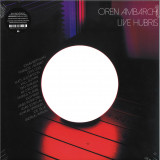
Black Truffle is pleased to announce Live Hubris, documenting the hypnotic and electrifying live performance of Oren Ambarchi’s 2016 LP Hubris by a fifteen-strong band at London’s Café Oto. Over three days in May 2019, Oto toasted Oren Ambarchi at 50/Black Truffle at 10 with Ambarchi and a large group of close friends and collaborators in a series of performances that interspersed existing projects with new collective endeavours, culminating with this: fourteen members of the extended Black Truffle family together on stage, joined by one special virtual guest, to translate the intricately studio-constructed layers of Hubris into a muscular live band workout.
Operating with only the bare minimum of pre-gig preparation after the planned afternoon rehearsal had to be wrapped up prematurely due to noise complaints, the gargantuan group lurches into motion with a 21-minute rendition of ‘Hubris Part 1’, powered by the pulsating electronics of Konrad Sprenger (the ‘ringmaster’ at the ensemble’s core) and no less than seven electric guitars spinning a web of intricately interlocking palm-muted polyrhythms. The layers of closely related but metrically distinct lines create ripples of shifting accents, flickering changes in emphasis that ricochet along the endless central pulse. Gradually building in density, this motorik continuum becomes the backdrop for the haunting tones of Eiko Ishibashi’s processed flute and an extended feature from long-distance guest Jim O’Rourke on guitar synth.
After the brief interlude of the second part, where Albert Marcoeur-esque guitar arpeggios accompany a halting attempt at phone conversation, the full ensemble gears up for the epic side-long rendition of ‘Hubris Part 3’. Now joined by the astonishing triple drum line-up of Joe Talia, Will Guthrie and Andreas Werliin, the layered pulse of the opening piece becomes a burning funk-fusion groove. Beginning on a medium simmer, the ensemble initially stick to its pulsating one-note mantra, over which Ambarchi unfurls a beautiful example of his signature shimmering Leslie-toned guitar harmonics, eventually joined by Ishibashi’s flute and some brooding, distorted dissonance from Julia Reidy’s guitar. Building steadily for the first nine minutes, the heat then rises dramatically with a first, gloriously loose chord change: with the all drummers now rolling and tumbling like a twice-cloned Jack DeJohnette circa 1970, Mats Gustafsson enters on baritone, his tortured roars and shrieks driving the band to peaks of insane intensity. Finally, the exhausted ensemble drops out, leaving only the jagged, skittering fuzz of Ambarchi’s guitar, brought to an abrupt conclusion at the command of crys cole. Arriving on hot pink vinyl with artwork by Lasse Marhaug and an extensive selection of live photos by Ivan Weiss and Fabio Lugaro, Live Hubris brings this ambitious and outrageous evening of music to the safety of the home stereo.
Following their recent solo releases Soniscope (Dauw) and Cells #5 (Important Records), Berlin-based multi-instrumentalist Midori Hirano and Tokyo based string experimentalist Atsuko Hatano have teamed up for their first collaborative full-length: Water Ladder. An intense, multilayered continuation of earlier collaborations (Atsuko was featured on Midori’s debut LP back in 2006), the foundation for this new collaborative album was laid when they shared stages in Berlin (Ausland) and Japan in 2019. Working remotely at first, they later recorded parts of the album in Nara’s snoihouse (using omnidirectional polyhedral speakers).
“As we rallied back and forth with our recordings in the process of creating this album, unanticipated fluctuations and irregularities emerged, coming together into a kind of music with a unique resilience and buoyancy that cannot be confined to existing molds. It was as though we had built a Water Ladder to bridge the gap between us,” explains prolific composer and viola player Atsuko Hatano, who’s been busy recording solo and with colleagues such as Jim O’Rourke, Eiko Ishibashi, Mocky, Tatsuhisa Yamamoto, Takeo Toyama, and Anzu Suhara (Asa-chang & Junrei).
Kyoto-born, Berlin-based Midori Hirano, who’s also been releasing music under her MimiCof moniker, adds multiple instruments to the ever-changing sonic landscapes of Water Ladder – an album defined by suspenseful and seemingly suspended compositions that often feel like floating in midair, a sensation the musicians compare to “that distinctive feeling you get from riding a high-speed elevator, where you can no longer tell whether you’re going up or down.”
Devoid of birdsong, the late summer air is nevertheless full of buzzing, whirring, hissing sounds on foreboding album opener “Summer Noise,” a cinematic intro with slow-moving piano chords and an ominous build-up over the course of its sprawling eight minutes. Elsewhere, sudden bursts of viola cut through nighttime peace (“Nocturnal Awakening”), followed by “Cotton Sphere” – which makes the sensation of floating in midair complete: harmonies and melodies rise and form to fall apart again, leaving only trails of previously defined space shimmering in their wake…
Whereas the title track truly explodes half-way in, the final “Cascade” brings closure to the electro-acoustic six-track collection: the floating continues, but the interlocking musical planes are no longer ruffled or rippling, no longer torn in many directions at once. Instead, the sonic streams merge and eventually disappear like ephemeral water falls after heavy rain or sudden snowmelt.
“Water cannot retain its form on its own, and can take any shape as effected by external forces. Its movements cannot be captured by eyesight alone: A body of water that appears to be crashing down into a deep, bottomless waterfall could actually be rising up very slowly into midair,” says Atsuko. “This is an invitation for you to cross the ever-transforming Water Ladder built between Midori and myself.”
Tancade is the solo debut by experimental cellist Gaspar Claus. Following on from his previous soundtrack work and a wealth of collaborations (incl. Bryce Dessner, Sufjan Stevens, Jim O'Rourke), Claus brings forth a collection of pieces which free the cello from its own limitations. Majestic and adventurous, stormy and radiant, dreamy and rigorous, Tancade defies categorisation, evoking chamber music suspended in the fourth dimension, the soundtrack of an experimental film or the strange folk music of an undiscovered tribe.
Sam Prekop's eponymously titled LP is a study in pop nuances. Simultaneously transporting the listener from mild climes and swinging palms to darkened skies and wind blown steppes, the record will be easily recognized by fans of The Sea and Cake. Known to many as the singer and main songwriter for said group, Mr. Prekop is assisted on this release by Chad Taylor (Chicago Underground Duo), Josh Abrams (ex-Roots, Town and Country), Jim O'Rourke (Gastr del Sol) and Archer Prewitt (The Sea and Cake). Those expecting to find more of the computer beats and trickery found on The Fawn and Two Gentlemen are in for a surprise. Whilst prevalent on "Faces and People" - (a lucious groove overlayed by cornet and guitar), the computer takes a back seat to real strings, drums, piano, electric piano and organ as well as electric and acoustic bass. The subtle grooves, a trademark of The Sea and Cake records, are still present here as Sam and his band blend West African rhythms with a bit of soul, jazz and pop. The resulting record is something wholly original, elegant and earthy. A cauldren, if you will, of sweet smelling and enlightening stew. So line up, grab a spoon, and dig in. All the ingredients and intoxicating aromas necessary for an auditory feast are contained within.
Binding a deep social and political conscious with rigorous musical experimentation, the Brussels based, Italian pianist, performer, composer, Giovanni Di Domenico, delivers Downtown Ethnic Music, the 4th instalment of Die Schachtel’s Decay Music series, focused on inspired contemporary experimental efforts in the ambient, ethereal, and emotively abstract music.
Over the last decade or so, Giovanni Di Domenico has carved a deep path through a diverse number of discrete fields within experimental music, working in various ensembles - Abschattungen, AufHeben, Bonjintan, Cement Shoes, Delivery Health, Going, etc. - as well as producing a discography of critically heralded solo efforts, and intimate collaborations with Jim O'Rourke, Tatsuhisa Yamamoto, Akira Sakata, Arve Henriksen, Tatsuhisa Yamamoto, Alexandra Grimal, Nate Wooley, Chris Corsano, and others.
Downtown Ethnic Music encounters Di Domenico reimagining the future of urban music, pluming the mysterious and emotive depths of self, to arrive at vision of sonorous utopia, radically divergent from those of the past. Hybridizing numerous forms of musical practice, while making a conceptual nod to Jon Hassell’s notion of the "fourth world”, as well as the cross-temporal transnationalism of Roberto Musci, Aktuala, Futuro Antico, and the Third Ear Band, Di Domenico’s vision of democracy - rendered through the creative metaphors of sound - is a true to life, bristling conflict, as open-ended as it is ordered, and as dramatic and tense as it is beautiful, playful, and refined.
A colorful tapestry of ideas, experiences, histories, and reference points, woven from a pallet of electronics, synthesis, and various acoustic sources - the intervening rhythms of drummer João Lobo, vocals by Pak Yan Lau and Patshiva CIE women choir, the horns of Ananta Roosens and Jordi Grognard etc. - across the length of Downtown Ethnic Music, the boundaries between idiom, expressive concept, collective, and individual blur, giving way to a visionary, forward-thinking rendering of electroacoustic music, that subtly reminds us of the social and political potential of art.
Seamlessly incorporating bubbling electronic abstraction, sprawling ambience and long tones, throbbing kosmische, acoustic free improvisation, and the human voice, Giovanni Di Domenico’s Downtown Ethnic Music represents a high-water mark in an already astounding career. Issued by Die Schachtel in a one-time edition of 250 copies, pressed to 180g marble vinyl and housed in a pro-printed inner sleeve and jacket, contained in a silk-screen PVC sleeve.
Not Waving renders his pop soul on a definitive album opus ‘How To Leave Your Body’, starcrossed with guest appearances by Jim O’Rourke, Jonnine Standish, Marie Davidson, Spivak and Mark
Lanegan
An escapist parable for the times, Alessio Natalizia marks a career high with his most sensitive production and songwriting illuminated by a coterie of notable collaborators. Its 11 songs deal with the necessity of friendship, the fragility of loss and spiritual transcendence via a spectrum of strategies that ultimately arrive at a mutual conclusion: love is the message. It packs sample amounts of nostalgia into a fantasy sequence of elegiac pop, skewed rave and midnight lullabies that fine-tune over 20 years of devotion to his craft, perfectly matching experimental restlessness with enduring pop appeal.
Perhaps unavoidably, circumstances had a hand in the creation of ‘How To Leave Your Body’, forcing Natalizia to work with collaborators remotely. Yet the strength of his bonds bleeds through in the album’s handful of poignant vocal pieces, none more so than the hushed intimacy of Marie Davidson on the bewitching downbeat trance hymn ‘Hold On’, but also in the bruised blush of ‘My Sway’ featuring Jonnine’s spine-tracing lilt over hovering organ and dembow bumps, while the hook-up with Mark Lanegan once again yields bittersweet fruit on ‘Last Time Leaving Home Part 2’, with gravelly blues vox diffused into detuned, miasmic cello that really tugs.
Effortless and made for rinsing, the whole album is testament to the humility and pathos of Natalizia’s oeuvre, which has gotten better with age. It plays out like a lovingly crafted mixtape, decanting all original material with a classic cadence and fleeting play of styles, from aerial jazz notes in ‘You Are Always Younger Than The Future’, to the gnawing club grind of ‘Define Normal’, a noisily gurning ‘Self-Portrait’, and the lushly resolved admittance of ‘My Best Is Good Enough.’
Comparisons don’t really work with this one, it’s just Not Waving.
Outside Ludlow / Desert Disco is the first major solo release from Australian performer-composer Sam Dunscombe, now based in Berlin after residing for the past decade in San Diego and Tokyo. A virtuoso clarinettist who has performed in composed and improvised settings with artists such as Klaus Lang and Taku Sugimoto, their practice also embraces computer music, lo-fi electronics and field recordings, in addition to their long-term commitment to archiving, studying and performing the work of Romanian spectralist composer Horatiu Radulescu.
The two side-long pieces presented on this LP began from a chance encounter in a specific geographic location (documented in the photographs that grace the record’s sleeve). Exploring California’s Mojave desert with a friend, Dunscombe made the unlikely discovery of a tangle of quarter-inch tape snared on a cactus. The digitised version of this tape, variously edited and processed, as well as Dunscombe’s own transcription and embellished performance of some of its material on Hammond organ, makes up one of the main ingredients of the LP’s first side. The other is a field recording of the area outside the ghost town of Ludlow, where the tape was found, where haunted silence is punctuated by freight trains and clusters of explosions from gold mines and the local marine corps. Far from any kind of documentary approach, the resulting composition reaches back to the smeared atmospherics and overdriven tape crunch of Hands To, Small Cruel Party or Joe Colley, before the Hammond organ rises up to cast a spectral shimmer reminiscent of 1960s tape music classics like Arne Nordheim’s ‘Warszawa’.
On ‘Desert Disco’ (its title perhaps a clue to the content of the mysterious tape), Dunscombe zeroes in on a single fragment of the tape, accompanying it with analogue synthesis to craft an immersive work based on a single chord. Throughout the course of this work, the monolithic opening sonority gradually splits apart, revealing an infinity of rhythmically phasing lines that swarm like a cloud of insects and patter like falling rain, placing Dunscombe’s piece in a lineage of patient electronic exploration that includes landmarks like Costin Miereanu’s Derives and the contemporary work of Jim O’Rourke.
Limited edition vinyl with images by Sam Dunscombe and design by Lasse Marhaug. Mastered by Joe Talia at Good Mixture, Berlin.
talian pianist, performer and composer Giovanni Di Domenico presents 4 new pieces in collaboration with Eiko Ishibashi, Jim O'Rourke, Joe Talia and Tatsuhisa Yamamoto.
Side A: The Walk (with Eiko Ishibashi: flute, electronics, synth and field recordings) 23:56
Side B: Peach Rino (with Jim O'Rourke: electronics) 25:11
Side C: Manyfold (with Joe Talia: drums) 22:35
Side D: Jaws Of Life (with Tatsuhisa Yamamoto: synth, electronics, sound processing) 22:39
Matière Mémoire presents the MMXX Series: In anticipation of the year 2020, Matière Mémoire asked 20 experimental/electronic artists to create an original 20 minutes piece and an artwork. Throughout the year batches of 5 new vinyls will be released.
Each record is limited to 500 copies and comes as a crystal clear vinyl featuring an original track of 20 minutes on one side, and a laser engraved artwork on the other. Each 12" is housed in a transparent sleeve printed with the MMXX logo, coming with a print of the artist artwork.
Participate in this series: Franck Vigroux, John Duncan, Phill Niblock, Jim O’Rourke, Reinier Van Houdt, Stephen O’Malley, CM Von Hausswolff, Hampus Lindwall, Oren Ambarchi, Shiva Feshareki, Bérangère Maximin, Kassel Jaeger, Daniel Menche, Charlemagne Palestine, Giueseppe Ielasi, Carlos Casas, Susanna Santos Silva, Joachim Nordwall, Karbé Dinel, Mauro Lanza
Matière Mémoire presents the MMXX Series: In anticipation of the year 2020, Matière Mémoire asked 20 experimental/electronic artists to create an original 20 minutes piece and an artwork. Throughout the year batches of 5 new vinyls will be released.
Each record is limited to 500 copies and comes as a crystal clear vinyl featuring an original track of 20 minutes on one side, and a laser engraved artwork on the other. Each 12" is housed in a transparent sleeve printed with the MMXX logo, coming with a print of the artist artwork.
Participate in this series: Franck Vigroux, John Duncan, Phill Niblock, Jim O’Rourke, Reinier Van Houdt, Stephen O’Malley, CM Von Hausswolff, Hampus Lindwall, Oren Ambarchi, Shiva Feshareki, Bérangère Maximin, Kassel Jaeger, Daniel Menche, Charlemagne Palestine, Giueseppe Ielasi, Carlos Casas, Susanna Santos Silva, Joachim Nordwall, Karbé Dinel, Mauro Lanza
Matière Mémoire presents the MMXX Series: In anticipation of the year 2020, Matière Mémoire asked 20 experimental/electronic artists to create an original 20 minutes piece and an artwork. Throughout the year batches of 5 new vinyls will be released.
Each record is limited to 500 copies and comes as a crystal clear vinyl featuring an original track of 20 minutes on one side, and a laser engraved artwork on the other. Each 12" is housed in a transparent sleeve printed with the MMXX logo, coming with a print of the artist artwork.
Participate in this series: Franck Vigroux, John Duncan, Phill Niblock, Jim O’Rourke, Reinier Van Houdt, Stephen O’Malley, CM Von Hausswolff, Hampus Lindwall, Oren Ambarchi, Shiva Feshareki, Bérangère Maximin, Kassel Jaeger, Daniel Menche, Charlemagne Palestine, Giueseppe Ielasi, Carlos Casas, Susanna Santos Silva, Joachim Nordwall, Karbé Dinel, Mauro Lanza
Matière Mémoire presents the MMXX Series: In anticipation of the year 2020, Matière Mémoire asked 20 experimental/electronic artists to create an original 20 minutes piece and an artwork. Throughout the year batches of 5 new vinyls will be released.
Each record is limited to 500 copies and comes as a crystal clear vinyl featuring an original track of 20 minutes on one side, and a laser engraved artwork on the other. Each 12" is housed in a transparent sleeve printed with the MMXX logo, coming with a print of the artist artwork.
Participate in this series: Franck Vigroux, John Duncan, Phill Niblock, Jim O’Rourke, Reinier Van Houdt, Stephen O’Malley, CM Von Hausswolff, Hampus Lindwall, Oren Ambarchi, Shiva Feshareki, Bérangère Maximin, Kassel Jaeger, Daniel Menche, Charlemagne Palestine, Giueseppe Ielasi, Carlos Casas, Susanna Santos Silva, Joachim Nordwall, Karbé Dinel, Mauro Lanza
The second release on Constructive (sister label of SN Variations) is Last Afternoon by Japanese composer Takuma Watanabe. Having studied at Berklee College in America, he is now living in Japan where he composes for film using his own string ensemble. This is Watanabe's first full length artist album.
He also created the animation music videos for the two tracks Tactile and Last Afternoon creating a unique imaginary visual counterpoint to the music.
Last Afternoon features collaborations with American vocalist and composer Joan La Barbara known for her recorded works with John Cage, Morton Feldman, Robert Ashley and composer and software developer Akira Rabelais known for his collaborations with Bjork and David Sylvian. The album is mastered by Jim O'Rourke. Cover photo courtesy of Swedish photographer and cinematographer Anders Edström.
Ryley Walker currently resides in New York City. But his latest LP is a Chicago record in spirit. The masterful Course In Fable, the songwriter’s fi@h solo effort,
draws from the deep well of that city’s ferCle 1990s scene, when bands like Tortoise, The Sea and Cake and Gastr del Sol were reshaping the underground,
mixing and matching indie rock, jazz, prog and beyond.
Walker spent his formaCve years in Chicago, absorbing those heady sounds and finding ways to make them his own. Even though he emerged at first in folkrock
troubadour mode, it makes sense that he’s arrived at this point; each LP has grown more intricate and assured, his influences disClling into something
original and unusual. To put it simply: Course In Fable is Walker’s best record yet, full of acCve imaginaCon and endless possibiliCes.
Last October, Ryley went straight to one of the primary architects of the Chicago sound to make the LP. John McEn:re, Course In Fable’s producer/engineer/
mixer, can rightly be called a legend for his work with Tortoise, Stereolab, The Red Krayola, Jim O’Rourke and countless others over a prolific career that now
spans more than three decades. Seeing his name in an album’s liners is preVy much a trademark of quality.
Another Windy City exile, McEnCre is based on the west coast these days, working out of the Portland, OR studio he’s dubbed Soma West. On the seven songs
here, he delivers the signature shimmering and prisCne sonics he’s become known for over the years. But McEnCre was also inCmately involved with Course
In Fable’s overall creaCve process. “I told him to take the mixes and have at it,” Walker says.
The result is a rich, immersive affair — a headphones record if ever there was one. Course In Fable’s songs are twisty, labyrinthine things, stuffed full of ideas
(Walker half-jokingly calls it his “prog record”). But no maVer how complex it gets, the album is never overwhelmingly busy. Wiry guitars melt into gorgeous
string secCons (arranged by Douglas Jenkins of the Portland Cello Project). Tricky Cme signatures abound but feel as natural as can be. Melodies o@en dri@ in
unexpected direcCons but remain downright hummable. Like Walker’s beloved Genesis, the pop element is never too far from the surface even when shit
gets weird. (And speaking of weird, Ryley says that in addiCon to Genesis, much of the album’s inspiraCon comes from “Australian extreme scooter riders on
YouTube and balding gear heads on Craigslist.” Go figure.)
To help put together these various puzzle pieces, Ryley assembled a band made up of several longCme collaborators. Bill MacKay (another Chicago mainstay)
and Walker have made two excellent instrumental duo records of interlocking guitars and warm give-and-take — a rapport very much in evidence
throughout Course In Fable. The freakishly talented drummer Ryan Jewell has performed with Walker for years now in a variety of seangs, from
straighborward song-centric sets to blown-out improv extravaganzas. Bassist Andrew ScoJ Young (Tiger Hatchery, Health&Beauty) has logged many miles on
tour with Walker; he and Jewell are frequently astonishing, a buoyant-but-always-locked-in rhythm secCon, able to navigate someCmes dizzying turnarounds
with apparent ease. Listening to the interplay between Walker and these musicians and you might be fooled into thinking they’d spent a year roadtesCng
Course In Fable’s songs. But it all came together relaCvely fast, thanks to demos, rehearsals and the kind of musical empathy that comes from years of
playing together.
Beneath the wondrous interplay, you’ll find some of Walker’s most personal – if sCll typically crypCc — lyrics, hinCng at some of the trials the songwriter has
been dealing with in recent years. Balanced with necessary doses of dark humor and oddball poetry, Course In Fable feels most of all like a life-affirming
record, fresh air in the lungs, sun on your skin. “Fuck me, I’m alive,” Ryley sings at one point, a moment of both disbelief and pure joy.
Walker has released his albums on a who’s-who of independent labels over the past decade — Tompkins Square, Dead Oceans, Thrill Jockey and Drag City
among them. This Cme around, he’s doing it DIY-style, puang Course In Fable out on his own Husky Pants imprint. You’re in good hands. This is an album that
sounds great (mastered by Greg Calbi), looks great (artwork by Jenny Nelson and design by Michael Vallera). It probably even smells great. Whether you’ve
been onboard since the beginning or are new to the Ryley Walker universe, you’re in for a treat.
Mats Gustafsson - Flute, baritone sax, live electronics, Johan Berthling - Electric bass, Andreas Werliin - Drums with Goran Kajfes - Quartertone trumpet, Mats Aleklint - Trombone, sousaphone, horn arrangements. Fire! tracking new paths and reaching new levels of excellence, still honoring their 12 year old vow of presenting a fresh approach to improvised music. Their debut album, You Liked Me Five Minutes Ago, was released in 2009 to wide international acclaim. "The basic strategy of pairing the expressive energy of free jazz with a sturdy sense of groove has yielded something potent and self-contained" (New York Times). Between this and Defeat there's been five albums, including collaborations with Jim O'Rourke (Unreleased?, 2011) and Oren Ambarchi (In The Mouth A Hand, 2012). No two Fire! records sound the same, but with Defeat they have taken their biggest leap so far, with Gustafsson giving the flute a prominent place in the sound image, a surprising and most successful move, his both expressive and ornamental approach given ample room to breathe, especially on the two long tracks bookending the album. In places more subdued than on previous efforts, but with the distinctive bass figures and hypnotic mood fully intact. There are some lively stretches with guests Goran Kajfes and Mats Aleklint, bringing to mind their big band offshoot Fire! Orchestra, albeit on a smaller scale. For over 20 years we have made a habit of releasing music that is beyond easy classification, in later years typified by Hedvig Mollestad, Elephant9 and Krokofant, but cemented by Fire! and their exploratory curiosity and deep love of music in general. We, and many others, have tried to compare the trio to other groups, but listening to Defeat we realize how futile this is. Given the above there's no doubt there are many influences at play, but the resulting brew is in a class by itself.
LP Ltd edition YELLOW vinyl (300 copies), DL card + BONUS Fire Records Compilation CD. New album from kosmiche folk-rock quartet Modern Studies on LTD edition Yellow vinyl. A glorious compendium of haunted disco hallelujahs, mercurial krautrock chorales, cosmic pop adagios and euphoric, resilient, anthems. 'The Weight of the Sun' sees principal songwriters Emily Scott and Rob St John further their warm, esoteric field studies with Pete Harvey and Joe Smillie, as previously reconnoitred on 'Swell To Great' (2016) and 'Welcome Strangers' (2018). "The exact point where Fairport Convention meet Jim O'Rourke at a remote Scottish railway station."
‘Instant Opaque Evening’ is an epic offering from The Underflow, the new trio of Mats Gustafsson, David Grubbs and Rob Mazurek. It makes vast strides on the heels of their self-titled 2019 debut (Corbett vs. Dempsey/Underflow Records) with nearly 90 minutes of intensely focused live performances from January 2020 shows in France, Belgium, Italy and Poland. That tour was a revelation for all three members, experienced as they are, with this still-new group’s freedom to walk onstage each night determined to surprise one another, moving from long instrumental improvisations into and out of songs and covering a terrific amount of ground at each of these concerts.
‘Instant Opaque Evening’ conveys this broad sweep, from the full-tilt electronics of ‘Self-Portrait As Interference Pattern’ and the climax of the seventeen-minute ‘Instant Opaque Evening’ to the inspired, alternate universe chamber music of ‘Planks’ and ‘A Thin Eternity’ and the group’s spontaneous arrangements of three previously recorded songs by Grubbs, ‘Gethsemani Night’, ‘An Optimist Declines’ and ‘Cooler Side Of The Pillow’.
The short version of the long tale of intersecting paths bringing together these three musicians begins in Chicago in the 1990s, with all three active participants in numerous convergences among jazz, free improvisation, experimental rock and more. Both Gustafsson and Mazurek appear as guests on Gastr del Sol albums (‘Upgrade & Afterlife’ and ‘Camoufleur’ respectively; that’s Rob’s cornet taking ‘The Seasons Reverse’ to new heights) and shortly thereafter Grubbs and Gustafsson recorded two duo albums, including the deep minimalism of ‘Apertura’, a talismanic favourite of both musicians.
David Grubbs has played in Gastr del Sol, the Red Krayola and Squirrel Bait and performed with Tony Conrad, Susan Howe, Pauline Oliveros, Will Oldham and many others. He’s the author of the books The Voice in the Headphones, Now that the audience is assembled and Records Ruin the Landscape.
Saxophone player, improviser and composer Mats Gustafsson is known as a solo artist and for international tours and projects with, among many others, Sonic Youth, Merzbow, Jim O’Rourke, Barry Guy, Otomo Yoshihide, Yoshimi, Peter Brötzmann, Neneh Cherry, Christian Marclay, Albert Oehlen, Ken Vandermark and the working groups FIRE!, THE END, LUFT, ANGUISH and Gush, as well as collaborations with contemporary dance, theatre, art, poetry and projects with noise.
Rob Mazurek is a multidisciplinary artist with a focus on electro-acoustic composition, improvisation, performance, painting, sculpture, video, film and installation, who spent much of his creative life in Chicago and then Brazil. He currently lives and works in Marfa, Texas. He leads/co-leads many ensembles of various sizes and shapes including his flagship large ensemble Exploding Star Orchestra, Chicago Underground and São Paulo Underground. He has
collaborated with Bill Dixon, Pharoah Sanders, Roscoe Mitchell, Jeff Parker, Nicole Mitchell, Chad Taylor, Jim O’Rourke, Naná Vasconcelos and many others.
'Leone' is the first meeting of electric guitarists Loren Connors and Oren Ambarchi. It's somewhat surprising it's taken this long as these two are connected by ongoing collaborators, like Jim O'Rourke and Keiji Haino. Connors, for more than 40 years, developed an iconic sound tethered to radical permutations of the blues. Ambarchi's own multi-decade transfiguration of the guitar inhabits a rarefied realm of abstracted tones and dissonance pitched between improvisation and composition. This album, like its title, is a sum of parts: solo performances by Connors and Ambarchi bookend a duo. On 'Lorn,' Connors unravels an aggressive ternary form, with an opening section wrapped in distortion and extreme phasing that contrasts against ghostly, distant single notes. Ambarchi's 'Nor,' supplants a guitar performance with melodic, shifting organ-like tones that are swallowed into a fluttering, glitchy squall. On 'Ronnel,' the duo, each audio landscape created by the two slowly rotates and overlaps the other, as if each is drawing the others' portrait on opposite sides of a translucent sheet. Recorded November 2017 by Bob Bellerue at the Issue Project Room. Mixed and mastered by Joe Talia and cut by Carl Saff. Cover illustration by Marissa Huber. Edition of 500; includes download.
Nuno Canavarro's Plux Quba hails from three decades in the past, yet the simple profi le of it's abstract/ambient/cutup collage makes it a record that sits quite comfortably in our IDM-informed future. In 1988, Plux Quba was a primal dark horse in the world of pants-forward electronic music - an obscurity issued with little explanation from the laid-back west coast of Europe: Portugal, of all places! - though the casual listener could hardly know that from an examination of the LP jacket. The vanguard of electronics in late-80s Europe was being pushed by organizations like Nurse With Wound, The Hafler Trio, HNAS - and yet, when Christoph Heemann came across this recording, it struck his ears and the ears of fellow listeners like nothing before. Plux Quba was handed around between the principles of the early 90s A-Musik scene: Jan St. Werner, C-Schulz, Frank Dommert, Georg Odijk, plus interested fellow travelers like Jim O'Rourke, to the intense curiosity of all. To ears that were already saturated with all things kraut, the dark corners of prog and the frontline of experimental and improvised music, it proved elusive. Not simply in how it sounded and how that sound was achieved, but in where it was coming from - like later Robert Ashley at times; certain stretches of melody recalled some of Eno's ambient pieces - but mostly, it was a completely alien soundscape!


