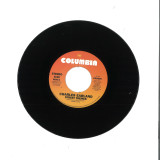
“Coming To You Love” is a classic and ever popular jazz funk and soul release from 1980. From its original release, the LP and 12” versions have dominated, this 7” version only recently coming to light as a different take on the track with a bonus Charles Earland organ solo. Since the realization of its existence, the previously styrene only US Columbia 7” has exchanged hands for increasingly higher amounts.
Charles came from Philadelphia, played sax first with Jimmy McGriff before turning to organ in the late 60s and earning a nickname ‘The Mighty Burner’
During his time at Mercury records he scored a hit song with the disco record “Let The Music Play”, building an audience with a jazz funk and soul crowd which exists to this day through numerous other releases on Mercury and then Columbia through to his passing in 1999.
quête:jimmy mcgriff
- 1
Nach ihrem ARIA-nominierten Debütalbum "The Stranger In The Mirror" meldet sich das australische Jake Mason Trio mit seinem zweiten Album zurück. Auf "The Modern Ark" schöpft das Trio aus der goldenen Ära des Orgel-Jazz (Jimmy Smith, McDuff, McGriff) und entwickelt dabei einen unverwechselbaren, modernen Sound. Aufgenommen in Melbourne mit Vintage-Equipment, fängt die LP die Leidenschaft und Finesse einer Band mit über 30 Jahren gemeinsamer Geschichte ein. Zu den Highlights zählen der Grammy-prämierte Sänger Kurt Elling auf dem cineastischen Titeltrack sowie die australische Ikone Kate Ceberano auf der Soul-Jazz-Ballade "Stop Searching For Love". Mit bereits gesicherter internationaler Presseunterstützung und Touren in Australien und Europa ist "The Modern Ark" für 2026 bestens aufgestellt.
- Neon Demon
- Mine—Sweet Tempest
- Demon Dance—Julian Winding
- What Are You
- Don T Forget Me When You Re Famous
- Gold Paint Shot
- Take Off Your Shoes
- Ruby At The Morgue
- Jesse Sneaks Into Her Room
- Real Lolita Rides Again
- Messenger Walks Among Us
- Runway
- Take Her To Measurements
- Who Wants Sour Milk
- I Would Never Say You Re Fat
- Thank God You Re Awake Remix
- Kinky
- Ruby S Close Up
- Lipstick Drawing
- Something S In My Room
- Are We Having A Party
- Get Her Out Of Me
- Waving Goodbye
The late, great Calvin Keys’1971 debut album for the Black Jazz Records label announced the arrival of a new star in the jazz guitar firmament. Keys had spent the ‘60s backing up the crème de la crème of jazz organists—Jimmy Smith, Jimmy McGriff, Jack McDuff, Richard “Groove” Holmes—but for his first record as a leader, he was eager to play with a piano player instead. So he recruited one of the best—Larry Nash, who, besides being a member of the L.A. Express, played with everybody from Eddie Harris to Bill Withers to Etta James. Bassist Lawrence Evans, drummer Bob Braye, and flautist-songwriter Owen Marshall rounded out the group on Shawn-Neeq, which might remind some of Pat Metheny’s early work (Metheny acknowledges Keys as an influence), or Grant Green.
But what gives Shawn-Neeq extra depth is that it comes from the heart; as Keys says in Pat Thomas’ liner notes, which feature an interview with the artist: “My thing was, I write about some of the experiences that I’ve had in my life.” Keys became a fixture in the Bay Area jazz scene before he passed in April 2024; this is the album that started his journey. Another gem from the celebrated Black Jazz catalog, pressed in blue with black swirl vinyl limited to 750 copies!
The late, great Calvin Keys’1971 debut album for the Black Jazz Records label announced the arrival of a new star in the jazz guitar firmament. Keys had spent the ‘60s backing up the crème de la crème of jazz organists—Jimmy Smith, Jimmy McGriff, Jack McDuff, Richard “Groove” Holmes—but for his first record as a leader, he was eager to play with a piano player instead. So he recruited one of the best—Larry Nash, who, besides being a member of the L.A. Express, played with everybody from Eddie Harris to Bill Withers to Etta James. Bassist Lawrence Evans, drummer Bob Braye, and flautist-songwriter Owen Marshall rounded out the group on Shawn-Neeq, which might remind some of Pat Metheny’s early work (Metheny acknowledges Keys as an influence), or Grant Green.
But what gives Shawn-Neeq extra depth is that it comes from the heart; as Keys says in Pat Thomas’ liner notes, which feature an interview with the artist: “My thing was, I write about some of the experiences that I’ve had in my life.” Keys became a fixture in the Bay Area jazz scene before he passed in April 2024; this is the album that started his journey. Another gem from the celebrated Black Jazz catalog, pressed in blue with black swirl vinyl limited to 750 copies!
JTQ experimentieren ständig mit verschiedenen Musikstilen, nach Soul- und Jazzalben, einem Chor- und einem Orchesteralbum, nehmen sie jetzt ein Funk-Rock-Album auf, das eigentlich die nächste The Prisoners-LP hätte sein können. Funky, teils punky Rock-Elemente wechseln sich ab mit Hammond-Funk-Instrumentals im Stil von Jimmy McGriff. James Taylor nahm viel mit Billy Childish und The Prisoners auf und fand es an der Zeit, seine Jazzband auch an diesem eher rock'n'rolligen Sound auszuprobieren. Während die Funk-Rock-Tracks auf BBC 6 laufen, spielt Jazz FM die Instrumentals.
- 01: Double Take (Feat. Lucas De Mulder)
- 02: Hey! (Feat. Lucas De Mulder)
- 03: El Gato (Feat. Lucas De Mulder &Amp; The Haggis Horns)
- 04: Guinnee Drop (Feat. Lucas De Mulder)
- 05: Sugar Man (Feat. Lucas De Mulder)
- 06: Galáctico (Feat. Lucas De Mulder)
- 07: Retiro (Feat. Lucas De Mulder)
- 08: Dame Lo Que Tienes (Feat. Lucas De Mulder)
- 09: Moonbow (Feat. Lucas De Mulder)
- 10: Lost On You (Feat. Lucas De Mulder)
An exciting new collaboration between New Mastersounds Hammond organist and Madrid based guitarist Lucas De Mulder plus drummer Luke Flowers (Cinematic Orchestra). Recorded at Joe's home studio on his cherished C3 Hammond (where The New Mastersounds' latest album "Old School" was recorded Galáctico will delight vintage jazz-funk fans with nods to Jimmy Mcgriff, Dr Lonnie Smith,George Benson etc etc. Joe and Lucas worked together on Lucas's album "Feel the spirit" in 2019 on Color Red label based in Denver.
The trio will be launching the record at the Saint Paul Soul Jazz festival in the south of France on 7th July and continue to play a series of other fgigs through-out the summer
The album starts with the frenetic James Brown groove of Double Take - a catch jazz guitar head that builds moving up in key to a frenetic hammond solo punctuated by The Haggis Horns.
Track 2 is the Meters-esque "Hey!" The only English language vocal track on the record and at that only one word
Next up is "El Gato" featuring Sam Bell on Congas and Atholl Ransome and Malcolm Strachan from the Haggis Horns a latin four to the floor vibe with solos traded throughout
Guinnee Drop is a swaggering funk jam with Luke Flowers funk drums breaks a feature
The only cover on the album is Sixto Rodriguez' Sugarman - Lucas and Joe were both inspired by his story and loved the song so much it had to go on the album with a mellow instrumental twist
The title track "Galáctico" is has funky soundtrack tune - the horns are back and take the track out with some blistering solos
"Retiro" inspired by the park near Lucas's pad in Madrid is a laid back boogaloo vibe and has Sam Bell on Congas and an upright piano solo from Tatton
"Dame Lo Que Tienes" - The first single from Joe Tatton's second album "Give me what you got!"- led by a funky guitar riff followed by a cutting hammond melody - a little "Meters, Booker T, The Crusaders "!
"Moonbow" a hypnotic slower tune with a nod to Khurangbin
The final track on the album is "Lost on You" A Breezy George Benson nod along
Out on vinyl, CD and digital on 5th July !
Proudly presenting a new series of Mr Bongo reissues exploring the incredible back catalogue of Sonny Lester’s iconic Groove Merchant record label. First up, the spellbinding funk-fuelled, soul jazz album ‘Simba’, by guitar maestro O'Donel Levy.
Baltimore-born, Levy was already well regarded as one of the best up-and-coming jazz guitarists at the time of Simba’s release. Having toured with George Benson and Jimmy McGriff, as well as featuring on McGriff’s Black Pearl album on Blue Note, he went on to sign with Sonny Lester’s Groove Merchant. Produced by Lester himself and recorded over two back-to-back days of sessions in 1973, Simba features a who's who of ‘70s session players. The album features the legendary studio drummer Steve Gadd, Cecil Bridgewater on Flugelhorn, bass by Tony Levin and arrangements by Manny Albam.
A masterclass in tight yet effortlessly funk-driven rhythms, the tracks showcase these musicians at their zenith. Album opener 'Bad, Bad, Simba' wouldn’t have been out of place on a Lalo Schifrin ‘70s car chase soundtrack. Levy's playing is brilliant, bright and slick, with an infectiously exuberant energy that is complimented perfectly by Gadd's supreme drumming. ‘Playhouse' serves up another vibrant offering, Wah Wah guitars, horns and flutes duelling it out in a fast-paced fashion.
The cinematic thread continues throughout, yet with the tempo taken down a notch. 'Sierra Lonely' and ‘Sad, Sad, Simba’ head into lush ballad territory, with superb arrangements by Albam and beautiful playing by Collins and Bridgewater on Flugelhorn. Here Levy shines without taking any limelight, as the players synergize to a relaxed perfection. ‘Nigerian Knights’ closes the album flawlessly, showcasing once more Levy’s understated yet magnetic flow on the guitar.
Every track on ‘Simba’ is a winner. As with CTI Recordings of the same era, the feel and textures of Sonny Lester's productions have that pre-emptive, hip-hop aesthetic, which later producers would rework and reimagine. This album is expertly balanced, deftly arranged and magically executed, ebbing and flowing with a cool buoyancy that just grooves and grooves.
- A1: Take Five - The Dave Brubeck Quartet
- A2: Moanin' - Art Blakey & The Jazz Messengers
- A3: Soul Bossa Nova - Quincy Jones & His Orchestra
- A4: Milestones - Miles Davis
- A5: My Bucket's Got A Hole In It - The Ramsey Lewis Trio
- B1: Watermelon Man - Herbie Hancock
- B2: Caravan - Duke Ellington
- B3: One Mint Julep - Ray Charles
- B4: Walk On The Wild Side - Jimmy Smith And The Big Band
- B5: Desafinado - Stan Getz & Charlie Byrd
- C1: So What - Miles Davis
- C2: Tuxedo Junction - Quincy Jones
- C3: Harlem Nocturne - King Curtis
- C4: Blues Walk - Herbie Mann
- C5: Unsquare Dance - The Dave Brubeck Quartet
- D1: Sing, Sing, Sing - Benny Goodman And His Orchestra
- D2: Love For Sale - Dexter Gordon
- D3: Take The "A" Train - Duke Ellington
- D4: Work Song - Cannonball Adderley & Ray Brown
- D5: I've Got A Woman (Part 1) - Jimmy Mcgriff
There are as many flavours of Jazz as there are pebbles on a
beach, but the majority combine rhythmic invention with
instrumental virtuosity to create a sound that can transport the
listener to a different plane. Our compilation features duos,
trios, bands and orchestras playing music inspired by Africa,
Brazil and all points in-between. Film themes, standards, charttoppers and relative obscurities have been carefully assembled
to provide a wide-ranging picture of the Jazz instrumental.
Drawn from three sessions in 1958–59 that featured The Incredible Jimmy Smith in a quartet with tenor saxophonist Percy France, guitarist Kenny Burrell, and drummer Donald Bailey, Home Cookin’ stands as one of the most deeply soulful albums the Hammond B3 organ virtuoso ever made. The band gives a soul jazz symposium that covers tunes by Ma Rainey, Ray Charles, and Jimmy McGriff along with originals by Smith and Burrell. This Blue Note Classic Vinyl Edition is all-analog, mastered by Kevin Gray from the original master tapes, and pressed on 180g vinyl at Optimal.
- A1: In And Out
- A2: Isola Natale
- A3: Black Cat
- A4: Lament For Miss Baker
- A5: Goodbye Jungle Telegraph
- B1: Tramp
- B2: Why (Am I Treated So Bad)
- B3: A Kind Of Love In
- B4: Break It Up
- B5: Season Of The Witch
- C1: A Day In The Life
- C2: George Bruno Money
- C3: Far Horizon
- C4: John Brown’s Body
- D1: Red Beans And Rice
- D2: Bumpin’ On Sunset
- D3: If You Live
- D4: Definitely What
- E1: Tropic Of Capricorn
- E2: Czechoslovakia
- E3: Take Me To The Water
- E4: A Word About Colour
- F1: Light My Fire
- F2: Indian Rope Man
- G1: Ellis Island
- G2: In Search Of The Sun
- G3: Finally Found You Out
- G4: Looking In The Eye Of The World
- H1: Vauxhall To Lambeth Bridge
- H2: All Blues
- H3: I’ve Got Life
- H4: Save The Country
- I1: I Wanna Take You Higher
- I2: Pavane
- I3: No Time To Live
- I4: Maiden Voyage
- J1: Listen Here
- J2: Just You Just Me
- F3: When I Was A Young Girl
- F4: Flesh Failures (Let The Sunshine In)
The ground- breaking, unique jazz/R&B/pop group Brian Auger & The Trinity were formed from the ashes of Long John Baldry’s and Brian Auger’s previous group bandThe Steampacket, an R&B Revue collective, which also featured a then barely known Rod Stewart and Julie Driscoll.
Adding the UKs then greatest soul/pop singer Julie Driscoll to this new collective meant that not only did the band have a unique, beautiful voice and face to front the group – Driscoll also embodied everything about the 1960s fashionable It Girl; her sound, her clothes, hair styles and make up assured that nearly as many column inches were dedicated to her stylish demeanour as much as the band’s genre bending music.
The group were the one of the first too to intentionally set out to break down musical barriers – Brian himself specifically stated in the sleeve notes for 1968s ‘Definitely What!’ album that his concept “lies along a straight line drawn between pop and jazz and aims at the ‘fusion’ of both elements”. ‘Fusion’ at that time was not even a recognised musical term, reinforcing Auger’s credentials as an originator and innovator.
“Back then the jazz audiences were purists. They really looked down on rock and pop,” he explains. “I had people cross the road when they saw me coming, I was persona non grata at Ronnie Scotts because of themusic we were doing and the clothes we were wearing”.
Happily – audiences of the time didn’t take the same dismissive approach, Julie Driscoll, Brian Auger & The Trinity toured the US and had exploded onto American TV screens as guests of The Monkees, and also scored hits across Europe's pop charts via the singles ‘This Wheels On Fire’ & ‘Save Me’ – but simultaneously appeared on the UK’s ‘Top Of The Pops’ in the same month as headlining major European Jazz Festivals – a feat no other act has equalled since.
Between 1967 and ’70, Brian Auger experienced a four year run of unprecedented creativity – 1967’s Open with Julie Driscoll, 1968’s Definitely What!, 1969’s Streetnoise again with Driscoll and 1970’s Befour – taking the Hammond Organ in new directions with their thrilling fusion of club R&B, jazz and psychedelic cool, engaging both the underground and the mainstream, and bringing the group chart success in the UK and Europe. “I look back on my years with The Trinity as aperiod of discovery,” Auger concludes. “I didn’t know what would happen or where it would take me but we were breaking down barriers and going someplace new.”
King Britt “The Multi-Genre Maestro, Brian Auger is every producer and DJ’s secret weapon. A hero who deserves his flower now”
DJ Format “I have more Brian Auger records in my collection than any other British artist, which says more about my love of his music than words ever could"
FOR FANS OF:
Jimmy Smith, Aretha Franklin, The Spencer Davis
Group, Nina Simone, Georgie Fame, Traffic. Sly &
The Family Stone, Jimmy McGriff.
With their album "B-3 Vol.1" the Hanoverian Lutz "Hammond"
Krajenski aka krajenski. on the B-3 organ, Ben Kraef from Berlin on
the saxophone and Peter Gall from southern Germany on the drums
break new ground even if the old path of the Hammond-infected Blue
Note refinement always remains in view.
An organist, a saxophonist and a drummer - the classic organ trio has been arousing special expectations to Jazz listeners since the glory days of Jimmy Smith, Groove Holmes and the McDuffs and McGriffs. The organist can spread out, the saxophonist can follow him and the drummer swings and provides the groove "in the pocket". With their album "B-3 Vol.1" the Hanoverian Lutz "Hammond" Krajenski aka krajenski. on the B-3 organ,
Ben Kraef from Berlin on the saxophone and Peter Gall from southern
Germany on the drums break new ground even if the old path of the
Hammond-infected Blue Note refinement always remains in view. KraefKrajenski-Gall do their thing and that very consistently. They play with the different readings of the format with reflections from Jimmy Smith to Larry Young. They play with expectations and play around clichés with sophisticated twists and tongue-clicking rhythmic and harmonic treasures.
It's an album to dig out the phrase "No fillers, all killers" for.
Grammy-nominated album features some of Albert's most popular tracks
like "I Ain't Drunk," "Lights Are On But Nobody's Home" and "Too Many
Dirty Dishes
" The Master of the Telecaster's last Alligator release, and his favorite, finds him
backed by a hand- picked all- star band featuring organist Jimmy McGriff and
guitarist Mel Brown, plus the Uptown Horns. All tracks remastered.
Sublime funky jazz album by Harold Vick under the Sir Edward name - first time reissue from the 1973 edition on Funky Drummer Bernard Purdies short lived Encounter Label !
One of the great unsung saxophone hero's: Harold Vick worked as a sideman with Hammond Legends Jack McDuff, Jimmy McGriff, Big John Patton, and Larry Young. He played on and off with Walter Bishop, Jr. and also worked with Philly Joe Jones, Howard McGhee, Donald Byrd and Ray Charles and appeared with Dizzy Gillespie, King Curtis, and from 1970 to 1974 with Aretha Franklin. He played in Jack DeJohnette's jazz-rock band Compost from 1971 to 1973,recording with them in 1972 which is about the same time as this recording and that is probably the reason it is under the pseudonym of "Sir Edward". Add to that an absolutely top notch band, including bassist Wilbur "Bad" Bascomb, Jumma Santos on percussion and the mellow vibes of Omar Clay and this is a must have soulful jazz outing.
The music is a funky mix of some of the big Soul tunes of the day, with versions of Donny Hathaway and The Stylistics and a nod to the CTI stylings of the day with a get down version of "People Make The World Go Round".
Drawn from three sessions in 1958–59 that featured The Incredible Jimmy Smith in a quartet with tenor saxophonist Percy France, guitarist Kenny Burrell, and drummer Donald Bailey, Home Cookin’ stands as one of the most deeply soulful albums the Hammond B3 organ virtuoso ever made. The band gives a soul jazz symposium that covers tunes by Ma Rainey, Ray Charles, and Jimmy McGriff along with originals by Smith and Burrell. This Blue Note Classic Vinyl Edition is all-analog, mastered by Kevin Gray from the original master tapes, and pressed on 180g vinyl at Optimal.
- A1: Axumites Feat Booker Gee & Lone Ark
- A2: Out In The Rain Feat Booker Gee
- A3: Never Too Much Feat Leo Carmichael
- A4: Matumbee Feat Booker Gee & Blundetto
- B1: Faith Feat Booker Gee & Lone Ark
- B2: I Want You (Sly & Robbie Remix) With Leo Carmichael
- B3: Cool Down Feat Booker Gee & Blundetto
- B4: Greedy G Feat Booker Gee
Since first emerging in the latter half of the noughties, Guillaume Metenier’s Soul Sugar project has evolved considerably. Initially a trio built around the virtuoso organist’s love of ‘60s and ‘70s soul-jazz and Hammond funk – Metenier studied under jazz organ legend Dr Lonnie Smith – Soul Sugar is now a collaborative collective that draws just as much influence from classic Jamaican dub and reggae as the works of Jimmy Smith and Jimmy McGriff.
The outfit’s musical evolution comes into sharp focus on Excursions in Soul, Reggae, Funk & Dub, a collection of hard-to-find tracks that have been released at different points, and on different vinyl formats, over the last three years. Taken as a whole, the set offers a stunning snapshot of Soul Sugar’s rapidly expanding catalogue of classics. Metenier is once again at the controls but this time round Soul Sugar’s cast list of contributing musicians includes Sly & Robbie, Blundetto, Lone Ark, Slikk Tim, Thomas Naim and honey-voiced soul singer Leo Carmichael. Metenier also stars as a musician, providing lively and ear-catching organ solos under his now familiar Booker Gee alias.
What’s most noticeable from the off is the richness of the reggae riddims, the warmness of the instrumentation and the effortlessly soulful nature of the music. This is particularly evident on the collective’s stunning covers of Luther Vandross’s "Never Too Much" and Marvin Gaye’s "I Want You": effortlessly sunny and life-affirming interpretations that re-imagine the tracks as sumptuous slabs of reggae-soul and provide a platform for Leo Carmichael’s inspiring and comforting voice. Metenier and friends’ take on dub reggae – toasty, authentically bass-heavy and seeped in analogue effects – can also be admired on "Matumbee" and "Cool Down", the latter a digi-dub influenced affair rich in colourful synths sounds, echoing delay trails and sub-bass so deep it will rattle your teeth. Both also contain lusciously jazzy guitar licks and some incredible keys-work from Metenier.The guiding hand of Spanish multi-instrumentalist and producer Lone Ark can be heard on album opener "Aximites" – think Lee ‘Scratch’ Perry producing Jimmy Smith – and "Faith", an expertly breezy concoction that sports Jackie Mittoo-esque Hammond B3 solos from Metenier over a luscious backing track that sounds like something that may have emerged from Studio One in the mid 1970s. The collective’s love of Studio One is explored further on a sweaty, reggae-funk cover of "Greedy" that features fabulous drums, bass and guitar from Slikk Tim, while "Out In The Rain" is an authentically sparse, spaced-out dub number laden with fluid instrument solos and devilishly heavy riddim.
Part compilation, part artist album, part collaborative celebration of dub-soul fusion, Excursions in Soul, Reggae, Funk & Dub is the strongest statement yet of who Soul Sugar are, and where they’re going.
Calvin Keys’s 1971 debut album for the Black Jazz Records label announced the arrival of a new star in the jazz guitar firmament. Keys had spent the ‘60s backing up the crème de la crème of jazz organists— Jimmy Smith, Jimmy McGriff, Jack McDuff, Richard “Groove” Holmes—but for his first record as a leader, he was eager to play with a piano player instead. So he recruited one of the best—Larry Nash,
who, besides being a member of the L.A. Express, played with everybody from Eddie Harris to Bill Withers to Etta James. Bassist Lawrence Evans, drummer Bob Braye, and flautist-songwriter Owen Marshall rounded out the group on Shawn-Neeq, which might remind some of Pat Metheny’s early work (Metheny acknowledges Keys as an influence), or Grant Green. But what gives Shawn-Neeq extra depth is that it comes from the heart; as Keys says in Pat Thomas’ liner notes, which feature an interview with the artist: “My thing was, I write about some of the experiences that I’ve had in my life.” Keys has since become a fixture in the Bay Area jazz scene; this is the album that started his journey. Another gem from the celebrated Black Jazz catalog!
Columbus, Ohio’s Rudolph Johnson drew comparisons to John Coltrane during his career; like the jazz legend in his later years, Johnson eschewed drugs or alcohol and spent his time every day either meditating and rehearsing on his horn. You can definitely hear
a little bit of Coltrane in Johnson’s playing on this, his 1971 debut release for the Black Jazz label, the first of two he recorded for the
imprint and the first he recorded as a leader after some sideman work (most notably for organist Jimmy McGriff); his ability to explore the upper registers and overtones of his tenor sax while retaining control is quite striking. Of course, this being a Black Jazz release, along with the bebop sounds of “Sylvia Ann” and the mid-‘60s Blue Note stylings of “Sylvia Ann,” there’s the soul jazz of “Diswa” and the groove funk of “Devon Jean,” all played by, as is typical on Black Jazz releases, by top-notch sidemen including drummer Raymond Pounds, who’s layed
with everybody from Stevie Wonder to Pharoah Sanders to Bob Dylan, and pianist John Barnes, whose work is very familiar to Motown fans (Supremes, Temptations, Marvin Gaye). Bassist Reggie Jackson, who appeared on the Walter Bishop, Jr. Coral Keys record we previously released, rounds out the quartet. First vinyl reissue of another stellar Black Jazz release!
Beat Bronco Organ Trio play Soul Jazz, the sound of the 60's popularized by artists such as Jimmy Smith, Grant Green, Jimmy McGriff and Reuben Wilson. With a warm and solid sound, the Madrid combo breaks into the scene with a groovy funky 45. The Mid-tempo Jazz Funk cut "Easy Baby" on one side and the dancefloor burner "Geriatric Dance" on the flip. Soon on a turntable near you.
Gabri Casanova, Hammond.
Lucas de Mulder, Guitar.
Antonio "Pax", Drums.
Recording & Mixing - Santi "Sweetfingers" Martín.
Mastering: Victor García.
First Ever Vinyl Reissue, Limited Edition To 500 Copies Only, Bonus Tracks Not On The Original Lp, Remastered Sound, Insert With Liner Notes By Nick Rossi And Photos, Beautifully Housed In Three Back-flapped 1960s Uk Style Picture Sleeve ! The Wynder K. Frog Story Evolves Around Mick Weaver. After He Switched From Piano To Organ He Joined A Band Named The Chapters That Would Soon Be Renamed Wynder K. Frog And Perform Material From James Brown's Flames, Booker T. And The Mgs Or Even Songs Learned Through Georgie Fame's Recordings And Graham Bond's Repertoire. Wynder K. Frog Moved To London And Became Regulars In The City's R&b Scene Playing At Swingin' London's Clubs Like The Tiles Or The Marquee. A Contract With Island Records Was Secured And -under The Wings Of Producers Like Chris Blackwell, Guy Stevens, Jimmy Miller Or Gus Dudgeon- Wynder K Frog, A Name That Would Eventually Be Used As A Pseudonym For Weaver More Than A Proper Band Name, Did Some Some Amazing Hammond Organ-ized Recordings And Issued In Three Lps And A Bunch Of Cool 45s.
At The End Of The 1960s, Weaver Would Quit The "band Scene" To Become One Of The Most In Demand Session Musicians And Throughout His Career He'd Be Heard Backing Names Such As Eric Burdon, Roger Chapman, Dave Gilmour, Keef Hartley, Alexis Korner, Ralph Mctell, Taj Mahal Or Otis Rush A.o, But His Lps As Wynder K Frog Are Classic Hammond Sound From The 1960s Uk And Will Appeal To Those Into Brian Auger, Graham Bond, The Artwoods, Zoot Money, Jimmy Mcgriff, Booker T. & The Mgs And The Likes.
Out Of The Frying Pan
Released At The End Of The Summer Of 1968, And With A Host Of Session Musicians That Included The Brass Section Of John Mayall's Bluesbreakers, Producer Gus Dudgeon Helped Weaver / Wynder K Frog To Improve The Results Obtained On The Debut Lp And Get One Step Closer To The Live Action. The Formula Was More Or Less The Same, Instrumental Hammond A Go Go Covers Of Hits From The Era, Including The Rolling Stones' "jumping Jack Flash", A Funked Up Version Of The Classic Tommy Tucker Blues Number "hi Heel Sneakers", An Exploding Cover Of "tequila" Or The Standard "green Door", But It Also Included The Sensational Weaver-penned "harpsichord Shuffle".
Until he was about 20, Texas-born Melvin Sparks was a rhythm & blues guitarist, backing Jackie Wilson, Curtis Mayfield and Marvin Gaye as a member of The Upsetters. But Sparks gave up his seat on The Upsetters' bus in New York City, where a chance introduction to George Benson led him to a place in soul jazz history. Melvin played and recorded with Lou Donaldson, Leon Spencer, Bernard Purdie, Jack McDuff, Jimmy McGriff, Idris Muhammad, Dr. Lonnie Smith, Charles Earland, Grover Washington Jr., Reuben Wilson and so many more. Even during the quietest years of soul-jazz Melvin stayed relevant through hip-hop and r&b, a quick search at WhoSampled turns up more than 150 samples of his funky chicken scratch. And Melvin's legacy is heard in contemporary soul/funk bands like The New Mastersounds, Soulive and The Greyboy Allstars, all of whom he also guested with several times before his early departure from this realm in 2011.
This release documents Melvin's final band just months before his death. Organist Beau Sasser and drummer Bill Carbone had been working with Sparks for several years, and, despite the power dynamic - they were in their early 30s, Melvin an elder-statesmen of the genre - the unit was sharp, relaxed and performed Melvin's music with a jovial spirit. The trio played the Burlington, VT club Nectar's regularly, but this night featured two "onlys." Per the recommendation of Nectar's agent they used the "Grippo Horns," the only time Sparks used a horn section in the last several years of his life, and they allowed a multitrack recording of the show. Both were strong decisions.
The tracks on this album, lovingly mixed by guitarist, producer and Melvin Sparks fan Eddie Roberts, demonstrate that Melvin played as well in the final months of his life as at any time. Sparks counts "Whip! Whop!" off at what he said The Upsetters called a "showtime tempo," and peppers it, as well as most of the album, with quotes from jazz standards, pop songs and cartoon themes, all woven effortlessly into the bebop-funk dialect he helped create. He unfolds amiable melodies, patiently and methodically, through his several-minute lead on "Breezin'." And Sparks is audibly uplifted by the Grippo Horns helping him perform his 1973 arrangement of "Ain't No Woman" for the first time in decades.
- 1