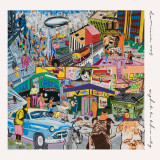
UGLY is slowthai pulling himself apart and exposing his anxieties of the last couple of years, an acronym for U Gotta Love Yourself. Musically, this new album may show a side of him that people haven’t heard before but he sees it as the fullest picture yet - and attentive listeners will have noticed this musical tendency before. UGLY is about reconnecting with first principles. Plunging into rock music with as much singing as rapping, it is both a striking departure for slowthai and a return to the roots of Tyron Frampton. Recorded in producer Dan Carey’s home studio alongside frequent collaborator Kwes Darko, UGLY is a fluid combination of musicians including Ethan P. Flynn, Jockstrap’s Taylor Skye, Beabadoobee guitarist Jacob Bugden, drummer Liam Toon, and on the dark and woozy title track, his friends Fontaines D.C.
Search:jock d
- A1: Psalm 34:4
- A2: Metatron, Archangel Of Kether
- A3: Raziel, Archangel Of Chokmah
- A4: Tzadkiel, Archangel Of Chesed
- A5: Tzaphkiel, Archangel Of Binah
- A6: Kamael, Archangel Of Geburah
- A7: Gabriel, Archangel Of Yesod
- B1: Michael, Archangel Of Hod
- B2: Raphael, Archangel Of Tiphareth
- B3: Haniel, Archangel Of Netzach
- B4: The Sun
- B5: Sandalphon, Archangel Of Malkuth
- B6: Anu/Enlil/Enki (The Way Of Anu)
John Bence can be described as a Savant in the world of Avant-Garde classical composition, and puts his mastery on full display in his newest release with Thrill Jockey. Archangels is a deep dive into the world and soundscape that Bence carefully crafts to offer a glimpse of the divine. Raised in Bristol"s burgeoning underground electronic music scene and a graduate of the Royal Birmingham Conservatoire, John Bence manages to employ compositional complexity to manifest potent emotions. Bence"s acclaimed early works focused on the human experience, charting the composer"s own experiences with addiction and alcoholism in both stark minimalism and caustic noise eruptions. Having written Archangels two years into his recovery, Bence deftly threads together gauzy electronic atmospheres, brooding orchestral passages, and minimalist piano meditations. Throughout his work, he manages to finely sew together Gregorian chant, orchestral arrangements, rippling synthesizers, and field recordings to reveal new surprises at every turn. Archangels is a compelling addition to contemporary composition by an artist unbound by classical traditions.
The title, nature morte, is the French term for still life paintings whose literal translation is "dead nature." BIG|BRAVE color the songs of nature morte with unease, creating an air of beauty in decay, chords suspended in contemplative stillness. Robin Wattie"s experiences structuring lyrics and song forms on The Body & BIG|BRAVE"s Leaving None But Small Birds informed her work on nature morte, creating stories that, like many folk tales, are at once specific and universal. Wattie"s voice manages to be commanding and vulnerable with impressive range and intimacy. Even her gasps carve their way through the tidal crash of Mathieu Ball"s distortion wail and the pummel of Tasy Hudson"s drums. The momentum of nature morte conjures the image of a beast collapsing beneath its own weight before resiliently staggering upright to thunder onward. BIG|BRAVE convey heft from silence as deftly as they do from swaths of feedback and distortion to cathartic ends. "Distortion is key," notes Ball The three members recorded primarily live over the course of a week at Machines with Magnets with Seth Manchester, pushing the potential of their instruments beyond expectations. For each song, the trio"s songwriting and attention to detail deliver its simple but devastating emotional power. Across the album"s six pieces BIG|BRAVE create a tension between immediacy and patience, invoking the essence of disquiet, while conveying anguish through inventive arrangements and nuanced performances. nature morte captures BIG|BRAVE at their heaviest and their mournful fury is at its zenith, an album where each moment is so immense and consuming that it possesses its own gravitational pull.
PUPPY formed in 2015 when school friends Jock Norton (vocals, guitar) and Billy Howard (drums) met bass player Will Michael while working in a London bar. Later that same year, the band released their eponymous debut EP, that quickly earned comparisons to acts like The Smashing Pumpkins and Dinosaur Jr. A second EP quickly followed in 2016, and “Vol ii” saw the band take their first major steps into the live sphere, with UK festival appearances at Download and 2000 Trees. The Goat, Puppy's debut album, was released in January 2019, while the band were midway through an epic European tour with Monster Magnet. In support of the album, the band recorded a live set at BBC’s iconic Maida Vale studios (their second), and racked up festival appearances everywhere from Glastonbury to Bloodstock Open Air. That year also saw PUPPY travel to the US for the first time, selling out a headline show in Brooklyn’s iconic St Vitus Bar for Revolver Magazine. Without missing a beat, the band saw out the year by releasing a surprise EP, ‘iii’, and is now ready to open a new chapter.
Expanded Edition[176,43 €]
Double LP[41,13 €]
Black Vinyl[9,12 €]
Blue Vinyl[10,29 €]
Translucent Blue vinyl[35,92 €]
15 years after the album’s release, ‘City Of Echoes’ is now
available in a deluxe 2LP edition, newly remastered by
Josh Bonati and featuring a full LP’s-worth of bonus
material, including original album demos, alternate takes,
and pieces originally only available on the rare ‘Pink
Mammoth’ EP.
‘City Of Echoes’, originally released in 2007 by Hydra
Head Records, marked a paradigm shift for Pelican.
Coming off the heels of the glacial ‘Australasia’ and their
even more expansive and acclaimed follow-up, ‘The Fire
In Our Throats Will Beckon The Thaw’, their third album is
a study in precision.
Inspired by their non-stop tour schedule following ‘The Fire
In Our Throats Will Beckon The Thaw’’s release, the
quartet composed ‘City Of Echoes’ to be a lean
powerhouse of non-stop melodic hooks and lurching
rhythms that reflected the energy of live performance.
Guitarists Trevor Shelley de Brauw and Laurent
Schroeder-Lebec trade crisp riffs that twirl in opposition
before thundering together in monoliths. The sheer
amount of potent interplay between the two, often
borrowing from disparate edges of rock and metal at a
whim before completely transforming, is mind-boggling.
Bassist Bryan Herweg and rhythm section compatriot /
drummer / brother Larry Herweg lock into a wider array of
grooves than ever before. Their considered bedrock
guides the band’s dynamics into some of the ensemble’s
most tender moments as well as their most ferocious.
Recorded by Andrew Schneider at Electrical Audio Cover.
Art designed by ISIS and SUMAC founder Aaron Turner,
with photography by Robin Laananen.
Also available to independent retailers on Translucent Blue
vinyl.
Expanded Edition[176,43 €]
Double LP[41,13 €]
Black Vinyl[9,12 €]
Blue Vinyl[10,29 €]
Black Vinyl[34,24 €]
15 years after the album’s release, ‘City Of Echoes’ is now
available in a deluxe 2LP edition, newly remastered by
Josh Bonati and featuring a full LP’s-worth of bonus
material, including original album demos, alternate takes,
and pieces originally only available on the rare ‘Pink
Mammoth’ EP.
‘City Of Echoes’, originally released in 2007 by Hydra
Head Records, marked a paradigm shift for Pelican.
Coming off the heels of the glacial ‘Australasia’ and their
even more expansive and acclaimed follow-up, ‘The Fire
In Our Throats Will Beckon The Thaw’, their third album is
a study in precision.
Inspired by their non-stop tour schedule following ‘The Fire
In Our Throats Will Beckon The Thaw’’s release, the
quartet composed ‘City Of Echoes’ to be a lean
powerhouse of non-stop melodic hooks and lurching
rhythms that reflected the energy of live performance.
Guitarists Trevor Shelley de Brauw and Laurent
Schroeder-Lebec trade crisp riffs that twirl in opposition
before thundering together in monoliths. The sheer
amount of potent interplay between the two, often
borrowing from disparate edges of rock and metal at a
whim before completely transforming, is mind-boggling.
Bassist Bryan Herweg and rhythm section compatriot /
drummer / brother Larry Herweg lock into a wider array of
grooves than ever before. Their considered bedrock
guides the band’s dynamics into some of the ensemble’s
most tender moments as well as their most ferocious.
Recorded by Andrew Schneider at Electrical Audio Cover.
Art designed by ISIS and SUMAC founder Aaron Turner,
with photography by Robin Laananen.
Also available to independent retailers on Translucent Blue
vinyl.
- 01: Emerson, Lake & Palmer – Peter Gunn (Live)
- 02: Basement Jaxx – Where’s Your Head At (Head-A-Pella)
- 03: Peaches – Fuck The Pain Away
- 04: The Velvet Underground – I’m Waiting For The Man
- 05: Polyester – J’aime Regarder Les Mecs
- 06: Sly And The Family Stone – Dance To The Music
- 07: Ready For The World – Oh Sheila (A Capella)
- 08: Dakar & Grinser – I Wanna Be Your Dog
- 09: Ural 13 Diktators – Disko Kings
- 10: Bobby Orlando – The “O” Medley
- 11: Felix Da Housecat – Silverscreen-Shower Scene
- 12: The Stooges – No Fun
- 13: Salt ‘N Pepa – Push It
- 14: Hanayo With Jürgen Paape - Joe Le Taxi
- 15: The Jets – Crush On You (A Capella)
- 16: Funkacise Gang – Funkacise
- 17: Soul Grabber – Motocross Madness
- 18: Lil Louis And The World – French Kiss
- 19: Zongamin – Serious Trouble
- 20: Garbage – Androgyny ‘Thee Glitz Mix’ By Felix Da Housecat
- 21: Frank Delour – Disc Jockey’s Delight Vol. 2
- 22: The Residents – Kaw-Liga (Prairie Mix)
- 23: Carlos Morgan – Shake Your Body
- 24: Alphawezen – Into The Stars (Firebirds Remix)
- 27: Destiny’s Child – Independent Women Part 1 (A Capella)
- 28: 10Cc – Dreadlock Holiday
- 29: Dolly Parton – 9 To 5
- 30: Röyksopp – Eple
- 31: Arbeid Adelt – Death Disco
- 32: Jeans Team – Keine Melodien Feat. Mj Lan
- 33: Skee.lo – I Wish (A Capella)
- 34: Maurice Fulton Presents Stress – My Gigolo
- 35: The Breeders – Cannonball
- 36: The Cramps – Human Fly
- 37: The Wildbunch – Danger! High Voltage
- 38: Op L Bastards – Don’t Bring Me Down
- 39: Adult – Hand To Phone
- 40: Vitalic – La Rock 01
- 41: Queen Of Japan – I Was Made For Loving You
- 42: New Order – The Beach
- 43: Detroit Grand Pubahs – Sandwiches (A Capella)
- 44: Lords Of Acid – I Sit On Acid (Soulwax Remix)
- 45: Streamer Feat. Private Thoughts In Public Places – Start Button
- 25: Interstellar – Concepts
- 26: Nena – 99 Luftballons
Das ikonische belgische DJ-Duo 2ManyDJs, bestehend aus den Brüder Stephen und David Dewaele, feiert das 20-jährige Jubiläum ihres Albums 'As Heard on Radio Soulwax Pt. 2' mit einer besonderen Re-Issue. 2002 erschien es ursprünglich nach einer Reihe von Radioshows der beiden Brüder, damals vor allem bekannt als die Köpfe hinter der Electronic/Indie-Rock Band Soulwax. Die Re-Issue erscheint mit dem Foto von Richard Young auf dem Cover, das ursprünglich als Cover vorgesehen, aber nach Rechtsstreitigkeiten mit Tipp-Ex verfremdet wurde.
Hot on the heels of the sold-out limited ep Was It Ever Real?, The Soft Pink Truth releases a super catchy, sexy contemporary disco banger Is It Going To Get Any Deeper Than This?, Throughout the ten songs of the album, the provocation to go "deeper" prompts promiscuous moves across the genres of disco, minimalism, ambient, and jazz, sliding onto and off of the dancefloor, sweeping higher and lower on the scale of frequencies, engaging both philosophical texts re-set as pop lyrics and wordless glossolalia. Throughout, Is It Going To Get Any Deeper Than This? aims for a kind of psychedelic poolside take on disco, using the steady 120 bpm rhythmic chassis of the music as a launchpad for reverie rather than big room EDM bluster. Sidestepping retro kitsch but paying homage to highly personal interpretations of disco such as Arthur Russell, Don Ray, Dr. Buzzard"s Original Savannah Band, and Mandré, or the jazz-funk of Creed Taylor and CTI Records. Its emphasis on slowly morphing deep house grooves will also appeal to fans of DJ Sprinkles, Moodymann, and Theo Parrish. At once catchy and spacey, poppy and perverse, Is It Going To Get Any Deeper Than This? shows a restless musician trying to square the circle of dance music and meditation, repetition, and change.
- A1: John Coltrane & Art Blakey's Big Band - Pristine
- A2: Cécile Mclorin Salvant - One Step Ahead
- A3: Serge Gainsbourg - Black Trombone
- A4: Marcus Miller Feat Corinne Bailey Rae - Free
- A5: Anne Paceo - Smile
- B1: Neue Grafik Ensemble Feat Brother Portrait - Hedgehog
- B2: Mel Tormé - Comin' Home Baby
- B2: Michel Legrand Feat Bill Evans, John Coltrane & Miles
- B4: Yaron Herman Trio - Heart Shaped Box
- B5: Miles Davis - Générique (B O.f "Ascenseur Pour L'echafa
- B6: I | Brahim Maalouf - True Sorry
- C1: Melody Gardot & Seth Kallen - My Sweet Darling
- C2: Norah Jones & Joel Harrison - Tennessee Waltz
- C3: Laurent De Wilde - Misterioso
- C4: Mélanie De Biasio - Afro Blue
- C5: Ella Fitzgerald - How High The Moon
- C6: Quincy Jones - Soul Bossa Nova
- D1: Térez Montcalm - Sweet Dreams
- D2: Biréli Lagrène & Sylvain Luc - So What?
- D3: Sandra Nkaké & Jî Drû - Always The Same
- D4: Youn Sun Nah - Jockey Full Of Bourbon
- D5: Nina Simone - Love Me Or Leave Me
- D6: 2Charlie Parker & Miles Davis - A Night In Tunisia
- A1: Tnt
- A2: Swung From The Gutters
- A3: Ten-Day Interval
- B1: I Set My Face To The Hillside
- B2: The Equator
- B3: A Simple Way To Go Faster Than Light That Does Not Work
- C1: The Suspension Bridge At Iquazu Falls
- C2: Four-Day Interval
- C3: In Sarah, Mencken, Christ, & Beethoven There Were Women & Men
- D1: Almost Always Is Nearly Enough
- D2: Jetty
- D3: Everglade
TNT is the third full length studio album released by Tortoise in 1998 1998 : Tortoise"s third studio album TNT is released. In and out of print over the past decade we are happy to finally give everyone what they have been asking for - TNT on vinyl again! Pressed on high quality virgin vinyl, the two LPs are packaged in a deluxe old-style tip?on gatefold jacket fully replicating the original artwork and includes a download coupon for the first time! Tortoise"s third full-length release, TNT, was written and recorded during a 10-month interval in 1997. This longer-than-usual writing/production schedule was purposefully undertaken by the group in the hopes of crafting an expansive, diverse, yet thematically coherent offering. TNT builds upon the spare, instrumental framework of the group"s first, self-titled album, and the extended edits, melodic adventures, and klangfarben of the subsequent full-length release, Millions Now Living Will Never Die. Further to this, Tortoise"s interest in the possibilities offered by the remixing of tracks was realized within the actual production of TNT; individual elements, sections, or sometimes whole compositions mutate within the album"s shifting framework. These techniques were suitably realized thanks in part to the use of non-linear digital recording and editing methods, the first example of such work for the group
The Exaltics need no further introduction.. operating since 15 years now and become one of the stalwarts of the international underground electro scene. Robert Witschakowski-Jockel founded the project The Exaltics in 2006 as well as the electro/ techno label SolarOneMusic with his long term friend Nico Jagiella. Since then he published countless 12"s and several LP's with labels like Clone, Creme Organization, Bunker or his own label SolarOneMusic and worked during that time with outstanding artists like Drexciya's Gerald Donald, Helena Hauff or the legendary Martin Gore from Depeche Mode. He turned his deep cinematic and most of all charismatic electro into his own trademark. The collection contains 13 Tracks recorded between 2009-2019 including tracks from long out stock titles first time on vinyl. Probably the best overview over the world of The Exaltics.
- A1: Rock This Mother
- A2: Talk To Me Girl
- A3: You Can Find Me
- A4: Check This Out
- A5: Jesus Going To Clean House
- A6: Hope You Understood
- A7: Is It What You Want
- A8: Love Is Everlasting
- A9: This Is Hip-Hop Art
- A10: Opposite Of Love
- A11: Do You Know What I Mean
- B1: Saving All My Love For You
- B2: Look Out Here I Come
- B3: Girl You Always Talking
- B4: Have A Great Day
- B5: Take My Hand
- B6: I Need Your Love
- B7: Your Town
- B8: Talk Around Town
- B9: Booty Head/Take A Little Walk
- B10: I Love My Mama
- B11: I Never Found Anyone Like You
Vinyl LP[23,49 €]
As the sun sets on a quaint East Nashville house, a young man bares a piece of his soul. Facing the camera, sporting a silky suit jacket/shirt/slacks/fingerless gloves ensemble that announces "singer" before he's even opened his mouth, Lee Tracy Johnson settles onto his stage, the front yard. He sways to the dirge-like drum machine pulse of a synth-soaked slow jam, extends his arms as if gaining his balance, and croons in affecting, fragile earnest, "I need your love… oh baby…"
Dogs in the yard next door begin barking. A mysterious cardboard robot figure, beamed in from galaxies unknown and affixed to a tree, is less vocal. Lee doesn't acknowledge either's presence. He's busy feeling it, arms and hands gesticulating. His voice rises in falsetto over the now-quiet dogs, over the ambient noise from the street that seeps into the handheld camcorder's microphone, over the recording of his own voice played back from a boombox off-camera. After six minutes the single, continuous shot ends. In this intimate creative universe there are no re-takes. There are many more music videos to shoot, and as Lee later puts it, "The first time you do it is actually the best. Because you can never get that again. You expressing yourself from within."
"I Need Your Love" dates from a lost heyday. From some time in the '80s or early '90s, when Lee Tracy (as he was known in performance) and his music partner/producer/manager Isaac Manning committed hours upon hours of their sonic and visual ideas to tape. Embracing drum machines and synthesizers – electronics that made their personal futurism palpable – they recorded exclusively at home, live in a room into a simple cassette deck. Soul, funk, electro and new wave informed their songs, yet Lee and Isaac eschewed the confinement of conventional categories and genres, preferring to let experimentation guide them.
"Anytime somebody put out a new record they had the same instruments or the same sound," explains Isaac. "So I basically wanted to find something that's really gonna stand out away from all of the rest of 'em." Their ethos meant that every idea they came up with was at least worth trying: echoed out half-rapped exhortations over frantic techno-style beats, gospel synth soul, modal electro-funk, oddball pop reinterpretations, emo AOR balladry, nods to Prince and the Fat Boys, or arrangements that might collapse mid-song into a mess of arcade game-ish blips before rallying to reach the finish line. All of it conjoined by consistent tape hiss, and most vitally, Lee's chameleonic voice, which managed to wildly shape shift and still evoke something sincere – whether toggling between falsetto and tenor exalting Jesus's return, or punctuating a melismatic romantic adlib with a succinct, "We all know how it feels to be alone."
"People think we went to a studio," says Isaac derisively. "We never went to no studio. We didn't have the money to go to no studio! We did this stuff at home. I shot videos in my front yard with whatever we could to get things together." Sometimes Isaac would just put on an instrumental record, be it "Planet Rock" or "Don't Cry For Me Argentina" (from Evita), press "record," and let Lee improvise over it, yielding peculiar love songs, would-be patriotic anthems, or Elvis Presley or Marilyn Monroe tributes. Technical limitations and a lack of professional polish never dissuaded them. They believed they were onto something.
"That struggle," Isaac says, "made that sound sound good to me."
In the parlance of modern music criticism Lee and Isaac's dizzying DIY efforts would inevitably be described as "outsider." But "outsider" carries the burden of untold additional layers of meaning if you're Black and from the South, creating on a budget, and trying to get someone, anyone within the country music capital of the world to take your vision seriously. "What category should we put it in?" Isaac asks rhetorically. "I don't know. All I know is feeling. I ain't gonna name it nothing. It's music. If it grabs your soul and touch your heart that's what it basically is supposed to do."
=
Born in 1963, the baby boy of nine siblings, Lee Tracy spent his earliest years living amidst the shotgun houses on Nashville's south side. "We was poor, man!" he says, recalling the outhouse his family used for a bathroom and the blocks of ice they kept in the kitchen to chill perishables. "But I actually don't think I really realized I was in poverty until I got grown and started thinking about it." Lee's mom worked at the Holiday Inn; his dad did whatever he had to do, from selling fruit from a horse drawn cart to bootlegging. "We didn't have much," Lee continues, "but my mother and my father got us the things we needed, the clothes on our back." By the end of the decade with the city's urban renewal programs razing entire neighborhoods to accommodate construction of the Interstate, the family moved to Edgehill Projects. Lee remembers music and art as a constant source of inspiration for he and his brothers and sisters – especially after seeing the Jackson 5 perform on Ed Sullivan. "As a small child I just knew that was what I wanted to do."
His older brother Don began musically mentoring him, introducing Lee to a variety of instruments and sounds. "He would never play one particular type of music, like R&B," says Lee. "I was surrounded by jazz, hard rock and roll, easy listening, gospel, reggae, country music; I mean I was a sponge absorbing all of that." Lee taught himself to play drums by beating on cardboard boxes, gaining a rep around the way for his timekeeping, and his singing voice. Emulating his favorites, Earth Wind & Fire and Cameo, he formed groups with other kids with era-evocative band names like Concept and TNT Connection, and emerged as the leader of disciplined rehearsals. "I made them practice," says Lee. "We practiced and practiced and practiced. Because I wanted that perfection." By high school the most accomplished of these bands would take top prize in a prominent local talent show. It was a big moment for Lee, and he felt ready to take things to the next level. But his band-mates had other ideas.
"I don't know what happened," he says, still miffed at the memory. "It must have blew they mind after we won and people started showing notice, because it's like everybody quit! I was like, where the hell did everybody go?" Lee had always made a point of interrogating prospective musicians about their intentions before joining his groups: were they really serious or just looking for a way to pick up girls? Now he understood even more the importance of finding a collaborator just as committed to the music as he was.
=
Isaac Manning had spent much of his life immersed in music and the arts – singing in the church choir with his family on Nashville's north side, writing, painting, dancing, and working various gigs within the entertainment industry. After serving in the armed forces, in the early '70s he ran The Teenage Place, a music and performance venue that catered to the local youth. But he was forced out of town when word of one of his recreational routines created a stir beyond the safe haven of his bohemian circles.
"I was growing marijuana," Isaac explains. "It wasn't no business, I was smoking it myself… I would put marijuana in scrambled eggs, cornbread and stuff." His weed use originated as a form of self-medication to combat severe tooth pain. But when he began sharing it with some of the other young people he hung out with, some of who just so happened to be the kids of Nashville politicians, the cops came calling. "When I got busted," he remembers, "they were talking about how they were gonna get rid of me because they didn't want me saying nothing about they children because of the politics and stuff. So I got my family, took two raggedy cars, and left Nashville and went to Vegas."
Out in the desert, Isaac happened to meet Chubby Checker of "The Twist" fame while the singer was gigging at The Flamingo. Impressed by Isaac's zeal, Checker invited him to go on the road with him as his tour manager/roadie/valet. The experience gave Isaac a window into a part of the entertainment world he'd never encountered – a glimpse of what a true pop act's audience looked like. "Chubby Checker, none of his shows were played for Black folks," he remembers. "All his gigs were done at high-class white people areas." Returning home after a few years with Chubby, Isaac was properly motivated to make it in Music City. He began writing songs and scouting around Nashville for local talent anywhere he could find it with an expressed goal: "Find someone who can deliver your songs the way you want 'em delivered and make people feel what you want them to feel."
One day while walking through Edgehill Projects Isaac heard someone playing the drums in a way that made him stop and take notice. "The music was so tight, just the drums made me feel like, oh I'm-a find this person," he recalls. "So I circled through the projects until I found who it was.
"That's how I met him – Lee Tracy. When I found him and he started singing and stuff, I said, ohhh, this is somebody different."
=
Theirs was a true complementary partnership: young Lee possessed the raw talent, the older Isaac the belief. "He's really the only one besides my brother and my family that really seen the potential in me," says Lee. "He made me see that I could do it."
Isaac long being a night owl, his house also made for a fertile collaborative environment – a space where there always seemed to be a new piece of his visual art on display: paintings, illustrations, and dolls and figures (including an enigmatic cardboard robot). Lee and Issac would hang out together and talk, listen to music, conjure ideas, and smoke the herb Isaac had resumed growing in his yard. "It got to where I could trust him, he could trust me," Isaac says of their bond. They also worked together for hours on drawings, spreading larges rolls of paper on the walls and sketching faces with abstract patterns and imagery: alien-like beings, tri-horned horse heads, inverted Janus-like characters where one visage blurred into the other.
Soon it became apparent that they didn't need other collaborators; self-sufficiency was the natural way forward. At Isaac's behest Lee, already fed up with dealing with band musicians, began playing around with a poly-sonic Yamaha keyboard at the local music store. "It had everything on it – trumpet, bass, drums, organ," remembers Lee. "And that's when I started recording my own stuff."
The technology afforded Lee the flexibility and independence he craved, setting him on a path other bedroom musicians and producers around the world were simultaneously following through the '80s into the early '90s. Saving up money from day jobs, he eventually supplemented the Yamaha Isaac had gotten him with Roland and Casio drum machines and a Moog. Lee was living in an apartment in Hillside at that point caring for his dad, who'd been partially paralyzed since early in life. In the evenings up in his second floor room, the music put him in a zone where he could tune out everything and lose himself in his ideas.
"Oh I loved it," he recalls. "I would really experiment with the instruments and use a lot of different sound effects. I was looking for something nobody else had. I wanted something totally different. And once I found the sound I was looking for, I would just smoke me a good joint and just let it go, hit the record button." More potent a creative stimulant than even Isaac's weed was the holistic flow and spontaneity of recording. Between sessions at Isaac's place and Lee's apartment, their volume of output quickly ballooned.
"We was always recording," says Lee. "That's why we have so much music. Even when I went to Isaac's and we start creating, I get home, my mind is racing, I gotta start creating, creating, creating. I remember there were times when I took a 90-minute tape from front to back and just filled it up."
"We never practiced," says Isaac. "See, that was just so odd about the whole thing. I could relate to him, and tell him about the songs I had ideas for and everything and stuff. And then he would bring it back or whatever, and we'd get together and put it down." Once the taskmaster hell bent on rehearsing, Lee had flipped a full 180. Perfection was no longer an aspiration, but the enemy of inspiration.
"I seen where practicing and practicing got me," says Lee. "A lot of musicians you get to playing and they gotta stop, they have to analyze the music. But while you analyzing you losing a lot of the greatness of what you creating. Stop analyzing what you play, just play! And it'll all take shape."
=
"I hope you understood the beginning of the record because this was invented from a dream I had today… (You tell me, I'll tell you, we'll figure it out together)" – Lee Tracy and Isaac Manning, "Hope You Understand"
Lee lets loose a maniacal cackle when he acknowledges that the material that he and Isaac recorded was by anyone's estimation pretty out there. It's the same laugh that commences "Hope You Understand" – a chaotic transmission that encapsulates the duality at the heart of their music: a stated desire to reach people and a compulsion to go as leftfield as they saw fit.
"We just did it," says Lee. "We cut the music on and cut loose. I don't sit around and write. I do it by listening, get a feeling, play the music, and the lyrics and stuff just come out of me."
The approach proved adaptable to interpreting other artists' material. While recording a cover of Whitney Houston's pop ballad "Saving All My Love For You," Lee played Whitney's version in his headphones as he laid down his own vocals – partially following the lyrics, partially using them as a departure point. The end result is barely recognizable compared with the original, Lee and Isaac having switched up the time signature and reinvented the melody along the way towards morphing a slick mainstream radio standard into something that sounds solely their own.
"I really used that song to get me started," says Lee. "Then I said, well I need something else, something is missing. Something just came over me. That's when I came up with 'Is It What You Want.'"
The song would become the centerpiece of Lee and Isaac's repertoire. Pushed along by a percolating metronomic Rhythm King style beat somewhere between a military march and a samba, "Is It What You Want" finds Lee pleading the sincerity of his commitment to a potential love interest embellished by vocal tics and hiccups subtlely reminiscent of his childhood hero MJ. Absent chord changes, only synth riffs gliding in and out like apparitions, the song achieves a lingering lo-fi power that leaves you feeling like it's still playing, somewhere, even after the fade out.
"I don't know, it's like a real spiritual song," Lee reflects. "But it's not just spiritual. To me the more I listen to it it's like about everything that you do in your everyday life, period. Is it what you want? Do you want a car or you don't want a car? Do you want Jesus or do you want the Devil? It's basically asking you the question. Can't nobody answer the question but you yourself."
In 1989 Lee won a lawsuit stemming from injuries sustained from a fight he'd gotten into. He took part of the settlement money and with Isaac pressed up "Saving All My Love For You" b/w "Is It What You Want" as a 45 single. Isaac christened the label One Chance Records. "Because that's all we wanted," he says with a laugh, "one chance."
Isaac sent the record out to radio stations and major labels, hoping for it to make enough noise to get picked up nationally. But the response he and Lee were hoping for never materialized. According to Isaac the closest the single got to getting played on the radio is when a disk jock from a local station made a highly unusual announcement on air: "The dude said on the radio, 107.5 – 'We are not gonna play 'Is It What You Want.' We cracked up! Wow, that's deep.
"It was a whole racist thing that was going on," he reflects. "So we just looked over and kept on going. That was it. That was about the way it goes… If you were Black and you were living in Nashville and stuff, that's the way you got treated." Isaac already knew as much from all the times he'd brought he and Lee's tapes (even their cache of country music tunes) over to Music Row to try to drum up interest to no avail.
"Isaac, he really worked his ass off," says Lee. "He probably been to every record place down on Music Row." Nashville's famed recording and music business corridor wasn't but a few blocks from where Lee grew up. Close enough, he remembers, for him to ride his bike along its back alleys and stumble upon the occasional random treasure, like a discarded box of harmonicas. Getting in through the front door, however, still felt a world away.
"I just don't think at the time our music fell into a category for them," he concedes. "It was before its time."
=
Lee stopped making music some time in the latter part of the '90s, around the time his mom passed away and life became increasingly tough to manage. "When my mother died I had a nervous breakdown," he says, "So I shut down for a long time. I was in such a sadness frame of mind. That's why nobody seen me. I had just disappeared off the map." He fell out of touch with Isaac, and in an indication of just how bad things had gotten for him, lost track of all the recordings they'd made together. Music became a distant memory.
Fortunately, Isaac kept the faith. In a self-published collection of his poetry – paeans to some of his favorite entertainment and public figures entitled Friends and Dick Clark – he'd written that he believed "music has a life of its own." But his prescience and presence of mind were truly manifested in the fact that he kept an archive of he and Lee's work. As perfectly imperfect as "Is It What You Want" now sounds in a post-Personal Space world, Lee and Isaac's lone official release was in fact just a taste. The bulk of the Is It What You Want album is culled from the pair's essentially unheard home recordings – complete songs, half-realized experiments, Isaac's blue monologues and pronouncements et al – compiled, mixed and programmed in the loose and impulsive creative spirit of their regular get-togethers from decades ago. The rest of us, it seems, may have finally caught up to them.
On the prospect of at long last reaching a wider audience, Isaac says simply, "I been trying for a long time, it feels good." Ever the survivor, he adds, "The only way I know how to make it to the top is to keep climbing. If one leg break on the ladder, hey, you gotta fix it and keep on going… That's where I be at. I'll kill death to make it out there."
For Lee it all feels akin to a personal resurrection: "It's like I was in a tomb and the tomb was opened and I'm back… Man, it feels so great. I feel like I'm gonna jump out of my skin." Success at this stage of his life, he realizes, probably means something different than what it did back when he was singing and dancing in Isaac's front yard. "What I really mean by 'making it,'" he explains isn't just the music being heard but, "the story being told."
Occasionally Lee will pull up "Is It What You Want" on YouTube on his phone, put on his headphones, and listen. He remembers the first time he heard his recorded voice. How surreal it was, how he thought to himself, "Is that really me?" What would he say to that younger version of himself now?
"I would probably tell myself, hang in there, don't give up. Keep striving for the goal. And everything will work out."
Despite what's printed on the record label, sometimes you do get more than one chance.
Joakim Ahlund has been a member of both internationally successful
groups Caesars and Teddybears and is responsible for evergreens such
as Jerk it out (Caesars) and Cobrastyle, Punkrocker, Hey Boy
(Teddybears) as well as starting and being the main driving force behind
projects like the more space rock oriented Les Big Byrd, indie pop two
man orchestra Smile (With Björn Yttling from Peter, Björn and John)
He has also worked as a songwriter and producer for numerous other artists like
for example Robyn, Giorgio Moroder, Charlie XcX and Håkan Hellström etc.
Jockum Nordström is one of Swedens most internationally acclaimed visual
artists and has had successful exhibitions at museums like the MoMA in NYC
and prestigious art fairs and museums in Paris, Berlin, Japan and all over the
world. The two friends met when Joakim asked Jockum to make the cover art for
his band Caesars' albums. When Joakim found
Auf dem zweiten Album des in Chicago lebenden Produzenten und Sozialarbeiters Dominic Voz verschmelzen Ambient, Klassik, Spoken Word und dekonstruierte Dance Music zu einem Werk von viszeraler Schönheit und berauschenden Ideen. 'Right To The City' setzt sich mit Themen der urbanen Anfechtung und Enteignung auseinander und zelebriert unser gemeinschaftliches Gefüge angesichts der sozialen Schichtung und der endemischen Gewalt des heutigen Kapitalismus. Das Album ist die erste gemeinsame Veröffentlichung von Accidental Records, dem Zentrum für experimentelle Veröffentlichungen des renommierten Elektronikmusikers Matthew Herbert, und Beacon Sound aus Portland, einer festen Größe für großartige und innovative Musik aus dem pazifischen Nordwesten und darüber hinaus. Auf 'Right To The City' sind mehrere Kollaborateure vertreten, darunter Patricia Wolf (Balmat) und Jonathan Sielaff von Golden Retriever (Thrill Jockey).
In January 2011 Sam Prekop, Archer Prewitt, John McEntire, and Eric Claridge reconvened at Chicago"s Soma Electronic Music Studios to record their latest release The Moonlight Butterfly. This thirty three minute mini-album finds the band deliverying much more long form and cinematic pieces. The new songs lean upon the band"s more experimental tendencies, taking time to stretch the forms and in someways the new material relates to the way the band re-interpretes some of their songs live. With the band making a shorter than usual record they were allowed to take more chances and ended up with a release that leans a bit more towards the instrumental. Rather than having the vocals be the sole focal point the shifts in emphasis to other instruments facilitated a more open approach. The song "Weekend" from Car Alarm was kind of an unwitting blueprint for some of the new material. Especially the new song "Inn Keeping" where a synthesizer pattern became the armature for the song, a constant to play with and against. "Inn Keeping" is also quite a breakthrough for the band, sounding unlike anything they have done before and breaking the 10 minute mark.