A Chaos Of Flowers is an album that builds on their ferocious 2023 album nature morte. BIG|BRAVE"s music has been described as massive minimalism. Their fusillades of textural distortion and feedback emphasize their music"s frayed edges as much as its all-encompassing weight. The potency of the trio"s work is their singular artistry combining elements of traditional folk techniques and a modern deconstruction of guitar music. Gain, feedback, and amplitude are essential. For A Chaos Of Flowers guitarist/vocalist Robin Wattie drew heavily on the poems of artists whom Wattie found kinship in, their words resonant with experiences of those often sidelined by cultural norms. "I discovered that most poems from folk traditions or in the public domain seem to be by men - to which I could not quite relate. In my search, I rediscovered some of my favorite works and poets," says Wattie. Guitarist Mathieu Ball and drummer Tasy Hudson help Wattie shape poetry into pieces as dense and impenetrable as they are vulnerable. BIG|BRAVE achieve their colossal sound through minimalist approaches, a deft understanding of dynamics and an inventive employment of percussion and distortion. The trio reconceptualize what it is to be heavy or minimal, challenging perceptions with their illumination of painfully overlooked perspectives. Guest guitarist Marisa Anderson lends earthen, blues-inflected atmospheres to the album, where guitarist Tashi Dorji and saxophonist Patrick Shiroishi amplify the squall. Working closely with frequent collaborator and producer/engineer Seth Manchester, the internal tumult of Wattie"s voice rings out in warbles, haunting echoes, and unearthly harmonies across bold immense walls of distortion. BIG|BRAVE have collaborated with metal monsters The Body on a previous Thrill Jockey release, Leaving None But Small Birds, and have toured internationally with bands like SUMAC, Godspeed You! Black Emperor, SUNN O))), and Lingua Ignota. As they continue to ascend in their journey as pioneers in the contemporary metal scene, it"s safe to say that BIG|BRAVE are here to stay.
Suche:jocke
sentiment is a meditation of the poignant emotional terrains of loneliness, nostalgia, sentimentality, guilt, and sex. The album"s narrative arc is guided by delicate musical gestures and artistic vulnerability, audaciously synthesizing disparate and unexpected influences. claire rousay is a singular artist, known for challenging conventions in experimental and ambient music forms. rousay masterfully incorporates textural found sounds, sumptuous drones and candid field recordings into music that celebrates the beauty in life"s banalities. Her music is curatorial and granular in detail, deftly shaped into emotionally affecting pieces. rousay"s vocals and guitar take center stage on sentiment. Her intimate, diaristic lyrics contrast with her mechanical-inflected vocal effects, emphasizing a powerful desire for connection, a deep yearning and a lingering sense of separation. The spare guitar playing and laconic tempo both drive the songs and exude a sense of resignation. Her delicate mastery of nuance draws on her explorative musical past that she, with sincerity and admiration, seamlessly interweaves into her adventurous textures and distinctive compositions. "I want to belong to the worlds and communities I look up to. Same as someone using a Fender guitar or dressing like Kurt Cobain. Emulate your heroes," says rousay. The album balances the poetic soul of her influences with a documentarian heart, rousay capturing moments of her life while living alone in houses across the country, learning to play guitar, and reconnecting with pop music. Her innate ability to conjure pure feeling from sound derives from her delightful embrace of pop forms, the vulnerability found in field recordings, minimalistic arrangements and innovative sound choices. sentiment is blissfully, achingly melancholic, and an undeniably sensual listening experience.
- A1: Singapore
- A2: Clap Hands
- A3: Cementary Polka
- A4: Jockey Full Of Bourbon
- A5: Tango Till They're Sore
- A6: Big Black Mariah
- A7: Diamonds & Gold
- A8: Hang Down Your Head
- A9: Time
- B1: Rain Dogs
- B2: Midtown (Instrumental)
- B3: 9Th & Hennepin
- B4: Gun Street Girl
- B5: Union Square
- B6: Blind Love
- B7: Downtown Trains
- B8: Bride Of Rain Dog (Instrumental)
- B9: Anywhere I Lay My Head
Much like the North Carolina wilds it reflects, Needlefall waxes and wanes from mysterious and unsettling to ecstatic and awe-inspiring, capturing the sacred dimensions of the natural world. Magic Tuber Stringband draw on a host of fellow travelers to realize Needlefall"s intricate arrangements, exemplifying the diversity of contemporary folk movements, placing their work in the tradition of modern innovators like Moondog, Harry Partch, Pauline Oliveros, and labelmate Sally Anne Morgan. The vast forests and mountains that inspire the band as a metaphor for living music traditions - ever-changing and yet still standing, shaped over time by human hands while equally shaping the human experience. Magic Tuber Stringband, from North Carolina, are Courtney Werner and Evan Morgan, accompanied by their regular bassist Mike DeVito. Morgan is an organizer within the local music community, and Werner is a dedicated naturalist involved in local land stewardship. Needlefall answers the question "what does a modern string band sound like?" with powerful new arrangements of traditional songs and transcendent originals. The album is teeming with life, translating abundant ecosystems into arcing melodies and shimmering, mystic drones. The band explains: "If you spend enough time out in the woods you inevitably see or hear things that are hard to explain. I"ve been in caves where it"s total darkness and you"re enveloped by the disorienting sound of dripping water. The natural sights and sounds in these places are often repetitive, percussive, expressive, sometimes unsettling - the way that water carves patterns into rock or tree trunks appear in endless rows."
SAICOBAB channels the vital energy of living music traditions through ecstatic performance. NRTYA, Sanskrit for "dance", explores the shared roots of Japanese and Indian spiritual practices in a tangible, intoxicating form. YoshimiO"s experiments in this field are well documented and legendary from her work in OOIOO to her work in the Boredoms. Multi-instrumentalist Yoshida Daikiti reveals the human hand that shapes living traditions, as much through his fluid playing as his own collection of handmade instruments, while percussionist and multi-instrumentalist Motoyuki "Hama" Hamamoto embodies the metaphysical power of rhythm. YoshimiO"s wild vocal acrobatics and inimitable range shift from hypnotic chants to ethereal atmospherics and darting melodies, ducking and weaving around Daikiti"s serpentine sitar figures and basslines. Hama"s solid rhythmic architectures and deft polyrhythms are here enhanced by additional drums from Taketawa Yo2ro, slipping from subtle pulses to thundering grooves that drive the music. SAICOBAB"s music exudes a true reverence for living musical traditions while remaining unbound by orthodoxy. The electrifying energy of the quartet"s performance is palpable in every track, eliminating established hierarchies with performer and listener alike entwined in the same cosmic dance.
Le jazz homme is the 2nd album of Black To Comm related entity Mouchoir Ètanche. This time heavily influenced by French Jazz (?) as well as the usual suspects: Nurse With Wound, Luc Ferrari, JG Ballard, Surrealism. The human entity has finally been replaced.
"Program music, instrumental music that carries some extramusical meaning, some “program” of literary idea, legend, scenic description, or personal drama. It is contrasted with so-called absolute, or abstract, music, in which artistic interest is supposedly confined to abstract constructions in sound. It has been stated that the concept of program music does not represent a genre in itself but rather is present in varying degrees in different works of music." (Encyclopædia Britannica)
Prompt 1: Pascal Comelade's toy piano falling down the stairs , Hector Zazou pushing from behind, laughing
Prompt 2: Cool jazz played on antique mellotron, low in fidelity, and sad, Glenn Miller‘s grandma crying silently
Prompt 3: A hippie commune version of jazz as played by a cheap computer fed by Chat GPT with medieval buisine fanfare information and samples, trained on the entire Amon Düül II history, heavily looped yet unsynchronized
Prompt: 4: Same, but flutes and synths and trance and chants
Prompt 5: French female artist philosophizes about Shirley Temple, mysterious atmosphere, insensitive homme laughing nervously, heavily looped, hynotic 18th century orgue de salon underneath
Prompt 6: Cool jazz, Echoplex, strange rhythm, Blue Note daydreaming
Prompt 7: Hammond jazz with fake Cyro Baptista loop, Madagascar indri indri lemurs chanting fake sax solos in Malagasy language, electronic bells
Prompt 8: German jazz and artificial prayers, and Shirley Temple returning, with defect Publison recorded at GRM, destroying the voice recording
Prompt 9: Andrei Tarkovsky's moustache meets Johann Sebastian Bach's wig, a well gently lapping in the background, fifths, car crashing into a poor violent onsen geisha
Marc Richter records as Black To Comm for Thrill Jockey and under the Mouchoir Ètanche and Jemh Circs monikers (and solo) for his own Cellule 75 imprint. He collaborated with visual artists such as Ho Tzu Nyen, Jan van Hasselt and Mike Kelley. He also produces soundtracks and acousmatic multichannel installations for institutions such as INA GRM Paris, ZKM Karlsruhe and Kunstverein Hamburg.
The Body & Dis Fig are a natural pair. Each has pioneered instantly recognizable worlds of sound all their own that defy any traditional categorizations or boundaries. The Body, Lee Buford and Chip King, continually challenge any conventional conception of metal, collaborating with myriad artists and from the folk-leanings of their work with BIG|BRAVE to their groundbreaking work with the Assembly of Light Choir to the intensity of their collaborations with OAA or Thou. Dis Fig, aka Felicia Chen, pushes electronic music into dark extremes, from warped DJ sets to, avant production. From being a member of Tianzhuo Chen"s performance-art series TRANCE, to being the vocalist with The Bug. The Body and Dis Fig find kinship in reimagining what it means to make "heavy music". Their debut Orchards of a Futile Heaven is the perfect synthesis of two forces, twisting melodicism and intoxicating rhythms, layering a dense miasma of distortion with intense beats, and a soaring voice clawing its way towards absolution. Orchards of a Futile Heaven affirms The Body & Dis Fig"s distinct and unified tastes as skilled sound sculptors who have an exceptional ability to make deeply affecting music, bracing as it is touching, harrowing as it is awe-inspiring. Together, the three have harnessed their expansive artistry to make music that is profoundly emotional, and staggering in its beauty.
The English duo Persher, Arthur Cayzer (Pariah) and Jamie Roberts (Blawan), take the same subversive, boundaryless approach to extreme music that underpins their electronic explorations. Their individual singles output are highly anticipated in the dance world in part because of their affinity expression beyond a trend. The debut album Sleep Well is ferocious and innovative. Cayzer and Roberts take a decidedly unconventional approach to writing, using the full potential of the studio in their exploration of extreme music. What sounds like a live band performance is more often than not an amalgam of many different sessions, the duo applying techniques from electronic music to heavier sonics. Recording in Roberts" studio at Funkhaus, the home of the former East German state-owned radio station, Cayzer would improvise long takes on guitar and bass, contorted and mutated by Robert"s using his extensive modular setup to add weight and texture. This primordial ooze of raw sonics was then chopped up and reassembled into bristling hooks and corrosive atmospheres. The duo"s playful, exuberant approach to music is evident in their absurdist themes and lyrics. Much of the album is inspired by "really disgusting food". Medieval Soup from the Milkbar references the epically bad meal of gray, gruel-like soup, and seeps into the track"s noxious slurry and stomach-churning riffs. "Portable Aquarium" was born of a cup of herbal tea overflowing with foliage. Their playful and often self-deprecating sense of humor allows them to find inspiration in the smallest of life"s events. Persher"s Sleep Well provides a daring, revelatory expansion on heavy music"s myriad mutations. The duo uses their production skills and their humor to embrace the powerful release they find in extreme. Persher"s debut album exudes the sheer joy of making music unconstrained by genre boundaries, as gleefully weird as it is visceral and primal.
The Body & Dis Fig are a natural pair. Each has pioneered instantly recognizable worlds of sound all their own that defy any traditional categorizations or boundaries. The Body, Lee Buford and Chip King, continually challenge any conventional conception of metal, collaborating with myriad artists and from the folk-leanings of their work with BIG|BRAVE to their groundbreaking work with the Assembly of Light Choir to the intensity of their collaborations with OAA or Thou. Dis Fig, aka Felicia Chen, pushes electronic music into dark extremes, from warped DJ sets to avant production, from being a member of Tianzhuo Chen’s performance-art series TRANCE to being the vocalist with The Bug. The Body and Dis Fig find kinship in reimagining what it means to make “heavy music”. Their debut Orchards of a Futile Heaven is the perfect synthesis of two forces, twisting melodicism and intoxicating rhythms, layering a dense miasma of distortion with intense beats and a soaring voice clawing its way towards absolution.
Orchards of a Futile Heaven’s walls of sputtering texture and tectonic booms are soaked in the reverence and melancholy of sacred spaces brought to life by palpable intensity by Chen’s voice. Crafted during a time of personal fragility, the album’s devastating force lies beyond any of the expected noise and abrasive textures typically associated with both The Body & Dis Fig. Suffused with a raw vulnerability and a longing for catharsis, Chen’s voice searches for escape in the midst of oppressive atmospheres as if determined to find relief from guilt. “Eternal Hours” patiently unfurls waves of surprising sounds, whispered undulations that are punctuated by sudden crashes, all beneath Chen’s haunting harmonies. “Dissent, Shame” evokes grief and shame with a minimalist drone dirge that gradually builds to an enchanting choral passage. King’s guitar on “Holy Lance” matches the uncanny drone of Chen’s accordion in an all-consuming blast, Chen’s voice transforming the moment from anguish to defiance and empowerment. The album’s arc finishes with “Coils of Kaa” acting as a kind of propulsive exorcism, breaking through a suffocating air before the funeral procession of “Back to the Water” lays the album to rest.
While sampling has long been essential to each, The Body & Dis Fig deftly meld their differing approaches to sampling and creating extreme sounds until the boundaries are entirely blurred. The two found kinship in their desire to find new avenues to make heavy music that looked beyond tropes of metal and electronic music by merging the two. “I always wanted the heavier stuff but I also didn’t really like heavier guitar music,” says Buford. “None of it really felt quite heavy enough to me. A human can’t be as heavy as a machine.” Chen counters, “I love the balance. You could never connect to just a machine as well as you could a human. Which is why the combination is so potent for me. I don’t want to hide. I think nothing connects you more empathetically than another human's voice.”
Orchards of a Futile Heaven affirms The Body & Dis Fig as skilled sound sculptors who have an exceptional ability to make deeply affecting music, bracing as it is touching, harrowing as it is awe-inspiring. Together, the two have harnessed their expansive artistry to make music that is profoundly emotional, and staggering in its beauty.
- A1: Radium - Piss On Me - Ganez The Terrible Rmx
- A2: Zheta - Vapors - Ganez The Terrible Rmx
- B1: Dr Chekill - Metamorphosys - Ganez The Terrible Remix
- B2: Rex - The Ultimate Sound - Ganez Remix
- C1: Alex Jockey - Technosfera - Ganez The Terrible Remix
- C2: Andreas Kremer - I Wanna Give U The Mayhem - Ganez The Terrible Rmx
- D1: Dj Flint - I Bust It - Ganez The Terrible Rmx
- D2: Hardy - Navarro - Ganez Remix
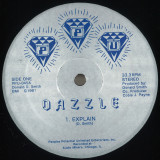
Dazzle rolled deep. Very deep. In the 1980s, it wasn't unusual for the Milwaukee-based group to show up at various Midwest night clubs in a caravan of 30-40 cars and vans. Their live following was hard won over a career that spanned 20+ years, many line up changes, and a handful of project names. Friends, family, and fans made the journey with them weekend after weekend, a testimony to both the musical prowess of the group and the tight-knit community that they emerged from.
Donald Smith, band leader, was there the whole time - joined by many of his siblings and friends - first as founder of the Ghetto Players, a early 70's nine-piece which also included siblings Michael, Ronald, and Charles. They played hard funk in the style of early Kool and the Gang, and although they sadly left no recordings, the strength of their live act managed to catch the eye of local Milwaukee R&B music entrepreneur Cobie Joe Payne. Cobie had made a couple of records locally in the early/mid 70s as a singer, including the impossibly weird and amazing rare afro-blues-funk 45 "Sweet Thing", but had never enjoyed national success. When the Ghetto Players disbanded in the early-mid 70s, Donald soon put together a new group, C on the Funk (the 'C' referring to lead vocalist and sibling Charles), under Payne's tutelage. Sister Lorrie Smith came in as the drummer, the line-up being fleshed out by brothers David and Melvin Johnson, and friend Robert Mitchell. After a few years as a strictly live attraction, they drove to Chicago and produced a single, "In the Disco" / "A Place" for Payne's small record label Sweet Thang Records in 1980. Lacking the financial backing needed to supply the local R&B disk jockey's "promotional fees" , this single sadly languished in obscurity, gathering dust inside the local tavern jukeboxes and manilla promo envelopes that comprised Payne's DIY distribution network.
C on the Funk were traveling the Mid West extensively at this point, and making some important friends on the road. Ike Wiley Jr. of the Dazz Band/Kinsman Dazz took particular interest and the band was re-christened Dazzle, partially as a tie-in with Dazz, partially to embrace the new sounds that would distinguish the 70s disco scene from what record collectors and DJs would now refer to as the "Boogie" era. There no doubt was a stigma attached to the word "Disco" as the eighties began, and as we see in this collection C On the Funk's "In the Disco" is remixed and transformed into the psychedelic synth instrumental of Dazzle's "Disco's Out", a title which embodies both the next-step approach Smith and company were pushing for, and humorously comments on the state of black dance music in the early 1980s. The Dazzle recording, done in Chicago in 1982, updated the sound and featured an expanded line up, most notably a second synth player (Charles Washington), and a percussionist/second lead vocalist (Greg McDonald). The added synth textures and deep percussive grooves give the Dazzle recordings an elegant late night vibe that resonate just as well in a good pair of headphones as they do on the dance floor. The trance inducing cough syrup-warble of "Explain" may best exemplify this here. Sadly, a pressing flaw in the 12" halted production and promotion, and the EP and the songs within were lost to the ages. The group, having done a much better line in the live music business, followed that path instead all the way to the early 90s. --bio provided by andy noble
Christian Thielemann&Wiener Philharmoniker
Neujahrskonzert 2024 / New Year's Concert 2024 / Concert du...
- A1: Erzherzog Albrecht-Marsch, Op. 136 3:03
- A2: Wiener Bonbons, Walzer, Op. 307 9:47
- A3: Figaro-Polka, Op. 320 4:14
- B1: Für Die Ganze Welt, Walzer 7:03
- B2: Ohne Bremse, Polka Schnell, Op. 238 2:18
- B3: Waldmeister: Ouvertüre 10:13
- C1: Ischler Walzer 7:55
- C2: Nachtigall-Polka, Op. 222 4:08
- C3: Die Hochquelle, Polka Mazur, Op. 114 4:42
- D1: Neue Pizzicato-Polka, Op. 449 3:39
- D2: Estudiantina-Polka 1:56
- D3: Wiener Bürger, Walzer, Op. 419 6:51
- E1: Quadrille, Wab 121 (Arr. For Orchestra By Wolfgang Dörner) 5:41
- E2: Glædeligt Nytaar! 2:05
- E3: Delirien, Walzer, Op. 212 9:06
- F1: Jockey-Polka, Op. 278 1:42
- F2: Neujahrsgruß / New Year's Address / Allocution Du Nouvel An 1:12
- F3: An Der Schönen Blauen Donau, Walzer, Op. 314 9:46
- F4: Radetzky-Marsch, Op. 228 3:52
Kein anderes Konzert wird auf der ganzen Welt mit so viel Spannung erwartet wie das alljährliche Neujahrskonzert aus Wien. In diesem Jahr wird das Mega-Klassik-Event in über 90 Länder übertragen und von mehreren Millionen Menschen verfolgt.Am Pult des Neujahrskonzerts 2024 steht Christian Thielemann, Chefdirigent der Sächsischen Staatskapelle Dresden und künftiger Nachfolger von Daniel Barenboim an der Berliner Staatsoper Unter den Linden. Thielemann ist den Wiener Philharmonikern seit dem Jahre 2000 musikalisch eng verbunden, und 2019 leitete er erstmals eines ihrer Neujahrskonzerte. Darüber hinaus dirigiert er das Orchester regelmäßig in Abonnementkonzerten im Wiener Musikverein, bei den Salzburger Festspielen sowie auf Tourneen in Japan, China, Europa und den USA. Nach der Referenz-Einspielung eines gemeinsamen Zyklus sämtlicher Beethoven-Symphonien begannen die Wiener Philharmoniker und Christian Thielemann noch während der Pandemie mit der Arbeit an einer Gesamtaufnahme der Symphonien von Anton Bruckner, die im Oktober 2023 bei Sony Classical erschien.Bruckner wird auch im Neujahrskonzert 2024 mit einer dortigen Erstaufführung seiner Quadrille op. 212 geehrt.
The Rock & Roll classic Whole Lotta Shakin’ Goin’ On, originally appeared as the Bside of Jerry Lee’s second Sun single, It’ll Be Me, but Disc Jockeys and audiences went crazy for it. It would always be associated with the swaggering Jerry Lee Lewis, as would the follow-up… In early 1958, Great Balls Of Fire reached No.1 in the U.K. charts.
For these two songs alone, Jerry Lee was cemented into music history. And for all his appreciation of other styles of music, it is as a pure, first-generation, Rock & Roll legend that Jerry Lee will be remembered. You can hear why on this collection as he pounds out Good Golly Miss Molly… Breathless… and Sweet Little Sixteen. Not forgetting his love of Country music and the songwriting genius of Hank Williams, Jerry Lee covered Hank’s You Win Again and Cold Cold Heart.
INTRODUCING OAKS23, FROM HAVEN'S LABEL BOSS KEEPSAKES. AFTER YEARS OF PLAYING HIS RECORDS, I AM PROUD TO INTRODUCE THIS SPECIAL RELEASE FROM HIM. IT DIVERGES FROM HIS USUAL INDUSTRIAL CONTEXT AND BRINGING IT MORE TO THE OAKS STYLE, SURE WEAPON FOR DISC-JOCKEYS.
EXPLORING NEW DIMENSIONS TO HIS SOUNDS WITH A FOCUS ON FUNK AND GROOVE, SPRINKLES OF EUPHORIA, ZANY ACID AND HIS USUAL DARK ATMOSPHERES.
It’s quite amazing that in a world that has become increasingly digital and where ‘stuff’ has become invisible, vinyl has made such a spectacular comeback.
Yet it is very likely also one of the main reasons for its resurgence. People like to collect. The physical aspect of playing a record adds to the listening experience and creates memories.
An album can take you back to an important time or place. And buying a new record is a great way of supporting a favorite artist and their label. That’s also the reason why new generations of music lovers have embraced vinyl.
This new edition of Passion for Vinyl tells these stories. It’s about the records that inspire people. The way they shaped their lives. How they sparked them to pick up an instrument,
become a DJ, or start a label, pressing plant or YouTube channel.
Passion for Vinyl features exclusive interviews with Blue Note recording artist Gregory Porter, CEO of Linn Gilad Tiefenbrun, Bettina Richards of Thrill Jockey Records,
YouTube personality Melinda Murphy, Beggars Group US president Nabil Ayers, Ben Blackwell of Third Man Records, Classic Album Sundays’ Colleen ‘Cosmo’ Murphy,
Liz Dunster of Erika Records, Robert Trujillo of Metallica, DJ, collector and label owner Gilles Peterson, Jenn D’Eugenio of Gold Rush Vinyl and Women in Vinyl,
Bad Seed member Warren Ellis, Paulo Jr. of Sepultura, Chad Kassem of Acoustic Sounds, and many others.
This book offers close to 30 interviews with a very diverse cast of characters. They have in common a deep love of music.
Passion for Vinyl shares the unique experience of making, buying, collecting, and enjoying vinyl. Its purpose is to inspire.
Passion for Vinyl is written by the Dutch author, music journalist, audiophile, and vinyl collector Robert Haagsma.
Over the course of 20 years, German artist Black To Comm (Marc Richter) has pushed the limits of / and merged the aesthetics of art, conceptual installations, and music, coming in a wave of innovation alongside his peers Pita, Fennesz, and later Sarah Davachi to name a few. Through it all Richter as Black to Comm has challenged assumptions, explored identity, and confronted the concept of authorship itself. At Zeenath Parallel Heavens finds Black to Comm contemplating the hybridity within each and every one of us, be it sexual, racial, cultural, or linguistic. Richter mirrors personal dualities musically with a combination of sounds he created and manipulated samples, blurring their boundaries. "I always try to blur the line between sampling and my own recordings, also between "real" instruments,MIDI, electronics, editing, between authenticity and theatrics/artificiality," says Richter. When recording he became aware of how AI text programs processing resembles his own methods. "I had the realization recently that the way I compose is not too dissimilar to what AI software is doing nowadays - especially when the AI is hallucinating (this is the term used when the AI is overloaded/overcharged/inundated and comes up with made-up results)." Human behavior reflected in a computer facsimile of human intelligence appealed to the ethos of Black to Comm, whose titles and concepts are often oblique and tongue-in-cheek.