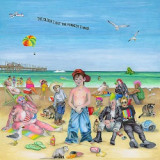
The Older I Get, the Funnier I Was, which follows Thomas’ brilliant 2020 HBO special The Golden One and his Can't Believe You're Happy Here EP released earlier this year, surveys a range of emotion and offers a broad sonic palette, moving between pop punk, electro, and the obvious influence of the singer-songwriters he grew up listening to in early childhood. It conjures the ennui of Bright Eyes alongside the barefaced storytelling of John Prine, the overstuffed lists of Fred Thomas with the lackadaisical humor of Colleen Green, among many others.
Thomas attributes the dexterity of the record to Duterte, who recorded and engineered most of it in addition to serving up plenty of encouragement when Thomas got down on the process. “As a comic, I used to test out new songs during sets to see if the funny bits were hitting, but since I wrote this in isolation I ended up writing lyrics and worrying less about making jokes,” Thomas says. That said, the album’s plenty funny. Stand-out and lead single “Rigamarole” opens with a Thomas-voiced infomercial that recalls his oft-cited lookalike Jim Carrey as the Grinch, before launching into a buoyant pop song about being depressed.
Whitmer Thomas will admit that when he traveled home to small town Gulf Shores, Alabama to record his HBO stand-up special, The Golden One, he expected to be greeted as a returning hero, a conquering king, or at minimum, a guy with a moderately successful career as an entertainer in Los Angeles. “I expected a big welcome home, open arms, but when I went back I realized: nobody fucking knows me. Nobody remembers me,” Thomas says. “In the years I’d been performing that show, I’d been romanticizing my childhood in this mythologized place, but the visit made me see that I’m not really from there anymore.”
The sense of alienation compounded when Thomas recognized how few people in town remembered his mom, to whom The Golden One is dedicated and largely about. Thomas grew up watching her perform with her twin sister at the legendary Flora-Bama Lounge, where he set the special, and still counts her as one of his musical influences. His new album, The Older I Get, the Funnier I Was, isn’t overtly about his mom, her presence is deeply felt throughout. While in Gulf Shores, Thomas discovered dozens of her old recordings, all of which had been wrecked by Katrina, but upon returning to LA, Thomas paid “a fancy place in Hollywood” to fix the tapes and hired Melina Duterte (Jay Som, Bachelor, Routine) to mix them. The two struck up a collaborative friendship, and Thomas had the sound of his mom’s voice back. “I was listening to songs she recorded when she was about my age, just these heartfelt, sweet Americana songs,” he says. “I decided then that I wanted to lose the Ian Curtis voice I always sing with; I wanted to do what came naturally, because my mom always sounded like herself, even when she was singing some cheesy reggae song about, like, Jamaica.”
Thus he went into The Older I Get, the Funnier I Was knowing it was time to retire his darkwave persona, and leaning into his natural, chirpier voice, which he says sounds “like a 12-year-old’s.” It makes sense: much of the album chronicles what Thomas calls “being a kid and feeling like you have no control and overcompensating by being annoying.” “So much of the album is about witnessing drug and alcohol addiction as a kid and seeing what it does to people, but also realizing that there's nothing you can do about it,” Thomas says. It’s familiar territory (see: “Partied to Death”) but the methodology is different this time around; true to its title, The Older I Get, the Funnier I Was isn’t always looking for laughs. Thomas might’ve left his hometown behind, but his kid self is still tagging along, a Peter Pan shadow he can’t untether himself from. The first line he sings on The Older I Get, the Funnier I Was is: “There should be a room at every party where you can just sit and watch a movie.” Find a 12-year-old who wouldn’t say the same.
quête:john b
RUBY THE HATCHET liefern mit "Fear Is a Cruel Master" genau das siedend heiße, eingängige und doch voller roher Energie steckende Killer-Album ab, das sein gefeierter Vorgänger "Planetary Space Child" (2017) versprochen hatte. Fünf lange Jahre hat sich die amerikanische Psych Rock Truppe aus New Jersey nach der Veröffentlichung ihrer letzten Scheibe Zeit gelassen, aber das sehnsüchtige Warten hat endlich ein Ende. RUBY THE HATCHET haben in ihrem kollektiven Songwriting einen neuen Gipfel erklommen. Dies hat sich die Ausnahmetruppe durch zahlreiche Opfer sowie einen eisernen Willen, sich erneut zu steigern, hart erkämpft. Der Albumtitel "Fear Is a Cruel Master" spiegelt die Stimmung der Zeit, in der die neuen Songs geschrieben wurden, perfekt wider. Sängerin Jill Taylor, Gitarrist Johnny Scarps, Schlagzeuger Owen Stewart, Bassist Lake Muir und Organist Sean Hur hatten sich längst daran gewöhnt, als Gruppe zusammenzuarbeiten. Doch während der Arbeit am neuen Album konnten sie nur wenig Zeit miteinander verbringen. "Ich habe während der Pandemie viel gelesen und bin dabei auf den Satz 'Angst ist ein grausamer Meister' "Fear Is a Cruel Master" gestoßen", erklärt Taylor. "In dieser Zeit wurde die Angst sichtbar und wie sie die Menschen zurückhielt. Der Titel hat einen Bezug zur Musikbranche, denn alle waren verunsichert - von den Bands über die Booking-Agenten bis hin zu den Clubs. Angst lag in der Luft". "Fear Is a Cruel Master" wurde zusammen mit Paul Ritchie (THE PARLOR MOB) im New Future in New Jersey aufgenommen und war nicht so akribisch durchgeplant wie RUBYs vorherige Alben. Die Band ließ bewusst mehr Spielraum für Spontaneität und magische Momente. Das Hauptthema von "Fear Is a Cruel Master" ist letztlich die Selbstreflexion. Obwohl die neuen Songs im Schmelztiegel einer weltumspannenden Pestilenz geschmiedet wurden, besitzen sie doch eine Zeitlosigkeit, die weit über den Moment ihrer Entstehung hinausreicht. Alles, was RUBY THE HATCHET zu einem so herausragenden und selbst bei ihren Kollegen äußersten beliebten Act macht, findet sich auf diesem Album - von Jills üppigem Gesang voll rauchigem Honig, über die psychedelischen, aber dennoch knackigen Gitarren, bis hin zum Spirit der Rock'n'Roll-Orgelhelden. "Fear Is a Cruel Master" ist definitiv ein Album, das von einer Band geschrieben wurde, die nach einem Jahrzehnt ohne Bedauern auf all die Momente zurückblickt, die sie gelebt oder nicht durchlebt hat. "Fear Is a Cruel Master" ist sowohl Ergebnis als auch Zeugnis dieser Reise. Es ist Zeit, sich auf den Weg zu machen, um RUBY THE HATCHET in ihrem ebenso beeindruckenden wie mächtigen klanglichen Kielwasser zu folgen.
We Jazz Records presents the second volume of their reworks albums dealing with source material from the Helsinki-based label's catalog. This time around, it's Carl Stone's turn to tackle the source albums at hand and filter the label's output through his musical lens.
We Jazz Reworks is an idea that repurposes some of the label's output 10 albums at a time. That is, the label invites producers whose music they love on board, and one by one, they tackle 10 albums worth of source material, of which they are free to use as much or as little as they choose. The series evolves chronologically, so this volume being number two, the source material is pulled from We Jazz LPs numbers 11 through 20. The artist has complete freedom.
Volume 2 in the series happens with Carl Stone, a legendary figure in creative music. His career spans decades of unlimited musical innovation. Stone's recent output on Unseen Worlds, the label who has also been instrumental in issuing some of his remarkable earlier work, ranks among the most original art of our time and renders notions such as "genre" virtually meaningless.
Here, We Jazz originals by Terkel Nørgaard, OK:KO, Jonah Parzen-Johnson and more are met here with a fresh sense of discovery, spun around and delivered ready for the turntable once again.
Carl Stone says:
"It was wonderful that We Jazz gave me carte blanche to work with any materials from the set of ten releases in its catalog. This freedom to work with everything could have been a mixed blessing though, as it could be a challenge to try to deal with so much musical information. In the end I did what I almost always do: Let my intuition be my guide and to seize upon any musical items that seemed to fit into an overall approach."
"To make a new piece I usually start with an extended period of what really is just playing, the way a child plays with toys. Experimentation without necessary expectation, leading to (hopefully) discovery of things of musical interest, then figuring out a way to craft and shape these into a structured piece of music. Each track uses a different approach, which I found along the way during this play period."
This conceptual approach becomes complete with the design, in which album graphics are treated in a similar fashion, reworking what's there. This time around, the artwork is reinvented by Tuomo Parikka, a regular cover collage contributor for the We Jazz Magazine.
CURACAO BLUE TRANSPARENT VINYL, INSIDE OUT SLEEVE, OBI W/ LINER NOTES, PRINTED INNER SLEEVE WITH SOURCE ALBUM DESIGN REFLECTIONS.
- 1: Give It Up (Feat. J-Live)
- 2: Supa
- 3: Renaissance 2.0 (Feat. Hell Razah, Tragedy Khadafi, And Timbo King)
- 4: Windows Of The World (Feat. Ayatollah And Dynasty The Emp)
- 5: Uncommon Valor: A Vietnam Story (Feat. Jedi Mind Tricks)
- 6: Who's Dat Guy (Feat. Havoc Of Mobb Deep)
- 7: L.i.'s Finest
- 8: Stanley Kubrick
- 9: Cunt Renaissance (Feat. The Notorious B.i.g.)
- 10: 3 Kingz (Feat. Kool G Rap And Big John)
- 11: Smithhaven Mall
- 12: Posse Cut (Feat. Hell Razah, Jojo Pellegrino, Remedy, And Blaq Poet)
- 13: What The Fuck (Feat. Akinyele)
- 14: Poor People
- 15: 50,000 Heads (Feat. Sadat X)
- 16: Effin' Yo' Bitch
- 17: Every Record Label Sucks Dick
- 18: The Greatest (Feat. Marcella Puppini) (Bonus)
Reissue! Before the acclaimed albums "Legends Never Die" and "All My Heroes Are Dead" brought his career to new heights, R.A. The Rugged Man spent years as an underrated rap enigma, with a slew of storied records to his name that had never received a proper release.
With the 2009 compilation "Legendary Classics Vol. 1, R.A. finally unleashed many of the lost gems that earned him a reputation as one of hip-hop's most feared lyricists, showcasing his undeniable history.
An essential collection from a true hip-hop original, the album features appearances by The Notorious B.I.G., Havoc of Mobb Deep, Jedi Mind Tricks, Kool G Rap, J-Live, Hell Razah, Tragedy Khadafi, Akinyele, and Sadat X, along with track-by-track commentary from the Rugged Man himself. This "Legendary Classics Vol. 1" reissue also includes the new bonus track “The Greatest” featuring famed Italian singer Marcella Puppini, which has never before been available on vinyl.
Cassette[13,40 €]
‘Stumpwork’ is the follow-up to 2021’s ‘New Long Leg’. The
South London-based group’s first studio album, recorded in
just two weeks with producer John Parish at the iconic
Rockfield Studios, became a huge critical and commercial
success reaching #4 in the UK Album Charts and featuring in
Best Of 2021 polls across the board. Buoyed by its success,
Nick Buxton (drums), Tom Dowse (guitar), Lewis Maynard
(bass) and Florence Shaw (vocals) returned to rural Wales in
late 2021, partnering once more with Parish and engineer
Joe Jones. Working from a position of trust in the same
studio and with the same team, imposter syndrome and
anxiety was replaced by a fresh freedom and openness to
explore beyond an already rangy sonic palette, a newfound
confidence in their creative vision. A longer period in the
studio afforded the time to experiment, improvise, play,
sharpen their table tennis skills.
‘Stumpwork’ was inspired by a plethora of events, concepts,
and political debacles, be they represented in the icy mess of
ambient elements reflecting a certain existential despair, or
the surprising warmth in celebrating the lives of loved ones
lost through the previous year. Surrealist lyrics are as ever at
the forefront - but there is a sensitivity now to the themes of
family, money, politics, self-deprecation, and sensuality.
Furious alt-rock anthems combine across the record with
jangle pop and ambient noise, demonstrating the wealth of
influences the band feed off and their deep musicality. With
the pressure of their debut album behind them, Dry Cleaning
have crafted an ambitious and deeply rewarding new work
that marks them out as one of the most intelligent and
exciting acts to come out of the UK.
LP pressed on white vinyl.
White Vinyl LP[29,83 €]
‘Stumpwork’ is the follow-up to 2021’s ‘New Long Leg’. The
South London-based group’s first studio album, recorded in
just two weeks with producer John Parish at the iconic
Rockfield Studios, became a huge critical and commercial
success reaching #4 in the UK Album Charts and featuring in
Best Of 2021 polls across the board. Buoyed by its success,
Nick Buxton (drums), Tom Dowse (guitar), Lewis Maynard
(bass) and Florence Shaw (vocals) returned to rural Wales in
late 2021, partnering once more with Parish and engineer
Joe Jones. Working from a position of trust in the same
studio and with the same team, imposter syndrome and
anxiety was replaced by a fresh freedom and openness to
explore beyond an already rangy sonic palette, a newfound
confidence in their creative vision. A longer period in the
studio afforded the time to experiment, improvise, play,
sharpen their table tennis skills.
‘Stumpwork’ was inspired by a plethora of events, concepts,
and political debacles, be they represented in the icy mess of
ambient elements reflecting a certain existential despair, or
the surprising warmth in celebrating the lives of loved ones
lost through the previous year. Surrealist lyrics are as ever at
the forefront - but there is a sensitivity now to the themes of
family, money, politics, self-deprecation, and sensuality.
Furious alt-rock anthems combine across the record with
jangle pop and ambient noise, demonstrating the wealth of
influences the band feed off and their deep musicality. With
the pressure of their debut album behind them, Dry Cleaning
have crafted an ambitious and deeply rewarding new work
that marks them out as one of the most intelligent and
exciting acts to come out of the UK.
LP pressed on white vinyl.
From the dawn of doo-wop to the death of disco, the Notations saw_and sang_it all. Persisting through changing trends and technologies, on major labels and minor ones, produced by both Syl Johnson and Curtis Mayfield, nothing could stop the Notations from representing Chicago's Southside for decades. The first overview of their indie label golden age, Still Here 1967-1973 finds the Notations at a musical crossroads, turning from simmering R&B ballads to socially-conscious soul. Offering up a platter of golden-dipped harmonies, inventive arrangements, and super-powered soul, the Notations survived as unheralded legends in their own time.
- A1: Peter Maffay / Tabaluga Ouvertüre 2 26
- A2: Peter Maffay & Alexander Wesselsky / Tabaluga Es Ist Heiß 3 24
- A3: Peter Maffay / Tabaluga Die Menschlinge 2 58
- B1: Peter Maffay / Tabaluga Rock 'N' Roll 3 47
- B2: Peter Maffay Feat Stefanie Heinzmann / Tabaluga Elektrizität 3 19
- B3: Peter Maffay / Tabaluga Sieben Gründe Für Die Sonne 4 04
- C1: Peter Maffay / Tabaluga Ich Bin Der Wind 4 34
- C2: Peter Maffay / Tabaluga Ohne Wasser Gibt's Kein Leben 4 09
- C3: Peter Maffay / Tabaluga Engel Und Auch Teufel 3 56
- D1: Peter Maffay / Tabaluga Raumschiff Erde 4 04
- D2: Peter Maffay / Tabaluga Die Welt Ist Wunderbar 4 26
- D3: Peter Maffay Feat Stefanie Heinzmann / Tabaluga Königreich Der Liebe 4 09
2x12" Coloured Vinyl + 2CD + Book[60,97 €]
Doppel-LP, Coloured Vinyl in Tabaluga Grün. Gatefold."Wir schauen auf dieselbe Sonne und auf denselben Mond. Wir teilen uns dieselbe Erde, sind alle im selben Boot".So lauten die beiden ersten beiden Zeilen des Refrains von "Königreich der Liebe", der ersten Single aus dem neuen Drachenabenteueralbum "Tabaluga - Die Welt ist wunderbar". Zu mitreißend-anschwellendem, vielleicht ein bisschen an Elton Johns Hymne "Circle Of Life" erinnerndem Piano-Pop zeichnen Peter Maffay und seine Duett-Partnerin Stefanie Heinzmann (die hier ausnahmsweise auf Deutsch singt) in der kraftvollen Ballade das Bild von einer besseren Welt. "Es geht nicht um Farbe deiner Haut oder um das, woran du glaubst", heißt es in dem Lied weiter, und dann: "Komm, wir bauen ein Königreich mit Liebe auf dem Thron." Mit einer stärkeren Botschaft - und einem stärkeren Song - könnten die Feierlichkeiten zum vierzigsten Geburtstag des kleinen grünen Drachen kaum eingeläutet werden. 1983 erfand Peter Maffay die kindgerecht-kluge, wenngleich etwas stoffelige Figur zusammen mit Gregor Rottschalk, Rolf Zukowski und Helme Heine. Seither hat die liebenswerte Märchengestalt auf sechs Alben, mit zahlreichen Tourneen, einem Musical, einer Zeichentrickserie und einem Kinofilm immer wieder neue Generationen von Kindern und Eltern in Entzückung versetzt, aber auch zum Nachdenken gebracht.Denn Tabaluga steht für Unterhaltung mit einer klaren, positiven Botschaft. Auf dem neuen Album, so viel sei verraten, wird der ewige Drachenjunge zusammen mit seinen Freunden und der geballten Power der regenerativen Energien gegen die Klimakatastrophe antreten. Maßgeblich verstärkt wird Tabalugas Team erstmals von Lucy, einem schlauen, gemeinsam mit dem langjährigen Partner Volkswagen, entwickelten Glühwürmchen-Charakter. Tabaluga ist also definitiv so politisch relevant wie nie, und das, unterstreicht sein Mitschöpfer, sei auch dringend geboten. "Natürlich erzählen wir eine utopisch anmutende Geschichte", sagt Peter Maffay. "Aber zu dieser Utopie sehe ich keine Alternative. Wenn wir nicht mehr an die Zukunft glauben, dann geben wir uns selbst - und unsere Kinder - auf. Wir waren noch nie so gefordert, den Zusammenhalt zu stärken, wie jetzt".Für Peter Maffay (72) krönt das neue Tabaluga-Werk ein ereignisreiches Jahr. Am 18. August ist er erstmals im TV als neuer Juror bei "The Voice of Germany" zu sehen, und einen Tag zuvor startet - mit zwei Jahren Verspätung - endlich seine große Hallentournee.
“Micro tonal poetry” - Mats Gustafsson
'Its an honor for the AFJ-Series to introduce the self-titled debut album by Danish Oslo resident Signe Emmeluth. Recorded at Flerbruket, in the forest an hour outside of Oslo - Emmeluth alone in a room with her alto and tenor saxophones.
A fantastic session of sax solo ecstasies recorded by Magnus Hemnes Nergård. Much like Joe McPhee’s Tenor and Peter Brötzmann’s 14 Love Songs, this album share the same beautiful intimacy. It is close, sparse, poetic and raw at the same time. Minimalist and soulful free music.
Signe Emmeluth is a Danish saxophonist and composer educated by the Jazz Department in Trondheim and is currently based in Oslo. Emmeluth has recently become a rising star on the international scene for improvised music. She has her own quartet Emmeluth’s Amoeba and has worked with Trondheim Jazzorkester, John Edwards, Tony Buck, Paal Nilssen-Love, Mats Gustafsson and Mette Rasmussen to name a few.'
All music by Signe Emmeluth, except 'I’ll Be Seeing You' by Sammy Fain
Signe Emmeluth: alto saxophone, tenor saxophone, recorder and electronics
Recorded at Flerbruket, Hemnes (December 2020/January 2021)
Sound Engineer: Magnus Skavhaug Nergaard
Mix/Master: Lasse Marhaug
Artwork: Kim Hiorthøy
Tak til Karl, Magnus, Lasse og Joakim for hjælp og gode vibber
Rance Allen, from Monroe Michigan, with older brother Tom on drums and younger brother Steve on bass recorded their first record and won a talent contest in Detroit and were subsequently signed to Stax's Gospel Truth label in 1971. After four albums Rance signed to Capitol and made his most highly acclaimed album 'Say My Friend'. It was produced by the Mizell Brothers (responsible for iconic albums on Donald Byrd, Bobbi Humphrey, Gary Bartz and Johnny Hammond). 'Reason To Survive' and 'Peace Of Mind' were the two singles, and both these 7' versions have been impossible to find. Original copies are expensive and extremely sought after. Expansion can now deliver both A sides back to back remastered from the original tapes in all their glory. The full album is available on CD from Soul Brother Records.
- A1: Soul Children - Intro
- A2: Isaac Hayes - Ik'e Mood
- A3: Jackie Wilson - Light My Fire
- A4: Syl Johnson - Different Strokes
- A5: The Counts - Thinking Single
- A6: The Emotiions - Blind Alley
- B1: Camille Yarbrough - Take Yo' Praise
- B2: Linda Lyndell - What A Man
- B3: Lowell Fulson - Tramp
- B4: Googie Rene Combo - Smokey Joe's La La
- B5: Jean Jacques Perrey - Eva
- C1: The Blackbyrds - Rock Creek Park
- C2: Fatback Band - Got To Learn How To Dance
- C3: Pleasure - Bouncy Lady
- C4: Joe Simon - Drowning In The Sea Of Love
- D1: Cannonball Adderley - Walk Tall
- D2: Soul - Burning Spear
- D3: The Otis & Carla Band - Tramp
- D4: The Pazant Bros - Chick A Boom
- D5: The Detroit Emeralds - Baby Let You Take You (In My Arms) (In My Arms)
- A1: Rock This Mother
- A2: Talk To Me Girl
- A3: You Can Find Me
- A4: Check This Out
- A5: Jesus Going To Clean House
- A6: Hope You Understood
- A7: Is It What You Want
- A8: Love Is Everlasting
- A9: This Is Hip-Hop Art
- A10: Opposite Of Love
- A11: Do You Know What I Mean
- B1: Saving All My Love For You
- B2: Look Out Here I Come
- B3: Girl You Always Talking
- B4: Have A Great Day
- B5: Take My Hand
- B6: I Need Your Love
- B7: Your Town
- B8: Talk Around Town
- B9: Booty Head/Take A Little Walk
- B10: I Love My Mama
- B11: I Never Found Anyone Like You
Vinyl LP[23,49 €]
As the sun sets on a quaint East Nashville house, a young man bares a piece of his soul. Facing the camera, sporting a silky suit jacket/shirt/slacks/fingerless gloves ensemble that announces "singer" before he's even opened his mouth, Lee Tracy Johnson settles onto his stage, the front yard. He sways to the dirge-like drum machine pulse of a synth-soaked slow jam, extends his arms as if gaining his balance, and croons in affecting, fragile earnest, "I need your love… oh baby…"
Dogs in the yard next door begin barking. A mysterious cardboard robot figure, beamed in from galaxies unknown and affixed to a tree, is less vocal. Lee doesn't acknowledge either's presence. He's busy feeling it, arms and hands gesticulating. His voice rises in falsetto over the now-quiet dogs, over the ambient noise from the street that seeps into the handheld camcorder's microphone, over the recording of his own voice played back from a boombox off-camera. After six minutes the single, continuous shot ends. In this intimate creative universe there are no re-takes. There are many more music videos to shoot, and as Lee later puts it, "The first time you do it is actually the best. Because you can never get that again. You expressing yourself from within."
"I Need Your Love" dates from a lost heyday. From some time in the '80s or early '90s, when Lee Tracy (as he was known in performance) and his music partner/producer/manager Isaac Manning committed hours upon hours of their sonic and visual ideas to tape. Embracing drum machines and synthesizers – electronics that made their personal futurism palpable – they recorded exclusively at home, live in a room into a simple cassette deck. Soul, funk, electro and new wave informed their songs, yet Lee and Isaac eschewed the confinement of conventional categories and genres, preferring to let experimentation guide them.
"Anytime somebody put out a new record they had the same instruments or the same sound," explains Isaac. "So I basically wanted to find something that's really gonna stand out away from all of the rest of 'em." Their ethos meant that every idea they came up with was at least worth trying: echoed out half-rapped exhortations over frantic techno-style beats, gospel synth soul, modal electro-funk, oddball pop reinterpretations, emo AOR balladry, nods to Prince and the Fat Boys, or arrangements that might collapse mid-song into a mess of arcade game-ish blips before rallying to reach the finish line. All of it conjoined by consistent tape hiss, and most vitally, Lee's chameleonic voice, which managed to wildly shape shift and still evoke something sincere – whether toggling between falsetto and tenor exalting Jesus's return, or punctuating a melismatic romantic adlib with a succinct, "We all know how it feels to be alone."
"People think we went to a studio," says Isaac derisively. "We never went to no studio. We didn't have the money to go to no studio! We did this stuff at home. I shot videos in my front yard with whatever we could to get things together." Sometimes Isaac would just put on an instrumental record, be it "Planet Rock" or "Don't Cry For Me Argentina" (from Evita), press "record," and let Lee improvise over it, yielding peculiar love songs, would-be patriotic anthems, or Elvis Presley or Marilyn Monroe tributes. Technical limitations and a lack of professional polish never dissuaded them. They believed they were onto something.
"That struggle," Isaac says, "made that sound sound good to me."
In the parlance of modern music criticism Lee and Isaac's dizzying DIY efforts would inevitably be described as "outsider." But "outsider" carries the burden of untold additional layers of meaning if you're Black and from the South, creating on a budget, and trying to get someone, anyone within the country music capital of the world to take your vision seriously. "What category should we put it in?" Isaac asks rhetorically. "I don't know. All I know is feeling. I ain't gonna name it nothing. It's music. If it grabs your soul and touch your heart that's what it basically is supposed to do."
=
Born in 1963, the baby boy of nine siblings, Lee Tracy spent his earliest years living amidst the shotgun houses on Nashville's south side. "We was poor, man!" he says, recalling the outhouse his family used for a bathroom and the blocks of ice they kept in the kitchen to chill perishables. "But I actually don't think I really realized I was in poverty until I got grown and started thinking about it." Lee's mom worked at the Holiday Inn; his dad did whatever he had to do, from selling fruit from a horse drawn cart to bootlegging. "We didn't have much," Lee continues, "but my mother and my father got us the things we needed, the clothes on our back." By the end of the decade with the city's urban renewal programs razing entire neighborhoods to accommodate construction of the Interstate, the family moved to Edgehill Projects. Lee remembers music and art as a constant source of inspiration for he and his brothers and sisters – especially after seeing the Jackson 5 perform on Ed Sullivan. "As a small child I just knew that was what I wanted to do."
His older brother Don began musically mentoring him, introducing Lee to a variety of instruments and sounds. "He would never play one particular type of music, like R&B," says Lee. "I was surrounded by jazz, hard rock and roll, easy listening, gospel, reggae, country music; I mean I was a sponge absorbing all of that." Lee taught himself to play drums by beating on cardboard boxes, gaining a rep around the way for his timekeeping, and his singing voice. Emulating his favorites, Earth Wind & Fire and Cameo, he formed groups with other kids with era-evocative band names like Concept and TNT Connection, and emerged as the leader of disciplined rehearsals. "I made them practice," says Lee. "We practiced and practiced and practiced. Because I wanted that perfection." By high school the most accomplished of these bands would take top prize in a prominent local talent show. It was a big moment for Lee, and he felt ready to take things to the next level. But his band-mates had other ideas.
"I don't know what happened," he says, still miffed at the memory. "It must have blew they mind after we won and people started showing notice, because it's like everybody quit! I was like, where the hell did everybody go?" Lee had always made a point of interrogating prospective musicians about their intentions before joining his groups: were they really serious or just looking for a way to pick up girls? Now he understood even more the importance of finding a collaborator just as committed to the music as he was.
=
Isaac Manning had spent much of his life immersed in music and the arts – singing in the church choir with his family on Nashville's north side, writing, painting, dancing, and working various gigs within the entertainment industry. After serving in the armed forces, in the early '70s he ran The Teenage Place, a music and performance venue that catered to the local youth. But he was forced out of town when word of one of his recreational routines created a stir beyond the safe haven of his bohemian circles.
"I was growing marijuana," Isaac explains. "It wasn't no business, I was smoking it myself… I would put marijuana in scrambled eggs, cornbread and stuff." His weed use originated as a form of self-medication to combat severe tooth pain. But when he began sharing it with some of the other young people he hung out with, some of who just so happened to be the kids of Nashville politicians, the cops came calling. "When I got busted," he remembers, "they were talking about how they were gonna get rid of me because they didn't want me saying nothing about they children because of the politics and stuff. So I got my family, took two raggedy cars, and left Nashville and went to Vegas."
Out in the desert, Isaac happened to meet Chubby Checker of "The Twist" fame while the singer was gigging at The Flamingo. Impressed by Isaac's zeal, Checker invited him to go on the road with him as his tour manager/roadie/valet. The experience gave Isaac a window into a part of the entertainment world he'd never encountered – a glimpse of what a true pop act's audience looked like. "Chubby Checker, none of his shows were played for Black folks," he remembers. "All his gigs were done at high-class white people areas." Returning home after a few years with Chubby, Isaac was properly motivated to make it in Music City. He began writing songs and scouting around Nashville for local talent anywhere he could find it with an expressed goal: "Find someone who can deliver your songs the way you want 'em delivered and make people feel what you want them to feel."
One day while walking through Edgehill Projects Isaac heard someone playing the drums in a way that made him stop and take notice. "The music was so tight, just the drums made me feel like, oh I'm-a find this person," he recalls. "So I circled through the projects until I found who it was.
"That's how I met him – Lee Tracy. When I found him and he started singing and stuff, I said, ohhh, this is somebody different."
=
Theirs was a true complementary partnership: young Lee possessed the raw talent, the older Isaac the belief. "He's really the only one besides my brother and my family that really seen the potential in me," says Lee. "He made me see that I could do it."
Isaac long being a night owl, his house also made for a fertile collaborative environment – a space where there always seemed to be a new piece of his visual art on display: paintings, illustrations, and dolls and figures (including an enigmatic cardboard robot). Lee and Issac would hang out together and talk, listen to music, conjure ideas, and smoke the herb Isaac had resumed growing in his yard. "It got to where I could trust him, he could trust me," Isaac says of their bond. They also worked together for hours on drawings, spreading larges rolls of paper on the walls and sketching faces with abstract patterns and imagery: alien-like beings, tri-horned horse heads, inverted Janus-like characters where one visage blurred into the other.
Soon it became apparent that they didn't need other collaborators; self-sufficiency was the natural way forward. At Isaac's behest Lee, already fed up with dealing with band musicians, began playing around with a poly-sonic Yamaha keyboard at the local music store. "It had everything on it – trumpet, bass, drums, organ," remembers Lee. "And that's when I started recording my own stuff."
The technology afforded Lee the flexibility and independence he craved, setting him on a path other bedroom musicians and producers around the world were simultaneously following through the '80s into the early '90s. Saving up money from day jobs, he eventually supplemented the Yamaha Isaac had gotten him with Roland and Casio drum machines and a Moog. Lee was living in an apartment in Hillside at that point caring for his dad, who'd been partially paralyzed since early in life. In the evenings up in his second floor room, the music put him in a zone where he could tune out everything and lose himself in his ideas.
"Oh I loved it," he recalls. "I would really experiment with the instruments and use a lot of different sound effects. I was looking for something nobody else had. I wanted something totally different. And once I found the sound I was looking for, I would just smoke me a good joint and just let it go, hit the record button." More potent a creative stimulant than even Isaac's weed was the holistic flow and spontaneity of recording. Between sessions at Isaac's place and Lee's apartment, their volume of output quickly ballooned.
"We was always recording," says Lee. "That's why we have so much music. Even when I went to Isaac's and we start creating, I get home, my mind is racing, I gotta start creating, creating, creating. I remember there were times when I took a 90-minute tape from front to back and just filled it up."
"We never practiced," says Isaac. "See, that was just so odd about the whole thing. I could relate to him, and tell him about the songs I had ideas for and everything and stuff. And then he would bring it back or whatever, and we'd get together and put it down." Once the taskmaster hell bent on rehearsing, Lee had flipped a full 180. Perfection was no longer an aspiration, but the enemy of inspiration.
"I seen where practicing and practicing got me," says Lee. "A lot of musicians you get to playing and they gotta stop, they have to analyze the music. But while you analyzing you losing a lot of the greatness of what you creating. Stop analyzing what you play, just play! And it'll all take shape."
=
"I hope you understood the beginning of the record because this was invented from a dream I had today… (You tell me, I'll tell you, we'll figure it out together)" – Lee Tracy and Isaac Manning, "Hope You Understand"
Lee lets loose a maniacal cackle when he acknowledges that the material that he and Isaac recorded was by anyone's estimation pretty out there. It's the same laugh that commences "Hope You Understand" – a chaotic transmission that encapsulates the duality at the heart of their music: a stated desire to reach people and a compulsion to go as leftfield as they saw fit.
"We just did it," says Lee. "We cut the music on and cut loose. I don't sit around and write. I do it by listening, get a feeling, play the music, and the lyrics and stuff just come out of me."
The approach proved adaptable to interpreting other artists' material. While recording a cover of Whitney Houston's pop ballad "Saving All My Love For You," Lee played Whitney's version in his headphones as he laid down his own vocals – partially following the lyrics, partially using them as a departure point. The end result is barely recognizable compared with the original, Lee and Isaac having switched up the time signature and reinvented the melody along the way towards morphing a slick mainstream radio standard into something that sounds solely their own.
"I really used that song to get me started," says Lee. "Then I said, well I need something else, something is missing. Something just came over me. That's when I came up with 'Is It What You Want.'"
The song would become the centerpiece of Lee and Isaac's repertoire. Pushed along by a percolating metronomic Rhythm King style beat somewhere between a military march and a samba, "Is It What You Want" finds Lee pleading the sincerity of his commitment to a potential love interest embellished by vocal tics and hiccups subtlely reminiscent of his childhood hero MJ. Absent chord changes, only synth riffs gliding in and out like apparitions, the song achieves a lingering lo-fi power that leaves you feeling like it's still playing, somewhere, even after the fade out.
"I don't know, it's like a real spiritual song," Lee reflects. "But it's not just spiritual. To me the more I listen to it it's like about everything that you do in your everyday life, period. Is it what you want? Do you want a car or you don't want a car? Do you want Jesus or do you want the Devil? It's basically asking you the question. Can't nobody answer the question but you yourself."
In 1989 Lee won a lawsuit stemming from injuries sustained from a fight he'd gotten into. He took part of the settlement money and with Isaac pressed up "Saving All My Love For You" b/w "Is It What You Want" as a 45 single. Isaac christened the label One Chance Records. "Because that's all we wanted," he says with a laugh, "one chance."
Isaac sent the record out to radio stations and major labels, hoping for it to make enough noise to get picked up nationally. But the response he and Lee were hoping for never materialized. According to Isaac the closest the single got to getting played on the radio is when a disk jock from a local station made a highly unusual announcement on air: "The dude said on the radio, 107.5 – 'We are not gonna play 'Is It What You Want.' We cracked up! Wow, that's deep.
"It was a whole racist thing that was going on," he reflects. "So we just looked over and kept on going. That was it. That was about the way it goes… If you were Black and you were living in Nashville and stuff, that's the way you got treated." Isaac already knew as much from all the times he'd brought he and Lee's tapes (even their cache of country music tunes) over to Music Row to try to drum up interest to no avail.
"Isaac, he really worked his ass off," says Lee. "He probably been to every record place down on Music Row." Nashville's famed recording and music business corridor wasn't but a few blocks from where Lee grew up. Close enough, he remembers, for him to ride his bike along its back alleys and stumble upon the occasional random treasure, like a discarded box of harmonicas. Getting in through the front door, however, still felt a world away.
"I just don't think at the time our music fell into a category for them," he concedes. "It was before its time."
=
Lee stopped making music some time in the latter part of the '90s, around the time his mom passed away and life became increasingly tough to manage. "When my mother died I had a nervous breakdown," he says, "So I shut down for a long time. I was in such a sadness frame of mind. That's why nobody seen me. I had just disappeared off the map." He fell out of touch with Isaac, and in an indication of just how bad things had gotten for him, lost track of all the recordings they'd made together. Music became a distant memory.
Fortunately, Isaac kept the faith. In a self-published collection of his poetry – paeans to some of his favorite entertainment and public figures entitled Friends and Dick Clark – he'd written that he believed "music has a life of its own." But his prescience and presence of mind were truly manifested in the fact that he kept an archive of he and Lee's work. As perfectly imperfect as "Is It What You Want" now sounds in a post-Personal Space world, Lee and Isaac's lone official release was in fact just a taste. The bulk of the Is It What You Want album is culled from the pair's essentially unheard home recordings – complete songs, half-realized experiments, Isaac's blue monologues and pronouncements et al – compiled, mixed and programmed in the loose and impulsive creative spirit of their regular get-togethers from decades ago. The rest of us, it seems, may have finally caught up to them.
On the prospect of at long last reaching a wider audience, Isaac says simply, "I been trying for a long time, it feels good." Ever the survivor, he adds, "The only way I know how to make it to the top is to keep climbing. If one leg break on the ladder, hey, you gotta fix it and keep on going… That's where I be at. I'll kill death to make it out there."
For Lee it all feels akin to a personal resurrection: "It's like I was in a tomb and the tomb was opened and I'm back… Man, it feels so great. I feel like I'm gonna jump out of my skin." Success at this stage of his life, he realizes, probably means something different than what it did back when he was singing and dancing in Isaac's front yard. "What I really mean by 'making it,'" he explains isn't just the music being heard but, "the story being told."
Occasionally Lee will pull up "Is It What You Want" on YouTube on his phone, put on his headphones, and listen. He remembers the first time he heard his recorded voice. How surreal it was, how he thought to himself, "Is that really me?" What would he say to that younger version of himself now?
"I would probably tell myself, hang in there, don't give up. Keep striving for the goal. And everything will work out."
Despite what's printed on the record label, sometimes you do get more than one chance.
- A1: Science (Intro)
- A2: Flashlight
- A3: Birth Night
- A4: Fire
- A5: Darkness Bout Ya (Flashlight Ii)
- A6: Shit Hot
- A7: All John Travolta
- A8: Nuff Imports
- A9: Chillin In The Morning
- A10: Pure Niceness (Flashlight Iii)
- A11: Shockout Business
- A12: Pure Wicked Tune
- A13: Work To Do
- A14: Sweetback (No Poll Tax)
- A15: Canning Town Posse
- A16: Hello Stranger (Flashlight Iv)
- A17: Special Birthday Request (Find A Partner)
- A18: Set Speed Operator
- A19: For All Those Who Never Hear It Proper (Outro Chop)
Pure Wicked Tune is a mixtape-style collection of extracts & cut-ups, taken from DIY cassette recordings featuring rare groove and "soul blues" soundsystems playing at early morning house parties and blues dances - mostly in South & East London - between the mid 1980s & early 90s.
Sounds like Funkadelic, Touch of Class, Latest Edition, JB Crew, Manhattan, 5th Avenue (and the many more featured on this tape) originally began to form in the mid-1980s. With lovers rock dwindling, and the reggae scene becoming dominated by harder digital-style dancehall, these sounds provided a tight but loyal crowd with a potent alternative - playing a mixture of killer rare soul, funk and boogie records in an inimitably reggae soundsystem style, complete with toasting, sirens and effects aplenty.
They were most well-known for playing at house parties and blues dances, typically in small flats or warehouses, with timing of such events generally running from the early morning hours until late the next afternoon. Though the popularity of the sounds faded following the dance music explosion of the early 1990s, there has been continued demand for revival sessions ever since. Whilst the influence of key British reggae & dancehall soundsystems on subsequent UK sounds like hardcore & jungle is relatively well documented, a similar line can just as easily be drawn from these sounds and the aforementioned styles' tendency toward sampling popular rare groove cuts, particularly well evidenced in the work of Tom & Jerry, 4hero, Reinforced & LTJ Bukem among others.
This represents the first outing in a series of collections exploring the sounds of UK soundsystem culture, via extracts from archival DIY cassette recordings of blues parties, dances & clashes made between the late 70s and early 90s. Often duplicated and shared widely, these ruff and ready "sound tapes" provided keen ears with music that wasn't otherwise readily available on the airwaves or in the record shops, and would go on to leave a deeply-rooted but too often overlooked influence on the UK's musical landscape.
Canary Yellow vinyl[29,71 €]
Freedy Johnston is one of those rare singer-songwriters who counts
critics among his biggest fans — and whose heroes consider him a peer.
Not bad for a self-proclaimed "geek in glasses who never left his room."
Johnston's 9th album, 'Back on the Road to You' is a record steeped in
wit, humor, pathos, love, and friendship drenched with memorable,
infectious melodies
Johnston recorded the album in Los Angeles with producer Eric Corne after
setting up house in nearby Joshua Tree. The new surroundings seem to have
imbued the album's mood and instrumentation with echoes of The Byrds,
Jackson Browne, Joni Mitchell, and Neil Young. Joining Johnston in the studio
were Aimee Mann, Susanna Hoffs of The Bangles, and longtime collaborator,
Susan Cowsill, along with an all-star roots music band, including Doug Pettibone
(Lucinda Williams), Dusty Wakeman (Jim Lauderdale), Dave Raven (Shelby Lynn)
and Sasha Smith (Priscilla Ahn).In 1994 Rolling Stone named Johnston the
'Songwriter of the Year', describing him as "A master storyteller, (who) sketches
out full- blown tragedies in a few taut poetic lines." Adding, "He joins that elite
cadre of songwriters—Bob Dylan, Neil Young, Elvis Costello—whose brilliant pop
compositions turn magical with the addition of a defiantly idiosyncratic singing
voice."
'Back on the Road to You' is a return to grace for this gifted songwriter. It
embodies the sound of an American original reminding us that he is still
considered one of the best songwriters of his generation.
Black Vinyl[26,01 €]
Freedy Johnston is one of those rare singer-songwriters who counts
critics among his biggest fans — and whose heroes consider him a peer.
Not bad for a self-proclaimed "geek in glasses who never left his room."
Johnston's 9th album, 'Back on the Road to You' is a record steeped in
wit, humor, pathos, love, and friendship drenched with memorable,
infectious melodies
Johnston recorded the album in Los Angeles with producer Eric Corne after
setting up house in nearby Joshua Tree. The new surroundings seem to have
imbued the album's mood and instrumentation with echoes of The Byrds,
Jackson Browne, Joni Mitchell, and Neil Young. Joining Johnston in the studio
were Aimee Mann, Susanna Hoffs of The Bangles, and longtime collaborator,
Susan Cowsill, along with an all-star roots music band, including Doug Pettibone
(Lucinda Williams), Dusty Wakeman (Jim Lauderdale), Dave Raven (Shelby Lynn)
and Sasha Smith (Priscilla Ahn).In 1994 Rolling Stone named Johnston the
'Songwriter of the Year', describing him as "A master storyteller, (who) sketches
out full- blown tragedies in a few taut poetic lines." Adding, "He joins that elite
cadre of songwriters—Bob Dylan, Neil Young, Elvis Costello—whose brilliant pop
compositions turn magical with the addition of a defiantly idiosyncratic singing
voice."
'Back on the Road to You' is a return to grace for this gifted songwriter. It
embodies the sound of an American original reminding us that he is still
considered one of the best songwriters of his generation.
- 1: John Sinclair Introduction / Yusef Lateef - Happyology
- 2: Donald Byrd - Christo Redentor
- 3: Donald Byrd - Blackjack
- 4: Detroit Contemporary - Effi
- 5: Detroit Contemporary 4 - The Promise
- 6: Bennie Maupin Quartet - Water Torture
- 7: Ron English - Bees
- 8: Teddy Harris - Passion Dance
- 9: Lyman Woodard - Déjà Vu
- 10: Lyman Woodard Organisation - Help Me Get Away
Strut and Art Yard present the culmination of a 5-year project researching the archives of author, DJ and activist John Sinclair with the first ever retrospective of the influential Detroit Artists Workshop spanning 1965 to 1978. This first compilation of Detroit Artists Workshop is a revelation for any fan of jazz, featuring previously unreleased recordings by Byrd, Moore, English, Woodard, Bennie Maupin and Teddy Harris accompanied by extensive sleeve notes from John Sinclair, Robin Eichele and Herb Boyd. All tracks are remastered from the original tapes by Technology Works.
Live Blue Vinyl LP from the master of rocking Rhythm and Blues
Recorded at The Opera House, Newcastle on 26th November 2002. Features a
track by track synopsis written by Southside Johnny of the songs by Steven van
Zandt, Tom Waits, amongst others plus their own self penned compositions .
Promotion across social media platforms
Advertising in Shindig and Record Collector
- A1: The Animals - We've Gotta Get Out Of This Place
- A2: Chris Farlowe - Out Of Time
- A3: Dave Berry - Don't Gimme No Lip Child
- A4: Peanuts Wilson - Cast Iron Arm
- A5: The Cougars - Saturday Nite At The Duck-Pond
- B1: Dave & Ansell Collins - Double Barrel
- B2: Burundi Steïphensonblack - Burundi Black
- B3: John Leyton - Johnny Remember Me
- B4: The Dakotas - Cruel Sea
- B5: The Legendary Stardust Cowboy- Paralyzed
- B6: Fats Domino - Sick & Tired
- C1: Winifred Atwell - Hawaiian Cha Cha
- C2: Max Bygraves - You Need Hands
- C3: Lloyd Price - Where Were You On Our Wedding Day
- C4: The Ethiopians - Train Toskaville
- C5: Dave & Ansell Collins - Monkey Spanner
- D1: Billy Fury - Wonderous Place
- D2: Nico - I'm Not Sayin
- D3: The Leaves - Funny Little World
- D4: The Animals - I Can’t Believe It
- D5: Ron Moody - You Got To Pick A Pocket Or Two
- D6: Dave Berry - The Crying Game
- D7: Mott The Hoople - The Golden Age Of Rock 'N' Roll
Mohair Blue Vinyl[46,18 €]
The second installment of gems and nuggets straight from the infamous jukebox at Malcolm and Vivienne's King's Road SEX boutique.
Compiled again by Marco Pirroni (Adam and The Ants, Siouxsie and the Banshees) another collection of carefully curated tracks that were played on rotation at 430 kings road Chelsea, throughout 1974-1976.
Years in the making, this follow up to Marco’s 2004 “SEX: Too Fast To Live Too Young To Die” continues to complete the jukebox playlist with tracks contributed from those friends who frequented the shop - Jordan Mooney (RIP), Paul Cook, Steve Jones and Sam Bully amongst others – remembering those all-important songs that soundtracked the shop and left lasting impressions on them over 47 years ago.
Another wild ride and a kaleidoscope of jukebox bangers from The Animals to Max Bigraves, Nico to Burundi Black, these tracks undoubtedly played a heavy influence on SEX’s customer’s young ears many who would go on and change the musical world forever - Sex Pistols, The Clash, Chrissie Hynde, Siouxsie Sioux to name just a few.
Artwork supplied by Personality Crisis with unpublished photographs from Jane England, a student at the time but already understood the cultural significance and beauty of both the shop and Jordan Mooney who the compilation is dedicated to.
- A1: The Animals - We've Gotta Get Out Of This Place
- A2: Chris Farlowe - Out Of Time
- A3: Dave Berry - Don't Gimme No Lip Child
- A4: Peanuts Wilson - Cast Iron Arm
- A5: The Cougars - Saturday Nite At The Duck-Pond
- B1: Dave & Ansell Collins - Double Barrel
- B2: Burundi Steïphensonblack - Burundi Black
- B3: John Leyton - Johnny Remember Me
- B4: The Dakotas - Cruel Sea
- B5: The Legendary Stardust Cowboy- Paralyzed
- B6: Fats Domino - Sick & Tired
- C1: Winifred Atwell - Hawaiian Cha Cha
- C2: Max Bygraves - You Need Hands
- C3: Lloyd Price - Where Were You On Our Wedding Day
- C4: The Ethiopians - Train Toskaville
- C5: Dave & Ansell Collins - Monkey Spanner
- D1: Billy Fury - Wonderous Place
- D2: Nico - I'm Not Sayin
- D3: The Leaves - Funny Little World
- D4: The Animals - I Can’t Believe It
- D5: Ron Moody - You Got To Pick A Pocket Or Two
- D6: Dave Berry - The Crying Game
- D7: Mott The Hoople - The Golden Age Of Rock 'N' Roll
Black Vinyl[44,50 €]
The second installment of gems and nuggets straight from the infamous jukebox at Malcolm and Vivienne's King's Road SEX boutique.
Compiled again by Marco Pirroni (Adam and The Ants, Siouxsie and the Banshees) another collection of carefully curated tracks that were played on rotation at 430 kings road Chelsea, throughout 1974-1976.
Years in the making, this follow up to Marco’s 2004 “SEX: Too Fast To Live Too Young To Die” continues to complete the jukebox playlist with tracks contributed from those friends who frequented the shop - Jordan Mooney (RIP), Paul Cook, Steve Jones and Sam Bully amongst others – remembering those all-important songs that soundtracked the shop and left lasting impressions on them over 47 years ago.
Another wild ride and a kaleidoscope of jukebox bangers from The Animals to Max Bigraves, Nico to Burundi Black, these tracks undoubtedly played a heavy influence on SEX’s customer’s young ears many who would go on and change the musical world forever - Sex Pistols, The Clash, Chrissie Hynde, Siouxsie Sioux to name just a few.
Artwork supplied by Personality Crisis with unpublished photographs from Jane England, a student at the time but already understood the cultural significance and beauty of both the shop and Jordan Mooney who the compilation is dedicated to.
2x12" Coloured Vinyl + 2CD[33,57 €]
Premium-Edition: Buch + Doppel Coloured Vinyl 180gr in Tabaluga Grün + 2CD."Wir schauen auf dieselbe Sonne und auf denselben Mond. Wir teilen uns dieselbe Erde, sind alle im selben Boot".So lauten die beiden ersten beiden Zeilen des Refrains von "Königreich der Liebe", der ersten Single aus dem neuen Drachenabenteueralbum "Tabaluga - Die Welt ist wunderbar". Zu mitreißend-anschwellendem, vielleicht ein bisschen an Elton Johns Hymne "Circle Of Life" erinnerndem Piano-Pop zeichnen Peter Maffay und seine Duett-Partnerin Stefanie Heinzmann (die hier ausnahmsweise auf Deutsch singt) in der kraftvollen Ballade das Bild von einer besseren Welt. "Es geht nicht um Farbe deiner Haut oder um das, woran du glaubst", heißt es in dem Lied weiter, und dann: "Komm, wir bauen ein Königreich mit Liebe auf dem Thron." Mit einer stärkeren Botschaft - und einem stärkeren Song - könnten die Feierlichkeiten zum vierzigsten Geburtstag des kleinen grünen Drachen kaum eingeläutet werden. 1983 erfand Peter Maffay die kindgerecht-kluge, wenngleich etwas stoffelige Figur zusammen mit Gregor Rottschalk, Rolf Zukowski und Helme Heine. Seither hat die liebenswerte Märchengestalt auf sechs Alben, mit zahlreichen Tourneen, einem Musical, einer Zeichentrickserie und einem Kinofilm immer wieder neue Generationen von Kindern und Eltern in Entzückung versetzt, aber auch zum Nachdenken gebracht.Denn Tabaluga steht für Unterhaltung mit einer klaren, positiven Botschaft. Auf dem neuen Album, so viel sei verraten, wird der ewige Drachenjunge zusammen mit seinen Freunden und der geballten Power der regenerativen Energien gegen die Klimakatastrophe antreten. Maßgeblich verstärkt wird Tabalugas Team erstmals von Lucy, einem schlauen, gemeinsam mit dem langjährigen Partner Volkswagen, entwickelten Glühwürmchen-Charakter. Tabaluga ist also definitiv so politisch relevant wie nie, und das, unterstreicht sein Mitschöpfer, sei auch dringend geboten. "Natürlich erzählen wir eine utopisch anmutende Geschichte", sagt Peter Maffay. "Aber zu dieser Utopie sehe ich keine Alternative. Wenn wir nicht mehr an die Zukunft glauben, dann geben wir uns selbst - und unsere Kinder - auf. Wir waren noch nie so gefordert, den Zusammenhalt zu stärken, wie jetzt".Für Peter Maffay (72) krönt das neue Tabaluga-Werk ein ereignisreiches Jahr. Am 18. August ist er erstmals im TV als neuer Juror bei "The Voice of Germany" zu sehen, und einen Tag zuvor startet - mit zwei Jahren Verspätung - endlich seine große Hallentournee.



