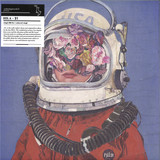
Singer-songwriter, multi-instrumentalist and collaborator; the mighty Ásgeir returns with highly anticipated third album ‘Bury The Moon’.
The Icelandic artist returns to his folk roots for lead single ‘Youth’ written in collaboration with his admired poet father, the song documents his childhood growing up in his small Icelandic town, unburdened by worry and full of unbridled joy.
The stunning new track swells with horns and hushed acoustic guitars, Ásgeir’s unmistakable honey-soaked vocal soaring across weaving instrumental melodies, culminating in a anthemic peak that exudes nostalgia. ‘Bury The Moon’ will be available via One Little Indian 7th February 2020.
Cerca:joy o
Andras’Joyful is a cornucopic vision rooted in the decay of dance music from one of Australia’s most distinct yet understated voices. Cutting a path through an overgrowth of nostalgia around 70's acid folk and 90's acid house, Joyful is an invitation to till a n old garden in a glistening new light.
A thirteen year old Andrew Wilson sits in the back of his parents’ sedan, driving down the coast from Melbourne. Headphones covering his awkwardly aged ears and connected to a jam-packed mp3 player, he experiences an intense synchronicity when the car careens over a mountain crest in the Otway Ranges right as the track in his ears peaks. A momentary vision of a “first rave rush,” in which Australia’s lauded party history dances tellingly with this dreamer’s destiny.
Not so much later but perhaps more worldly and certainly more aware, Wilson returns home from touring, now a “veteran” of the dance world, to realize a different synchronicity in his record collection. Finding Ian Van Dahl nestled next to John Fahey, William Orbit spine-to-spine with Shira Small, the harmony between folk music of the early 70's and dance music from the 90s becomes perfectly audible in unimaginable ways.
Through an afterglow from both summers of love seeped in shared sonic soil, on Joyful, Wilson cultivates melodic drama and tenderness, memorable hooks and rapturous arpeggios; sentimental strings summon both joyful aspirations and the shadows of faded dreams. Using folk songs as fodder—lyrics, samples, note progressions—each entry of Wilson’s debut album under his Andras moniker is a return to a different springtime of the mind.
Many artists working in Australia can relate to the feeling of “not quite being there,” as Wilson describes it. Always a couple years behind trend. Turning up at the party as it’s winding down. Fearing that in many ways the culture is looking backwards, confirming the narrow outlook of a parochialism that many have worked tirelessly to disprove. Using this disconnect as an invitation to dream another dream, Joyful becomes the soundtrack of early teen Andrew’s fantasy of Utopic parties past, specifically the late discovery of a bygone warehouse rave scene, as well as a return to a guileless chapter of personal history as heard through plain, sane, and simple folk melodies. Joyful is a homecoming, a testament to the evolving euphoria of a flower garden rooted in earth’s tender rot, of birds and bees flying free but not without a changing landscape in sight.
Andras’Joyful is available on LP and digital formats on January 31, 2020 via Beats In Space. On behalf of Andras, a portion of proceeds from this release will benefit the Invasive Species Council on the recommendation of Tim Low, author of the book Feral Future and Where Song Began.
"21" is the well-crafted, sharp and original first album by the duo HILA, composed by American cellist Artyom Manukyan (who already worked with Kamasi Washington, Daedalus, Flying Lotus, Run DMC, Gretchen Parlato, Raphael Saadiq, Clive Lowe Mark...) and french producer Dawatile.
The combination of jazz, Los Angeles beat-scene and the vibrations of 80s and 90s Soviet Armenia make it a striking and unprecedented fusion. These kind of nostalgic and unconventional references forcefully shake the codes of mainstream culture to create a sincere, raw and intimate expression.
"HILA" was born from a spontaneous and intense creative impulse between Artyom Manukyan, a Los Angeles-based Armenian celloist and his partner in crime, David Kiledjian aka Dawatile, a French multi-instrumentist of Armenian descent. This project is proving to be a true master stroke given that it only took 21 days for the duo to make it a reality.
"HILA" was made in less a moon cycle but captivates and electrifies audiences upon its first outings. "H.I.L.A" colors the warmth of the Californian "High" with Armenian vibes. The artists chose this name for their creation since both have a close and valuable connection to these locales. This journey began in 2007, on the day Dawatile went to Yerevan, the capital of this small country in the Caucasus mountain to realize a first fusion project centered around local folkloric music genres.
There he was introduced to local musicians including the Armenian Navy Band, one of the country's foremost groups in which Artyom played the bass and cello. In this context, he also met many musicians such as Tigran Hamasyan and Norayr Kartashyan. This will be the beginning of connections between Lyon, Yerevan and Los Angeles. The following year, the two artists will be be seen performing next to Taylor Mc Ferrin at the Jazz à Vienne festival. More recently, they partnered up again when the cellist, who had freshly relocated in California, invited Dawatile to produce his album. As soon as the studio’s threshold was crossed, they decided to postpone this record and create a joint project: Hay (as the Armenians call themselves) / High In Los Angeles. HILA was born at the end of these 21 days of intense creation. The association of Artyom Manukyan and Dawatile is the combination of two visions, two versions of Armenia, two personalities, the reunion of the Eastern and Western blocs.
One grew up nurtured by the sounds of hip-hop and jazz in Europe and the other by art music and Russian-influenced 1980s Armenian folkloric music before moving to L. A., Ca. The cornerstone of it all, the glue that unites everything : Armenia and music. They generate a new identity synthesizing two perceptions, their complicity transcending these cultural discrepencies. To achieve this, they will scour through images of Artyom’s childhood, within the popular culture of Soviet Armenia. Together, they revisit this decidedly retro vibe, based on the work of Caucasian groups inspired by African American music. This background is rehashed and fused with ancestral Armenian sounds. The DNA of the album "21" is molded by these dear influences.
We can also hear the ancestral sounds of Armenia, a country at the edges of both Europe and Asia. The presence on two tracks of Armenian music Master Norayr Kartashyan, infuses the languor of past melodies and traditions. These purposeful anachronistic sounds offer a fantastic depth to this powerful opus. Listening to the album, one can appreciate the successful fusion of styles and influences. Those combinations, however, manage to preserve individual identities only to enhance the art through an adamant musical dialogue.
Being driven by the urge to transpose Armenian musical traditions into a unique universe, the daring artists, offer an innovative combination by blending, for the first time, these ancestral sounds with the world of Los Angeles beat-scene and jazz. An invention largely fueled by the magic strings of Artyom and maestro Miguel Atwood-Ferguson, a pillar of the genre in Los Angeles combined. These associations resonate with a triumphant equilibrium. HILA is musical uncharted territory in which Artyom's cello strings intertwine to ignite the harmonies of keyboards, the machines, the vocals and electronic layers Dawatile pieced together. HILA plays the soundtrack of an adventure set between Armenia around the end of the Soviet era and a mysterious near future.
Artyom Manukyan grew up in Armenia in the 90s. At the time, he studied Russian classical music while learning jazz with assistance by his father, a music journalist. Being an unconditional music lover, he went on to sharpen his skills at the prestigious Berkelee College of Music. Subsequently, he’s been lucky enough to travel the world touring with numerous acts and mainly with the Armenian Navy Band. The group has fostered alacritous success honored by a BBC Award as a crowning achievement. He moved on 10 years ago and made his way to L.A. with his cello on his back. In the City of Angels, he quickly became a popular figure of the jazz and hip-hop scenes thanks to his first album "Citizen". He’s accompanied prestigious musicians such as Kamasi Washington, Melody Gardot, Daedalus, Flying Lotus, Run DMC, Gretchen Parlato, Raphael Saadiq, Clive Lowe Mark, or Vulfpeck. He released his solo album on the cello, "Alone" in October 2019.
Dawatile is a bold producer and multi-instrumentist as well as a passionate and resolute musician molded by jazz. As a versatile artist, he handles and juggles the saxophone, the keys, the bass and composition. Simultaneously, Dawatile produces cross-over projects and soundtracks for the movie industry. He, as well, has had the opportunity to be a part of many tours, including with his electro hip-hop band, Fowatile and more recently with the "Future Kreyol" trio, Dowdelin. Being the ever workaholic, he has under his belt a string of prestigious collaborations with the likes of Talib Kweli, Foreign Beggars, Roy Ayers, Tigran Hamasyan, Mathieu Boogaerts, Voodoo Game and Piers Faccini. His taste for developing new musical recipes and his know-how in production make him a much sought-after album producer. In concert, the HILA duo offers a sober, precise and rhythmic performance. "21" is an aerial and lively album taking the audience on an at times joyous and sometimes melancholic dreamlike journey. The magic of "HILA" operates at the speed of light and positions it already as an avoidable group.
This debut album, by prodigious keys player, composer and producer Joe Armon-Jones, is buoyant, celebratory and welcoming. With a background in jazz, he draws from influences in dub, hip-hop and soul. Different traditions are infused and commingled together. Soulful brass arrangements are coloured with carefully-tuned atmospherics, individual flashes of brilliance are bound into the album's bigger picture.
He's part of London's young, jazz-influenced music scene. Drawn from that same close-knit circle, the album features the likes of Moses Boyd, Nubya Garcia and Oscar Jerome. It's playing with those - along with Ezra Collective, which he co-founded, and touring with the likes of Ata Kak and Pharoahe Monch - which has honed his playing and grown his ideas.
It's made for a record with an unmistakable depth. He draws on deep musical understanding, making music which is warm and has a feeling of joy. A document of his vision for bringing together his different influences, it's also a testament to hard-earned, head-turning musical virtuosity.
In 2019, The Mighty Mocambos returned in fine form with their new album "2066", played a storming European tour and celebrated a colourful year delivering their own true style of funk, Afro, hip hop with cinematic compositions and storytelling.
The mean streets groove and furious drums versus car chase workout of "Golden Shadow" and the joyous instrumental stomper "Preaching To The Choir" were soon identified as DJ favourites. ... So here they are on glorious golden 7inch vinyl to jumpstart in 2020 with.
Total Refreshment Centre is proud to present a brand new mini-LP from Neue Grafik Ensemble entitled 'Foulden Road'. French producer, instrumentalist and DJ, Neue Grafik, has been building a strong rep for himself over the past few years, releasing records previously on labels such as Rhythm Section, 22a, CoOp Presents and Wolf Music.
His sound is a hybrid of jazz, house and hip hop, all with his unique geographical flavours of African ethnicity, Parisian roots and a love for London sounds like broken beat & grime thrown into the mix. In his own words "this mini album has been conceived as a journey from Deptford to Dalston, right through Peckham. During a personal period of transition, I put this music forward at a crossroad of all my influences, taking the time to share and experiment with a band more than that, an ensemble. The idea is to incorporate musicians with their own sensibilities, collaborating together as a reflection of our society; unreal & rebellious, but with magic moments, and full of hope.
The best representation of that is Total Refreshment Centre. This building and its community were a perpetual source of inspiration for me over the past two years & gladly allowed the creation of this project". Having been first properly introduced to the community of the TRC during an after-hours jam, it came to TRC founder Lex Blondel's attention that New design had some exquisite compositions of his own. A few weeks later, it was decided that Neue Grafik would form a band and that they would do their first gig at TRC, a week after the first day of rehearsals. No pressure … Lex continued; "we paired him up with Emma-Jean Thackray, to arrange his compositions for a quartet, added Vels Trio's Dougal Taylor on drums, Matt Gedrych from MaddAddam on bass and Jordan Saintard on sax.
Then the band got to work…" Title track 'Foulden Road' commences the session in truly energetic fashion, named after the street in North London where TRC is based, and where these sessions were largely laid down. Keeping with the geographical vibe, next we have 'Dalston Junction', a two-part affair starting on a sci-fi boom-bap tip, before switching to the ethereal flute playing of Brussels musician Esinam, and the first outing on the collection for Brother Portrait.
'Voodoo Rain' is next, a sweet slice of afro-funk, featuring the incredible talents of London's own Nubya Garcia on sax, and the tempo picks up once again for 'Something Is Missing' - this live version comes from the afore-mentioned infamous first gig at TRC.
The goosebump-enducing vocals of Melbourne soulstress, Allysha Joy, set off the second half of the record with the beautiful downtempo track 'Hotel Laplace', recorded at a live session at Giant Steps, before kicking the energy levels back up with 'Hedgehog's Dilemma', once again featuring the vocals of Brother Portrait, as does the closing track, 'Dedicated to Marie Paule', a mid-tempo piece akin to 90's golden era jazz-hop, bringing the set to its conclusion.
This collection of tracks reflect the many moods and various genres indicative of Neue's creative approach illustrated above.
- A1: Pinta Manta - António Sanches
- A2: Dia Ja Manche - Dionisio Maio
- A3: Morti Sta Bidjàcu - José Casimiro
- A4: Pontin & Pontin - Bana
- B1: That Day - Fany Havest
- B2: Odio Sem Valor - Pedrinho
- B3: Mino Di Mama - Quirino Do Canto
- B4: Mundo D'margura - Tchiss Lopes
- C1: Po D'terra - Joao Cirilo
- C2: Corre Riba, Corre Baxo - Abel Lima
- C3: Ilyne - Os Apolos
- C4: Sintado Na Pracinha - Americo Brito
- D1: Capchona - Elisio Vieira
- D2: Djal Bai Si Camin - Antonio Dos Santos
- D3: Stebo Cu Anabela - Abel Lima
repress
2LP 140G VINYL + 12 PAGE BOOKLET.
"Space Echo - The mystery behind the "Cosmic Sound" of Cabo Verde finally revealed!" is the 20th release by the fabulous Analog Africa Label.
In the spring of 1968 a cargo ship was preparing to leave the port of Baltimore with an important shipment of musical instruments. Its final destination was Rio De Janeiro, where the EMSE Exhibition (Exposição Mundial Do Son Eletrônico) was going to be held.
It was the first expo of its kind to take place in the Southern Hemisphere and many of the leading companies in were all eager to present their newest synthesisers and other gadgets to a growing and promising South American market, spearheaded by Brazil and Colombia.
The ship with the goods set sail on the 20th of March on a calm morning and mysteriously disappeared from the radar on the very same day.
One can only imagine the surprise of the villagers of Cachaço, on the Sao Nicolau island of Cabo Verde, when a few months later they woke up and found a ship stranded in their fields, in the middle of nowhere, 8 km from any coastline.
After consulting with the village elders, the locals had decided to open the containers to see what was inside - however gossip as scintillating as this travels fast and colonial police had already arrived and secured the area.
Portuguese scientists and physicians were ordered to the scene and after weeks of thorough studies and research, it was concluded that the ship had fallen from the sky. One of the less plausible theories was that it might have fallen from a Russian military air carrier. The locals joked that again the government had wasted their tax money on a useless exercise, as a simple look at the crater generated by the impact could explain the phenomena. "No need for Portuguese rocket scientists to explain this!" they laughed.
What the villagers didn't know, was that traces of cosmic particles were discovered on the boat. The bow of the ship showed traces of extreme heat, very similar to traces found on meteors, suggesting that the ship had penetrated the hemisphere at high speed. That theory also didn't make sense as such an impact would have reduced the ship to dust. Mystery permeated the event.
Finally, a team of welders arrived to open the containers and the whole village waited impatiently.
The atmosphere, which had been filled with joy and excitement, quickly gave way to astonishment. Hundreds of boxes conjured, all containing keyboards and other instruments which they had never seen before: and all useless in an area devoid of electricity. Disappointment was palpable. The goods were temporarily stored in the local church and the women of the village had insisted a solution be found before Sunday mass.
It is said that charismatic anti-colonial leader Amílcar Cabral had ordered for the instruments to be distributed equally in places that had access to electricity, which placed them mainly in schools.
This distribution was best thing that could have happened - keyboards found fertile grounds in the hands of curious children, born with an innate sense of rhythm who picked up the ready-to-use instruments. This in turn facilitated the modernisation of local rhythms such as Mornas, Coladeras and the highly danceable music style called Funaná, which had been banned by the Portuguese colonial rulers until 1975 due to its sensuality!
The observation was made that the children who came into contact with the instruments found on the ship inherited prodigious capabilities to understand music and learn instruments. One of them was the musical genius Paulino Vieira, who by the end of the 70s would become the country´s most important music arranger. 8 out of the 15 songs presented in this compilation had been recorded with the backing of the band Voz de Cabo Verde, lead by Paulino Vieira, the mastermind behind the creation and promulgation of what is known today as "The Cosmic Sound of Cabo Verde".
The field of electronic music were involved. Rhodes, Moog, Farfisa, Hammond and Korg, just to name a few.
Cynosure returns with OHMS, a playfully uplifting collaboration from Mike Shannon and Ohm Hourani. The three-track EP features two originals laced with twisted drums and slippery synths, equally fitting for intergalactic exploration or a beachside sunrise. The original tracks’ intimately minimal production is complimented by a remix from Akufen of elegant deep house, making for a record that is both contemporary and classic. “Hightower PSA" slips out the gate with a carefree ambling baseline over a slow, swelling tide-like pad. Breezy, pulsing synth stabs pull the groove together while precise, quick hats and snares weave around buzzing tones like alien chatter. “Nova In The Sun” moves into steadier and darker territory: the bass hops between a stark kick-snare, with hats tastefully drizzled on top.
But when singer Ilhem’s sultry voice cues subtle hand drums and squiggly echoes, the track transforms from a slick minimal affair into a soulful throwback. “Nova In The Sun (Akufen’s Aldo Nova In The Sun mix)” takes the female voice of the original and jumps right in with an upbeat staccato piano and swirling violins. A full-blown house arrangement ushers in lush strings, electric piano chords, and loosely fitting open hats and snares, all conspiring to bring a splash of joy to any peak-time crowd. On the whole, OHMS deliver a versatile EP that swaggers with a smile.
The hyper talneted Stellar Om Source (NOT NOT FUN, RVNG, NO 'LABEL) blowing up new styles on this one!
"If there is one thing that leaps out from Stellar OM Source’s music, it is the sense of a highly active mind at work. There is an indivisible feeling that a real person is behind this dynamic flurry of tones, waves, vibrations and modulations. On I See Through You, the first full Stellar OM Source release in over four years, the spark that first LP piqued the interest of so many listeners is glowing stronger than ever.
In the 2010's, Christelle Gualdi carved a name as one of the most essential live electronic musicians around, dazzling dancers and home listeners in kind with her bombastic, acidic hardware jams. Circumstances outside her control forced a stop for the Stellar OM Source project. It was touring, including two shows in the summer of 2019 at Dekmantel Festival and Listen! that Gualdi credits as year highlights, which proved to be the integral jump-start to the engine.
Inspiration came rushing back thanks to the human connection of performing. Seeing a younger generation connect with her put fresh charge into the circuitry of her gear. All this accrued into new material on the road, and thus I See Through You was born.
The spirit of 2013’s cult favourite Joy One Mile is alive and well on I See Through You. There is once again immediacy, urgency and lust. But Stellar OM Source stepping into a comparatively more poppy and playful mode on these four tracks could also throw some. Fundamentally she says, it comes from a similar place, and ends with an enmeshed and positive outcome. Gualdi credits both “1995 rave” and “the clarity, bass and breath” of hi-def hip-hop productions as being twin northern stars for her to follow.
The artwork comes from friend and highly respected photographer & director Pierre Debusschere, whose work similarly flits between arresting close-ups and, well, the widescreen luxe of Beyoncé videos. “I’m definitely not a purist anymore,” Gualdi laughs – and with club-ready impact meeting human warmth, this shows in abundance.
“Night Alone” wastes no time in getting the listener up to speed. Is that an LFO sample running through “Night Alone”? Is this a lost Metro Area classic? Is that Stellar OM Source taking a diversion into searching Ibiza-rousing vocal for a moment, or did we imagine that in a heat haze? Where are the kicks? Oh there they are. How many elements are buried and revived within just over five minutes?
It’s hard to tell. Before we know it, “Lost Codes” is up and away, keeping pulses racing. A pitter-patter of baby kicks feel like a pre-tremor before a welting electro-Italo lead crashes into play. With fizzing energy, rasping synths and a frisson of danger, fans of Unit Moebius and The Hacker will be doing somersaults of joy.
“White Echoes” wastes kicks off the flip side with low gurgles descending briefly like a UFO reverse parking into the spot SOS had vacated. Soon, 303s are twisting like Chinese burns while warm chords offer a salve. The mood maintains on “Wild Palms”, the only song on this record not to feature additional mixing work from Peaking Lights’ dub-wise sensei Aaron Coyes.
True to form, the B2 is all Stellar: elements switching up and out, with all the fun and frenzy of capital-L Live action. Kick drums and bassline darting back and forth like a synchronised swimming routine, all elements in concert. The momentum of a runaway mine cart that you can’t help but strap yourself to. I See Through You is one for the dancers who have given Stellar OM Source the motive to move forward once again."
They Say: “Documentary and industrial underlays for current themes of modern life”.
We say: Mind-blowing, percussion-heavy, Afro-tinged, cosmic-disco library bomb.
This is the one. An absolutely outstanding record from 1983 and definitely one of the hardest to find on the collectable German library label, Coloursound. The Now Generation (Percussive Underscores) is comfortably one of the very best library records full stop.
The record comes galloping out the gate with a pair of rapid synthy-eurodisco bombs - the title-track and “Panama” - before slowing down to a woozy pace on “Inorganic Matter”. “African Nightclub” sounds like it reads, and is a particular favourite of Prins Thomas. Indeed, it was used to great effect on his seminal Cosmo Galactic Prism mix for Eskimo back in 2007. It’s followed by the dark, druggy, slow motion industrial groove of “Grease Plant” before “Southerly” lifts the tempo to close out side A with its Latin funk strut of bells and melancholic keys.
For us, though, it’s all about the opener to side B: “Mechanical Heart”. Seven minutes of building, mid-tempo disco-funk joy, deceptively explosive, club-ready gear for body and soul. The back cover dryly describes the track as “Guitar and percussion, light industrial underlay”. Hmmm. How about, “after finally emerging from a particularly heavy week jamming in a sunless, lawless German warehouse, Chic warily press record on a wayward, illicit instrumental for basement gatherings”. Just wait for those drums at the 3 minute mark…
The beatless ambience and menacing stabs of the proto-electro “Chemical Threat” follows, before the open drums and incredible fills of the metronomic “Steady Going” and fantastically monotonous funk breaks of “Nepal Trek” round out this sensational set.
This is a library masterpiece in no uncertain terms, full of synth funk, afro beats, exotica, leftfield madness, dance floor dynamite and all-around greatness.
As with our KPM and Themes re-issues, the audio for The Now Generation comes from the original analogue tapes and has been remastered for vinyl by Be With regular Simon Francis. Richard Robinson has brought the original Coloursound sleeve back to life in all its metalic silver glory.
- A1: Red Earth
- A2: Raw Gold
- A3: Citrine Sun
- A4: Cadmium Vert
- A5: Cerulean Blue
- A6: Indigo Dore
- A7: Magenta Rose
- A8: Omega Prism
- B1: Red Earth (Instrumental)
- B2: Raw Gold (Instrumental)
- B3: Citrine Sun (Instrumental)
- B4: Cadmium Vert (Instrumental)
- B5: Cerulean Blue (Instrumental)
- B6: Indigo Dore (Instrumental)
- B7: Magenta Rose (Instrumental)
- B8: Omega Prism (Instrumental)
Sound is a potent force that can awaken your purpose and re-balance your spirit. It has the power to relax, as well as inspire you, through the positive therapy of sound vibrations. Elemental Resonance is a trailblazing meditation album where vibrational sound practitioner, Tracie Storey, combines the energy waves made by music, with positive words of love and harmony to produce inner peace, deep relaxation and a higher spiritual connection.
Storey explains “The idea for this album came to me 2 years ago when I was living in Montreal, Canada. I’d been learning to form shapes, textures and colour with sound and going deep within the architecture of my own inner space. These powerful compositions have really helped me on my journey. Creating transformative tools are now part of my life’s work, using the medium of vibrational sound which transcends all boundaries”.
Storey guides you through a series of mindful meditations - each connected to the seven energy chakras - and each supported by sound vibrations, colours to visualise, and positive affirmations to re-balance your entire being and bring you waves of calmness, strength, warmth and joy.
Released on Celestial Being, label boss Felix Buxton (Basement Jaxx), says “I’m thrilled to support this project, everywhere I look people are discovering more about Vibration and how it affects them.
Tracie is leading the way forward for new generations, uncovering more of our potential as humans. This is a great way to switch off the world and switch on to your deeper self.”
Storey has been active as a vibrational sound practitioner, for the past 5 years. Previous to six years training under Master Fabien Maman, who’s one of the world's leading experts on vibrational sound therapy, founder of the Tama-Do Academy.
She also travelled the globe as a DJ on the international dance scene (releasing on Ministry of Sound and producing mixes for the likes of Kiss FM).
When acclaimed South African musician Guy Buttery first sought out Dr. Kanada Narahari in late 2016, it was as his patient.
“It was a dark time.” Buttery recalls, “I had been bedridden for months and had been suffering from debilitating bouts of fatigue which no diagnosis or medication could help me get to the bottom of. When I first met Kanada, I was at the stage where even picking up my guitar to make music had become a joyless and taxing exercise.”
As Buttery’s searched for a cure, a family member recommended he see Kanada an Ayurvedic doctor who had relocated to South Africa from India and set up a practice in Durban. It was during this consultation, that the musician first experienced how Narahari infused the healing properties of Indian Classical music into his practice. Rather than treating him with a smorgasbord of pharmaceuticals, Narahari played his sitar and set Buttery on a strict daily diet of Raga’s to fast track his recovery.
Buttery was not only struck by his doctor’s musical talents but by the powerful healing properties inherent in his sitar compositions. When he left Narahari’s doctors room that afternoon, he asserts he was feeling decidedly clearer, lighter and stronger.
“Diving into Kanada’s music was definitely one of the reasons I'm still here today.” he admits. “The consistent tonal centre at the heart of Indian Classical Music, literally became my support pillar over this period. A central core of sorts in which to fall back on, strengthen and discover.”
Narahari as it turned out, was not only a prominent music therapist (and one of the only Ayurvedic doctors practicing in South Africa) but like Buttery, a highly accomplished musician with a devoted following back in his homeland.
Born in a small village along the Western Ghats in Karnataka, India, Narahari, at the age of nine, had enrolled to study Carnatic classical vocal and developed an interest in Hindustani Classical music with a particular passion for the sitar. While Buttery had secured his reputation as one of South Africa’s musical treasures, a multi-instrumentalist who commands sold-out performances both locally and internationally and more recently had been awarded the prestigious 2018 Standard Bank Young Artist for Music.
From this consultation, a friendship developed between the two musicians with Buttery soon inviting Narahari to join him in his studio. But it wasn’t all plain sailing in the beginning. While Buttery and Narahari’s sensibilities were very much aligned, there were a range of cultural and musical influences, nuances and inflections that first needed to be navigated and understood.
“I suppose we had to find a common ground.” Buttery says, before adding, “Which in the end turned out to be pretty "uncommon ground" for the both of us.”
It was after a few intensive sessions together that something exhilarating began to emerge. What began as a few idle improvisations soon evolved into feverish and lengthier jams. Whenever time permitted, the musicians would meet, descending deeper into the emerging sounds, while reimagining the realms that existed between their African and Indian heritages.
Over the next few months, the duo would rack up over fifteen hours of recordings in studio, and it was up to Buttery to shape the material into an album which they collectively titled Nāḍī, which Narahari translates from the Sanskrit as "The Channel" or "An Internal River".
During this period, Narahari bestowed upon Buttery, the moniker Guruji while Guy would refer to him, in affectionate return, as Panditji. Each time the musicians would meet, the studio space would be cleared by an impromptu ritual, with Guruji burning African Imphepho while Panditji would chant a Sanskrit mantra dusting Indian Agarbatti clouds over their instruments.
Once the room had been made hazy with this aromatic alchemy (with the ancestors welcomed in) the musicians would pick up their instruments and plunge into shimmering tides of sound. Reflecting on these sessions, Narahari recalls the immense creative freedom he felt throughout: “Guy and I tried to wander as much as possible, without any speculative, preoccupied ideologies or limitations. Love remained at the forefront of our journey together.”
“Those evenings we spent together in the studio” adds Buttery, “felt incredibly rich with purpose and a profound sense of freedom. While improvising, anything could happen and mostly did.”
On a first listen, the tracks on Nāḍī emerge as salty, humid invocations to the inscrutable depths and misty myths of the Indian ocean-- that vast body of water that stretches between, and laps the shorelines, of the artists’ respective homelands.
When asked to describe the sound him and Narahari refined, Buttery prefers to relay a series of evocative images.
“For me” he explains, “Nāḍī is a lighthouse, a beacon that resides at the bottom of the ocean.” As Buttery envisions it, “what once offered light to guide ships to safety, has been submerged and re-purposed by marine life as a coral-reef temple. Similarly, this sunken lighthouse exists as a concealed cenotaph, memorializing the ancient sea-routes and passages that once connected the two distant lands.”
On paper this may sound obscure but listening to the songs, it serves as an apt metaphor.
Across each meditative movement, listeners are able to relive the journey, immersing themselves in a series of incantations, replete with high dynamics, delicate African-Indian inflections and virtuoso string playing of an entirely new order. Further complimenting the fusion of musical dialects are a range of guest artists including Shane Cooper on bass, Thandi Ntuli on vocals, Chris Letcher on organ, Ronan Skillen on tabla and percussion and Julian Redpath on guitar, synth and backing vocals.
Now like the submerged lighthouse, the recordings stand as a monument, a marker and snapshot of this fortuitous meeting, a tribute to the healing gifts of Guruji and Panditji in performance. It’s a process that already, both musicians look back on with reverence and nostalgia.
Buttery ruminates in closing, that when he first met Kanada his illness correlated with the biggest drought South Africa had experienced in many years “…for whatever reason, whenever we would connect and make music together, the sky would tend to open. Even if it was just a few drops. This went on for months, until finally the drought dissipated and my health had been restored.”
By the time the heavens did open across the East Coast, a deep friendship had been forged and with it abundant musical offerings poured down. A treasured sample of which we able to share in every time we press play and immerse ourselves in the sacrosanct musical universe that is Nāḍī.
Second phantasmagorical audio outing from former Seefeel andLoops Haunt members, Mark Clifford and Scott Gordon. 'Two' expands the duo's unique take on spectral synthesis incorporating a diverse amount of approaches to experimental sound. Twoexpoundsa hybrid mix of acoustic based audio design, ambient tonality, sound effects, music, abstraction and world's hybrid video game soundtrack.
There is something of an onomatopoeia quality to the release as the six tracks take on the character of their individual title. Silt, Dapple, Overcurve, Scutter, Strain and Plates appear as extremely well executed versions of the inferred intent of their namesake. This inquisitive approach will appeal to those interested in the more exploratory end of sound production providing hope as newly formed methods and colours are exposed from the duo's contemporary audio tactics.
Seasoned veterans can lie in a bed of laurels whereas 'Two' is an exemplary release revelling in the enthusiasm that comes from the joy of unabated exploration.
My Music is a stellar spiritual soul / jazz-funk gem, recorded by keyboardist-singer Samuel Jonathan Johnson in 1978. The epitome of a cult classic, it didn't do much upon its release but steadily found an audience over the decades that followed. It eventually worked its way into the culture, and latterly the wantlists, of wave after wave of soul aficionados.
This is music that shares the jazzy R&B DNA of contemporaries like Roy Ayers and is an intoxicating blend of mellow moments and more groove-heavy tracks. Spacey keys and lush production give it a luxurious, enveloping warmth.
My Music opens with the gorgeous title track: an indulgent slow jam opus. Introducing us to Johnson’s compelling musical vision, it features a rich mélange of production techniques. Dripping in strings, horns, backing singers, popping funk bass lines and swooshing synth waves, it’s an unusually structured cosmic two stepper that has an irrepressible groove. Accordingly, it’s been a favourite with the diggers and it was sampled by The Alchemist for Jadakiss’s “We Gonna Make It” (and it was also used on Ras Kass’s “Home Sweet Home”… but that’s a story for another time).
The up-tempo “Sweet Love” bubbles over with joy, its uplifting lyrics backed by infectious bass and jazzy Fender Rhodes lines. It follows a cover of “What the World Need’s Now Is Love”, taken at a funereal pace that transforms it into a heartfelt plea for love and understanding. Essential in these dark days.
After a full-minute-long opening of lush cinematic strings and horns, “Because I Love You” makes space for Samuel’s voice, accompanied by some keys and just a sprinkle of guitar. It builds back up and then mellows its way out to a jazz lounge finish (in all the right ways). The feel-good ebullience of the Stevie Wonder-esque “It Ain’t Easy” closes out the LP’s first side.
The second side bursts open with the heavy bounce and disco-funk basslines of “You”, a slightly off-beat string-laden dancer with insistent horns and a piano-assisted groove. Next up is “Just Us”, a legendary steppers track that could be heard oozing out of deep soul radios and funk sound systems back in the late 80s.
“Yesterdays and Tomorrow” is a moving original ballad that is followed by an exquisite high-stepping paean to mom in the form of “Thank You Mother Dear”. The thumping easy-glide of “Reason For The Reason” brings the album to a close.
Respectfully mastered by Simon Francis and cut by the master Pete Norman, this reissue of Samuel Jonathan Johnson’s sole LP sounds as sumptuous as that scarlet gown on the front cover. The sleeve artwork was lovingly restored by the Be With team. My Music is a luxurious and rare collection of songs that now has an opportunity to reach beyond its cult audience.
- A1: Spinning Wheel
- A2: Westbound # 9
- A3: Mind, Body And Soul
- A4: Shades Of Green
- A5: Going In Circles
- A6: Why Don't You Stay
- B1: Flashbacks And Reruns
- B2: This Girl Is A Woman Now
- B3: Stop The World And Let Me Off
- B4: Heart On (Loving You)
- B5: Where's All The Joy
- B6: The Empty Crowded Room
• Detroit blue-eyed soul from The Flaming Ember, a band who signed to the then newly created Hot Wax
Records (founded by the prolific hit making Motown team Holland Dozier Holland)
• Features the hit single ‘Westbound #9’ (24 US Billboard) alongside ‘Mind Body and Soul’ (26 on US
Billboard)
• Recognised for their contribution to music and inducted into the Rockabilly Hall of Fame in 1999
• The first reissue of this 1970 album on 180g heavyweight black vinyl with printed inner sleeve, and original
artwork
Skyf Connection (pronounced skAyf) was a short lived project by long time friends Anthony Mthembu and Enoch Nondala. At the time they were working for Annic Music, an independent label run by married couple Anne and Nic Blignaut. Although the label was known mostly for Zulu, Sotho, Tsonga and other traditional styles, they had a few Disco releases on the label including groups like Keith Hutchinson’s Focus and Enoch’s discovery Lena, who went on to have huge success under the name Ebony a few years later.
In 1984, when an artist didn’t show up for a booked session they decided to make use of the studio time and began working on a demo. At the time Anthony and Enoch had been playing for a year at a new club called Gamsho, located on a farm on the outskirts of Kliptown Soweto. Along with Blackie Sibisi, Sepate Mokoena and Elijah “chippa” Khumalo they made up the resident house band. Due to cultural boycotts and American artists refusing to perform in the country, locals took it upon themselves to fill the market with the American sound the crowds demanded. The demo they recorded at Blue Tree Studios was going to be their product they could use to promote their brand of the American sound. They then took the demo to Universal Studios where their friend and trusted engineer Jan “fast fingers” Smit was working. It would be here that they would polish their demo into something they could take to their bosses and have pressed. Equipped with a DX 7, Linn Drum and some Juno synthesizers they were on their way. Jan lived up to his name and programmed the drums, it is rumoured he could program in almost real time, a skill that translated to the local arcade where he held high scores on many machines. Enoch would be singing and playing guitar while Anthony would do all the Bass and Keyboards. The result was 4 funky party anthems with synth work like no other recording at the time. Their take on what they believed the crowd would want to hear at the beloved club they called home.
From start to finish the 4 tracks portray what would have been a standard night at the Gamshu. Although the club would open earlier and the standard hours of most clubs was 6 to 6 , the band would start playing at 10pm. With their standard set time and Anthony and Enoch unique view on what a Disco should be, they chose the motto Ten to Ten as the album title because those were the hours when they were the stars and Disco ruled the dance floor. To get to the club was a bit difficult, you needed to drive along an empty road where thieves waited for any patrons trying their luck walking after dark. Since there was no transport during the night, the safest way to get home was to wait till the next morning to walk home. Even though in the summer months of Johannesburg light begins to peek in just after 4am, crowds refused to leave and stayed enjoying good music and company until 10am. The lead off track “Let’s Freak Together” has powerful lyrics encouraging people to let go of their worries, put aside any differences and let the music bring everyone to freak and dance together. The whole album is about the joy we can all feel when we share the same moments and how music can bring people together in a unique way, a philosophy shared with the original nightclubs of 70s New York. This approach to music is where the name Skyf Connection comes from, translating from slang to mean the connection we create through sharing, in this case Music and good times.
Skyf Connection would go on to play at Gamsho till the club’s closure in 1986. In those years their popularity lead to being booked for private events like weddings and birthday parties, as well as gigs in some other venues like Mofolo Hall. They would share the stage with many artists through the years learning artist’s songs and providing support as a backing band. After the club closed Anthony would go on to join the house band at The Pelican, another famous club located in Orlando East, as well as dabbling with songwriting for artists like Phumi Maduna and helping Enoch on many projects through the years. Enoch would ditch live music altogether and immerse himself in studio work, starting full time as a house producer and A&R for the recently formed Ream Music. He would go on to produce hit albums for pop artists like Percy Kay and Makwerhu but made his mark discovering countless artists that would become stars in the traditional market. They would remain friends until Anthony’s passing in 2016 and although Anthony is no longer with us his spirit lives in the grooves he left on this one of a kind record. His wife Vinolia will be accepting his portion of the profits on his behalf.
For his return to Make Mistakes, Derek Russo ventures into the Belly of the Whale with three pieces of beautiful, retro future, dance floor chic.
Embryonic Speck opens up the record, evoking classic rave beats, in a crisp, clear, modern style. With this cut, Derek has crafted a late-night slayer for the discerning dance floor. A relentless groove drives the track along, creating the hypnotic, smoky dreams of rave’s past.
Night Sea Journey takes it down into disco depths. A wandering bassline swaggers through the track, crashing through dark waves of sound. Sexy and mysterious, made to drag the sweaty sea on the dance floor through the night.
Straddling, a piece of timeless, familiar house music, rounds things out by bringing in a touch more warmth and whimsy. Still for the darkness, but with a lighter mood, and booty wiggle bass. Deep, and grooving, with a playful sexiness, what more could you ask for?
“Consider the subtleness of the sea; how its most dreaded creatures glide under water, unapparent for the most part, and treacherously hidden beneath the loveliest tints of azure. Consider also the devilish brilliance and beauty of many of its most remorseless tribes, as the dainty embellished shape of many species of sharks. Consider, once more, the universal cannibalism of the sea; all whose creatures prey upon each other, carrying on eternal war since the world began.
Consider all this; and then turn to the green, gentle, and most docile earth; consider them both, the sea and the land; and do you not find a strange analogy to something in yourself? For as this appalling ocean surrounds the verdant land, so in the soul of man there lies one insular Tahiti, full of peace and joy, but encompassed by all the horrors of the half-known life. God keep thee! Push not off from that isle, thou canst never return!”
― Herman Melville, Moby Dick
- A1: Leo - Fee Fi Fo Fum
- A2: The Sonarphonic - Super Breaker
- A3: Santiago - Bionic Funk
- A4: Frank Cornilius - Computer Games
- B1: Juju & The Space Rangers - Plastic
- B2: Jamie Jupitor - Computer Power
- B3: Solaris - Space Invaders
- B4: Copperfield - Make It Good To Me Baby
- C1: Ernest Flippin Ii - Supersonic Space Lady
- C2: Funk Machine - Funk Machine
- C3: Ramsey 2C-3D - Fly Guy & The Unemployed
- D1: Ose - Computer Funk
- D2: Below Zero Band - Seven (We Are) (We Are)
- D3: Rodney Stepp - Break-Out
Soul Jazz Records are releasing their new ‘Space Funk – Afro Futurist Electro Funk in Space 1976-84’, an intergalactic journey into black space, fuelled by funk, powered by computers.
‘Space Funk’ is a lovingly compiled collection of superb, rare and off-the-wall space funk and electro releases mostly released on small independent labels in the late 1970s and 1980s.
Reactors are reacting, boosters are boosting, pack your funk and shake your booty! Computer funk … makes you jump! This is the space funk program!
The album comes in deluxe artwork and three formats – digipack + slipcase CD, a very limited deluxe 2xLP + bonus 7” single + download vinyl version, and a standard 2xLP + download standard vinyl version.
Features music by Jamie Jupitor, Solaris, Robotron 4, Juju & the Space Rangers and many more intergalactic space warriors!
The shuttle program has been altered – there is no Star Wars only electro funk jam joyriders in Space – hold tight!
2x12"
A stunningly accomplished work, ‘Deep Rave Memory’ is an insight into Fearless’ worlds – both metaphysical and geographical. Pulsating in unison with the heartbeat of a modern metropolis, it was recorded at the Metal Box’ – his studio located on the peninsula of land where the River Lea meets the Thames.
The haunting and wistful blue ambient ‘Vision of You’ leads into the bracingly chilly ‘New Perspective’, which evokes a heavy rush where perceptions are blurred and vision is freeze framed, via elements of techno-soul, Sheffield Bleep and Mika Vainio.
A snarling beast of a track, the relentless machine funk of ‘Devil on Horseback’ perfects the pure cathartic release of dark ‘n’ hot body music, whilst ‘Acid Angels’ is a throbbing low-fi 303 requiem, which encapsulates that perfect dancefloor moment, when the first light breaks through the shutters.
A future classic and the album’s modus operandi, title track ‘Deep Rave Memory’’s discordant filter passes sweep across a hypnotic melody, communicating a deep sense of warm nostalgia and taking you on an epic journey – stretching out a single riff over 12 minutes – akin to the krautrock greats of which Fearless is so fond.
‘Atlas of Insanity’ is big room techno with pounding kicks, death-whip metallic snares and head spinning, spiralling synth lines that drill into your core. This is raw, impulsive and frantic music that sizzles with electric effervescence.
The Germanic kosmische idyll of ‘Driving with Roedelius’ is a homage to one of Richards’ heroes – Hans-Joachim Roedelius – and was inspired by his experience playing a set consisting solely of the electronic pioneer’s music, at a festival celebrating his life and career.
On the album's closer, Fearless recounts, “‘Broken Beauty’ is something I’ve always strived for in my art. It’s inspired by Robert Frank, William Eggleston and the way they could take the most inane object a turn it into something of beauty. It’s equally schooled by the aggressive simplicity of King Tubby’s dubbing and the transcendence of Joy Division’s ‘Decades’. The sparse allure of the best dub and techno is something I’m always striving for; being able to conjure emotion with the fewest possible elements; to not fix what’s broken, but to make it shine.
Limited to 500 copies.
- A1: Thore Pfeiffer - Urquell
- A2: Max Würden - Diminish
- A3: Yui Onodera - Cromo 4
- A4: Joachim Spieth - Meteor
- B1: T Raumschmiere - Notre-Dame
- B2: Klimek - All The Little Horses
- B3: Morgen Wurde Feat Maria Estrella - Lässt Los
- B4: Markus Guentner - Clade
- C1: Thomas Fehlmann - Liebesperlen
- C2: Gen Pop - Iron Woman
- C3: Klimek - Requiem For A Butterfly
- C4: Leandro Fresco - Brenda
- D1: Max Würden / Pepo Galan - Stay
- D2: Leandro Fresco / Thore Pfeiffer - Neo
- D3: Thore Pfeiffer - Alles Bleibt Anders
- D4: Andrew Thomas - Song 9
- D5: Andrew Thomas - Sleep Fall
20 years of Pop Ambient. Already? One didn’t notice. It’s an anniversary which comes quietly. An anniversary with quiet tones.
In the spirit of the special restraint of pop-elegance, it has no reason to drawn attention to itself with a big „Tam-Tam“. Or better: „Bum-Bum“. The bass drum stays outside. Nevertheless, in fast-paced, overstimulated times of moving forward, it’s a joyful occasion to look back.
What strikes most by putting or listening to 20 years of pop ambient in a row is the central theme that holds together the dense aesthetic concept like the pearls of a necklace.
Floral beauty for digital naturalists. Music like flowers, that don’t wilt. Timeless. Ageless. But with all of the conceptual unity and resolution, Pop Ambient would not be Kompakt without the break, the friction, the expansion of musical boundaries in between tradition and innovation, in between conspiracy and the openness of the discourse.
Aestheticism, escapism, acting in the spirit of „nevertheless“. Swans drifting by, clouds pass over, everything is floating and: „Boredom is a stylistic device“ (Andy Warhol).
Pop Ambient Music is medicine against illnesses, that you don’t even suffer from. It’s giving everything, demanding nothing.
Musical lotus leafs, off which the virtual wastewater of our time is rolling like the reality is dripping off the matrix.
In this sense, we’re happy about the pop-ambient anniversary greetings from new and old companions like Thore Pfeiffer, Max Würden, Yui Onodera, Jörg Burger, Thomas Fehlmann, Morgen Wurde, Leandro Fresco aswell as contributions from T.Raumschmiere, Andrew Thomas and, after a long break, from friends from early days like Joachim Spieth, Markus Guentner und Klimek.
Pop Ambient 2020 is released digital, as CD and of course as a chic double vinyl. Also included in the package: The whole distinctive cover-series as an art book of 44 pages. And for all of the old and young fans and collectors there is the Pop Ambient 2001 in a overhauled original version out on vinyl for the very first time.
Breath in. Breath out. Thank you.
Wolfgang Voigt, September 2019.
20 Jahre Pop Ambient. Schon? Hat man gar nicht gemerkt. Ein Jubiläum auf leisen Sohlen. Ein Jubiläum der leisen Töne. Und ganz im Sinne pop-eleganter Zurückhaltung, kein Grund, großes Tam-Tam zu machen. Oder besser gesagt: Bum-Bum. Denn die Bassdrum bleibt ja draußen. Dennoch freudiger Anlass genug, in reizüberfluteten, schnelllebigen Zeiten auf dem Weg nach vorne einen Blick zurück zu werfen. Wenn man 20 Jahre Pop Ambient Platten hintereinander legt / hört, sticht einem zunächst der sprichwörtliche rote Faden ins Auge und ins Ohr. Der Faden, der das dichte, ästhetische Konzept zusammenhält wie die Glieder einer Perlenkette. Florale Schönheit für digitale Naturalisten. Musik wie Blumen, die nicht welken. Zeitlos. Alterslos. Aber Pop Ambient wäre nicht Kompakt, wenn nicht bei aller konzeptionellen Ge- und Entschlossenheit, auch der Bruch, die Reibung, das Ausweiten musikalischer Genregrenzen zwischen Tradition und Innovation, zwischen Konspiration und Diskursoffenheit, inkludiert wäre. Ästhetizismus, Trotzdemismus, Eskapismus. Schwäne treiben, Wolken ziehen, alles fließt – und: »Langeweile ist ein Stilmittel« (Andy Warhol).
Pop Ambient Musik ist Medizin gegen Krankheiten, die man gar nicht hat. Gibt alles und verlangt nichts. Musikalische Lotusblätter, an denen das virtuelle Schmutzwasser der Zeit abperlt, wie die Realität an der Matrix.
In diesem Sinne freuen wir uns über pop-ambiente Jubiläumsgrüße von neuen und alten Weggefährten wie Thore Pfeiffer, Max Würden, Yui Onodera, Jörg Burger, Thomas Fehlmann, Morgen Wurde, Leandro Fresco sowie Beiträge von T.Raumschmiere, Andrew Thomas und nach langer Pause, von Freunden aus frühen Tagen wie Joachim Spieth, Markus Guentner und Klimek.
Pop Ambient 2020 erscheint Digital, als CD und natürlich als schickes Doppelvinyl. Mit im Paket: Die gesamte unverwechselbaren Cover-Serie als 20-seitiges Kunstbuch. Und für alle neuen und alten Fans und Sammler, erscheint zeitgleich Pop Ambient 2001 erstmalig auch auf Vinyl, in generalüberholter Originalversion. Das Ganze gibt es zudem im schicken Jubiläumsschuber in limitierter Auflage und farbigem Vinyl, exklusiv erhältlich nur auf kompakt.fm …
Einatmen. Ausatmen. Danke.
Wolfgang Voigt, September 2019