A fascinating thing about jazz is what can arise through force of
circumstance rather than the result of planning. The drummer
scheduled to appear in a trio with Jan Lundgren at the Ystad
Sweden Jazz Festival had to cancel because of the pandemic,
which forced Lundgren to rethink the gig. The pianist - who is
also artistic director of the festival - quickly realised that things
could also work without a drummer. Serendipitously, the name
of Emile Parisien came to his mind... and a new trio was born.
The three musicians had never played together in this
configuration before; so, after a single day of rehearsals, the
band took to the festival’s main stage on 1 August 2020.
Jan Lundgren is one of those pioneers who gave European jazz
its distinct identity and freed it from American jazz. The Ystadbased pianist combines virtuosity, an acute sense of tonal
colour, awareness of form from European classical music and
his own folk music tradition. For him, to make music where
many different genres coalesce is both inevitable and natural.
Lars Danielsson’s bass playing is unmistakably melodic and
lyrical. He is one of just a handful of bassists who stand out
both as creative composers and as distinguished band leaders.
Technical brilliance, outstanding musical imagination and an
almost telepathic understanding of his fellow musicians - his
presence is ideal in this trio.
Soprano saxophonist Emile Parisien found his way into this
band practically out of nowhere. The vivacious Frenchman lives
jazz with body and soul and his honesty and authenticity ring
true in every note he plays. Parisien is a visionary of jazz,
aware of its legacy but always looking forward in an innovative
way.
This unique performance leaves the listener begging for more.
Having started this new venture so auspiciously, Jan, Lars and
Emile are surely going to want to aim even higher.
Recorded live in concert by Mattias Dalin (Eurosound AB) at
Ystad Sweden Jazz Festival, August 1, 2020. Mixed by Bo
Savik, Jan Lundgren and Lars Danielsson at Tia Dia Studios,
Mölnlycke, Sweden. Mastered by Bo Savik.
Поиск:jus now
Все
In November, the new ABBA album, ‘Voyage’, will
be released, after 40 years. Just in time for the
music comeback of the year, and as a tribute to the
Swedish supergroup, a classic is now being
released on vinyl for the first time: ‘Funky ABBA’ by
the Nils Landgren Funk Unit from 2004.
Fans and music magazines count the cover
numbers by Mr. Redhorn and his cult band among
the best in the world, and even today they are
played on the radio and in clubs by DJs. Landgren,
who once played trombone himself on the ABBA
hit ‘Voulez-Vous’, personally asked ABBA
mastermind Benny Andersson for his blessing for
the album: “ABBA was never funky. But if you can
do it, then do it!” replied Andersson. Andersson
was so enthusiastic about the project that he was
also present at the legendary Polar Studio during
the recording sessions and did not miss the
opportunity to record a bonus track for the album
himself as a duo with Viktoria Tolstoy.
The result was celebrated, and ‘Funky ABBA’
became the best-selling Funk Unit album of all
time. “It's hard to believe: ABBA grooves, and
how!” claimed STEREO in their review after the
CD’s release.
For this vinyl edition, the album has been
remastered.
180g vinyl with digital download code.
Legendary Brazilian group Orquestra Afro-Brasileira are reborn for first new album in over fifty years, produced by Beastie Boys collaborator Mario Caldato Jr.
Led by maverick composer Abigail Moura, Orquestra Afro-Brasileira were one of the most influential yet overlooked groups in Brazilian music history. Operating for almost thirty years until 1970, they released just two albums - the first of which, Obaluayê, has recently been reissued by Day Dreamer Records - and left behind a legacy of Afro-Brazilian consciousness that continues to resonate today.
Combining Yoruba spirituality, folk tales, Candomblé chants and West African percussion with the instrumentation of the big band jazz tradition in the United States, the Orquestra placed Afro-Brazilian heritage in a new and vital context. Weaving emancipatory narratives into complex poly-rhythms and powerful, syncopated horn lines, the group educated and enlightened all those who saw them perform.
For Abigail’s protégé and percussionist on the group’s 1968 album Carlos Negreiros, the message of the group’s music had a profound impact: “I became aware of what it is to be black,” he says, “discovering the extraordinary potential of the Afro-Brazilian culture in the making of the national ethos.” Now the last remaining member of the original Orquestra, Carlos was tracked down by producer Mario Caldato Jr. - whose credits include Beastie Boys, Marcelo D2 and Seu Jorge among others - to oversee the first new album of Orquestra Afro-Brasileira material since 1968.
“I was overwhelmed with the percussive rhythms, beautiful deep vocals and combined energy,” Caldato Jr. explains. “It felt like the most authentic Brazilian roots music I had ever heard. It was raw and dynamic, a pure organic sound and energy. It was a spiritual experience.”
Alongside arranger Caio Cezar, Carlos assembled his Orquestra to record five tracks at Berna Ceppas’ Estudio Maravilha 8 studio in Rio De Janeiro. With percussion, horns and vocals cut in single takes over three days, the session captured the intuitive, pure and natural spirit of the group in full flow.
Following the success of the initial session, five additional tracks were recorded at the iconic Estudio CIA dos Tecnicos in Copacabana to complete the album. Mixed by Caldato Jr., 80 Anos is a contemporary incarnation of Abigail Moura’s vision, bristling with the flair of the original recordings.
For their 9th release Slam City Jams welcomes the fabulous Manuel Darquart to the family!
After brilliant releases on imprints like Wolf Music or Coastal Haze and recently getting remixed by the Italo-House legend Don Carlos, we are happy to have the duo on the label with their „Down 2 Dance“ EP. Originally from New Zealand but now living in London, Manuel Darquart bless us with a record full of balearic bliss, backed with a dope remix by Tech Support.
We are kicking things off with the title track, a deep, yet uplifting Italo-House tune: „Down 2 Dance“ is full of sweet chords, perfectly cheesy sax stabs and this catchy vocal cuts we just can’t get out of our head. On „Cultivating Yucca“ Manuel Darquart maintains the Italian vibe but
gets even more balearic with warm pads, some muted trumpets and of course: The slight sound of the ocean.
On the flip things get interesting with „Prince Of The Rinse“: Distorted 808s paired with a funky lead that builds up steadily and finally dissolves into a wonderful synth solo. A tune that reminds of the early Funkineven on Apron Records. To round this record off, we invited
Londons finest Tech Support to give the title track his remix treatment: He added his signature 80s sound to the original and perfecftly stripped back the tune to its essentials, with gated snare drums and little synth blips. What more can you ask for?!
strumentalist Teddy Lasry's story is noteworthy not just in regards to the music he released, but in the ways approached the craft of composing and experimenting with sounds and sonics.
Always intrigued with the capabilities of instruments, their groove and their feel, it was very much his family’s influence that helped to fuel these life long affections. As a performer in a parisien cabaret, Teddy’s father Jacques would mingle with giants like Serge
Gainsbourg and Charlie Chaplin (impressed by his ability to improvise, Chaplin wanted him to become his accompanist, but the pianist politely refused). Jacques and his wife (Teddy’s mother Yvonne), would later become members of the innovative experimental group Les Structures Sonores, and surround their children’s lives with sounds. Electronic music was still in its infancy and Les Structures Sonores, with their resonators that produced long, mysterious tones, were deemed ‘cosmic’. It was the era of the launching of the first Russian Sputnik and every time a radio or television station wanted music for their science fiction programs, they turned to one of their compositions. Showing a natural ability with multi instrumentalism, Teddy was rewarded with a spot in the band, allowing him to really explore unconventional methods of composition.
Following a brief stint with Ariane Mnouchkine's avant-garde Théâtre du Soleil after graduating school, Teddy joined the pioneering prog band Magma, with whom he would record three groundbreaking records during the early 1970s (According to former member
Laurent Thibault, their album Mëkanïk Dëstruktïẁ Kömmandöh and its sound were strong influences on David Bowie during the recording
of Low and Iggy Pop’s The Idiot at Hérouville). Despite the successes with these projects, Teddy was constantly searching for new ways
of expressing himself through music, leading him into the beginnings of a solo career that would last the better part of three decades.
Teddy’s transition into his solo career came with contrasting fortunes, in that he was now becoming a music to image composer but with the unfortunate realisation that his eyesight was gradually worsening (due to being diagnosed with retinitis pigmentosa at an early age). Nonetheless, his solo career would begin in 1975, and for the rest of the decade his sound would become increasingly mired in electrified Funk-Fusion and its endless sonic possibilities. The resulting music would serve to highlight Teddy’s love affair with the possibilities found within tireless instrumentation, with the flute and particularly synthesisers becoming a mini-obession of his (he once spent a 7,000 Francs loan, which was meant to be spent on fixing his roof, on synths).
To this day Teddy continues to record and experiment with music, a passion which in many ways has never left his sid, even at the age of 75. His career was one that was fuelled by innate curiosity and an intrinsic desire to discover new methods of expressionism, be it through the realms of Jazz-Funk, ambient electronics, Swing music or indeed through the medium of instrumentation itself. On this compilation, we look to encapsulate the essence of his innovative sound, and from start to finish a sense of his ingenious approach to composing structure and mood is made abundantly clear. The funk-jazz fusion style that embodied the majority of his 70s work is on full display here, with the vibrant flute driven "Los Angeles", the Miles Davis inspired "Blue Theme", the progressive and driving
"Chamonix", and the deeply intricate "Krazy Kat", along with one of his finest 80s slow jams, "Funky Ghost". Two cuts off the ‘Back To
Amazonia’ album are also featured (Teddy’s last album including his Prophet T8, Yamaha DX7 and Oberheim drum machines). "Raising
Sun in Bali" and the title piece both emphasise an ever present passion for synthesisers. "Birds of Space", a standout track off the e=mc2 album, closes the comp, and is a fitting way to end this journey.
Pulled together in close collaboration with Teddy and his family, this collection of songs looks to introduce new listeners to his work and we are proud to present this limited and carefully remastered compilation on vinyl, including extensive liner notes.
Spoken word recordings from Gregory Corso, Tina May Hall, Sam Lipsyte, Christine Schutt, Gary Lutz, Allen Ginsberg, Dawn Raffel, Jason Schwartz, Kathryn Scanlan, Scott McClanahan, & Terry Southern. About 40 years ago, in a record shop on Long Island during a weekend visit there to see my parents, i found a double-LP that looked like something i should definitely buy. It was called "BIG EGO", by the The DIAL-a-POEM POETS. On the cover was a picture of John Giorno (a great poet Ed Sanders had turned me on to) on a NYC rooftop with Philip Glass, Meredith Monk, and two kids. It cost $2. I bought it and rushed back to my parents house, where i still had my old turntable in the basement, not far from my Jimi Hendrix and Zappa Crappa posters, and my framed portrait of John Cage. My copy of Eno's "Discreet Music" was still on the turntable, having been left there years before, when i'd fled Long Island for good. I lifted it from the platter, gently slid it back into its sleeve, like a priceless religious artifact, and put Side A of the Dial-a-Poem LP on. I almost lost my mind while listening to it. The next day i went back to the same record shop looking for more DIAL-A-POEM LP's. i found two. One had a long list of names on the back, some famous, and some i'd never heard of before. I bought both LP's, and an hour later, for the first time in my life, i was exposed to the art of Laurie Anderson, whom i'd never heard of before. This was 1978. Her contribution was a piece called "Time To Go". It changed my life. Or at least, that’s how I remember it. I was just a kid, so there were a lot of moments like that, around then. Nowadays, these moments can be had in seconds, with a click of the cursor. That evening, as i sat alone by my imaginary campfire (ie; that record player in my parents basement), i promised myself that someday, somehow, i would embark upon a WORDS & MUSIC project that might move people the same way i was moved when i first heard Laurie, and Robert Wilson & Christopher Knowles, and Burroughs, and Ginsberg, and Corso, and Anne Waldman, and John Ashbery, and the great Charles Olson, and so many others. Words, for the very first time, had wielded the same power as music. And it was visceral. Just like music. It ran deep. It was a FEELING. John Giorno died in 2019, but he kept poetry alive like nobody's business. I was lucky enough to have spent some time with him in the early 1980's, when i was briefly a member of The Fugs, and often found myself surrounded by those Ginsberg called, "...the greatest minds of my generation". Ed Sanders (who'd ushered me into that scene) once told me that when he came to NYC, it was easy to go to a cafe, or to St Marks Church, and hear Burroughs, Corso, Ginsberg, and all the greats, reading their poetry. He said that even if you were just a bum on the street, you could just walk right up to them, and start a conversation. They were totally accessible, if they were in the right mood at that particular moment. So i was shocked when Sanders told me he didn't approach any of them, not even once, til he'd been going to their readings for nearly ten years. "For almost a decade, I went to every reading, every lecture, every panel discussion. But I never went near them. Never approached them. Not even once", Sanders told me. "For ten years, all I did, was listen." It took me four decades, but ... better late than never. I finally made WORDS & MUSIC, Book One.
With the release of Sweet Inspirations At Muon, the first appearance on vinyl of Tori Kudo’s mythical early ‘80s primitive rock gang Sweet Inspirations, another piece of the seemingly endless puzzle of the Japanese underground has fallen into place. Recorded some time in 1982 at Yokohama venue Muon – precise details are sketchy – we’re now given another chance to discover what was going on in Kudo’s mind just before he formed the group he is now best known for, the ragtag gang of pro and amateur musicians that was Maher Shalal Hash Baz.
Sweet Inspirations were one of several groups formed by Kudo around this time. He’d already released the visionary naïve-art album, Tenno, in collaboration with Reiko Omura, in 1980, and a trip to New York the following year led to the recording of Atlantic City, under the name La Consumption 4. Returning to Japan, Kudo first formed Guys’N’Dolls with Jun Yoshiwara (bass) and Kiyoaki Iwamoto (drums); Yoshiwara carried over into Sweet Inspirations, who existed for a few years, their membership, at various times, featuring Asahito Nanjo (High Rise etc.), Jutok Kaneko (Kousokuya), Yoshio Kuge (Les Rallizes Denudes etc.), 3C123 and many more.
The material here was originally released, without permission, by the Cragale label on CD-R in 2000. It was one of a sudden wave of archival CD-Rs that Cragale pumped out that year of material recorded at Muon, which was owned by Kohei Iehara, who co-founded Cragale with Tamotsu Hongo. In the context of the recent unleashing of material from the Kudo archives – the 9CD At Goodman set, the reissue of the first two Maher Shalal Hash Baz cassettes and the Noise LP, and the tantalising glimpses of other historical gems via Tori’s own Bandcamp page – hearing Sweet Inspirations with such clarity fills in a significant piece of the puzzle; here is Kudo, just before Maher, channelling the rough conceptualism of Red Krayola and the glinting, staggered rhythms of Syd Barrett into extended blooms of ragged glory, sketching out future classics like “Manson Girls”; A bonus CD includes a cover of a song by legendary South Korean rock group San Ul Lim.
Amel Bent surrounded in particular by Vitaa, Dadju, Slimane and Renaud Rebillaud reinvents herself and delivers "VIVANTE", one of the most powerful and moving albums of the year. After marking the 2020 with the huge hit "Jusqu'au bout " and then the year 2021 with the inevitable "1, 2, 3" in duet with Hatik and "le Chant des colombes ", Amel Bent finally releases the album entitled "Vivante" Now released on Vinyl. Ad in London Macadam
LP is limited to 1000 copies, black vinyl. Swansea Sound started in the middle of lockdown. They realised that fast, loud, joyous, angry indie-pop punk was the answer to being stuck indoors. Who needs introspection? Hue Williams is reunited with Pooh Sticks partner Amelia Fletcher (ex- Talulah Gosh, Heavenly). Rob Pursey (also ex-Heavenly) and Ian Button (Wreckless Eric’s live collaborator) provide the noise. Swansea Sound are the fast, acerbic and joyous past, present and future of indie. Four of the tracks were released as singles, all of them now impossible to obtain. ‘Corporate Indie Band’ was a limited edition cassette, ‘I Sold My Soul on eBay’ was a one-off lathe cut that got auctioned on eBay (with a £400 winning bid), ‘Indies of the World’ was a 7” inch single that briefly hit the UK physical charts, but immediately sold out and plummeted back out again. And then there was ‘Swansea Sound’: a requiem for a lost radio station; an anti-corporate lament - another limited edition cassette single. First track Rock N Roll Void gives a three minute revision session, just in case you’ve forgotten about The Ramones, The Kinks, The Buzzcocks and the brief explosion of indie noise pollution of 1986. Some of the songs are reflexive – ‘Swansea Sound’ and ‘The Pooh Sticks’. (Who else was going to write a tribute to The Pooh Sticks?) Others are searching for hope in the digital desert – ‘Let It Happen’, ‘I’m OK When You’re Around’, ‘Pasadena’, ‘Angry Girl’. ‘Je Ne Sais Quoi’ is pure pop throwaway fun. The others songs are dead catchy too, they just happen to express a sickness and a contempt for the state of things. ‘Corporate Indie Band’ is about a group who have mortgaged their creativity to a major label and sold their identities to an online marketing team of public schoolboys. Freedom of Speech takes a look at three contemporary ‘alternative’ music stars and considers how they’ve responded to BLM, the pandemic and the rise of right-wing populism. ‘Like self-serving arseholes’, is the unfortunate answer. (You won’t struggle to work out who the three ‘alternative’ stars are.) Swansea Sound took their name from a well-loved local radio station when it was given a corporate makeover in 2020. They even used the radio station’s abandoned logo. Like the indiepunk pop songs, something modern acidic and angry has taken up residence in a familiar, borrowed frame. You can throw yourself around to Swansea Sound like it’s 1986, but if you catch the lyrics you’ll remember you’re in 2021. (Sorry about that.) The Rum Puncheon, a notorious pub in Swansea, closed down decades ago.
Change The World, the brand new EP from Ringo Starr, contains 4 new tracks recorded in lockdown. The EP features the lead single “Let’s Change The World”, written by Joseph Williams and Steve Lukather, “Just That Way”, written by Ringo and Bruce Sugar, “Coming Undone”, written by Linda Perry and featuring Trombone Shorty, and Ringo’s version of the blues-rock track “Rock Around The Clock”. Change The World is now available on 10” vinyl.
Originally released as a limited yellow vinyl LP in April 2021, this debut from Taiwan’s psych-heads Dope Purple quickly sold out and gained immediate cult appreciation. Now recut and reissued on swanky transparent lavender coloured vinyl. For fans of Acid Mothers Temple, Les Rallizes Denudes, Asian psych etc
'Grateful End’ in their own words ...
"Grateful End" is our album release in 2019 in the form of CD and cassette.
The title "Grateful End" clearly shows that this is our album with the theme of "End", such as "The Last Day of Humanity" and “Good Night, Good Death" are two of our songs with the theme of "End". However, this album also has another theme of " Live", in fact most of the songs on this album are based on our imagination of "Live". “End" is not the antonym of “Live”, "End" is just one of the stages of “Live”, in other words “End" is also our “Live”. “Grateful End" is a meaningful “End" for people struggling to “Live”. It is only when the “End" comes together with “Live” that we can find significance in it and pay attention to how people face the “End" of “Live”. The End of something enables us to understand “Live”.
Most of the tracks for Grateful End was recorded in 2018, before the epidemic, so our music doesn't reflect the situation of epidemic, but there was a time in 2020 when I thought about the reality that humanity was facing the last day of humanity. Thanks to the efforts of many people, humanity is not yet extinct, and thanks to the help of many people, we can now release this vinyl. We are very grateful to all of you.
But at the same time, the plight of the epidemic has re-emerged many humanity and morality issues that we have avoided looking at. Maybe we won't die out, but if we don't face our humanity squarely, we will lose our humanity in the future and will no longer be human. I don't know what our music can do about humanity, but it is true that music is one of the creations of humanity, and music cannot leave humanity. As music music lovers, our creations will always face humanity. I hope that in the future, after the epidemic is over, we can understand and inspire each other through our live and music.
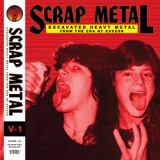
By now you’re probably familiar with our wildly popular Brown Acid series of rare, lost and unreleased proto-metal and stoner rock singles from the 60s-70s. In the endless pursuit of those glorious gems, we often uncover equally brilliant rarities from the late-70s to late-80s Golden Age of Heavy Metal that also just must be heard, but they don’t fit the series’ aesthetic. Scrap Metal, Volume 1 collects some of the greatest unknown and lost Heavy Metal tracks, long buried beneath the avalanche of the era’s classic output.
We all know the old adage that history is told by the winners. But sometimes the losers tell the best stories. And while none of these bands found fame and fortune, this artifact and the volumes to come are testament to the enduring power of heavy music. You can hear the blood, sweat and beers that went into each of these singles. The recordings may be low budget, but the inspiration and talent is immutable. Not only are the amps turned up to 11, the boyish sexual innuendo is cranked to 69. You can hear the convergence of influences — NWOBHM, thrash, glam metal, doom, etc — colliding at once as the era birthed a wellspring of subgenres.
Many of these singles are self-released and were thus limited to a small run of copies. Those that remain are hoarded by collectors and sold for exorbitant amounts. We’ve collected the best of the best for you here. As with Brown Acid, all of these tracks are licensed legitimately and the artists all get paid. Because it’s the right thing to do.
LINER NOTES:
Rapid Tears launch this series with the perfect christening. The Toronto, ON quintet’s 1981 single “Headbang” is such the pinnacle of heavy metal madness that it almost sounds like a spoof. There’s also enough of the rapid-fire sputum that inspired Metallica to bang the head that doesn’t, as such, engage in said practice, to be found on the band’s sole full length Honestly. But “Headbang” is a straightforward glammy anthem for the ages.
Air Raid’s “69 In A 55” may be lyrically so sophomoric that it’s actually pretty clever, but this 1983 Bay Area power metal single is loaded with sleek Judas Priest riffs and interwoven melodies that are downright sublime. The band’s sole release, the 2-song Rock Force 7” features a curious band photo in which 3 band members — dolled up in Crüe makeup and leather — are sexually menacing the lead singer/guitarist tied to a bed. Another low budget highlight is when singer/guitarist Tommy “Thrasher” Merry imitates a delay effect on his vocals as he sings, “tonight!...tonight...night.”
Hades’ “Girls Will Be Girls” has a real demo cassette feel to its vastly uneven mix, but the energy to the performance makes this an undeniable keeper. The long running Paramus, NJ quintet’s 1982 2- song debut 7” titled Deliver Us From Evil features this blistering thrasher dominated by shimmering leads and confident vocals that show why the band went on to near-fame on Metal Blade Records.
Resless don’t need no T to prove that they’ve got “The Power” with this 1984 driving mid-tempo rocker in the vein of Mötley Crüe and Ratt. The River Vale, NJ quartet’s tight crunch wails all over Bon Jovi posers but it’s the band’s unique and subtle deployment of background vocals that gives this rager its staying power.
Pittsburgh, the Steel City, is home to Don Cappa, a band that pays tribute to the burgh, the metal, and the awesomeness of both with “Steel City Metal.” Their lone single, issued in 1987 with only 300 copies released, sounds like the work of some serious steel driving men, with a drummer who might’ve forgotten to wear a hard hat one too many times on the construction site.
The Beast has more of a punk feel to their aggressive “Enemy Ace” track from the 4-song Power Metal EP from 1983 — something like Dr. Know meets D.O.A. But their look, artwork and lyrics all prove that Heavy Metal is where their hearts lie. And this hook filled monster delivers repeated lines like, “I command them all in my lofty realm,” with commendable conviction.
Dead Silence from Denver, Colorado, debuting in 1984 is not to be confused with Dead Silence from Denver, Colorado, who also debuted in 1984. The former a workman’s hard rock bar band, the latter a political peace punk band and neither knowing of the other’s existence throughout their tenure. The pre-internet days were a marvel, indeed.This Dead Silence spits out a slick, Nugent tinged rocker called “Can’t Stop” about life on the road.
The Danger Zone is, by all accounts, not the place to be. And, Hazardous Waste of Boston, MA saw fit to add their two cents on the matter with this 1986 single that combines Van Halen’s flashy musicianship with NWOBHM aggression that sounds so awesome it teeters on itself entering the “Danger Zone.”
Czar’s heavy, doomy “Iron Curtain” single from 1982 hearkens to the sleazy sounds of Saint Vitus and Pentagram with its cranked up DOD Distortion pedal in a Peavey combo amp guitar tone and meaty, barking vocals. The upstate NY quintet only issued this 2-song single, but its driving rhythm, nosedive whammy-bar guitar solos and comparatively mature Cold War subject matter show they had real potential.
Not much is known about Real Steel’s majestic “Viking Queen” from 1987, other than it rocks hard and the 7” 45 sells for upwards of a grand on the collectors market. The Flint, Michigan band recorded at the home studio of local radio personality Bill Lamb, who primarily released Christian Gospel recordings. So, perhaps the band was struck down by a bolt of lightning shortly after this rare single’s release. Whatever the case may be, it’s a must have for fans of classic metal mayhem.
The AA Sessions began in the summer of 2019 as a loose assortment of musical friends collaborating on one-off improvised recordings at the Agricultural Audio studios in rural Sussex, under the direction of producer Ben Hampson. It quickly grew into what it is now: a never-ending, and constantly expanding collaboration project.
The premise is simple: to release a new single every month, forever. And each single must feature a different combination of artists. Every song is written and recorded from zero, in only one day, with no going back. Like Josh Homme’s Desert Sessions, or Broken Social Scene, except the AA Sessions features more people and has much tougher deadlines to meet. Then in every December, all 12 songs from the year are released on a limited edition vinyl album.
A unique live performance at Issue Project Room gathered the former Sonic Youth member and artist Kim Gordon and the legendary minimal blues master and artist Loren Connors in 2014.
In December 2014, the Issue Project Room venue in New York City offered the first-time duo with the legendary Brooklyn- based guitarist Loren Connors and the rock icon Kim Gordon. From this almost 1 1⁄2 hour set, Kim and Loren decided to archive their favourite movement on a physical record which is a 12” vinyl now available from the french label Alara.
Through this long improvised session, Kim and Loren do dialogue and browse between installations of deep soundscapes at the limit of drone, and distorted, abrasive sonic attacks wrapped in reverberated harmonics. In this unprecedented exchange between two legends, the languages are as borrowed from one to the other: Kim Gordon plays on the land of the first inventions of Loren in rumbling / growling “unaccompanying” strings pinch, when Loren Connors envelops the entire hall of distorted harmonics that Kim would not have denied in her loudest attacks within her solo or group experiences from decades.
Just through the story of each of the protagonists and thanks to the quality of the recording and the mastering that bring the intensity of this meeting to life as if we were physically attending to the show, this album is a unique opportunity to witness the exceptional meeting between two legends of sonic and experimental music.
Green Marbled Vinyl
THE KINGS OF JUNGLE aka Jungle pioneer and all-round legend DJ Dextrous, served up some genre defining releases on Suburban Base and just a couple of much demanded pieces of brilliance slipped through the net. Many VIP versions were made of tracks and specials for one time use at particular events, in the tradition of reggae clash events from which jungle took much inspiration.
Two such VIP dubplates feature here brought together for one heavy hitting 12inch release, ‘KING OF JUNGLE VIP’ was made especially as a dubplate for Jungle Fever events, rinsed and rewound repeatedly at these shows and elsewhere, it only appeared just once as an exclusive on the seminal D&B Selection album in ‘94, and we have been asked for DJ friendly copies of this track ever since!
The Junglist anthem ‘JUNGLE THEME VIP’ another rare version only held on dubplate by a select few but became a mainstay of the very best Jungle events through 1994, it graced The Joint LP as an exclusive and never had a single release until now.
Saved from the original master tapes directly from DJ Dextrous studio these have both been carefully and stunningly remastered and are being made available as a 12 inch single DJ friendly format for the first time ever!
Looking absolutely amazing in camo style colouring to the vinyl and in the classic Suburban Base house sleeve to evoke those memories of the gold age of Jungle! Grab yourself a piece of history in the making now!
- A1: Temporal Control Of Light Echoes
- A2: Mangrove (Feat Elucid & Antonia Gabriela)
- A3: Race Function Limited (Feat Brother May)
- A4: Shekere (Feat Lojii)
- A5: Vera Hall (Feat Bfly & Orion Sun)
- A6: Obsidian (Feat Pink Siifu)
- A7: Iso Fonk
- B1: Rogue Waves
- B2: Made A Circle (Feat Nappy Nina & Maassai & Antonia Gab
- B3: Tarot (Feat Yatta & Dudu Kouate)
- B4: Nighthawk Of Time (Feat Black Quantum Futurism)
- B5: Zami
- B6: Clock Fight (Feat Elaine Mitchner & Dudu Kouate)
Get yo ass in the house, robot-- you cyber-spectre, you outhouse prime minister, you hard-headed mirror ninja, snapping selfies, living in the pixelated seams between bursts the of flashing images, birthed in a pool of TV static and Tik Tok dust. BLACK ENCYCLOPEDIA OF THE AIR is here, not to save but to drown you. Heads better learn how to swim cause listen, this record is beat soup, hearty yet still minimal, a sonic mirage of prophetic soul that drop kicks your "chill beats to study to" Youtube playlist and hyper-intellectual rap podcasts into a hadron collider; it's only black matter on the other side-- 13 mesmerizing tracks about memory and imprinting and the future, all of them wafting through untouched space like the ghostly cinders of a world on fire, unbound and uncharted, vast and stretching across the universe. Moor Mother is a holographic figment of an Afrotopian dream, all at once goddess and warrior, mystic and cyborg, griot and future time traveller, etching noisy pieces of reverie into our consciousness for decades now. But check it: on BLACK ENCYCLOPEDIA she's joined by a wide-range of friends, collaborators and co-conspirators on a trip through the murky cosmos, navigating the black universe with stardust as currency. In these times, they'll say, as they click and mash their way through the same inter-webs that seek to strangle them, BLACK ENCYCLOPEDIA OF THE AIR is just what we need: a post-everything, 12:01 on the doomsday clock, anti-trip hop type of situation. "We ain't gotta fight no more," they'll say; the rest of us, we'll put this record on and imagine again that it's real.
Far Out Recordings presents a double bill of two monumental Brit funk classics. Keep In Touch and Stay were the first two 12” singles by the iconic Freeez, both self-funded passion projects of its founding member John Rocca, for his own Pink Rhythm imprint.
It all started over the counter at Derek’s Records on Petticoat Lane, London in the mid-70s. Rocca - at the time a budding teenage percussionist - met the prolific guitarist, composer, producer and all round brit funk fixer Jean-Paul “Bluey” Maunick (also the father of Far Out producer Daniel Maunick). Best known as the founding member of Light of the World, Incognito, and more recently Str4ta, Bluey’s involvement in the origins of Freeez are lesser known, but no less crucial. Bluey invited Rocca to a weekly jam session in an East London basement, where they would develop their craft, form their first band Freeez and develop the idea for ‘Keep In Touch’: “Back in the basement there was this one particular track we were playing that I really loved. It had a groove that I thought I could sell” Rocca reminisces.
Going against the advice of all the musicians involved, who thought he was mad and set to lose all his money, John decided to go full DIY, hire out a high end studio in the West End to record ‘Keep In Touch’ and release it as a private press, birthing his now famed Pink Rhythm label. Featuring Bluey on guitar, Peter Maas on bass, Paul Morgan on drums, Jason Wright on keyboards, and John Rocca on percussion, Keep In Touch was a surprise underground hit selling over 5000 copies and reaching #49 in the UK, leading Freeez into a record deal with Pye / Calibre.
Still giddy from the experience of having produced and pressed his first record at the age of just 19, John set out to do it all again with ‘Stay’ and ‘Hot Footing It’, enlisting Bluey & co once again. This time Rocca attempted to take things to the next level by adding vocals into the mix. Though this new arrangement initially backfired and cost John the deal with Pye / Calibre who weren’t feeling the slight change of vibe, original copies of the Stay 12” have become one of the most in demand from the brit funk canon.
These foundational DIY 12” singles paved the way for Freeez to become a household name in the history of British funk who went on to record hits like ‘Southern Freeze’ and ‘IOU’ as well as underground cult classics like ‘Melodies of Love’ and ‘India’ as Pink Rhythm, John Rocca’s later formation of Freeez named after his imprint.
Bill Withers created mellow, downhome-style soul for barely more than a decade before electively retreating from the industry to pursue craftsman interests. Yet over the course of the handful of albums he made for Sussex and CBS, the Appalachian native struck lasting emotional chords in legends ranging from Booker T. Jones to Stephen Stills—not to mention the millions of listeners that fell under the spell of now-standard tracks such as “Lean on Me,” “Use Me,” and “Ain’t No Sunshine.” The antithesis of the sweaty R&B shouter that prowled the edge of stages, Withers dealt in calm and vulnerability. Serving as a template for modern British soul contemporaries like Sam Smith and an extension of the timeless fare explored by Van Morrison, Curtis Mayfield, and Al Green, Bill Withers’ Greatest Hits belongs in every music lover’s library.
Mobile Fidelity’s reissues of the 1981 compilation provide a transparent view of Withers’ relaxing timbre and the subtle grooves underlining his arrangements. Characteristics ranging from the tension of the guitars, funky bends of the bass, whisper-soft coo of the formal strings, airiness of the backing harmonies, and sharpness of the snare drum emerge with utmost clarity and lifelike presence. Always prized for its naked honesty and pure conviction, Withers’ music positively caresses the senses on this LP and SACD, the unadulterated production and beautiful soundscapes revealed anew with each listen. You won’t find a better-sounding roots R&B collection.
Does returning to a place have a sound? Can the ear have a memory? And what if places which we return to are just empty shells? Choreographed rooms which we need to play, fill from scratch each time with fragments from the past and present, layer upon layer, familiar and still somehow always new and differently assembled. Paula Schopf’s Espacios en Soledad are acoustic walks around present day Santiago de Chile, the city where she was born - which she always left, had to leave and to which she always returns - but more than anything also through her own memories which resonate throughout the public places, squares, streets though still in their own way remain strange.
„Every immigrant in the world has a piece like this - a kind of missing link, something which is incomplete. And every time one returns to the home country you are looking for it. For me it was a matter of sound.“ (Paula 2019).
In the mid 70s leaving Santiago was a flight of exile as a child with her family. Leaving in 1990 was an autonomous decision to head for Europe, Berlin, where the wall fell, where the heavens opened up all at once and electronic music became a kind of new home to so many. Paula Schopf belonged there. For her the Ocean Club at Tresor club was a central place where friends and mentors like Gudrun Gut and Thomas Fehlmann made it possible for her to get really into it. Dancing, being and feeling your body, forgetting oneself in the bass and beats, who one is and where one’s from, to becoming the DJ Chica Paula. Chile was very far away during this time, Latin America was more just a code, a musical and habitual cliche to be cautious of. This was especially true for the culture of the Chilean exile, the pathos of the “Canto Nuevo”, the sound and ideologically charged instruments of the „música andina“, for example the Zampoña, Quena or Charango. Techno was the greatest thinkable alternative to this even if or perhaps because so many kids exiled from Chile became key figures in the German and European scene: Ricardo Villalobos, Dandy Jack, Cristian Vogel, Matias Aguayo and many more.
How does returning to a place sound? Does the ear have its own memory? The field recordings which were recorded in Santiago de Chile in 2016 and form the central sonic material for Espacios en Soledad represent the paradox for Schopf’s return to her home country after emigrating: the inevitable drifting apart of her own lived time from that of her former home. Already the Venezuelan and Colombian hawkers are unmistakable signs of the deep change in Chilean society which has happened in recent years due to immigration. Which is in contrast to the old lady who sits on the floor in a pedestrian zone and without break sings the same three songs by Violeta Parra and then keeps falling asleep while doing so. The fragile presence of her voice is joined with a repertoire which is almost mythologically timeless in Chile in a particularly moving way.
By layering, ordering and conjoining such found sounds from modern day Santiago this piece become about the urban sound of Chile’s present. But more than anything by doing this Paula Schopf becomes an arranger of her own sonic memory or sound-triggered memories of returning to this city. Just as techno and Berlin helped her for such a long time to get away from too strong of an identification as a Chilean in exil, now with Espacios en Soledad she has found a way to bring these two seemingly disparate lives and remembered worlds together.
Matthias Pasdzierny
In pairing words with art, the ESP Institute often does everything journalists hate. We drown the reader in hyperbole, abstractions as opposed to didactic or literal depictions, and paint the press release with superlatives that construct an existential struggle around the art and its conditions. To articulate our reasoning behind collaborating with the artist, or the synergy between their work and our catalogue, is sometimes so challenging that crossing that finish line is achingly delayed. Patrick Conway’s 2xLP 'Cellular Housekeeping', his fourth release with the label, is one of these works so monumentally exciting for us that we’ve strained over how to deliver with honor his art unto the masses. After the initial hurdle of visual representation (in this case handled with gusto by artist Hassan Rahim), how do we directly and intentionally talk about the art we deeply love, when in reality we’re largely guided by instinct? We explore many angles, often failing along the way, until finding a final click in the combination that unlocks the floodgates. With Patrick’s album, that elusive impetus revealed itself in a literary gem that both symbolized his aggressive, melancholic, romantic, and bleak overtones, as well as synchronized his work and our task with a metaphor so grand it justified putting these words to paper. In the deeply British poem of despair and hope, 'Comus: A Mask Presented at Ludlow Castle', John Milton immortalized the classic idiom of the “silver lining”, and we find comfort in this transaction between struggle and what the poet considered divine intervention. Our bout of procrastination that brewed a cloud over the art may too tout a silver lining, the time that’s elapsed clearing a path for the album to exist in its rightful place, as opposed to fighting for a voice at an overcrowded table. In hindsight, this final hurdle might have only existed because without it, there is no glory, no resolution, but as all the pieces click and we collectively cross the finish line, Patrick Conway’s once captive 'Cellular Housekeeping' is now truly released.