
Suche:k de


4
auch erhältlich
Black Vinyl[11,72 €]

13
With over 100 releases to date Dark Vektor, is considered by everyone in the industry to be the most respected Spanish Elektro producer. On December 3, 2023, Dark Vektor played a historic live set at Ombra Festival. This tribute record includes 99% of the playlist from that performance, featuring tracks from his most acclaimed releases to date. This record is an absolute must-have for any avid collector, its value is guaranteed to increase.. Presented in a ONE-OFF truly limited edition of 300 copies lacquered pressed on 180 gr. high quality solid LIGHT GREEN and LIGHT MAGENTA vinyl. All tracks have been specially mastered for vinyl by Daniel Hallhuber at Young and Cold Studios (Germany).
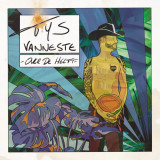
- A1: Tijs Vanneste - Zonde
- A2: Tijs Vanneste - Talent
- A3: Tijs Vanneste Feat. Stefan Dixon - We Kunnen Nog Mee
- A4: Tijs Vanneste Feat. Metejoor - De Kempen
- A5: Tijs Vanneste - Da Was Den Tijd
- A6: Tijs Vanneste Feat. Dirk De Wachter - Praatjes
- B1: Tijs Vanneste - Best Fijn
- B2: Tijs Vanneste - Radio Desschel
- B3: Tijs Vanneste - Ongeluk
- B4: Tijs Vanneste - Muug
- B5: Tijs Vanneste Feat. Helena Mayorga Paredes - De Verrijzenis
11
Tijs Vanneste, succesvol muzikant én tv-maker, komt met zijn eerste eigen plaat 'Over De Helft'.
Als deel van het iconische duo 'Van Echelpoel' werd het hoog tijd voor Vanneste om zijn eigen muzikale pad te bewandelen.
Tijs scoorde al eerder met albums in functie van zijn televisiewerk: 'Hier Is Het Goed' en 'Wildgroei' maakten deel uit van zijn gelauwerde televisieprogramma 'De Kempen' op VRT1. Dit nieuwe project wordt gedreven door zijn persoonlijke passie en mag gelabeld worden zoals iedereen in deze woelige tijden dat zelf wilt: een daad van egoïsme, nakend narcisme of gewoon een uiterst hoge nood aan een eigen creatieve uitlaatklep.
'Over De Helft' is geen toevallige schepping, integendeel, het is een belichaming van elementen die voor Tijs van onschatbare waarde zijn: humor, diepgang en plezier doordrenkt met wereldwijde muzikale invloeden zoals Reggae, Dub en Slavische klanken.
Zoals we van Vanneste gewoon zijn wordt dit alles op zijn eigen hardnekkige en eigenwijze manier van uitdrukken gepresenteerd: het authentieke en ondertussen tot wereldtaal verheven Kempense dialect.
De titel van dit zelfverklaard meesterwerk is treffend: 'Over De Helft'. Want laat dat nu de plek zijn waar Tijs zich bevindt: bijna 45 jaar oud en vooral erg blij met waar hij nu voor en in het leven staat: eerlijk en rechtdoorzee. Nummers als 'Talent' en 'De Kempen' vertellen over vroeger, nu en... later.
In het allerbeste geval is 'Over De Helft' een stimulans voor zowel lichaam als geest of op zijn minst een plaat die je doet dansen, lachen en verlangen naar een eeuwigdurende zomer.

15

Speedcore IDM post breakcore flashcore ... in one word Experimental Electronic Hard music !
Unique sound/style !!


VALIS is a new ongoing project that was initiated over a year ago by Reeko and Eduardo De La Calle. The project is a tribute to Philip K. Dick, the author of the novel that inspired the iconic film Blade Runner. Given the ambitious and extensive nature of the project, the artists have focused on transposing the cinematic and dystopian sci-fi feel that characterises the author's work on a sonic level.

- A1: Los Agentes Secretos - Loco Poco A Poco
- A2: Interface - Terregator
- A3: Casino Shanghai - Cuerpos Huecos
- A4: Duda Mata - Se, Soy
- A5: Ford Proco - Central De Datos
- B1: Voces Múltiples - Que No Se Pare El Tiempo
- B2: Neo Danza - La Reina Blanca
- B3: María Bonita - Rezo El Rosario
- B4: El Escuadrón Del Ritmo - Hielo Congelado
- B5: Las Flores Del Mal - El Ojo Del Gato
10
Dark Entries returns to Mexico with Back Up Dos: Mexican Tecno Pop 1982-1989. Following 2021’s Back Up compilation, Back Up Dos delivers 10 more tracks of synth-pop and New Beat, 7 of which have never before appeared on vinyl. From mutant drum machine beats to irresistible synthesizer hooks, fans of the fringes of the 80s will find songs to stir their cold, dark hearts. But Back Up Dos does more than mine retro kitsch; it documents the development of a rich DIY music scene that is still underexplored. As affordable samplers and digital synths spread throughout the decade, post-punk and new wave gave way to more aggressive EBM and cyberpunk sounds. The scene also developed in opposition to the political climate of the times: the rise of the drug cartels and a reactionary turn in national politics. Using home recording techniques, these bands took cues from the electronic wizardry of the Human League and Wax Trax Records while reflecting the vibrant and chaotic Mexican cultural landscape of the era. On Back Up Dos, impeccable pop anthems from Casino Shanghai and Los Agentes Secretos sit alongside gnarled obscurities from Ford Proco and María Bonita, showcasing a decade of sly deviance and enthusiastic experimentation. This album comes housed in an 80s-inflected neon sleeve designed by Gwenael Rattke and includes a 12-page booklet with photographs, lyrics, and notes. Back Up Dos compiles synthetic music produced in Mexico at the crossroads from Tecno Pop to Post-Industrial, nourished by culture shock and stories of dystopian worlds.


8
auch erhältlich
TRANSPARENT BLUE VINYL[24,79 €]
Etran de L'Aïr, die Sterne der Luft, die am längsten bestehende Hochzeitsband in Agadez, der Hauptstadt der Tuareg-Gitarre, kehren mit einem neuen Album mit sonnenbeschienenem Wüstenklang zurück! Ihr erstes Album, No.1, brachte ihre Musik den Kritikern und Fans näher. Ihr zweites Album, Agadez, führte sie auf internationale Tourneen. Und jetzt sind sie zurück mit 100% SAHARA GUITAR, bereit, die Welt zu erobern, mit diesen swingenden Melodien, wie ein vom Meer her wehender Sandsturm . Etran de L'Aïr sind 100% SAHARA, und das gilt auch für die Band, alles Söhne aus Agadez, darunter die Brüder Moussa, Abdoulaye und Abdourahamane,und ihr lieber Freund, der jüngste der Gruppe, Alghabid. Alle Brüder schreiben und spielen Gitarre und tauschen die Instrumente aus, während Alghabid die vier auf dem Boden hält. Mit 100% SAHARA GUITAR sind Etran de L'Aïr zurück, um den Thron zu erobern, mit ihrem ersten Studioalbum! Und was für ein Sound das ist. Aufgenommen in sonnigen Studios an der Westküste, bringen die Brüder den alten Agadez-Sound auf ein neues Niveau. Sie fügen noch mehr Gitarren hinzu und verweben Schichten von halligen Melodien und schimmernden Harmonien zu einem Klangteppich. Wie viel Gitarre können sie in eine Platte packen? Die Antwort lautet 100%.

8
auch erhältlich
Black Vinyl[23,49 €]
Etran de L'Aïr, die Sterne der Luft, die am längsten bestehende Hochzeitsband in Agadez, der Hauptstadt der Tuareg-Gitarre, kehren mit einem neuen Album mit sonnenbeschienenem Wüstenklang zurück! Ihr erstes Album, No.1, brachte ihre Musik den Kritikern und Fans näher. Ihr zweites Album, Agadez, führte sie auf internationale Tourneen. Und jetzt sind sie zurück mit 100% SAHARA GUITAR, bereit, die Welt zu erobern, mit diesen swingenden Melodien, wie ein vom Meer her wehender Sandsturm . Etran de L'Aïr sind 100% SAHARA, und das gilt auch für die Band, alles Söhne aus Agadez, darunter die Brüder Moussa, Abdoulaye und Abdourahamane,und ihr lieber Freund, der jüngste der Gruppe, Alghabid. Alle Brüder schreiben und spielen Gitarre und tauschen die Instrumente aus, während Alghabid die vier auf dem Boden hält. Mit 100% SAHARA GUITAR sind Etran de L'Aïr zurück, um den Thron zu erobern, mit ihrem ersten Studioalbum! Und was für ein Sound das ist. Aufgenommen in sonnigen Studios an der Westküste, bringen die Brüder den alten Agadez-Sound auf ein neues Niveau. Sie fügen noch mehr Gitarren hinzu und verweben Schichten von halligen Melodien und schimmernden Harmonien zu einem Klangteppich. Wie viel Gitarre können sie in eine Platte packen? Die Antwort lautet 100%.

12
By 1963, great Latin American artists such as Lucho Gatica, Felipe Pirela, Bienvenido Granda, Leo Marini, Benny Moré, Tito Rodríguez, Toña La Negra, Blanca Rosa Gil and the so- called queen of boleros, Olga Guillot, had enriched the musical landscape, giving personality to the bolero. That year, in the midst of a new panorama, a bolero star was born from the depths of Venezuelan radio: Estelita Del Llano. “Sensual”, her debut album, is one of the greatest gems of the genre, with arrangements and orchestration by Porfi Jiménez. The backing of the Porfi Jiménez Orchestra and his arrangements made “Sensual” one of the most successful albums of its time. The selection of the twelve songs on the album was also a success. Although the years of the bolero's greatest splendor seemed to have passed, the bolero continued to spread throughout Latin America. The great success of “Sensual” lay in the arrangements and the choice of boleros with elements of the cha-cha-cha, another genre that was enjoying great popularity.


10
Pianist and composer Bas Bulteel turns his gaze inward after a successful track record as leader of the adventurous energy bomb Wasdaman and as inspirer of his own trio, with which he won the 2014 Klara Music Prize for best CD in the jazz category for the album Coming Home, his debut as a bandleader.
Bas went into residency with visual artist Jan Frederik De Cock which resulted in a unique collaboration where image and sound dialogue with each other, feeding off each other, cursing against each other, loving each other ....
The result has become a profound and layered solo piano record that showcases Bas' versatility as a pianist and composer. Musically hovering between minimalism and avant-garde. Sometimes melancholic and always compelling.

The common thread throughout the album is the sitar. With this album Nicolas Mortelmans (Condor Gruppe, Leki, Merdan Taplak) builds a bridge between his love for Indian music and his roots in Western genres such as electronic, jazz and rock music.
On April 12, 2024, Nicolas Mortelmans (Condor Gruppe, Leki, Merdan Taplak) will release his long-awaited debut album MÁYÀ on WERF Records!
The common thread throughout the album is the sitar, an instrument that he learned in the traditional way from various sitar masters in India. Since 2017 he has been trained by the world-famous Anoushka Shankar. In every song he tries to approach this unique instrument in a different way.
With this album he builds a bridge between his love for Indian music and his roots in Western genres such as electronic, jazz and rock music. On the album guest musicians from all over the world are playing, such as Ravichandra Kulur from India (Anoushka/Ravi Shankar, John McLaughlin, Aka Moon,..), Benny Bettane (Australia/handpan) & Belgian friends like Roland van Campenhout, Tim Vanhamel and Stef Kamil Carlens.


5
Lukas de Clerck brings us the ancient greek instrument, the aulos, of which his new interpretation of long form expression is coaxed forth on this tremendous recording. Lukas de Clerck explores a niche of archaeological research in music; the aulos is a historical Greek instrument that Lukas analyzed and reinterpreted by a luthier in modern times_navigating this impression as an artwork or living sculptural object, as there is an absence of historical partitions or written information about how to recreate technique on the instrument. Lukas de Clerck has interpreted information from the rare archaeological resources and visual art of the classical Greek period to recreate both playing technique and possible sound timbres with the instrument. With his contemporary approach to drone, post-minimalist music, and contemporary folk, we find a deeply satisfying and compelling, even playful set of songs, timbral exercises and compositions. An important document of new music meets contemporary archaemusicological research via Stephen O'Malley of SUNN O)))'s label Ideologic Organ. _ The telescopic aulos is speculative: might it have existed? It takes on features from the historical aulos, a double-reed instrument of which we know how it looked but little about what music was played on it or how it would have really sounded. It's an instrument without the limitations of canon or manual, providing creative freedom and awakening curiosity. The new instrument featured on this album is ancient and futuristic at once. The aulos has no tone holes; instead, each of the two tubes consists of three parts that can slide into each other. In this sense, the metal pipes bear a certain resemblance to the principle of a trombone. However, since both hands are already in use to hold both tubes, the sliding has to be done by way of gravity and the help of a «phorbeia», a leather mask which helps keep the reeds in place. The aulos's material is metal (instead of wood), which gives it a certain electronic allure and intensity, as well as a variety of sonic possibilities and textures. It produces overtones efficiently and allows them to play with their microtonality. The aulos Lukas plays on this recording was developed at Brasserie Atlas, a temporary occupation of a former brewery in the heart of Brussels where Lukas lives. It is quite a poetic coincidence that the birthplace of the instrument is named after the Greek titan condemned to carry the sky, while this instrument needs to be turned skywards to lower its pitch with the help of gravity. At Brasserie Atlas, Lukas has found collaborators who have shared in the process of building this new instrument: the collective Noir Métal has constructed the tubes, in this way becoming instrument builders; the phorbeia has been manufactured by Jot Fau; a former water reservoir in the vast cellar of the building carried the instruments' resonance for its first sounds. The place has left an imprint on this new instrument. With all of the telescopic aulos' layers, its sonic, musical and extra-musical components are still unfolding their potential as a medium for discovery and research, next to being an instrument of great musical potential. The music on The Telescopic Aulos of Atlas reflects this spirit. In several miniature pieces, it presents an encyclopaedia of musical possibilities that the instrument offers while keeping an intense and corporeal sonic specificity. The short pieces are studies that reflect on the sonic possibilities of this instrument that are yet to be explored. It meanders, searches and interacts with itself and the space. It needs to answer common expectations of old instruments being harmonious or pleasing. It transports a kind of experimental archaeology that, by formulating hypotheses in the present, allows us to reflect on what might have been in the past and simultaneously questions concepts of beauty, harmony or virtuosity. However, in the end, this instrument might have never existed before. -Julia Eckhardt
