Aki is an emerging jazz collective led by drummer Anke Verslype. The core of the group consists of guitarist Willem Heylen, bassist Ruben De Maesschalck and harpist Marjolein Vernimmen. They perform atmospheric jazz with at its base uncomplicated, restrained melodies whose boundaries are pushed during improvisations.
With two previous EPs, "Warm Days" and "Niobe," aki has already impressed. In the fall of 2022, they surprised their audience with the debut of their first full-length album,
titled "Nader," released under W.E.R.F. records. This album featured an exciting collaboration with Joachim Badenhorst on clarinet, who added a new dimension to their sound.
For theirlatest album and upcoming tour, aki once again joins forces with Joachim Badenhorst and asked Niels Van Heertum (euphonium) as a guest. This expansion enriches the color palette of their music and brings out a new depth. Together they create a unique sound that takes listeners on a journey of warmth and melancholy, somewhere between cinematic landscapes, jazz and minimalism.
Cerca:k de
Between December 2022 and January 2024, the collective De Niemanders (producer Rick Wiegerinck joined the team) visited asylum seekers' centers in the Netherlands with a mobile studio, searching for singers, musicians, and their music and stories. The music sessions were mostly filled with pure joy, while the conversations were heavy, hopeless, hopeful, cheerful, and everything in between. The collective connected with creative individuals from all over the world, who in turn introduced them to even more artists, writers, and storytellers. Rocco, Wout, and Rick quickly realized that they needed to offer more than ‘just’ the music album as a platform, so a completely unique Niemanders newspaper was born, and journalist Christianne Alvarado joined for a six-part podcast series.
Following their instincts, they created a new Niemanders album that became a genuine collaboration between the people they met and themselves. A significant difference from the prisons was that this time, the singers and musicians could be recorded in a mobile studio. As a result, the album is a mix of many singers and languages, telling the stories of their journeys, dreams, families, past lives ‘back home,’ and their current situation as refugees. There are songs inspired by the stories that residents of asylum seekers' centers told or wrote down, sung by Rocco, while other tracks emerged from writing sessions with singers Isma IP, Guy-El Mabiala, Q-Mars, and Hamid Reza Behzadian, and are also sung by them. The song material is a creative melting pot of colorful music that ranges from swinging afrobeat, highlife, desert rock, and rootsy psychedelia, but the alternative rock for which Ostermann and Kemkens are known also seeps through. You could say that, with few exceptions, each song is a film soundtrack for the text.
Unfortunately, the harsh reality of asylum procedures also intruded into some of the blossoming musical friendships. Due to a negative decision by the Immigration and Naturalization Service (IND), one of the great singers was forced to leave the Netherlands. This is just one example of the lack of control over—and the nerve-wracking wait for—an IND decision, which unfortunately seems to be something every person in an asylum procedure must endure. The asylum process can bring years and years of uncertainty and waiting, or sudden deportation.
‘Zerinjit’ invites us to the molecular world of sound, where every sonic entity is meticulously compounded to constitute the alchemic matter of the doomed reality and post-tribal escape, putting every cell into motion. Born out of debut collaboration between Den Haag’s JEANS and Florence’s TOMO from DE RIO, the EP is a massive merge of like-minded brains in a sonic dialogue, re-shaking the otherworld of techno music. An exhilarated heartbeat amidst industrial cries, shrieks, and squeals is levitated by fat hypnotic synth lines, while the rudimentary “chuckles” over the fate of the progressive, amplifying towards infinity in a symphonic and rhythmic celebration. The “Spectral Pattern” unveils the mystic force behind dragging and pulling the Hertz of the wavelength cycle, reflecting the emitted energy from the hardware core. We are turning around in vertigo, trying to capture “Gengar” bouncing across space, catching the liquid multiples of themselves. We are approaching the smoky clouds around “Acondrite-ung”, the unclimbable mountain that samarium creatures obsessively climb in hypnosis, never destined to reach the peak.
‘Zerinjit’ is a tale of the otherworld, its creatures, patterns, rhythms, saints, and martyrs, science and utopia, translated into a dance floor body language of the ordinary.
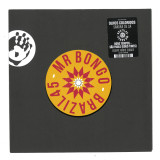
Two 1980s Brazilian boogie bombs from Sandra de Sá and Equipe Rádio Cidade get a remastered reissue as part of Mr Bongo Brazil 45’s series.
Sandra de Sá’s ‘Olhos Coloridos’ is an ‘80s MPB/boogie jam, taken from her self-titled 1982 LP on RGE Brazil, that sits perfectly alongside the likes of Tim Maia, Marcos Valle, Robson Jorge and Lincoln Olivetti. No surprise then that Lincoln Olivetti and Robson Jorge feature on the track, backed by some of the members from Banda Black Rio. A joyous combination of funk basslines and dreamy Rhodes that marry with jubilant horns and Sá’s incredible vocal tones.
On the B side, Equipe Rádio Cidade ‘Bons Tempo Sao Paulo (Good Times)’ was originally released on a rare promo only 7 inch from 1980. Giving a Brazilian boogie makeover to Good Times by Chic / Rapper’s Delight by Sugarhill Gang, the track is voiced by radio DJs from Sao Paulo wishing their listeners a Merry Christmas and Happy New Year.
This replayed version, heavy on the clavinet with a samba-infused, cuica-laced percussion breakdown, gives a true Brazilian spin on one of the most distinctive melodies out there.
Remastered with refreshed artwork.
Rio-born, Joyce Moreno, is one of the greatest Brazilian artists of all time. The voice, the playing, the writing, they all combine to make her a true allrounder. She possesses the ability to transport, captivate and transcend listeners. With a career that has spanned more than 30 albums and over 50 years, she continues to record and tour the world.
‘Aldeia de Ogum’ is one of her most well-known songs. With a joyfully jazzy arrangement, building Latin percussion, Brazilian flute and tropical atmosphere, this full-bodied samba smash became an anthem amongst London’s DJs and dancers in the Acid Jazz days. A favourite of Patrick Forge and Gilles Peterson, it was regularly spun at their legendary Dingwalls sessions.
Originally featured on her sought after Feminina LP from 1980, it also appears on our 'Essential' Joyce compilation from 1997. The original pressing of this Brazil 45 was the first time the track had been released on 7".
A fellow Rio native, Rosinha was a highly acclaimed composer, arranger and guitarist who played with legends including Baden Powell, Sérgio Mendes and Sivuca.
Here we present her stunning cover of the Gershwin classic, ‘Summertime’. Rosinha’s elegant, instrumental interpretation showcases her majestic guitar playing, and what a player she was! Backed with beautifully arranged, emotion-drenched strings, this track is guaranteed to stir your soul.
'Summertime' is taken from her 1975 RCA LP entitled Um Violão Em Primeiro Plano. The original pressing of this Brazil45 was the first time the track had been released on 7".
Remastered with refreshed artwork.
For over three decades Toby Marks, aka Banco de Gaia, has been redefining world electronica, leaving an indelible footprint on the global music scene, rousing many a dancefloor, and inspiring countless musicians to follow. At the forefront of blending acoustic and electronic sounds, integrating themes and techniques from cultures and traditions the world over, Toby has worked with musicians and producers as ingenious and diverse as Pink Floyd's Dick Parry, Natacha Atlas, Tim Wheater and Hawkwind– to name just a few.
Ranging from cinematic ambience to pounding dancefloor-fillers, his music defies genres, and borrows from a wealth of musical sources and styles. Toby's background in jazz and rock combine with his love of dance and world music to produce a glorious, uplifting and, at times, mesmerizing sound.
Erste Vinyl-Neuauflage dieses fantastischen Albums von 1981 von Marcos Valle, eines der bedeutensten Künstler der brasilianischen Musik. In Brasilien aufgenommen, nachdem er Ende der 70er Jahre in den USA gelebt hat, brachte Valle sein angeborenes Talent für Arrangements und seine vielfältigen Einflüsse auf diesem unwiderstehlichen Album zusammen. Gäste sind u.a. Sivuca, Chicago's Peter Cetera, Robson Jorge und Joses Azymuth Roberto Bertrami. Valle ist einer der wenigen Künstler, die man sich nicht entgehen lassen sollte, wenn man auch nur das geringste Interesse an brasilianischer Musik hat. Ob Sie nun Bossa Jazz, Samba, Psych Folk oder Soul mögen, Valle hat mit Sicherheit ein großartiges Album für Sie aufgenommen. Ende der 60er Jahre hatte er bereits genug qualitativ hochwertige Platten veröffentlicht, um sich einen Platz unter den besten brasilianischen Songwritern aller Zeiten zu sichern, aber seine Karriere war glücklicherweise noch nicht zu Ende, und er veröffentlichte in den folgenden Jahrzehnten weiterhin erstaunliche Musik. Mitte der 70er Jahre ließ er sich in Los Angeles nieder, weil er es leid war, unter der brasilianischen Militärdiktatur zu leben, und begann, mit so talentierten Künstlern wie Leon Ware oder Chicago zusammenzuarbeiten. ,Vontade de rever você" (1981) ist sein erstes Album nach der Rückkehr nach Brasilien und zeigt all die musikalischen Einflüsse, die er während seiner Zeit in den USA erhalten hat, insbesondere Boogie, Soul und Funk, mit hervorragenden Mitwirkenden: Sivuca, Peter Cetera aus Chicago, Robson Jorge und sogar José Roberto Bertrami von Azymuth am Rhodes. Das Eröffnungsstück ,A Paraíba nao é Chicago" ist Marcos Valles eigene Interpretation von Leon Ware's ,Baby Don't Stop Me" und macht deutlich, dass das, was er in LA erreicht hat, nun auch in Brasilien ankommt. Dies ist ein unverzichtbares Album für Boogie-Liebhaber. Hören Sie sich den unwiderstehlichen Groove von ecados de amor, (Valles eigene Komposition, die allerdings zuvor von Cristina Camargo aufgenommen wurde) oder elhos surfistas querendo voar" an, und Sie werden schnell feststellen, dass dieses Album zu den solidesten Leistungen in seiner gesamten Diskografie gehört. Selbst wenn das Tempo im Midtempo gehalten wird, wie beim abschließenden Stück ao pode ser qualquer mulher", schaffen es Valles Songs, die Tanzfläche mit seiner sehr gut gelungenen Mischung aus brasilianischen Klängen und funkigen Rhythmen zu erschüttern.
- Tino Rossi - Petit Papa Noël
- Dalida - Douce Nuit, Sainte Nuit
- Les Petits Chanteurs À La Croix De Bois - Mon Beau Sapin
- André Dassary - Noël Blanc
- Line Renaud - Berceuse De Noël
- Henri Salvador - C'est Noël Mamie
- André Claveau - Trois Anges Sont Venus (Noël)
- Les Compagnons De La Chanson - Ave Maria
- Tino Rossi - Il Est Né Le Divin Enfant
- Dalida - Vive Le Vent
- Georges Brassens - La Petite Fille Et Le Père Noël
- Édith Piaf - Le Noël De La Rue
- André Dassary - La Révolte Des Joujoux
- Line Renaud - Étoile Des Neiges
- Yvette Giraud - Joyeux Noël
- Charles Trenet - Chanson Pour Noël
repressed !
The multi-media project Kraftwerk was started in Düsseldorf, Germany 1970 by Ralf Hütter and Florian Schneider. They set up their electronic Kling Klang Studio where they conceived and produced all Kraftwerk albums.
Kraftwerk created the soundtrack for the digital age of the 21st century. AUTOBAHN 1974, RADIO-ACTIVITY 1975, TRANS EUROPE EXPRESS 1977, THE MAN-MACHINE 1978, COMPUTER WORLD 1981, TECHNO POP 1986, THE MIX 1991, TOUR DE FRANCE 2003. Their compositions, using innovative techniques, electronic sounds and synthetic voices combined with computerised rhythms, had a major musical influence on Electro, Hip Hop, Techno and Synth-Pop.
Dark Entries again shines a spotlight on bathhouse disco don Patrick Cowley with a newly remastered release of Kickin’ In. Although Cowley tragically passed from AIDS-related illness in 1982, he left an extensive archive of unreleased tapes, many of which Dark Entries has had the honor of releasing. While working as a lighting technician at The City, SF’s disco cabaret, Cowley saw rising star Frank Loverde perform. Cowley asked Loverde to contribute vocals to some material in progress, and Frank, Linda Imperial, and Peggy Gibbons joined Cowley in the studio. The resulting songs included “Kickin’ In,” a 9-minute cybernetic disco stormer that taps into the essence of Cowley’s hi-NRG sound: equal parts spaced out and zoned in on the dancefloor. In May 1978 Cowley joined Loverde on stage at The City to perform “Kickin’ In” as they opened for disco diva Sylvester.
“Kickin’ In” was initially released in 2015 via Honey Soundsystem who found the tapes in the basement of Megatone Records owner John Hedges. This newly remastered version was made possible due to the discovery of the original multi-track recordings of "Kickin’ In," allowing for a fresh mixdown by Jim Hopkins as well as the creation of a new instrumental version. Also included are two impeccably sleazy Cowley jams recorded in 1980, “Thief of Love” and “Make It Come Loose.” Cowley narrates excerpts from his erotic journals on these raunchy slow-burners, capturing the vibe of SF’s leather bars and backrooms. “Thief of Love” features frequent Cowley collaborator Paul Parker on background vocals. This reissue of Kickin’ In includes features an illustration by Gwenaël Rattke that originally appeared Cowley’s erotic journal, Mechanical Fantasy Box, as well as a postcard with lyrics. “Patrick parted the veil and entered a dark world of forbidden vices, wondrous musical panoramas and bold, strident, hopeful possibilities. Patrick brought the future to us and laid it at our feet.” – David Diebold, Tribal Rites
PAPILLON DE MER'('Sea Butterfly') is jazz guitarist Jean-Franois Pauvros' and electro musician/composer Alain Mahe's latest collaboration - music inspired bythe paintings of Belgian artist Vincent Fortemps, and their shared attraction to an imagined underwater world withmetaphorical guidance of the legendary trombonist and singer Rico Rodriguez, instigator of Jamaican ska with whom Pauvros was lucky enough to play and record with.
Jean-Francois Pauvros - guitar, vocals
Alain Mahe - Kobol RSF modular synthesizer, tenor sax, stones...
Rico Rodriguez - trombone ( feat. on 'Disparition' and 'Au bout des mondes'
Dark Entries Collected Music Graphics Compiled by Josh Cheon and Eloise Shir-Juen Leigh To celebrate 15 years of Dark Entries, this zine showcases the label’s visual aesthetic, bringing together some of the most iconic designs that we’ve released. While Dark Entries’ sonic mission has included sounds as diverse as synth-pop, Italo disco, darkwave, house, and techno, it is equally staggering to see the breadth of visuals the label has encountered and collected over the years. Included here are selected typography, logos, and illustrations from the label’s extensive catalog — well over 300 releases to date. Designs have been created using DIY analogue techniques as well as more contemporary digital approaches. A full discography is included at the end for reference and an essay by Shawn O’Sullivan (Led Er Est, Further Reductions). This zine serves as a source of inspiration for artists as well as a means of preserving and documenting these distinct graphics. DARK ENTRIES RECORDS is a San Francisco-based record label that was born in July 2009. Helmed by Josh Cheon, a vinyl-focused DJ and collector, the label has focused largely on excavating the 1980s underground era – but releases have spanned from sultry vintage disco to bleeding-edge contemporary techno. Graphic designer Eloise Shir-Juen Leigh has been responsible for most of the label’s artwork, whether reproducing original designs accurately for reissues or creating exciting new ones. Much care and attention is given to each release to represent the music in a memorable way as well as tell the stories behind these projects. Hand-stamped and limited to 200 numbered copies. 64 pages with neon cardstock covers. Measures 5×7 inches.
Biomes are little worlds of organic relationships, full of struggles, symbiosis, and sheer obsolete noise. In "De Silenti Natura," Henrique Vaz is meticulously crafting synthetic auditory biomes, sprouting from their own fuzzy logic. Unfolding across two distinct acts, the Brazilian artist interprets and replicates the complex, often ambiguous sounds of (un)natural environments, creating imaginary systems to inhabit over two sides of tape. The soundscape of the first side and title track is entirely algorithmically synthesized, with no samples used, leveraging Supercollider for real-time sound generation. The environment thus built is a flourishing one, seemingly unable to escape its own grandeur as insect-like buzzing and crackles expands into mountain ranges and forests of erupting sonorous drama. The second side introduces 'hydrophone' water synthesizers, submerged in a goldfish bowl to interface with the unfurling waves of electronic chords, creating a unique blend of damp and unwieldy sloshing movements, prismatically scattered into a luscious soundscape, and resembling everything from the bridge of a starship to the echoed drip-drip of stalactites.
Both sides of the album slowly unwrap and uncrinkle, revealing layers of hisses, distant digital choirs, warm enveloping chords, and juddering bleeps. Despite their unwieldy and strange nature, myriad elements convey a familiar sense of environment, flitting between the blossoming of new (manmade) life and the doom and destruction of the (real) world.
As the ringing of bells (fully synthetic; no samples were used) hove into view during the closing movement of side one, a simulacrum cacophony of voices is ushered in. It’s a reminder of the holy nature of sound itself, beamed into our heads intangibly. The flipside’s water ritual, frantically dunking ‘water synthesizers’ to birth swooping melodies and yawning tones, is jabbing at sleeping giants. It’s pushing and pulling the stars in the night sky into place. It’s both a simple act of beautiful creation, and a storm in a teacup.
As one of the most enigmatic figures of the 1970's Italian soundtrack and library music network Emma De Angelis and her short recording career provides thirsty fans of speedball psychedelic rock and drum heavy instrumental funk with a tight discography rivalling many of the long-standing bastions of the otherwise male-orientated business. * Strictly limited to 1000 copies.*
.
Born in Rocca di Papa, near Rome, into a flourishing musical environment Emma was the younger sister of future award-winning composers Guido And Maurizio De Angelis, a duo, who under names like Oliver Onions and Dream Bags, would write chart-topping lyrical theme tunes for a wide range of Italian crime, Giallo and Spaghetti Western films featured alongside full scores by Ennio Morricone and the Magnetic System composers (Bixio Frizzi Tempera).
With encouragement from her brothers, Emma, who would also write music under the pseudonym of Juniper, would record a tight clutch of solo-penned material and seldom credited studio contributions to Guido And Maurizio's film commissions, such as the score for Giuliano Carnimeo's Simone e Matteo: Un gioco da ragazzi (aka Convoy Buddies). While simultaneously pursuing a career as an illustrator and set designer the De Angelis family contacts would lead Emma to the offices of Romano Di Bari, whose up-and-coming Flirt label was finding success providing custom built mood music for use in TV and film. Alongside important composers like Alessandro Alessandroni, Gerardo Iacoucci and A. R. Luciani, the young Emma Di Angelis would record a small number of tracks for a compilation called Underground Mood (credited in the small print to E De Angelis - not to be confused with Italian singer Edoardo De Angelis). It is from this rare LP that the record you are now holding is compiled. Within the Flirt family of labels Emma De Angelis would also share schedules with other important female composers such as Daniela Casa and Giulia Kema' De Mutiis - both of whom have appeared on dedicated Finders Keepers releases.
The tracks on this record provide us with a rare glimpse into Emma De Angelis' short musical career before she became a full-time visual artist. With an unknown personnel or studio date it is easy to speculate a potential family jam in Piero Umiliani's Sound Workshop studio in 1972. One only has to take a listen to Guido And Maurizio's instrumental theme Gangster Story from Enzo G. Castellari's 1973 thriller High Crime (which later appeared on Tarantino's Death Proof soundtrack) or the trippy title theme to Paolo Poeti's kinky 1976 drama Inhibition to spot the family resemblance
Bolbec, brand new project of childhood friends and multi-instrumentalists Axel Concato and Barth Corbelet, present their debut record, "Victime De L"aube", on Batov Records. Drawing on their wide blend of musical tastes, from spiritual jazz and folk to classical and electronic sounds, to create an imaginary soundtrack that could easily sit beside the best of Piero Piccioni or Michel Legrand.
Lullaby for the Debris is the second album from Moses Brown of Institute’s solo project Peace de Résistance. Those of us who loved Peace de Résistance’s 2022 debut, Bits and Pieces, will be pleased to hear that much of what made that album so memorable—the glam-infused art rock sound, the gritty yet richly textured production, and Moses’s bluntly class-conscious lyrics—carries over into Lullaby for the Debris. Yet Lullaby for the Debris also sounds more refined, more timeless than its predecessor, with “40 Times the Rent,” “Coddle the Rich,” and “Ain’t What It Used to Be,” all built around chooglin’ Lou Reed-style riffs beamed in from the great rock and roll beyond. Elsewhere on the record, Moses’s arty side shines through, with “The Funny Man” and “Pay Us More” full of uncanny sounds that invite the listener to bathe in their rich sonic textures. “I Am” and “You Are Absurd” move into a new territory Brown calls “despondent funk,” their rubbery bass sounds and eerily progressive soundscapes evoking Station to Station-era Bowie, while the title track closes the album on a pensive note, landing somewhere between 70s minimalist composition and the mellower moments from Eno’s solo albums. The real strength of this record, though, is Brown’s ever-developing songwriting skills, which meld wry social observation and Crass-style confrontational politics to melodies you’ll sing along with for the rest of your life
Specially prepared liner notes by renowned music writer Brian Morton. Brazilian singer/ song writer Joao Gilberto was a legend of bossa nova. While Antonio Carlos Jobim set the standard for the creation of bossa nova in the mid-'50s (with songs like The Girl from Ipanema and Desafinado), it was Gilberto who brilliantly reimagined defined the genre.
In 1959 Gilberto presented his first LP, Chega de Saudade presented here. The title song turned into a massive hit, launching Gilberto's career and the bossa nova craze.
"In 1959, before I left my hometown, I heard Joao Gilberto. And hearing Joao Gilberto was a revolution in my mind; it was an enlightenment, really. I knew that something had to happen, something was already happening, and that Brazil could be freer and bigger and could make some kind of original contribution for world
civilization." - Caetano Veloso (Brazilian singer/composer)