Reissue for John Joseph’s own all-star group 2017 debut album
At its purest, there is little that can match the visceral thrill and empowering spirit of hardcore. As front-man of New York City hardcore kings Cro-Mags, this is something John Joseph knows very well, and with Up In Arms, he and his Bloodclot compatriots deliver a furious collection that hits hard on every level. "In this band we're doing what each of us have always done: give it our all," he states plainly. "We work hard, and we have a lot to say. Look around the planet - people are fed up with the corrupt ruling class. They destroy the planet and kill millions for profit, and the formula for our response is simple: Anger + applied knowledge = results. Don't just bitch. Change it."
The results reflect the roots and passions of the individual members. Danzig/Murphy's Law guitarist Todd Youth was the first piece of the puzzle. "We've always talked about doing this record together, Todd had songs written and I had notebooks full of lyrics. In late September 2015, I went out to LA to do a triathlon and injured my calf muscle, so I couldn't race, and Todd said he could get some studio time. So, we went in and cut the demo. While there are things we may perceive as a negative in our lives, in fact the universe has a bigger plan, and that experience ultimately resulted in the record." Having been friends with Queens Of The Stone Age and Danzig powerhouse drummer Joey Castillo for three decades, the two musicians had long admired each other's work, and their collaboration has been a long time coming. Following Castillo's suggestion of bringing in Nick Oliveri (Queens Of The Stone Age/The Dwarves) to handle bass duties, the lineup was complete. The songs that comprise Up In Arms manifested after the quartet plugged in and let the music speak for them. "We didn't decide to try to play anything, these are the songs that happened when we started jamming, and I love this band because there are no egos involved. Our goal is to make the best music possible, period. I love it when those guys contribute with melodies, etc., and I've even helped with some of the arrangements. Because we all think alike, our lyrics deal with the issues of the day, and that makes for better songs."
Every track on Up In Arms lives up to the rallying cry of the album's title - the bursts of high energy hardcore act as the perfect accompaniment to Joseph setting his sights on injustice and the seemingly endless flaws of the contemporary world. The breakneck thrashing of "Slow Kill Genocide" is an anthem for everyone sickened by those responsible for "killing the planet and all its inhabitants through industry and war. They're fucking maniacs and must be stopped." The suitably titled "Manic" attacks with bared fangs, Joseph making it clear that you can only push someone so far before they will react with violence - a call to arms for the disenfranchised who want tomorrow's world to be better than today's. Tracked at NRG in Los Angeles, the raw, old-school production that leaps out from the speaker comes courtesy of producer Zeuss (Hatebreed, Revocation), and the record was mixed by Kyle McAulay at NRG. From the moment the opening title track explodes to life, it's clear that everyone involved is having a blast and playing from the heart, and that this is no frills / no bullshit music at its most passionate - every song evoking mental images of utter chaos in a heaving mosh pit.
For anyone approaching the album for the first time, Joseph has only this to say: "Turn the volume way the fuck up!" And with plans to tour everywhere, Bloodclot will be getting in a lot of faces in 2017 and beyond. "We are already writing material and the next album is in the works. But, for now, all we want is to hit the stage to support 'Up in Arms', and every single night leave every ounce of ourselves up there."
Suche:k un experience
- 1: Of Tesseractual Gateways And The Grand Duplicity Of Xhul
- 2: Black Hole Quantum Thermodynamics
- 3: Hypercube Necrodimensions
- 4: Frozen Winds Of Thyraxia
- 5: Incantation Of The Red Order
- 6: Beyond The Wizardthrone (Cryptopharmalogical Revelations Of The Riemann Zeta Function)
- 7: Forbidden Equations Deep Within The Epimethean Wasteland
- 8: The Coalescence Of Nine Stars In The System Once Known As Markarian-231
"Behold! Arise! Vast distances from Earth’s dimension, in a galaxy millions of light-years away, the WIZARDTHRONE resurges! Traversing vivid sci-fi multiverses in the spirit of H.P. Lovecraft via comprehensively established technical death- power- and symphonic black metal, Hypercube Necrodimensions (out July 16 via Napalm Records) is a bombastic journey through hyperspace and otherworldly realities. Featuring members of ALESTORM, GLORYHAMMER, AETHER REALM, FORLORN CITADEL, NEKROGOBLIKON and more, the musical brilliance of WIZARDTHRONE is absolutely undeniable. Title track “Hypercube Necrodimensions” is a hard-hitting, astronomically technical trip through portals of the Euclidean reality, entering the fifth dimension with whirlwinding synth and guitar leads. Throughout the runtime of Hypercube Necrodimensions, WIZARDTHRONE effortlessly sear from one fast-paced sonic romp to another, evident with frost-bitten “Frozen Winds Of Thyraxia”’s orchestral blast beats, or “Forbidden Equations Deep Within The Epimethean Wasteland”’s incredibly elaborate, multi-faceted songwriting. Hypercube Necrodimensions finds its grand finale in the extensive 14-minute sci-fi experience “Beyond the Wizardthrone (Cryptopharmalogical Revelations of the Riemann Zeta Function)”, taking you through the prismatic light of the twin stars of Thyraxia into the cathartic revelations of WIZARDTHRONE’s cosmos! Featuring guest appearances from Aleksi Munter (SWALLOW THE SUN/INSOMNIUM), Florian Magnus Maier (DARK FORTRESS/ALKALOID) and Evan Berry (WILDERUN), Hypercube Microdimensions is a spectacular display of WIZARDTHRONE’s musical finesse, constantly pushing the boundaries of heavy metal and thus offering a one-of-a-kind Extreme Wizard Metal listening experience!
Tonnon produced the album with longtime collaborator, and The Beths’ guitarist and producer, Jonathan Pearce. Tonnon wrote the bulk of the songs during an extensive period of touring after the release of Successor - a period where Tonnon performed with Nadia Reid in Europe, The Veils in the USA, and The Chills, The Phoenix Foundation and Don McGlashan in New Zealand. The pair workshopped songs between tours, often recording new parts as the live versions developed.
Tonnon and Pearce recorded between 2017 and 2020, and in that time, Tonnon’s practise evolved heavily. He incorporated new technology into his set, including the Wellington-designed Synthstrom Deluge, which allowed him to adapt his set for new performance environments;Art Galleries, Museums, even New Zealand Fashion Week. He took that technology further when he collaborated with the Otago Museum on the immersive show for Planetariums, A Synthesized Universe, which travelled to Arts Festivals around New Zealand in 2019.
Creating a music video for ‘Old Images,’ which explored a lost passenger train network, Tonnon came to the idea for a new experience-based show called Rail Land. It took audiences on railways to reach distant community halls around Aotearoa. The show saw Tonnon combine historical research and spoken word narrative, with the immersive lighting and musical technology he developed for A Synthesized Universe. In March, Rail Land finished a three-night run at Auckland Arts Festival, cementing Tonnon’s move to the concept show.
Over time, Tonnon and Pearce’s production moved further from the traditional rhythm sections that powered songs like Successor’s ‘Water Underground.’ In their place came off kilter electronic rhythms, like the beat in ‘Two Free Hands,’ and textures that blur lines between organic and synthesized sound. Guitars are set against synthesizers, and drums against drum machines in ‘Entertainment’ and ‘Peacetime Orders,’ which Tonnon also used in his soundtrack for RNZ’s 80s spy-themed podcast The Service. In ‘Leave Love Out Of This,’ a ballad starts with a piano and a string quartet, but ends in a wall of electronic sound.
The constant has been Tonnon’s lyrics. Whether singing about evolution and the future of work in ‘Two Free Hands,’ the television industry in ‘Entertainment,’ or environmental disaster and regulatory failure in ‘Mataura Paper Mill,’ Tonnon has followed a distinct approach to subject matter, description and phrasing that have seen him longlisted for the APRA Silver Scroll three times.
Tonnon’s explorations of local government and civic infrastructure in his work - an unusual preoccupation for a songwriter, have taken new meaning in his adopted home of Whanganui, where last year, he was elected by councillors as Whanganui District Council’s representative for public transport.
After Tonnon moved to Whanganui, and Pearce toured almost constantly after the success of The Beths’ first album, the pair conducted their collaboration over distance, but with key sessions at Pearce’s Karangahape Road studio, including drums and bass with long time band members Stuart Harwood and David Flyger, a string quartet led by Charmian Keay and arranged by Matthew Bodman, and additional drums with The Beths’ Tristan Deck.
As Leave Love Out Of This is released, Tonnon and Pearce find themselves in very different places to where they started, working on Auckland’s Karangahape Road, close to the venues like Wine Cellar and Whammy Bar where they regularly performed. Back in New Zealand since Covid, Pearce has had to adjust to being in one of Aotearoa’s best-known bands, while Tonnon, when not working on conceptual shows, wrestles with how to restore civic infrastructure to a post industrial city in the regions.
Created over a life-altering period of, Leave Love Out Of This is the culmination of years of experimentation and development - with new technology, new sounds, and new ways of creating, and performing music.
Here is the the effortless work of a band entirely confident in their own craft - the consolidation of nearly three decades of peerless songwriting and almost telepathic musicianship amongst the band's three founder members: Norman Blake, Raymond McGinley and Gerard Love. Recorded with the band’s soundman David Henderson alongside regular drummer Francis Macdonald and keyboard player Dave McGowan in three distinctly different environments (initially at Vega in rural Provence, then at Raymond’s home in Glasgow before mixing at Clouds Hill in the industrial heart of Hamburg), it’s a record that embraces maturity and experience and hugs them close.
As ever, song-wise the Fanclub present a textbook representation of democracy in action, the record offering four each by Blake, Love and McGinley. From the almighty chime of opener I’m In Love through The First Sight’s ecstatic soul-search and the paean to unerring friendship With You, Here is a a collection of twelve songs about the only things that truly matter - life and love.
Teenage Fanclub will be touring the UK extensively throughout the Autumn, including two London shows – Islington Assembly Hall and Electric Ballroom – both of which sold out within days of going on sale. Glasgow's finest will also be making an exclusive appearance at this year's End Of The Road festival in early September.
For more than five decades, John McLaughlin has deployed his peerless guitar technique, compositional gifts, and imagination in service of a deeply personal higher calling, forging a vast legacy unmatched in improvised music. Now as the world reels from the toll of the ongoing viral-induced global lockdown, McLaughlin reflects on both the perils and potential of this challenging moment with ‘Liberation Time’. Characterised by both joy and reflection, ‘Liberation Time’ finds McLaughlin harnessing his frustrations and redirecting that energy. “The result,” he explains in a candid liner note, “was an explosion of music in my mind.”. Unusual for McLaughlin’s recent projects, ‘Liberation Time’ is not the work of one fixed ensemble. With physical proximity no longer a prerequisite, McLaughlin drew upon decades of experience as a bandleader to select musicians best suited to each composition. “That is a choice that can only be made correctly if you know how the musicians play,” he explains. “Not just how well they play technically, but how they play intuitively. Only then can you make the right decisions.” “As the Spirit Sings” introduces the album by contrasting churning rhythmic tension (stoked by drummer Vinnie Colaiuta and bassist Sam Burgess) with McLaughlin’s soaring guitar figure - all underpinned by Gary Husband’s subtle,expansive piano. Knotty post-bop figures form the basis of “Right Here, Right Now, Right On,” one of the most jazz-inflected performances McLaughlin has laid down in some time, featuring Nicolas Viccaro (drums), Jerome Regard (bass), Julian Siegel (tenor saxophone), and Oz Ezzeldin (piano). It is impossible to ignore the profound brotherhood that exists between the members of 4th Dimension - McLaughlin’s current ensemble, which includes Husband along with Etienne Mbappe (bass) and Ranjit Barot (drums). They are featured on the soulful “Lockdown Blues,” a playful refraction examination of blues tropes first released last summer to benefit the Jazz Foundation of America.
Riding the razor’s edge between rigorous experimentation, innovation, and tradition, London based, Italian composer, cellist, and electronic performer, Sandro Mussida, joins the Die Schachtel family with Rueben, his 3rd solo LP.
Active since the early 2000s, Sandro Mussida worked extensively with Mark Fell, Curl Collective, Lorenzo Senni, Oren Ambarchi, and Alessandra Novaga, among others, as well as a founding member of the interdisciplinary artists' group TQS Collective, before releasing his solo debut, Ventuno Costellazioni Invisibili, on Metrica in 2017, followed by Eeeooosss, released by Soave in 2019. Rueben, like its predecessor, deploys a microtonal vocabulary within a three-instrument sound palette and builds upon Mussida’s long-standing investigations of active listening, augmented by a developing practice that challenges aural perceptions of historical, non-equal-tempered tuning systems.
The 3rd instalment of Die Schachtel’s Decay Music series - launched to highlight inspired contemporary experimental efforts in the ambient, ethereal, and emotively abstract music - Rueben was recorded during 2018 in the church of St.Giusto in Volterra, Italy. Deeply inspired by Italian Renaissance paintings encountered by Mussida during the work’s composition, and conceived at the intersection of acoustic and electronic aural fields, in careful response to the space itself, the sounds of electric guitar, bass clarinet and cello - treated as minuscule sound atoms, rapidly projected to form structures of evolving densities - harmoniously enter into dialogue, forming a multi-layered, contemplative sonic landscape, within the interwoven complexity of their own reflections.
Central to Mussida’s work is the role of the performer, the experience of sound in a given space, and the relation of those sounds to memory and observation. Across the length of Rueben, bound to the work’s inspiration in the visual realm, the interplay between the senses blurs, presenting the act of listening as a mirror for the experience and legacies of seeing. In Mussida’s hands, sound emerges as a trace or memory suspended in a non-linear conception of time, where imprint, movement, and event, as they relate to place and happening, are perceived by the ear, recalling the Russian theologian Pavel Florenskij’s idea of ‘reverse time’, that likens temporal condition activated by experiences with art as similar to that of dreams.
Vast in scope and intricate detail, the 9 discrete compositions that form Rueben unfold in a series of interconnected, shimmering landscapes of tone and texture, each, through the interplay of their elements, configuring a radically dense rendering of minimalist, ambient music that challenge the perceived boundaries of those historical definitions. The identity of individual sound sources fades against their collective whole, sculpting an inward-looking aural image of the church of St.Giusto, that echoes the radiance of the paintings that lay at the heart of the album’s inspiration.
An inspired and radically forward-thinking realization of electro-acoustic music, Mussida pushes toward innumerable possible futures of experimental practice, imbued with ghosts and histories of the past. Rueben is issued Die Schachtel on vinyl in a one-time edition of 250 copies, pressed to 180g marble vinyl and housed in a pro-printed inner sleeve and jacket, featuring an original Sumi-e painting by Japanese artist and avant rock drummer Akihide Monna (Bo Ningen), contained in a silk-screen PVC sleeve.
Pink Sweat$ has finally arrived with the unveiling of his highly anticipated debut album, PINK PLANET via Atlantic Records. PINK PLANET is a 16-track testament (plus 2 bonus tracks) to the Philadelphia rising superstar’s sonic abilities, luring in fans with ballads about his highs and lows, many successes and a heart-warming number from Pink along with family members. For his heartwarming debut, production credits include D Mile (Lucky Daye, H.E.R.), John Hill (Khalid), Rogét Chahayed (Drake, Miguel) and Michael Keenan.
PINK PLANET CD and vinyl will be available on 9th July. “Pink Planet is about love, it’s about inclusivity, and it’s about creative freedom. “As an artist you should have the ability to make whatever music feels good to you, and that’s what I tried to do with this album. Top to bottom, I’m giving a glimpse into my creative world; and I hope there’s a little something for everybody in it.” – Pink Sweat$
The new album includes eight brand new songs alongside six stellar tracks released in 2020 as THE PRELUDE EP, a token to fans adjusting to a new landscape surrounding the pandemic. His debut embodies a world that we aren’t living right now, with a purpose to heal and gift fans with a stellar project that speaks to listeners’ daily experiences. PINK PLANET further includes such captivating tracks as “Icy,” “17,” and the powerful “Not Alright,” all joined by official music videos streaming now at YouTube.
In 2021, Pink Sweat$ welcomes the year with a brand new remix to “At My Worst” featuring Kehlani, along with today’s release of his debut album, Pink Planet. Ultimately, Pink Sweat$ makes a statement by unapologetically bringing love to the forefront.
Tkać means ’to weave’ in Polish. On this album, Swedish–Polish composer and musician Marta Forsberg delivers two compositions that capture her unique ability to transmit visions of light into glimmering sonic landscapes. To weave: crossing threads of dreams and light under and over each other.
LED AND LOVE SOUNDS is a live recording of a piece based on frozen and processed violin sounds. Weave and Dream was composed on an OP-1 synthesizer, and Forsberg’s use of LED light strips played a crucial role in the composition process.
This is tactile drone music, enriched by Nikos Veliotis' mixing work (MMMΔ) and the mastering by Mell Dettmer (collaborator of Eyvind Kang, SunnO))), Earth, Tim Hecker).
"The composer and sound artist now lives in Berlin, but is closely associated with the so-called Stockholm Drone Society around artists such as Kali Malone, Mats Erlandsson and Ellen Arkbro.
Having recently presented a composition for an installation with LED lights with her album New Love Music, now combines older material from very similar contexts: »LED AND LOVE SOUNDS« was performed in an art gallery and consists of processed violin sounds that Forsberg layers into haunting drones in front of the clearly audible soundscape of the room. »Weave and Dream« has been written for synthesiser and was part of an installation style that combined LED lights and fabrics with music.
More insistent in style and more intense in sound, the effect of »Weave and Dream« is similar to that of the first piece: Forsberg’s music enters into a dialogue with space and time that unfolds its full power even without the originally associated visual and physical experiences – very slowly and carefully, of course." (field notes)
If you don't yet know, Flexi is a record store and music label based in Italy and run by Simone and Lorenzo.
Over the years, Flexi have gained both the respect and recognition of the music scene, earned by almost forty years of experience in the world of music and with the support of many DJs, artists and fans
Finally Flexi Cuts returns with a brand new release pressed on a “raw transparent" vinyl called “Velvet Series” no 2 – six quality tracks from six superb artists for an electronic journey that makes you fly over “velvet”.
Selection of the works wasn't easy; the tracks were chosen tryin' to maintain a high quality level, such as the oldest (v. series part 1) which have been so appreciated out there.
The A side opening is by Bologna-based Brine, with “YR Body” that provides a Juno-ish bassline with a catchy vocal and a jazzy mood.
Then we have “Benerice" from Daughters and Sons (aka the master Luca Fronza) who throws us into a beautiful Detroit-inspired analog jam.
This side ends with our very own Sicily man Manuold with fresh Italo-House vibes absolutely made for the dance floor.
On the B side, welcome back the veterans Tengrams (formerly the Piatto brothers from N.O.I.A Records) with the outstanding "Rapid Eye Movement"… travelling across retro-future influences and 808 patterns… under a dystopian-sci-fi movie theme.
B2 track is by the Calma duo who plays with a few elements to build a neverending techno climax...did you recognise the sample?
The last track is a sort of relaxing downtempo sunset closure complete with bells, from the California producer Gloved Hands, a name that speaks for itself.
fter a hiatus of over eight years Fuzzy Lights are making a welcome return. Burials is the follow-up to the critically acclaimed album Rule of Twelfths, and the fourth album from the Cambridge-based post-folk collective.
Their sound has been stripped back to its component parts, deconstructed and rebuilt under less obvious influences. There’s a bedrock of folk-rock - predecessors like Trees and Fairport Convention - but this is then built upon through multiple layers, from the stillness of Talk Talk to the orchestral chaos of Godspeed You! Black Emperor. With Burials Fuzzy Lights have cultivated these sounds and influences into something new and fresh that distances the album from the rest of the folk-rock crowd.
The most striking element of these songs is how intimate they are. Lyricist Rachel Watkins has revealed a lot about herself in these seven songs, which have been written from a very personal perspective. Raw experiences have been distilled into each piece, her translucent vocals often betraying the content of the songs themselves. The album is bookended with the most personal of these. Opener ‘The Maidens Call’ reveals her loss from suffering a miscarriage, whilst album closer, ‘The Gathering Storm’ frames the rallying cry of women’s rights around how individuals must work together now, and in future generations, to destroy prejudice. There is also engagement with humanity’s immediate surroundings and the environment. ‘Under The Waves’ deals with devastation of coral reefs, ocean resources and our natural world, and ‘The Graveyard Song’ imagines the perception of time from the juxtaposed views of a yew tree and a young woman.
As scenarios, paths, and outcomes shift around us, Burials’ amalgam of glowering, intense instrumentation, timeless, weightless melody, and exactingly revealing lyricism carves a very particular path through the world. This is music that tears us away from the everyday not just as a form of escapism, but as a means of self-reflection on hardship and the strategies we develop to overcome it. It is the band’s rawest yet most accomplished statement to date.
- A1: All Ausländer Go To Heaven (Reprise) 05 42
- A2: Deutsche Pässe 02 01
- A3: Professional People 01 53
- A4: The Price Of Teilhabe 03 02
- A5: Automobile Love 02 27
- B1: Bürogebäude In Und Um Frankfurt 04 57
- B2: Dark Boys 01 52
- B3: Freizeit ´20 03 15
- B4: The Good Policeman 03 01
- B5: Proposal For A Worker`s Anthem At Dmu2 Daglfing 02 44
- C1: Doggerland 03 43
- C2: All We'll Ever Need 03 18
- C3: In Every City, In Every Aldi The Blood Of My Brothers And Sisters Taints Your Spargel 03 11
- C4: The Crowd 02 12
- C5: Home 02 59
- D1: Soziokultur 02 10
- D2: Transatlantic Ideology 02 58
- D3: Mjunikcentral Is A Dangerous Place, We Need More Guns To Keep You Safe 3 45
- D4: Wohlfahrt 03 45
In view of the immense Black Lives Matter mobilisation in reaction to the murder of George Floyd and the comparatively meagre societal reaction to the attack in Hanau, the question arises: How come our society does not show the same empathy and solidarity towards its own fellow citizens with Kurdish, Turkish, Bulgarian, Bosnian, Afghan migrant backgrounds or members of the Roma and Sinti?
How limited is our postcolonial discourse if we are unable to address the racist exploitation of those who repair our cars, deliver our parcels or harvest our asparagus?
It’s all a sham. Shake it off like a biometric photograph. Shake off that false consciousness. The Black Diaspora is a transatlantic lie invented by music curators and journalists. Embrace this nuanced return to structures and superstructures, to articulations and historical constellations as analytical tools.
Allow me to dampen your expectations. This is not the sound of decolonisation. This is no compilation of BLM protest songs. This is no celebration of Black emancipatory struggles. You will not be able to play this at your hip post-pandemic house party. This will not go down well with your woke friends. This is music for the square in the room. For that reluctant BAME/Person of Color repelled by your fetishisation of the African-American experience.
This is music for gated communities. This is Fehler Kuti singing of class relations, not of identities and positionalities. This is Fehler Kuti resisting.
Listen to these songs of infrastructure and appraisal of the welfare state. Join me in mourning the broken promises of prosperity for all. Send that “Ausländer“ of your mind to heaven. Colonialism fucked you up. Platform Capitalism is keeping you in chains. Are we to unionise all human and non-human workers at Amazon? Will modernity always have that "forever nigger“? What about those dispossessed field hands harvesting your asparagus?
All is lost. The system is rigged. Because all histories, gestures and identities have been absorbed into this late capitalist apparatus we call diversity. It can integrate anything and anyone. It made me. It is the price of the ticket. And it is unable to challenge its own premise of an atomised society. As if you and I had so little in common.
They will try and help you. They will build a museum for your history and a scholarship program for your future. I warn you. Don‘t let them give you a name. Resist appellation. Don’t get that German passport. Don‘t eat asparagus.
Fehler Kuti, Spring 2021
All songs by Julian Warner. Produced by Markus Acher and Tobias Siegert.
Markus Acher – drums, percussion, backing vocals Micha Acher – sousaphone, trumpet Cico Beck – synthesizer Jenny Bohn – backing vocals Pacifico Boy – vocals Katja Kobolt – spoken word Theresa Loibl – bass clarinet, backing vocals Sascha Schwegeler – steeldrum, kalimba, percussion, backing vocals Tobias Siegert – bass, synthesizers, percussion, backing vocals Julian Warner – piano, memotron, vocals
recorded and mixed by Tobias Siegert at Minga Records, july – december 2020 mastered by Moritz Illner at Duophonic
Cover art and photography by Andreas Neumeister. Layout by Sascha Schwegeler.
Fehler Kuti “Professional People” is part of the same multiverse as “The History of the Federal Republic of Germany as told by Fehler Kuti und die Polizei”. A production by Julian Warner. In cooperation with Münchner Kammerspiele. Funded by the Department of Arts and Culture of the City of Munich. Released by Alien Transistor.
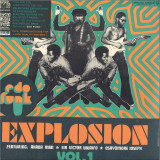
- A1: Africa Is My Root - Osayomore Joseph And The Creative Seven
- A2: Ta Gha Hunsimwen - Akaba Man The Nigie Rokets
- A3: Popular Side - Akaba Man And The African Pride
- B1: Iranm Iran - Victor Uwaifo And His Titibitis
- B2: Sakpaide No 2 - Victor Uwaifo And His Titibitis
- B3: Ta Ghi Rare - Akaba Man The Nigie Rokets
- C1: My Name Is Money - Osayomore Joseph
- C2: Ogbov Omwan - Akaba Man The Nigie Rokets
- C3: Aibalegbe - Victor Uwaifo And His Titibitis
- D1: Who Know Man - Osayomore Joseph And The Ulele Power Sound
- D2: Obviemama - Victor Uwaifo And His Titibitis
- D3: Ororo No De Fade - Osayomore Joseph And The Ulele Power Sound
Analog Africa Presents Edo Funk Explosion Vol. 1, available on
2xLP/Gatefold LP with 20-page booklet / CD with 36-page booklet. It was
in Benin City, in the heart of Nigeria, that a new hybrid of intoxicating
highlife music known as Edo Funk was born.
It first emerged in the late 1970s when a group of musicians began to experiment with different ways of integrating elements from their native Edo culture
and fusing them with new sound effects coming from West Africa s night-clubs.
Unlike the rather polished 1980 s Nigerian disco productions coming out of the
international metropolis of Lagos Edo Funk was raw and reduced to its bare
minimum.
Someone was needed to channel this energy into a distinctive sound and Sir
Victor Uwaifo appeared like a mad professor with his Joromi studio. Uwaifo
took the skeletal structure of Edo music and relentless began fusing them with
synthesizers, electric guitars and 80 s effect racks which resulted in some of the
most outstanding Edo recordings ever made. An explosive spiced up brew with
an odd psychedelic note known as Edo Funk.
That’s the sound you’ll be discovering in the first volume of the Edo Funk Explosion series which focusses on the genre’s greatest originators; Osayomore
Joseph, Akaba Man, and Sir Victor Uwaifo: Osayomore Joseph was one of the
first musicians to bring the sound of the flute into the horn-dominated world
of highlife, and his skills as a performer made him a fixture on the Lagos scene.
When he returned to settle in Benin City in the mid 1970s - at the invitation of
the royal family - he devoted himself to the modernisation and electrification
of Edo music, using funk and Afro-beat as the building blocks for songs that
weren’t afraid to call out government corruption or confront the dark legacy of
Nigeria’s colonial past.
Akaba Man was the philosopher king of Edo funk. Less overtly political than Osayomore Joseph and less psychedelic than Victor Uwaifo, he found the perfect
medium for his message in the trance-like grooves of Edo funk. With pulsating
rhythms awash in cosmic synth-fields and lyrics that express a deep personal
vision, he found great success at the dawn of the 1980s as one of Benin City’s
most persuasive ambassadors of funky highlife.
Victor Uwaifo was already a star in Nigeria when he built the legendary Joromi
studios in his hometown of Benin City in 1978. Using his unique guitar style as
the mediating force between West-African highlife and the traditional rhythms
and melodies of Edo music, he had scored several hits in the early seventies,
but once he had his own sixteen-track facility he was able to pursue his obsession with the synesthetic possibilities of pure sound, adding squelchy synths,
swirling organs and studio effects to hypnotic basslines and raw grooves. Between his own records and his production for other musicians, he quickly established himself as the godfather of Edo funk.
What unites these diverse musicians is their ability to strip funk down to its
primal essence and use it as the foundation for their own excursions inward to
the heart of Edo culture and outward to the furthest limits of sonic alchemy.
The twelve tracks on Edo Funk Explosion Volume 1 pulse with raw inspiration,
mixing highlife horns, driving rhythms, day-glo keyboards and tripped-out guitars into a funk experience unlike any other.
DJ Sotofett and LNS have teamed up with Tresor Records for Sputters. The double-vinyl album with 15 cuts spans a hybrid of warped electro and psychedelic hypnosis, all the while remaining fixed in an unmistakable dance release. Recorded between 2017 – 2020, and bookmarked throughout by intros and interludes dug out from archival material, it's a deconstructed yet classic compound of techno-sonics.
LNS from Calgary, Canada, is rooted in braindance, electro and acid. Releasing 12inches on both her self-titled imprint LNS and Sotofett’s Wania - LNS, whilst in the studio, has often pointed out “the lacking blend of dub and electro in dance music”.
DJ Sotofett, hailing from Moss, Norway, is among a myriad of things commonly known for the extended work of his Sex Tags Mania and Wania labels, without forgetting his afro, dub and jazz releases on Honest Jon's London.
Together both artists give space to a guest appearance by E-GZR, a fellow Wania artist, to open the Sputters journey. The sinus bending drum stutter of K.O. by E-GZR collisions flanging basses and chronic-inducing synth pads to blueprint the technoid atmosphere to come. LNS & DJ Sotofett take control with El Dubbing, evoking an effect-heavy demeanour, typical of the Sex Tags Mania soundworld that DJ Sotofett is responsible for, this time rubbing up against solid electrified rhythms. The hypnotic moods carry over to Dúnn Dubbing's deep delays, freely running over a surprisingly minimal skeleton retaining a solid direction. Crafting a warmly emotive end of Side-A with sparse rhythms to perfection.
A meaner turn introduces Side-B. Hints of electro are scattered everywhere, fat basslines, ricocheting drums and synths that mourn and drift in and out of harmony. Vitri-Oil exposes a tumbling sound design, fog-lit chords of material fragility and nosedives - with an alive mix that wallows and grows in equal measures. The side closes with Shim, a classic drift between house and techno releasing sensual euphoria with the albums first big surprise – grand strings.
“LNS wanted to sell her TR-606, while my reply was for us to make a track with the 606 sounding so fresh that she'd never even think about selling it again” Sotofett states. Side-C proves the artists to be some of the most singular producers around with album centrepiece The 606. Clocking in over 10 minutes, it kicks off as a driving techno banger, chugging bass and big chords. Midway through everything falls away, and out of the void enter scattered drums and improv piano lines emerge, while twisted dubs lead us back in an enduringly warm groove.
Side-D sets the clock back to the original electroid foundation of the album, casting fires with alien vibrations. Synchronic Bass Blort is a hard-hitting electro track, steaming sonics and thrills, its melodic hook diving in subterranean motions. On Sputtering the duo raspily beams into outer space, with fizzy motives that disfigure and dazzle while the harmonies of the closing track is for yourself to experience.
DJ Sotofett and LNS deliver an album inhabiting a world full of sci-fi sonics and fierce groove. Their sound is free and live, simultaneously wondrous and sharp.
Snapped Ankles return to the forest, but it's not as they left it. Trees planted in neat rows. A well-ordered monoculture with access roads and heavy machinery. The smell of greenwashed money in the air. There's no sign of the ancient woodland they emerged from on debut album, Come Play The Trees. And it's far cry from the gentrified East London they found themselves hawking on Stunning Luxury. All is not well in the face of progress. Welcome to the Forest Of Your Problems. Even among the famously close-knit woodwose community there are factions forming. Meet The Business Imp, The Cornucopian, The Nemophile and The Protester. Each with their own motivations and belief systems. Their own sense of injustice: contradictions, anxieties and guilt. There are woodwose who have risen to the top in the boom and bust world of real estate and hedge funds. Grab what you can before the next crash. Others find euphoria in the absolute conviction that wealth and technology will see us through this. There are those with their recycling in order, who are well-versed in the prospect of imminent ecological and economic collapse, burying themselves in vegan cookery and extensive international holiday itineraries. And there's an increasing number angry at the state of the world, ready to take to the streets and the trees in an attempt to force real change. Forest Of Your Problems runs the gamut of modern woodwose emotions. In this neat human approximation of the forest, it's an increasingly knotted affair. Despite all of this, Snapped Ankles haven't lost their innate ability to make you want to move your feet - their Teutonic forest rhythms are still shot through with post-punk lightning. Whether they're exploring those opportunities which might arise when a Nigerian prince emails out of the blue on 'The Evidence', or referencing the crooked woodwose attempting to go straight on 'Rhythm Is Our Business', this is music to lose your inhibitions to. The moments of pure elation on 'Shifting Basslines Of The Cornucopians' are worth the admission price alone - "It's a great time to be alive!" ...apparently. Snapped Ankles outsider status has always allowed them to hold a mirror up to society. Now the boundaries are not so clear. In the four years since Come Play The Trees was released, their cult has flourished. Previous album Stunning Luxury saw the band invited to play the BBC 6 Music Festival and a KEXP session on the back of a sold-out UK tour which culminated with two nights at Village Underground in London. As those who have witnessed the shamanic ritual of their live shows will attest, they are a truly unique, communal experience. Forest Of Your Problems will see the woodwose bring their ancient forest rhythms and high-wire, multi-media live act to ever bigger stages - including Camden's iconic Roundhouse in October.
Yen Tech’s second album is fully eye-popping cyber-theatrical medieval deconstructed nu-metal. Like Amnesia Scanner banging out Slipknot covers with Siri and Arvo Pärt in a distant space prison.
‘Assembler’ is a bizarre record, even for SVBKVLT. Yen Tech’s debut “Mobis” was a future-facing hi-tech part rap deconstruction, all blitzed trap and vaporwave shimmer. “Assembler” is completely different proposal, addressing the post-COVID world with growling anxiety and lavish, multidimensional digital fireworks.
Hoarse semi-human vocals are meticulously painted over hydraulic, machine-gun kicks, drunken synth drones and simulated choirs. Techpilled harpsichord chimes burp and resonate over swirling, supernatural soundscapes, while alien chatter butts heads with disembodied artificial voices. “Herd immunity,” a voice echoes on ‘Leech’, as unsettling drones build through clouds of white noise.
Yen Tech takes Amnesia Scanner’s dystopian deconstructed airlock club template and debones it to fit the actual dystopia of 2021. Jarring, fanged and packed with sneering nu-metal adjacent attitude, “Assembler” sounds as awkward and genre-allergic as an algorithmic playlist. It’s an uneasy listening experience that’s both familiar (‘Extinction Game’ is almost chart-ready future pop) and defiant all at once.
Following the release of Limewax's Untitled and Speed Dealer Moms' SDM-LA8-441-114-211, Trickfinger and Aura T-09's Evar Records imprint is keeping its foot on the gas, officially introducing the arrival of its sub-label, RAVE4EVAR. Embracing more of an outlaw mindset, RAVE4EVAR was created as a place for rebellion to collide with rave, offering refuge for off-the-cuff releases, special projects and occasional one-off collaborations.
Ushering in the sub-label's inaugural release, RAVE4EVAR is proud to present Chicago-based DJ, producer and new media artist S4M23's debut EP, Angelface. The five-track project, set to arrive on July 2nd via a limited edition cassette and digital download, combines haunting vocals with pounding kicks and rave synths to create a moving take on hardcore. Written and recorded during a weeklong session in April 2020, the creation of Angelface took place during a period of processing grave personal loss juxtaposed with the collective state of chaos, grief and fear brought on by the covid-19 pandemic.
Within that specific period of time, S4M23 channeled intense emotion to reflect how cathartic it can be to honor the connections we build with one another despite how frenetic and heart-wrenching the circumstances of a particular moment or experience can be. Pouring an immense spectrum of emotions into Angelface, these productions eschew simple repetition to create unexpectedly complex rhythms and textures that evoke the sounds of British club music and '90s rave, while simultaneously creating something entirely new.
Nimbus West spirit jazz essential: the Creative Arts Ensemble's classic debut One Step Out. One of the most sought after and highly-regarded titles to have appeared on Tom Albach's celebrated Nimbus West imprint, One Step Out is a timeless work of spiritualized jazz. A true gem from the Los Angeles jazz underground, the album was pianist and composer Kaeef Ruzadun Ali's first recording as leader of the Creative Arts Ensemble, the only large ensemble group that emerged directly from Horace Tapscott's legendary Pan Afrikan Peoples Arkestra community jazz group. A Los Angeles native, Kaeef was introduced to the Tapscott circle in the late 1970s. His first experience of the Arkestra's ethos was through PAPA tenorist Michael Session, who took him to the famous "Great House" at 2412 South Western Ave., LA -- a large mansion house which members of the Arkestra had taken over as a space for communal living. Life in the Great House was a continuous stream of music, dance and community events. "When I walked in there," recalled Kaeef, "it was like this whole rush came over me, just from going in the front door -- It was like a very, very warm feeling of love. I went and I came out with 'Flashback Of Time', and that was my first arrangement." Kaeef quickly became a significant contributor of compositions to the Arkestra's songbook -- his piece "New Horizon" would be recorded by Horace Tapscott for the latter's Tapscott Sessions series. But "Flashback Of Time" would eventually appear on One Step Out, played by the new group he had put together from stalwart Arkestra members. Inspired by both Tapscott's example and by the Art Ensemble of Chicago, Kaeef had wanted to follow their lead by assembling a larger unit. Featuring seasoned Arkestra regulars including reedsman Dadisi Komolafe, drummer Woody "Sonship" Theus and altoist Gary Bias, with veterans Henry "The Skipper" Franklin on bass and George Bohannon on trombone, One Step Out is a key document of the Los Angeles radical jazz underground. Featuring the sanctified vocals of Kaeef's sister, B. J. Crowley, the album is a tour de force of spiritually energized independent jazz music.
Re-mastering by: Ray Staff at Air Mastering, Lyndhurst Hall, London
Morgan was one of the most active artists in the Los Angeles underground jazz scene, and a member of the late great Horace Tapscott‘s artist collective Union of God’s Musicians and Artists Ascension (UGMAA). He performed alongside Tapscott, and other Nimbus recording artists like Jesse Sharps, who he introduced to Tapscott. He also performed with Arthur Blythe, Gary Bartz, Azar Lawrence, as well as soul icons Willie Hutch (notably on the Foxy Brown soundtrack) and Rufus & Chaka Khan. Most recently he contributed to Carlos Niño’s 2016 album Flutes, Echoes, It’s All Happening!, and was a part of Niño and vocalist Dwight Trible’s soul-jazz group Build An Ark (which also featured Tribe’s Phil Ranelin).
Journey Into Nigritia was Morgan’s debut as a leader, and the first of three recordings he released for Nimbus West. The album has a strong post-Coltrane spiritual feel, with some modal-based melodies, and some fiery solos from saxophonist Dadisi Komolafe. The record also features a solid rhythm section featuring bassist Jeff Littleton and drummer Fritz Wise.
Review by T J Gorton
At the dawn of the Reagan years, LA jazz pianist Nate Morgan recorded his first album for Nimbus West. Journey Into Nigritia portrays an artist marked by the icons of his day, and striving for reinvention. Although he came from a solid jazz background, coming up through the Pan Afrikan People's Arkestra, Morgan found more exciting work with pop bands in the seventies, including glory years with Rufus w/Chaka Khan. On Journey into Nigritia, Morgan re-embraces jazz. Included in the band are Jeff Littleton on bass, Fritz Wise on drums, and Dadisi Komolafe on alto sax.
The collection opens with the Trane-ish Mrafu. Komolafe blasts off in short order, and while the modal chording recalls Tyner, Morgan shows flashes of the nimble loquacious gift that define him. While Alice Coltrane incense perfumes "Morning Prayer, Morgan's devotional sincerity and personnel expression triumph.
Suitably complex with yearning minors, Mother features the trio performing a memorable composition. Littleton's deep-note sustain contrasts Wise's shimmering cymbals, while Morgan tells heart-wrenching truth. With a somewhat solemn theme, He Left Us a Song regularly bursts through into straight-ahead fast break sprints up and down the court. The unexpected "Study in C.T. offers an homage to Cecil Taylor and Morgan's musical roots with free improvisations on a dense and spiky theme. The exhilarating result has Morgan exploring his own way, with a winking slinging of jagged bass chords halfway through.
While a quarter century's experience has nurtured Morgan's prodigious gifts beyond this ambitious debut, Journey Into Nigritia offers enjoyable insights into his artistic evolution, while adding another precious title to the discography of one of the most woefully under-recorded greats of our time.
The Miami Maestro is back with a superb slice of moody, mid-tempo Latin Soul. Anyone who has had the pleasure of seeing one of Jason's passionate live performances can attest that he exudes raw energy and emotion on a level seldom seen on today's soul scene - attributes that Jason delftly applies to the pen.
Drawing from personal experience, “Se Acabó” is a bilingual lament about the challenges of navigating mental illness within the context of a romantic relationship. Jason pleads "Her heart was a butterfly flying through the winds of the hurricane of her mind" as he comes to grips with the fact that in spite of his undying love she may never return.
Accompanied by a grooving, unrelenting beat, he distills the pain down to an elixir of high-proof soul sure to requite the lovelorn among us. Yet another Penrose playbox essential by one of the hardest working players in the game.
Hong Kong based hypno-tropicalia duo Blood Wine or Honey are set to release their second album 'DTx2' on 30th June 2021. Made up of seasoned multi-instrumentalists James Banbury (synths, bass, percussion, cello) and Joseph von Hess (vocals, clarinet, sax, percussion), they create a heaving, heady brew of brazen sax themes, lo-fi/hi-tech electronics, densely layered cello inflections and motorik drums.
These explorations start with the dance-floor then go above and beyond, taking notes from post-punk and tropical polyrhythms, always anchored by the bass weight of the sound system. Their distinctive sound is created in the industrial warehouses and hidden rural settlements of Hong Kong, surrounded by the low-end throb of heavy machinery, the lingering scent of hand sanitiser and the humidity of the South China Sea.
Written and recorded during 2020-21, new album 'DTx2' looks ahead to an uncertain future, drawing deep on their experiences and influences and welcoming a host of co-conspirators.
Jean Daval, aka Preservation (credits include Yasiin Bey fka Mos Def, MF Doom, RZA, GZA, Raekwon, KRS-One, Aesop Rock), provided truffle-hunted beats, synths and basses, which, when put through the BWoH mangle, emerged as 'Messenger'.
Superstar and old friend of the band KT Tunstall came to work with BWoH after they contributed a DJ mix for her lockdown 'KTRave' on Instagram. 'Attraction' was the result. Wonky bass, found-bounce beats and Buddy Rich drums smashed out by Tim Weller (Marc Almond, Future Sound of London, Goldfrapp, The Chemical Brothers, David Axelrod) resulted in a bonkers production with passionate vocals and layers of harmony.
'I Shall Rush Out As I Am' is a collaboration with legendary pop provocateur Paul Morley and Janice Lau of Hong Kong band David Boring. The track is based on the words and the spirit of sci-fi writer, satirist, literary critic and radical feminist Joanna Russ and took shape quickly, with tinges of A Certain Ratio and memories of Suicide, provoking Janice to an authentic scream-of-consciousness delivery.
Multi-talented London singer, musician and composer Kamal (Neighbourhood Recordings) took time away from being the Next Big Thing to transform 'Testing Time' with funk-edged keys. A key figure in the extraordinary '90s Hong Kong music scene, Zoë Brewster contributed vocals.
Roughly divided, the album's first set of songs make relatively short statements, punchily self-contained with common threads. The final four tracks, Testing Time, Embers, Embrasure
and Echt Embrace disperse into flights of mantric fantasy, with quicksand time-signature shifts and key-changes emerging into a more introspective zone with a fervent pulse, a shift in energy: stamina over speed.