Lancaster had initially cut his musical teeth with the avant-garde on New York’s Lower East Side in the 1960s (famously on sessions with pianist Dave Burrell and drummer Sunny Murray) and in Paris during the ‘70s after an appearance at the Actuel festival but, throughout his career, his path was built around community engagement, positivity and “the Philly jazz sound, Germantown style.” He became an ambassador for the music of the City Of Brotherly Love, starting his own Dogtown label, helping launch the Philly Jazz imprint and campaigning tirelessly to improve the circumstances of the city’s street musicians. Lancaster’s sessions for Black Fire were planned following a gig at Caverns Jazz Club in Washington DC. “Jimmy Gray of Black Fire and I originally met during the ‘riotous blisters’ of the late Sixties there,” explained Lancaster. “We became the best of friends.” Backed by a band of Philly musicians including percussionist Keno Speller and Baba Robert Crowder (drummer for Olatunji and Art Blakey), the album also featured the Drummers From Ibadan led by Tunde Kuboye, another influential figure dedicated to community jazz with whom Lancaster had bonded while teaching in Lagos. The result was a free-flowing set of spirituality and positivity, built around full band groove workouts, solo pieces and heavy African roots. “We had big fun documenting this music,” remembered Lancaster. The message of the album remains as relevant today as ever, “I dedicate this album to all African Americans in the USA. To the youth, I ask ‘What does it profit a man to gain the whole world and lose his soul?’”
Buscar:ku bo
- Engineering Systems
- The Latent Space
- Speech And Ambulation
- Thousand To One
- Walking And Talking
- Youmachine
- Doublekeyrock
- Machine Rights
- Go Tick
- The Fear Of Machines
- Artificial Authentic
- Machine Perspective
- Cut That Fishernet
- Tools Use Tools
- Loose Tools
- Seven Months
- Paymig
- Borrow Signs
- New Definitions
- New Life Always
- Announces Itself
- Through Sound
Mouse on Mars, the Berlin-based duo of Jan St. Werner and Andi Toma, approach electronic music with an inexhaustible curiosity and unparalleled ingenuity. ‘AAI’ (Anarchic Artificial Intelligence) takes their fascination with technology and undogmatic exploration a quantum leap further.
Emerging from a primordial ooze of rolling bass and skittering electronics, hypnotic polyrhythms and pulsing synthesizers propel the listener across the
record’s expanse. Hidden in the duo’s hyper-detailed productions is a kind of meta-narrative.
Working with AI tech collective Birds on Mars and former Soundcloud
programmers Ranny Keddo and Derrek Kindle, the duo collaborated on the creation of bespoke software capable of modelling speech; text and voice from writer and scholar of African Studies Louis Chude-Sokei and DJ/producer Yağmur Uçkunkaya were fed into the software as a model, allowing Toma and Werner to control parameters like speed or mood, thereby creating a kind of speech
instrument they could control and play as they would a synthesizer.
The album’s narrative is quite literally mirrored in the music - the sound of an artificial intelligence growing, learning and speaking. This exploration of artificial intelligence as both a narrative framework and compositional tool, allowing the duo to summon their most explicitly science-fiction work to date. Original artwork by Casey Reas, inventor of the computer graphics language Processing.
Recently, Mouse on Mars received the 2020 Holger Czukay Prize for Pop Music.
Mouse on Mars have been regularly streaming performances throughout 2020, partnering with organizations like Goethe-Institut, Haus der Kulturen der Welt, Conditions of a Necessity and others and will continue these in 2021.
‘AAI’ is available on grey or black double LP packaged in a single sleeve with full colour insert / lyrics. CD comes with 8-panel poster booklet.
“Andi Toma and Jan St. Werner continue to create soundscapes that blur the line between programming and live musicianship, and sometimes between Earth and outer space.” - AV Club
“Enthralling and impossible to categorize.” - Pitchfork
“Sustained and ephemeral electronic sounds conjure unearthly open spaces… It’s not a song; it’s sound as a temporal phenomenon, a few minutes of sculpted attention.” - The New York Times
About a hundred kilometers south-west of Bamako, on the left bank of the Niger River, the Malian village of Kela is known to be home to a large community of griot musicians (jeliw) mostly belonging to the Diabaté family. Their art is recognised throughout West Africa and many griots come from all over the world to stay there, sometimes for several years, in the hope of becoming immersed in it. The six pieces for voice accompanied by guitar or traditional koni lutes were recorded in 1978 (tracks 3 to 6) and in 2019 (tracks 1 to 3), in the same traditional dwelling, which still serves as a "studio". The accompanying booklet contains the testimonies of several important musicians who took part in the recording, and evoke key elements of their universe
Points of interests
- For the fans of the traditional repertoires of Mali's famous griot musicians.
- For music lovers who love the voices accompanied by the guitar and the traditional lutes of the griots.
- Recordings made 40 years apart in the same "studio": a dwelling located in the village of Kela (Mali), from where famous lineages of griots originate.
- Original sound archive on magnetic tapes, digitised and restored in 2019.
- Fourteen colour photographs, taken in 1978 and 2019 at the same time as the sound recordings.
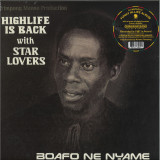
A spectacular Hi-Life album with funky digital touches from the great Ghanaian producer Frimpong Manso.
Recorded in 1987 at Ghana Films Studio in Accra, the album Boafo Ne Nyame, that we can translate as “Helper is god”, is led by the great and sweet voice of K. Adusei.
Five long tracks filled with hypnotic hi-life grooves and many funk inflexions that go way beyond lots of standard riffing of modern Afro Funk. The track “Asem De Ye So” (There's a problem on us) is a dancefloor-friendly song, already known from connoisseurs and maybe a future anthem when the clubs will reopen!
Manso Frimpong was born Feb 21st at Nkawkaw and sadly died Nov 23rd 2016 in Kumasi.
Digging deep through old and new, Basso captures arcane woodland fusion, serene electronic suites and wide eyed Balearic bliss on this first Growing Bin compilation.
This collection celebrates those precious records which land in your life on their own terms. Even the most advanced digger will admit that chance is the secret ingredient in any successful haul. Sure, it helps if you know where to look, but if you arrive a day early at that secluded second hand shop, or an hour late at the convention, you might miss out on a rare sight of sound. But there are still ways to skew the odds in your favour. Even in the most crowded urban environment, a solitary tree soon becomes a nest, and Basso's fostered an abundant garden in his Hamburg hometown. A decade on and the Growing Bin is a safe haven for those exquisite sounds crowded out of the mainstream, the rare birds with the most striking song.
'Coffee' comes right after cocoa in the bin's headquarter, though start your morning with One Tongue and be prepared for a different kind of day. A witch's brew spiced with a hint of Durian and the early bird, this 1990 composition could be the blueprint for the Teutonic trance dancers beloved by the Salon set. A more meditative magic flows through the A2, a smooth blend of fusion guitar, softly syncopated drums and counterpoint keys from one time art-rockers Inandout. This Growing Bin favourite from their '93-95' LP sounds right at home beside the majestic melodies and spheric bass of Matthias Raue's 'Brücke am schwarzen Fluss 2'. Taken from the soundtrack to a TV drama filmed in Mali, this digital homage to African rhythm shimmies in step with New Age dancers from Mkwaju Ensemble and Louis Crelier. The A-side ends with the unbridled optimism of Kosmische maverick Hardy Kukuk. The synthesist hit the studio with friends Karsten Raecke and Andreas Schneider in 86, coalescing crystalline electronics and gentle guitar into tender chord progressions suited for sun bathing beside the Sea of Tranquility.
The second side slinks into motion with the deep beauty and sincere spoken word of Frank Suchland's 'Schnee', a subtle body in a cocoon of reverb which takes Sade's 'I Never Thought I'd See The Day' to another level of placidness. Melancholic Germans Die Fische met in Cairo for the first time, and 'Conversation Of Everyday Lovers' could be the theme for that great city. Underpinned by primal percussion and a restrained groove, the track twists and turns between a trio of ineffable motifs, eternal combinations to the catacombs of Abusir. From there we go sublime, soaring skywards with a ten minute triumph from Hugh Mane. Balancing concentric sequences and space age synth riffs atop an irresistible breakbeat and bubbling bassline, the British producer finds a sensuous sweet-spot between fellow Growing Bin affiliates Krakatau and Singu.
Lucky are we who hear the Bin's sounds.
Patrick Ryder
- 1: Introduction
- 2: I Can't Stand It
- 3: Damaged Goods
- 4: (You Gotta) Fight For Your Right (To Party!)
- 5: The Crystal Ship
- 6: Pump It Up
- 7: Love Is The Drug
- 8: Big Sky
- 9: Queen Bitch
- 10: Bike
- 11: Mirror In The Bathroom
- 12: E.m.i
- 13: The Lovecats
- 14: Drive My Car
- 15: Caught By The Fuzz
Die Hot Rats waren Gaz Coombes (Supergrass) und Danny Goffey die sich den Spaß machten Songs ihrer Jugend zu covern. Überwacht hat das Ganze dann noch Star-Producer Nigel Godrich. Neben Songs von Bowie, Kinks, Velvet Underground, Sex Pistols u.a. 2010 ging das Duo auf eine kurze Welt-Tour mit Stationen in NewYork, Mexico City, London, Paris oder auch Tokyo. Und hier wurde das lärmende Live-Vermächtnis des Duos festgehalten. 'Live In Tokyo' komm mit 15 Tracks, 180 Gr. Black Vinyl und seitlichem Obi-Strip wie sonst fast nur bei Japan-Releases üblich!
'Open Door Policy' is The Hold Steady's 8th full length studio album and the follow up to 2019's 'Thrashing Thru The Passion'. Produced by Josh Kaufman (The National, Hiss Golden Messenger, Josh Ritter), this new release once again finds the 6-piece line up in peak form in what Craig Finn describes as "the best band we've ever been". The Hold Steady is: Bobby Drake (drums), Craig Finn (vocals), Tad Kubler (guitar, vocals), Franz Nicolay (keyboards), Galen Polivka (bass), and Steve Selvidge (guitar, vocals).
More than 40 years after its original release, this limited and numbered facsimile edition of Keith Jarrett’s legendary 10-LP box set “Sun Bear
Concerts” is recreated from original analog sources.
Sun Bear Concerts - documenting five complete solo performances by Keith Jarrett in Japan - counts as a milestone achievement in the history of jazz recording. As Down Beat wrote, on the occasion of the original release, Jarrett’s improvisations are “the inventions of a giant, overpoweringly intimate in the way they can draw a listener in and hold him captive. Jarrett has once more stepped into the cave of his creative consciousness and brought to light music of startling power, majesty and warmth.”
Rich in incident and detail, the music in this beautifully produced, illustrated and presented ten-LP set, first issued in 1978 revealed Jarrett as a player of limitless creativity, unique in his ability to find new forms in the moment, night after night. “These marathons showed Jarrett to be one of the greatest improvisers in jazz,” Ian Carr wrote in his biography of the pianist, “with an apparently inexhaustible flow of rhythmic and melodic ideas, one of the most brilliant pianistic techniques of all, and the ability to project complex and profound feeling.” The present edition is a facsimile of the original LP set, described by the late Haus der Kunst curator Okwui Enwezor as “part of ECM’s declaration of independence from standard packaging of jazz records. Setting itself apart in this way, ECM treated its recordings as works of art by musicians of the highest artistic and conceptual order.”
A work of art by any standards, Sun Bear Concerts brings together solo concerts in November 1976 in Kyoto, Osaka, Nagoya, Tokyo and Sapporo, in recordings made by Japanese engineer Okihiro Sugano and producer Manfred Eicher, who travelled through Japan with Keith Jarrett. The set’s book-form packaging, with design by Barbara Wojirsch, includes photographs by Klaus Knaup, Tadayuki Naitoh and Akira Aimi.
Green Marbled Vinyl
Polifonic Records is the melodic balance between antagonistic vibrations, spirits and energiesthat inhabit the land of Puglia since the dawn of time.
An harmonic exploration into colorful, vibrant sunrise atmospheres and emotional, introspectivesunset sensations. One Body. Many Souls.
PF001 // The Frst installment comes with four contributions by festival aliates and long timefriends - from the explorative psychedelia of Francis Inferno Orchestra and the introspectiveexotica of Simone de Kunovich, to the playful 707- ish mediterranean vibes of Jolly Mare and thebalearic uplifting arpeggios of Yanik Park.
The package represents indeed a tribute to Itria, the magic Valley placed between two seas,Adriatico and Ionio, in the earth of Regione Puglia.
Jupiter, the gas giant in our Solar System, with thunderstorms a thousand times more powerful than on Earth, rainfalls of diamonds in the atmosphere, temperatures below -100°C, plenty of hydrogen, 79 moons and a South pole that looks like an abstract painting, has just the kind of environment this music seems to emanate from.
Jupiter and Beyond, the second collaborative effort of composer/performer Rafael Toral and percussionist João Pais Filipe as a duo (after Saturn in 2016), is definitely not quite a record of Earth music. On the contrary, Jupiter and Beyond, is indeed gas music, unfolding over two long movements without solid body or any tangible outline, between ambient and noise. A music of sheer volume and beauty, icy, massive, in which the elements of Toral's signature, in particular his use of jazz-inspired electronics and feedback, dissolve to become a labile, nebulous, expansive material, occasionally struck by abyssal depressions and masterful densities, magnified by the return, after 17 years of silence, of the electric guitar in Rafael Toral's instrumentarium.
Towards the end of Beyond, the second piece on the record, lurking behind the volutes of feedback, a bell and a bass drum, one can detect from the distance... a barking dog, as a surreptitious and prosaic reminder of where we are here and now, a calling back to Earth. Between sadness and joy, anger and peace, movement and stillness, Jupiter and Beyond is indeed a mirror held out to us, music reflecting our times and that emotionally speaks first of all about us.
"While João Pais Filipe was drummer in the Space Quartet, we played a live duo set. During soundcheck we were jamming for a while on bowed gongs and feedback and lost track of time, it just flowed so well. I joked "we could make a whole record with this!". But later we took the idea seriously and set to record an improvised session at his cymbalsmith workshop (he made the gong on the cover and it was used in the recording). When we listened to the first take the mass of sound was amazing. At some point it reminded me of the complex clusters of sound in Ligeti's music as it appears on Kubrick's 2001 scene "Jupiter and Beyond the Infinite". In the end the title felt like an apt choice for Saturn's successor. Back at my studio I felt the need for some more layers of density in some sections. I thought of using trombones, but ended up picking up the electric guitar, which I hadn't used since 2003.” Rafael Toral
- A1: Pa Pa Pa (Lp1 Stop The Hate)
- A2: As We Struggle Everyday
- A3: Stop The Hate
- A4: Land Grab
- A5: Na Bigmanism Spoil Government
- B1: You Can't Fight Corruption With Corruption
- B2: Show Of Shame
- B3: Privatisation
- B4: Set Your Minds & Souls Free
- C1: Free Your Mind (Lp2 For(E)
- C2: Your Enemy
- C3: Blood
- C4: Different Streets
- D1: Higher You'll Find
- D2: Hymn
- D3: Young Lady
- D4: We Are Strong
Legendary activist and Afrobeat originator Fela Kuti used his
music to lament social injustices and political corruption in his
native Nigeria. Fela’s legacy spans decades and genres,
touching on jazz, pop, funk, hip-hop, rock and beyond. While
this impact can be felt in Nigeria and the entire world, it also
greatly affected Fela’s son Femi and his son Made, both of
whom carry his legacy as torchbearers for change. Partisan
Records release two albums from Femi and Made, packaged
together and appropriately titled ‘Legacy +’.
Both albums that make up ‘Legacy +’ are steeped in the
tradition of Afrobeat invented by Fela but each also offers their
own unique vision.
Femi’s ‘Stop The Hate’ honours Fela in a traditionally fun,
sharply political and affirming way. Meanwhile Made’s
‘For(e)ward’ is a modern and progressive freedom manifesto,
pushing boundaries of the subgenre even further. Made also
performs every instrument on his album.
Both albums also feature portraits of Femi and Made, done by
Brooklyn-based artist Delphine Desane, whose work was
recently featured on the cover of Vogue Italia.
“The album title ADELA comes from a song by Rodrigo which constitutes the emotional culmination of our duo’s programme. What counts is not the name, but the person we love and long for. Everyone certainly has such a person, and so we hope that each listener will find something close to his or her heart on our album.
The piano and classical guitar virtually never collaborate in music. However, after our first joint performance with Łukasz Kuropaczewski, we immediately realised that we could create intriguing music worlds together. We followed the same line of thinking in our choice of programme, which derives from both the piano and guitar repertoires, though the spirit of the South that informs most of that music is more typically associated with the guitar tradition. In my arrangements of classical works, I strove to represent the sonic qualities of both instruments, their unique expression, and cultural associations. I reworked Domenico Scarlatti’s famous “Sonata in D Minor (Toccata)” K. 141 so as to bring out its Spanish roots. Titled “Domingo” on our album, it features distinctive flamenco qualities and an improvised layer. The “Aranjuez Concerto BWV 1056” is, as its very name suggests, a fusion of the world’s most famous piece for guitar and orchestra, Joaquin Rodrigo’s “Concierto de Aranjuez”, with Johann Sebastian Bach’s “Keyboard Concerto in F Minor” BWV 1056. Themes from the second, slow movements of both concertos interlink here as in the film cross-cutting technique, and we swap roles, Łukasz leading the Bach theme while I take up Rodrigo’s.
Three of the works on this album have been enriched by the angelic voice of Jakub Józef Orliński. In these three, Egberto Gismonti’s guitar composition “Água e Vinho”, my own “Quarantine Song”, and even the famous “Adela” by Joaquin Rodrigo, the voice has been treated more as an instrument than a lyrical subject. “Quarantine Song” was composed during the COVID-19 quarantine in 2020 specially for Jakub Józef Orliński as its performer. “Pedro” was inspired by the films of Pedro Almodóvar.
[c] A3. Água e Vinho [feat. Jakub Józef Orliński] - Egberto Gismonti
[f] B2. Quarantine Song [feat. Jakub Józef Orliński] - Aleksander Dębicz
[h] B4. Adela [feat. Jakub Józef Orliński] - Joaquín Rodrigo
- A1: Aussen (Feat Tre B Mal)
- A2: Opus 23 (Feat Hexia)
- A3: Brack St Twen (Feat Cole Collective)
- A4: 27 Secrets (Feat Bob Drew)
- A5: Mind No Ever No Xxx (Feat Hrafnhildur Melsted)
- A6: Flow (Marked Red) (Marked Red)
- B1: To The Bone (Feat Grand Ox)
- B2: San Remo (Feat Giovanni Dimachelli)
- B3: Juice Tonight (Feat Pernille Solberg)
- B4: Dorian (Feat Martin Stollmayr)
- B5: Thema Zwei (Feat Maral Moradi)
- B6: Spheres (Feat Room Trail)
- B7: Bolero Azul (Feat Las Abuelas)
- B8: I Thought Of Ian (Feat Ging Gang Gong)
„Lamberts Musik bricht gängige Hörgewohnheiten“ – Die Welt Lambert ist ein Unikat, und das nicht etwa nur etwa deshalb, weil er seine Musik versteckt hinter einer in
Sardinien handgefertigten Ledermaske zum Besten gibt und kein Zuhörer sein Antlitz bislang zu Gesicht bekam. Bereits mit seinem letzten Album “True” ist der Berliner Pianist und Komponist Lambert ganz anonym in die unterschiedlichsten musikalische Identitäten geschlüpft. „Die Miniaturen von Lambert, der ausschließlich mit Maske auftritt, zeugen von einem enormen Gespür für Melodien.“ – Rolling Stone Nun erscheint mit “False” bereits das fünfte Album des inspirierenden Künstlers für welches er für jedes einzelne Stück ein besonderes Alter Ego kreierte, um das Verwirrspiel um seine Identität perfekt zu machen.
Bei Lambert hat diese Verhüllung etwas poetisches, das sein meditativ impressionistisches Klavierspiel im
Niemandsland zwischen Klassik, Jazz und Pop noch etwas entrückter und verzauberter klingen lässt. Lamberts Welt ist nicht nur geheimnisvoll, sondern auch randvoll mit genialer Musik, die sich mit jedem
Titel neu erfindet. 14 neue Kompositionen mit 14 verschiedenen Gesichtern — so erweitert Lambert sein
musikalisches Schaffen um eine breite Fülle stilistischer Einflüsse.
OPAQUE GARAY VINYL
SUMAC (Aaron Turner on guitar and vocals, Nick Yacyshyn on drums, and Brian Cook on bass) invests in the recursive exercises of chaos and control, which manifest on the band's second album What One Becomes. The trio's debut The Deal (2015) revealed a new side of Turner's combustible songwriting and guitar work, further expanding on his efforts in Isis and Old Man Gloom. On the new album (recorded by the prolific engineer Kurt Ballou of Converge, who has also recorded High on Fire and Torche), the trio has elevated the songs' complexities with a greater entanglement of velocity, density, form, and function. The results are a testament to the tour-honed collective intuition and technical skills of drummer Yacyshyn (Baptists), bassist Cook (Russian Circles, These Arms Are Snakes, Botch) and Turner. The music of What One Becomes requires that each player be attuned to the dynamics and the tension within the multilateral structures.
"On The Other Side" ist das lang erwartete Debütalbum des Londoner Künstlers Josh Edwards aka Blanco White. Mit drei bislang veröffentlichten EPs - "The Wind Rose" (2016), "Colder Heavens" (2016) und "Nocturne" (2018) - konnte Blanco White derart beachtliche Erfolge verzeichnen, die ihm monatelange Tourneen durch die ganze Welt ermöglichten. Josh studierte Gitarre in Cádiz (Spanien) und das andine Zupfinstrument Charango in Sucre (Bolivien), so verwundert es nicht, dass er Elemente der andalusischen und lateinamerikanischen Musik mit traditionellem Folk seiner Heimat verbindet. Das Album wurde hauptsächlich in London aufgenommen und von Josh selbst produziert. Für den Mix zeichnet sich Jake Jackson (Air Studios) verantwortlich.
Fabrizio Lapiana continues to offer up deep musical escape from these troubling times with another expertly crafted techno EP, Cantamen, on his own Attic Music label. It features four of his own original cuts and builds on the success of his latest release, Collective Chaos, back in March.
For more than a decade, this Italian artist has been at the forefront of a techno scene that deals in deep and rolling drums, well sculpted synths and cavernous grooves that are rich in ambient detail. His Attic Music label has been at the centre of that thanks to careful A&R and always innovative releases, while he has also released on cult imprints such as M_Rec Ltd, ARTS, Figure Jams and Out-Er and many other collaborations.
Sleek opener 'Demons' is a mind melting and widescreen deep techno groove. Groaning synths creep across the face of the track as all manner of earthy and organic motifs drift by, as if you're racing through an underground network of caves. It's music for the mind as well as the body, and the hugely atmospheric 'Cantamen' is just the same - fizzing synth details and alien life forms fill the airwave with tension as the smooth and supple kick drums pound away down below.
The hypnotic masterclass continues on 'Kura' with rattling snares and harder hitting drums making you move your body before coarse claps and a majestic arpeggiated synth hook repeats up top and takes you to another level of rapture. Last of all is the fantastic 'Back Home', which has a skeletal electro groove run through with late night sci-fi pads. Its vast sense of cosmic infinity leaves you feeling floating adrift amongst the stars.
These are four evocative and cinematic techno tracks that take you into another dimension.
Under the impression of the racially motivated murders on 19 February 2020 in Hanau, her hometown, the visual artist and musician Michaela Meise recorded the piece "Cemalim" by the Turk Erkin Koray in German translation. The production of the song was supported by the Städtische Galerie Nordhorn and the NS-Dokumentationszentrum München, both of which have included the work in their exhibition programmes this year.
Erkin Koray is a representative of the psychedelic Anadolu-Rock and published "Cemalim" as an arrangement in 1973. The original composer, Rafik Başaran, came from the Cappadocian town of Ürgüp, which is also mentioned in the song. "Cemalim" means, translated into German, "My darling Cemal", and is a lament for the dead. Meise wrote the German text based on the translation by Fatih Alasalvaroglu, who also comes from Hanau.
Besides the mourning of nine young people, solidarity with the relatives and friends of the murder victims is urgently needed. They have organised themselves in the "Initiative 19 February Hanau" - on their website you can find information about what support they would like to receive.
Most of the concert programme of the last two years included anti-fascist songs and was a reaction to the increasing right-wing populism. Folk songs, hits and chansons of the 1960s, published in July 2018 on the album "Ich bin Griechin" (Martin Hossbach), dealt with the experience of the Second World War, told of the longing to leave home or the experiences of a seasonal worker. The songs were composed by the anti-fascist Mikis Theodorakis, the musician Barbara, who survived the Shoah with her family in the underground, and George Moustaki and Alexandra, who crossed both national borders.
Unter dem Eindruck der rassistisch motivierten Morde am 19. Februar 2020 in Hanau, ihrer Heimatstadt, hat die bildende Künstlerin und Musikerin Michaela Meise das Stück »Cemalim« des Türken Erkin Koray in deutscher Übersetzung eingespielt. Die Produktion des Liedes wurde von der Städtischen Galerie Nordhorn und dem NS-Dokumentationszentrum München unterstützt, die beide das Werk in ihre diesjährigen Ausstellungsprogramme aufgenommen haben.
Erkin Koray ist ein Vertreter des psychedelischen Anadolu-Rock und veröffentlichte »Cemalim« im Jahr 1973 als Bearbeitung. Der ursprüngliche Komponist, Rafik Başaran, stammte aus der kappadokischen Stadt Ürgüp, von der auch im Lied die Rede ist. »Cemalim« bedeutet, ins Deutsche übersetzt, »Mein Liebling Cemal«, und ist eine Totenklage. Meise schrieb den deutschen Text auf Grundlage der Übersetzung von Fatih Alasalvaroglu, der ebenfalls aus Hanau kommt.
Neben der Trauer um neun junge Menschen ist Solidarität mit den Angehörigen und Freunden der Mordopfer dringend notwendig. Sie haben sich in der »Initiative 19. Februar Hanau« organisiert – auf ihrer Website finden sich Informationen, welche Unterstützung sie sich wünschen.
Meises Konzertprogramm der letzten zwei Jahre umfasste anti-faschistische Lieder und reagierte somit auf den zunehmenden Rechtspopulismus. Volkslieder, Schlager und Chansons der 1960er Jahre, erschienen im Juli 2018 auf dem Album »Ich bin Griechin« (Martin Hossbach), verarbeiteten die Erfahrung des Zweiten Weltkrieges, erzählten von der Sehnsucht, die Heimat zu verlassen oder den Erfahrungen eines Saisonarbeiters. Die Lieder stammten vom Antifaschisten Mikis Theodorakis, der Musikerin Barbara, welche die Shoah mit ihrer Familie im Untergrund überlebte, sowie von George Moustaki und Alexandra, die beide nationale Grenzen überschritten.
Downloads
Founded in 1996 by the German-Nigerian lead singer Ade Bantu, his brother Abiodun Odukoya and Patrice, BANTU have been one of the West African acts transforming the legacy of King Sunny Adé and Fela Kuti into the soundtrack of the continent. The group is distinguished by the fact that while created and fronted by vocalist Ade Bantu, it is unmistakably a collective, collaborative effort. When you have a band this strong, this tight where everyone gets to shine, magic happens. And once again with this new album, the 13-piece ensemble is pushing the boundaries of funkiness and political prowess for contemporary music, in Africa or globally.
From their first release, “No Vernacular in 1996 to the present, BANTU has scored a series of hits across Europe and Africa garnering major awards. Indeed, the list of artists who've collaborated with BANTU is a testament to the power, originality and talent of the band: an international cornucopia including UB40, Tony Allen, Orlando Julius, Brothers Keepers (which they created), Gentleman, Ebenezer Obey and Burna Boy just to name a few. These collaborations helped the band earn several major Continental awards, including the Kora Awards (the Pan African equivalent of the Grammys) for “Best Group West Africa” and “Best Group Africa”.
Their latest release Everybody Get Agenda is nothing short of a musical sensation - Afrobeat, Funk and Soul seamlessly flow into one another as they merge with Jazz, Highlife, Hiphop and Yoruba music. The lyrics address issues around corruption, injustice, migration, xenophobia and urban alienation while a guest appearance by Seun Kuti on “Yeye Theory” rounds up this solid long player. There is no doubt that with Everybody Get Agenda BANTU has not just charted new musical territory but reached it and planted the flag.
Kurt Vile’s ‘Speed, Sound, Lonely KV (ep)’ was recorded and mixed in sporadic sessions that spanned four years at The Butcher Shoppe studio in Nashville, TN. It includes five songs - covers of John Prine and “Cowboy” Jack Clement as well as two originals - and was recorded alongside a cast of local heavies like Bobby Wood, Dave Roe and Kenny Malone, with Dan Auerbach (The Black Keys) and Matt Sweeney (Chavez, Superwolf) tossed into the mix as well.
Most importantly, it features what KV has called “Probably the single most special musical moment in my life” - a duet with the late John Prine on the songwriter’s well-loved tune, ‘How Lucky’. “The truth is John was my hero for a long time when he came into The Butcher Shoppe to recut one of his deepest classics with me. And, man, I was floating and flying and I couldn’t hear anything he told me while he was there till after he was gone for the night,” notes Vile in a personal statement that accompanies the record. “A couple nights later we were playing ‘How Lucky’ together again; this time onstage at the Grand Ole Opry on New Year's Eve at the turn of 2020. Nothing like seeing John and his band of musical brothers and family and friends playing into the new decade in front of an adoring audience on that stage in Nashville, TN... and, yup, that’s just how lucky we all got that night."