
11
pre-order now22.06.2022
expected to be published on 22.06.2022
28,15 €
expected to be published on 22.06.2022

Amy Winehouse’s Live at Glastonbury 2007 will be available on vinyl for the first time from June 3. It captures her performance on the Pyramid Stage at that year’s festival, 15 years ago this summer.
Winehouse’s show, her second at Glastonbury, will be released in a 2LP black vinyl set. They bring back to the fore one of the most memorable highlights of her all-too-short career, capturing not only her unique artistry and song craft, but the singer and writer’s trademark, between-songs banter and the sheer love for her emanating from the festival crowd. Highlights include “Rehab,” “You Know I’m No Good,” “Love Is A Losing Game,” “Valerie,” and “Tears Dry On Their Own,” as well as her cover of Toots and the Maytals’ “Monkey Man.”
Amy played a second set later the same day on the Jazz World Stage, and returned to the Pyramid Stage the following year, firmly establishing herself as part of the world-famous festival’s remarkable history. The artwork for the forthcoming release includes recollection of the performance by Glastonbury Festival’s co-organizer Emily Eavis. “Amy Winehouse was a Glastonbury-goer through and through,” she says. “She either came and played or, when she wasn’t working, came and camped. She played in the blistering heat and the heavy rain, and there were so many magical moments to her performances.”
Order now and we will order the item for you at our supplier.

8.2[21,64 €]
After releasing her sophomore album Inner Song in the midst of the pandemic, Kelly Lee Owens was faced with the sudden realisation that her world tour could no longer go ahead. Keen to make use of this untapped creative energy, she made the spontaneous decision to go to Oslo instead. There was no overarching plan, it was simply a change of scenery and a chance for some undisturbed studio time. It just so happened that her flight from London was the last before borders were closed once again. The blank page project was underway.
Arriving to snowglobe conditions and sub-zero temperatures, she began spending time in the studio with Lasse Marhaug. An esteemed avant-noise artist, Marhaug envisioned making music that would fall loosely in line with Throbbing Gristle. Kelly, on the other hand, had planned to create something inspired by Enya, an artist who has had an enduring impact on her creative being. They met each other halfway, pairing tough, industrial sounds with ethereal Celtic mysticism, and creating music that ebbs and flows between tension and release.
One month later, Kelly called her label to tell them she had created something of an outlier, her ‘eighth album’.
Order now and we will order the item for you at our supplier.

Swedish disruptors SHXCXCHCXSH return to Avian.
Following on from 2018’s SHULULULU EP, the duo are back channeling their sound-design focused experimentalism into a brace of characteristically high energy recordings. Melding contemporary explorations in rhythm and texture with more traditional club tropes, Kongestion places recognizable leitmotif’s from the dance music continuum in the context of the pair’s inimitable production prowess
A1 Kong and follow up Onge offer two takes on a similar template that marry a stepping kick drum pattern with dense, ever-shifting granules of processed white noise. The mentasm sample, that will become a recognizable device across the EP’s course, provides it’s own twisted energy – front and center on the former, and sunk – but no less effective, on the latter. With Nges SHXCXCHCXSH draw on their beatless material for inspiration, inviting a more musical sensibility into the work. What begins life as a staccato, monotonal recording develops slowly and organically into an emotive patchwork piece – drawing on the mentasm, but this time twisting it further and introducing a bassline and shuffling hats. Relentless rhythm track Gest follows – a dense, thorny construction that segues neatly into Esti, another more caustic composition that places it’s focus on intricate, delay-driven sound design with ghostly lead tones that operate just below the surface. As the record approaches it’s close, the duo showcase their range with Stio – a pulsing, meditative ambient cut. Final track Tion wraps up the EP neatly, acting as a fulcrum for the themes explored so far. Bending the mentasms into a hook, the artists create a wall of undulating sound, broken by sporadic kick drum hits and propelled forward with percussive strikes that run through the track before dissolving into soft reverb tails.
Order now and we will order the item for you at our supplier.

Camisole is proud to unveil another part of the french cold wave history with the reissue of "Paroles Absurdes" LP by White Pain.
Hailing from Lyon the band began as a duo with Patrick Saveau and Patrick Gravier in 1984.Active figures in the underground scene of their city, they played some gigs and even had their own show on the local radio station.They developed a small following around them and recruited other members to record this album in 1986.
"Paroles Absurdes" is driven by the feeling that you can't escape your fate. Saying Words that you sometimes regret but you feel to be true.This testimony infuses this whole album.However, positive assumptions flow from time to time and left their more pop appeal roll into some songs.
This reissue also includes the first two tracks of the group only released on tape in 1985.As a duo, White Pain was a synth and drum machine band inspired by early 80's german pioneers like DAF or Din a Testbild.They used to have a raw, powerful, and dark sound quite unique in France at this time."Vienna" is probably the best way to resume their first intention.
Order now and we will order the item for you at our supplier.

White Vinyl[31,51 €]
In 1990 Ronald Lee Trent Jr. was the teenage creator of Altered States – a raw, futuristic techno-not-techno anthem, which in retrospect was something of a stylistic anomaly for the young artist. Across subsequent years, with time spent in Chicago, New York and Detroit, came the development of his signature sound, and renown as a world class purveyor of deep, soul infused house/garage. This story has already been told, and on casual inspection, the well-worn platitude ‘house music legend’ is an old shoe that still fits. However, in fact, he’s actually so much more, and has been for quite a while. A genuine musician, songwriter, and ‘producer’ in the proper, old-school sense, the artist today has more in common with Quincy Jones than he does your average journeyman DJ track-hack.
To those in the know, these broader skills haven’t gone unnoticed, which is why on the highly collaborative, career-topping new LP ‘What Do The Stars Say To You’, it took little persuasion to recruit serious star power. Brazilian royalty Ivan Conti and Alex Malheriros from Azymuth, violin maestro Jean Luc Ponty, ambient hero Gigi Masin, hype band Khruangbin and more performed, whilst NY cornerstone François K provided mastering duties. At various points Ron himself played drums, percussion, keys, synths, piano, guitar and electronics.
Harking back to the 70s and 80s boom in adventurous, luxurious albums, WDTSSTY is a love letter to the longplayer, where rich musicality and a liquid smooth, silky flow make seemingly odd genre bedfellows acquiesce harmoniously. Each song its own high-fidelity odyssey, Trent incorporated a broad range of live instruments and electronics into a sophisticated, euphonic whole. Described by him as being “designed for harmonising with spirit, urban life and nature”, this is aural soul food, gently easing you into balmy nights, where everything is alright.
Originally wanting to be an architect, Trent’s views his approach to collaboration and music in general as having the same principles. A firm believer in the nourishing qualities of sound, he sees direct parallels between the two disciplines, being as the purpose of good architecture is to improve quality of life. “With WARM, through sound design, I built frameworks for the musicians, who furnished and occupied these structures beautifully, which was a big compliment for me”, he comments.
The conditions required for a good collab are more than simply structural though, as Trent expounds, “I’m a huge fan of everyone on the record, especially Jean Luc and Azymuth, who’re part of my DNA. Each track was made with that guest in mind – for example, when I started writing ‘Sphere’, I immediately thought ‘this IS Ponty’. I played the keys in his style, and did a guide violin solo using a synth, which he then re-did, amazingly. ‘Cool Water’ is based around Azymuth themes, so when I sent it to Ivan, he could immediately see himself in the piece; He got what I was going for straight away. For ‘Melt Into You’ I hit up Alex on Instagram, sent him the track, he liked it, and within 24 hours he’d sent back six different bass passes!”
“Conversely, Admira began with a sketch sent by Gigi and became something combining Jon Hassell-esque chords and the feel of ‘Aquamarine’ by Carlos Santana, which links back to Masin’s recurrent nautical theme”, he adds.
With community, history and the need for racial equality never far from Ron’s mind, ‘Flos Potentia’ translates from Spanish as flower power, but rather than promoting some hippy idyll, instead it refers to plants which drove the slave trade: tobacco, sugar and cotton. Joined by Khruangbin, together they propel Dinosaur L, Hi-Tension and afrobeat into an ethereal, clear-skyed stratosphere.
Aside from these esteemed guests, other key influences cited by Trent include ‘Gigolos Get Lonely Too’ by Prince, ‘Beyond’ by Herb Alpert, David Mancuso, Jan Hammer, Tangerine Dream, The Cars, Trevor Horn, Alan Parsons Project and pre-Kraftwerk incarnation Organization. A multitude of others are audible too, including George Bension, Vangelis, Loose Ends, Maze, Flora Purim, Weather Report, Atmosphere, Grace Jones, James Mason and Brass Construction.
On the subject of influences, although opposed to the fences erected by genre tags, to understand where Ron is coming from, and where he’s at, it’s important to acknowledge just how big the palette is from which he paints. Traversing jazz funk, quiet storm, sophisti-pop, new age, new wave, kosmische, Balearic, samba, afrobeat, Latin rock, soft rock and yacht rock, his deeply entrenched digger’s knowledge pays off in dividends.
Order now and we will order the item for you at our supplier.

Black Vinyl[24,79 €]
In 1990 Ronald Lee Trent Jr. was the teenage creator of Altered States – a raw, futuristic techno-not-techno anthem, which in retrospect was something of a stylistic anomaly for the young artist. Across subsequent years, with time spent in Chicago, New York and Detroit, came the development of his signature sound, and renown as a world class purveyor of deep, soul infused house/garage. This story has already been told, and on casual inspection, the well-worn platitude ‘house music legend’ is an old shoe that still fits. However, in fact, he’s actually so much more, and has been for quite a while. A genuine musician, songwriter, and ‘producer’ in the proper, old-school sense, the artist today has more in common with Quincy Jones than he does your average journeyman DJ track-hack.
To those in the know, these broader skills haven’t gone unnoticed, which is why on the highly collaborative, career-topping new LP ‘What Do The Stars Say To You’, it took little persuasion to recruit serious star power. Brazilian royalty Ivan Conti and Alex Malheriros from Azymuth, violin maestro Jean Luc Ponty, ambient hero Gigi Masin, hype band Khruangbin and more performed, whilst NY cornerstone François K provided mastering duties. At various points Ron himself played drums, percussion, keys, synths, piano, guitar and electronics.
Harking back to the 70s and 80s boom in adventurous, luxurious albums, WDTSSTY is a love letter to the longplayer, where rich musicality and a liquid smooth, silky flow make seemingly odd genre bedfellows acquiesce harmoniously. Each song its own high-fidelity odyssey, Trent incorporated a broad range of live instruments and electronics into a sophisticated, euphonic whole. Described by him as being “designed for harmonising with spirit, urban life and nature”, this is aural soul food, gently easing you into balmy nights, where everything is alright.
Originally wanting to be an architect, Trent’s views his approach to collaboration and music in general as having the same principles. A firm believer in the nourishing qualities of sound, he sees direct parallels between the two disciplines, being as the purpose of good architecture is to improve quality of life. “With WARM, through sound design, I built frameworks for the musicians, who furnished and occupied these structures beautifully, which was a big compliment for me”, he comments.
The conditions required for a good collab are more than simply structural though, as Trent expounds, “I’m a huge fan of everyone on the record, especially Jean Luc and Azymuth, who’re part of my DNA. Each track was made with that guest in mind – for example, when I started writing ‘Sphere’, I immediately thought ‘this IS Ponty’. I played the keys in his style, and did a guide violin solo using a synth, which he then re-did, amazingly. ‘Cool Water’ is based around Azymuth themes, so when I sent it to Ivan, he could immediately see himself in the piece; He got what I was going for straight away. For ‘Melt Into You’ I hit up Alex on Instagram, sent him the track, he liked it, and within 24 hours he’d sent back six different bass passes!”
“Conversely, Admira began with a sketch sent by Gigi and became something combining Jon Hassell-esque chords and the feel of ‘Aquamarine’ by Carlos Santana, which links back to Masin’s recurrent nautical theme”, he adds.
With community, history and the need for racial equality never far from Ron’s mind, ‘Flos Potentia’ translates from Spanish as flower power, but rather than promoting some hippy idyll, instead it refers to plants which drove the slave trade: tobacco, sugar and cotton. Joined by Khruangbin, together they propel Dinosaur L, Hi-Tension and afrobeat into an ethereal, clear-skyed stratosphere.
Aside from these esteemed guests, other key influences cited by Trent include ‘Gigolos Get Lonely Too’ by Prince, ‘Beyond’ by Herb Alpert, David Mancuso, Jan Hammer, Tangerine Dream, The Cars, Trevor Horn, Alan Parsons Project and pre-Kraftwerk incarnation Organization. A multitude of others are audible too, including George Bension, Vangelis, Loose Ends, Maze, Flora Purim, Weather Report, Atmosphere, Grace Jones, James Mason and Brass Construction.
On the subject of influences, although opposed to the fences erected by genre tags, to understand where Ron is coming from, and where he’s at, it’s important to acknowledge just how big the palette is from which he paints. Traversing jazz funk, quiet storm, sophisti-pop, new age, new wave, kosmische, Balearic, samba, afrobeat, Latin rock, soft rock and yacht rock, his deeply entrenched digger’s knowledge pays off in dividends.
Order now and we will order the item for you at our supplier.

Dark Entries presents a reissue of Shawn Pittman’s 1989 Dreams, an obscure and highly sought-after private press gem produced and written by Art Forest. An undersung figure in the development of the late 80’s Detroit techno sound, Forest collaborated with, produced, or penned material for many of the key players in the movement, including Inner City, Suburban Knight, and the Belleville Three themselves (on Kreem’s “Triangle of Love”). This reissue gives Forest’s own productions some shine while providing a thrill for both dancers and collectors.
Dreams features two songs, both written and produced by Art Forest and featuring Shawn Pittman on vocals. The A-side contains two mixes of “Dreams”, a smooth R&B/modern soul number driven by Pittman’s vocal. While the song is undeniably radio-friendly, it contains some of the hallmarks of the Detroit techno sound – sparse arrangement, lush reverb, and booming bass. On the B-side, we are treated to two different versions of the clubbier “I’m Losing Control”. The original mix leans towards boogie/freestyle, with syncopated 909 beats and sassy synth vamps, and wouldn’t sound out of place next to Forest’s work with Inner City. The Extended-Bass-ment Club Mix strips things down and dubs them out, leaving us with shards of bass synth, brooding strings, and Pittman’s vocals eerily warped to the edge of recognition; a perfect late-night warehouse anthem.
All songs were remastered by George Horn at Fantasy Studios. The sleeve is a replica of the original cover art. Also included is a 2-sided postcard with lyrics and photos of Art.
Order now and we will order the item for you at our supplier.

(Emmanuel Top, Tom Hades, Kony Donales + original remastered) Zolex heads up our next Bonzai Classics vinyl release with his 1993 cut, Time Modulator. New remixes come from Emmanuel Top, Tome Hades and Kony Donales who add their own unique twists to a techno classic.
Zolex heads up our next Bonzai Classics vinyl release with his 1993 cut, Time Modulator. New remixes come from Emmanuel Top, Tome Hades and Kony Donales who add their own unique twists to a techno classic. Back in the mid-nineties, Frank Struyf was churning out top club hits on Dance Opera, Circus, Frank’s own Zolex Records and our very own XTC and Bonzai Records imprints. Despite his busy DJ schedule Frank still found the time to produce his own sounds. Many years of producing quality records followed and he is still twiddling the knobs and spinning sets to this day.
The Original Mix graces the A1 slot, with its dark drums and rolling techno vibe hitting the spot. Moody and twisty, the groove becomes infectious and hypnotic thanks to a combination of blippy, bleepy sounds and relentless strings. The energy levels rise after the break, causing chaotic scenes on the floor, an absolute stomper. French DJ and producer Emmanuel Top takes up the A2 slot, delivering a fine remix with his instantly recognisable signature sound. Responsible for so many acid laden moments throughout his career, Emmanuel Top remains an inspiration to many. On the remix here, the tension mounts as 303 lines fade up alongside a hybrid drum construction and hypnotic FX. The acid effect takes hold, dominating the groove, the perfect set builder to whip up the crowd. Over on the flip, Belgian artist Tom Hades offers up his interpretation, turning the original into a slamming slice of techno for the modern dancefloor. Undoubtedly, Tom is responsible for some of the best techno joints released in recent years. Here, he employs his skills to great effect, using banging beats and minimalistic sounds that drive a solid, dark room techno vibe. This one is a must have, no doubt. To complete the vinyl, we have French artist Kony Donales on remix duties. Kony is the owner of Cayden Records which has churned out top techno tracks since 2011. He is known for his minimal style and he definitely knows how to work a track. The remix here brings the essence of Time Modulator into the 21st century with a strong contemporary groove. Nice pounding kicks and crispy percussions set the rhythm loose as metallic hits join raucous percussions and FX. Top-notch stuff once again.
Order now and we will order the item for you at our supplier.

Maurice Lecoeur could be considered as France’s best kept secret composer. Although hardly known outside of « digging-nerds » circles, he produced an incredible number of themes for movies, TV programs and commercials. Inspired by his friend and mentor François de Roubaix, he managed to create his own print, juggling freely with genres, harmonies, tonalities and string arrangements.
This fine compilation gathers together the cream of his 70s-to-mid-80s work ; a journey overflowing with pop fantasies, crazy drum-breaks and beautiful orchestral themes.
Most of these magnetic tapes are totally unrealeased and could have burned in the terrible fire that devastated Lecoeur’s home studio in the early 90’s. For fans of Jean Claude Vannier, Michel Colombier, François De Roubaix and Janco Nilovic…
Order now and we will order the item for you at our supplier.

Busy is Good is an assemblage of rare-groove and jazz-funk cuts pulled from 45s of the 70s and 80s. A project that celebrates pure creative expression, these under-appreciated tracks reflect the individual efforts of artists both of their time and ahead of it; local legends who challenged convention and produced work steeped in ambition.
From the seductively smooth “Twilight,” by New York’s own Febop, to the blistering key breaks and infectious funk of Bob Payne’s “Side By Side”, this anthology highlights the fusions and crossovers that occurred in jazz, rock, funk and soul at the time. Buddy Emmer’s jazz-kissed breezer “That Summer Nite” and Forest’s synth-pumped AOR cut “Crazy Days” further traverse the many styles that bloomed in the 70s and 80s.
Order now and we will order the item for you at our supplier.

A.B. Crentsil is a heavyweight of Highlife music and the main vocalist of Sweet Talks, one of the most popular Ghanaian bands of the 1970’s. In 1992, musician Charles Amoah and producer Richie Osei Kuffour offered him the opportunity to explore a new popular sound: Bürger Highlife. Little did he know these studio sessions would give birth to the biggest song of his career.
Charles Amoah, who had released his Sweet Vibrations LP in 1984 to great acclaim, extensively toured in Europe with bands such as Black Earth and Saraba, was eager to bring a new sound to Crentsil, an artist he had admired for years. Throughout the 1980’s, Highlife had been changing pretty radically, following the same evolution as Congolese Soukous, Caribbean Zouk and most popular black music
genres of that era: Heavy use of drum machines, synths and digital technology was conveniently replacing big bands and expensive
analog studios and equipments. Mostly recorded, produced or mixed in Germany, this new breed of electric Highlife dubbed ‘Bürger Highlife’ could be defined as a fusion of Disco, Jazz, Funk and Pop with the popular Highlife beats, rhythms and lyrics.
According to A.B. Crentsil, the name was a reference to the ever present American cultural influence on Ghanaian musicians. Charles
Amoah has his own take: “I initially called this particular kind of Highlife ‘Ethno Pop’. Bürger is the German word for citizen, and that’s how Ghanaian musicians living and working in Germany were calling each other”.
The music for both “Obi Baa Wiase'' and “Sika Be Ba” was entirely composed and played by Charles Amoah, using minimal equipment: a
DX7 synth, a Korg M1, a Yamaha RX5 drum machine, and an Akai 1000 sampler. A.B. Crentsil provided the lyrics for both tunes on the spot. Obi Ba Wiase’s message is one of gratitude and faith: it says we should appreciate our life way more and follow the example of people who have a lot less but still praise God all day.
Charles remembers fondly Crentsil’s larger than life personality: "A.B. slept a lot, he really loved sleeping. His lack of punctuality was easily dismissed by his wonderful sense of humour and it wasn't uncommon to find musicians rolling with laughter on the studio floor."
Charles also remembers vividly the "Obi Baa Wiase" session: he could feel the magic in the air while working on the soon to be hit, and
knew something special was happening. A.B. asked for a break in the middle of the session, which Charles adamantly refused until the song was finished and the magic fully captured.
Success was not immediate, and Charles was first a little concerned by the lack of buzz following the immediate release of the Gyae Me
Life Ma Me album. But a few months down the line, the situation took a new turn. "Obi Baa Wiase" was making its way into radio playlists,
weddings and festive celebrations. It was covered by local bands, and soon most of Ghana and its European and American diasporas were hooked. It became A.B. Crentsil’s most requested song at live events for the following decades.
As producer Richie Moore wrote on the album back cover : "A perfect integration of two musical geniuses, the result of which are the
scintillating tracks of music on this record… so all you party fans go onto the floor and dance the body music"
Order now and we will order the item for you at our supplier.

If you check the credits of The Rolling Stones' Goats Head Soup LP from 1973 you'll find a certain "Pascal" listed on the percussion section. That is none other than Los Angeles based artist Nicolas Pascal Raicevik (1933-1994), aka 107-34-8933, aka Head, aka Nik Pascal, aka Nik Raicevic. Besides his hitting the bongoes on the Stones album, Nik was a great artist on his own, both as a painter and as a musician. As a musician, he was a pioneer in the use of synthesizers, preceeding the Berlin school by some years when his Head LP was released on on Buddah in 1970. Buddah probably saw in Head the opportunity to cash in some money from the remains of the psychedelic scene - the three tracks on the LP are named after drugs used in the late sixties. The sounds, however, are accomplished works that show Raicevic as one of the most interesting pioneers in the use of synths. The album probably didn't do too well, since Buddah didn't renew the contract with Raicevic, who instead took his own way releasing his works on his very own Narco Records and Tapes label. Between 1968 and 1975 Narco would issue 4 LPs credited either to Nik Raicevic (Beyond The End... Eternity) or Nik Pascal (The Sixth Ear, Magnetic Web and Zero Gravity) plus one credited to 107-34-8933 (Numbers, which is in fact the same LP as Buddah's Head, albeit with different cover art). Copies of these LPs came with an ironic sticker over the shrinkwrap that read "Do not listen to this LP if you are stoned".
Numbers was the first reference in the Narco catalogue (NR101), each of the three tracks it contains is named after a drug: Cannabis Sativa, Methedrine and Lysergic Acid Diethylamide. The album was credited to 107-34-8933, there is no date of release on the disc, some sources take it as back as 1968 - in any case, this is the same record that was issued on Buddah in 1970 credited to Head and eponymously-titled. The Wah Wah reissue features the original cover artwork from the Narco edition.
Besides his musical explorations, Nik was also an interesting painter. His paintings are auctioned from time to time, and are consciousness expanding works influenced by abstract cubism and surrealism, some kind of Salvador Dalí on drugs exploring the outter and inner space. All the artwork on the sleeves of his LPs is done by himself. Spacey landscapes and psychedelic colours that fit perfectly to the music they contain.
"Nik Raicevic's music is at the intersection of radical psycho-electronic weirdness and kraut kosmische music (in particular the scifi-hypno-minimal modules of Conrad Schnitzler in Grun, Rot and Blau). It presents mega epic & tripped out electronic improvisations.
"This is an absolute must for collectors and fans of visceral, neurotic soundscapes."
"As far as late-60s / early-70s American Bedroom' Electronic Music goes, these LPS have to be among the first transmissions from this sector, made all the more attractive when coupled with Raicevic's alien topographIes - the covers are high-color portrayals of Venusian lanes, knotted growths, & future-past architecture in a style you might equate with Vintage' sci-fi pulp-novel covers - & copious Downer' sentiment. This music is imbued with a sort of lonely, anti-social sensibility that's about as far as you can get from the Academic' Early Electronic vector. I will say that if the Steve Birchall, Cellutron & the Invisible, and/or Pythagoron™ seed your garden, this will likely do the same."
Never reissued before on vinyl format, the Wah Wah reissue features original sleeve artwork made of paintings and drawings by Nik himself and reproduction of the famous ironic "Do not listen if you are stoned".
Limited edition, 500 copies only.
expected to be published on 17.06.2022

If you check the credits of The Rolling Stones' Goats Head Soup LP from 1973 you'll find a certain "Pascal" listed on the percussion section. That is none other than Los Angeles based artist Nicolas Pascal Raicevik (1933-1994), aka 107-34-8933, aka Head, aka Nik Pascal, aka Nik Raicevic. Besides his hitting the bongoes on the Stones album, Nik was a great artist on his own, both as a painter and as a musician. As a musician, he was a pioneer in the use of synthesizers, preceeding the Berlin school by some years when his Head LP was released on on Buddah in 1970. Buddah probably saw in Head the opportunity to cash in some money from the remains of the psychedelic scene - the three tracks on the LP are named after drugs used in the late sixties. The sounds, however, are accomplished works that show Raicevic as one of the most interesting pioneers in the use of synths. The album probably didn't do too well, since Buddah didn't renew the contract with Raicevic, who instead took his own way releasing his works on his very own Narco Records and Tapes label. Between 1968 and 1975 Narco would issue 4 LPs credited either to Nik Raicevic (Beyond The End... Eternity) or Nik Pascal (The Sixth Ear, Magnetic Web and Zero Gravity) plus one credited to 107-34-8933 (Numbers, which is in fact the same LP as Buddah's Head, albeit with different cover art). Copies of these LPs came with an ironic sticker over the shrinkwrap that read "Do not listen to this LP if you are stoned".
"Raicevic is clearly still in the early learning-curve stages," which it a key LP to understand Nik's evolution and setting the path for more evolved works to follow.
Besides his musical explorations, Nik was also an interesting painter. His paintings are auctioned from time to time, and are consciousness expanding works influenced by abstract cubism and surrealism, some kind of Salvador Dalí on drugs exploring the outter and inner space. All the artwork on the sleeves of his LPs is done by himself. Spacey landscapes and psychedelic colours that fit perfectly to the music they contain.
"Nik Raicevic's music is at the intersection of radical psycho-electronic weirdness and kraut kosmische music (in particular the scifi-hypno-minimal modules of Conrad Schnitzler in Grun, Rot and Blau). It presents mega epic & tripped out electronic improvisations.
"This is an absolute must for collectors and fans of visceral, neurotic soundscapes."
"As far as late-60s / early-70s American Bedroom' Electronic Music goes, these LPS have to be among the first transmissions from this sector, made all the more attractive when coupled with Raicevic's alien topographIes - the covers are high-color portrayals of Venusian lanes, knotted growths, & future-past architecture in a style you might equate with Vintage' sci-fi pulp-novel covers - & copious Downer' sentiment. This music is imbued with a sort of lonely, anti-social sensibility that's about as far as you can get from the Academic' Early Electronic vector. I will say that if the Steve Birchall, Cellutron & the Invisible, and/or Pythagoron™ seed your garden, this will likely do the same."
Never reissued before on vinyl format, the Wah Wah reissue features original sleeve artwork made of paintings and drawings by Nik himself and reproduction of the famous ironic "Do not listen if you are stoned" sticker. Limited edition, 500 copies only.
expected to be published on 17.06.2022

Helsinki quartet OK:KO releases their third album "Liesu" with We Jazz Records on 15 April. The band, led by drummer/composer Okko Saastamoinen and including saxophonist Jarno Tikka, pianist Toomas Keski-Säntti and bassist Mikael Saastamoinen (of Superpostion & Linda Fredriksson "Juniper") is a scene favourite in Finland and has recently garnered some international attention with their melodic, dynamic and original approach. The OK:KO sound is adventurous yet accessible, and contemporary yet rooted in the lineage of acoustic small group jazz.
When listening to OK:KO, you can feel that their influences also come from out of the musical realm. After all, isn't this just how it should be? Making music from your own life. Here, you can tell that the landscape of rural Finland, its poetic, at times even melancholy beauty, is ever present. It's folk song country. But don't be fooled, these guys form a real flesh and blood jazz band. That means that the music just starts when the first note hits, and onwards from there, we're in for a wild ride.
Whether punchy like on "Anima", solemn like on "Arvo", or just trekking out there a skiing lane of their own like on "Vanhatie", what you'll get is pure OK:KO. Melodic, interactive, honest and forward-reaching contemporary jazz music. That is something we appreciate – a lot!
Vinyl editions available on opaque white / black vinyl, with inside-out 3mm spine sleeve and a polylined black inner sleeve.
Order now and we will order the item for you at our supplier.

Released for the first time on vinyl, Queen’s compilation ‘The Platinum Collection’, featuring all three of their Greatest Hits albums, shows their unrivalled track record of chart-topping, award-winning, record-breaking rock and pop classics. June 17th will see the limited edition 6LP colour vinyl set released in a slipcase with brand new artwork. Each piece of vinyl will be a different colour and come in its own individually designed sleeve. The set also comes with an exclusive 24-page 12″ photo booklet. LIMITED EDITION
Order now and we will order the item for you at our supplier.

One of the most legendary LPs from Uruguay remains a hidden treasure in the rest of the world. It is the first LP by singer Diane Denoir. Diane was a regular in the “Conciertos Beat” (“Beat Concerts”) of Montevideo's 1960s scene where she performed with Eduardo Mateo on guitar (leader of El Kinto, one of the most influential bands in "candombe beat", and the ones who coined the term), Roberto Galletti on drums and Antonio Lagarde on double bass. Diane was also Mateo's muse throughout the early years of his career, he wrote several songs for her, among them “Esa tirsteza,” “Y hoy te vi,” and the classic “Mejor me voy.” Eduardo Mateo would become one of the biggest names of all times in Uruguay's musical scene. Diane, instead, found herself outside the country when the military coup installed a non constitutional government in Urugay in 1973 and was wisely advised by friends not to go back home to avoid trouble with the new dictatorial regime. A brave defendant of Human Rights, she had been very active against torture, thus becoming a target for the dictatorial regime military intelligence. She exiled in Argentina and Venezuela, and she later settled in Europe and didn't perform in public or record again until recent years when she returned to her home country.
On her eponymous 1972 debut album, Diane fused all her influences in one solid sound through songs created by Uruguayan songwriters (Eduardo Mateo, Urbano Moraes –bassplayer for El Kinto,– Daniel Amaro, Giuso Bellanca), plus Argentinian lyricist Edgardo Lisi. She had released a couple of 7" between 1966 and 1970, but it is her debut album –which would be her only one until her 2008 comeback– that made her legend grow among future generations of music lovers.
It's hard to name artists in the same dimension as Diane Denoir for reference, but be sure that you will love this LP if you like the candombe beat scene of El Kinto, Tótem or the Fattorusso brothers (Hugo and Osvaldo) in their post Los Shakers works, but also the bossa nova sound and even artists of their own like Vainica Doble.
Very limited edition, only 500 copies made. Remastered sound. Comes in upgraded artwork, gimmick cover with printed inner sleeve.
expected to be published on 17.06.2022

The only album by Austrian trio Cultural Noise is a an electronic marvel. Band members were Gerhard Lisy, Walter Heinisch and Karl Kronfeld, and instruments used included an ARP Sequencer, an ARP 2600, a VCS 3, an EMS Digital Sequencer, a Mellotron M400, a Micro Moog, a Roland Studiosystem 700, a Roland Analogue Sequenzer and an electric guitar. With these weapons and a strong influence from the Berlin school Cultural Noise created a rich electronic tapestry which expanded through the two pieces of this record, one per side, being compared by reviewers to works by Zanov or Anna Själv Tredge. Mentions of Tangerine Dream are also present on reviews, although Cultural Noise have a pretty unique personality on their own and besides sharing the use of Mellotron, sequencers and analog synths we have a totally personal concept here which sets them aside from all TD impersonators of the era.
The album was originally released in 1980 on CBS and later repressed in 1981 which came in a B&W version of the sleeve that some sources list as a self release private pressing done by the band themselves - this has been denied by members of Cultural Noise.
500 copies only reissue, housed in its original full colour version artwork.
expected to be published on 17.06.2022

Following the sublime smash debut "X17", LA-based label Elbow Grease head conductor Dave Aju continues on his righteous piece-by-piece journey toward a multi-genre multiverse, where deep musical roots come together in kaleidoscopic expression, and unfakeable funk reigns supreme.
"Spacio Tempo" picks up where we last left off, though with a notable drop in bpm as the title implies, with a rolling 4/4 textural tapestry that combines pulsating layers of soulful synth work, effervescent live percussion, and heavenly strings into a dense yet open-as-the-night-sky extended gem yet again. Just as the machine patterns of near-equator rhythms bubble over and begin to lock into a hypnotic groove, a bold left turn into a dank latin jazz noir vibraphone solo and SH-101 duet tango ensues, before landing us safely back at home base - right on time, at its own spacial pace.
As per the Elbow Grease release recipe so far, the B1 cut offers DJs a more driving flex, this time in the form of the "Acido Tempo Mix": a raw 303-driven take on the original which will undoubtedly stomp its way fiercely thru many bass bins in sweaty basements and warehouses worldwide. Finally the B2 blessing "Domingo Dub" closes things out, removing all but the highest vibes as an ambient drifting and uplifting take on the main theme, where the faintest of vocal tones, space echoes, and light percussive touches leave us elated in a West Coast, with subtle splashes from the D, sunset dream. Another solid single turned three-tracker sure-shot from EG.
Order now and we will order the item for you at our supplier.
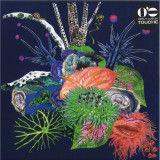
O’o share many of the musical characteristics of their ornithological namesake. The Kaua’i O’O produced the most exquisite birdsong before its extinction in Hawaii in the late 1980s. The beauty and character of its voice was delicate and mysterious, tuneful and surprising. You can experience it with just a cursory websearch, a haunting cri de coeur from the last century. If the poor O’O is consigned to history, then life is just beginning for this French duo, based in Spain, who’ve won plaudits and awards already in their short musical lifespan.
O’o are about to release their sublime debut album Touche. This is not an endling, it’s just the beginning: “I found the name on a website of weird English language words, and I loved the way the letters were arranged like a pair of glasses,” says O’o singer Victoria Suter. “Afterwards, I went onto YouTube and started listening to the last bird of its species, calling for a mate that would never come. I thought: ‘Oh my God, that’s so sad’. Then we talked about the name and we thought it could be a nice thing to honour it and keep it alive in some way.”
Suter met her musical partner Mathieu Daubigné at college in Agen, South West France, when the pair were studying music theory in their teens. Victoria moved to Barcelona in 2010; Mathieu followed six years later. Their debut EP, Spells, appeared in 2018 a beautifully crafted patchwork of vocals and samples that is redolent of the uncanny vocalese of Laurie Anderson. The bird makes an appearance at the beginning of the EP: “Sweet tooth beak. Soft melody peak / Oh O’o, go round and round in circles / Looking for a honeydrop, til you vanish, til you drop”.
That sense of profound longing for something lost is carried over to Touche, as well as the same heightened sensory awareness of the world around them. What has developed in spades is the creative process. O’o have blossomed organically, augmenting their pop sensibilities. Avant-garde techniques have been brought to heel as the pair create off-kilter pop music that warms the heart and nourishes the brain. The catalyst that enabled this bold pop transformation came with the song ‘Touche’ itself, a saucy chanson at the heart of the album. Suter’s wry narrative about a botanical femme fatale is inserted into a lithe and skittish song with reggaeton beats and an inviting, balmy atmosphere.
“The song is about a flower which attracts male insects, producing the very same smell as the female of the species,” explains Victoria. “The poor male is fooled by the sex-appeal of this botanical trap, and gets so excited that he exhausts himself and wastes all his other chances of ulterior mating and having any offspring. The flower entices the insect in in mermaid-like fashion, to come nearer and touch her. It’s the hot track!”
‘Touche’ reaches into hitherto unexplored areas of pop, while the rest of the album is accessible in the way that James Blake, Radiohead or Kate Bush are accessible, and it always challenges, in a way that pop isn’t supposed to. Suter writes playful, poignant, observational songs that tell stories as well as tell us something about ourselves. Songs like ‘Dorica Castra’ are built upon the voice as an instrument, centrifugal and layered from its core.
Complimentary to this method is Daubigné, who brings startling innovation with found sounds, samples and clever vocal manipulations—creating unique, otherworldly sonic flourishes. A guitar whirs like a musical spinning top on ‘Spin’, created in Ableton; an Ondes Martenot appears to make a guest appearance on the title track, though it’s the ingenuity of the Prophet 8 synthesiser. “I’ll often say to Mathieu, ‘what’s that?’” says Suter, He’ll reply, ‘that’s your voice’.”
O’o found their own voice when they won a competition held by the legendary festival organisers Primavera Sound. Victoria entered the band into a competition she saw on Instagram, sending off rough demos on the final day of entry, thinking little more about it other than the fact Mathieu might be annoyed. Soon they would have to build a live set from scratch and figure out how to present their music for the first time. At stake was seventy hours of recording time at Aclam studios, used by Rosalía and Kendrick Lamar, and for the winner a coveted spot at the festival. A pool of 350 acts were whittled down, and then O’o triumphed at a Battle of the Band style face off.
The O’O might be extinct, but O’o the band have learned how to fly. Just watch them go.
Order now and we will order the item for you at our supplier.
