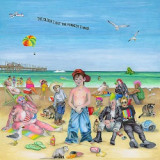
This extraordinary NYC trio combines free jazz and post-punk with pointed commentary about issues of race, gender, the pandemic, and political autonomy.
Rose Tang, a Mongol from Sichuan, sings/recites and plays guitar, piano, and percussion. Tenor saxophonist Ayumi Ishito, from Japan, plays in a plethora of bands along the jazz/rock spectrum. Drummer, composer, and educator Wen-Ting Wu, from Taiwan, combines jazz drive and classical rigor.
The group came together to play one song at an event. ESP-Disk’, already familiar with the separate work on the NYC scene of all three members, immediately invited them to make an album. After intensive rehearsals, the members recorded the album in a one-day session, then reunited during the pandemic to add words about its effect to an existing instrumental on “8 Steps/7 O’Clock.” This album is simultaneously part of ESP-Disk's Drive To Revive Weird Rock and an extension of the label's famed free-jazz legacy.
Buscar:la familia
The Microphones, Bon Iver, Lomelda, Vegyn, Hovvdy, Dijon. “Lemon Cream” vinyl is for Indies Only. Follow up to 2019’s critically acclaimed ‘bunny’. Sam Hall’s new album as ghost orchard, ‘rainbow music’, is a collage of patience and meditation. It’s filled with nuances as quietly imperceptible as the seasons, or the profound movement of time, where one day looking back you realize your whole spirit has shifted. Where 2019’s critically revered ‘bunny’ was a love letter to a romantic relationship, ‘rainbow music’ documents the culmination of Hall’s first personal experience with loss in several forms. At the end of 2020, his longterm childhood pet passed away, and with it the last continuing threads of familiarity between being a kid and adulthood. Still based in the Grand Rapids, Michigan town he’d grown up in, the static ease of familiar living seemed to be coming apart at the seams, as friends moved on to bigger cities, relationships shapeshifted and in a short period of time, another kitten he’d adopted passed away prematurely, leaving Hall to question the trajectory in which he himself was headed. Like “songs in the key of life,” the title ‘rainbow music’ refers to the myriad of colors and qualities within Hall that are refracted throughout. It’s a symbolization of hope and the aftermath, the flickering light at the end of the tunnel (or “when a rainbow shows up after a big storm”). “Wish I could have fun anymore,” Hall ruminates on “dancing”, as well as confessing he “wish he made more upbeat bangers.” But reality packs more of a punch, and this collection of songs sees him finally be at peace with the current state of affairs. Relatable to anyone who has contemplated what it means to settle down, or even just catch your breath in an era where anguish is commonplace, the release of ‘rainbow music’ is a happy ending in its own right, a marker of survival that remains close to the bone. // Ghost Orchard’s “bunny” is a blushing, beatific beat. - The FADER // Fluttering and transportive, a swirl of beats and plucky guitar and strings that feels like a cocoon. - Stereogum // Hip-hop inflected, stream-of-consciousness confessionals that’ll have you swooning in the lazy summer sunlight. – Paste // Track listing: 01. Rest 02. Jessamine 03. Cursive 04. Maisy 05. Cut 06. soot 07. memory storage 08. Dancing 09. bruise 10. sweet song 11. comfort (rainbow)
For over a decade, Names You Can Trust has presented a variety of new music that has grown from a prolific network of talented musicians in Colombia's capital city. Frente Cumbiero, Romperayo, La Boa, and Meridian Brothers are some of the important names to have reached a well-deserved global audience. The scene itself in Bogotá has been on the cutting edge for some time, and this new generation of musical spirit has naturally become a beacon in the tropical music community, not only as a standard bearer for honoring tradition but as well as the ability to flip that tradition on its head, with thoughtful modern and technological experimentations. The good news is that there are no signs of this particular renaissance slowing down, as some of these marquee names in the aforementioned list have expanded their creative output as producers, engineers and mixers.
In this case, Meridian Brothers creator and musical savant, Eblis Álvarez lends his expertise to a new emerging septet of tropicalistas, La Sonora Mazurén, named after a northern neighborhood in Bogotá. The group's mission is best described as an exploration into the many influences of tropical music that have thrived in Colombia for decades. Thinkcumbia,chicha,charangaandvallenatoto name a few, and that's where we land on with the group's debut single for NYCT. It's an apt illustration of the band's range, starting with the A-side's quintessential "Charanga Mazurén," a throwback to pure dancefloor accordion bliss, a pulse that is synchronized with the aura of Colombia's legends such as Landero, Meza, or Gutiérrez. The B-side "Cachicha" is a take on the all-importantchicha, which has become an inescapable and essential part of Peru's nationalcumbia, and likewise a staple within Colombia's borders since the advent of the popular style on record back in the day. That tradition continues here, the familiar pluck of the psychedelic guitars mixed with an array of synthesized sonics, the palette of Peru mixed with that of producer Álvarez's wizardry and the group's talented players.
Positive Disintegration was DIÄT’s sophomore album in which they expanded their post punk to a new pop level, reaching their songwriting peak. DIÄT sound builds upon the FALLOUT/ SIX MINUTE WAR / CRISIS skeletal sound adding muscular marching drums and sparsely using synths and drums machines. Their trademark dead pan vocals is at the center of the mix narrating the inane existence of a soul under the dreads of late capitalism. Questioning your own existence in a sea of depression, low paid jobs, borders, information, lack of sleep and a fast moving world that threatens to leave you behind. All too familiar. Positive Disintegration was originally released in 2019. Re-released with a totally new mix on time for DIÄT’s rare appearance at Static Shock Weekend in London. Marking the 10 years since their first London show. Remastered by Guitarist Tobias Lill at Dong Xuan Productions the new edition sounds deeper and highlights many parts of the album buried in previous editions, breathing new life to it. This edition keeps the same artwork of previous presses. With sleeve artwork by Yuta Matsumura and including a lyric insert and poster by Nada Ollosp.
Nashville-based instrumental rock combo Los Straitjackets have been
proving for years that rock & roll is a truly universal language by doing
away with vocals, but for this album the masked guitar manglers have
decided to focus on a more specific tongue - namely Spanish
For Rock en Español, Vol. 1, Los Straitjackets have recruited three talented friends
to perform a set of rock & roll classics in Spanish -- Cesar Rosas of Los Lobos,
Big Sandy of retro-country kings Big Sandy & His Fly-Rite Boys, and Little Willie G.,
lead singer with legendary East L.A. soul-rockers Thee Midnighters. While most
folks will be familiar with these tunes in their English-language originals, many of
the versions that appear on this album were taken from Spanish rewrites
recorded in the '60s by Mexican teen groups such as Los Teen Tops, Los Locos
del Ritmo and Los Rebeldes del Rock. This 15th anniversary edition LP is the first
ever reissue of Los Straitjackets' 2007 classic album and is pressed on purple
vinyl.
Chris Crack is back with a brand new album called Growthfully Developed. Fans and critics alike are already calling it the Westside Chicago native’s best album in the last few years. Pitchfork said “Crack’s latest album is a delicate balance of fresh and familiar from one of the funniest and most thoughtful rappers working today.” With song titles like “Pussy Better When You Eat It First” and “Shitting With The Door Open,” it’s no wonder why he’s said to have the best song titles in the game. Whether it’s heavy hitting 808’s, soul loops or head nodding boom bap Chris laces up the variety of beats with style and finesse. Praised by media outlets such as Billboard and Rolling Stone as well as by iconic hip hop artists such as Earl Sweatshirt and Madlib. Like the album title suggests, Chris has fully grown and developed to reach this point in his career and critics will believe that Growthfully Developed be looked back upon as a pivotal album in his prolific career. The 18 track effort is set to drop on vinyl this fall via Chong Wizard Records in partnership with Fat Beats. TRACKLIST: 1. I The Buck They Couldn’t Break 2. Chicago Don’t Make Industry Plants 3. Therapy Don’t Work, Try Drugs 4. Jordan Never Did That Move 5. Pussy Better When You Eat it First 6. Whoa Dair 7. Celebrate Everything Until Further Notice 8. Uknowwhereihadderat 9. Ate Ball in My Sock 10. Illuminati Phone Numbers 11. Shitting with the Door Open 12. Nine 2 Fives Make You Fake 13. Beer Just Bread in a Can 14. A Blunt Forced This Trauma 15. That Hate Us Because We’re Magic 16. Air Mattresses and Machine Guns 17. Weed is an Expensive Habit 18 . No Shortcut to Enlightenment
Keiji Haino/Jim O'rourke/Oren Ambarchi
Caught in the dilemma of being made to choose” This makes the...
- 1: A Contradiction Has Started To Devour The Numerical Sequence We May Be Made Aware That Normal??? Exists Finally
- 2: Thinking Too Deeply I Skipped Over ¯¯ Three By Three
- 5: “Caught In The Dilemma Of Being Made To Choose” This Makes The Modesty Which Should Never Been Closed Off Itself Continue To Ask Itself: “Ready Or Not?” Part 1
- 6: “Caught In The Dilemma Of Being Made To Choose” This Makes The Modesty Which Should Never Been Closed Off Itself Continue To Ask Itself: “Ready Or Not?” Part 2
- 7: Overtightened The Screw Of The Password To Mystery Drowns In An Infinite Number
The renowned trio of Keiji Haino, Jim O’Rourke and Oren Ambarchi return to Black Truffle with their 11th release, “Caught in the dilemma of being made to choose” This makes the modesty which should never been closed off itself Continue to ask itself: “Ready or not?” Demonstrating once again their commitment to continual experimentation in instrumentation and approach, the record begins with a long-distance collaboration made in response to a commission from New York’s Issue Project Room in 2021 during widespread lockdowns and travel limitations. A unique piece in the trio’s extensive body of work, this side-long epic finds Haino performing on metal percussion, O’Rourke on electronics and Ambarchi on gongs and bells. Initially dominated by rapid patterns on resonant, high-pitched tuned percussion, the piece sets Haino’s dynamic and dramatic performance against a calm backdrop of cycling electronics, thrumming gong strikes and hanging bell tones. The performance develops a heightened, intensely concentrated atmosphere reminiscent of Haino’s classic Tenshi No Ginjinka or his Nijiumu project; when Haino moves to clashing hand cymbals in its second half, the piece’s ritualistic energy suggests aspects of the music of Tibetan Buddhism.
The remainder of the double LP documents the trio live at Tokyo’s SuperDeluxe (the location of all but their very first recording) in a wide-ranging set recorded in December 2017. The concert opens, in another first for the trio, with Haino on drums, O’Rourke on Hammond organ and Ambarchi on his signature Leslie cabinet guitar tones. Haino’s explosively untutored approach to the drumkit will be familiar to some listeners from the radical duo iteration of Fushitsusha heard on Origin’s Hesitation. Setting flurries of rapid activity against moments of silence, his drumming here at times suggests Milford Graves in its tumbling toms and thudding kick-drum propulsion. Accompanied by O’Rourke’s organ and Ambarchi’s guitar, which in their shared use of long tones and shifting modulation speeds almost blend into a single voice, the opening sections of this performance are some of the most magical music the trio has committed to tape thus far.
After an interlude of spoken vocals in both Japanese and English, Haino makes a dramatic entrance on guitar. Against O’Rourke and Ambarchi’s increasingly intense electronic backdrop, Haino unleashes a stunning passage of slowly moving chromatic melodies and sudden shrieking explosions bathed in distortion and reverb. By the time we reach the third side, the guitar/bass/drums power trio is established and lurches into a passage of massive, lumbering rock that threatens to fall apart at every beat, O’Rourke’s strummed chordal work on six string bass creating a harmonic density equivalent to a second guitar. An abrupt edit throws the listener in media res into a frantic locked groove grounded by fuzzed out bass patterns and caveman drums. As Haino moves through a variety of approaches, from massive edifices of stuttering fuzz to ominous swarms of feedback, the trio eventually stumble into a kind of Harmolodic military tattoo, Haino’s guitar weaving and slashing across the rhythm section’s irregular accents. Moving through an epic opening duet for O’Rourke on Hammond and Haino’s wailing guitar, the fourth side eventually ramps up into a frenetic finale of mad bass riffing, crackling snare hits and guitar squall.“Caught in the dilemma of being made to choose” This makes the modesty which should never been closed off itself Continue to ask itself: “Ready or not?” is a testament to the continuing power and invention of this trio, who continue to seek out new terrain after over a decade working together. 2LP set presented in a lavish gatefold sleeve on heavy stock along with inner sleeves containing live pics by Tsuyoshi Kamaike. Photography by Jim O’Rourke, design by Lasse Marhaug and translation by Alan Cummings.
Pkew Pkew Pkew is looking on the bright side. As a band that lives and dies by touring, it’s been a while since they could say fuck it, we’re taking a year off to make something. That decision wasn’t entirely theirs, but 2020 handed them an opportuni-ty. Open Bar doesn’t navigate any of the tired pandemic tropes. Instead, Pkew is celebrating the things that make their lives awesome, even if those things suck sometimes. The band was forced to take a step back and use a slower approach. Mike Warne (guitars/vocals), Ryan McKinley (guitars/vocals), Emmett O’Reilly (bass/vocals) and David Laino (drums) bounced song ideas off Craig Finn of The Hold Steady, and went into the studio with Jon Drew, who produced their first album. “Since we didn’t have a hard deadline to finish, we felt a lot more freedom to take our time and mess around in the studio. Jon is the kind of producer that is down to try anything, so we had lots of fun playing with trumpets, old moog synths, glockenspiels,” says Warne. In a weird year, the familiar Pkew themes—navigating life’s small daily troubles with a sardonic grin and your friends by your side—are comforting, nostalgic. The result is tight, rowdy modern punk with the heart and soul of classic rock. It’s cracking a beer in the park, plugging in the AUX cord on a summer road trip, cramming into a sweaty bar with your friends and a million strangers.
From their new millennium rise to MTV superstardom through pop-punk’s modern resurgence that has introduced their iconic, multi-platinum sound to new audiences around the world, SIMPLE PLAN have been an indelible part of pop culture for more than two decades because they’ve never lost sight of what got them there in the first place: their fans.It’s this same sense of mutual respect that’s fully on display on “The Antidote,” the first single from their sixth studio album, HARDER THAN IT LOOKS., their first new music since 2016’s Taking One For The Team, and the most authentically Simple Plan album since 2004’s Still Not Getting Any. Free agents for the first time in their storied career, the band kept their circle tight during the recording process, enlisting longtime songwriting partners like We The Kings’ Travis Clark and producers Brian Howes and Jason Van Poederooyen (who worked on the band’s 2011’s album Get Your Heart On!) and Zakk Cervini (blink-182, Good Charlotte). From the skyscraping choruses of “Congratulations” and “Ruin My Life” (ft. Sum 41’s Deryck Whibley) to the unflinching poignancy of the album-closing “Two,” which instantly ranks alongside “Perfect” and “Untitled (How Could This Happen To Me?)” as one of the band’s best closers ever, HARDER THAN IT LOOKS certainly respects Simple Plan’s storied career – and the same spirit that helped the band sell 10 million albums worldwide – without being overtly reverent. The album-opening “Wake Me Up (When This Nightmare’s Over)” is a cathartic rush of familiarity and freshness – not to mention a bit lyrically prescient, as the COVID-19 pandemic hit shortly after the band wrapped the album. (“We certainly didn’t set out to write a pandemic album,” Bouvier says with a laugh. “It’s funny how some of the songs might seem like that, though.”) There are even spiritual successors to early material, like the glass-half-full skate-punk-leaning “Best Day Of My Life,” quite a 180 for a band who put a song called “The Worst Day Ever” on their genre-defining, Platinum-selling 2002 debut No Pads, No Helmets...Just Balls. But you won’t find an ounce of fat on the 10-song album, no obvious plays to recapture the radio waves they claimed in the early aughts with smash hits like “I’d Do Anything,” “I’m Just A Kid” and “Addicted.”
As three souls plunge down from the heavens, death and destruction can be felt hanging in the air like a foul stench. Red clouds swirl around a black sun that never sets and an erratic clock ticks off-tempo, moving faster and slower before rewinding and starting anew.
“Let me paint you a picture…” vocalist Mikey Arthur sings, welcoming listeners with a dramatic opening scene. It takes a skillful guide to navigate the darkest depths of hell. And, as The Gloom In The Corner depict in their second full-length album Trinity, death is merely the beginning of the series of chilling adventures
Purposefully aligning their song count with unlucky number thirteen – a reoccurring symbol in the ever-unfolding Gloom Cinematic Universe or GCU – it comes as little surprise to longtime fans that each of the Australian quartet’s enticing tracks intertwine to form an interlocking tale; this time centered around the appropriately labeled unholy trinity.
Comprised of previously deceased characters Rachel Barker, Ethan Hardy, and Clara Carne, the group’s bloody battle is woven throughout the album as the anti-heroes determinedly claw their way back to Earth from the Rabbit Hole dimension, slashing, shooting, and extinguishing anyone who dares to oppose their quest. Yet, for the Girl of Glass, Ronin, and Queen of Misanthropy, there is clearly more to the story than what can be contained within a single package.
Projecting a wide and complex web of lore, plot twists, and tongue and cheek humor, frontman Mikey Arthur, guitarist Matt Stevens, bassist Paul Musolino, and drummer Nic Haberle, have been producing highly detailed concept releases since their formation. And, consistently filling in more missing pieces of the puzzle with every body of work, the band equate each new record to a fresh season of The Umbrella Academy dropping on the streaming service of your choice. Because, just as a great TV series captivates viewers with its music and storytelling, the quartet’s work provides a complete experience designed to allow fans to check in with their favorite characters, all the while enjoying a cinematic new soundtrack.
For those just joining the GCU, as well as those looking for a quick refresh, 2016 debut album Fear Me introduced listeners to main protagonists Julian “Jay” Hardy, a Section 13 agent consumed by anger over his girlfriend Rachel’s death, and Jay’s gloom (later known as Sherlock Adaliah Bones), a demonic entity who at times takes over Jay’s body as a host vessel. 2017 EP Homecoming tells the tale of Jay’s brother Ethan, a war veteran suffering from PTSD, who upon discovering his brother’s struggle, kills himself as part of a Dante-style rescue mission to bring Rachel back to life. In 2019 EP Flesh and Bones, we’re introduced to Clara Carne, a past witness to one of Jay and Sherlock’s crimes, who instead of taking revenge, began a twisted love story with Sherlock, only to be murdered by his forced hand. And 2020’s Ultima Pluvia EP where we finally learn of Sherlock’s past as an ancient warlord under the tyrannical King Baphicho, and see Sherlock and Jay’s deaths ushered in by Section 13 opponent and New Order leader Elias DeGraver and his gloom Atticus Encey.
After 2016’s Fear Me, the band admit that their original intention was to jump straight into the events of Trinity before pivoting to create Homecoming, Flesh and Bones, and Ultima Pluvia. However, upon reflection, primary storywriter Mikey Arthur believes that pushing the timeline back actually provided greater opportunity for the group to properly flesh out the songs and plotlines for their sophomore studio record.
Indeed, while Trinity re-introduces the three central “heroes” of this new arc, it’s important to understand that while familiar, the characters are not carbon copies of who they were earlier in the story. And neither is the band who brought them to life.
Fully embracing the weird and whacky has never been a struggle for The Gloom In The Corner. Rather, it’s together with this attitude that the group come away with special moments such as the fascinating old and new dynamic between neighboring tracks “Red Clouds” – a song whose initial version predates the formation of The Gloom In The Corner as an official band – and “Gravity” in which a demo intended for future material was adjusted to fit the sonic drop.
Mirroring this evolution in the band’s musical approach, a sense of growth can also be seen projected in the characters and story that the quartet chronicle across the thirteen tracks.
Classifying their individual sound as an intricate form of “cinema or theater-core” due to the depth and breadth of their musical approach, features, samples, symphonic elements, and conceptual nature, The Gloom In The Corner continue to prove that they’re more than just a simple concept band.
In fact, similar to character theme music in movies and video games, the group seamlessly play off their diverse sonic story in a variety of ways. Continuing to breathe new life into older staples from their catalog, the quartet reworked their infamous “Oxymøron” breakdown from Fear Me into an impactful moment in Trinity’s “Nor Hell A Fury” and sprinkled audio easter eggs of this sort all throughout their new music for fans to discover.
Listeners are also brought further into the world of the GCU with the help of what The Gloom In The Corner call their “casting process.” Like picking actors for a musical, the band meticulously selected eleven different vocal features and several additional voice actors to bring the album and characters to life. Described as a 50/50 split between notable talents such as Ryo Kinoshita (Crystal Lake), Joe Badolato (Fit For An Autopsy), and Lauren Babic (Red Handed Denial), as well as talented friends and family like Elijah Witt (Cane Hill) and Mikey’s sister Amelia Duffield, each featured artist brought their own touch and realistic spark to the characters they portrayed.
For in the end, as much as Trinity and it’s cast live within the confines of their own supernatural worlds, themes such as falling out of love (Gatekeeper), battling depression (Obliteration Imminent), and standing behind women’s empowerment (Nor Hell A Fury), are ones that many can relate to or understand. And, while most individuals may avoid drowning their woes by way of transforming into full-on egotistical murderers like the Queen and King of Misanthropy and the gang, The Gloom In The Corner have illustrated that time and time again, life’s a little more fun when you can crack a smile. Taking a page from the trinity’s playbook: try to avoid the end of the world. But if you can’t…at least spend it with a killer soundtrack.
Oliver Johnson alias Dorian Concept veröffentlicht am 28. Oktober 2022 sein neues Album, „What We Do For Others“, auf Brainfeeder. Es ist das dritte Studioalbum des österreichischen Produzenten und Synthesizer-Experten, der für seine einzigartigen, wunderschön detaillierten Klangteppiche und wilden, gar euphorisierenden Live-Keyboard-Jam-Videos bekannt ist.
„What We Do For Others“ ist ein entspanntes, ruhiges, selbstbewusstes und intimes Album, das auf herrlich lockeren Arrangements und rückgekoppelten Klanglandschaften basiert und mit Fetzen seines eigenen verfremdeten Gesangs unterlegt ist, der eher als zusätzliche Instrumentierung denn als lyrische Phrasen präsentiert wird. Alle Elemente und Schichten wurden ohne Unterbrechungen aufgenommen und absichtlich nicht bearbeitet. „Ich glaube, deshalb hat diese Platte so etwas wie einen ‚Bandsound‘.“, erklärt Johnson. „Ich spiele alle Arten von Tasteninstrumenten, singe und benutze Effektgeräte, um diese freien Kompositionen zu schaffen.“ Der in Wien lebende Johnson ist ein fester Bestandteil der experimentellen Jazz-/ Elektronik-Szene, die im Umfeld von Brainfeeders Aushängeschild Flying Lotus floriert und sich diversifiziert hat. Mit frühen Veröffentlichungen auf dem Kindred Spirits-Label Nod Navigators und Affine Records spielte Johnson bei den ersten internationalen Label-Nächten von Brainfeeder im Jahr 2009 (Off-Sónar in Barcelona und die berüchtigte Hearn Street Car Park-Session in London) und bildete eine starke familiäre Bindung mit der Brainfeeder-Crew, die auf der gemeinsamen Liebe zu freaky Elektronik-Jazz-Fusion beruht. Johnson war an der Produktion von Thundercats „The Golden Age Of Apocalypse“ beteiligt, spielte die Tasten auf Flying Lotus' bahnbrechendem Album, „Cosmogramma“, und tourte mit den Live-Bands von FlyLo und The Cinematic Orchestra. Außerdem steuerte er die Tasten auf MF DOOMs „Lunchbreak“ bei, das von FlyLo und Thundercat produziert wurde. Kürzlich arbeitete er mit Kenny Beats an dessen Debütalbum, „Louie“, zusammen, wobei er bei drei Stücken die Tasten beisteuerte, und tat sich mit einem weiteren Pionier zukunftsorientierter Elektronik - Mark Pritchard - zusammen, um Musik für Damien Jalets zeitgenössische Tanzperformance, „Kites“, an der Göteborger Oper zu komponieren. Im Jahr 2020 arbeitete Oliver mit einem der weltweit führenden Ensembles für zeitgenössische Musik zusammen, dem Klangforum Wien, und komponierte ein Stück namens „Hyperopia“, das beim TRANSART Festival in Österreich aufgeführt wurde. Johnson veröffentlichte sein Debütalbum, „Joined Ends“, 2014 auf Ninja Tune, bevor er 2018 auf Brainfeeder landete, um „The Nature Of Imitation“ zu veröffentlichen: ein Album mit schwindelerregenden Partituren, kakophonischen Breakdowns und formidablen Rhythmen, von denen Pitchfork schwärmte: „Dorian Concept schafft etwas, das Elektro-Funk-Autoren der 70er und 80er Jahre wie Kraftwerk, George Clinton und Roger Troutman angedeutet haben: Computermusik, die den Funk unverhohlen imitiert, anstatt ihn nur zu faken.“.
This two sided split record between Roberto Auser and Melting Dogmas is a showcase of two sides of contemporary elektro… on one side there is the music of electro veteran Roberto Auser… his modular synth sounds are minimal electronics and 80’s inspired… but these two tracks are a bit different then the beat driven music he released mostly these past few years… despite his recognizable sound these two tracks deliver something new to his repertoire… less beat driven but still very much rhythmic… some industrial and pulsating sounds keep these tracks going and even suitable for the dancefloor late at night or early in the morning… I wish for more of this from Herr Auser! Melting Dogmas is 4Cantons together with Numèric… if you are familiar with the debut EP by 4Cantons then you will recognize his dark elektro sound… but these two debut tracks of Melting Dogmas are a bit more complex… without losing their club minded attitude… the sounds of Melting Dogmas is idm driven with elektro and techno elements all there in a perfect mix and maybe even making these tracks punchier as the music by 4Cantons… and at the same time also a bit more daring… the structure is less straight forward with a good balance between building up the tension and full out beat parts… just like 4Cantons I cannot recommend enough to keep an eye out for Melting Dogmas… it is very hopeful to have musicians like this around with such good and daring sounds…
- A1: Fragments Of Yesterday
- A2: Wendys Hollow Path
- A3: Less Real Than You
- A4: In Sosteso
- B1: L'ennui Hâté
- B2: Moving Tiles
- B3: Melee
- C1: The Place Is What Emerges
- C2: Setting Things Apart
- C3: Perhaps Significant
- D1: Non C'é
- D2: Indefinable Basement
- D3: Dance Of The Forgotten
- D4: Shaping The Experience
- D5: L'anticipazione Del Futuro
"While focusing on the current conditions we find ourselves in and bracing for what seems like the collapse of humanity, I made this collection of music in an attempt to ignite the essential remnants of my inner euphoria, and perhaps yours too" - Feldermelder
Euphoric Attempts is a finespun, voluminous manifestation of euphoria, a testimony to creativity, produced at a time when the outside world seems to be slowly disintegrating. The musical language is pure, vast, resilient, and vulnerable. The compositions of Feldermelder have a tonality both strange and familiar, intensified and influenced by classical music, yet distinguished by the coalescence of contrasting styles.
Euphoric Attempts relates to the state of our external surroundings but also refers to our inner life: it passes through our memories — through our organism — through our stories, and intends to elude the cold grip of analytical listening, instead retrieving intrinsic truths. The track titles signify a form of homage to our inner individuality, existing in parallel with the severities of the tangible, the external.
For this album, Feldermelder draws together compositions from his extensive archives, focussing on material that reflects the simple joy of making music. As a counterpoint to the abstract complexities and intricate rhythms of his live performances, here Feldermelder creates candid compositions of purity and minimalism, finding a sense of elegance in the details. Euphoric Attempts discovers the prospect of liberation and vitality in concealed intimacies, capturing their resemblance in gentle, elaborate, and prodigious movements of sound.
Feldermelder is a Swiss musician, sound designer, producer, and installation artist. He is co-founder of -OUS and part of the audio-visual collective Encor.studio. He has previously released several releases on -OUS, both as a solo artist, and in collaboration with Sara Oswald and Julian Sartorius. Feldermelder's influences range from pioneering early electronic music to contemporary analogue electronics to classic jazz and beyond. The diversity of the music that inspires him is mirrored in his own work, which illustrates an ever-evolving sound, and indicates that influence is seen as both map and compass, guiding divergent inclinations.
'The Arbitrary Dimension of Dreams' is Cate Kennan's oblique exploration of memory, nighttime, and narrative. The resulting 12 compositions are brisk, evocative, and lingering. Kennan's sonic palette is vast yet harmonized, deftly matching spectral synthesizers to hazy lap steel guitars and watery analog effects. Existing in the sparsely occupied world of early melodic electronic music, her songs call to mind the sonic landscape's of Malcolm Cecil, Hans-Joachim Roedelius, and Deux Filles. Each individual track sculpts a setting, constructing an amorphous landscape of surreal musical vignettes. Picture a boat tied to a dock, bobbing with the waves, wisps of fog refusing the complete vision. This is the nebulous space of 'The Arbitrary Dimension of Dreams,' an enveloping, insistent realm that feels both intimately familiar and profoundly otherworldly.
The Older I Get, the Funnier I Was, which follows Thomas’ brilliant 2020 HBO special The Golden One and his Can't Believe You're Happy Here EP released earlier this year, surveys a range of emotion and offers a broad sonic palette, moving between pop punk, electro, and the obvious influence of the singer-songwriters he grew up listening to in early childhood. It conjures the ennui of Bright Eyes alongside the barefaced storytelling of John Prine, the overstuffed lists of Fred Thomas with the lackadaisical humor of Colleen Green, among many others.
Thomas attributes the dexterity of the record to Duterte, who recorded and engineered most of it in addition to serving up plenty of encouragement when Thomas got down on the process. “As a comic, I used to test out new songs during sets to see if the funny bits were hitting, but since I wrote this in isolation I ended up writing lyrics and worrying less about making jokes,” Thomas says. That said, the album’s plenty funny. Stand-out and lead single “Rigamarole” opens with a Thomas-voiced infomercial that recalls his oft-cited lookalike Jim Carrey as the Grinch, before launching into a buoyant pop song about being depressed.
Whitmer Thomas will admit that when he traveled home to small town Gulf Shores, Alabama to record his HBO stand-up special, The Golden One, he expected to be greeted as a returning hero, a conquering king, or at minimum, a guy with a moderately successful career as an entertainer in Los Angeles. “I expected a big welcome home, open arms, but when I went back I realized: nobody fucking knows me. Nobody remembers me,” Thomas says. “In the years I’d been performing that show, I’d been romanticizing my childhood in this mythologized place, but the visit made me see that I’m not really from there anymore.”
The sense of alienation compounded when Thomas recognized how few people in town remembered his mom, to whom The Golden One is dedicated and largely about. Thomas grew up watching her perform with her twin sister at the legendary Flora-Bama Lounge, where he set the special, and still counts her as one of his musical influences. His new album, The Older I Get, the Funnier I Was, isn’t overtly about his mom, her presence is deeply felt throughout. While in Gulf Shores, Thomas discovered dozens of her old recordings, all of which had been wrecked by Katrina, but upon returning to LA, Thomas paid “a fancy place in Hollywood” to fix the tapes and hired Melina Duterte (Jay Som, Bachelor, Routine) to mix them. The two struck up a collaborative friendship, and Thomas had the sound of his mom’s voice back. “I was listening to songs she recorded when she was about my age, just these heartfelt, sweet Americana songs,” he says. “I decided then that I wanted to lose the Ian Curtis voice I always sing with; I wanted to do what came naturally, because my mom always sounded like herself, even when she was singing some cheesy reggae song about, like, Jamaica.”
Thus he went into The Older I Get, the Funnier I Was knowing it was time to retire his darkwave persona, and leaning into his natural, chirpier voice, which he says sounds “like a 12-year-old’s.” It makes sense: much of the album chronicles what Thomas calls “being a kid and feeling like you have no control and overcompensating by being annoying.” “So much of the album is about witnessing drug and alcohol addiction as a kid and seeing what it does to people, but also realizing that there's nothing you can do about it,” Thomas says. It’s familiar territory (see: “Partied to Death”) but the methodology is different this time around; true to its title, The Older I Get, the Funnier I Was isn’t always looking for laughs. Thomas might’ve left his hometown behind, but his kid self is still tagging along, a Peter Pan shadow he can’t untether himself from. The first line he sings on The Older I Get, the Funnier I Was is: “There should be a room at every party where you can just sit and watch a movie.” Find a 12-year-old who wouldn’t say the same.
The classic sci-fi series teleports to Demon Records for two thrilling full-cast radio adventures.
From 1977 to 1981, a heroic band of freedom fighters waged war against the merciless Terran Federation,
spearheaded by Supreme Commander Servalan. In the mid-1990s Terry Nation’s intergalactic epic switched from BBC
TV to radio with two new adventures, The Sevenfold Crown and The Syndeton Experiment. Both now come to vinyl
for the first time, alongside cast interviews and extracts from Zen and the Art of Blake’s 7.
Presented across 3 x 140g vinyl discs in three colours, these full-cast dramas star Paul Darrow as Avon with Jacqueline
Pearce as Servalan, Michael Keating as Vila, Steven Pacey as Tarrant, Paula Wilcox as Soolin, Angela Bruce as Dayna,
and Peter Tuddenham as Orac and Slave. Written by Barry Letts (Doctor Who) they feature incidental music by Jeff
Mearns as well as the familiar strains of Dudley Simpson’s iconic theme music.
The removable slipcase cover reveals a trio of coloured LPs - plus a frameable art print - in a widespine sleeve. The
discs are presented in individual sleeves which, when place side by side, reveal a landscape scene of Scorpio in flight.
Full cast and credits are accompanied by graphics illustrating the tech of Blake’s 7.
Make sure you’re Down and Safe with this exclusive limited edition.
Perpetual Doom proudly presents the new album from Austin Leonard Jones: Dead Calm. On this collection of nine new tracks, the Texas-based troubadour channels his eclectic talent into a melancholy country groove. Full of signature tumbleweed melodies and his deadpan wit, it is an essential addition to Jones’ unique and varied catalog.
Like any good country record, Dead Calm starts with a joke and ends in tears. “A werewolf walks into a bar,” Jones sings on opener “Cape Fear,” where vampires pour drinks and no one seems to escape. The town might be full of the undead, but it could be anywhere—after all, as Jones says, “It’s hard on the living in Cape Fear.” The slide guitar and faint bright keys set the tone for an album that mixes domestic sorrow with a touch of kitsch, like Conway Twitty at a seasonal Halloween outlet. “I’m the sole survivor of the all-night show,” he sings on “Back in the Black Lagoon,” “and it cost a thousand tears for every episode.” Somewhere between a funeral and a costume party, Dead Calm bursts with classic songwriting sure to get you on the dance floor and crying.
All these ghost towns, desert bars, and haunted capes emerge from the small town outside Austin where Jones wrote and recorded the album. Alongside producer Jesse Woods, he crafted a sound based on the traditional country palette of acoustic and slide guitar, organ and gentle drums. Songs like “Night Parrots” and “Demon Sands” take stock of life’s disappointments as Jones’ maudlin voice and Jesse Siebenberg’s pedal steel twist tighter around each other. “The Australia Song” puts autobiographical storytelling first, while “Exotics” laughs at our tendency to seek satisfaction in far-off places and things. It all comes together on “Its Treachery,” where Jones confronts the intimate betrayals of “a whole life not working out as planned.”
Sound familiar? Austin Leonard Jones invites you to join the club.
First ever vinyl release of this tribal ambient gem. A plethora of exotic rhythms and sonic meteorological phenomena. Loops, leftfield beats, and all kinds of textures from the 4th world and beyond. Originally released in 1994 on CD, it is a true beauty of electronic hypnotism and sonic exoticism. Through a highly developed process of layering, Jeff composes and performs music rich in texture, depth, mood, and subtle detail. His blend of electronic and acoustic instruments and textures produces haunting yet inviting soundscapes with a strong sense of place that hover somewhere between the exotic and the familiar. Moreover, you will find here collabs from other great artists: Dennis Rea (Savant) on guitar and Rob Angus with drum programming.
Jeff Greinke began composing and performing music in 1980 while studying meteorology at Pennsylvania State University. After moving to Seattle in 1982, Jeff formed the production company and recording label, INTREPID, through which he produced his first LP, Cities in Fog. He has since released twenty other recordings on various U.S. and European labels. He has composed music for film, video, dance, theatre, radio, and art installations. Jeff has toured throughout the United States and Europe and has performed in China, Canada, and Mexico. He has also been a member of numerous ensembles and is founder of the group LAND.