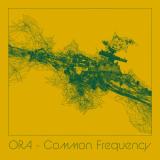
Love Reaction returns with a new release and unveils the third and final chapter of its vinyl catalogue: ZONE, a series dedicated to club-oriented electronic music. For the occasion, the label welcomes ORA, two seasoned professional musicians rooted in the jazz scene, eager to explore new sonic territories together.
With Common Frequency, the duo unfolds a raw and organic sonic tapestry. Live, they sculpts landscapes in real time using drum machines and synthesizers, unleashing a club energy that is both electric and vibrant. Between analog textures and immersive rhythms, this debut EP asserts a strong and magnetic identity.
Поиск:la la land
Все
- 1: Nuvole I
- 2: Nuvole Ii
- 3: Nuvole Iii
- 4: Nuvole Iv
- 5: Nuvole Ix
- 6: Nuvole V
- 7: Nuvole Vi
- 8: Nuvole Vii
- 9: Nuvole Viii
- 10: Nuvole X
In Gianfranco Rosi’s portrait of Naples, Sotto le Nuvole, the ground shakes periodically. Between Mount Vesuvius and the Tyrrhenian Sea, the fumaroles of the Phlegraean Fields hiss volcanic gas and steam. Below the sleeping volcano, modern day Naples emerges in black and white and fills with voices, with lives. From the traces of history and the concerns of the present, Rosi documents a city immersed in its continuous past, with Daniel Blumberg’s minimal soundscape hovering in a sonic space between liquid and air.
Tasked with creating a soundscape that would suspend space within Rosi’s film, Blumberg called upon the extended technique of saxophonists Seymour Wright and John Butcher to create a gossamer fabric of traces and sounds abstracted from their instruments. Having transitioned from theoretical physics to the saxophone, John Butcher has always deeply considered space in the context of his playing. His concerns are with flow, density and how the saxophone is situated in the living world. Zeroing in on the core sonic properties of the mechanical and acoustic components of the saxophone, Seymour Wright has integrated its every breath, reed vibration, keypad clatter and hissed microtone of his alto into his own, unique improvisational language. In his work with these two seminal players, Blumberg makes his most concentrated soundtrack to date - reinforcing the film's sense of overlapping time and space, and pushing at the limits of experimentation.
Initially recorded in Daniel’s flat in London, Butcher and Wright centre themselves around long, consistent tones, so soft that it seems breath is being gently pulled from the saxophone's bell by an invisible hand. Blumberg himself adds haunting bass harmonica, and recordings of Wright’s launeddas - a traditional and ancient triple pipe polyphonic reed instrument from Sardinia, Italy. Blumberg then travelled to the volcanic region of Baia, next to Pompeii. Once a flourishing classical Roman city loved by Nero, Baia slowly sank under hydrothermal pressure, leaving the city in a kind of geological purgatory. Using specialised geophones and hydrophones, Blumberg took those initial recordings and amplified them underwater, sending them calling out across the ruins of Baia’s mosaics, Nymphaeum statues and villas.
“It was important to me that the music was whispered in the same landscape that Gianfranco has worked for the past three years, so that you can hear the volcanic air gulping, the lapping of the waves, the steam and bubbles popping against John and Seymour’s saxophone breaths – an echo from a suspended time.”
What emerges is deeply melancholic, tender, subtle and right at the edges of audio technology. Submerged in an aquarian mausoleum, the mysterious vibrations of the saxophone and its bell become an echo of an echo, wading from the future into the past. ‘Sotto le Nuvole’ is less a soundtrack than a process of aeration - a sonic puncture in the material of the film which allows its central message to breathe, and a remarkable experiment at the limits of the saxophone’s possibility.
- 1: Glass Bottom Boat
- 2: Paper Screen
- 3: Awhile
- 4: Fog On Mirror Glass
- 5: Old Universe
- 6: Makeshift Room
- 7: Your Dreaming Eyes
- 8: Valley Floor
- 9: Usual Phantom
- 10: Bamboo
Fog On Mirror Glass introduces a new aesthetic amongst Donald Beaman albums. After four albums of varied full-band arrangements, this album emerged as an idea to present solo performances in conversation with full-band work. The bulk of the songs were recorded in the same place they were written: Beaman’s living room. Long time bandmate and producer Kirt Lind set up a makeshift studio at Beaman’s house to record the guitar parts in the same room where they were written, using the same guitars on which they were first played.
Unfurling with a measured pace, the resulting album combines elegiac lyrics with elemental arrangements played with an almost jazz-like reverential expressiveness, calling to mind the works of Cass McCombs, Will Oldham, and Jake Xerxes Fussell. Album opener “Glass Bottom Boat” sets the tone for the album with just Beaman and his guitar – written during the final months of a decade-long stay in New York City, the song was finished upon his arrival back in California. Meanwhile the title track, long a staple in live sets, lands near the middle of the album to recalibrate the mood, featuring the ghostly guitar work of longtime collaborator Ken Lovgren. “Old Universe” lifts things up a bit, propelled by the brushwork of drummer Michael Nalin and the jaunty bass playing of Kirt Lind. Finally, the album ends much the way it began, with Beaman and his guitar on album closer “Bamboo”.
“The dictionary definition of less is more.” - ---- Mojo
“His ability to carve universal empathy from mundane domesticity is remarkable.” - ---- RNR Magazine
“...a collection of evocative scenes and vivid emotions sung to sparse musical arrangements in Beaman’s distinctive sonorous tones” - Americana UK
“...pure and simmering, like a tattoo dedicated to a long lost friend, slightly fading from years in the sun, a memory that will always bring a tear in those quiet reflective moments.” - Psychedelic Baby Magazine
(DL code included)
Six touching tracks that, starting from quiet ambient atmospheres, initially soft, tenuous, and crepuscular, gradually seem to soar... ascending towards celestial spaces, revealing ever-wider and brighter landscapes below, ever-more distant horizons, ever-more infinite spaces...
Highly evocative progressions, guided by sober and delicate melodies and driving, pulsating bass lines, wonderfully deep (best enjoyed with a good stereo system to truly appreciate them), the kind that make your stomach churn before you even perceive the exact frequency and harmonic progression, often "set" in sober rhythmic patterns that mark the time, making a sonic journey even more dynamic and compelling.
If it doesn't surprise you, it's probably only because you've already had the opportunity to explore and "plumb" Fabio Orsi's most recent discography, and are already accustomed to the best of what this new wave of distinctly electronic but ambient-inspired music has to offer.
- A1: Accepting The Storm
- A2: Future Friday
- A3: Murdoc‘s Revenge
- A4: The Years Under The Stars
- A5: Kebu X Johan Becker - Everyone‘s A Story
- B1: The Missing Bolt
- B2: Disbelief
- B3: Urban Skies
- B4: Winter‘s Kiss
- C1: Kebu X Johan Becker - Stand Up
- C2: The Time We Had
- C3: Madis X Kebu - Touching The Sun
- D1: Aurora‘s Wings
- D2: Kebu X Gattobus - Dreamers‘ Lullaby
- D3: Prayer For The Living
Urban Skies ist das neue Album des finnischen SynthKünstlers Kebu, das am 20. März über ZYX Music erscheint.
Das Album ist der Nachfolger von Urban Dreams (2021) und enthält Kollaborationen mit Johan Becker, Madis und Gattobus sowie eine Vielzahl an Solo-Tracks. Vollständig mit analogen Synthesizern und Drum-Maschinen produziert, verbindet Urban Skies melodisches Songwriting mit kraftvollen, von den 80er-Jahren inspirierten Pop-Metal- Ästhetiken und gilt als Kebus bislang vielfältigstes und ausgereiftestes Album. Die Veröffentlichung wird von einer europaweiten Tour begleitet, die 12 Länder und 32 Konzerte umfasst.
Continuing his inspired path into fractalised micro-dub-techno, John Howes lands his Paperclip Minimiser project amongst kindred spirits on Blank Mind. Crooked rhythms and tender machine hums hang in crisply defined virtual space — a gallery of science and soul that follows a natural lineage from the breakthrough years of the clicks n' cuts era by way of UK bass permutations.
Operating out of the UK's North West, Howes has been incubating a singular sound through his ongoing development of intuitive production and performance tools under the Cong Burn banner. The sometime record label and software stamp has a long-standing friendship with Blank Mind—the affinity is easy to hear in their shared exploration of modernist broken techno. Having just released a second album under his Paperclip Minimiser alias for similarly spirited West Coast US lodestar Peak Oil, Topology Transform extends the project's sound world with three tracks carved from the same period of studio orienteering. Free of the constraints of the LP format, these three tracks open up broader possibilities from Howes' customised systems, navigating the outer edges of the Paperclip paradox.
The A side opens on a 150BPM cascade of crunchy percussion and pin-prick ripples, driven by twitchy kinesis while maintaining a light-footed dexterity. If the first track finds its locomotion through double-time intensity, the second track celebrates the space that opens up around half-time pacing — two sides of the same tempo that radiate distinct energies. Conversely, the B side stretches out into an extended ambient repose. The consistency between this beatless excursion and the more propulsive A side speaks to the clarity of Howes' craft—a shimmering, blue-hued pool of advanced sonic treatment from a producer in command of a truly personal studio practice.
12 Inch Picture Disc in Picture Sleeve
Few voices possess the immediate recognition and infectious soul of Starley, the Australian artist whose talent captured the world's attention. Her landmark hit, ‘Call On Me,’ is far more than just a song; it's a global phenomenon, boasting well over one billion streams and achieving platinum and gold accreditation in over 26 countries worldwide.
Marking the 10th anniversary of the iconic ‘Call On Me’ in 2026, Starley is celebrating the milestone by releasing an exclusive, highly anticipated vinyl pressing for her global fanbase. This commemorative edition will be a picture disc, including essential remixes from Ryan Riback, Odd Mob, Dexcell, and Anton Powers.
Re-release for this LP-Set "Kiss Land" is the debut studio album by Canadian singer, The Weeknd. It was released on September 10, 2013, through XO- and distributed by Republic Records.
The album was supported by six singles: "Kiss Land", "Belong to the World", "Love in the Sky", "Live For", "Pretty" & "Wanderlust". The album's production was primarily handled by DannyBoyStyles, The Weeknd himself and Jason "DaHeala" Quenneville, among others.
Follow up to Goodge's 2023 album Echoes Of Yesterday. Previous releases found on Hip Dozer and Cascade Records. Tracks found on the popular Spotify Mellow Beats playlist. 11th in 'Jet Set' Cold Busted series. Designed and manufactured similar to the vintage 60's style rice paper sleeves. In his latest EP, Sunday Soul, Goodge takes listeners on a four-track journey through the heart of funk, masterfully blending elements of R&B, jazz, and chilled lo-fi. Released as part of Cold Busted's Jet Set series, this four-song offering follows Goodge's 2023 album Echoes Of Yesterday and showcases his dedication to crafting timeless music. "Lights Out" kicks off the EP with heavy funk and stirring breakbeats, accompanied by a scratchy guitar that summons the revolutionary spirit of the '70s. Horns serve as a call to action, while a rollicking bass line and chunky electric piano might inspire listeners to go out and fight crime. "Promised Land" follows, featuring a formidable funk bass guitar and lead guitar chords that rhythmically play off the delightfully busy drums, creating an atmosphere reminiscent of the city's bustle. The title track, "Sunday Soul," is a rowdy affair with a speech-over-beats leading to crispy snare rolls and chiming electric piano. Shaker magic, staccato horn bleats, and spiral flute bits combine to create a swirling vintage-hued photograph of sound. The EP concludes with "Within Myself," a spacier sonic experience that could serve as the soundtrack for chasing someone across rooftops. It's funk spelled with a capital K. Sunday Soul is a must-listen for fans of of the heavier side of funk, solidifying Goodge's position as a master of his craft, creating a nostalgic yet fresh soundscape that keeps listeners grooving back for more.
- Land Of Eternal Delight
- Teleportation
- Black Hole In, White Hole Out
»Cosmogonical Ears« is Amosphère's first album for Hallow Ground. Following her contribution to the Swiss label’s »Epiphanies« compilation and her 2021 full-length debut »More Die of Heartbreak« on 33-33, it features three expansive pieces. The Paris-based composer and multidisciplinary artist delves deeper into themes of time, space, cosmology, human perception, and psycho-physical effects, crafting profound sonic meditations. Drawing on a minimalist approach while blending electronic and acoustic elements, Amosphère’s long-form compositions are living, breathing entities whose sonic richness and evocative power unfold gradually over time, putting »Cosmogonical Ears« in direct kinship with previous Hallow Ground releases by artists such as Kali Malone and FUJI|||||||||||TA.
The album opens with its longest piece, »Land of eternal delight,« composed for the Buddha10 exhibition at the Museo d'Arte Orientale in Turin. Written during three years of isolation—a period in which Amosphère explored meditation practices and diverse belief systems—it merges mythology with personal transcendental experiences, reflecting on a challenging time for humanity. »By blending Buddhist philosophy and sculpture with my own meditation practices, I sought to explore a way for people to transcend the boundaries of space and time—not as a believer, but as an observer,« she explains. Featuring handmade ceramic instruments and recorded by Thomas Lefevre, the piece combines Amosphère’s electronic organ with Marc Lochner’s flute contributions, creating a sound that is simultaneously minimalist and expansive.
The concept of teleportation and how it challenges traditional notions of time and space serves as the foundation for the second piece. »Recent advances in quantum physics suggest that teleportation might be possible through quantum entanglement,« Amosphère notes. »What if science fiction is becoming reality—or has already existed in ancient times?« Drawing inspiration from theories proposed by physicists such as Roger Penrose, Amosphère again worked together with flutist Lochner, this time using her VCS 3 synthesizer. »Teleportation« weaves single notes into intricate, non-linear patterns that defy conventional logic, creating a complex auditory tapestry. The last piece »Black hole in, white hole out« was recorded on Corsica and features Miao Zhao’s bass clarinet drones alongside Amosphère’s church organ. It imagines the possible sound of crossing a black hole while also suggesting the study of its theoretical exit and its potential applications for large-scale time and space travel.
The questions posed by »Cosmogonical Ears« do not yield straightforward answers. Instead, Amosphère’s restrained yet intricately layered compositions require full immersion and concentration from the listener. As expressed by the album’s title—which envisions the birth of a new universe through listening—»Cosmogonical Ears« offers an experimental approach to auditory perception as a tool for seeking truth, freedom, and harmony between the outer world and the inner self.
- A - Ricardo Eddy Martínez Y Expreso Rítmico - La 132
- B - Juan Pablo Torres Y Algo Nuevo - Rompe Cocorioco
- C - Farah María - Ámame Y No Pienses Mas
- D - Grupo Ismaelillo - Amanecer - Dj Koco Edit
- E - Fa-5 - Muévete Con Las Fuerzas Del Corazón - Dj Koco Edit
- F - Grupo Los Yoyi - Paco La Calle
- G - Juan Pablo Torres Y Algo Nuevo - Y Viva La Felicidad
- H - Orquesta Riverside - En Casa Del Trompo No Bailes
- I - Grupo Fa-5 - Ya Tengo Un Amor Verdadero
- J - Rembert Egües - Tema Para Un Amanecer
Two years since DJ KOCO aka SHIMOKITA curated his sold-out Mr Bongo Brazil 45 boxset, he is back with another Record Store Day special, this time turning his attention to Cuba. Following a meteoric rise to the top, the Japanese DJ / turntablist extraordinaire has won the world over with his unquestionable humility, refreshing positivity, and flawless skills. The DJ’s DJ, it’s as much about taste as it is technicality for one of the world’s best showmen.
When the idea arose for a Cuban Classics 45 Boxset to mark RSD 2026, DJ KOCO was top of the list. With a deep-seated passion for Cuban music, its melting pot of cultures, its focus on rhythm, and its undeniable groove, DJ KOCO presents a selection of his favourite Cuban cuts, as well as two exclusive edits for the boxset.
It kicks off with the Latin funk sounds of Ricardo Eddy Martínez y Expreso Rítmico’s ‘La 132’ from 1978, before rolling into one of two spellbinding Juan Pablo Torres y Algo Nuevo cuts found on the boxset. Elsewhere, you’ll hear Farah María’s slow disco ‘Ámame Y No pienses Mas’, an unusual American-leaning production for Cuba at the time, given the state of US-Cuban political relations in that period. Other highlights include Orquesta Riverside’s ‘En Casa Del Trompo No Bailes’, taken from a rare collectable 7”, channelling a low-slung Latin bounce which explodes into an Afro-Cuban dancer as the track progresses.
In signature style, DJ KOCO has also served up two exclusive edits for the boxset. These include a reworking of the Cuban children's band Grupo Ismaelillo’s quirky ‘Amanecer’, giving it a more DJ-friendly structure. You’ll also find DJ KOCO’s take on FA-5’s much-loved funky dancer ‘Muévete Con Las Fuerzas Del Corazón’ with its heavy b-boy/girl break from 1976.
Testament to Cuba’s vast and vibrant musical landscape, DJ KOCO has cherry-picked some of the finest recordings to emanate from the country, spanning a wide range of styles and rhythms. Yet what ties all the tracks on this boxset together, is a hip hop sensibility and thirst for a breaks-heavy, danceable energy which radiates through DJ KOCO’s masterful DJ sets.
- 1: Die For Allah
- 2: Deathwish
- 3: What?S The News
- 4: Life Inside Iran
- 5: Iranians On Bikes
- 6: Simple Life
- 7: Fifh
- 8: Blow Up The Embassy
- 9: Theme
- 10: Iranian Klan
- 11: Ultraviolence
- 12: Chant
- 13: Land Of The Free
The classic Fearless Iranians From Hell Die For Allah LP is now back in print after a twenty-five year hiatus. Remastered and repressed on nuclear green vinyl, this hardcore punk arsenal also includes all tracks from their literally explosive Blow Up The Embassy 7-inch debut. FIFH was a mysterious Texan monstrosity formed in 1983 by Iranian expat (and modern day hashashin) Amir Mamori, who gathered to his side various mutants and apocalyptic freaks from the San Antonio punk rock blast zone, even throwing in two Butthole Surfers rejects for good measure (including none other than the notorious Anus Presley himself). The subsequent recording sessions were a chaotic affair, as guitars were rarely in tune and the drums were seemingly scavenged from the trash. It was all directed by Amir who, with fanatical focus, would inspire the band on to victory from behind a stupifying cloud of hash smoke. The resulting releases were widely praised; from places like Maximum Rock n Roll and the Village Voice in the US, to Sounds and New Musical Express in the UK. They were even cited as forerunners of the musical genre known as Taqwacore. After touring the US in the late ’80s—and leaving in their wake crowd turbulence, police intimidation, and even bounties being place on the heads of the members—the band disbanded in 1989 upon the death of the Ayatollah Khomeini (may Allah have mercy on him). “We’re stoned as shit, and we’re ready to roll.” - F.I.F.H. ’87
- 1: Pulse Repetition
- 2: Absolute Elsewhere
- 3: The Proxy
- 4: Progress Report
- 5: Buran
- 6: Tesseract
- 7: Backscatter
- 8: Frequency Shift
On a remote gravel-covered spit of land on the east coast lie the abandoned buildings of a government facility for weapons testing and experiments with radar.
In the mid 1960s this site witnessed the construction of an over-the-horizon radar, a technological marvel bouncing signals off the ionosphere, built to covertly monitor the activities of other nations.
The reflectivity of the ionosphere is a function of frequency, time of day, time of year and of the solar cycle. In essence, a sympathy for the celestial was required to fully exploit this man made construction.
Plagued by noise that created false returns on the monitors, the intended performance was never achieved, and despite several investigations the system was shut down and eventually dismantled in the early 1970s.
The long dormant Cobra is now a nature reserve.
- 303: Eyelashes Out {16’52’’}
- Her Panties {11’31’’}
- Unwashed (105 Oven) {05’28’’}
- Another Stain {04’32’’}
'Tense from the first note and decisively uncompromising ‘GHSTING’ is the debut collaboration by Polish artists Alex Freiheit and Aleksandra Słyż, an incredibly unique piece of work that mixes fiction, spoken word poetry, theatrical antics, dense synthesis, acoustic ensemble and dark landscapes all set within the backdrop of a sinister Eastern Europe hotel. The resulting sound is menacing, humorous, harmonious, tumultuous, and at times quietly erotic.
Alex Freiheit, a poet and vocalist, is widely recognized for her captivating work with the SIKSA duo. Over the past decade, she has delved into the realms of personal feminist storytelling, postmodern fairy tales, and queer legends, crafting unique and thought-provoking narratives. In this groundbreaking collaboration with talented composer Aleksandra Słyż, they are now delving into the herstory of lies and exaggerations, extracting the raw essence of these tales filled with stench, stains, secretions, and torn organs. Eyeless Freiheit haunts the hotel guests while dressed in a binder and holding a bottle filled with a corrosive substance. She shares compelling stories about the hidden activities and other secrets that unfold within the walls of hotels when no one is watching. Her gripping narrative is complemented by equally haunting and eerie music. Słyż divides the text into four chapters, skillfully intertwining synthetic and acoustic elements. She combines the sounds of synthesizers, woodwind and percussive instruments with vocals, creating a tense, dynamic soundscape. Freiheit’s voice possesses an earnest quality, where a frightening cadence suspiciously flips into a meditative cycle.
Together, Freiheit and Słyż have crafted a bold and suggestive story that feels like the mesmerizing soundtrack to a contemporary Eastern European horror film, captivating an essence that is hard to pinpoint but instantly recognizable. This is abstractly powerful music that pushes listeners into a kaleidoscopic spiral that channels ecstatic over loss.
- 1: Ljoss (Remastered) 05:5
- 2: Thor's Stone (Remastered) 04:8
- 3: Irby Tremor (Remastered) 04:07
- 4: Onward (Remastered) 05:0
- 5: The Weight Of Gold (Remastered) 0:03
- 6: An Hour (Remastered) 05:01
- 7: Anneka's Battle (Remastered) 04:06
- 8: Gathering (Remastered) 04:55
- 9: The Plumes (Remastered) 03:36
- 10: Friend, You Will Never Learn (Remastered) 08
- 11: Fertil (Bonus Track) 06:32
Forest Swords' debut album 'Engravings' is back in print on vinyl and CD for the first time in years, newly remastered by Rashad Becker with previously unheard bonus tracks exclusive to this edition.
Created by electronic producer and composer Matthew Barnes, and originally released via Tri Angle Records, 'Engravings' received instant acclaim from the likes of Resident Advisor, Pitchfork, The Guardian and saw Barnes take his hypnotic live show across festivals like Sonar, Glastonbury, Unsound and Le Guess Who.
While much of British electronica is defined by its inner cities, 'Engravings' was recorded in Barnes' hometown on the banks of an ancient river in Merseyside, the album's earthy, organic soundscape reflected the landscape and climate: all silt and sandstone, woodlands and wind, with the ghosts of Liverpool's pop music and clubbing history echoing in the near distance.
The album was a prototype for a sonic vocabulary Barnes has expanded on over the next few years: in critically acclaimed studio albums ('Compassion' and 'Bolted' via Ninja Tune), collaborations with Massive Attack and Neneh Cherry, remixes for the likes of Bjork, as well as commissions for video games, ballet and film scores - of which he has carved a career as an in-demand composer and sound designer.
'Engravings' is a snapshot of an artist confidently defining their own language: a piece of work that distills influences like dub, ambient, rave, post-rock and psychedelia into an ancient-futurist musical vision that feels timeless and vital.
With Coalescence, The Third Room brings together artists from distinct yet interconnected techno lineages, united by a shared understanding of the music as both physical and introspective. Rather than staging contrasts, the EP focuses on convergence, where propulsion, atmosphere and restraint fold into a coherent whole. Rene Wise & Ignez open the release with Anjos, pairing Wise's tactile, percussive pressure with Ignez's expansive, oceanic pads. The result sits at the intersection of functional drive and elevated, almost devotional space, reflecting a new generation's approach to techno as both tool and inner landscape. Norbak's remix draws the track further inward, deepening its hypnotic pull and extending its energy into a more meditative, slow-burning form. On the B-side, Claudio PRC & Luigi Tozzi present Onirica, a deeply restrained and immersive composition rooted in atmosphere, spatial detail and subtle psychedelia. Unfolding with patience, it rewards attentive listening and long-form dancefloor contexts. Markus Suckut closes the EP by reducing Onirica to its bare essentials, applying his signature economy and precision to heighten tension and focus. Coalescence reflects The Third Room's vision of techno as a shared terrain, where different voices and generations meet, align and quietly reinforce one another.
2026 Repress
Laurie Torres is a Canadian musician and composer raised in Montréal, Québec by Haitian parents. Since 2008, she has been a trusted stage and studio performer for Julia Jacklin, Pomme, and Land of Talk, as well as being a founding member of Folly & The Hunter, with whom she recorded four studio albums and toured Canada, Europe and the UK.
In 2023, Laurie shifted focus to work on her own creations, a process of making time - the will and the need becoming omnipresent. Drawing creative inspiration from contemporary artists like Tirzah, Gia Margaret, Valentina Magaletti, Tara Clerkin Trio and ML Buch, 'Après coup' finds Torres intersecting at a pivotal moment where artists whose marginalized identities are at the forefront in creating a beautiful array of "other options".
"Being othered and tokenized as a woman who plays music, as well as a queer and black person, takes a toll, while also positively feeding a strong urge to push and be seen."
Centering around piano, drums and synthesizer with interweaving field recordings, 'Après coup' follows the precursor ep 'Correspondances' in the form of a sprawling 11-track album. Translating directly from French - afterwards, after the event - its title subliminally points at something deeper between the lines. Recorded in 2023 between tours in a small window of time where 'normal' life hadn't quite recommenced, Torres meticulously crafted her debut solo material in view of surrounding nature, all providing the perfect nourishment for long streams of improvisation. Built right up to the edge of a lake, Studio Wild in St-Zénon, Québec offered an unparalleled location and set up for her freeform creativity.
Instrumental music seemed like a natural response and evolution for Torres who had long basked in the world of "pop music" as she elaborates: "I had an urge to use creativity as a sort of resting place, a place where things can unfold slowly and take time to reveal themselves. In other worlds words, I felt the need to make something slower, more elusive"
The immediacy of Torres' recorded takes doubled with minimal overdubs create a fiercely direct, intimate and unpolished lo-fi beauty. 'Après coup' then is self-reflective, open and inclusive with Torres allowing herself to be fully seen. An album to be felt at close distance with unrivalled authenticity. This album stands as a testament to Laurie's artistic evolution and serves as a beacon, inspiring her to continue nurturing her own creative pursuits and finding exhilarating freedom.
Between flesh and silicon. “Under My Skin” (2026) is the first album by IADI, released by Neo Life. A record like few
others, highly conceptual, cover art included. Its essence lies in the folds of the increasingly ambiguous relationship
between man and machine, where the former designs the latter and, perhaps without fully realizing it, is gradually
destined to adapt and be reprogrammed by it. Each track of “Under My Skin” is, in fact, a sort of interface, connector, or
any other imaginative point of contact between two creative phases, amid emotional impulses and binary calculations.
The sonic architecture oscillates between analog warmth and algorithmic coldness, constructing landscapes in which
pulsating synthesizers and mechanical rhythms seem to question each other. There's no linear narrative, but rather a
progressive immersion in a zone of near-friction, where the comfort of technology coexists with more than a faint
musical uneasiness, like a background noise that never ceases to remind you who's truly in charge. In “Under My Skin”,
the machine is neither an enemy nor a simple instrument: it's a real presence, intimate, even tactile, amplifying desires,
fears, and dreams of dawns beyond the digital realm. Intelligent dance music. Less noise, more sensations. Electronic,
but profoundly human.
The final result, then, is a music project that speaks to the present, yet sounds like an X-ray of the future, capturing that
fragile moment when humanity and technology stop observing each other from afar and begin to merge, track after
track. It's no coincidence that IADI's album opens with “Impulse”, an immediate expression of an electrical impulse, for
both humans and machines, which is also the language of the nervous system, as fast as it is vital—pure energy and
rhythm, a track as intense as it is irregular. And after this introduction, it's the turn of the equally erratic “Axon”, whose
title describes the neuron that transmits the signal over distance, telling the listener to sit back and relax for a new
journey through the notes toward the more melodic “Cortex”. The cerebral cortex, the ultimate seat of thought and
memory, becomes the source from which the musical flow of the first part of the work is drawn.
Then, suddenly, an automatic, or instinctive, response to the constant succession of impulses: “Reflex”, or zerotemperature techno, with a fragmented pace, featuring vocal samples, breaks, and restarts. In the producer's
imagination, the subsequent, and conversely placid, “Neuron” represents the emotional core of the second part of the
work, providing a kind of respite from the seething vibrations. While the neuron is the basic unit of the nervous system,
the synapse is the functional connection point between one neuron and another effector cell, essential for the
transmission of nerve impulses and communication in the nervous system, enabling functions such as learning and
movement. Likewise, a track like “Synapse” once again illuminates the path traced by IADI. The more experimental and
streamlined “Static” instead suggests true ordered chaos. “Dreamstate” is the conclusion suspended in the void, relating
to that dreamlike state between waking and sleeping, where consciousness fades toward infinity and visions begin. Pure
fading into the subconscious. Eternal return to where it all began. Dancing is a form of consciousness. Every beat is a
question. IADI, however, holds all the answers you need.
2026 Repress
Gaudi’s Jazz Gone Dub is a masterclass in genre fusion, seamlessly blending the improvisational essence of jazz with the heavy atmospheric grooves of dub. Known for his eclectic approach to music production, Gaudi pushes the boundaries yet again, creating a sonic landscape that feels both nostalgic and refreshingly innovative.
Four years in the making, from the opening track it’s clear that Jazz Gone Dub is more than just a mashup of styles—it's a thoughtful exploration of the intersections between two rich musical traditions.
Gaudi’s multi-instrumental talents are on full display, and the presence of reggae royalty is palpable, courtesy of rootsy melodies from David Hinds (Steel Pulse), Jah Wobble’s iconic bass grooves, Ernest Ranglin’s intricate guitar lines and Sly & Robbie’s rhythmic genius. Add Sardinia’s Train to Roots band, Manu Chao collaborator Roy Paci, veteran guitarist Marcus Upbeat, Mr Woodnote and Tim Hutton’s brass work, Gavin Tate-Lovery’s sultry sax and flute, Horseman’s percussive flair plus Colin Edwin and Vlastur’s serious basslines, and the
result is a rhythmic foundation that’s both solid and fluid, allowing the jazz elements to float freely above the dub undercurrents.
Despite this star-studded line-up, Gaudi remains the glue that holds this gem together: his production is meticulous yet organic, allowing each track to breathe and evolve naturally. The use of space, delays and reverb—a hallmark of dub music—is expertly handled, giving the album a dreamy, immersive quality. Tracks like Susceptible and Alabaster Moon showcase Gaudi’s ability to create mood and atmosphere without sacrificing melodic and rhythmic complexity.
In Jazz Gone Dub Gaudi has crafted an album that feels both timeless and forward-thinking, a celebration of musical synergy where the free-spirit of jazz meets the deep resonance of dub. Whether you’re a fan of either genre or simply appreciate masterful musicianship and innovative production, this album is a must-listen.