Bart Skils comes in strong with a career highlight offering, ‘Roll the Dice’.
We can always rely upon the Dutchman to craft a breath taking dancefloor heater. ‘Roll the Dice’ sees him level up again. The title track is driven by his sharp reverb-heavy bottom end that’s coloured by a brain spangling vocal sample that counts down in Arabic to thrilling effect. From a raucous tour of South America to Space Miami, it’s highlighted every gig he’s played.
Its accompaniment is ‘Into the Clouds’, a dreamy Balearic-tinged slice of techno that featured in all of Adam Beyer’s Ibiza sets last summer.
quête:las
Fans of American metal act Iced Earth have long hoped for a new sign of life from their icons. On 28 April 2023, the wait will be over at last: Guitarist and founder member Jon Schaffer has announced the release of two new EPs on ROAR! Rock Of Angels Records. Entitled 'Hellrider' and 'I Walk Among You', these releases will include rare recordings from the transition phase between singer Tim 'Ripper' Owens' and predecessor/successor Matt Barlow in 2007 and 2008, a particularly exciting and eventful period in Iced Earth's band history. The 'Hellrider' EP consists of the songs 'Prophecy', 'Birth Of The Wicked' and 'The Coming Curse', originally from the album 'Something Wicked This Way Comes' (1998), voted one of the best power metal records of all time by Metal Hammer. In late summer 2007, all three tracks were re-recorded, featuring Tim 'Ripper' Owens. Schaffer: "Before now, these releases hadn't been issued on anything other than CD. Now they've been remastered, with new artwork, new mastering, new formats on vinyl, picture disc, and they'll be available for digital download for the first time."
Up and next on the releases are Decka & Roseen with "Keynote", introducing their first ever collaborative musical project.
With "Message From The Error System" we dive into an abyss of icy blue vibrations. Just like the alternate rising and falling of the tide, so does this track expand and breathe through a cyclical recurrence of the groove... Cycles and repetition. A cinematic, abrasive polyrhythm will drown all your senses as the
frequencies increase and increase. And so does the tension. Until... all of a sudden.. The frequency is lost... no more life signals... You feel alone in the cold. You are scared. But slowly... Hope grabs your hand from the water... takes you on the shore and slowly dries your tired and wet body.
The storm has passed. Clearing our heads from this apocalyptic sonic journey, B1 jumps in with a distracting and high energy looped cut. A classic, dance-floor oriented percussive and versatile track. Once again, repetition marks a fundamental element of the KEY family.
Last but not least comes B2 "Captivate"- which is a sort of synthesis between the dreamy A1 and the minimalistic composition of B1. A soft and mellow synth line is seduced by playful high hats into a redundant, cyclical game of sounds.
On this second delivery of Uruguayan Sound, Mephis presents us with two like-minded producers with a love for machines and their sound.
On the A side we have Elias Sternin, with his particular nostalgic, mysterious and trance-inducing sound. The EP opens up with Wah Wah y Phaser, evoking the feeling of a spaceship lifting off, into the big Other. Bass rolls into the stratosphere, whilst sharp and poignant synths push us past the space rubble that surrounds our planet. The second Track is a proper mood work, landing us in an uncharted yet familiar alien landscape. You can breathe the mystery in, whilst closing your eyes and embracing the unknown.
On the B side we continue travelling through a path of esoteric and questioning vibes. Artesano Titer delivers an ominous mind trip with Science to Music, an utterly mesmerising soundscape to question yourself and your Umwelt. Closing off the EP, we have White Rabbit, a profoundly narcotic trip to the centre of our own perception. Slides, breaks, smooth lines and an acidic bass that spiral down to the core of the self.
Detective of Perspective; Need to try and get a bigger eye, Open wide.
Recently created Guatemalan label Identidata is extremely proud to present Sacratávica, the very first collected survey of Joaquín Orellana’s compositions. With a career spanning over 50 years of activity across contemporary art, performance, theater and sound art, Orellana is a highly singular figure in Guatamalan culture. Often considered to be the sole avant-garde composer in the country, his work has a deeply interdisciplinary quality. Most of his music was created using an orchestra of his self-built instruments, also known as Útiles Sonoros. Sitting at the border of sculpture, sound installation and musical instrument, these Útiles Sonoros, which he’s been building and developing since the late ‘60s, are at the center of his artistic activity.
Aside the obvious formal aspect, his compositions also have a strong political message, while being deeply rooted in Guatemalan history, folklore and various identities, both indigenous and modern. Playful opener “Híbrido a presión” was one of the first of his compositions to be performed entirely using the Útiles Sonoros. However, due to its technical complexity the piece was seldom reproduced, except for a later staging that Orellana directed in Louisville, Kentucky. “Ramajes”(1984), initially titled “Evocación profunda y ramajes de una marimba” , tracks the many incarnations of the marimba across history, before reaching its final form as one of Orellana’s instruments by combining vibrational percussion with melody and poetry fragments.
The title track, ‘’Sacratávica’’, represents one of the most ambitious and emotionally charged pieces from the album. An expansive 22 minute composition mixing textures that mimick field recordings and multi-layered vocal melodies culminating in choral catharsis, ‘’Sacratávica’’ deals in baroque maximalism without ever feeling cluttered. For the casual listener, the track immediately stands out, not only because of the moving vocal layered harmonies, but also through its epic scale and strong sonic narrative. Dubbed “Las voces del Rio Negro”, the piece references the massacres that took place in Coban during a period where the army massacred numerous towns, throwing the bodies in the nearby Rio Negro (the Black River).
Final track, “Fantoidea”, a glistening, metallic ambient improvisation, was a reimagining of Disney’s Fantasia using Paul Dukas’s “The Sorcerer's Apprentice” as inspiration.
Despite his work being presented in numerous exhibitions and concerts in various prestigious museums and theaters across the world, very few quality recordings exist to date. The only previously available recordings so far or either of very poor quality or did not receive enough attention. This is why, although The compositions presented not being previously unheard, having them all together in a high quality audio object represents a key moment In Guatemalan and Latin American culture.
Recorded on August 31st 2016 during a historical concert attended by over 1000 people at the Centro Cultural Miguel Angel Asturias, designed by Efrain Recinos, one of Guatemala’s leading contemporary artist from the last century, the four pieces were performed by a selection of over 90 musicians (including 60 vocalists) who were already familiar with Orellana’s instruments, cherry-picked from the Guatemalan Conservatory.
For the people behind Identidata, it has been a long and arduous process to put together these pieces. Trying to offer a panoramic view of Orellana’s work, the curators have selected pieces ranging from different decades and artistic periods. Sacratávica is a portrait of a singular artist whose work speaks not only to his culture, but carries strong aesthetic sensibilities that resonate universally.
"Drums from heaven, keys from Mars, a bass made from mother earth's soil and guitars from a guy who's time-traveling from German Kraut in the last 60ies into the next 60ies and who happens to gift us today with this funky, dirty, pulsating, delicious music that's everything which music is supposed to be: ALIVE! (Note to self: Always keep a copy of this record in your suitcase!)." (Malakoff Kowalski)
"Afrokraut" is a stylistic expression of Krautrock, primarily associated with Can, and their creative use of time and space in music. "A Guide To Afrokraut III" is David Nesselhauf´s third and last contribution to the dusty shrine of this long forgotten style.
Next to "Afrokraut" (2016) and "Afrokraut II: The Lowbrow Manifesto" (2018), this album completes a humble sonic Trypticon in honour of David Nesselhauf's musical heroes. Experimentation was key in the immersive process of producing this album, which encompasses elements of Funk, Afrobeat and Krautrock as well as otherworldly Drones, early Elektronische Musik and even field recordings.
Inspired by the unfinished manuscript 'History Deletes Itself' by the late science fiction author Joseph Sabiers, Nesselhauf decided to produce a b-movie soundtrack to the original plot, ignoring the fact that there will likely never be a movie to this music.
In the original script, a virus has infected history, the resulting changes of historical facts leading to an unpredictable present and future for mankind. Every attempt to solve the problem – including time travelling – only worsens the situation. But three planets at the end of the known universe seem to be unaffected by the phenomenon, they become a sanctuary known as 'Afrokraut III'. Three brothers arrive there to start new lives. They are introduced to The Guide, their mysterious advisor...
The striking parallels to today's uncertainties, a strong feeling of hope and the idea to never stop exploring (come what may) certainly have encouraged the making of this album, which sees a belated release due to the obstacles everyone faces right now.
David Nesselhauf lives in Hamburg/Germany and appears as a bass player/songwriter in bands like Hamburg Spinners, The Drawbars, Diazpora, and Angels Of Libra.
- A1: Intro
- A2: The Magic Number
- A3: Change In Speak
- A4: Cool Breeze On The Rocks (The Melted Version)
- A5: Can U Keep A Secret
- A6: Jenifa Taught Me (Derwin’s Revenge)
- A7: Ghetto Thang
- A8: Transmitting Live From Mars
- A9: Eye Know
- A10: Take It Off
- A11: A Little Bit Of Soap
- B1: Tread Water
- B2: Potholes In My Lawn
- B3: Say No Go
- B4: Do As De La Does
- B5: Plug Tunin’ (Last Chance To Comprehend)
- B6: De La Orgee
- B7: Buddy (With Jungle Brothers And Q-Tip From A Tribe Called Quest)
- B8: Description
- B9: Me Myself And I
- B10: This Is A Recording 4 Living In A Full Time Era (L I.f.e.)
- B11: I Can Do Anything (Delacratic)
- B12: D A.i.s.y. Age
2X12 VINYL[35,25 €]
Orange Version[18,28 €]
Yellow VINYL[35,50 €]
Magenta version[35,50 €]
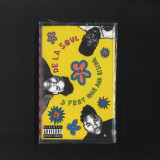
Finally back on tape, officially reissued. Must have! 3 Feet High and Rising is the debut studio album by hip hop trio De La Soul and was released on March 3, 1989 It marked the first of three full- length collaborations with producer Prince Paul, which would become the critical and commercial peak of both parties. Critically, as well as commercially, the album was a success. It contains the singles, "Me Myself and I", "The Magic Number", "Buddy", and "Eye Know". The album title came from the Johnny Cash song "Five Feet High and Rising". It is listed on Rolling Stone's 200 Essential Rock Records and The Source's 100 Best Rap Albums. When Village Voice held its annual Pazz & Jop Critics Poll for 1989, 3 Feet High and Rising was ranked #1. It was also listed on the Rolling Stone's The 500 Greatest Albums of All Time. Released amid the 1989 boom in gangsta rap, which gravitated towards hardcore, confrontational, violent lyrics, De La Soul's uniquely positive style made them an oddity beginning with the first single, "Me, Myself and I". Their positivity meant many observers labeled them a 'hippie' group, based on their declaration of the 'D.A.I.S.Y. Age' (Da. Inner. Soul. Yall). Sampling artists as diverse as Hall & Oates, Steely Dan and The Turtles, 3 Feet High and Rising is often viewed as the stylistic beginning of 1990s alternative hip hop (and especially jazz rap).
New York, NY (May 09, 2023) - Techno powerhouse, Charlotte de Witte releases her highly anticipated EP, Overdrive as the anchor to her larger Overdrive Campaign within the KNTXT Label. Following de Witte’s breakthrough to the top of the electronic music scene in 2019 with her signature sonic approach that refuses to be boxed in, Overdrive is a reflection of this ethos. The EP aims to showcase street style that is both rough and energizing, while delivering high-energy tracks meant to pull listeners into the fast-paced thrill that unlocks one's turbocharged version of themselves. Listen HERE.
“While making Overdrive, I didn’t fully realize how applicable the lyrics are to my philosophy of life,” said de Witte. “The fast-paced tempo, which goes full force without looking back, is all about the feeling of being on the edge and living life to the fullest.”
Best known for her “dark and stripped-back” brand of techno and underground music, DJ, record producer, and label head de Witte pushes the boundaries of the electronic genre with music that has a distinct and unforgettable sound that is uniquely her own. De Witte’s innovative ability allows her to seamlessly blend genres and styles that have won her a dedicated fan base and critical acclaim.
“Overdrive is a love story between hip hop and techno, it’s inspired by both genres, but coated in a techno jacket,” said de Witte. “It’s meant to be played loud while driving at night and watching the city lights pass by, and where better to experience that than in New York City?”
Overdrive marks de Witte’s first release since her single “High Street,” and first EP on her KNTXT label since her last EP, “Apollo” which was released in October 2022 as well as her collaboration with fellow techno artist Enrico Sangiuliano on the “Reflection” EP in March 2023. De Witte had previously worked with Sangiuliano on their remix of “The Age Of Love”, which amassed over 40 million streams on Spotify and achieved certified gold status in Belgium. De Witte’s other recent releases include her “Universal Consciousness” EP in 2022 and her “Formula” EP in 2021, which featured the chart-topping lead track “Doppler”.
*MILKY CLEAR VINYL - 300 COPIES ONLY FOR WORLD!!* Technology + Teamwork’s fizzling synths, interweaving textures and punchy rhythms are beguiling on their long-awaited debut album We Used To Be Friends. However, at the heart of it all it’s the connection between the group’s two members, Anthony Silvester and Sarah Jones, the friendship the much-travelled duo have managed to maintain for nearly 15 years and a showcase of the slow-burning construction of the electronic world that they’ve surrounded themselves with. We Used To Be Friends is ultimately the tale of two storied artists in their own right, holding onto each other through personal and career twists and turns, relocations and broader movements through respective phases of their lives. Silvester and Jones first met and then collaborated as part of biting post-punk five-piece XX Teens in 2008, eventually breaking off to forge their own path together even as the latter’s demand as a drummer grew. Performing with everyone from Hot Chip, Harry Styles and Bloc Party among many others, Jones has been a constant percussive presence across the sphere of alternative UK pop music – she’s also found time for her own solo project Pillow Person and played on records by the likes of Puscifer and Kurt Vile. Silvester meanwhile has performed in art galleries across Europe including: Fridericianum in Kassel, Kölnischer Kunstverein in Cologne, and Vleeshal in Middelburg, as well as providing sound design and composing work for several art films. Technology + Teamwork is the constant throughout all of that though. “Technology + Teamwork's name perfectly describes how we work” Silvester explains. “Sometimes the teamwork is between each other and sometimes it’s between us and the technology.” Although going by the name Technology + Teamwork as far back as 2014, two events conspired that pulled the project into focus for the pair of them: firstly, Silvester spent a year constructing a soundproof studio shed on the border of London and Essex where he lives. Secondly, inevitably, the pandemic brought the globe-trotting Jones back home to just seven miles away from her long-time collaborator and friend. “We probably hung out more than we had for a few years” says Silvester. “Also, after all her Pillow Person releases Sarah had gotten really good with recording vocals and knowing what did and didn’t work and had a really good home studio set up. We still worked separately though, exchanging ideas via email and WhatsApp.” As with many artists through 2020 and early 2021, working separately was a new necessity that they were forced to adapt to. However, it became clear that there were creative benefits to it. “It really changed our sound and our sounds became a lot more focused as a result” Jones says. “I wanted to use the same ideas of improvisation that I might use while playing the drums for myself and apply that to melodies and lyrics.” The album bristles with hyperpop modernity. You can hear it in the manipulated vocals most prominently on Big Blue’s disco strut and on Moving Too’s heady mix of pitched up voice and burrowing sub bass. However, the pair also looked to San Francisco and the West Coast synthesis movement of the 60s, Silvester inspired by the likes of Suzanne Ciani and Don Buchla. The plaintive lo-fi and melancholy of Amsterdam incorporates Mutable Instrument’s Marbles by Émilie Gillet which – inspired by Buchla’s own synthesis work – outputs random voltages to give the track an air of unpredictability. It’s something that occurs throughout the album, the duo revelling in the happy accidents that disrupt the flow of their hook-laden pop. “The ‘Buchlian’ ideas of music having randomness and uncertainty, completely freed us up” Silvester explains. “It felt a bit like having more members in the band, machines that didn't do what you expected or intended.” Perhaps more subtly, is the influence of 17th and 18th century Baroque music, with Silvester drawing a line between it and the 90’s R’n’B he and Jones both love – exemplified perhaps best on K+B’s percussive claps and sultry grooves. The portentous juddering synthpop of the title track, meanwhile, alludes specifically to Handel’s Sarabande. It’s typical of an album that only needs a scratch of its seemingly glossy surface to unearth a myriad of contorted touchstones and reference points that’ve fermented beneath it. Thematically there’s an anxious sense to the record, with tracks often balancing above a quiet sense of unerring tension even at their most bombastic. Moving Too is the result of an existential doubt that hit Silvester while out cycling, with the outro refrain "it's not enough to die you also have to be forgotten" a take on something Samuel Beckett once said. These worries are echoed on the album’s closing track What A Year, which borrows a lot of lines from the late drag performer and fashion designer Dorian Corey including the grimly defiant "you're gonna leave your mark somewhere in this world just by getting through it”. Those clouds offer a counter point to We Used To Be Friends, but then isn’t that what great pop albums do? Technology + Teamwork undoubtedly love the craft of the hook and the song, but they always position themselves left of centre, prepared to scuff things up, pull something out of shape or manipulate something to leave it sounding warped. Much like their friendship, nothing here is particularly linear – and it’s all the better for it. Bio: Anthony Silvester & Sarah Jones first collaborated as part of biting post-punk five piece XX Teens in 2008, eventually breaking off to forge their own path together even as the latter's demand as a drummer grew. Performing with everyone from Hot Chip, Bat for Lashes, Harry Styles and Bloc Party (among many others), Jones has been a constant percussive presence across the sphere of alternative UK pop music - she's also found time for her own solo project Pillow Person and played on records by the likes of Puscifer and Kurt Vile. Silvester meanwhile has performed in art galleries across Europe including Fridericianum in Kassel, Kölnischer Kunstverein in Cologne, and Wleeshal in Middelburg, as well as providing sound design and composing work for several art films. Technology & Teamwork is the constant throughout all of that though. "We Used To Be Friends" proves that Technology & Teamwork undoubtedly love the craft of the hook and the song, but they always position themselves left of centre, prepared to scuff things up, pull something out of shape or manipulate something to leave it sounding warped. Much like their friendship, nothing hear is particularly linear - and it's all the better for it.
Linda Jo Rizzo the 80s icon and former singer of the FLIRTS (produced by Bobby Orlando) stays musically true to iconic Italo Disco / Euro Disco sound!
Greatest Hits & Remixes compiles her best songs and is a must have for all fans of Linda Jo Rizzo!
Now finally available on vinyl!
Ain’t no stopping him now. Krystal Klear’s streak continues with Automat Kingsland. The recipe remains, perfectly seasoned to taste. The extended menu of four tracks is musical testament to the artist’s life of the last six months. Emphasizing movement at a pace that is hard to hold on to, but embraced nonetheless. Trying to transport that „lost in translation“ (and transit) sense of normal life due to constant motion to a dance floor near you. Euphoric melancholia meets rave romance, shutters open to let happiness crawl in and anxiety turns into excitement through the usual cocktail of tearjerkers and white noise risers. Recorded between Paris, New York, Dublin and London and brought to your city via Running Back. Automatic non stop existential output.
Layton Giordani’s two-track stunner ‘Life Moves Fast’ continues his inspiring run of form.
The young New Yorker begins the year in a similar vein to how he ended 2022; working tirelessly to push his sound forward, while delivering captivating studio results in the process. Case in point, ‘Rabbit Hole’ his collaboration with HI-LO, that not only topped charts to end the year as one of 2022’s standout techno tracks, but also marked a definitive step in the development of his sound signature.
His latest offering ‘Life Moves Fast’ continues in this adventurous vein. First tested at Warehouse Project and at the Gashouder for Awakenings late last year, the title track is characterised by a distinctive lead, which is both playful and pensive and arouses a dramatic energy, before a series of magnetic drops lobs it into peak-time dancefloor territory.
‘Heart is King’ is an elegant, rhythmic slice of techno that balances euphoria and tension on a knife’s edge, while showcasing Giordani’s classy sound design.
Vincentiulian is the kind of name that needs no introduction. He is one of the best-known DJs and producers from the famous Romanian scene, and his evolution throughout the years tells its own story. He has played alongside the biggest names in the industry, shared the decks with household DJs like Priku, Rhadoo, or Cezar, and played the most important festivals out there.
His Subbass EP on Vivus Records cements his aura even more as a wonderful producer.
The opening track, Works, kicks things off wonderfully and subtly. It’s certainly a perfect track for the warm-up moments in the club, but its intricate background noises add a lovely layer of complexity as the track goes on.
Then we head off in a different direction: At Chalet is a much stronger track with an imposing bassline that dominates the sound and perfectly complements the mysterious vocals.
The titular track, Subbass, has a natural futuristic vibe and feels like a
ready-made club banger. The spacey atmosphere is something that only adds charm to it. The Tobias Laun Remix is a more chill but equally powerful way to end this mesmerizing EP, with Tobias showing his prowess at adjusting the pace just at the right rhythm for the dancefloor. The strong bass complements superbly with the sublime background noises to make this the perfect last chapter.
Recent times have seen After Caposile become one of the most sought after locations on the underground circuit, and this reflects in their acclaimed record label - Caposile Music. This Spring they have prepared a stellar release of firm favourites from the club. “The Sound
of Garden” release will come in two parts, both on 12” and will include a heavy hitting lineup such as Romanian duo Super Moon (Arapu & Priku), family members and residents Maggio, Francesco Maddalena, and Yaar Kü, Silat Beksi, Mihai Pol, Giuliano Lomonte and Sublee. A perfect blend of club affiliates, coming together to provide the soundtrack from that famous garden.
Volume One kicks off with the dynamite combination of Arapu & Priku under their Super Moon moniker. Hypnotic movements set a serious tone for the journey ahead, mysterious elements simmering throughout “I Can Help”. Dreamy meets dance floor in Maggio’s aptly named “Just Landed” floating synths calmly lift you, but you remain grounded by the killer elasticated groove. After delivering the previous EP on the label Yaar Kü returns with a stripped back encounter, his unique touch shining bright. Silat Beksi provides a certain sunshine jam with his track “Jaho”, you immediately feel the warmer times are coming, after parties in the sun.
Landing just a few weeks after is the equally special Volume Two, packed full of ammo for the tastemakers. Mihai Pol inaugurates proceedings with “Sugar Rush”, the 7 minute quest boasts shimmering synths and a sweet bass line to match. Francesco Maddalena ups the ante with his garage influenced “Breath Of Air”, an energy boost for the peak times of the party. Giuliano Lomonte’s “More Time” rumbles from the get go, begging to be played on a high quality system to allow each of the intricate details to speak for themselves. Last but not least is Sublee, his “Day Six” track is a chugging body of work, blurring the lines between house and minimal with a raw edge.
With a huge European tour on the table, and a release of this stature After Caposile are flying high at the moment with an indispensable team behind the project. Expanding on their party paradise location, but simultaneously propelling innovative underground sounds under the Caposile Music offshoot. Both Volume One and Two will land this May, right on cue for the summer time madness.
Alluring Stripped Down Dribblers
Volta Cab transports us, once again, into his own-defined post-punk universe, bringing nostalgia from 80s synthwave and 90s beats in his own modern context.Throughout his new EP “Alphabet of Humanity”, Volta Cab creates raw emotions from the first track to the last. There is a before and an after when listening to the subtle arrangement and dynamics of each tune, as the atmosphere that embeds his music can only let our imagination flow.
The EP also features astonishing artwork by Anthony Burrill.
We're thrilled to release two exciting electro tracks by Art P, as well as the classic minimal synthwave tune 'Der böse Osten' by related band project Die Synthetische Republik on this limited split 12".
The single kicks off with 'Genscher Pull and Push', an incredible and previously unreleased electro/wave/proto-techno tune from the P.A.P. archives, recorded in October 1982 with a political background. The song was only available on a demo cassette for a radio show and had been forgotten since then. Genscher was a long-time Federal Minister for Foreign Affairs and Vice Chancellor of Germany, who played a key role in a coalition change in September/October 1982, leading his party, the FDP, to leave the Helmut Schmidt cabinet with the SPD and continue with the opposition, the CDU/CSU. As a result, the German lyrics of the song shout 'bitte geh nach links / bitte geh nach rechts' ('please go to the left' - meaning the left-leaning SPD, and 'please go to the right' - meaning the right-leaning CDU), and so on.
Unfortunately, this track was never released, as the topic of the coalition change quickly became uninteresting and outdated. If it had been issued on vinyl in late 1982, it would probably be considered one of the first proto-techno tracks ever. With its driving and heavily-punching 808 rhythms, and the bending synth bass leads played on the Jupiter 4 synthesizer, it gives you a groove that owes as much to Kraftwerk's 'Computerwelt' album as it may rhythmically pre-date the sound of Detroit's Juan Atkins. The energetic German vocals are giving the track a unique Neue Deutsche Welle touch. They are heavily left/right panned to fit the political topic.
Next up on the Art P side is a remix of 'Polaroid', originally found on the No Message LP that we re-released last year. The track was recorded in 1985, and at that time, the duo of Frank Grotelüschen and Jens-Markus Wegener had become bored with the sound of the Roland 808 drum machine, so they made the track with a DrumTraks by Sequential Circuits. However, for this remix, DJ Scientist, the curator of this 12", wanted to recreate the typical electro-funk sound of the era and added 808 bass drums and claps. The track was also shortened to a more DJ-friendly arrangement. The result is a dancefloor delight for all lovers of classic electro and SVC-350 vocoder sounds!
Die Synthetische Republik was a project by Wegener of Art P and Olav Neander. The track 'Der böse Osten' can originally be found on the cassette album 'Faktor D', recorded in just two weeks on a Tascam Portastudio 245. The original recording sessions were pure fun but also rushed. Hence, none of the tracks was perfectly mixed. With digital technologies, we remastered 'Der böse Osten' to achieve the best possible result and are pleased to release this serious synth wave gem on a loud 12" for the first time as an exclusive extended mix.
The split 12" is released in a picture sleeve with a unique artwork on each side. It is limited to 500 copies.
AMAS_JAHRE
das album JAHRE ist ein musikalischer abriss der letzten 15 jahre zweier freunde und weggefährten. alle persönlichen höhen und tiefen sind auch hier musikalisch zu finden und sollen durch einen typischen abend unserer generation führen.
es beginnt mit dem prolog, der alle ängste und hoffnungen auf einer einsamen straße zum gemeinsamen sein skizziert. was erwartet einen, wird man sich wieder mit seinem besten freund streiten, oder liebt man sich mit einer fremden auf dem klo? all das läuft langsam die straße hinunter…
die abenddämmerung beschreibt das zusammenkommen mit deinen liebsten und freunden und die erste euphorie auf das was kommen mag. man sitzt gemeinsam beim essen oder im wohnzimmer, redet über alte geschichten oder neue liebschaften, alles schwingt und swingt im richtigen groove der zeit.
in aufbruch kommt die ganze nervosität und vorfreude auf das gemeinsame ausgehen zum ausdruck. alle werden hibbelig und springen umher, einer zieht sich etwas durch die nase, die andere tanzt auf dem sofa und schreit ihre liebe in die nacht. wenn endlich alle fertig sind kann man dann auch mal aufbrechen.
getanze beschreibt den moment des betretens einer musikalischen szenerie und tanzerei, die alle sofort mitreist und befreit. der geruch im club ist stark und leicht süßlich von rauch und schweiß, alles bewegt sich, alles fließt, man wird einfach geführt und lässt sich gehen.
mit begierde kommt der sexualisierte augenblick, verstärkt durch alkohol und drogen jeglicher fasson, über uns alle - man möchte alles begehren und besitzen, man liebt alles, fickt alles und beweint alles und jeden, bis man wieder klar wird und den ursprünglich pfad zu seiner gemeinschaft findet.
ricardo zerlegt kurz vor dem ende des abends nochmal völlig wild und ekstatisch das gehör, den raum und die zeit. alles biegt sich wie in einem schwarzen loch, überall ist gravitation und klang, alles zerschmilzt zu einem brei aus liebe, angst, geborgenheit und wahnsinn.
das morgengrauen ist der moment des erwachens, sowohl der sorgen und des grauens der folgen dieser nacht, aber auch der geborgenheit der freundschaften die einen umgeben. man schwankt freudig und zitternd nach hause, manch einer alleine, andere wollen noch weiter in ihren armen liegen, ob aus furcht oder liebe ist eigentlich egal, hauptsache man spürt!
am ende soll der epilog heilen, er zeigt uns wie gut und selten unsere fast schon schizophrene lebensweise war und immer noch ist :).
„There are imaginary signs or signals that make your arm twitch mutely.
In such cases, you may have to interpret the meaning of such a "message".
If you ignore it, it's almost certain that nothing will happen, but you may also miss the chance to change your life because you passed a potential turning point and didn't notice.”
There were once many worlds on this Earth. Each had its own land, language, population, borders and history. There were people and societies.
They already looked alike, but they didn't realise it.
When the borders disappeared, the looked at each other, but by this time suddenly, the languages and the histories also disappeared.
The present worlds do not have any Earthly home, they have moved to the kingdom come of the collective subliminal sociostasis.
There they are still living for a while, exactly so long as humans have human form and the time for transhuman cultures arrives.
To fumble about in this gap of time bubble, that has been opened for a short time between the collapse and the vanishing of the borders of cultures: this is the science of Ishin-denshin burdened with Heisenberg’s paradox.
Don’t forget: never before and never after.
- A1: Black - Everything's Coming Up Roses
- A2: Ice Mc - Easy
- A3: Gigi D'agostino - Another Way
- A4: Mark Oh - Tell Me
- A5: The Human League - Don't You Want Me
- A6: Camouflage - Love Is A Shield
- B1: Silent Circle - Stop The Rain In The Night
- B2: Ken Laszlo - Don't Cry
- B3: Animotion - Obsession
- B4: Fancy - Slice Me Nice
- B5: Valerie Dore - Get Closer
- B6: Caught In The Act - My Arms Keep Missing You