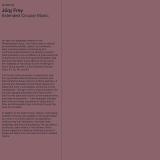
Since its founding back in 2014, Blume has carved a unique place in cultural landscape, issuing free-standing works, spanning the historical and contemporary, that represent singular gestures of creativity within the field of experimental sound. Joining their broad efforts in building networks of context and understanding that already includes the works by Werner Durand, Sarah Hennies, Bruce Nauman, John Butcher, Jocy de Oliveira, Mary Jane Leach, Valentina Magaletti, Alvin Curran, Julius Eastman, Alvin Lucier, and following the first ever vinyl release to attend to James Tenney's legendary Postal Pieces, the label now presents the first LP published by the visionary Swiss composer Jürg Frey. Drawing from the transformative power of breath and resonance, this release represents one of the most profound explorations of musical metamorphosis to emerge from the contemporary experimental landscape.
The completed work represents a "conjunction of these two artists" that has "activated a transformative form of experimentalism." These renderings "dance with an airy lightness, humour, and play, imbuing them with a beauty and emotiveness that can be rare within experimental music." They exist as "breaths, carrying the curiosities of life, belonging to no time and all time, to no one and everyone: a human music to be inhaled and pondered, for which the outcome remains unknown." In this liminal space between composition and interpretation, between breath and resonance, Zurria and Frey have created something that transcends the boundaries of experimental music itself, offering what might be called a metaphysical cartography of sound in its most essential form. As Bradford Bailey observes in his penetrating liner notes, "music is rarely a fixed entity," existing instead in a state of perpetual flux, "taking on the influences of its interpreters and performers." This fundamental truth finds its most eloquent expression in the transformative collaboration between Italian flutist Manuel Zurria and Frey, longtime member of the Wandelweiser Group. Where conventional recordings might preserve a definitive version, this release activates what Bailey calls "states of unknowing and continued experimentation," allowing Frey's compositions to evolve into entirely new dimensional territories. The original string quartet and piano works dissolve into breath-carried architectures of sound, where "the original remains in a constant dialogue with its transformation." This is not mere arrangement but ontological metamorphosis - an alchemical process through which crystalline harmonies are reborn as atmospheric phenomena.
The metaphysical dimensions of this transformation become clear through detailed analysis of the musical result. Where Frey's original compositions operate through what he calls "basic confidence in the clear and restricted material," Zurria's interpretation activates entirely new perceptual territories. Space holds almost atomic sense of weight against the airy punctuations of timbres, textures, and tones, creating "suspensions of time within which questions and identities posed by instrumentation fade." The Extended Circular Music pieces - each comprising "a small number of bars to be repeated an undetermined number of times" - become organizations of sound that defy being definitive or fixed. Originally scored for different combinations of violin, viola, cello, and piano, these works now exist as pure phenomena of breath and resonance, where "hanging, breath-length utterances dance and intertwine amongst complex harmonic clusters and conjunctions."
The philosophical implications of this transformation illuminate a lineage of composers who have moved "away from abstraction and responding to the need to create" something beyond mere technique. Drawing parallels to Morton Feldman's understanding of non-functional harmony, Zurria's approach represents "a transformative form of experimentalism" that activates what Frey calls the "thaumaturgic power" of music - its capacity to heal and transform consciousness itself. The result is "a radical reimagining of ambience: sprawling sonorities and resonances adrift in space, carrying the liberated traces of the work's former incarnations and their truths." In Zurria's interpretation, Frey's String Quartet n.3 becomes something approaching "an organ played in slow motion, its seals leaking," while the Extended Circular Music pieces transform into "glacial chords from a diverse palette of voicings, harmonies, timbres, and tones."
Performed by Manuel Zurria. Recorded and mixed by Zurria at BigCardo, Catania between 2022-2024, with mastering by Bruno Germano at Vacuumstudio, Bologna, this Blume release represents a profound exploration of musical transformation.
Cerca:le car
This new "Experimental Chapter" by DJ Narciso comes as no surprise, really. Autonomous in the motorization of his music, pushing for progress within the framework of an undeniable (inescapable?) heritage. Twisting and bending sound every step of the way, Narciso definitely keeps in touch with the dancefloor, offering the always much needed transcendence through distinctive, non-linear melodies and patterns. The artist pursues a direct link with bodies in motion but seldom in the expected, institutionalized way club culture is being largely promoted.
This is challenging dance music, proud statements of difference. Narciso's previous record was named "Diferenciado". Now we get "Dificuldades", a track that simultaneously carries the weight of being somewhat odd and the difficulties of life. Check how the piano is venting, freestyle, communicating a feeling, and then lets itself get stuck in a loop, but that's exactly when the groove really starts flowing. And then another layer. It's like direct speech.
A common assertion of pride is found in the origin of the artists. The ghetto as a place where any transformation projects more power precisely because of... inherent difficulties. As others (including himself) did in more or less obvious ways, Narciso clearly states "I come from the ghetto" ( "Não Sabes" ). Twice the value. At least. Almost every segment of music in this album ends up sounding heavily emotional, reaffirming what may be - perversely - a well-known characteristic of Portuguese music: melancholy.
"Não Quero" begins side B as a march maybe more significant than a thousand words, such is the ominous tone of its texture. Next track is another lunar tarraxo, pulling down the shades. Then, "Dor de Barriga" lets things loose again, steering clearly off road, shouting this way and that until a peaceful resolution comes. In "Livra-me Desta", vocal snippets blend into synth snippets, disembodied voices abandon all traces of humanity and finally mutate into different entities that, towards the end, again sound vaguely human but now we find ourselves doubting. Closer "Bob" is a rather classic percussion track with plenty of echo, reverb and an unconscious nod to dodecaphonic music. Unlikely? No, the structural ADN of this music is made up of elements western and eastern, southern and northern. To say all-over-the-place is usually not flattering but in this case the expression translates as wonder, surprise, The Unexpected, and reveals Narciso perfectly at ease inside the nucleus of creation.
Italian techno force Alarico makes a striking debut on KEY Vinyl with 'Sweaty Techniques', a seven-track LP that encapsulates his signature style: groove-centric, stomping and irresistibly danceable. Known for his prolific output, the Berlin-based artist delivers a fast-paced and energetic sound, interwoven by the thematic thread of the whole release: a sweaty encounter.
From the opening pulse of 'Cradle to the Grave', rhythm takes center stage-percussion-driven and primed for peak-time occasions. Snipped vocals and bouncy baselines carve out some sort of hypnotic patterns, while deep, rolling low ends keep the momentum locked in. Gritty textures collide with fragmented modulations, twisting into distorted, high-energy productions. Across the LP, tightly coiled bleeps and moaning snippets emerge, lending a sinister yet seductive edge.
Then there's 'Dammelo'-Italian for 'give it to me'-which subsumes the album's thematic essence into pure physicality, embracing its vocal motif with a knowing smirk. As the record progresses, Alarico shifts between functional, stripped-back rhythms and more tension-driven moments, culminating in 'Touch My Heart', where sharper drum programming meets hypnotic vocal loops. Closing on a high, 'Jamira' encapsulates the album's crisp percussive edge, rounding off a release that is as relentless as it is intoxicating.
With 'Sweaty Techniques', Alarico solidifies his place as one of techno's most electrifying new voices-an LP made of steel, but definitely built to move.
- 1: Coyote
- 2: Amelia
- 3: Furry Sings The Blues
- 4: A Strange Boy
- 5: Hejira
- 6: Song For Sharon
- 7: Black Crow
- 8: Blue Motel Room
- 9: Refuge Of The Roads
Mobile Fidelity's UltraDisc One-Step 180g 45RPM 2LP Set Plays with Authoritative Tonality, Airiness, and Clarity:
Pressed on MoFi SuperVinyl and Strictly Limited to
3,000 Numbered Copies
1/4” / 15 IPS Dolby A analogue master to DSD 256 to analogue console to lathe
Joni Mitchell is the only artist who could’ve made Hejira. The legendary singer-songwriter said as much when discussing the album decades after its release. Yet that fact seemed obvious from the moment the gold-certified effort streeted in fall 1976. An adventurous travelogue, probing narrative, and offbeat homage to freedom, Hejira remains an inimitable entry in the catalog of recorded music — a spare, gorgeous, meditative series of sonic vignettes comprised of floating harmonic pop, cool jazz, soft rock, and sensitive vocal elements that beckon feelings of motion, discovery, and self-examination.
Sourced from the original analog master tapes, pressed at Fidelity Record Pressing on MoFi SuperVinyl, and strictly limited to 3,000 numbered copies, Mobile Fidelity's UltraDisc One-Step 180g 45RPM 2LP set presents the record ranked the 133rd Greatest of All Time by Rolling Stone with definitive detail, richness, accuracy, and directness. Marking the first time the revered LP has received audiophile treatment, it's one of six iconic 1970s Mitchell records Mobile Fidelity is reissuing on vinyl and SACD.
Playing with a virtually nonexistent noise floor, dead-quiet surfaces, and superior groove definition, this collectible reissue reproduces in enveloping fashion the tones, textures, and craftsmanship that help Hejira function as the equivalent of a liberating trip down an open road with nothing but blue sky, natural landscape, and fresh air in the immediate vicinity. Passages bloom, carry, decay as they do amid an acoustically optimized environment. Soundstages extend far, wide, and deep, with black backgrounds and pinpoint images adding to the realism.
The reference-grade immediacy, airiness, and presence put in transparent perspective Mitchell’s dense strings of words, stream-of-conscious-like phrasing, and unhurried albeit forward momentum. Likewise, the instrumental contributions of her A-list support musicians — a cast that includes L.A. Express members John Guerin, Max Bennett and Tom Scott, plus Neil Young, Victor Feldman, and Abe Most — emerges with breathtaking clarity and dimensionality.
While Mitchell, whose intimate vocals and abstract guitar parts center everything, Mobile Fidelity's restoration of Hejira further reveals the visionary breadth of guitarist Larry Carlton and bassist Jaco Pastorius. Though heard on only four tracks, Pastorius' fretless bass epitomizes the fluid, subtle, flexible, roomy, and shape-shifting characteristics of songs that often appear to transpire out of nowhere akin to the formation of a puffy cumulus cloud overhead. In sync with Mitchell’s voice, Pastorius’ fusion hovers and floats, suspended in a fog you want to deeply inhale. The "grace notes" Mitchell desired on Hejira can now be heard in full. Ditto the luxurious tapestries of alinear lines, fills, and supplements unreeled on Carlton’s six-string.
Visually, the packaging of this UD1S set complements its identity as the copy to own. Housed in a deluxe slipcase, the LPs come in foil-stamped jackets with faithful-to-the-original graphics. This version is for listeners who desire to become immersed in everything about Hejira, including the unforgettable album cover — a pastiche of 14 different photos Mitchell used a Camera Lucida to assemble into one image that’s anchored by a portrait of her in a stoic pose — and the interior shots of Mitchell skating on a frozen Wisconsin lake wearing a pair of black skates, black shirt, and fur cape.
The notion of skating, feeling an awakening wind whipping against your face, and losing yourself to the surroundings are extremely apt for Hejira, which Mitchell wrote after a sequence of trips and relationships prompted her to reflect on the complicated conflicts between independence and marriage, success and satisfaction, duty and desire — and, more specifically, “the cost of being a woman.” The Canadian native delved into such themes before. But never as she does on Hejira, whose liberating, running-away aura doubles as another of Mitchell’s rejections of tradition as well as a suggestion of a better alternative.
At once observational and personal, expansive and insular, cheerful and poignant, Hejira spans a sea of human conditions, emotions, and circumstances. It addresses drifting, isolation, pleasure, place, time, and surroundings with strikingly poetic discourse matched with music that, save for the crooned ballad “Blue Motel Room,” forgoes conventional structures and choruses.
The jazz-based arrangements, marked by scaled-down percussion and all manner of bent, rounded, and unsettled notes, hint that Mitchell has no exact destination in mind. Excursions such as the moody “Furry Sings the Blues,” funky “Coyote” and edgy “Black Crow” throw open previously locked doors to possibility and journey. They signal it’s time for a welcome departure from norms and the past, one that leads to a heightened sense of clarity and perspective. Or, as Mitchell said upon choosing the album title, it’s time for “leaving the dream, no blame.”
- Personality Crisis
- Looking For A Kiss
- Vietnamese Baby
- Lonely Planet Boy
- Frankenstein (Orig.)
- Trash
- Bad Girl
- Subway Train
- Pills
- Private World
- Jet Boy
The extroverted blend of attitude, energy, and ostentatiousness that spills from the New York Dolls’ self-titled debut can be seen in full view on the album cover. Depicting the quintet in its hallmark flash-and-trash apparel and in drag appearance, the 1973 album scared away a considerable amount of potential listeners while capturing the attention of a sizable audience that recognized the band for what it was: zeitgeist pioneers who helped develop the punk and glam rock movements.
Named by Rolling Stone the 301st Greatest Album of All Time and by Mojo the 49th greatest album of all time, New York Dolls receives long-overdue audiophile treatment on Mobile Fidelity’s numbered-edition 180g 45RPM 2LP set. Sourced from the original master tapes, pressed at Fidelity Record Pressing in California, and housed in a Stoughton gatefold jacket, this collectible version marks the first time the group’s career-making statement is available to be experienced in audiophile quality.
Far from harboring the crude elements that became associated with the punk scene, New York Dolls benefits from keen production overseen by none other than Todd Rundgren. Though more accustomed to working far higher-caliber musicians, Rundgren — taken by the New York Dolls’ charisma and cool, if not their instrumental approach — fully understood the ensemble’s aesthetic. He captured what went down at New York City’s Record Plant with an astute blend of live-on-the-floor feel, raw authenticity, and professional acumen.
On Mobile Fidelity’s definitive-sounding reissue, you can hear those facets as well as key details, dynamics, and textures with previously unimaginable insight. Rundgren preserved generous degrees of grit, grime, and grease while bestowing the raucous music with elevated levels of separation, solidity, and impact every landmark recording deserves. His vision extends to introducing choice accents — barroom piano notes, Moog synthesizer passages, Buddy Bowser’s honking saxophones — that add to the songs’ appeal without interfering with the primary architecture.
Afforded extra groove space on this pressing, the tenor, presentation, and attack of both vocalist David Johansen and now-iconic guitarists Johnny Thunders and Sylvain Sylvain come across with stunning vibrancy and vitality. The New York Dolls often seem headed off the rails and into the red, but somehow, the strut, swagger, and sloppiness — and the associated sleaze and scruff, scrape and snarl, frenzy and feverishness those characteristics entail — remain together as a whole that shakes its collective fist at the frustrations, isolation, disarray, and disillusionment of youth chaos and urban decay.
Kicking off its debut with “Personality Crisis,” cited by Rolling Stone as one of the 500 Greatest Songs of All Time, the band makes obvious its grasp of alienation, deviance, displacement, and suburban disaffection — as well as its capacity to play hanging-by-a-thread boogie, noisy rock ‘n’ roll, and Brill Building-inspired pop. The lipstick-kissed New York Dolls possesses traits many of its harsher predecessors would overlook: joyfulness and melody, topped with a knack for knowing how and where to take a song inside of three-and-a-half minutes.
Dive and dash with the belligerent “Looking for a Kiss”; stomp your feet and clap your hands to the big choruses of “Jet Boy”; surrender to the demands and provocations of the coded “Vietnamese Baby”; decide whether “Bad Girl” yearns to explode or implode. It’s one of several tunes here that allude to the world coming to end. Of course, that doesn’t mean there isn’t time for a fling before everything burns. “There’s no place I gotta go,” yowls Johansen. And he means it.
Adorned with tonal crunch, glitter, and gristle, New York Dolls takes pride in its brashness and brattiness. The rambunctious effort, which earned the band the distinction of being voted both “Best New Group of the Year” and “Worst New Group of the Year” in the pages of Creem, displays knowing reverence for the blues without calling attention to the style. The folk-laden “Lonely Planet Boy” is nothing if not a collision of heart-on-the-sleeve emotions and the desire in the face of challenges to maintain a tough-skinned exterior. An interpretation of Bo Diddley’s “Pills,” complete with shivering harmonica and clattering rhythms, announces there’s no cure for what infects this band. It’s that contagious. And how.
His deliveries gushing with campy fun, playful irreverence, and sheer decadence, Johansen doubles as the equivalent of an open fire hydrant that spouts at will. He’s at once tender and vicious, serious and tongue-in-cheek. On arguably his finest hour on the album, Johansen’s phrasing, passion, and lyrical ambiguity alone turn “Trash” into an insistent glam-rock gem whose echoing harmonies and girl-group references stamp it a pop classic.
Too much, too soon? Only for those averse to some of the finest rock ‘n’ roll ever put on tape.
Jazz Is Dead geht in die dritte Phase von Veröffentlichungen mit erstklassigen Aufnahmen, die den Hörer auf eine Reise durch die funkigen Klänge Ghanas bis hin zum psychedelischen Soul und Samba Brasiliens mitnehmen. Von den Labelgründern Adrian Younge und Ali Shaheed Muhammad produziert, enthält Jazz Is Dead 021 neue analoge Aufnahmen der lebenden Legenden Ebo Taylor, Hyldon, Dom Salvador, Antonio Carlos e Jocafi, Carlos Dafé, und Joyce e Tutty Moreno.
- A1: Wake Me Up
- A2: Cry For Me
- A3: I Can't Fucking Sing
- A4: São Paulo
- A5: Until We're Skin & Bones
- A6: Baptized In Fear
- A7: Open Hearts
- B1: Opening Night
- B2: Reflections Laughing
- B3: Enjoy The Show
- B4: Given Up On Me
- B5: I Can't Wait To Get There
- C1: Timeless
- C2: Niagara Falls
- C3: Take Me Back To La
- C4: Big Sleep
- C5: Give Me Mercy
- D1: Drive
- D2: The Abyss
- D3: Red Terror
- D4: Without A Warning
- D5: Hurry Up Tomorrow
Der mehrfach mit Platin und siebenmal mit Diamant ausgezeichnete R&B- und Popstar The Weeknd kommt mit seinem Album „Hurry Up Tomorrow“ zurück. Nach seinem 2020 erschienenen Erfolgsalbum „After Hours“, welches auch das am häufigsten gestreamte R&B-Album aller Zeiten ist, und dem 2022 veröffentlichten Album „Dawn FM“ bringt The Weeknd die Trilogie mit „Hurry Up Tomorrow“ zu ihrem Höhepunkt. Dieses Album hebt seine künstlerischen Erzählungen auf ein neues Level und fängt existenzielle und selbstreferenzielle Themen des Sängers ein. Titel wie „Dancing In The Flames“, „Timeless“ mit Playboi Carti und “Sao Paulo” mit Anitta werden bereits seit dem Sao Paulo Konzert von den Fans gefeiert. Im Jahr 2023 wurde The Weeknd vom Guinness-Buch der Rekorde zum „Beliebtesten Künstler der Welt“ ernannt.
- A1: Wulomei – Takoradi
- A2: Conjunto Ana N’gola – Puxa Odoette
- A3: Zeal Onyia & His Music – Egbe Ne Lueli
- A4: Los Corraleros De Majagual – Remanga
- A5: Aquí Suena – Abel Llinas
- B1: Peacocks International Highlife Band – Igbala Oso
- B2: Pedro Lima Et L’orchestre Os Leonenses – Philomene
- B3: The Shoe Laces – Isitha Somunthu
- B4: Claudio Y Su Combo – Como Sea
- B5: Pa’ Entro Mi Gente – Ángelo El Auténtico
- C1: Zaire – I’m Tired Of Living In The Shack
- C2: Afous - Anavdhou (Edna Martinez Extended Edit)
- C3: Zaïko Langa Langa – La Tout Neige (Edna Martinez Edit)
- C4: Erick Cosaque Et Les Voltage 8 – Ajaccio (Edna Martinez Remix)
- C5: Picó Sin Fronteras – Abel Llinas
- D1: La Calandria – Como Duele Una Traición
- D2: African System International – Amina
- D3: Carlos Díaz Y Su Orquesta – Tres Meses De Vida
- D4: No Puedes Conmigo – Ángelo El Auténtico
Berlin-based Colombian DJ, producer, and curator Edna Martinez presents a sonic journey into the electrifying world of Picó—the vibrant and dynamic sound system culture that has defined the streets of Cartagena and Barranquilla for decades. More than just a musical movement, Picó is a way of life, a bold expression of identity, community, and resistance. From its roots in the working-class neighbourhoods of Colombia’s Caribbean coast to its deep connections with Africa and the Caribbean, this compilation captures the pulse of a culture where music is played at full volume, rhythms travel across oceans, and dance is both a form of celebration and storytelling. For those unfamiliar, Picós are hand-painted sound systems, often adorned with dazzling colours and striking imagery, each with its own name and sonic identity. These mobile discos became the heart of neighbourhood bailes, where the sounds of champeta, highlife, soukous, mbaqanga, zouk, soca, and cumbia would turn every street corner, market, and terrace into a dancefloor. Initially built by local craftsmen using modified speaker components, Picós became legendary for their powerful bass and exclusivity, with DJs sourcing rare vinyl from African and Caribbean ports and rebranding them with unique piconemas—new names adapted to local slang, making the tracks instantly recognisable within the community.
This compilation brings together a carefully curated selection of these rare and sought-after tracks, tracing the deep-rooted musical exchanges between Colombia, West and Central Africa, and the Caribbean. Featuring artists like Los Corraleros De Majagual, Peacocks International Highlife Band, Pedro Lima, Zaïko Langa Langa, and more, the album also includes edits by Edna Martinez, reimagining these timeless rhythms for contemporary audiences while staying true to their original spirit.
Strut presents ‘Picó! Sound System Culture From The Colombian Carribbean’ across 2LP Vinyl, 1CD & Digital focusing on a celebration of the raw, undiluted energy of Picó culture. Through Edna Martinez’s curation, and extensive liner notes, this compilation offers a powerful and authentic glimpse into one of the most vibrant musical traditions of the Colombian Caribbean
- A1: Positive Vibration
- A2: Roots, Rock, Reggae
- B1: Johnny Was
- B2: Cry To Me
- B3: Want More
- C1: Crazy Baldhead
- C2: Who The Cap Fit
- D1: Night Shift
- D2: War
- D3: Rat Race
Bob Marley & The Wailers' Rastaman Vibration Analogue Productions' UHQR, the pinnacle of high-quality vinyl! 45 RPM 2LP Ultra High Quality Record release limited to 4,500 copies Mastered from the original tapes by Ryan K. Smith at Sterling Sound Pressed on 180-gram at Quality Record Pressings using Clarity Vinyl® Includes "12 x 12" 8-page booklet featuring new liner notes by musician and Marley biographer Leroy Jodie Pierson (APO Records Direct-To-Disc AAPO 005), plus exclusive photos by Kim-Gottlieb Walker Purest possible pressing and most visually stunning presentation and packaging!
When Rastaman Vibration was first released in America in 1976 it did what some in the music industry considered nearly impossible at the time. It took Bob Marley into the Top Ten alongside disco records and corporate rock, points out Rolling Stone, which rates the album 4 stars. Despite the good cheer of the title track and the upbeat "Roots, Rock, Reggae," Rastaman Vibration contains some of Marley's most intense images of oppression, paranoia and despair. Tracks such as "Who the Cap Fit," "Crazy Baldhead" and "War" are offered by the Wailers with dire urgency as Marley's brutal visions are echoed by his own church choir, the I-Threes.
More than four decades later, neither Marley's music nor his message has lost its sting. Now, Analogue Productions presents perfection — Rastaman Vibration cut at 45 RPM in UHQR format on 180-gram 2LP Clarity Vinyl. This Ultra High Quality Record release will be limited to 4,500 copies, with gold foil individually numbered jackets. For Bob Marley, 1975 was a triumphant year. The singer's Natty Dread album featured one of his strongest batches of original material (the first compiled after the departure of Peter Tosh and Bunny Wailer) and delivered Top 40 hit "No Woman No Cry." The follow-up Live set, a document of Marley's appearance at London's Lyceum, found the singer conquering England as well. Upon completing the tour, Marley and his band returned to Jamaica, laying down the tracks for Rastaman Vibration (1976) at legendary studios run by Harry Johnson and Joe Gibbs.
At the mixing board for the sessions were Sylvan Morris and Errol Thompson, Jamaican engineers of the highest caliber. Of the material on Rastaman Vibration, "War," for one, remains one of the most stunning statements of the singer's career. Though it is essentially a straight reading of one of Haile Selassie's speeches, Marley phrases the text exquisitely to fit a musical setting, a quiet intensity lying just below the surface. Equally strong are the likes of "Rat Race,""'Crazy Baldhead," and "Want More."
These songs are tempered by buoyant, lighthearted material like "Cry to Me," "Night Shift," and "Positive Vibration." Not quite as strong as some of the love songs Marley would score hits with on subsequent albums, "Cry to Me" seems like an obvious choice for a single and remains underrated. This UHQR is remastered at 45 RPM by Sterling Sound's Ryan K. Smith from the original analog master tapes. Each UHQR will be pressed at Acoustic Sounds' industry-leading pressing plant Quality Record Pressings (QRP) using hand-selected Clarity Vinyl® with attention paid to every single detail. These records will feature the same flat profile that helped to make the original UHQR so desirable. From the lead-in groove to the run-out groove, there is no pitch to the profile, allowing the customer's stylus to play truly perpendicular to the grooves from edge to center.
Clarity Vinyl allows for the purest possible pressing and the most visually stunning presentation. Every UHQR will be hand inspected upon pressing completion, and only the truly flawless will be allowed to go to market. Each UHQR will be packaged in a custom clamshell box and will include a booklet detailing the entire process of making a UHQR along with a hand-signed certificate of inspection. This will be a truly deluxe, collectible product. In addition to the UHQR booklet the package will contain a 8-page 12" x 12" booklet containing new liner notes by musican and Marley biographer Leroy Jodie Pierson as well as exclusive photos by Kim-Gottlieb Walker. Pierson is a past performer for Blues Masters at the Crossroads, the two-night historic blues festival at Blue Heaven Studios in Salina, Kansas. He's also recorded a Direct-To-Disc blues album for APO Records. (AAPO 005) Rastaman Vibration — now a landmark production on 180-gram 45 RPM Analogue Productions UHQR Clarity Vinyl!
AV1 is the new project of Chris Carrier & Le Loup. With countless releases under their belts, the parisian producers are long time heroes of many around the globe. It’s an honor to welcome these two with a release that merges the different sounds they listened over their long-spanning careers. From trancy tech house, to dark techno beats and a more slowed-down electroish piece on the B-Side, here is a first solid appearance on the label as a duo. Are they done with us? Probably not.
- 1: The New Resident
- 2: All Virtue
- 3: Blow The Horns On 'Em
- 4: Blinfold Test #10 (He Don't Play)
- 5: The Thang-Thang
- 6: The Plan Pt. 1
- 7: Tension
- 8: Heat
- 9: Smoke Break
- 10: Gamble On Ya Boy
- 11: The Plan (Reprise)
- 12: The Ox (805)
- 1: Take That Money
- 2: Life
- 3: Parklight
- 4: Drinks Up!
- 5: Yo Yo Affair Pt. 1 & 2
- 6: The Way That I Live
- 7: Ratrace
- 8: I Want It Back
- 9: Go!
- 10: Disco Dance
- 11: What It Do
- 12: Stop
Madlib’s WLIB AM: King of the Wigflip Returns on Double Vinyl via BBE Music BBE Music is thrilled to announce the long-awaited rerelease of WLIB AM: King of the Wigflip, the final installment in the legendary Beat Generation series from none other than Madlib. Originally released in 2008, this masterful collage of dusty loops, raw beats, and left-field soundscapes remains a high-water mark in the Stones Throw producer’s sprawling discography.
Now, for the first time in years, fans can experience the album in all its analog glory with this deluxe double vinyl edition, carefully remastered to preserve Madlib’s signature warmth and grit. A tribute to pirate radio culture and late-night airwaves, WLIB AM weaves together a rich tapestry of hip-hop, jazz, and soul, featuring an all-star cas t of collaborators, including Talib Kweli, Guilty Simpson, MED, and Oh No. Each track showcases Madlib’s uncanny ability to blur the lines between genres, effortlessly flipping obscure samples into hypnotic, off-kilter rhythms. From the hypnotic bounce of “Blow the Horns on ‘Em” to the smoked-out groove of “The Plan Pt. 1,” this is Madlib at his most playful, unpredictable, and inspired.
This special double vinyl edition, released exclusively via BBE Music, brings one of the Beat Generation series’ most celebrated albums back into circulation for crate-diggers and collectors alike. With original artwork and a high-quality pressing, this rerelease is a must-have for Madlib aficionados and vinyl lovers who appreciate raw, unfiltered beat craftsmanship. Don’t miss your chance to own a piece of hip-hop history—WLIB AM: King of the Wigflip is back and sounding better than ever.
- A1: Design - Premonition
- A2: Vision - Lucifer’s Friend
- A3: Richard Bone - Alien Girl
- A4: John Howard - I Tune Into You
- A5: Ian North - We’re Not Lonely
- A6: Selwin Image - The Unknown
- B1: Harry Kakoulli - I’m On A Rocket
- B2: Rich Wilde - The Lady Wants To Be Alone
- B3: Billy London - Woman
- B4: Alan Burnham - Science Fiction
- B5: The Microbes - Computer
- B6: The Goo-Q - I’m A Computer
- C1: Gerry & The Holograms - Gerry & The Holograms
- C2: The Warlord - The Ultimate Warlord
- C3: Die Marinas - Fred From Jupiter
- C4: Dee Jay Bert & Eagle - I Am Your Master
- C5: Peta Lily & Michael Process - I Am A Time Bomb
- C6: Sole Sister - It’s Not What You Are But How
- D1: Alasdair Riddell - Do You Read Me?
- D2: Karel Fialka - Armband (The Mystery Song)
- D3: John Springate - My Life
- D4: Idncandescent Luminaire - Famous Names
- D5: Disco Volante - No Motion
- D6: Dream Unit - A Drop In The Ocean
Compiled by Philip King
“And then came the rise of synth pop : blokes with dodgy haircuts hunched over keyboard-operated
machines stuffed with wires and do-it-yourself tone oscillators making sounds like a brood of geese
passing gas in a wind tunnel. Whoopee! This is the way the ‘70s ended : not with a blood-curdling bang
bang but with a cheap, synthesized, emasculating whimper.”
NICK KENT, NME.
All The Young Droids: Junkshop Synth Pop 1978-1985 is a new compilation that charts the
underbelly of the epoch-defining sound of the synthesiser in 80s popular music. Compiled by Philip
King (previously seen compiling All The Young Droogs, Glitterbest and Boobs - The Junkshop
Glam Discotheque), the music here connects the dots between DIY synth enthusiasts grappling with
new, cheap synthesisers at the tail-end of punk and wannabe, jobbing songwriters enthral to the new
music pioneered by Gary Numan, Depeche Mode and Daniel Miller’s Mute Records. Featuring rare
tracks of auto-didactic progressive pop music, proto-techno punk, shoot-for-the-stars-land-in-the-gutter
chart flops and heralded, underground synth classics, School Daze paints a picture of beautiful failure.
Complete with extensive sleeve notes written by King and never before seen imagery, all 24 tracks
were remastered by RPM in-house engineer Simon Murphy, many from vinyl copies due to lost master
tapes. The story told on All The Young Droids is one of the dawning opportunity presented by both the
emergence to the market of cheaper analog synthesisers and the distribution networks plus indie labels
that exploded with the advent of punk music in 1976. While the music that sprouted out all over the
globe in the wake of these factors was decried as fake, plastic, a refutation of punk’s guitar-led
revolution, it’s telling that much of the music on All The Young Droids.. was created in bedrooms,
ramshackle studios and home-made set ups with often borrowed equipment. In the era of record labels
jumping to capitalise on the success of The Sex Pistols, The Clash (both on major labels, of course)
these artists struggled to stand out from a new gold-rush with next to no budget or PR team. With radio
and labels desperate for the new Yazoo, what resulted was a testament to necessity being the mother
of invention.
At the time, the synthesiser was the music of the future, a shiny new machine that could paint like an
orchestra with a single finger and a 4-track. In the hands of Manchester avant-pranksters Gerry & The
Holograms it’s a pulsing, sardonic weapon.. the only instrument on the Messthetics classic lampooning
of New Wave fashion. In Hamburg, a 16 year old Andreas Dorau used it to write and record (with his
female classmates on vocals) a global smash in Fred Vom Jupiter (later licensed to Mute Records).
The hard-to-find English version (Fred From Jupiter, natch) is included here. Many artists with alreadystoried careers caught the bug and recorded synthesiser-fuelled peons to space, computers, the future
and, of course, love-interests. Harry Kakoulli, late of Squeeze, recorded a solo album in 1979 that
included the incredible power-synth-pop smash-that-never-smashed I’m On A Rocket. Similarly, Ian
North of Neo and American Power Pop stalwarts Milk ’n’ Cookies bought a Korg MS20 and used a
tape machine to record We’re Not Lonely, an absolute lost-classic of minimal synth pop. We’re Not
Lonely also features on the Junkshop Synth Pop sampler 7” twinned with John Howard unreleased
track You Will See, released April 12th 2025.
There are plenty of compilation debuts in evidence. Sole Sister were a mysterious trio who were
featured on the Scaling Triangles compilation of female-fronted, queer-adjacent post-punk /
underground music that also featured The Petticoats. Selwin Image were from San Francisco and
featured members of the recently defunct power pop/punk group The Pushups. Their stupidly catchy
The Unknown fizzes with New Wave energy - think XTC to Sparks but remains unreleased until now.
Dream Unit’s A Drop In The Ocean is an early synth wave cut, positively teaming with Joy Division
instrumentation, previously only released on a long-forgotten and super rare, self-released EP.
Incandescent Luminaire’s Famous Names belies an archetypal struggle of a small-town trying to
make it in a cruel industry but is a thrilling New Romantic-Synth Wave cross over with a OMD
gloominess that’s a joy to hear. Feminist Minimal Wave track I Am A Time Bomb by performance artist
Peta Lilly and Michael Chance is a revelation destined for new found cult status. It was released on 7”
and lost until now.
The flipside to the subterranean, never-made-it synth pop mentioned above are the ambitious, even
fruity attempts at success that have a perennial elegance to their confidence. New Jersey-ite Billy
London (real name Ed Barth) tried to cash in on the synth boom with Woman, released by a major
label, a lurching new wave track built on the Louie Louie rhythm and a wonderfully camp Lou Reedstyle sleazy vocal before exploding in the synthesised chorus. The song bombed but with a chorus like
this, you have to wonder why? Ex-Glitter Band member John Springate’s My Life is truly epic, with
doomed chord progressions and massive sounding drums turning into at least 3 different songs in the
course of the track. Before you wonder what’s going on the song resolves with a glorious return to the
main refrain.
The dry-ice-dressed dance floor is well catered for too. Design’s Premonition and Vision’s Lucifer’s
Friend are stone-cold minimal synth bangers, well loved but given a new lease of life here. The
Warlord’s The Ultimate Warlord was released in 1978, a homespun proto Hi NRG banger that was
later re-recorded by The Immortals in Canada who had a club hit with it. One-man- band Disco
Volante’s No Motion was re-issued by Synth wave label Medical in 2012 but makes its first vinyl
compilation appearance here. Close your eyes and you can imagine what Lawrence of Felt would have
sounded like with some cheap Korgs a little earlier in his career. Gibraltar-based trio The Microbes
imagined a computer programming people to dance - how prescient - and ended up with a propulsive,
robo-funk track with splendid rubbery bass playing over a tectonic drum machine. Previously picked up
by Belgian label Stroom TV, Dee Jay Bert & Eagle’s heavily Euro-accented I Am Your Master
demands the listener to “come to paradise!” In a frankly terrifying manner.
All The Young Droids is the first compilation to peel away from the narrative that dour, Minimal Synth
and Cold Wave were the only musical children of the first rush of synth pop. Philip King and School
Daze Records describe a much more complicated world: along with the austere, Brutalist children of
Daniel Miller (who produced Alan Burnham’s Bowie-Low-influenced Science Fiction here) was a
plethora of desperate cash-ins, accidental mainstream hits, ambitious pop dramas and major label
punts that went nowhere. Crucially, the compilation blurs the line between junk and treasure. What if the
two things are interchangeable. What if it’s all science fiction?
Jeroen van der Smut launches the 2nd volume of Smutty Edits. The crew from the first release DJ Mawashi, Tom Bolas and MLiR are joined by Italian Dama and Japanese crew C.O.M.P.A.S… The second edition carries through the concept of 3 electronic and House edits on one side with more disco and synth-pop leaning offerings on the flip.
- A1: Days Of Thunder (Main Title)
- A2: Rowdy Drives/Who Is This Driver?
- A3: Let Me Drive/Cole Drives Rowdy’s Car
- A4: Car Building
- A5: Darlington – Cole Wins
- A6: You’re Home/Daytona Race/The Crash
- B1: The Hospital
- B2: Wheelchair Race
- B3: Rental Car Race
- B4: Claire Arrives At Her Apartment
- B5: Physical Kiss
- B6: Cole Blows His Engine
- B7: Wheeler/Cole Smashes
- B8: Cole At The Laundry/Cole Agrees To Drive Rowdy’s Car
- B9: Cole And Harry Fight/Harry Talks To Car
- C1: Cole In Truck/Pre-Race
- C2: The Last Race
- D1: The Hospital (Alternate)
- D2: Wheelchair Race (Alternate)
- D3: Claire Arrives At Her Apartment (Alternate Ending)
- D4: Cole Blows His Engine (Alternate)
- D5: Pre-Race (Alternate Mix)
- D6: Days Of Thunder (Main Title) (Rock Arrangement)
Enjoy The Ride Records in conjunction with Paramount Pictures proudly presents the score to Days Of Thunder (Music From The Motion Picture) by Hans Zimmer (35th Anniversary Edition). After decades of being locked in the vault, the iconic full score was finally released to the public for the 30th Anniversary on limited edition CD by La-La Land Records, and we are excited to bring it to our favorite format yet again to celebrate the 35th Anniversary! This 2xLP 140g vinyl set has the full score, along with six bonus tracks with five alternate takes, plus the rarely heard Rock Arrangement of the Days of Thunder main title. Days Of Thunder (Music From The Motion Picture) is housed in a high gloss gatefold jacket featuring the iconic film poster, along with stills from the film.the film.
- Caroline
- Blue Corduroys
- Kebab Tune
- Blood Related
- Low Mood Season (Prelude)
- Low Mood Season
- Best Friends
When Casey Lowery’s grandfather passed away in 2023, he inherited a caravan on the English coastline, which became a retreat that helped him reconnect with his past and create his debut album, lekkerland. The album reflects Casey’s journey of recalibrating his career and reconnecting with the kind of community the music industry had promised him but failed to deliver.
Through his growing fanbase of 6 million online followers, Casey has carved out a space where he can be himself, keeping his shows affordable and supporting local creative communities on his tours. lekkerland is the culmination of a busy 2024 and 2025 releasing singles (including Kebab Tune, Blue Corduroys and Low Mood Season), headline shows and international festival appearances. From the caravan, Casey is building a more intimate, inclusive world for his fans - one where he can truly be himself.
Mutant is proud to present another contemporary classic from Quebec duo Le Matos, a follow-up to their acclaimed science fiction score, TURBO KID. Released in 2015, the movie TURBO KID became an instant cult hit, and since then, fans have been aching for a video game. This is the future; the world as we know it is gone. You are The Kid, a lone warrior on a journey to cross the Wasteland in search of hope. What you will find on your way, however, is a land riddled with scoundrels and creeps, which you’ll have to go through – sometimes quite literally – to survive. Propelling this madness is an incredible soundtrack by Le Matos returning to the wasteland they helped create in 2015. They cherry-pick influences from the best of electronic music from the past forty years; John Carpenter, Vangelis, and Tangerine Dream are all touchstones, but so are Daft Punk or Justice, all put through an 80's synthpop blender. Creating some incredible retro-futuristic synth wave sounds, including an astonishing re-teaming with Pawws for the single To Tomorrow. TURBO KID – A place beyond your dreams, a record beyond your imagination.
- Getaway Plan
- Weekend Fever
- Facedown
- Drive All Night
- Don't Get Scared Now
- Well Kept Secret
- Sanatorium
- Smiles And Cries
- Everything Is So Fucked Up
- Howie On The Brain
- Waiting On Someone
- The Way It Crumbles
Nihilistic Easyrider ist das geistige Kind von Narrow Head-Frontmann Jacob Duarte - aber täuschen Sie sich nicht, er geht nicht solo. DELUXE EDITION ist eine Art Mixtape, eine Sammlung von Songs, die zu verschiedenen Zeitpunkten in Duartes Karriere geschrieben wurden. Diese Songs umfassen ein breites Spektrum an stilistischen Referenzen, von zuckersüßem Y2K-Emo und jungem, dummen und poplastigem Punk Punk bis hin zu sowjetischem Fuzz-getriebenem Alt und reinem Evan Dando-Core Vers-Refrain-Vers-Refrain-fertig Pop-Rock. Zum Leben erweckt von einer Reihe von Charakteren, darunter Narrow Head-Schlagzeuger Carson Wilcox, Produzent (und ehemaliger Tourkollege) Graham Hunt und Features von Momma's Allegra Weingarten und Ella Friedman, bietet dieses Debütalbum dennoch meisterhaft ausgefeilten und mit Hooks gespickten Interpretationen von Duartes charakteristischer Songwriting-Ästhetik. Diese Songs waten in derselben Unordnung aus romantischen Fehlschlägen und verbrannten Gehirnsynapsen, die langjährige Narrow Head-Hörer kennen und lieben gelernt haben, nur aus einer anderen, neuen Perspektive. Duartes Geschichten über Einsamkeit, Vorfreude und die verworrenen Komplexitäten des Lebens in Songs wie ,Getaway Plan" und ,Well Kept Secret" werden von einer lebendigen Begleitband aus dröhnenden Synthesizer-Klängen, Bar-Piano-Stichen, rasselnden Akustikgitarren und tribal-tat-codierter Record-Scratch-Ästhetik umrahmt, die subtil sowohl an die härtesten Momente von Incubus als auch an die sanftesten von Deftones anknüpft. Mit DELUXE EDITION liefert Duarte uns tagebuchartige Vignetten eines Lebens in ständiger Bewegung und bietet einen eher introspektiven Einblick in die Gedankenwelt eines Songwriters, dessen Leben sich um die Bühne dreht, aber letztlich anderswo stattfindet. Für Jacob sind "die Songs von Nihilistic Easyrider näher an der Musik, die ich schon immer machen wollte, als ich aufwuchs, sagt er, "ein persönliches Tagebuch des Erwachsenwerdens durch Musik."
- Les Fleurs
- Les Châteaux Faibles
- Est-Ce Que Tu Te Rappelles
- T'aimerais Avoir
- Les Hommes
- Roches
- Piccolo
- 5: Mille Ans
- Un Petit Oiseau Dans Le Ciel
- Noir Foncé
- Les Amis
- Planète Terre
- Il Y A Du Rouge
- Il N'y A Plus Rien À Vivre Ici
- Tout Ce Que Tu Aimais
- C'est L'histoire De Quelqu'un
- L'eau Sans Citron
- Pr Dessous Ta Peau
- Quand Je Serai Morte
- Le Restaurant
Alice is a vocal harmony trio made up of three persons, joined by a cheap synth and limited virtuosity. Together, they craft a kind of future folklore that’s part funny, part apocalyptic — half-soft, half-harsh, half-sad, half-simple, half-complex, half-controlled, half-Yvonne Harder, half-Sarah André, half-Lisa Harder.
Since their last album L’Oiseau Magnifique, Alice have spent time on the road — in cars, in trains, out in the open. Accustomed to writing outdoors, they slowly stitched together a collection of new songs. After two years of performing in clubs, bars, stairwells, carpentry workshops, activist agricultural fairs and roadside shoulders, they took their Oiseau Magnifique just about everywhere. It felt like time to sew these new pieces together — a quilt of humour and soft words, something we could really use in these half-sweet, half-fascist times.
Les Châteaux Faibles is the name of one of their latest songs, and naturally, the title of their new album. It captures the group’s ethos perfectly — a search for refuge in fragility, in a weakness that’s better when shared. A collective sensitivity to bring us closer, stronger — united in our Châteaux Faibles.
- A1: Made For Me (Ft. Jermaine Holmes)
- A2: Can We Go Back (Ft. T3 Of Slum Village)
- A3: Alright (Ft. Joanné Nugas)
- B1: Voice Memo
- B2: U (Feat. Venus Anon & Jermaine Holmes)
- B3: Lost My Mind (Ft. Elma)
Pink[27,31 €]
Pink Butter’s debut EP is a bold fusion of jazz, R&B, hip-hop, and indie, blending structured composition with raw improvisation. Rooted in deep grooves and spontaneous creativity, the project channels influences like J Dilla, D’Angelo, and Robert Glasper while carving out a sound uniquely their own.
With live instrumentation at its core, the band brings an organic, dynamic energy that bridges classic and contemporary influences. Collaborations with legendary artists like T3 of Slum Village and Jermaine Holmes (D’Angelo) add an undeniable depth, reinforcing their vision of modern soul-jazz innovation. This release isn’t just a collection of songs—it’s an experience where musical chemistry and fearless creativity take centre stage.
Pink Butter is a Scandinavian collective of four musicians—Oskar Bettinsoli (guitar), Björn Lehnert (keys), Malte Bergman (bass), and John Bjurström (drums)—dedicated to the art of live performance and improvisation. Merging jazz’s freeform energy with the rhythmic pulse of hip-hop and the soulful depth of R&B, the band’s sound is both timeless and forward-thinking. Their approach embraces the rawness of live musicianship, creating a fresh sonic landscape that resonates with the essence of legends like J Dilla and D’Angelo. With a deep respect for both classic and modern influences, Pink Butter is not just making music—they’re redefining the space where jazz, soul, and hip-hop converge.
Pink Butter’s debut EP is a bold fusion of jazz, R&B, hip-hop, and indie, blending structured composition with raw improvisation. Rooted in deep grooves and spontaneous creativity, the project channels influences like J Dilla, D’Angelo, and Robert Glasper while carving out a sound uniquely their own.
With live instrumentation at its core, the band brings an organic, dynamic energy that bridges classic and contemporary influences. Collaborations with legendary artists like T3 of Slum Village and Jermaine Holmes (D’Angelo) add an undeniable depth, reinforcing their vision of modern soul-jazz innovation. This release isn’t just a collection of songs—it’s an experience where musical chemistry and fearless creativity take centre stage.
Pink Butter is a Scandinavian collective of four musicians—Oskar Bettinsoli (guitar), Björn Lehnert (keys), Malte Bergman (bass), and John Bjurström (drums)—dedicated to the art of live performance and improvisation. Merging jazz’s freeform energy with the rhythmic pulse of hip-hop and the soulful depth of R&B, the band’s sound is both timeless and forward-thinking. Their approach embraces the rawness of live musicianship, creating a fresh sonic landscape that resonates with the essence of legends like J Dilla and D’Angelo. With a deep respect for both classic and modern influences, Pink Butter is not just making music—they’re redefining the space where jazz, soul, and hip-hop converge.