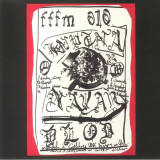
The LP ‘All Welcome on Planet Ree-Vo’ due for release on 29th July could only really have been made in one city steeped as it is in Bristol’s decades of less conventional hip hop and bass music. Tweaked and fine tuned during the summer of 2020 the record punches with a mix of red eyed paranoia to a playful future funk.
The album was all recorded, produced and mixed by Andy at Christchurch Studios, Bristol (home of Mezzanine era Massive Attack) with all vocals written and performed by T. Relly.
During 2021 the first two singles from the LP were released. The first was the juggernaut that is ‘Groove With It’. T. Relly growling out polemic against the relentless cacophony spun by Andy Spaceland, The brutality of the bass and horns is temporarily smoothed with Relly’s soulful, swaggering placation of ‘Turn your speakers on/ Till ya speakers blown baby/ If you’re feeling strong baby/ We can keep it going baby’.
This was followed in April by the 12” release of Combat featuring a thumping remix by Surgeon (Tresor Records) and an extended electro remix by Ree-Vo themselves.
2022 began with the limited red 7” release of remixes by NØISE and Batbirds with stunning original artwork by Shepard Fairey who came to the project via mutual friend Joe Cassidy (Butterfly Child). The release was announced on OBEY’s website
‘Spacebox’ which will be the last single to be released in time with the album is their hookiest, a party throwing chorus spinning tipsy visitors around the intergalactic control booth of mission control.
“Lift off, blast off, shirt off, dance off! Naked in the dancehall SPACE BOX!” is the beamed mantra, Relly transmitting to all occupants of the galaxy.
“We wanted to make a hedonistic and colourful dancehall track, a bold response to the suppressive circumstances of the last two years”.
About Ree-Vo:
T. Relly is pure Bristol hip-hop royalty – known in the community variously for his links to all of the city’s major club nights, his passion and support for the most disadvantaged (through his work with the youth and prison leavers), through to compering stages at St Paul’s Carnival and his seminal 2018 LP with DJ Rogue ‘Let Them Know’. He collaborates with many crews including Innalife and Killer Crab Men.
Andy Spaceland (AKA Andy Jenks) got involved in Bristol bass music as soon as he moved to the city with Static Sound System and a collaborative 12” with Rudy Tambala (AR Kane) as Sugarboat Vs Sufi, before his band Alpha were signed to Massive Attack’s label Melankolic, whilst he also became one of their tour DJ’s. His CV of collaborations range from Smith and Mighty to Madonna. He has released music on Dj Die’s label, Gutterfunk as White Bully and he is also currently releasing music with US producer Butch Vig in the band 5 Billion in Diamonds, whilst working on new tracks with Mark Stewart (The Pop Group) including remixes by Adrian Sherwood. His signature sound can also be heard on this remix for Elizabeth Fraser -
Поиск:leave
Все
Kula Shaker's most inspired album in years, 1st Congregational Church Of Eternal Love and Free Hugs is a firebrand double-album, energised with an assured display of vehemence and songcraft that spills over with 15 blazing songs of cross-genre sonics and a renewed super confidence. The album will be available on double vinyl, CD and digital formats.
On a base level, the term ‘blood harmony’ is simple—it describes the specific sound two siblings make when they sing together. Given that Dave Hause has been writing and recording songs with his younger brother Tim for a while now, it made sense to use that phrase as the title for his fifth solo record. But this being a Dave Hause album also means there’s much more to it than that. Beneath the surface of Blood Harmony, in fact, are multiple layers of meaning relating to Hause’s role as a musician, a brother, a husband, a son and—having become a father to twins a few months before the release of 2019’s Kick—a dad. As such, Blood Harmony is a reassertion of what family means to him..
Recorded under a loft bed in the guest bedroom of his Nashville home, Michael Ruth aka Rich Ruth’s “I Survived, It’s Over” starts in a humble space. And while many contemporary music projects are produced in such an environment, “I Survived, It’s Over” sets itself apart in its transformative properties as well as its transparency. What we have here is honest sound exploration, session musician-level instrumentation, and a true love for nature run through the fingers of a dude who can channel some acute and undeniable magic. This music goes deep. "I conceived much of this record amidst the quiet and tumult of 2020 in my neighborhood that had recently been ravaged by a tornado," Ruth recalls, "I spent most of my days working on these pieces between bicycle rides - watching the beautiful Tennessee ecosystem flourish in Shelby Park, listening to Keith Jarrett’s The Koln Concert and John Coltrane’s Ascension." Underneath the swell of the strings and the shredding of the guitars, this record has hard working, rustbelt, drum-heavy roots all over it (which makes sense as Ruth hails from outside of Toledo, the album was mixed by John McEntire from Chicago band Tortoise). Many of the flutes, saxophones, pedal steel, and other instruments were recorded remotely because we live in the future, but this only adds to the collage of sampled and sample-able material that Rich Ruth has to offer. The organic relationships between the artist and other musicians on the album is evident even in the compilation style sampling that needs to occur in putting such a project together. "Working on this music is a daily meditation," says Ruth. "I constantly experiment with sound until it reflects the way I am feeling and attempt to sculpt something meaningful from it. Through years of being a touring musician, it is a constant inspiration and privilege to collaborate with the individuals that graced this record with their voices." And those relationships pay off, because “I Survived, It’s Over” is a sonic meal. It’s rich (no pun intended) with massive instrumentation that’s usually reserved for more symphonic delights. But at the same time it’s simple and leaves space to breathe–space you didn’t know you needed. In his own words; "I Survived, It’s Over is a meditation on healing, confronting trauma, surrendering, and finding peace. I wanted to encapsulate the tranquility and disarray found within this process." Ruth’s heart and the peace that his presence produces is all over this album. And despite his midwestern humility and willingness to brush off any praise, he’s put together something really special that carries its own weight. It's the kind of record that only comes around every once in a while and it's worthy of all the head-bobs, acclaim, and celebratory potlucks that Mike and the gang have coming their way. “I Survived, It’s Over” is a record you should buy for your friend, your foe, and yourself. It’ll sit perfectly on your shelf between Alice Coltrane and Hiroshi Yoshimura.
- Disc: 1 1. Yearly Dying
- 2: Under Silence
- 3: Pelekas
- 4: Magnificent Obsession
- 5: The Space Inbetween
- 6: Blind Mountain (1994 Version
- 7: If This Is All
- Disc: 2 1. Left Brain Ambassadors (1999 Demo)
- 2: If You Should Leave (1994 Version)
- 3: Save Your Soul (1999 Demo)
- 4: Nowhere To Go (199 Version)
- 5: Until The Morning (1999 Demo)
- 6: Sour Stains (1994 Version)
- 7: Angel Of Betrayal (1999 Demo)
- 8: Per Aspera Ad Astra (1999 Demo)
- 9: Blessed (Instrumental Version 1 Demo)
- Disc: 3 1. Mushroom Tea Girl (1996 Demo)
- 2: Let The Magic Talk (1999 Demo)
- 3: The Goddess (1999 Demo)
- 4: Inside Charmer (1996 Demo)
- 5: Trouble In My Head (1996 Demo)
- 6: Mr White
- 7: Broken Morning (1996 Demo)
- 8: Monster Astronauts (1996 Demo)
- 9: Sad Queen Boogie
Traffic Lights Vinyl Edition[52,90 €]
The Spiritual Beggars debut album (1994) reissued with 2 full LPs of extra tracks – 18 demo cuts and other rare versions, presented in ravishing triple fold packaging with astounding art by Costin Chioreanu. The Spiritual Beggars mastermind Michael Amott (Arch Enemy, ex-Carcass) is one of today’s most important guitarists in Metal, and this reissue originally coincided with the band’s 20th anniversary. The original limited vinyl being long sold out, Svart Records present a new edition as the band’s 30th anniversary draws near.
- Disc: 1 1. Yearly Dying
- 2: Under Silence
- 3: Pelekas
- 4: Magnificent Obsession
- 5: The Space Inbetween
- 6: Blind Mountain (1994 Version
- 7: If This Is All
- Disc: 2 1. Left Brain Ambassadors (1999 Demo)
- 2: If You Should Leave (1994 Version)
- 3: Save Your Soul (1999 Demo)
- 4: Nowhere To Go (199 Version)
- 5: Until The Morning (1999 Demo)
- 6: Sour Stains (1994 Version)
- 7: Angel Of Betrayal (1999 Demo)
- 8: Per Aspera Ad Astra (1999 Demo)
- 9: Blessed (Instrumental Version 1 Demo)
- Disc: 3 1. Mushroom Tea Girl (1996 Demo)
- 2: Let The Magic Talk (1999 Demo)
- 3: The Goddess (1999 Demo)
- 4: Inside Charmer (1996 Demo)
- 5: Trouble In My Head (1996 Demo)
- 6: Mr White
- 7: Broken Morning (1996 Demo)
- 8: Monster Astronauts (1996 Demo)
- 9: Sad Queen Boogie
Black Vinyl[52,90 €]
Traffic Lights Vinyl Edition
The Spiritual Beggars debut album (1994) reissued with 2 full LPs of extra tracks – 18 demo cuts and other rare versions, presented in ravishing triple fold packaging with astounding art by Costin Chioreanu. The Spiritual Beggars mastermind Michael Amott (Arch Enemy, ex-Carcass) is one of today’s most important guitarists in Metal, and this reissue originally coincided with the band’s 20th anniversary. The original limited vinyl being long sold out, Svart Records present a new edition as the band’s 30th anniversary draws near.
- 1: Invisible
- 2: Light Nights
- 3: Song For Alice
- 4: 22 Dreams
- 5: Cold Moments
- 6: All I Wanna Do (Is Be With You)
- 7: Have You Made Up Your Mind
- 8: The Dark Pages Of September Lead To The New Leaves Of Spring
- 9: Empty Ring
- 10: Black River
- 11: Where’er Ye Go
- 12: Why Walk When You Can Run
- 13: God
- 14: Push It Along
Am 22. Juli veröffentlicht Paul Weller ”22 Dreams”, sein 9. Studioalbum, zum ersten Mal auf Vinyl!
Auf dem Album sind die Oasis-Stars Noel Gallagher und Gem Archer sowie Steve Cradock (Ocean Colour Scene) und Blur-Gitarrist Graham Coxon zu hören. Erstmals veröffentlicht im Jahr 2008 stieg das Album
direkt auf Platz 1 der britischen Albumcharts ein.
”22 Dreams” erscheint als 2LP Gatefold Sleeve und enthält ein 12ff x 36ff s/w-Poster mit gedruckten Lyrics, Tracklist und Credits auf der Rückseite, sowie ein 8-seitiges Booklet mit dem Titel ”The Missing Dream AKA Dream # 22” von Simon Armitage.
- 1: Descending In E
- 2: Never Again
- 3: Bet I Can
- 4: Hunted Down
- 5: What You See And What You Say
- 6: Obstinate
- 7: Nobody But Me
- 8: All Revved Up
- 9: Leave Me Alone
- 10: Novelty Item
- 11: I Can’t Take You Anywhere…
- 12: Don’t Call Me Honey
- 13: Drink More Brew
- 14: Suburbia Bop
- 15: Terrorist Valentine
- 16: Stupid Lawn Ornaments
- 17: Why Do You Exist
- 18: Jeff Goes Off!
The Catatonics were Syracuse and Central New York’s first hardcore punk band. (Non-Returnable.)
Besides pioneering the original 1981/1982 Syracuse Hardcore scene, their classic Hunted Down EP/7" is considered one of the first hardcore thrash/metal crossover releases, right up there with COC or DRI and remains a sought after (and pricey) collectors item 30+ years after it's release.
Often compared to Jerry's Kids, SSD, Negative Approach and even Slayer, The Catatonics weren't followers or imitators, more like period contemporaries. Although the wait has been decades in the making, Southern Lord will be reissuing Hunted Down as a 12” vinyl release with bonus tracks.
Released in 1957, Loving You did very well at box offices around the world. In the UK the album was issued on 10-inch vinyl and topped the album charts featuring popular tracks Mean Woman Blues, (Let Me Be Your) Teddy Bear, Got A Lot O' Livin' To Do!, Party, Lonesome Cowboy, Hot Dog and the title song Loving You. In the US, the album was issued on 12-inch vinyl with four extra additional tracks
topping the US album charts for 10 weeks. Those four songs are equally strong with Elvis covering Blueberry Hill, I Need You So and Have I Told You Lately That I Love You? Plus, the original version of Don't Leave Me Now, which he would later re-record for his next film, Jailhouse Rock. The reception of the film placed
Elvis among the biggest selling box office stars, and he was now managing both a musical and acting career with the call of the US Army draft.
In the spring of 2020, Ben Cook _ a.k.a. Young Governor, Young Guv, or just Guv _ was holed up in the New Mexico high desert, his U.S. tour having been abruptly covid-cancelled during a southwest swing. He and his bandmates were living moment to moment in something called an Earthship, a solar-rigged adobe structure sustainably constructed with, among other things, recycled bottles and tires. And out there in the serene vastness, as a short ride-it-out stint turned into a nine-month sojourn, Ben was writing music, slowly, little by little, mostly at night while the others slept. By the New Year, almost in spite of himself, he had created a new album, two new albums actually, and through the ordeal he was forever changed. In a place he never expected to be, under circumstances no one could have predicted, and in the face of physical isolation, emotional desolation, and existential dread, Ben created GUV III & IV, a collection of songs dedicated and testifying to the eternal healing power of love _ how to find it in the world, in others, and most importantly, in himself. Written in the New Mexico wilderness and produced in Los Angeles, the double album will finally be available in it's entirety this summer via Run For Cover. Young Guv's talent as a songwriter has been with us for a long time. From forming iconic hardcore act No Warning in 1998 to joining Toronto legends Fucked Up, Ben Cook started writing songs as Guv in 2008 between a slew of other projects that were ambitiously working to define the genres they operated in. When he first started working with Run For Cover in 2019, the plan was to release a single record - but with too many songs to turn away, the project expanded into his first double album, GUV I & II. GUV III & IV finds the same ambition and expertise in hit-making, but this time the individual records hone into specific parts of Guv's sonic palette. GUV III is full of iconic hooks, power-pop guitar riffs and dancable-rock songs, while GUV IV takes notes from psych rock, electro pop and Laurel Canyon jangle to make something that as a whole, can only be defined as definitively GUV
lynyn sounds like if Aphex Twin or Autechre could compose for symphony and shred jazz. Though lynyn is a new Artist, his debut LP lexicon is essential listening for anyone interested in the compositional heights of electronic, synth, and modular music. So, who is lynyn? lynyn is the moniker of Chicago artist Conor Mackey, a working symphonic composer who has scored for institutions including the Illinois Philharmonic Orchestra and Brain.fm (the neuroscience driven musical platform where he is currently lead composer on staff). He is also a guitarist / composer in the Chicago jazz fusion quintet Monobody. After years of quietly mastering the creation of electronic music in his home, Mackey first introduced his electronic alias lynyn as producer of NNAMDI's Are You Happy EP in the Fall of 2021 (Pitchfork described his production on that project as "a novel intersection of IDM" and contemporary pop). lynyn now offers up his debut electronic oevure lexicon via Chicago label Sooper Records. lexicon displays a mastery of both musical composition and sound design, as well as a deep appreciation of the vocabulary and history of the electronic genre_ with particular emphasis on the 90s IDM movement. Throughout lexicon we are propelled through the sounds of musique concrete, footwork, hip-hop, ambience, glitch-core, IDM, drum and bass, dub, break beats, and so much more. These influences work in tandem to produce a linear experience that can be spellbinding, euphoric, and sometimes destabilizing, but without ever feeling listless or wandering. The dense arrangements of lexicon are intentionally constructed with a painstaking attention to the most minute detail, and also with a masterful awareness of the macroscopic sound design profile of the entire work. Synth sequences and modular tones merge with sounds that seem wholly organic to create a series of purposeful movements from start to finish. Mackey is particularly adept at taking disparate, often difficult to control elements and introducing them harmoniously. He is a fastidious architect and designer of sound tinkering away in his modular laboratory. lexicon is an innovative entrant into the history of IDM and electronica with all the makings of an essential contribution. What Mackey accomplishes with lexicon is a progression; he's taking the sum articulation of a genre and attempting to carry it forward by imbuing it with his own unique language as a symphonic composer. His melting together of genres and techniques is a gateway into a more wide-ranging expression of the artform, particularly with respect to the sophistication of melodic composition. The result is arguably a landmark. While rightfully positioning the lynyn moniker as an electronic alias, lexicon leaves no doubt that Mackey is a composer above all else.
Black Vinyl[21,64 €]
lynyn sounds like if Aphex Twin or Autechre could compose for symphony and shred jazz. Though lynyn is a new Artist, his debut LP lexicon is essential listening for anyone interested in the compositional heights of electronic, synth, and modular music. So, who is lynyn? lynyn is the moniker of Chicago artist Conor Mackey, a working symphonic composer who has scored for institutions including the Illinois Philharmonic Orchestra and Brain.fm (the neuroscience driven musical platform where he is currently lead composer on staff). He is also a guitarist / composer in the Chicago jazz fusion quintet Monobody. After years of quietly mastering the creation of electronic music in his home, Mackey first introduced his electronic alias lynyn as producer of NNAMDI's Are You Happy EP in the Fall of 2021 (Pitchfork described his production on that project as "a novel intersection of IDM" and contemporary pop). lynyn now offers up his debut electronic oevure lexicon via Chicago label Sooper Records. lexicon displays a mastery of both musical composition and sound design, as well as a deep appreciation of the vocabulary and history of the electronic genre_ with particular emphasis on the 90s IDM movement. Throughout lexicon we are propelled through the sounds of musique concrete, footwork, hip-hop, ambience, glitch-core, IDM, drum and bass, dub, break beats, and so much more. These influences work in tandem to produce a linear experience that can be spellbinding, euphoric, and sometimes destabilizing, but without ever feeling listless or wandering. The dense arrangements of lexicon are intentionally constructed with a painstaking attention to the most minute detail, and also with a masterful awareness of the macroscopic sound design profile of the entire work. Synth sequences and modular tones merge with sounds that seem wholly organic to create a series of purposeful movements from start to finish. Mackey is particularly adept at taking disparate, often difficult to control elements and introducing them harmoniously. He is a fastidious architect and designer of sound tinkering away in his modular laboratory. lexicon is an innovative entrant into the history of IDM and electronica with all the makings of an essential contribution. What Mackey accomplishes with lexicon is a progression; he's taking the sum articulation of a genre and attempting to carry it forward by imbuing it with his own unique language as a symphonic composer. His melting together of genres and techniques is a gateway into a more wide-ranging expression of the artform, particularly with respect to the sophistication of melodic composition. The result is arguably a landmark. While rightfully positioning the lynyn moniker as an electronic alias, lexicon leaves no doubt that Mackey is a composer above all else.
Debut full-length collaboration from Jack Burton and Rory Glacken (Tourist Kid)
Follows Jack Burton's solo LP on Analogue Attic and Tourist Kid's solo LP on Melody As Truth
Early support from Ben Fester, Best Effort/DJ Earl Grey, Biscuit (Good Morning Tapes), Brian Not Brian, Ewan Jansen, Kato, Merve, Sleep D & Wax'o Paradiso
Dentistry is the dual energies of Rory Glacken and Jack Burton, Boorloo originals now living in Naarm. The pair have previously released an EP, "Ribbons," on their own Deep Water label, and a track on its local showcase comp "Greenhouse Vol. I" at the end of 2021. This transmission is their debut full length offering, channeled through hometown beacon Good Company Records.
"LP1" was created in unusual conditions between September and December of 2020, when the duo's shared Northcote studio became a site of remote collaboration. One person would start working on a track and leave the session open for the other, with no overlap of physical space shared. Responding to an invitation from GCR to make a record, the initial impulse was to write dance music. But what dance floor were these incorporeal partners writing for?
The album takes a spectral approach to the dance space, wrapping up air in a strata of textural tech, pulsing dub house and fractal illbience. Drawing on dub production techniques, "LP1" combines the structure of an ambient record with intricate percussive elements. Results are both atmospheric and material, abstract and palpable: a synthesis which expresses sonic relations of surface and depth, with the correlating mirage of light and shadow.
At times tinkering methodically and others in mercurial lurch, there is an immediacy to this album that stems from the way it was produced, using a mixing desk and outboard gear to rich and living effect. When we listen, we commune with the artists in the heat of working out of an otherworldly space, and feel every tweak and and turn. "LP1" is a current which carries the substance of process in communicable form. Intuitive and moving, breathing, dancing.
Detroit, Michigan hip hop artist, producer and Wu-Tang affiliate Bronze Nazareth began cooking up heat in 2002. Twenty years later, ain’t a damn thing changed — except he’s bringing the noise for a new generation with fellow Detroit artist, Lord Jessiah. Their latest outing, Time Waits for No One is a bangin’ street soundtrack that’s sure to leave bullet holes in every speaker that blasts it. Features include Recognize Ali, Ty Farris and a team of heavy gunners from hip hop’s frontlines.
Y U QT are back on Time Is Now, and with them they're bringing the sun. "Sweet Fantasy" EP sees the Leicester duo return to what they do best: capturing UKG at its least po-faced, and most energetic.
And who better to help kick off proceedings than the one of the most recognisable voices in today's UKG revival? Ell Murphy's smooth-as-syrup vocals add another level of dynamism to the already-buoyant 4x4 garage banger "Fantasy", coming complete with a hook just as irresistible as the ones which shot their previous releases to success. "Buss Down" picks up the energy with propulsive kickdrums and old school MC vocal chops before "Leaving All Your Cares Behind" follows suit, adding a feel-good vocal melody for an extra serotonin hit. It's up to the more light-footed "Just Be Friends" to leave a sweet taste in our mouths. Euphoric Korg organ stabs give a sense of nostalgia whilst a meandering bassline lends it plenty of swing.
- 1: Connais Tu L'animal Qui Inventa Le Calcul Integral?
- 2: Evariste Aux Fans
- 3: Les Pommes De Lune
- 4: La Chasse Au Boson Intermédiaire
- 5: Dans La Lune
- 6: La Faute À Nanterre
- 7: Ma Mie
- 8: Wo I Nee
- 9: Si J'ai Les Cheveux Longs C'est Pour Pas M'enrhumer, Atchoum!
- 10: La Révolution
- 11: Je Ne Pense Qu'a Ça
- 12: Je Chante Pour Vous Faire Marcher
- 13: Je Ne Suis Pas Simple
- 14: Si Les Étoiles Pouvaient Parler
Évariste is one of the rare specimens of artist-cum-scientists. Among his kind stand others like Pierre Schaeffer, a Polytechnique graduate (an engineer but also the father of musique concrète) and the eccentric Boby Lapointe (graduate of the École centrale and inventor of the Bibi-binaire system, patented in 1968). Évariste's songwriting, joyful and full of energy (albeit extremely critical), shrouds an original tragedy: born in 1943 among résistants, Joël Sternheimer (aka Évariste) grew up without a father, lost to Auschwitz. Although he makes little reference to Jewish culture in his music, his origins leave their mark: in 1974, he sings a Hebrew song on television. In 1966, the young Joël sports Princeton's colourful paraphernalia - that's because he's freshly returning from the US, where he was sent to pursue his research on "particle mass and the interpretation of observed regularities, such as the effects of a wave" (will understand who may). When he gets there the country's in the midst of the Vietnam War. With McNamara keen to find an alternative to the nuclear weapon and calling upon the country's biggest brains to undertake the task, there's a "fund shift" within the university - a diplomatic way to give notice to whoever may not be disposed to follow the government's scheme. Joël, who's under the supervision of a rebellious physician, is dismissed. He regardless keeps following the prestigious seminaries of the Institute for Advanced Study, chaired by Oppenheimer, inventor of the atomic bomb. Likely inspired by the hippie movement and music, Joël buys a guitar and starts playing in Washington Square - after all, Bob Dylan himself started there. He blithely skips Oppenheimer and receives a warm (though surprised) welcome from a crowd thoroughly unfamiliar with French. When the ageing physicist questions him about his decreasing attendance, Joël explains how drawn he is to music, and how he thinks it could help him in self-financing his research. Évariste recalls seeing the sickened man, his face torn by remorse, lighten up to his words and say: "What's keeping you - go for it! If I was still young that's exactly what I'd do." The student takes these words as a testimony from his professor - and it's enough to convince him . And so he takes the leap during the Christmas vacations he spends in Paris. A journalist friend he often sees around the Sorbonne introduces him to the artistic director of Disques AZ. The latter passes the tapes on to the label's boss, Lucien Morisse, also program manager on Europe N°1. Morisse is blown away - and signs him onto the label right away. Michel Colombier, arranger for Serge Gainsbourg and co-author of "Psyché Rock", with Pierre Henry, contributes some of his original ideas to the 7 inch "E=mc2": Évariste's preoccupation with the percussion sound on the track "Le calcul intégral" is that it goes "poom poom" and not "tock tock" - Colombier is aware of the issue and records Évariste's guitar like a percussion in an isolated booth. The organist Eddy Louis, who is to participate, in 1969, to the success of Claude Nougaro's "Paris mai", also appears on the record. It's 1966 and the Antoine phenomenon (signed on Vogue) storms through France. The two singers share similarities: Antoine is an engineer of the École centrale, gifted with a great originality in his song-writing. A godsend for the two labels who turn this resemblance into a commercial strategy, setting them out as rivals. To this day though, Évariste still denies what was little more than slushy tabloïd gossip. Success comes around swiftly and in 1967 Évariste launches into a second 7 inch, "Wo I nee", again arranged by Michel Colombier. Quantum mechanics fans finally get their anthem with "La Chasse Au Boson Intermédiaire" (or the "Intermediary Boson Pursuit"). To sum up what's a boson, say he's a close pal of the meson, photon and other gluons. A few months later, it's May 68 and everything's turned upside down. Évariste writes a series of songs inspired by the events, which he immediately submits to Lucien Morisse. When the man behind "Salut les copains", once married to Dalida, hears the song "La révolution" - a father and son dialogue - he can't take any more: AZ simply cannot release this. But there and then Lucien Morisse makes a gesture which will remain engraved in French music's history: sorry to be unable to officially stand by the singer, he encourages him to self-produce the record, but with his tacit support. He calls the pressing factory and asks they apply the same rate for Évariste as they would for AZ. The singer and his musicians use the same studio as for the previous record, all of them playing for free awaiting a return on investment. Évariste keeps singing at the Sorbonne with "Jussieu's gang" and "the young Renaud" he nicknames "le p'tit gavroche" (or "street urchin"). Renaud volunteers to type the lyrics of the song "La révolution" so that the chorus can be sung and recorded. A boy in the group is related to Wolinski and introduces them. The two get along so well that Wolinski ends up drawing the cover for the record "La révolution", for free. The self-released 7 inch "La révolution / La faute à Nanterre" is sold under the table and door-to-door for half the price of a standard record, on and around the boulevard Saint-Michel; and it runs out fast. In the end, there will be 6 releases of the record, and 25000 copies sold. When the theatre director Claude Confortès decides to adapt Wolinski's drawing series titled "Je ne veux pas mourir idiot" ("I don't want to die a fool"), he asks Évariste to write the original soundtrack. His friend, now cartoonist for Hara-Kiri Hebdo, often promotes him in accordance with a principle dear to him by virtue of which he gives a special place to his friends. Dominique Grange (writer of the song "Nous sommes les nouveaux partisans") soon joins the team. After 150 performances, Évariste leaves his place to Dominique Maurin (brother of Patrick Dewaere). Évariste composes the songs for Claude Confortès' next play, "Je ne pense qu'à ça" ("That's all I think about"), co-wrote with Wolinski in 1969. The comedians of the play record the songs on a 7 inch, with a cover signed, again, by Wolinski. In 1971, French television produces the documentary "Évariste et les 7 dimensions", but doesn't air it. Indeed, the scientific sub-comity of the programming comity (sic) censors the show. The given justification is that "Évariste dangerously mixed science with science-fiction, numerology and other non-scientific disciplines". The underlying motive might have been a will to censor the singer-mathematician's political discourse. In the documentary and among other things, Évariste discusses hierarchy, alienation and revolution. Half a century later the documentary remains invisible, though some excerpts resurfaced in 1992 in the cult show "L'oeil du cyclone", on Canal +. Though flourishing, Évariste's career is nearing its end. 1970 is the beginning of a decade in the course of which he is to make a decisive discovery in the musical and scientific domains. Following this breakthrough, he moves away from self-produced music and gaucho magazines to focus on science. He keeps Oppenheimer's encouraging words in mind, now freely pursuing his research thanks to the sales of his records. Joël realises that when decoding protein sequences, one finds musical sequences recognisable to humans. He names them "proteodies". If, when listening to a proteody, one responds by being so sensitive as to finding it beautiful, then it reveals a deficiency of the related protein - and this peculiar music may be the cure. We could trace back the music history in light of proteins lacking in a given artist, or within a public's majority. You always thought these hysterical groupies who'd throw their underwear with passion and faint in the pit had miraculously appeared because they had never heard anything as wonderful as the Beatles? Make no mistake! For Évariste, it all boils down to an intro's protein content. Indeed, the beginning of their first hit "Love Me Do" corresponds to dopamine, the neurotransmitter linked to compulsive buying. An intro like this could only unleash the fervour of groupies, victims of fashion and biology. Évariste's success is such that the income from his sales gives him the autonomy to which he had aspired when confiding to Oppenheimer. It made it possible for him to pursue his research without any institutional constraints. He now devotes himself to his proteodies, sat in the offices of the European University for Research, just around the corner from the Sorbonne he knew so well. Évariste is no more. Joël regained control of this strange and comical beast.
Incl. Schacke Remix
Having been extensively road-tested this past year by DJs including Daniel Avery, HAAi and Gerd Janson, Highdive arrives with tangible anticipation. The work of less-than-shadowy figures Gramrcy and John Loveless, the pair have passed lockdown and beyond remixing artists such as WH Lung, Discovery Zone and Ghost Culture. Debuting their first original material, closely following Gramrcy’s recent appearance on Loveless’s own Hot Concept imprint, Highdive is a long-anticipated explosion of energy.
Built around a sonic-boom breakdown, glossy rave chords and pounding post-punk drums, Highdive feels immediately at home on Phantasy. Having worked closely alongside founder Erol Alkan in recent years to shape the imprint's diverse output, Loveless' collaboration with the Peach Discs founder nods to the electro landscape of the label's earliest days. Having never left dance floors since, Gramrcy & John Loveless take a golden opportunity to plunge dancers into the sublime and the ridiculous.
While a stripped-down ‘Beats Mix’ sees the pair adopt a less-maximal approach, leave it to Schacke to stretch Highdive into hardcore rave heaven. The already-influential Copenhagen artist underscores his refreshing funk in the ‘fast-techno’ scene through which he has risen, turning the screws and upping the tempo with intense but elastic results.
In 1989's In Step, Vaughan found his own songwriting voice, blending blues, soul, and rock in unique ways, and writing with startling emotional honesty. Yes, there are a few covers, all well chosen, but the heart of the album rests in the songs he co-wrote with Doyle Bramhall, the man who penned the Soul to Soul highlight "Change It." Fueled by a desire to make up for lost time and delight in his reawakened commitment to life and sobriety, Vaughan turned in what many consider his greatest artistic statement, an album ensconced in sweat, soul, determination, and not an ounce of filler.
Swedish progg is not to be confused with "prog" as in progressive rock music. When we are talking about progg, we are referring to the Swedish music movement influenced by the political climate of the late 60's, to some extent the hippie movement and in many cases also Swedish folk music. Music highly driven by a political agenda. Blod's Knutna Nävar, originally released in an edition of 150 copies on Förlag För Fri Musik in 2018 and later a small cassette run, is pretty much a lost progg classic from the 70's. This is not a case of copying a certain sound though, far from it, neither are ideas really rehashed nor does the album feel nostalgic in that sense. Rather it feels like if someone has read about the progg movement and all the records but never actually heard it, yet decided to do an album and somehow managed to succeed big time. Further developing the sound palette and ambience initiated with parts of the Leendet Från Helvetet recording, the music feels slightly louder and more in your face. It's like it's more of everything. The melodies are immediate and it's quite impossible to resist the brash catchiness of it all. Albeit mentioning progg music and its importance for this recording, the actual musical side of Knutna Nävar has in reality more in common with soundtrack/library music and Swedish composers like the late Björn Isfält when you attempt to break it down. The crude DIY approach and anything-goes mentality just adds an extra dimension to it all and ultimately places the music somewhere else. There's a rather blunt use of samples throughout the record (sources probably best to leave out, though you don't have to be a Einstein to figure these out), but then again this is made by the same guy that gave the world the ABBA album. Those samples has managed to become an integral part of the music through the few years that has passed and though well familiar with the records those snippets are now to me genuinely Blod and nothing else. It seems like everyone has their own favourite but Knutna Nävar is the Blod album I have returned to the most. It has that extra something that sets it apart and if I would have to pick up a few records that sums up why Gothenburg has been a pretty damn awesome place to be in the last 10 years or so, this would definitely be one of the top picks.