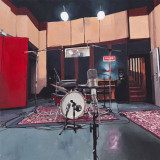
Berlin-based Swedish bassist and producer Petter Eldh returns with a new Koma Saxo album Post Koma, out on We Jazz Records, 10 November. The title Post Koma aptly describes the vibe of this one: The Koma Saxo sound continues its evolution, morphing into a holistic vision of jazz now and soon, where live instrumentation and repurposed sampling lose their boundaries.
Over the course of its three iterations (self-titled debut in 2019, LIVE in 2020, Koma West in 2022) Koma Saxo has sounded at times "liquid" and postproduced, at times raw and direct, at times acoustic and at other times oddly electronic (even while still being made with acoustic instruments). Post Koma is a culmination of this sonic study by Eldh, resulting in a music vision that never second-guesses throwing tasty hooks and everlasting melodies out the window after a mere bite of them. But fear not: there are even more new ideas just around the corner.
Eldh's compositions and ideas merge together in a way that just flows. There are quality musicians in the mix, including Koma Saxo live band members Sofia Jernberg, Jonas Kullhammar, Otis Sandsjö, Mikko Innanen, Maciej Obara and Christian Lillinger, but that's like saying that a cake includes flour and sugar. This music is not about playing, it's essentially about how the music is and how it takes its shape, so you quickly lose track of who did what, and that's all in the benefit of encountering this music as an entity that is constantly challenging itself while moving forward. The musicians are valued contributors, and an integral part of what's here, but this is far from traditional jazz playing where a band sits in a room playing takes after takes of compositions on sheet.
That being said, this is jazz to the fullest. That is, music that understands its past but always moves forward, and is never afraid of taking risks. Petter Eldh uses jazz as a starting point, not the end goal. This gives his music edge and mobility beyond what can be contained on one album. In a way, an album, then, becomes a snapshot of a creative process in constant flux and evolution.
Opening track "Koma" is literally drum & bass. It only consists of those two elements, yet what comes out of it is an open invite, a way of clearing your palette. It would be useless to describe individual tracks beyond that, but there's a strong sense of deliverance to the set. It feels like an ending, and also like a new beginning.
Cerca:like a tim
Berlin-based Swedish bassist and producer Petter Eldh returns with a new Koma Saxo album Post Koma, out on We Jazz Records, 10 November. The title Post Koma aptly describes the vibe of this one: The Koma Saxo sound continues its evolution, morphing into a holistic vision of jazz now and soon, where live instrumentation and repurposed sampling lose their boundaries.
Over the course of its three iterations (self-titled debut in 2019, LIVE in 2020, Koma West in 2022) Koma Saxo has sounded at times "liquid" and postproduced, at times raw and direct, at times acoustic and at other times oddly electronic (even while still being made with acoustic instruments). Post Koma is a culmination of this sonic study by Eldh, resulting in a music vision that never second-guesses throwing tasty hooks and everlasting melodies out the window after a mere bite of them. But fear not: there are even more new ideas just around the corner.
Eldh's compositions and ideas merge together in a way that just flows. There are quality musicians in the mix, including Koma Saxo live band members Sofia Jernberg, Jonas Kullhammar, Otis Sandsjö, Mikko Innanen, Maciej Obara and Christian Lillinger, but that's like saying that a cake includes flour and sugar. This music is not about playing, it's essentially about how the music is and how it takes its shape, so you quickly lose track of who did what, and that's all in the benefit of encountering this music as an entity that is constantly challenging itself while moving forward. The musicians are valued contributors, and an integral part of what's here, but this is far from traditional jazz playing where a band sits in a room playing takes after takes of compositions on sheet.
That being said, this is jazz to the fullest. That is, music that understands its past but always moves forward, and is never afraid of taking risks. Petter Eldh uses jazz as a starting point, not the end goal. This gives his music edge and mobility beyond what can be contained on one album. In a way, an album, then, becomes a snapshot of a creative process in constant flux and evolution.
Opening track "Koma" is literally drum & bass. It only consists of those two elements, yet what comes out of it is an open invite, a way of clearing your palette. It would be useless to describe individual tracks beyond that, but there's a strong sense of deliverance to the set. It feels like an ending, and also like a new beginning.
- A1: She Belongs To Me - Live At The Royal Albert Hall (04:49)
- A2: Fourth Time Around - Live At The Royal Albert Hall (04:45)
- A3: Visions Of Johanna - Live At The Royal Albert Hall (09:29)
- A4: It’s All Over Now, Baby Blue - Live At The Royal Albert Hall (05:10)
- B1: Desolation Row - Live At The Royal Albert Hall (12:29)
- B2: Just Like A Woman - Live At The Royal Albert Hall (05:55)
- B3: Mr. Tambourine Man - Live At The Royal Albert Hall (06:29)
- C1: Tell Me, Momma - Live At The Royal Albert Hall (04:46)
- C2: I Don’t Believe You (She Acts Like We Never Have Met) -Live At The Royal Albert Hall (05:33)
- C3: Baby, Let Me Follow You Down - Live At The Royal Albert Hall (02:47)
- C4: Just Like Tom Thumb’s Blues - Live At The Royal Albert Hall (05:51)
- D1: Leopard-Skin Pill-Box Hat - Live At The Royal Albert Hall (03:42)
- D2: One Too Many Mornings - Live At The Royal Albert Hall (04:02)
- D3: Ballad Of A Thin Man - Live At The Royal Albert Hall (06:11)
- D4: Like A Rolling Stone - Live At The Royal Albert Hall (06:36)
Cat Power veröffentlicht am 10. November ein Live-Album Cat Power Sings Bob Dylan: The 1966 Royal Albert Hall Concert via Domino.
Cat Power Sings Dylan: The 1966 Royal Albert Hall Concert" wurde am 5. November 2022 in der berühmten Londoner Royal Albert Hall aufgenommen und zeigt Chan Marshall wie sie Song für Song eines der legendärsten und transformativsten Live-Sets aller Zeiten nachspielt. Im Mai 1966 fand das Konzert in der Manchester Free Trade Hall statt, das aufgrund eines falsch beschrifteten Bootlegs lange Zeit als "Royal Albert Hall Concert" bekannt war. Bei dem Originalauftritt wechselte Bob Dylan in der Mitte des Konzerts von der akustischen auf die elektrische Gitarre, was den Zorn der Folk-Puristen auf sich zog und den Verlauf des Rock 'n' Roll für immer veränderte. "Cat Power Sings Dylan: The 1966 Royal Albert Hall Concert" würdigt liebevoll Dylans Spuren in der Geschichte und bringt eine bezaubernde Vitalität in viele seiner am meisten verehrten Songs, einschließlich "She Belongs to Me" und "Ballad of a Thin Man"."
- A1: String Quartet No. 5 I
- A2: String Quartet No. 5 Ii
- A3: String Quartet No. 5 Iii
- A4: String Quartet No. 5 Iv
- A5: String Quartet No. 5 V
- B1: String Quartet No. 4 (Buczak) I
- B2: String Quartet No. 4 (Buczak) Ii
- B3: String Quartet No. 4 (Buczak) Iii
- C1: String Quartet No. 2 (Company) I
- C2: String Quartet No. 2 (Company) Ii
- C3: String Quartet No. 2 (Company) Iii
- C4: String Quartet No. 2 (Company) Iv
- D1: String Quartet No. 3 (Mishima) 1957 – Award Montage
- D2: String Quartet No. 3 (Mishima) November 25 – Ichigaya
- D3: String Quartet No. 3 (Mishima) 1934 – Grandmother And Kimitake
- D4: String Quartet No. 3 (Mishima) 1962 – Body Building
- D5: String Quartet No. 3 (Mishima) Blood Oath
- D6: String Quartet No. 3 (Mishima) Mishima/Closing
When Kronos plays a piece, they become fellow composers, true collaborators. Without them, we wouldn’t have the kind of string quartet playing that we find around us today. There are two kinds of string quartet playing: the ‘Before Kronos’ and the ‘After Kronos’.” – Philip Glass
‘Kronos Quartet has broken the boundaries of what string quartets can do.’ – New York Times
Nonesuch releases Kronos Quartet’s acclaimed album Kronos Quartet Performs Philip Glass on vinyl for the first time to coincide with Kronos Quartet: Five Decades, a year-long celebration marking the quartet’s 50th anniversary. Originally released in 1995, the album features David Harrington (violin), John Sherba, (violin), Hank Dutt (viola) and Joan Jeanrenaud (cello) performing Quartet No. 2 (Company) (1983), No. 3 (Mishima) (1985), No. 4 (Buczak) (1990), and No. 5 (1991), the first piece Glass wrote especially for Kronos. Recorded at Skywalker Sound in California, the album was produced by Judith Sherman, Kurt Munkacsi and Philip Glass. The cover art features Francesco Clemente’s painting The Four Corners (1985). At the time of the album’s release, the New York Times said, ‘It contains some of Glass's best music since Koyaanisqatsi. His ear for sumptuous string sonorities is undeniable,’ while the Washington Post called it ‘An ideal combination of composer and performers.’ It was a top 10 hit on Billboard’s Top Classical Albums, and spent 12 weeks on Billboard’s Classical chart.
In his original liner note, critic Mark Swed wrote, ‘Glass’ string quartets may contain his most intimate music. They are works through which a very public composer, perhaps the most important opera reformer of our age and a longstanding collaborator in large-scale music theater, holds up a mirror to himself and his way of composing. “In an odd way,” Glass explains, “string quartets have always functioned like that for composers. I don’t really know why, but it’s almost impossible to get away from it. It’s the way composers of the past have thought and that’s no less true for me. It’s almost as if we say we’re going to write a string quartet, we take a deep breath, and we wade in to try to write the most serious, significant piece that we can.” Glass says that as he sat down to write String Quartet No. 5, he had discovered that perhaps not taking a serious tone might be the most serious way to deal with it. “I was thinking that I had really gone beyond the need to write a serious string quartet and that I could write a quartet that is about musicality, which in a certain way is the most serious subject.”’
Glass’ first numbered quartet was written in 1966; however, he did not return to the string quartet medium until 1983, when he provided incidental music for a dramatization of Samuel Beckett’s prose poem, Company. During those 17 years, Glass had formed an ensemble and developed his style in a series of increasingly elaborate pieces for it. String Quartet No. 3 is also adapted to dramatic music, this time from his score to the 1985 Paul Schrader film, Mishima. It was with the music of Mishima that Kronos became associated with Glass, recording the string quartet sections of the soundtrack and subsequently working extensively with the composer on all five of his numbered quartets. Kronos also gave the first concert performances of Company and Mishima. String Quartet No. 4 was composed in remembrance of the artist Brian Buczak, who died of AIDS in 1988.
As Kronos’ anniversary season continues with further concerts around the world, Nonesuch will reissue Black Angels on vinyl on February 16. First released in 1990, the award-winning album includes George Crumb’s title piece, which inspired David Harrington to found the quartet. Called ‘an unusually elevated and searing Vietnam War protest’ by the New York Times, it sets a dark, powerful tone for this collection, which addresses the political/physical/spiritual consequences of war. Also featured are works by Charles Ives, István Márta, Thomas Tallis, and Dmitri Shostakovich. ‘Stylishly packaged, intelligently programmed, superbly recorded and brilliantly performed,’ proclaimed Gramophone. ‘In short, very much the sort of disc we’ve come to expect from the talented and imaginative Kronos Quartet.’ The Evening Standard included it among its ‘100 Definitive Classical Albums of the 20th Century’.
Born in Baltimore, Maryland, in 1937, Philip Glass is a graduate of the University of Chicago and the Juilliard School. By 1974, he had created a large collection of music for The Philip Glass Ensemble. The period culminated in the landmark opera, Einstein on the Beach. Since Einstein, Glass’s repertoire has grown to include music for opera, dance, theatre, orchestra, and film. His scores have received Academy Award nominations (including Kundun and The Hours, as well as Notes on a Scandal) and a Golden Globe (The Truman Show). Recent works include his memoir, Words Without Music, his first Piano Sonata, opera Circus Days and Nights, and Symphony No. 14. Glass received the Praemium Imperiale in 2012, the US National Medal of the Arts from President Barack Obama in 2016, and 41st Kennedy Center Honors in 2018.
Nonesuch’s relationship with Glass began in 1985, with the release of the score for Paul Schrader’s Mishima featuring Kronos Quartet. Over the years other Glass works on Nonesuch have included Einstein on the Beach (1993), Kronos Quartet Performs Philip Glass (1995), Music in Twelve Parts (1996), Glass Box (2008), as well as the soundtracks for Powaqqatsi (1988), Kundun (1997), Koyaanisqatsi (1998), and The Hours (2002), amongst others.
For 50 years, San Francisco’s Kronos Quartet – David Harrington (violin), John Sherba (violin), Hank Dutt (viola), and Paul Wiancko (cello) – has challenged and reimagined what a string quartet can be. Founded at a time when the form was largely centred on long-established, Western European traditions, Kronos has been at the forefront of revolutionizing the string quartet into a living art form that responds to the people and issues of our time. In the process, Kronos has become one of the most celebrated and influential groups of our era, performing thousands of concerts worldwide, releasing more than 70 recordings of extraordinary breadth and creativity, and collaborating with many of the world’s most accomplished composers and performers. Through its nonprofit organization, Kronos Performing Arts Association, Kronos has commissioned more than 1,000 works and arrangements for string quartet – including the Kronos Fifty for the Future library of free, educational repertoire. Kronos has received more than 40 awards, including three Grammy Awards and the Polar Music, Avery Fisher, and Edison Klassiek Oeuvre Prizes.
Kronos is prolific and wide-ranging on recordings. The ensemble’s expansive discography on Nonesuch includes three Grammy-winning albums: Terry Riley’s Sun Rings (2019), Landfall with Laurie Anderson (2018), and Alban Berg’s Lyric Suite featuring soprano Dawn Upshaw (2003); the 40th-anniversary boxed set Kronos Explorer Series; Nuevo (2002), a Grammy- and Latin Grammy–nominated celebration of Mexican culture; Pieces of Africa (1992), a showcase of African-born composers that simultaneously topped Billboard’s Classical and World Music charts; and Folk Songs (2017), Nonesuch’s 50th album with Kronos, which featured Sam Amidon, Olivia Chaney, Rhiannon Giddens, and Natalie Merchant singing traditional folk songs.
Take the 101 north out of Los Angeles, and you'll pass by Agoura Hills, where the core duo of the band Dub Thompson grew up. Whatever you see in that town won't readily prepare you for the music they wrote while there, but you're free to look."Most everyone who's in a group who's our age lives on the Internet," says guitarist Matt Pulos. "The kinds of things that have shaped our band aren't anchored to any one time or place."Pulos and his bandmate, drummer Evan Laffer, are currently both 19 years old, and are putting that line of thought to the test; their musical influences travel from the Midwestern malaise of Big Black and Pere Ubu, to Kraut pioneers Can and Kraftwerk, while bowing to the British belligerence of The Fall and This Heat.Recording the album while living with Foxygen's Jonathan Rado at his rented house in Bloomington, the band had its first taste of a heavy Indiana summer, and all the humidity and insect life that buzzes along with it. "We woke up every day, ate hard-boiled eggs and stood on a porch," says Pulos of the experience.Their first collection of songs slyly unties the shoes of genre and convention, shapeshifts mischievously, and tramples on the promises delivered on the name itself.There are only eight songs on this rangy debut.Intense blasts of hook-filled noise rock ("Hayward!"), rocksteady marionette stomp ("No Time"), hypnotic bouts of doomy poetics ("Epicondyles"), outlandishly sexy groove rock ("Dograces"), and a number of other bite-sized forays into parts unknown are made manifest across 9 Songs. The vibes are strong here. Pulos sings and plays like he's working out long-standing grudges, pulling the most sinewy tones from an acoustic guitar and ripping huge chunks of demon flesh out of his electric. Laffer matches him step for step on the drums, an exacting presence behind the kit who pushes even the band's more placid moments into bouts of tension. Together they succeed in animating their musical ideas to startling, almost unnatural life. Reverb units, keyboards, samples and processing gluing everything together, saturated in the August heat and worn in until they sound second nature, it's like somehow you've been listening to these songs forever.
9Million is a Toronto shoegaze band helmed by the multi instrumentalist, songwriter and producer Matthew Tomasi. Best known for his work with alt pop icons like Ethel Cain and Nicole Dollanganger, Tomasi has gained increased notoriety in recent years for his behind the scenes work as a producer and mix engineer, but he is also a tireless creator and songwriter himself; playing and contributing to the music of countless bands and independent artists. With 6 other members including Ace Mendoza (Lead Guitar, Vocals), Danielle Clark (Vocals), Lia Lepre (Keys), Jamie Fastlane (Bass), Brandon Santi (Drums), and Looch Man (Guitar, Vocals); Tomasi says 9million started out “as a creative outlet for myself to explore new sounds and ideas that I wasn’t touching on with any of my other projects or clients'', but quickly the project took on a collaborative spirit not unlike his hardcore band Friction.
The sound of 9million infuses a shoegaze / alt rock foundation with elements of brooding alternative pop, indie rock, and synthwave - resulting in something that recalls ahead of their time 90s bands like Hum and Failure while connecting that sound from the past to the modern world of post-Lana Del Rey slowcore pop sound that Tomasi traffics in on records like Preacher’s Daughter, Natural Born Losers,
and Married In Mount Airy. Featuring several new original songs and two covers, the mixtape explores more electronic elements and layers of vocal processing that, when paired with the fuzzed out rock sound of Between Us, present an exciting blend of styles the band is pulling from. As a whole, Gush is a loose yet emotionally hefty collection of songs that highlights Tomasi’s distinct approach to shoegaze while also capturing the unique dynamic and possibilities of this band as a whole.
Flora Yin Wong’s ravishing interiority finds lucid expression on an absorbing second album for Modern Love, manifesting her instrumental storytelling in a syncretic bind of supernatural themes with hyperrealist, concrète sound design.
Through ten parts, Flora crystallises the ennui that followed an uncanny, disorienting trip to East and Southeast Asia. “On an unexpected stopover in Hong Kong after five years away, my friends took me to a Bazi reader one night - something I was curious about, but much of a ritual for them - ” Flora recalls. “My father told me that when I was born, he had obtained an auspicious reading that since stayed like a guiding talisman with me. It was almost past midnight but people were still lined up, rather shaken and visibly upset, to see the old man. He had kind eyes and asked me why I was there and I said I was at a crossroads. He asked me my time and date of birth, and told me to pick one of his four little white canary birds as a vessel for divination.”
This was the final stretch of an ultimately aimless few months across the continent, including a 20 year overdue return with her father to his adoptive family in his hometown Kuala Lumpur - for many reasons, ended up as a strange and uncanny trip. She spent solitude in a haunted house during the quiet snowfall of Kyoto, where she might have offended some spirit... and nights in mountain temples with South Korean monks, and an equally strange feeling return to the Island of the Gods.
“It culminated in what felt like a final disillusionment with Asia - sudden deaths and a breakdown in beliefs - somewhere I never really have or will be able to connect with. The process of the reading summoned a final blow to my gut - an overwhelming sense of rootlessness, and understanding that all there is is emptiness and entropy. No birth-divined protection, just a measurement of the night sky based off nothing and everything.”
Heavy with a sense of nightmarish dissociation and grief, Flora read about Giuseppe Tartini’s ‘Violin Sonata in G Minor’, aka the Devil’s Trill Sonata, a notoriously tricky c.18th composition which attempted to transcribe music heard in a dream, which the composer felt he could never fully bring into reality. It’s this soporific motif that binds and underpins ’Cold Reading’, finding Flora chasing the dragon of fleeting fantasy through passages of etched melancholy, pinched with hypnagogic jerks that linger in the memory.
From her use of the ‘Devil’s Trill’ Sonata in ‘All My Dreams are Nightmares’ through evocations of subtropical humidity in the Bryn Jones-esque, resonant hand-played percussion of ‘Konna’ and ‘Banjar’, to a breathtaking dreampop denouement ‘Nectar Dripping’ and the Enya-like lush of ‘Beautiful Crisis’, Flora blooms her ideas with an openended ambiguity so often missing from so called Ambient music, ushering the listener into a soundworld that disturbs and displaces, just as much as it calms.
- A1: The Its Way
- A2: Mindful Solutionism
- A3: Infinity Fill Goose Down
- A4: Living Curfew (Feat Billy Woods)
- A5: Pigeonometry
- B1: Kyanite Toothpick (Feat Hanni El Khatib)
- B2: 100 Feet Tall
- B3: Salt And Pepper Squid
- B4: Time Moves Differently Here
- C1: Agressive Steven
- C2: Bermuda (Feat Lealani Teano)
- C3: By The River
- C4: All City Nerve Map
- D1: Forward Compatibility Engine (Feat Rob Sonic)
- D2: On Failure
- D3: Solid Gold
- D4: Vititus
- D5: Black Snow (Feat Nikki Jean)
A tech company's "senior spirit guide" finally comes to the defense of the "financially unsuccessful" Vincent van Gogh; wonders of the natural world are reimagined as "muster points for brainstorming innovators"; the "artificial char lines" on fast-food burgers are cited as if signs of the apocalypse. For the better part of three decades, Aesop Rock has used the syntax of the moment to pinpoint the fault lines in that moment's supposedly solid foundation. With his tenth album, Integrated Tech Solutions, Aes wields insidious corporatespeak as a tool to pry that parasitic worldview away from the parts of life that truly matter. A concept album about an organization offering "lifestyle- and industry-specific applications designed to curate a desired multi-experience," Integrated Tech Solutions picks apart the charlatan language that hears app inventors put themselves on continuums starting with cavemen and continuing through da Vinci. On "Mindful Solutionism," the wheel evolves seamlessly into modern agriculture - and then into atomic bombs, Agent Orange, cigarettes, and surveillance cameras. In a rare moment of transparency, the engineers Aes give voice to sum up this spiral in just a few words: "We cannot be trusted with the stuff that we come up with." Appropriately, the album sounds like the past and future at once. Largely self-produced, Integrated Tech Solutions catches Aes at his leanest and most innovative, leveraging "SolutionismÖs careening bounce against the wistful "By the River" or the slow creep of "Salt and Pepper Squid." The effect is a record that sounds itself like an organism growing, mutating, hurtling toward profitability - and then destruction. As fans have come to expect, Aes is cuttingly funny and slyly profound at once, whether recounting a childhood restaurant run-in with Mr. T ("100 Feet Tall") or quipping, on "Pigeonometry," that "white dove is a pigeon - you motherfuckers is bigots." At the same time, Integrated Tech Solutions is working on another parallel project: tracing the sprawl of modernity and cutting directly to its core. "I've been doing laps of the lost worlds," he raps on "All City Nerve Map," sounding at once wearied and reinvigorated. "I can draw a map to the raw nerve."
A tech company's "senior spirit guide" finally comes to the defense of the "financially unsuccessful" Vincent van Gogh; wonders of the natural world are reimagined as "muster points for brainstorming innovators"; the "artificial char lines" on fast-food burgers are cited as if signs of the apocalypse. For the better part of three decades, Aesop Rock has used the syntax of the moment to pinpoint the fault lines in that moment's supposedly solid foundation. With his tenth album, Integrated Tech Solutions, Aes wields insidious corporatespeak as a tool to pry that parasitic worldview away from the parts of life that truly matter.
A concept album about an organization offering "lifestyle- and industry-specific applications designed to curate a desired multi-experience," Integrated Tech Solutions picks apart the charlatan language that hears app inventors put themselves on continuums starting with cavemen and continuing through da Vinci. On "Mindful Solutionism," the wheel evolves seamlessly into modern agriculture—and then into atomic bombs, Agent Orange, cigarettes, and surveillance cameras. In a rare moment of transparency, the engineers Aes give voice to sum up this spiral in just a few words: "We cannot be trusted with the stuff that we come up with."
Appropriately, the album sounds like the past and future at once. Largely self-produced, Integrated Tech Solutions catches Aes at his leanest and most innovative, leveraging "Solutionism"'s careening bounce against the wistful "By the River" or the slow creep of "Salt and Pepper Squid." The effect is a record that sounds itself like an organism growing, mutating, hurtling toward profitability-and then destruction. As fans have come to expect, Aes is cuttingly funny and slyly profound at once, whether recounting a childhood restaurant run-in with Mr. T ("100 Feet Tall") or quipping, on "Pigeonome- try," that "white dove is a pigeon-you motherfuckers is bigots." At the same time, Integrated Tech Solutions is working on another parallel project: tracing the sprawl of modernity and cutting directly to its core. "I've been doing laps of the lost worlds," he raps on "All City Nerve Map," sounding at once wearied and reinvigorated. "I can draw a map to the raw nerve."
[f] Kyanite Toothpick [feat. Hanni El Khatib]
[k] Bermuda [feat. Lealani Teano]
[n] Forward Compatibility Engine [feat. Rob Sonic]
[r] Black Snow [feat. Nikki Jean]
For over a decade, Dean Johnson’s rustic tenor and simply strummed acoustic guitar have been perking up ears around the Pacific Northwest and beyond. Johnson has gradually built a devoted fan base — strictly through live performances and word of mouth — singing existential cowboy waltzes, ballads about wishing one could find a way out of heaven, honest confessionals, and other heartbreakers from a unique perspective. The phrase “hidden gem” would seem appropriate here, but it’s a misnomer when talking about Dean Johnson. He shines bright, in plain sight, and it was only a matter of time before people stopped to take a look. Dean’s gentle and passionate approach to songwriting has inspired many, and his work provides the listener the opportunity to believe once more that a song can be more than the sum of its parts. If you catch even a phrase of his melodies or the sobering tone of his voice, it waltzes its way into your heart like a letter written, signed, sealed, and delivered just for you. His debut album 'Nothing for Me, Please' (Mama Bird Recording Co.) was recorded at Mashed Potato Records in New Orleans with the help of Sam Gelband and Charlie Meyer, Dean’s bandmates in The Sons of Rainier; as well as Mashed Potato regulars Sam Doores (The Deslondes), Duff Thompson and Steph Green. The record is a hazy, relaxed daydream – anthems for those who know the sweetness and coldness of quiet moments, the power and the pain of love. Whether you’ve been waiting patiently these many for Dean to release these songs, or you’re just now coming across his work for the first time, the name Dean Johnson, much like his songs, won’t soon leave your mind.
If there’s a secret to time travel, Kool Keith owns the patent. Even a flying DeLorean seems too
conventional for the Bronx legend. He’d more logically orbit throughout the galaxy in a gleaming
chrome spaceship, teaching the stars and aliens new forms of originality. He is too weird to live, too
rare to die, too uniquely ultra-magnetic to be accurately mimicked. Released on Mello Music Group,
Time? Astonishing! is the latest dimensional warp from hip-hop’s premiere astral traveler. His union
with MMG producer L’ Orange finds him exploring uncharted terrain: choppy volcanic rock planets, ice
glacier moons, new surgical procedures, and fresh rappers to toss into the ether. The scalpel remains
eternally sharp. The beats glow with radioactive grit. Hard enough to knock from your car speakers,
cinematic and plutonium-propelled enough to transport you to strange terra firma. Buck Rodgers
movie serials meet boom-bap. And along for the odyssey are a cast of the best underground MC’s of
the last decade: Blu, Open Mike Eagle, Mr. Lif, J-Live, and more. These are space symphonies and
occult odysseys, fuel for wanderers, wonderers, and all the a-likes. Welcome to the new world, even
more sinister and suspenseful than the last one. We live in astonishing times: abstract, absurd, and
indelibly Kool.
Remastered in 2022 by Bob Weston at Chicago Mastering Studio. Recorded in 1995 at Water Music in Hoboken, NJ, with producer Ted Niceley at the helm, House of GVSB captures Girls Against Boys at the zenith of their musical prowess. The album has a simmering anxiety throughout, a kind of vertigo, a taste of what the band was actually experiencing at the time. Released in 1998, on House of GVSB, Girls Against Boys hit their stride. "Super-Fire" leads off the album with more of a swagger than a bang. Follow that up with songs like "Click Click," "Zodiac Love Team," and "Disco Six Six Six," among others, and you've got the recipe for love, destiny, and straight up gin. No going awry with a song like "Crash 17 (X-Rated Car)." All together they play "TheKindaMzkYouLike." In 1998, Girls Against Boys left the Touch and Go stable for a run with major label and later with Jade Tree Records (2002). In recent years, apart from select short tours and shows in Europe, Girls Against Boys has remained on official hiatus. House of GVSB remains probably their most favorite album.
Five groups, one mythical studio - documenting the emergence of a generation!
The initial postulate was simple: five groups, one emblematic studio and 24 hours for each to imagine and record two unreleased tracks with one objective - the will to document a French jazz scene in the midst of renewal.
In these last few years, several innovative currents have shaken up the world of jazz and attracted new fans. They have bubbled up from Los Angeles, impregnated with hip-hop culture (Kamasi Washington, Terrace Martin, Thundercat), or from London, tinged with African rhythms (Nubya Garcia, Kokoroko, Ezra Collective). Meanwhile, in France, a new scene is emerging, carrying with it more of a dancefloor-oriented sound influenced by electronic music - an obvious kinship with the French Touch explosion of the late 90s.
Historically, every movement has been assimilated to a certain neighbourhood, to specific clubs where late at night, young guns stayed up to imagine the jazz of tomorrow - the Cotton Club for the jazz of the 20s, Minton’s Playhouse in Harlem for Be-Bop, the Black Hawk in San Francisco for West Coast jazz, Birdland in New York for Hard-Bop or a lot more recently, the Total Refreshment Centre which has been the playing field for the new London scene.
In Paris too, this new sound is associated with actual venues, places which have allowed these groups to form, create a repertoire and forge an aesthetic - Le Baiser Salé for Monsieur Mâlâ, La Gare/Le Gore for Photon, La Pêche in Montreuil for Ishkero, La Petite Halle for Underground Canopy and also le Duc des Lombards and le 38 Riv’ for Alex Monfort; it’s in a live context that this music will always continue to evolve.
Keeping this “live” spirit, with all its spontaneity, was actually the guiding line for the elaboration of this Studio Pigalle compilation. Each take was recorded in the most organic way possible, bringing all the musicians together in the same room to limit post-production alterations before the final cut was assembled, in just one day, by studio in-house sound engineer, Felix Rémy.
A feeling of urgency permeates a record guided by an artistic production taking care to crystalise the essence of this artistically free-range generation whose childhoods were rocked just as much by Bill Evans and Roy Hargrove as by J Dilla and Jeff Mills. One of the two tracks recorded is geared towards the dancefloor, and the other, more cosmic/ambient gives freer rein to individual interpretation.
There were therefore many possible ways of interpreting these guidelines for the five formations which number among the most distinctive on the current French musical landscape, and the occasion, for some, to rummage through their archives! With Transe (Mbappé) and Da Verdere (Vella), Monsieur
Mâlâ present us with two unreleased tracks issued from the very first rehearsals of the quintet reworked especially for this compilation. “Seen the aesthetic range of this group, it all worked out very naturally in the studio”, recounts keyboardist Nicholas Vella “Recording like they did in the sixties with all the channels live and working with small imperfections was a very interesting task, even when it came to the mix, we had to make do with the takes we had... “
“Our group is very recent, and with this session, in just two tracks, we had the opportunity to present the entirety of our musical universe,” says Photons pianist Gauthier Toux. “All too often, we assimilate this fusion between jazz and dance music to computers and post-production modifications. For “Dessine”, we kept the first take, and we must have recorded just three or four for the other track with more of a techno bent. In one day, we understood that we could play our entire repertoire live, from A to Z”.
“When the Komos label offered me this project, it immediately spoke to me”, remembers Alex Monfort “Straight away, I thought of “Since I Met You”, a track with a nine/four time signature which really is reminiscent of a new- soul groove, but with this extra cosmic vibe! I wrote the words to the chorus and Nina Tonji placed her voice on the track, adding her own verses. For “Tonight”, the up-tempo track, I wanted to head off in more of a hybrid direction inspired by Kaytranada or the Black Radio series by Robert Glasper. A cross-over between jazz and hip-hop which really does represent my world, and I also tried to place vocals centre stage (Emcee Agora)”.
“We truly resonated with the way Antoine Rajon imagined this compilation and the recording session”, confide Warren Dongué and Jérémy Tallon from Underground Canopy. “When arriving in this studio we felt as if we had gone backtothe70s! Inkeepingwiththespiritofthisera,heknewhowtoletus keep our spontaneity, without recording in too many takes, and that’s how we like to work”.
“We managed to adhere to the themes of the compilation without changing our instrumentation, we wanted to remain faithful to the sound of Ishkero on these new compositions and take them somewhere else” – says drummer TaoEhrlich -“Withoutaddinganyelectronics.Thesessionwassupervisedin a truly subtle and benevolent manner. From a human perspective, it was also a wonderful experience”.
Whether turned towards hip-hop, ethnic or electronic music, the artists featured on this Studio Pigalle compilation represent the eclecticism of a new generation in the process of writing the first chapters of its history. Open to experimentation, these artists continue to hold high an immutable love for improvisation and creation in the moment... another definition of the word Jazz!
- 1: Anne
- 2: Give Me Back To The Sky
- 3: Have You Been Eating That Sandwich Again
- 4: The Way We Were With People
- 5: Cop Graveyard
- 6: Dan Collins Vs. The Maryland Judicial System
- 7: Dead Bird Skeleton
- 8: Grim Reaper
- 9: The Same Things Happening To Me All The Time, Even In My Dreams
- 10 0: Swallow
- 11: Dead Cat
- 12: Spooky Ghost
- 13: No, The Moon
- 14: I Am My Own Hell
- 15: Afterlife Dating
- 16: If I Cleaned Everything
- 17: Untitled-Oct19
- 18: Yr Glow (Acoustic Demo)
teen suicide's first & only proper album, `i will be my own hell because there is a devil inside my body', has been a sought after release for many collectors after it's ultra-limited vinyl release in 2012. Now, Run For Cover Records will be reissuing my own hell, with remastered audio, expanded artwork and 8 never-before-issued bonus tracks. Across the album's 10 songs, the band displays a knack for different sounds and styles. Intimate, keyboard driven tracks like `cop graveyard' and `grim reaper' sit beside more energetic full-band outings like `dead bird skeleton and `give me back to the sky', the latter even adding an evocative viola, piano and choral arrangement to it's chaotic center. It's to the band's credit that their more outré moments feel necessary, not distracting. What becomes clear upon listening to `my own hell' is that beneath the dreamy haze & noisy apathy of teen suicide's recordings exist ernest, extremely well-written pop songs that reflect and express the uncertainty and desperation of reality
Singer-songwriter Thom Morecroft releases his sophomore album, “Waiting For Leo.” Drawing inspiration from the rich songwriting style of 1970s folk-rock and infusing it with the distinctive aesthetic lens of Glasgow’s C86 scene, Morecroft delivers a captivating lo-fi experience that pays homage to the past while carving its own unique path. Think Crosby, Stills, Nash & Young meets the infectious energy of Teenage Fanclub’s “Bandwagonesque.” During the pandemic-induced lockdowns of 2020 and beyond, Thom embarked on a remarkable creative journey, offering his Patreon subscribers a new digital album every month. It is within these prolific collections that the songs for “Waiting For Leo” were born. With an abundance of time and the freedom to explore his creative impulses, Morecroft crafted a collection of songs that are reflective, philosophical, and deeply personal. Some look towards the future with hope, others reminisce about the past, while some capture the essence of the present moment, and a few wander into realms of pure fantasy. As Thom navigated the challenge of selecting the final tracklist, he honed and refined each composition, adding production elements and creating a cohesive sonic tapestry. “Waiting For Leo” is an album that manages to strike a delicate balance, emanating a sense of contentment and carefree spirit while simultaneously delving into themes of family, alcoholism, grief, and loss. The introspective nature of these songs, born out of a period devoid of external stimulation, allows listeners to embark on a thought-provoking journey alongside Morecroft. Reflecting on the album’s title, Thom shares, “The album is called ‘Waiting for Leo’ because the songs were written and recorded during the period before my partner and I discovered we were expecting our son. There is also the famous Samuel Beckett play called ‘Waiting for Godot,’ which I must confess I have never seen. Is it good?” “Waiting For Leo” stands as a testament to Thom Morecroft’s artistic growth and showcases his ability to merge captivating songwriting with a distinct sonic aesthetic. As listeners immerse themselves in the intimate world he has created, they will discover a tapestry of emotions that resonate deeply.
Reggie Soul real name Reginald Stone is just one of many illusive recording artists who had a very limited recording career for a handful of small independent Chicago labels then disappeared into obscurity, Reggie reputedly left Chicago in the mid 1970’s for the lone star state of Texas never to be seen or heard from again!
Reggie’s recording legacy is the sum total of 3, 45 singles two of which he recorded under the supervision of respected Chicago songwriter and producer Clarence Johnson., firstly the funk outing “I Got Jody” backed with the soulful “I Feel So Bad” for Red Balloon Records, “I Feel So Bad” was composed by Lee Sain who recorded his own version under the title of “Baby Don’t Leave Me” for the Broach label. Reggie Soul’s “I Got Jody” also came out as a B-side on Nation Time Records, the A-side was a version of the James Brown song “Soul Walkin’ but this side was credited under the mis-credited artist name of Reggie Smith?
Finally, Reggie’s third release “My World Of Ecstasy/Mighty Good Loving” was released on the Scott Brothers own Capri Records label in 1968. Both sides of the 45 were written by Reggie with Charles and Walter Scott, arrangements were provided by John Jackson and Bill McFarland who provided the horn section to many of the Scott’s future productions. The Scott Brothers of which there were several (all musicians) had begun their own careers during the late 1950’s recording under the group name of The Masquerades on the Formal label. Often referred to as The Scott Brothers Orchestra with Howard Sephus Scott at the head of their growing musical dynasty they formed their own company Capri Productions circa 1968, their initial recording productions were Fred Johnson (Shi-Lush Records) and the aforementioned Reggie Soul & The Soul Swingers. The Scott’s were also the house band in one of Chicago’s Southside’s most popular night clubs ‘The Bonanza Lounge on 7641, South Halsted. The Scott’s often used the Bonanza as a source of finding future artists for their labels, such as The Soul Majestics, Judson Moore, Bobby Jones & Duke Turner amongst others, they even recorded a live performance on The Bonanza Lounges’ resident comedian Randolph Browner which gained a release on the Shi-Lush label.
“My World Of Ecstasy” like several Capri 45 releases were heavily imported into the UK, often sold in soul packs before finding favour with aficionados of the Crossover Scene in the late 1980’s with it’s popularity still remaining high to the present day.
Soul Junction through their licensing deal with Scot-Tees Publishing would like to present the first release of their Capri Records series.
I want to introduce this work ‘Halos of Perception’ to you in the way Lisa introduced me to it, through the sharing of experiences.
Lisa and I met for a walk near South Yarra station to talk about this work, when inclement weather made it too wet to visit the tunnels. Moving almost seamlessly from a world of leisurewear, infinite milk alternatives and blaring neons to stretches of green by the water that brimmed with sounds and life, we saw a few people climbing the Burnley bouldering wall, butterflies suspended in the hot wind and lots of plants I wish I knew the names of. Overhead the cars rumbled like a ceaseless animal as we talked about hidden ecosystems, imagined spaces and networks of care.
Stemming from a serendipitous encounter with an original Cave Clan member that led to many underground adventures, this work explores the worlds that exist outside of our perceptions. By the river, I leafed through a selection of tunnel photos Lisa had printed off at Officeworks, revealing alien textures, tunnels that stretch on into abysses of their own, underground flowing streams. Light is sparse and delicate, something reflected by the flickering and wavering in Lisa’s piano compositions.
As we walked, we noticed the ways in which infrastructure is often designed to keep people out—cut doors into fencing and clipped wires show an active and ongoing defiance of this. We spoke about how her Cave Clan friend used to go down to this painted room and read in solitude, using candles for light. The way sound exists underground, encased in these hollow cement tunnels, a painted room with its own deep hum. How people used to hold underground shows, how there were rules for safety (no exploring after rain, never alone) that was shared with each other. This warmth and absorption of other’s experiences is present in Lisa’s work—it’s immersive, like wading in water.
We paused on the walk to eat berries and talk about how The Caretaker creates transitory worlds with recorded sound, how this technology captures memory, and the exploratory pursuits of Pauline Oliveros’ Deep Listening Band. These citations of memory and deep listening inform Lisa’s use of analogue and classical instruments, playback artefacts and acoustic feedback in her own world-building. When speaking about ‘Halos of Perception’, she describes it as a fascination with timbre and acoustic artefacts.
Ideas of networks and enmeshment are felt deeply in Lisa’s compositions, motifs overlaid over each other evoking the image of many hands interlinking playfully, tenderly, softly. The way her compositions delve into refraction and echo makes me think about the tunnels and the way they splinter off into many possibilities. Manipulated textures reminiscent of the chalky, earthy, moss air that perfumes the tunnels’ subterranean air. Tactile details that gesture towards close attention, verging on obsession.
This work is also about imagining ecosystems of potential. Lisa shared with me that during this project, she has been reimagining subterranean networks in dreams, thinking about oral traditions, and the way water moves—from the sky to the earth, through the ground, connecting all these spheres. Realised in collaboration with hyperreal video artist Tristan Jalleh, Lisa’s dream landscape melds waterfalls, leaks, flower graffiti, and hidden messages lit up by imagined light sources with existing subterranean networks. There’s a real sense of wonder in this world she has built, how the city can reveal itself to you with some patience and care, how the city and its secrets can find its way into your dreams.
— Panda Wong
First music in 10 years from cult favourites Dark Dark Dark.
B Side is a solo cut from the bands lead vocalist Nona Maie Invie.
10” EP limited to 500 in UK/EU.
Fans of contemporaries Weyes Blood (of which DDD multi-instrumentalist Walt McClements is now a full-time member) and Angel Olsen (in whose live and studio band Invie is now a staple) will find much to love in these songs, as well as the b-side, Invie’s solo piece, “For Now” which, not unlike Invie’s 2017 solo release under the moniker IN / VIA, makes use of seamlessly interwoven piano and swelling, liquid synthesizer.
Invie sounds a bit like an alternate dimension Sharon Van Etten here and elsewhere. The three song set has the understated intensity of Nick Cave’s The Boatman’s Call and the promise of emotional liftoff that characterizes Kate Bush’s The Sensual World.
Dark Dark Dark’s rich history is punctuated by house shows and train hopping; touring as support for The National in Portugal;
playing both the National and TV on the Radio’s ATP Festivals, and years of indefatigable coast-to-coast U.S. touring. It’s a
history rich with recordings, including a pair of celebrated full-lengths produced by Tom Herbers (Low, The Cactus Blossoms),
three EPs, and a feature film score. Now, ten years later, –– surprise –– a new 10” single.
In 2013, when Dark Dark Dark released the What I Needed EP, anyone might have guessed it was a bridge between the previous year’s lauded LP Who Needs Who and the next big venture. The band had closed out 2012 as part of Australia's touring Harvest Festival, during which they stepped up to fill an unexpectedly vacant slot much later in the day, enchanting thousands of unsuspecting festival goers. Alas, after that, the band went silent.
The release of these new songs is certainly delightful and perhaps startling, as is the promise of more solo work from singer Nona Marie Invie. On the gorgeous and stately “Didn’t I Try,” Invie’s voice is elegant as ever, couched in the familiar sounds of Marshall LaCount’s distorted banjo and Mark Trecka’s rolling drums. The loping and haunted “Something Was There” follows –– a staple of Dark Dark Dark’s live sets in the last year of their touring.
Considering this band's history, their distinctive and dramatic sense of identity, this music is really and truly for fans of Dark Dark Dark.
Originally released in 2008, MACHINE 15, celebrates it"s 15th anniversary with a long awaited vinyl repress, remastered for vinyl by Dan Swanö. With an impressive string of releases behind them, nearly two million records sold worldwide and having shared stages with the likes of Blink 182, the Foo Fighters and Queens of the Stone Age, the Orebro based quartet of vocalist/bassist Nikola Sarcevic, guitarists Erik Ohlsson and Mathias Farm and drummer Fredrik Larzon show that they are on top of their game. While upholding the classic Millencolin sound, they chose to diversify, evolve and progress on the new album The explosive result is pop infused punk at its all-time best with driving beats, anthemic choruses and irresistible melodies that prove the band is back to kick ass and take names. For Machine 15, Millencolin re-teamed with producer Lou Giordano (Sugar, Taking Back Sunday, Plain White T"s), who previously worked with the band on 2003"s Home From Home. "We wanted the kind of crisp sound that Lou is notorious for. Plus we have a great chemistry with him," guitarist Erik Ohlsson adds.
Vinyl[16,77 €]
StriIn 2013, Blue Smiley officially formed in Brian Nowell and John Slavin’s rodent-infested North
Philadelphia apartment. With Nowell primarily composing from the hammock he used as a bed, Blue
Smiley created three short recordings within a year, featuring drummers Gracie Clements, Tim
McMonigle, and Joe Veltri. Matt McGraw, drummer and childhood friend of Slavin’s, later joined the
group to galvanize a sound that helped define Philadelphia indie rock of the 2010’s. Blue Smiley’s first
professionally recorded album ok released in 2015, featuring dystopian noise-pop compositions with
fuzzy effects, unique for its focus on groove and precipitous tempo changes. Slavin then relocated to
Austin, TX while close friend and bassist Michael Corso joined Nowell for the next iteration of the
group. True to the Blue Smiley ethos, their next full-length return soon followed, replete with snappy,
short songs that waste no time getting to the point. On return, Nowell’s hushed vocals settle deeper
into the band’s tapestry, like an iridescent thread that catches your eye at just the right moment.
During their last tour, the band introduced a handful of new songs, but never made it to the studio.
While celebrating his upcoming 27th birthday with his parents, Nowell expressed his intentions to put
these tracks together for a third LP. Tragically, Nowell was found unresponsive in his room the
following morning on October 8, 2017, a victim of fentanyl poisoning. In spite of the band’s premature
ending, their legacy is now immortalized with this physical recording.