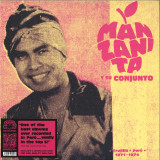
Afrosound's mission was to emulate the guitar-heavy tropical sounds emanating from Perú and Ecuador at the time. To add to the hippie vibe, there were plenty of whacky improvised vocal asides (called 'inspiraciones'), plus custom fuzz, wah-wah, flange and echo effects boxes for the guitar and keyboards. A barrage of odd sounding synths, drum machines and other electronic flourishes were also sprinkled in to spice up the proceedings. The dozen tracks on Afrosound's debut long play make for a surprisingly diverse palette from which these Colombian musicians painted their daring portrait of Peruvian cumbia, returning the favor in bold colors that still resonate almost 50 years later. "La danza de los mirlos" kicks off with most famous Afrosound hit of all, 'Caliventura', a genius blend of funk and cumbia. Aside from the cumbia amazónica title tune, there are several other covers including three popular songs by Nelson y Sus Estrellas, plus radically reimagined versions of various Colombian costeño classics published by Fuentes. Mario "Pachanga" provides a sad but still groove-oriented Christmas son montuno / cumbia hybrid while Fruko brings us the bomba-funk ditty 'El chorrillo' and the rocking cumbia andina gem 'Cabeza de chorlito' where Sepúlveda channels Enrique Delgado. Fruko collaborator Hernán "Hercovalle" Colorado Vallejo rounds things out with the melancholic psychedelic cumbia 'Esperando por ti', proving that every tropical party has to have its down side as well. The record was also released in the US, Ecuador, Perú, Panamá, Mexico and Venezuela, and probably had an influence of its own, at least in South America. The cover of this lovingly restored reissue features the artwork for the Peruvian edition, which was licensed and issued by Lima's El Virrey label in 1974. The original Fuentes artwork, with a far more outrageous "cheesecake" image, can be seen on the back cover.
Search:lima
Padre Himalaya first VA starting with P.Adrix(Principe discos) killer laser kuduro tool, Brazilian producer dj lima banging an old school funk and fast raves breaks from Rkeat.
B Side kicks off with slow lush tune from Dj Problemas, reaches the climax with the dreamy dub from Coletivo Vandalismo and finishes with Odete’s video-game like noise sound.
As long-time fans of this sublime four-track compacto 7" by the illustrious Brazilian duo Luli Lucinha e O Bando, we have floated the idea of re-issuing this beauty for several years now. So finally, the time feels right to release this beloved gem back into the world.
Originally issued on Som Livre Records in Brazil in 1972, this rarity has long been lost to only but the most hardened Brazilian record collectors and those lucky few who own an original copy. The four genre-defying compositions blend elements of psychedelic rock, MPB and folk, and are glued together by the synergy of Luli and Lucinha's vocals and the outstanding arrangements by Zé Rodrix. Whether it be the lost Brazilian-psych anthem of 'Flor Lilás’, or the tripped out folk-funk of 'Dourado Da Manhã’, the EP oozes magic and brilliance. The record also features the Brazilian percussionist, Alyrio Lima, who later became a member of the iconic Weather Report.
Luli (Heloisa Orosco Borges da Fonseca) and Lucinha's (Lucia Helena Carvalho e Silva) records have become extremely sought-after in recent years. Their inclusion on John Gómez's superb 2017 'Outro Tempo' compilation helped spread the gospel about their beautiful folky, MPB, private press albums from the late '70s and '80s. Prior to their musical partnership back in 1965, Luli released a heavenly Bossa Nova 7" nugget entailed 'Baleiro' and a self-titled solo album on Philips Records, which are now also highly-prized by collectors.
Here at Mr Bongo we feel Luli and Lucinha's names should be more widely recognised and break out of their cult artist status. They should be rated up there amongst some of the progressive, left-field greats of Brazilian music of their era. Sadly Luli passed away in 2018, but left behind an inspiring musical legacy for us all to savour.
This highly collectible LP from 1974 is a nonstop salsa dura party album from start to finish, comparable with any of New York's finest like Ray Barretto and Willie Colón from the same era, but with its own unique sound and joyful vibe. Includes the anthems 'Mi Nuevo Ritmo' and 'Alma y Sentimiento/ Soul and Feeling' recorded at different sessions in Colombia and Peru. Presented in its original artwork and pressed on 180g vinyl. The highly collectible LP Alfredo Linares Y Su Salsa Star "Mi Nuevo Ritmo" (1974) is a nonstop salsa dura party album from start to finish, comparable with any of New York's finest like Ray Barretto and Willie Colón from the same era, but with its own unique swinging sound and bright, crisp, joyful vibe. There are plenty of straight up Cuban-roots based salsa tunes, plus some Latin jazz and Latin soul and a bolero. Trumpets, hand claps, loud cowbell, and vigorous vocals all make for a great listen and an even better dance experience. As the track 'La Música Brava' proclaims, "Yo no quiero que pare la música brava!" (I don't want the badass music to stop!). The record is actually a patchwork of different recording sessions made in Peru and Colombia, featuring differing studio sound and musician lineups. Linares had just returned to his adopted home of Medellín from a period spent in Peru and was looking for a record deal. He had brought master tapes with four songs recorded in Lima and was shopping them around in the hopes of securing an album contract. Linares also cut some Colombian sessions which feature Roy "Tayrona" Betancourt as well as Henry Castro and Enrique Fabián. Unfortunately, neither Discos Fuentes nor Sonolux or Codiscos were interested. At that time, vinyl for making records was scarce and over-priced due to the petroleum crisis and hence the labels were reluctant to try out a new artist. "There was nothing to be done. The only company that had vinyl stock was INS. So I did the business with them even though they didn't have a known name in Colombia. The strength of that album made them rather famous." The song 'Mambo Rock' (with 'Estricto Guaguancó' on the B side) came out on a 45rpm record in 1974, and, as Linares recounts it, "two months later the sale was at a very high level. So, partly out of gratitude, I started producing for them. It is from there that my other records and the AfroINS albums came." Unfortunately the master tapes to the LP were lost or destroyed, as with all INS releases, so the best possible vinyl sources and audio restoration has been used for this deluxe reissue.
After the first EP release on visible spectrum a year ago, we are happy to announce the second EP on this label. It was a crazy year of radical change, that has also affected the label and its curator for the choice of this release. For the second EP label founder Yuri Boselie, aka Cinnaman, dives into deep listening territories with the five track “Kingfisher” EP. With two guest contributions by Oko Ebombo and Tom Trago, he completed a refined and well-rounded dreamy ambient narrative.
The first track ‘Verité' is the exciting collaboration with the Parisian street jazz artist Oko Ebombo. It originated two years ago as Oko came to Amsterdam for a friendly visit, resulting in a weekend long musical session that produced this blissful slow house trip. The track ‘Lima' is inspired by a trip Yuri made to this wonderful city, where he made field recordings of sea pelicans flying over the sea while walking on the beach. The collaboration ‘Changes' with Tom Trago came together early 2020, in which emotional and painful events were captured in a deeper ambient piece.
Artwork is by Marilyn Sonneveld. 150 copies with post card insert.
Rebuke returns to Drumcode with a trio of timeless dancefloor weapons.
The Irishman’s ‘Rattle’ was a standout of 2019, judged by DJ Mag as their no.22 top track of the year and is etched in the Drumcode discography as one of the most original releases to date. A valued part of Adam Beyer’s extended collective; he would have made his Drumcode event debut at WMC in Miami this March. Without a doubt, a sophomore EP was always on the cards.
‘Instatik’ kicks the work into gear, a rugged, reverb-heavy cut with industrial drums that pump like pistons and an undulating synth effect that makes you feel like you’re on a turbo-charged rollercoaster. ‘Livewire’ has the trademark Rebuke brain-scrambling stamp on it, a flurry of steelyard percussion bring the track to life, before a low-end melody swells to attention, rubbing shoulders deliciously with driving drumlines, for an uplifting second half. The title track ‘Obscurity’ is a dark slice of techno funk, filled with synapse-tickling arpeggios, before a rollicking groove takes hold and launches the track home at full-flight. Another thrilling and innovative release to add to the Rebuke canon.
“I think 2020 will go down in history as the craziest year of our lifetime. The future is still pretty unknown right now and things are drastically changing week to week. With that in mind, I felt ‘Obscurity’ would be a fitting title for my second Drumcode EP. It represents the state of being unknown, unclear or difficult to understand – feelings I’m sure most of us are going through right now. Most the tracks aside from ‘Livewire’ were written in quarantine; ‘Livewire’ was written right before the virus shut the world down, in a hotel room in Lima, Peru in January. This EP is my favourite to date as I think it shows a different side to my musical palette, whilst still developing the signature sound heard in all my music.” – Rebuke
Influenced by a life split between Lima, London, and Twentynine Palms, Peru-born M. Caye Castagnetto’s Leap Second is an intriguingly personal and hard to classify debut album. The album is a thick collage of samples Caye recorded with different artists and musicians, including Beatrice Dillon and the late Aileen Bryant, that spans five years in the making. There is something in Leap Second that tracks the speed of bodies, how they approach and retreat. The ten tracks are speedy and languid, thick ruffles, and dirges. In parts it feels like one’s stumbled upon a forgotten incredible ’70s folk record but that feeling gets broken quickly by clever sleights of hand. Caye’s balladry is angular, time is elastic. Each song is a fresh cape. How dandies really mean it, so masc- that it’s fay, how the only moment is this one and it’s just passed, etcetera.“While it doesn’t really sound like anything else, there are moments that feel like a Latin-flavored Nico, that’s edging its way towards some of the outings of the Sun City Girls. In my opinion it checks all the boxes, by checking none of them.” —Bjorn Copeland, Black Dice “A truly interesting conglomeration of loose inspirations and conjurings. A hard to decipher sound all together which makes it worth every moment...a sprinkling of Catherine Ribeiro, Dr. John, Terje Rypdal and Nico. Far-out sun-soaked odysseys and moon-dappled woodland night creepers...” —John Dwyer
Alfredo "El Inca" Linares is one of the best and most beloved musicians in the history of salsa. Fans love his piano playing because of his authentic Cuban feel and 'swing' combined with progressive arrangements and uncompromising phrasing. "Lo Que Tengo" is full of rock solid dance floor killers and no filler, recorded in 1980 with some of the cream of the crop of contemporary Venezuelan salsa musicians (members of Mango, Madera, El Trabuco Venezolano, Los Dementes, Los Melódicos, Dimensión Latina, Guaco, and La Salsa Mayor) and launched there on the indie label A.L.G. Records as ¡Con Todo!, and then a year later on the much larger Velvet Records with a different cover. This a classic Alfredo Linares album, but with the updated studio sound of 1980s Caracas. With five perfectly paced salsas, one funky cha cha chá, a steamy bolero and a dance-friendly Latin jazz number to top it off, there is something for everybody on this record. Thankfully today's generation can now enjoy this rarity at a fraction of the cost of an original copy. Presented in its original artwork and pressed on 180g vinyl. Good to know: Alfredo "El Inca" Linares is one of the best and most beloved musicians in the history of salsa. Fans love his piano playing because of his authentic Cuban feel and 'swing' combined with progressive arrangements and uncompromising phrasing that puts one in mind of Eddie Palmieri. As a composer, arranger and band-leader Linares is highly respected as well. Ever since the 1960s in Lima Peru when his career began, his records have always been on point, being super tight, sharp, and hard as hell, what salseros call salsa brava con afinque. It's no surprise that Lo Que Tengo is exactly that: full of rock solid dance floor killers and no filler, played with verve and flair. Unlike some of his other records that were patched together from various sessions made in different studios (sometimes even in several countries!), this album has the advantage of being produced, recorded and mixed by Alfredo Linares all in one studio and block of time, and backed by hand-picked seasoned professionals who Linares had already played with, both in the studio and on stage, lending it a consistency and sonic integrity that is excitingly manifest in every groove. The album was recorded in 1980 in Caracas with some of the cream of the crop of contemporary Venezuelan salsa musicians (members of Mango, Madera, El Trabuco Venezolano, Los Dementes, Los Melódicos, Dimensión Latina, Guaco, and La Salsa Mayor) and launched there on the indie label A.L.G. Records as ¡Con Todo!, and then a year later on the much larger Velvet Records with a different cover. The LP was also released in Colombia (INS, 1982) and the US (Gallo, 1984), both editions utilizing the Velvet Records cover. During this time Linares had been in Venezuela for some five years and was under contract with a nightclub in Caracas. Through being on the salsa scene there he became friends with the band Mango and even guested on an album with them in 1976. After the contract was up Linares was a free agent again and he was able to draw on his friendship with Mango and assemble a band to back him, first for the Colombian/Venezuelan production Salsa de Verdad (Fonodisco, 1976) and then again with ¡Con Todo! / Lo Que Tengo. One of the distinctive aspects of Alfredo Linares tunes is the 'break' (la cierre)-there are always plenty of dramatic hand-clapping breakdowns followed by an infectious tumbao (sustained vamp) section that sends shivers up the spine and makes the dancers go crazy. In addition, Linares always lets his musicians stretch out, especially in the percussion section. Again, Lo Que Tengo is no exception: there are so many examples of typical arrangements here that one could call this a classic Alfredo Linares album, but with the updated studio sound of 1980s Caracas, which was awash in petro-dollars at the time and so had the latest equipment and a strong consumer base for the salsa market. The album's title tune (originally credited on the Venezuelan edition as 'Lo que tengo que crear'-'What I Have To Create') is by Mango's timbalero José "Cheo" Navarro and sums up Linares' central career philosophy: the musician lives every day to create music, to spread joy and create a party, without complications, wherever he goes. With five perfectly paced salsas, one funky cha cha chá, a steamy bolero and a dance-friendly Latin jazz number to top it off (note the bluesy piano solo from Linares and the sublime vibes of Mango's Freddy Roldán), there is something for everybody on this record. Thankfully today's generation can now enjoy this rarity at a fraction of the cost of an original copy.
New imprint beam dump curated and run by Chris Geschwindner starts its operation with the usual madness. Following the idea of a beam dump, a device that captures and dissipates large amounts of radiation, the label showcases music that strikes through its energy and coherent complexity.
For its first release, beam dump introduces the newcomer trio of SINM from Lima, Peru with their infectious blend of breakbeat-infused house and no-nonsense tech groovers. Including 4 tracks, Simulation EP is a fun and innovative approach to current electronic club sounds borrowing inspiration from tech house as well as twisted UK garage and 2-step.
Long sought after by collectors, DJs and lovers of hard salsa and boogaloo alike, 'Yo Traigo Boogaloo' is now lovingly reissued in replica form with the original cover art, remastered from the studio tapes, reproducing that magical MAG studio sound for today's aficionados to enjoy like it was 1969 all over again. Alfredo Linares is a globetrotting pianist, composer, bandleader and producer from Peru with a long, prolific career in latin music. His long sought after by DJs and collectors of hard salsa and boogaloo alike, 'Yo Traigo Boogaloo' is now lovingly reissued in replica form with the original cover art, remastered from the studio tapes, reproducing that magical MAG studio sound for today's aficionados to enjoy like it was 1969 all over again. Details: Alfredito "Sabor" Linares is a globetrotting pianist, composer, bandleader and producer from Lima, Peru with a long, prolific career in hot Latin music spanning more than half a century. Though Linares has come to recent international fame through his work with William "Quantic" Holland, he was already quite popular and famous in his adopted countries of Colombia and Venezuela in the 1970s and 80s during the salsa boom. However, his career began in Lima, backing timbalero Ñico Estrada at age 17 in 1961, and Alfredito's first notable recording as a sideman was a few years later on the now legendary 'El Combo de Pepe' album for IEMPSA/Odeon. Subsequently Linares would advance his career by recording two fabulous records under his own capable leadership as Alfredo Linares Y Su Sonora at the end of the decade for the MAG label. These releases capitalized on recent developments in New York Latin music, namely Latin jazz, boogaloo, descarga (jam session) and what would later be marketed as "salsa" with roots in the Cuban guaguancó and guaracha genres. One can hear direct inspiration coming from Joe Cuba, Ricardo Ray, and Eddie Palmieri, especially on the first album, 'El Pito', and yet by the second record, there are plenty of original tunes as well. More importantly there is a 'swing' and assertiveness to the playing (and arrangements) that prove every bit as authentic, tough and danceable as their New York inspirations. As Linares himself recounts, "In that era, we fought against a generation that was half-blind, because the people who understood what we were doing were few. We had to fight hard for our space in Perú, that's where the swing comes from." That special 'swing' also emanated from Linares' ace backing band, which happened to be a talented stable of MAG studio musicians who all understood Cuban and jazz music: percussionists Mario Allison and Coco Lagos, bassist Joey di Roma, Kiko Fuentes and Carlos Muñoz on lead vocals and Melcochita on coro (vocal chorus). According to Linares, the studio band was "open-ended, some musicians came some days, others on other days_Nilo Espinoza on saxophone, Betico Salas and Tito Chicoma on trumpets. Otto de Rojas played piano, and so did Charlie Palomares, who played vibraphone. Another good musician was guitarist Carlos Hayre." Though the recordings were cut "live in the studio" and many were basically composed on the spot, the intrinsic strength and maturity of the performances on 'Yo Traigo Boogaloo' stand the test of time as one of Peru's most important contributions to tropical music across the decades, establishing Alfredito Linares as a master of the idiom and serving as a harbinger for great things to come for him in Colombia and Venezuela. Long sought after by collectors, DJs and lovers of hard salsa and boogaloo alike, 'Yo Traigo Boogaloo' is now lovingly reissued in replica form with the original cover art, remastered from the studio tapes, reproducing that magical MAG studio sound for today's aficionados to enjoy like it was 1969 all over again. Pablo E Yglesias DJ Bongohead of Peace & Rhythm
Omena hits release no.30 and celebrates by bringing in Twovi aka Vito Loperfido to the family.
Vito released his first track, 'Giango' on Bosconi Records back in 2017 and followed up with 'In Memory of Love', on Chez Damier's Inner Balance, a release that showcased his talent for blending classic house with a fresh approach.
Fast forward 2020 and we got a new release 'Panama' ready.
These four tracks show why Vito is leading the wave of musical talent coming from Italy and he's not afraid of using inspiration from different sources.
The opening track Panama is an ode to a jazzy KDJ breeze while Santiago is a clever broken beat track with a few latin vibes sprinkled on top.
On the flip, Manchester producer Contours continue to turn music into gold with a singular remake of Panama.
It's a deep and rich version with his signature percussions included.
Last but not least Lima ends this fine EP, a track which takes us back to the golden days of Nuphonic.
- A1: Africa Negra - Mino Bô Bé Quacueda
- A2: Africa Negra - Zimbabwe
- A3: Sangazuza - Sun Malé
- A4: Os Úntuès - Chi Bô Sá Migu Di Védê
- A5: Sum Alvarinho - M'konvètá Dédo
- B1: Conjunto Equador - Mad?
- B2: Tiny Das Neves - Cladênço Padê Cluço
- B3: Conjunto Mindelo - Taji Océdo
- B4: Africa Negra - Aninha
- C1: Pedro Lima - Nga Ba Compensadora
- C2: Sangazuza - Cortição
- C3: Os Úntuès - Piquina Piquina
- C4: Conjunto Equador - Meu Di Plôc?
- D1: Sum Alvarinho - Tólá Muandgi
- D2: Pedro Lima E Conjunto Os Leonenses - Esatela Licu
- D3: Agrupamento Da Ilha - Bô Gosa So Txi
"The two Portuguese-speaking African islands of Sao Tomé & Principe, located in the Gulf of Guinea, created an unique music called Puxa : a refined mixture of various musical components from both sides of the Atlantic Ocean. A blend of Semba, Merengue, Kompas, Soukouss, Coladeira patterns, often pushing forward with a voodoo-like energy, solid bass lines, delicate melodies and backing harmonies of the rich Sao Tomean melodic traditions. Very first compilation focusing on the golden age of these island’s sounds, the 16 tracks selected will surely set fire on all dance floors !
Léve-Léve is the first ever compilation devoted to music from São Tome and Principe, two small islands situated off the coast of Gabon in central Africa. The album unravels a story of liberation where the music of Africa, Europe and the Americas unify with a carefree spirit personified by a phrase the islanders use all the time: “léve, léve” (“take it easy”). With echoes of Angolan semba and merengue, of Brazilian afoxê, of coladeira from Cape Verde and dance music from the Caribbean, it is a sound fiercely proud of its island heritage, sung in local dialects and using distinctive local rhythms.
On this record you can hear the cultural and social history of São Tome and Principe, and how live music represented its beating heart. Once known as the “Chocolate Islands” (remarkably, these two tiny islands were the largest cocoa producers in the world, though now this title acts as a reminder of its colonial past), through the years leading up to independence from Portugal, music would be a fundamental voice of liberation and conviviality. Os Úntués were one of the first groups to make an impression, releasing a couple of 7 inches in Angola – the litmus test of success for any of the islands’ groups. They united unique rhythms and dances like socopé, puita and dança-congo – borne from the islands’ largely slave-descendant population – with the sound of pop music beamed in on the radio from Europe, even adding in a little bit of soukous and Brazilian instrumentation. Their main rivals were Conjunto Mindelo, who fused São Toméan rhythms with rebita, an Angolan style, to create high energy puxa, a truly original island rhythm.
From the mid-1970s, coinciding with independence from Portugal in 1975, the islands’ groups featured an even stronger African influence and nowhere was that more apparent than with Africa Negra. They would listen to the latest records from Gabon, Zaire and Cameroon, taking inspiration and trying out phrasing from the greats of Central African guitar playing, developing a devoted fan base off the islands, as well as on. A score of other bands would follow a similar musical path, with a few getting their dues overseas in Angola, Cape Verde, Portugal and across Africa.
Os Leonenses (led by the iconic Pedro Lima), Conjunto Sangazuza, Sum Alvarinho and Conjunto Ecuador were just some of the other bands that formed a lively home-grown music scene that lit up the islands’ bars and open-air shows from the 1950s through to the mid-90s. Regardless of class or age, they were responsible for keeping the population entertained come the weekend, with Sunday matinee shows the highlight of the week, the music not stopping from midday until midnight.
As a Portuguese island colony that was for many years populated with slaves brought from Africa, São Tome and Principe has much in common with other Lusophone countries and boasts a richly complex and idiosyncratic musical DNA. Whilst the musical tapestries of Angola and Cape Verde are well known, São Tome and Principe’s secrets were assigned to the islanders themselves. Until now."
'I Enjoy the world' is the first solo album by Efrain Rozas. The piece was composed to be listened to as a sonic meditation of 40 minutes. Buh Records (Lima, Peru), previously released the album as a limited cassette edition in 2017, accompanied with an animated video by Muriel Holguin. The album has now been remastered and pressed on vinyl by Futura Resistenza, a new record label from Rotterdam, the Netherlands.
Strangelove’s latest release turns left somewhere near the edge of the Atlantic, with Electricidade Estética” documenting a vibrant window into the musical landscape of 1980’s counter-culture Portugal. Compiling early un-issued works, DWART’s organic Ash-Ra Balearics meld with spikey Iberian electronics, coalescing around the floating beauty of ‘Mate’, reissued for the first time on vinyl. With emergent music technologies of the era enthusiastically adopted by Lisbon’s avante-garde, there was a collective desire by DWART and their contemporaries to push existing sonic boundaries;- Post new wave sounds melded with distinctive local sensibilities. Vítor Rua & Jorge Lima Barreto of the legendary Telectu (whom Antoñio currently tours with) were regular collaborators while composer/ guitarist Nuno Rebelo and guitarist/singer Bernardo Devlin feature throughout. Antoñio & Manuela Duarte’s search for an artistic language melded a continuing curiosity with aural and physical dualities: experimental pop integrated with performance art, mathematics sound-tracked on canvas, organic found sounds at ease alongside synthetic drum machines. The 9 songs found here document the early emergence of their own ‘Electricidade Estética’ (Big shouts to Invisible Cities & Steele Bonus- early champions of ‘Mate’) Vital Sales Points: Follow up to the labels previous releases - Frank Harris & Maria Marquez ‘Echoes’ and previous Portuguese release Lena d’Água ?- Jardim Zoológico
- A1: Afrodite Se Quiser - Fora De Mim
- A2: Lilith - Todo Amor E Bom (Remix)
- A3: Fabio Fonseca - Ladroes De Bagda Feat.marina Lima
- A4: Fernanda Abreu - Hello Baby
- A5: Luna E Dj Cri - Acabou Como Comecou
- B1: Junior - Vim Te Buscar
- B2: Thaide & Dj Hum_Coisas Do Amor (Trepanado Edit)
- B3: As Damas Do Rap - Um Sonho Real
- B4: Mc D' Eddy - Jeito Do Se Menina (Inst)
- B5: Sharylaine_Saudade
I grew up fascinated with the music played late at night on the radio.
As a kid, when times were tough and I couldn't get myself to sleep, I would tune the radio to my favourite FM station and dream on.
This was back in the late 80's and lasted until the mid 90's, a time when I was getting hooked by Hall & Oates, Loose Ends, Maze, S.O.S. Band, Soul II Soul, and other artists that used to rule the dial in the wee hours.
So this music didn't only comfort and nurture me at the time, it also shaped my music personality.
When Renata approached me in order to work on the first ever compilation for Hello Sailor, I knew the selection would end up reflecting this side of me. It had to come from the heart.
It also had to bring to the table something different than what's already associated with Brazilian music, and exploring our own take on the street soul genre sounded good.
It was never done before and it's also faithful to Brazil's musical heritage.
Back in the 80's and into the 90's, it was very common at parties to have a slow dance moment in between the more uptempo sections. A timeout from all the frantic dancing, when people could cool off and flirt in a more romantic way. (It does sound like a great idea to have this intimate just-the-two-of-us moment in the middle of a party; maybe it explains the number of marriages at that time.)
This is a tradition that goes back to the black music balls in the late 70's, which helps to explain why the majority of the early rap acts from Brazil used to have a couple of romantic songs in their albums. When you add to this recipe the power of the mellow pop acts during the aforementioned period, one can realise why it extended its tentacles to deeper depths of pop music in Brazil.
This compilation features some of my favourite music ever, songs that I've crossed paths with in different moments of my life.
Fernanda Abreu, for instance, is a longtime crush - I have been in love with her music since the mid 80's when she used to sing in a band called Blitz, which my mom loved.
Afrodite Se Quiser, on the other hand, created some buzz while the group was active with the minor hit "O Que Que Ela Tem Que Eu Nao Tenho", from their first album (1987), but I didn't know about "Fora de Mim" until 2015. My point is: even if it took me 25 years to find this track, I had a reserved spot in my brain for it and it laid there perfectly as if it innately belonged there.
It's a built memory, and I love playing with this idea when presenting music to people.
Street Soul Brasil is part mellow pop, part R&B, part rap.
One can surely feel a lot of street energy from the B Side. The music reflects the influence of international pop at the time, but it also shows how Brazilians are talented in making any sound their own!
This compilation is supposed to be a mixed collection of songs, something that might trigger the feeling of flipping through an old photo book full of tender memories. These are songs that should speak straight to the heart, music to comfort and heal, music that deals with joy and pain, feelings that I always liked being transmitted through music.
It's among the best forms of therapy. It worked for me and I hope it works for you...
Matasuna Records has once again unearthed two Latin gems for its latest release: two rare tracks by Argentina-born musician Enrique Lynch. Lynch moved from Argentina to Peru in the 1960s and became artistic director and producer of the Sono Radio label. He released an astonishing amount of albums with his various bands over the span of nearly three decades.
The two songs will be available together on a vinyl single for the first time - and the track from the flipside will also be released on a 7inch for the first time. For this official reissue Matasuna was lucky enough to have access to the original master tapes. The tracks were carefully restored and remastered in Lima (Peru).
African Bump is one of Enrique Lynch's greatest tracks and the original 7inch is much sought after by collectors and DJs alike. The song immediately captivates the listener as the Wah Wah guitar begins to play and enters into perfect harmony with organ and brass. A thrilling disco funk beat, rhythmic percussion elements and a hypnotic hookline spice up the track and show what great musical treasures South America has to offer.
On the flipside there's a great cover version of the Soul and Funk anthem K-Jee by American band The Nite-Liters, which had a hit with this song in 1971 and even entered the billboard charts. Enrique's version adds some extra grooves with killer beats and breaks, a heavy bassline and wild percussion parts. A distinctive horn section meets funky guitar riffs and deep organ sounds. A fantastic funk tune that will set any dance floor on fire!
- A1: S Curro & Manul - "Bloodclat
- A2: Limabeatz - "Lindeza
- A3: Pedro Ladroga - "Inter-View
- A4: Manul & Energy Man - "Sp Funky
- A5: The Gardener - "Nube Negra" (Feat Sklt Sklt)
- B1: Flat Erik - "Matrix" (Lost Twin Remix)
- B2: Highkili - "Lpgc" (Sklt Sklt Remix)
- B3: Manul & Energy Man - "Bombon" (Kid Cala Remix)
- B4: Bsn Posse & Hidden Jayeem - "Calabria
Sing a song fighter have never been more proud and happy than to finally announce and release this unissued and unheard fantastic recording South African in exile Johnny Dyani was one of the greatest bass players. Played with Don Cherry, Chris McGregor, Archie Sheep, Dollar Brand / Abdullah Ibrahim etc etc. He also made many great albums as a bandleader. And a few rare minimal albums where it was mostly him and his upright bass. He died way too early, in 1986. Karl Jonas Winqvist (Sing A Song Fighter) ranks some of Dyani's works ("African Bass", 'Witchdoctor's Son" with Okay Temiz and "Good News From Africa', with Dollar Brand) as "the most natural, creative musical force there is'. KJW investigated for years if there was more recorded Dyani material waiting to be heard. And where After e-mailing endlessly with the National Radio Museum in Switzerland he finally found what he was looking for.In 1978 graphic designer Niklaus Troxler arranged the great Willisau Jazz Festival in Switzerland. A lot of legendary artists like Max Roach, Jan Garbarek, Elvin Jones and Don Cherry were performing, and Johnny Dyani was one of them. He did this rare solo concert with some of the material that two years later would end up on his great album "African Bass". This LP contains the concert from beginning to end, showing Dyani at his very best on piano, gong, bass and vocals. Spiritual, adventurous and truly free,beautiful music.Gatefold cover, with extensive liner notes from Francis Gooding and Niklaus Troxler