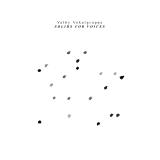
Valby Vokalgruppe was initiated in 2008 by Anja Jacobsen, the Danish collective’s current line-cup is completed by Lil Lacy, Sonja LaBianca, Cæcilie Trier and Laura Marie Madsen. The group has written and performed a large number of cross-aesthetic pieces over the years, including an album Bah New Era released in 2012 on Eget Værelse.
Sharpened to its core, the group dives deep into rhythmical architectures built almost solely from the voice - think Platonic solids reimagined as sound objects. Think trance without electronics. These new compositions are compressed, sparkling forms — vocal geometries that spin, collide, and dissolve through repetition. From inside the circle: radical precision, soft dissonance, and playful intuition guide the way. The group explores the voice not as melody alone, but as material — vibrating, modulating, refracting.
Solids For Voices transcends into deep concentration calling for a clear state of mind, in recognition of an increasingly fragmented and incoherent reality. Valby Vokalgruppe endeavours a total absorption into the voice, the rhythm and the trance.
Suche:lin
Four years on from their landmark Grassroots, visionary half-time heavyweights The Untouchables return with their third album, Lost Knowledge. The duo of Kate McGill and Ajit 'Nitrox' Steyns have carved out a space in modern D&B all their own, building on a legacy that reaches back to the late 00s to keep pushing into unexplored terrain with an assured and deadly line in rhythmic intrigue and atmospheric immersion.
Lost Knowledge launches into action instantly with the high-pressure drum science and dubby splashes of 'Drunken Bells', capturing the loopy techno propulsion and rolling intensity that drives so much of the output on Samurai Music. Where The Untouchables excel is in finding variety and nuance in their relatively forbidding, pared down sound. The heads-down groove of 'Mafia Town' owes as much to dembow and dancehall as D&B, while 'Lost Knowledge' spirals out into psychoactive flurries of synth strafes and organic percussion slathered in tight-locked delay trails. There's no light relief from strident hooks or riffs, just a pure, unshakeable commitment to the power of the beat and deeply designed layers of sound shaping out the space around.
'Busy Bones' makes space for carefully deployed hints of pad tone while the snares snap out of the mix with a sharp set of teeth. 'Four Eared Demon' baits the gabber crowd with its rapid-fire 4/4 hats atop seasick creaks across the midrange, keeping subtlety and patience in the lower frequencies to maintain the signature elegance readily associated with The Untouchables. 'Phase Correlation' teases an artfully unhinged ripple of synth that stands out amongst the murky murmurs filling out the middle distance, but it's still exercised with brutal precision.
Nothing happens by accident or feels out of place - McGill and Steyns are in total control, and they demonstrate incredible range and inventive approaches within their focused style. The accent of the grooves shifts, and individual sounds carry all kinds of artefacts, yet everything gets folded into the exacting Untouchables sound with a liberal dubwise sensibility. Brimming with inspiration and immaculately produced, on Lost Knowledge their one-of-a-kind sound is stronger than ever.
- 1: Amrita
- 2: Orun
- 3: Campana De Oro
- 4: Dedos De Conciencia
- 5: Atunwa
Norwegian–Cuban duo to you they are birds, to me they are voices in the forest return with their second album, Primordia. Using field recordings, electronics, and live instruments, they craft improvised soundscapes that blur the line between natural and musical environments.
Primordia continues their focus on the interaction between people, nature, and sound, combining raw textures with subtle improvisation. The result is an immersive work that feels both organic and otherworldly.
- 1: Avó I
- 2: Avó Ii
- 3: Avó Iii
- 4: Avó Iv
- 5: Avô I
- 6: Avô Ii
- 7: Avô Iii
- 8: Avô Iv
Guilherme Granado & Bruno Abdala reunite for a second volume of beats, jazz ghosts and synth-funk dust.
Following their first outing earlier this year (Vol. 1 on Sucata Tapes / SUC66), the duo returns with a bigger, deeper, and smoother bang on Vol. 2 – Filhos.
The grooves remain intact, expanding on the raw funk blueprint of Vol. 1 — now infused with Tropicália-rooted freedom, Sun Ra-style celestial chaos, and a tighter, more confident feel. The sonic palette is rich and eclectic: samplers, bells, analog synths, drums, marimba, vibraphone, bass, violas, and more are layered into a warm, rhythmic tapestry that honours the past while forging new sonic terrain.
At its core, Filhos (Portuguese for "Sons") is a tribute to lineage and tradition. It reflects the idea that we are all shaped by what came before — and through music, Guilherme & Bruno honor that legacy while pushing it into the future.
- A1: Part 1
- B1: Part 2
Free Jazz: A Collective Improvisation is a studio album by American jazz saxophonist Ornette Coleman, released in September 1961.
The album features what Coleman called a "double quartet," i.e., two self-contained jazz quartets: each with a reed instrument, trumpet, bass, and drums.
The two quartets are heard in separate channels, with Coleman's working quartet at the time in the left channel, and the second quartet, including
the former Coleman rhythm section of Charlie Haden and Ed Blackwell, on the right.
The two quartets play simultaneously. Free Jazz was the first album-length improvisation at thirty-seven minutes, unheard of at the time.
The original LP package incorporated Jackson Pollock's 1954 painting The White Light. The cover is a gatefold with a cutout window in the lower right corner allowing a glimpse of the painting;
opening the cover revealed the full artwork, along with liner notes by critic Martin Williams.
Free Jazz served as the blueprint for later large-ensemble free jazz recordings such as Ascension by John Coltrane and Machine Gun by Peter Brötzmann.
Free Jazz is available as a limited edition of 1000 individually numbered copies on white vinyl.
- The Free Design - Listen
- Evelyn Pope - Surround Yourself In Sound
- James Kirk & Warren Mcintyre - Iron Star
- Frank Schmiechen - Irgendein Französischer Film
- The Kingfishers - Long Lost Friend
- Brent Cash - Good Morning Sunshine
- David Scott - The Last Great American Dynasty
- Shack - Carousel
- Michel Van Dyke - Ich Find Dich Gut
- Marina Unlimited Orchestra - Vermont Snowflakes
- The Bathers - No Risk No Glory
- Fascinator - Mississippi Mud
- The Tall Poppies - The Return Of The Snow Lamb
- Ashby - You Can Have It All
- Norman Blake & David Scott - Hammond Song
- Oscar In Venice - Michael Joseph Scott
- Dislocation Dance - It's A Long Way Down
- The Pearlfishers - Limelight
- Colin Steele Quartet - The Vampires Of Camelon
- Malcolm Ross - Heartbroken All Over Again
- Van Dyke Parks - Chateau Marmont
"Viva Marina" celebrates the 100th release of Marina Records. The label was founded in Hamburg in 1993 by Stefan Kassel and Frank Lähnemann. Over the years the label released many outstanding albums by artists like The Pearlfishers, Shack, Brent Cash, The Bathers, James Kirk, The Free Design, Malcolm Ross, Ashby, Paul Quinn & The Independent Group, Der Plan, and many many more - incl. the best-selling Beach Boys/ Brian Wilson tribute album "Caroline Now!". "Viva Marina" is the 4th of the label"s acclaimed compilations - following in the footsteps of "In Bed With Marina", "Ave Marina" and "Goosebumps". These compilations have all been elaborate classy affairs with lots of attention to detail (packaging / design / liner notes / photography / mastering). Artefacts of beautifully curated Pop Art. The new compilation continues in that tradition. It features 21 tracks from the Marina roster and kindred spirits like Van Dyke Parks, The Kingfishers, Frank Schmiechen and Michel van Dyke. Featuring many exclusive and previously unissued contributions. Enjoy 21 tracks / 75 minutes of pure aural pop pleasure. Viva Marina!
- You Are(The Government)
- 1000: More Fools
- How Much Is Enough?
- When?
- Give You Nothing
- Land Of Competition
- Forbidden Beat
- Best For You
- Suffer
- Delirium Of Disorder
- Part Ii(The Numbers Game)
- What Can You Do?
- Do What You Want
- Part Iv(The Index Fossil)
- Pessimistic Lines
Obwohl "Suffer" lediglich eine Laufzeit von 26 Minuten hat, war die Platte für Fat Mike, den Sänger und Bassisten von NoFX, in Bezug auf das amerikanische Punk-Revival der Neunziger "das Album, das alles veränderte". Tatsächlich bedeutete der dritte Langspieler der Band 1988 nicht nur den internationalen Szenedurchbruch für Bad Religion, er schuf auch die Grundlage für den massiven Erfolg des Epitaph-Labels, das mit The Offspring, NoFX, Rancid und Pennywise just jene Gruppen unter Vertrag nahm, die in den Neunzigern mit Melodic Hardcore, Pop-Punk und Skatepunk für Furore sorgten. "Suffer" bot für die damalige Zeit etwas völlig Neues: Schnelle, aber sehr melodische Songs mit mehrstimmigen Gesängen und Hintergrundchören sowie abrupte Rhythmuswechsel; hinzu kamen der klare Gesang Greg Graffins, der durch eine exakte Aussprache und Metrik gekennzeichnet ist, sowie intellektuell inspirierte Lyrics. Bad Religion spielten die 15 Songs von "Suffer" in der Originalbesetzung - Greg Graffin (Gesang), Brett Gurewitz (Gitarre), Greg Hetson (Gitarre), Jay Bentley (Bass), Pete Finestone (Schlagzeug) - im April 1988 im Westbeach Recorders-Studio in Hollywood ein. Das Album wurde von Brett Gurewitz und Donnell Cameron in acht Tagen aufgenommen und gemixt.
- Reap The Fruits Of Famine
- Day Of Wrath
- Headstone
- Break Bread With The Dead
- Where Dead Hands Linger
- Deathless
Zebulon's debut album "Come Day of Reckoning" delivers slow-burning doom with crushing riffs, dramatic vocals, and haunting melodies. The material explores themes of judgement and faith. Recorded in the winter of 2025. Zebula hails from Jæren, Norway.
Old-time and traditional music stay exciting for their contrasts. Exacting instrumentation honed through mentorships and late-night jams at fiddler's conventions tangles with a community-sourced inventiveness that influences variants and new sounds. Joseph Decosimo is a master of this genre for this very reason, blending deep technique with an openness and curiosity that keep his music crackling with life. A "marvelous fiddler" (No Depression) and banjo player who braids "exultation and veneration" (INDY Week) into his music, on his third solo album Fiery Gizzard Decosimo gathers a close-knit ensemble of friends from his musical career to infuse his interpretations of fiddle and banjo pieces with a contagious communal joy. As an artist working with traditional music from the South and Appalachia, Decosimo chooses songs based not only on historical significance and lineage but also his own sensory approach. For Fiery Gizzard, his ear was tuned to otherworldly tones and mystery, sourcing from field recordings such as Virginia fiddler Luther Davis' hypnotic version of "Shady Grove" while amping up the music's psychedelic potential. On the middle Tennessee banjo composition "Flowery Girls," a VHS of bluesman Abner Jay inspired Decosimo to rig up a pickup inside a fretless banjo and play it thr ough a tube amp to capture some of Jay's edge and funkiness. But to round out the sound and keep it kinetic meant galvanizing a genre-eschewing crew to jam out - and not in a "spaced-out drooly" kind of way, he laughs, but as a sort of "responsive conversation." Decosimo has always been a community-minded artist. He began playing as a seventh graderin Tennessee, fostering relationships with older players at jams and in homes, a learning mode natural to his inquisitive nature and desire for musical connection. A folklorist by intuition, he later became one by profession, studying with old-time legend Clyde Davenport, teaching in East Tennessee State University's renowned bluegrass program, and receiving his PhD at the University of North Carolina with a dissertation titled "Catching the `Wild Note': Listening, Learning, and Connoisseurship in Old-Time Music." In North Carolina, Decosimo kicked about in the verdant environment of Durham and Chapel Hill's folk and indie scenes, collaborating with artists including Alice Gerrard, Hiss Golden Messenger, and Jake Xerxes Fussell. This community has influenced his own music, including his "sublime and strangely heartening" (Bandcamp Daily) 2022 release While You Were Slumbering and Beehive Cathedral, Decosimo's 2024 "Appalachian mountain music treasury" (New Commute) trio album with Luke Richardson and Cleek Schrey for Dear Life Records. Continuing on this path, Fiery Gizzard is home base for a loose outfit of mostly Tarheel-based musicians from within and beyond traditional music. Inspired by a tour with fiddler Stephanie Coleman (Nora Brown), guitarist Jay Hammond, and synth builder and multi-instrumentalist Matthew O'Connell, Decosimo assembled studiomates based on close friendships and comfort. Coleman, O'Connell, and Hammond contribute to Fiery Gizzard, along with bassist and producer Andy Stack (Helado Negro, Wye Oak), horn player Kelly Pratt (Beirut, David Byrne), Mipso and Fust's Libby Rodenbough, Joseph O'Connell (Elephant Micah), and trad/experimental artist Cleek Schrey. Decosimo's fiddle and banjo work is virtuosic, intricate and simple simultaneously, a testament to his many years of study. On some tracks, his playing or lovely, plain-hearted singing is the centerpiece, such as on his interpretations of Texan street preacher Washington Phillips' 1929 recording "I Had a Good Father and Mother" or the Eastern Kentucky fiddle barn-burner "Glory in the Meetinghouse," famously played by Luther Strong for Alan Lomax. But there's also a trusting open-door policy, like where Southern Appalachian tune "Ida Red" relaxes into Coleman's sweet, confident fiddling and Hammond's loping guitar. As a bandleader, Decosimo's confidence and enthusiasm for the music reveal the heart of traditional music and how it can come to life through community. Fiery Gizzard is Joseph Decosimo as a powerful champion of traditional music - a sponge who soaks up as much as he squeezes out, a responsive artist who makes his genre accessible, and a magnet who can bring musicians of all sorts into his orbit with his same passion.
- A1: Mean Woman Blues
- A2: (Let Me Be Your) Teddy Bear
- A3: Loving You
- A4: Got A Lot O' Livin' To Do!
- A5: Lonesome Cowboy
- A6: Hot Dog
- A7: Party
- B1: Blueberry Hill
- B2: True Love
- B3: Don't Leave Me Now
- B4: Have I Told You Lately That I Love You?
- B5: I Need You So
After being out of print for a good number of years, we are making 15 titles out of our Elvis Presley back catalogue available again between August 2025 and February 2026. Each title will see two different editions: one on regular-coloured vinyl and one very limited on mix-coloured, marbled vinyl, both housed in deluxe sleeves with a linen look and feel. Loving You from 1957 was Elvis Presley’s first soundtrack and accompanied the eponymous film that follows a delivery man who is discovered by a music publicist and a country–western musician who wants to promote the talented newcomer. This was Presley’s first major starring role. The fact that only the tracks on the A-side appeared in the movie couldn’t spoil the fun for the fans, as the LP contained hits such as “(Let Me Be Your) Teddy Bear” reaching #1 in the U.S., some covers and some lesser-known deep cuts. It’s not without reason that this album reached Certified Gold status. The Midas touch, so to speak. Loving You is available as a limited edition of 1500 individually numbered copies on yellow translucent coloured vinyl.
Wewantsounds is delighted to announce the release of Akiko Yano"s cult 1979 album 7 O"Clock in Tokyo, recorded live in September 1978 at a pivotal moment in Japanese music history, just as Yellow Magic Orchestra was about to take the world by storm (Yano would tour the world with the group in 1979). Featuring a very funky Yano performance accompanied by Haruomi Hosono, Ryuichi Sakamoto and Yukihiro Takahashi, plus Tatsuro Yamashita and Minako Yoshida, the album is presented outside Japan for the first time, with remastered audio, original artwork, and a four-page insert including new liner notes by Paul Bowler.
- E1: In Need
- E2: Riding My Bike Across The Lake In Wintertime
- E3: Sorry Jack
- E4: Step Man/Stat Man/Scat Man
- E5: Breate Yes. Breathe No
- F1: This Used To Not Be This Way, Or If So I Cannot Remember
- F2: Are We Sorry?
- F3: Reasonable Prices
- F4: Coffee Coin
- F5: We Did It
- F6: Clap
In 2023, k.d.b lived in a crumbling farmhouse on the edge of the River Maas. Each morning, he’d wake at 6:00 and walk along the river’s bank with his dogfriend Miemel, pausing at sunrise for a cup of coffee.
It’s 6:34, and a thick rug of mist rolls out across the river. It’s so dense that k.d.b can’t see the water beneath it. Then comes the sun: a single ray cutting through the mist like a tube of light, landing on Miemel’s face. In her mouth is a CD she’s picked up, and on the CD is the title Instrumental Romance.
'What is Instrumental Romance?' thinks k.d.b. 'Romantic instrumentals? Or a romance used instrumentally? As in, a romance used to get something—like love?'
Miemel drops the CD and turns her attention to a stray purple grape on the path. Grapes are poisonous to dogs, and as she bends toward it, k.d.b. shouts, “NO!” At that precise moment, a large fish rises from the mist. It launches into the air, mouth wide open, and hangs there above the clouds. His shout, having traveled across the river, bounces back towards k.d.b with a “NO,” and in perfect synchrony, it appears the fish is also shouting at Miemel. The timing is so perfect, they can’t be sure it isn’t.
The fish falls back down, entering its watery world with an eerie, splashless silence, leaving k.d.b and Miemel standing open-mouthed on the bank. Before they can register the perfection of this duet, another fish (or maybe the same one again) rises from the mist in the exact same spot and launches into the air. Without thinking, k.d.b shouts again. The word “ROMANCE” comes out. This time, however, he is slightly too late, and the word is too long, so “ROMANCE” lingers on after the fish has already fallen back down.
'What even is romance?' thinks k.d.b. 'The construction of mystery or excitement with dead red flowers and timing?'
A foghorn sounds behind him, and k.d.b turns 180 degrees to see a boat moving freight, right to left, along the River Maas. 'That’s strange', he thinks. 'If the river is there, then what’s that behind me, below the mist?'
Staring at the boat and its shipping containers as they float out of sight, k.d.b imagines a man. The man is standing at the bottom of a small valley, holding a fish. 'Who is this man, and what does he want?'
- Jacob Dwyer
- Stutter
- String
- Spot
- Crumple
- Nest
- Clocks
- Slash
- Plateaus
- Spurty
- Undertow
- Meshy
- Folds
Nest is a tactile and spatial experience; precise and atmospheric, jagged and lyrical. Broshy"s unique approach to developing the material blurs the line between improvisation and composition, mechanical and human to create a sonic experience that holds large extremes close to each other.
- 1: Semi Detached
- 2: Desire Lines
- 3: Apricity
- 4: Smashing Time
- 5: Faraday
- 6: Straphanger
- 7: The Midnight Bell
- 8: The Obelisk
- 9: Clifton Rise
- Stand In Line
- Find My Way
- Word Up!
- Don't Say It's Over
- The Only One
- Something Worthwhile
- Seems Like I'm Losing You
- Crying Over You
- One Reason
- Vicious Heart
Fresh from the success of 2024"s "Hombres", "Gun" continue their comeback with this revitalised edition of Swagger. Originally released in 1994, the album featured their hit single "Word Up", a cover of the Cameo"s pop song that they transformed into their own tongue-in-cheek hard rock banger which charted all over Europe and went to the top 10 in the UK. The Deluxe Double CD package contains a 24 page booklet with brand new liner notes written by Joel McIver featuring an interview with Dante (vocals) and Giuliani "Jools" Gizzi (guitar), plus archive photos from the original singles. The Green Vinyl version features renewed and replicated cover art, and contains an 8 page insert with brand new liner notes written by Joel McIver featuring an interview with Dante (vocals) and Giuliani "Jools" Gizzi (guitar), plus archive photos from the original singles.
Bad Brains is the self-titled debut studio album recorded by American hardcore punk/reggae band Bad Brains. Recorded in 1981 and released on (then) cassette-only label ROIR on February 5, 1982, many fans refer to it as "The Yellow Tape" because of it's yellow packaging. Though Bad Brains had recorded the 16 song Black Dots album in 1979 and the 5-song Omega Sessions EP in 1980, the ROIR cassette was the band's first release of anything longer than a single. The release includes the original liner notes by Ira Kaplan of Yo La Tengo. This reissue marks the second release in the remaster campaign on the band's own Bad Brains Records imprint with Org Music. In coordination with the band, Org Music has overseen the restoration and remastering of the iconic Bad Brains' recordings. The audio was mastered by Dave Gardner at Infrasonic Mastering.
- Jaipur
- Elijah
- Trick Mirror
- Island Garden Song
- The Coroner's Gambit
- Baboon
- Scotch Grove
- Horseradish Road
- Family Happiness
- Onions
- Bluejays And Cardinals
- Shadow Song
- There Will Be No Divorce
- Insurance Fraud #2
- The Alphonse Mambo
- We Were Patriots
Cassette[14,08 €]