2023 Backstock
MW present a repress of their thirteenth release, Linear Movement's ‘On The Screen’ LP (2008), a collection of songs originally slated for release in 1983. Linear Movement is Belgian mastermind Peter Bonne (A Split-Second, Twilight Ritual, Autumn) joined by Peter Koutstaal, and Lieve Van Steerteghem on vocals. Some tracks appear on the exquisite Pulse Music cassette (released by the Micrart Group) while the rest are previously unreleased.
Linear Movement was featured on The Lost Tapes LP compilation in 2006 with their highly acclaimed “The Game,” described as an “unstoppable pop song”. Due to so much interest in this song and this record as a whole, we decided a full LP needed to be released and so we present it to you: a hand-numbered, limited re-press on 180 gram vinyl, accompanied by a large glossy postcard collage of the band playing live.
Cerca:linear
Adrian Younge presents Jack Waterson is an ode to the mind-expanding albums of the psychedelic `60s. Both colorful and dark, the album forces listeners to get lost in the impressionistic worlds of prog, krautrock, mellotrons, and fuzzed soundscapes. Laced with hip hop breaks and acid rock, their intention is to subvert the designation of what is black vs. white music. Recorded and mixed by Adrian Younge at Linear Labs, the preeminent analog studio of Los Angeles, CA.
Original[21,22 €]
Adrian Younge Presents: Voices of Gemma is yet another achievement in Younge's continued exploration of songwriting and composition. Imagine if David Axelrod and Charles Stepney came together to record a psychedelic album with the vocalists from Sesame Street and Electric Company. Voices of Gemma features vocalists, Brooke de Rosa, a favorite of Younge's who sings on his Something About April, Ghostface Killah and Souls of Mischief projects, and another special voice, the classically trained Rebecca Englehardt. Recorded and mixed by Adrian Younge at Linear Labs, the preeminent analog studio of Los Angeles, CA.
Shlomi Aber presents his third album 'Linear Equations'. The ten-tracker LP closes the ten years celebration of the label and follows his 2010 album 'Chicago Days, Detroit Nights' on Ovum Recordings. Through carefully crafted EPs on NonPlus, Figure, Be As One and more recently Odd Even and Drumcode Ltd, Shlomi's sound has continued to evolve and refine with his Linear Equation album. The LP opens up with 'Interior', setting the tone for an introspective journey that will take you from the dub infused techno of 'Echo Mission' and 'Fractions' to the acidic trip of 'Midnight Spooks' and 'Mod3333'. Hypnotic techno on 'Eimeon' and 'Fall Into Wonder' flirts with broken beats on 'Installer' and climax with the floating percussions and anthemic pads of 'State Of Sorrow'.
- A1: Stop And Look (And You Have Found Love) (Instrumental)
- A2: Lost Without You (Instrumental)
- A3: True Love (Instrumental)
- A4: Silently (Instrumental)
- A5: Enemies (Instrumental)
- A6: To Be Your One (Instrumental)
- B1: Stand Up (Instrumental)
- B2: Just Love (Instrumental)
- B3: So In Love With You (Instrumental)
- B4: I Can't Cry No More (Instrumental)
- B5: Lover's Melody (Instrumental)
- B6: Party's Over (Instrumental)
- B7: Life Never Ends (Instrumental)
Adrian Younge presents: The Delfonics is quintessential sweet-soul from The Delfonics lead vocalist William Hart produced by Adrian Younge. From the very beginning, it was Younge's intention to create an old-school Delfonics vibe but offer a very hip-hop-informed perspective. There are distinguishing musical elements that Delfonics fans will recognize, like the electric sitar guitar, the French horn, string arrangements, and the tympani. Recorded and mixed by Adrian Younge at Linear Labs, the preeminent analog studio of Los Angeles, CA.
Adrian Younge Presents The Electronique Void: Black Noise is Younge's first and only electronic album. An album that represents Younge's take on what Black electronic music would sound like in `72. Narrated by Jack Waterson, long a guitarist in Younge's band. Recorded and mixed by Adrian Younge at Linear Labs, the preeminent analog studio of Los Angeles, CA.
In the years since the release of Adrian Younge's Something About April, he has been coined America's black genius: the evocation of analog vestige in a digital era. His majestic music has garnered him reverence, likened to Ennio Morricone's best work and the Beatles' tenacity to create new sounds. Fortuitously, Something About April has made an indelible impression on modern vinyl heads and producers alike, being sampled by DJ Premier, Jay-Z, Common, 50 Cent and more. The Something About April brand is an axiom to the modern 'Breakbeat' and Linear Labs is happy to announce its successor: Something About April II. Recorded with Younge's collection of rare instruments, Something About April II advances his musical paradigm with enterprising concepts and grander compositions — it synthesizes the boundaries between dark American soul and classic European cinema. With effervescent conviction, Younge executes with an array of entrancing vocalists: Laetitia Sadier (Stereolab) and Bilal perform duets on 'Step Beyond' and 'La Ballade,' reminiscent of Serge Gainsborg and Jane Birkin; Raphael Saadiq blends 'Black Jazz' vocals with psychedelic soul on 'Magic Music;' Israeli star, Karolina, delivers haunting chants over concertos like 'Hear my love' and 'Winter is Here;' Loren Oden croons as if the apparent ghost of Donnie Hathaway created one last love song, 'Sandrine.' Younge is the experimental spirit of the modernist vanguard, looking at the past to create the future. What this album extrapolates, from vinyl culture, will become further magnified by its sampling down the line. Something About April II will replace the former as a holy grail for producers and collectors alike.
RASTER MEDIA 30 YEARS ANNIVERSARY EDITION REPRESS / 180 G VINYL
Ich bin meine Maschine features remixes by Boys Noize, Function and AtomTM himself.
to underline this tryptic statement (and to demonstrate the diversity) of one of atom™'s compositions that appeared on his 2013 'HD' album, raster-noton now releases a vinyl ep featuring remixes by boys noize, function and atom™ himself. 'ich bin meine maschine', in an elaborate manner, illustrates uwe schmidt´s main musical concern - the exploration of electronics in pop music. inspired by a statement of the cybernetician heinz von foerster, atom™ constructed/generated a message that is playing around with a widely-cited kraftwerk quotation, turning 'ich bin eine maschine' into 'ich bin meine maschine' (i am my machine). besides the album version of 'ich bin meine machine,' the ep features some dominantly techno infuenced versions that perfectly connect the pop attitude of 'HD' with dancefoor functionality. the boys noize remix shows off alexander ridha´s deft skills for translating atom™´s futuristic pop into his own rough and driving electronic language. on the other hand, atom™'s 'linear remix' breaks down the original structure of the song and turns it into a reduced and much straighter, forward looking composition. function - one of techno's true underground heroes - provides a remix that is breathing the air of solid and hypnotic club music, in which just the essential elements are streamlined and ondensed into perfection. all 3 remixers adapt the track to their particular universe. by doing so, they prepare the 12' vinyl for its fnal destination - the club.
Asyncro Is A Record Label Launched By Moscow's Electronic Music Producer Ol In 2019. The Opening Release Is An Lp By Serwed - The Debut Collaborative Project From Ol And His Gost Zvuk Label-mate Flaty. This Record Offers Precise Cuts With A Wide Range Of Rhythmic Structures And Granulated Backgrounds, Based On The Duo's Explorations Of Free-form Generative Sound.
We are proud to unveil our next vinyl release of 2017 on Dust Audio.
* Mikal takes his first bow for Dust Audio in the form of 'The Spirited EP'. The break and bass craftsman reigns down an assault of almighty weight for the imprint which holds no barred.
* Off the back of his critically acclaimed 'Wilderness' album on Metalheadz, Mikal continues to seek out the dance floor through his precision target and locks on for a serious assault of the senses.* The EP's title track 'Spirited' see's the sinister intro build up and transform into a bass laden drop. The stepping drums and jungle infused shuffles entwine with the ghost vocal, whilst the modulated bass will move even the harshest drum n bass skeptics. Unrelenting throughout.* The flip sees Mikal spread his considerable studio talent over two further tunes of constant surprise.
'Low Note' wastes no time in getting to the drop before you've had chance to take a breath. A thunderous one note bass underpins the mid ranged reece and stabs whilst the chunky drums compliment the tidy percussion nicely. A haunting vocal then sets off another 16 bars of unclouded rawness.* 'Linear' finishes the EP with aplomb. Synth chords open up into what you might expect to be a lovely liquid-esque style roller... think again! Mikal takes that premise and turns it upside down and inside out before bringing the dirty funk. Keeping in line with the 2 tunes before, this isn't for the faint hearted. Definitely one for the drum & bass purest, who may well be dancing, but will also be taking down mental notes!
* Mikal and Dust Audio continue 2017's release schedule in style...
The first volume of the new remixes series is up next on BLD Tape Recordings. Original tracks previously released have been revisited by artists that support the label since the early days and give shape to this varied and solid 3 remixes EP.
On side A, Eric Cloutier blurs the line between Deep House and Techno with a signature Theorem remix of The Transpose layered with acid basslines and scuffled Dub chords.
Stojche pops up on B1 with an advanced Power House-ish vision of Crawling showcasing drums, chords and leads precisely crafted.
And on B2, Copenhagen-based Anastasia Kristensen delivers her take on Bubble Games bringing us into a trippy and faster dark mood charged by repetition and enigmatic pads.
- Land Of Eternal Delight
- Teleportation
- Black Hole In, White Hole Out
»Cosmogonical Ears« is Amosphère's first album for Hallow Ground. Following her contribution to the Swiss label’s »Epiphanies« compilation and her 2021 full-length debut »More Die of Heartbreak« on 33-33, it features three expansive pieces. The Paris-based composer and multidisciplinary artist delves deeper into themes of time, space, cosmology, human perception, and psycho-physical effects, crafting profound sonic meditations. Drawing on a minimalist approach while blending electronic and acoustic elements, Amosphère’s long-form compositions are living, breathing entities whose sonic richness and evocative power unfold gradually over time, putting »Cosmogonical Ears« in direct kinship with previous Hallow Ground releases by artists such as Kali Malone and FUJI|||||||||||TA.
The album opens with its longest piece, »Land of eternal delight,« composed for the Buddha10 exhibition at the Museo d'Arte Orientale in Turin. Written during three years of isolation—a period in which Amosphère explored meditation practices and diverse belief systems—it merges mythology with personal transcendental experiences, reflecting on a challenging time for humanity. »By blending Buddhist philosophy and sculpture with my own meditation practices, I sought to explore a way for people to transcend the boundaries of space and time—not as a believer, but as an observer,« she explains. Featuring handmade ceramic instruments and recorded by Thomas Lefevre, the piece combines Amosphère’s electronic organ with Marc Lochner’s flute contributions, creating a sound that is simultaneously minimalist and expansive.
The concept of teleportation and how it challenges traditional notions of time and space serves as the foundation for the second piece. »Recent advances in quantum physics suggest that teleportation might be possible through quantum entanglement,« Amosphère notes. »What if science fiction is becoming reality—or has already existed in ancient times?« Drawing inspiration from theories proposed by physicists such as Roger Penrose, Amosphère again worked together with flutist Lochner, this time using her VCS 3 synthesizer. »Teleportation« weaves single notes into intricate, non-linear patterns that defy conventional logic, creating a complex auditory tapestry. The last piece »Black hole in, white hole out« was recorded on Corsica and features Miao Zhao’s bass clarinet drones alongside Amosphère’s church organ. It imagines the possible sound of crossing a black hole while also suggesting the study of its theoretical exit and its potential applications for large-scale time and space travel.
The questions posed by »Cosmogonical Ears« do not yield straightforward answers. Instead, Amosphère’s restrained yet intricately layered compositions require full immersion and concentration from the listener. As expressed by the album’s title—which envisions the birth of a new universe through listening—»Cosmogonical Ears« offers an experimental approach to auditory perception as a tool for seeking truth, freedom, and harmony between the outer world and the inner self.
“One foot out the door, another in the otherworld…”
So begins Hannah Lew’s debut, self-titled solo record, soaked in imperious, wide-eyed pop songwriting and a girl-group/post punk aesthetic that belies the artist’s history in the U.S. underground. A towering, hook-laden album, it’s infused with an optimism and surrealism that conversely deals with the times we find ourselves in.
Recorded at home in Richmond, CA and in The Best House studio with Maryam Qudus in Oakland CA, with the assistance of a crack team of West Coast musicians, this album sees Hannah Lew stepping out from behind the legacy of her two groups Grass Widow and Cold Beat. While musically bearing similarities with her previous work, “Hannah Lew” is a bold leap into direct pop territory, making ample use of a vocal style that teases out the inherent melancholy in her melodies. Mastered by Sarah Register, each song is a perfectly honed nugget that frequently pulls the heart in two directions at once.
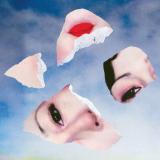
Themes of change, breaking up, shattering old ways of being are shot through the record. For the front cover, a photograph of the artist’s face was printed, ripped up and re-assembled, resembling the creative process embarked upon by Lew for her first “solo” material. The album feels instinctual, almost dream-like in its assemblage of sweeping synths and pulsating, propulsive drum machine beat patterns with Lew’s vocal performances sensitive and caressing over the top. Increasingly relying on the subconscious and dreams to guide her creative process, Hannah Lew frequently abandons literal interpretations or linear narratives, the songs seeming to exist in a swooning, effortless flow-state while remaining emotionally hard hitting.
On an album where every song could be a single, there are kaleidoscopic shades and varying emotional tones in abundance. First single Another Twilight is carried along a pumping, Italo-disco-style 4/4 beat and mono-synth bass line, the low end pulling at the heart and body. Lew’s vocal melody teases the track before swan-diving into a gorgeous chorus as she sings “it’s all over baby and I don’t mind… in decline, I take my time…” The album is suffused with moments like this. On slow builder Damaged Melody, an arpeggiated synth elongates the verse before a cascading synth showers down melodic glitter. The stunning Replica uses dual swirling synth patterns before a driving, synthpop chorus for the ages carries Hannah Lew’s vocal into the stereo field, sailing in on a high register singed with the embers of a break up.
In a departure from previous groups, her solo songs are guided by dreams and free association inspired by Dada and the Surrealist movement and sculpted afterwards. As such, the songs reveal themselves on repeated listens, revealing traces of heartbreak inspired by both personal and global elements - Hannah Lew regards the album “a wartime album.” On Move In Silence, Lew intones “there’s a war outside, just out of view,” revealing the dichotomy at play throughout. With the songs evolving naturally and in a flow state, the pressures and sadnesses of the modern age bleed through, mixed in with Lew’s inherent love, sensitivity and fractured-but-intact optimism. On the swooning, sublime Sunday layers of Numanoid synths open up for the commanding vocal performance pontificating on grief, love, pain as she “feels the ache on Sunday…” As the chorus builds and Lew’s call-and-response vocal adds to the emotional tension, it almost feels like too much to take.
Elsewhere, there are echoes of Hannah Lew’s previous work. On Time Wasted a bass guitar comes in with a heavy, punk attack before the synths and vocal harmonies reminiscent of later Cold Beat elevate everything. The glassy, sweetly resigned closer The Clock sounds like so classic it could be cover, a sweetened Jesus & Mary Chain tune perhaps, before it erupts into volcanic chorus that could only come from Hannah Lew in 2026.
Saxophonist, producer and composer Brian Allen Simon explores darker hues, transposing waking and altered states under his studio veil Anenon. On the deeply evocative new album 'Dream Temperature', he shifts electronic processing to the foreground, introducing digitized wind instruments and unworldly atmospherics, not heard since his innovating mid-late 2010s output.
A longtime Los Angeles resident, born and raised, Brian Allen Simon has expressively operated under the moniker Anenon, releasing the highly revered 'Petrol' (2016), 'Tongue' (2018) and the viscerally beautiful 'Moons Melt Milk Light' (2023), in a line of unwavering musical dialogues. While the penultimate album was a deliberate, reductive, entirely acoustic detour that was born out of a want to unplug, 'Dream Temperature' sees Brian primed with a newly discovered wind synthesizer as his central compositional tool, alongside acoustic piano and tenor saxophone. The entirety of the album's electronics are triggered by Brian's lungs, generating otherworldly synths modulated by expressive breath control, channelled through the laptop as the core processing chamber for added textural components and field recordings.
A free floating and heavy emotional resonance marks 'Dream Temperature' from beginning to end, invoking the feeling of waking up, still heavy from a night of half-remembered dreams, and continuing one's day in this state. Simon maps out the album's spatial voice early on the statement title track, a deep, yet compact cut, generated from digital saxophone rasps that whistle by in close proximity, along with haze filled textures and sub bass. There is a sonic oscillation of urban grit and pastoral drift throughout as tracks pass by like introspective thoughts, fueling both a tense and ethereal quality that underpins the album. Interluding solo and part-solo piano improvisations 'Last Sun 1' and '2' are positioned adjacent to the buffering digital soundscapes. Their softer, still processed timbres pierce the melancholic exterior, offering a contrasting tenderness that could echo the grace of Ry?ichi Sakamoto, the spiritualist rigor of ECM's Keith Jarrett and a touch akin to Aphex Twin's piano miniatures. 'Nulle Part 1+2' signals the first appearance of an acoustic wind instrument, as tenor saxophone flourishes are juxtaposed against noisy drones, all shouting at the void, with notes resurfacing like lost digital data.
The album was recorded at home during either sunset or nocturnal hours between September of 2024 and October of 2025, a period in which Brian found himself craving more lengthy and intimate studio time as he searched for more pronounced textural qualities amidst his new sonic ambitions. 'When The Light Appears, Boy' shows further evidence of this deeper universe, revealing a grittier edge as the album's essential blueprint is sonically inked. A sprawling expanse of wind synths rhythmically encircle the listener before a dreamy, ghostly ambience blankets 'Toyama'. The sound is evocative of the productions of post dubstep era luminaries such as Burial or the productions of HTRK's Nigel Yang. More isolating and enveloping than the previous all acoustic record, this is music both disorienting and yet warmly inviting all at once. A sonic diarist at heart, personal field recordings were also taken from Sardinia, Japan, Big Sur and LA which intersect at unexpected moments throughout the album's 31-minute play time.
'Dream Temperature' is a vital coalescence of both Simon's electronic and acoustic practices with repositioned electronics akin to earlier works, both haunting and elegant, yet still profoundly personal. Simon continuously resonates as an experimental outlier treading an enthralling, non-linear musical path. This music resolutely glows with an unknowing aura, like an untapped energy source waiting to be discharged.
- 1: Pass Between Houses
- 2: Theatre For Change
- 3: Real Home
- 4: Treat Me A Stranger
- 5: Utopia Of Bog
- 6: Void Attentive
- 7: My Love, Let's Take The Stage Tonight
- 8: The Kiss
- 9: He Had Always Led
Cathartic avant-rock, literate DIY folk & experimental composition exploring displacement, love, climate change, belonging & the places we call home - RIYL Jim O’Rourke, Richard Youngs, This Heat, Richard Dawson, Flying Nun. ‘Real Home’ is the new album by the Manchester-born, London-based artist Kiran Leonard. His sixth album proper (not including innumerable tour-only CD-Rs and short-run cassettes), since his precocious debut in 2013, ‘Real Home’ finds Leonard invigorated by inspiration and experience, making passionate, literate, and mercurial music that explores displacement, love, memory, climate change, connections to home and more. Encompassing songs recorded after moving to South London, ‘Real Home’ reflects on ideas of belonging and domesticity through folkloric, stream-of-consciousness songwriting. Across nine tracks, Leonard traces lived impressions of the household and the city, expressing sentiments of dislocation, alienation and stasis, but contentment too. Infusing the avant-rock effervescence, terraced dynamics and visionary lyricism of his music with what he defines as a greater sense of openness, Leonard is as versatile, fervent and imaginative as ever on ‘Real Home’, yet his music is somehow more intimate, affecting, and acutely expressive. Shaped by dual considerations of simplicity and formalism, ‘Real Home’ is by turns beautiful, allusive, and ruminative, an album on which Leonard considers what his songs have resembled in the past and what they mean now. In recent years, Leonard has crafted eloquent chamber music inspired by the likes of James Joyce and Clarice Lispector (‘Derevaun Seraun’), responded to contemporary politics and communication breakdown in the digital age (‘Western Culture’), and compiled solo works and ensemble recordings for a longform ode to Jonas Mekas and to one of Leonard’s enduring themes; home (‘Trespass On Foot’). On ‘Real Home’, Leonard reiterates this abiding thematic focus yet ascends to new, different heights, in music of cathartic delicacy and dissonance where all the myriad dimensions of his work to date seem to crystallize. There are sinuous songs about struggle and defying the pace of city life through drift and diversion (‘Pass Between Houses’), stirring songs of intense feeling and crescendo, described as a form of speculative detective fiction (‘Theatre for Change’). There are touching solo piano ballads (the title track), symbolic contentions with carbon capture and climate change (‘Utopia of Bog’), modes of experimental minimalism (‘Void Attentive’), and other profuse feats of compositional range, embroidered with wild tendrils of narrative and lyrical depth. A record to pore over, and get lost in. Exemplifying the vast aesthetic scope of Leonard’s music, lead single ‘My Love, Let’s Take The Stage Tonight’ is inspired by country lodestar Hank Williams, Russian poetry and a late period love poem by William Carlos Williams. Yet for Leonard, the song signals a sense of accessible materiality, and is the product of a more linear approach to writing songs: “My imitation of the great Hank Williams, in spirit if not in substance…This is one of the best efforts on Real Home at a song-as-object. Looking at it now I realise I was trying to write a song that made itself known as a song to the listener, and I wonder whether that’s crucial if you want a song to transcend its context. And that this is either accomplished through a total openness – by being inviting, by laying the tricks of the song out plain to see, as Williams and his many ghostwriters did so well – or by adopting a knowing aloofness, positioning oneself against the listener but letting it be known that that’s what it’s doing. In this song I try both, but mostly the former: as in, I wanted to write a song where every line follows on from the next.” Imbuing the endlessly elaborate and inventive qualities of his music with a newfound streak of candid, clear-cut melodicism, Leonard has reached a special place in his artistry, on a record that feels familial, and expresses closeness. Assembled with affiliates including Lauren Auder, Otto Willberg, Jasper Llewellyn (caroline), Tom Hardwick-Allan (Shovel Dance Collective), Magda McLean (caroline, The Umlauts), Alex Mckenzie (caroline, Shovel Dance Collective), Isabelle Thorn (Dear Laika) & more, the recording process had a significant influence on the subject matter of ‘Real Home’, in sessions defined by close-knit camaraderie and artistic eccentricity: “The theme of the home obviously recurs throughout the record; the album was mostly recorded in domestic spaces with friends, and the name of the album is Real Home. I like the qualifier ‘real’, like you’re getting past the cloak of the word and towards the thing-itself…also nearly all the percussion in this record was recorded on items from my dad’s shed (jam jars, sandpaper, blocks of wood, etc). Real home record!” ‘Real Home’, like anything by Kiran Leonard, is a record of dazzling multiplicity. Yet it’s a companionable prospect with a central premise; a collection of songs where listeners old and new can find a home. An album led by a scene; of Leonard standing at the threshold, ready to welcome you inside. “Exceptional songs that linger” - The Guardian // “An autodidact of amazing talent & energy” – Pitchfork // “A ridiculous amount of talent…confrontational, celebratory, provocative or perverse – he manages all of these emotions & more” - The Quietus /