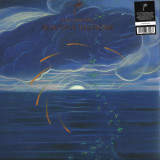
White Vinyl
Gost Zvuk prepare for a busy 2023 with an enthralling double LP's worth of futurist sound design from Flaty. In the game for more than a decade now, the producer, mastering engineer and all-round visionary artist has delivered an impressive range of music across both his own ANWO imprint as well as for West Mineral ltd., 12th Isle, Firecracker and more.
Always content to subvert expectations and blur stylistic lines, on Intuitive Word there is a clear fascination with a spectral, whittled-down-to-its-core type of avant-pop/RNB hybrid. Digital strings, dubbed beyond recognition semantic snatches, re-imagined new age style synthesis and even flourishes of MMORPG computer game soundtracks all combine into something that feels uniquely Flaty. In a sense, Intuitive Word marries ambient sound collage and hyperreal, narrative-style vocal processing. However, glimmers of shoegaze and old 'ethereal' bands (think Harold Budd & Cocteau Twins) crop up on tracks like 'Tree' and 'Nepal Lit', a testament to Flaty's skill for world-building and atmospherics.
Across the 19 cuts there is a recurring theme of choral style, computer generated elegies. A kind of 'cristal trance', in their words. 'Mint' combines these with overtly RNB style vocal samples, whereas darker, more broken beat soundscapes can be heard on the Madteo collab 'Observer'. With plenty of sombre and cinematic style ventures such as 'NEWS' breaking up the album and eschewing this focus on vocals, we find one of the most consistent producers in the current Russian scene delivering what may well be his most accomplished collection yet.
Cerca:lines
If Susan Subtract of High-Functioning Flesh / Physical Wash personally supports this Portand based duo is because everything that should be the modern american funky ebm / minimal synth is present in “Costo Humano”. Puerta Negra delivers amazing industrial breaks covered in a very simple but extremely effective by funky bass lines perfectly finished by ensoniq style super synth leads culminated by harsh raged vocals sung in castillan language. This is for sure one of the most fresh and brilliant modern ebm work coming from the states recently. For the likes of the west coast modern ebm acts such as Spike Hellis or the mentioned High-Functioning Flesh.
Swedish Doom/Death Metal from the Champions League of that genre!
Runemagick mines the darkest seams of crushing Death/Doom Metal for unremitting headbanging groove. Runemagick are among the most
underrated bands in the history of Metal. Their relative obscurity is hard to pin down. Musically, in terms of songcraft, atmosphere, and immersion into the unearthly realms of the occult, they are basically without peers. Yet despite a prolific thirty-year existence, their reputation exists on the fringes: highly regarded by some but not highly enough considering the overall quality of their output.
From start to finish Runemagick plays well done ancient Death/Doom metal, very slow and heavy, but the balance between Death and Doom Metal is very well chosen! This will relive the glory days of the good old 90’s stuff from the United Kingdom! Deep and intense grunts, the freezing thick guitars and the intense bass lines really spread a gloomy frightening atmosphere. Runemagick have written an album against all kinds of trends hailing a style which.
Entirely remastered from the original analogue tapes and featuring brand new artwork designed by Luke Insect, this Four Flies reissue finally brings back to life one of the most surprising albums from the strange phenomenon that was the Italian library music of the Seventies.
Gianni Safred's Electronic Designs was released in 1977 on the Milanese label Jump, in their "Music Scene" series, simply as a collection of musical pieces intended for use in television programmes. However, hidden behind a nondescript cover were twelve electronic music tracks revealing a recognizable style of composition; twelve little gems masterly combining experimentation, catchiness and practical functionality thanks to a unified and unique style. Each through a specific mood, these tracks give expression to Safred's distinctive sound, where irresistible mechanical grooves are over-layered with melodic lines perfectly played on a Polymoog or ARP Odyssey.
A native of Trieste, Safred started out with little swing bands soon after WW2, before eventually playing with great soloists like Django Rheinhardt. Ultimately, it is his background as a jazz pianist that makes Electronic Designs so special. As with other Italian jazzmen who got into synthesizers (above all, Piero Umiliani), Safred's blend of complex harmonies and (quasi-) bebop virtuoso flourishes, with its obsessive repetitions and refined tone colours, gives a retro-futuristic quality to this library album, whose electronic music islight-years ahead ofthe 'pop' electronic music of the time and, in many ways, anticipates the best stylistic features of early-Nineties dance music.
Safred best expresses his experimental verve – and does a great job in creating the 'electronic designs' of the title – in "Mystification", "City Problems", "Trapdoor", "Planetarium" and "Poe's Clock", all of which unfold through hypnotic beats and sinusoid or square wave explosions. In other tracks, however, the compositional style is less unconventional, with relaxed yet not banal atmospheres ("Spheres", "Elastic Points", "Sacred Interlude"), as well as flashes of irresistible groove inspired by Herbie Hancock's more pop-oriented work ("Automation Age", "Jazz Motion Study", "Bottom Up"). The album's masterpiece is arguably "Hasty Chant", a detective-funk ride with an unforgettable theme, which manages to pull all of the album's various strands into a cohesive whole – as a side note, the allusive and apt description of the song on the back cover reads: "Things are happening".
Custard Vinyl[16,35 €]
The Beths debut EP – new pressing on on Light Blue Vinyl
The Beths' Warm Blood is a strong contender for the catchiest record you've never heard. Formed when four jazz students at the University of Auckland bonded over their shared love of the pop-punk sounds of their youth, The Beths bring new energy to the genre. This 5-song debut EP, a deliriously pleasurable statement of purpose, comes crammed with enough blissful hooks to carry through most bands' careers.
Listeners for whom the tag 'New Zealand indie rock' brings to mind the Flying Nun sound of bands like The Clean and The Chills may be surprised to find Warm Blood's five unstoppable tunes landing closer to artists like Slant 6 and The Breeders. The nimble guitar work here moves from heavy riffing reminiscent of Sleater-Kinney to hazily bending lines that would make Stephen Malkmus and Mary Timony beam, while the joyous vocal harmonies from all four members bubble and swell to ecstatic crescendos that channel The Zombies' Odessey and Oracle.
With impeccable production from guitarist Jonathan Pearce and stellar musicianship across the board, Warm Blood is a non-stop delight. Tracks like leadoff track and first single 'Whatever,' the ridiculously addictive standout 'Idea/Intent,' and 'Rush Hour 3,' a playful ode to romance in this era of download-and-chill franchise films, take delight in the challenge of breathing new energy into the limitations of the 3-minute pop song.
Tongue-in-cheek as usual, belleter Niklas Wandt melts up pianos, acid lines and bass heavy breaks as raw material for Die Glocke (The Bell). When the hunchback pours the lead of three decades of rave culture onto your lost souls, it’s too late for shelter.
Fantastic Twins evaporates not just the bell but the whole bell tower into particles of peak time madness for the mental cases.
On the flip Bodyzeit heats up on an even more old schoolish tip with breaks that definitely win the bumper car dancefloor. Very sorry for the spilt drinks, thrown fags, popped pills, ripped shirts and funny faces trying to sing along these german vocoder phrases. Borusiade doing some serious bodywork, shifting gears down in her lowrider manner, modding this burner into a dreamish but deep wee-hour masterride.
Over the course of a 19-year career, Marshall Watson has released all manner of musical treats for a similarly wide array of labels, yet it’s the effortless beauty of his downtempo works – and particularly his ambient and Balearic excursions – that have often left a lasting impression.
It certainly caught the attention of NuNorthern Soul founder Phil Cooper, who brought the West Coast producer to the label in the summer of 2021. That EP, Sunsets on Larkin Parts 1 & 2, was undeniably special. The same can be said about his belated return to the label, Foothills, an EP packed to the rafters with slow-burn melodies, sustained chords, becalmed textures and gently unwinding grooves.
Watson’s distinctive take on Balearic naturally comes to the fore on EP opener ‘High Desert’, a soft-focus delight where languid electric guitars, starry electric piano lines, echoing chords and gently pulsing electronics stretch out across a shuffling groove. While tailor-made for watching the sun set off his beloved Pacific Coast – and over the Mediterranean Sea – ‘High Desert’ offers a dose of hazy sonic sunshine that can brighten up even the greyest of days.
Fittingly, the accompanying remix comes from long-time friends of the label Seahawks, whose textured, layered and atmospheric productions similarly blur boundaries between Balearic, ambient, pitched-down dancefloor grooves and glassy-eyed psychedelia. Employing opaque, shape-shifting pads, effects-laden guitars, subtle spoken word snippets and yearning, almost melancholic chords – all atop a crunchy, head-nodding beat and toasty bassline – the duo deliver a remix that’s as emotive and sonically stunning as Watson’s original mix.
The EP’s three other tracks amply demonstrate the subtle variety within Watson’s downtempo output. Vocalist Julie Childe makes her mark on ‘Sweet Sounds’, a brilliant blend of warming deep house and laidback Balearic nu-disco that sports subtle hints to his work as one half of synthwave duo Causeway, while ‘Open Sky’ brilliantly wraps undulating TB-303 acid lines and echoing Spanish guitars around a hypnotic, locked-in dancefloor groove.
Then there’s ‘The Landscape’, a deliciously saucer-eyed slab of breakbeat-powered, TB-303-sporting genius that evokes the immersive, early morning waviness of the ambient house era, the beach party psychedelia of San Francisco’s free party movement, and the bleeping wonder of turn-of-the-90s UK dance music. Like the rest of the EP, it’s an enveloping, head-soothing and mind-expanding treat.
e B2 High Desert Seahawks High Sky Remix
New York painter and musician exploratory industrialist Tor Lundvall initially envisioned his 14th album, Beautiful Illusions, as an entirely instrumental affair, "inspired by memories of sitting in a church or cathedral watching the shifting sunlight through stained glass." Although he ultimately chose to wreath the majority of the tracks with hushed, poetic vocals, his original muse still resonates. These are certainly songs of shadowplay and vaulted skies, the quiet grandeur of dusk deepening on the horizon. Lundvall characterizes the lyrical subject matter, too, in ways both specific and surreal, exploring "the doubts, the anxieties and even the bleak fantasies the mind spirals into during moments of isolation, separation and distance." Tricks of the eye, mind, and ear, magnified by silence and the looming long winter. Shivering pulses and muted bass lines tread the twilight while icicle synths and wiry guitar map the melody until the voice enters, narrating oblique moods of essence and absence, tenderness and truth. Glimpses of dark humor flicker in the wordplay but the greater sonic landscape is one of falling leaves and failing light, small gestures rendered as revelation, cloaked in reverb and spatial fog. Lundvall's mastery of nuance and negative space continues to heighten, whispered brushstrokes of the invisible and the unsaid, what lies beneath and what lies beyond: "Behind the shields and false fronts is usually a sadness. The heartbreaking reflections of what might have been."
Swedish drone alchemist Mats Erlandsson is sitting in a fictional room on ‘Gyttjans Topografi’, imagining a virtual chamber orchestra using zithers, tapes, double bass, harmonium, organ, and various synthesisers to draft a treatise on alternative tuning and non-normative harmonic structures. Transcendent material.
“The music on this recording is performed by a kind of fictitious chamber ensemble situated in an imaginary room outlined by textures that alternate between gestural foreground and passive landscape. The three pieces contained within this release are tied together by sharing similar harmonic material and instrumentation and could ideally be perceived as parts of one long performance stretching through the two sides of the record. The textural room in which this musical performance operates is unreliable, unstable, constantly shifting in size and activity from sparse and open to dense and claustrophobic. Inside this non-euclidean performance space a chamber ensemble made up of zithers expanded through analog tape transposition, harmonium and organ, double bass, digital FM, feedback-convolution and Serge modular synthesizer perform a music made from justly tuned intervals arranged in a way that blurs the distinction between traditional minor and major tonal harmony in favour of harmonic progression within an essentially modal framework.
‘Oxidationstabell för Hytta A’ unfolds the harmonic material slowly in three sections where individual lines move independently initiated by the attack of the zither while the textural properties of the room shifts and shimmers. ‘Törnar’ forms a dense harmonic counterpoint where lines built from the same intervallic relationships gradually shift the balance from one spectral focal point to the next while the textural-spatial elements move under pressure and permeate the harmonic layers. The double bass heard on this piece was performed by Yair Elazar Glotman.
The whole of Side B is made up of one piece - ‘Sänka’, using a series of chords made from harmonic inversions of a single set of intervals as an anchor, or synchronisation point, for voices gliding towards, or away, from their designated goal as parts of the harmonic structure of the piece. In addition to the harmonic and textural layers previously present, a third percussive voice is present here whose rhythmic material is intimately tied to the intervallic relationships present throughout the record.
The material used to make these pieces included non-harmonic sounds and contaminated field-recordings that have gone through a sort of feedback process between digital and analog, or acoustic, processing where the recordings were edited, processed and re-amplified and recorded again in acoustic spaces to shape their character and imprint acoustic identities on the recordings. The tonal instruments were treated in a process analogous to this - harmonic material built from recordings and digitally generated synthesis recorded, transcribed, rearranged and overdubbed again with additional electronic or acoustic instruments to form a composite electroacoustic instrumental sound.
Mats Erlandsson is a composer and musician, part of the vibrantly reemerging field of drone music in Stockholm, Sweden, associated with practices characterised by the extensive use of sustained sound. Erlandsson presents his work both as a solo artist and in collaborations, most notably together with Yair Elazar Glotman and Maria W Horn.
Liberation is the latest evolution by David West, a dedicated underground dweller and traveler with his groups Rat Columns and Rank/Xerox and previously spotted in Lace Curtain and Total Control. Many familiar elements of West's songwriting creep out from the speakers this time around, albeit in a sonically more adventurous and personal manner. Swathed in analogue and FM synths, pinned down by near-funk drum machines, and with a vision expanded into the past and future. While in previous incarnations, West's alienated and fragile vocal has battled with jangling guitars and distortion, Liberation sets free his woes and ruminations into space. Taking inspiration from the heyday of Mute Records, the beginnings of electronic dance music's rudimentary sampling, broken and sound art, Liberation's debut LP is 10 songs of the road, about the nameless ghosts on the highway, accidental lovers, the alienation of the stranger in a strange land, the unbearable weight of freedom.
Beginning with a curveball, Liberation's first vocal sets out the position of the forever-cuckold, the sad lover hanging on: Looking For A Lover combines a Roland 707's loping mid-tempo with creeped-out synth lines as West intones his intentions close to the ear. Continuing in a more baroque manner, Move Me makes astounding use of string samples and space, with esteemed engineer Mikey Young's (Total Control / Eddy Current Suppression Ring) production prowess making for a distilled yet inviting loneliness. Forget is the night-drive centerpiece of the album, a 7 minute that erupts into a nihilistic sub-disco darkness. A constant theme of Liberation is the friction between West's characters: a frustrated love in victim-status paired with a menacing intent. The adorable, fragile stalker in the moonlight, illuminated by Whatever You Want, a
subjugated protagonist offering they have while the city burns. The brightest pop moment of the album has this in abundance: Cold And Blue, a classic synth pop jam to be played on repeat til the end of time, like New Order played by one man in his bedroom, with no drugs for a cushion, coming down the stairs, she looks like a perfect fear and Im a monument to your existence. But West has moments of touching sincerity that speak direct to the listener, as in album highlight Leaves Falling; a sparse string arrangement frames his vocal, "why do I keep falling for you I must just really like to be alone." Liberation is the freedom from attachments, about how sometimes they're what you want most.
- A1: Radikal Guru Feat Vale - Riddim One
- A2: Radikal Guru Feat Tenor Youthman - Radical
- B1: Radikal Guru Feat Marina P - Do The Right Thing
- B2: Radikal Guru Feat Troy Berkley - Higher Frequency
- B3: Radikal Guru - Melody Dub
- C1: Radikal Guru Feat Junior Dread - Together We Shall Overcome
- C2: Radikal Guru Feat Baptiste - Beyond The Borders
- D1: Radikal Guru - Ready Fi War
- D2: Radikal Guru Feat Lady Skavia - Lost And Found
- D3: Radikal Guru - The Dreamer
Repress
One of Moonshine Recordings' flagship artists, Radikal Guru is going from strength to strength for more than a decade and 2020 is a further proof of it. With the fourth full-length LP release on the horizon, the outstanding
Polish talent ascertains his status as one of he most relevant figures in the international Dub and Dubstep scene once more.
The new project including vocal talents like Junior Dread, Marina P, Troy Berkley or India's up and coming vocalist Lady Skavya encapsulate the musical versatility and collaborative spirit of the sound system veteran alongside spirited instrumentals in various levels of intensity - ranging from meditative bass lines to apocalyptic turbosteppers.
Radikal Guru's digital dub sound signature presents itself in a variety of musical forms in his latest project 'Beyond The Borders' - a testament to his years of experience in lighting up dancefloors around the world. Music with a message nested on monumental heavyweight foundations, his fourth LP deals uplifting and conscious anthems to a set of speakers near you with a high-grade set of vibrations.
Ten meticulous productions designed to make you move as well as to reflect, a journey for body, mind and soul - features a multinational list of guest artists from India, Germany, Italy, Russia, Brazil and France.
Electronic sounds come to life, infused with gratuitous amounts of soul warmed by live instruments and murderous arrays of echo chambers and 808's. Perfectly placed drum fills and vocal fragments to top it all off in style, a masterclass in modern dub production seeking its equal. Bridging both physical and mental borders, Radikal Guru's latest LP release is sure to be heard, felt and enjoyed for time to come
On Garden Party, Rose City Band"s country psychedelic rock evokes the wide-open spaces of the American west and free spirits who call it home. Led by acclaimed guitarist and vocalist Ripley Johnson, Rose City Band are some of the best players in contemporary rock: pedal steel guitarist Barry Walker, keyboardist Paul Hasenberg, bassist Dewey Mahood (aka Plankton Wat), drummer Dustin Dybvig, and features Sanae Yamada of Moon Duo on Synthesizer. Garden Party is both a celebration of summer and all it brings: friends gathering at backyard BBQs, cold beers on a hot porch, 12-foot sunflowers, and an exaltation of the value and respite of a moment of calm; the pleasures of time in the garden to appreciate the beauty of a contorted carrot, or a morning on a stoop watching a hummingbird. Freedom, contentment, and joy were the sources for the songs; they certainly bring the listener right there. From the soaring guitar solos to the driving rhythms, the elegant pedal steel lines to the organ grooves, Garden Party has a live band"s energy captured in exquisite detail. Garden Party is an invitation, a welcoming hand extended, and a joyous ride. Like all great music, the album taps into the listeners" emotional center and takes them to their happy place - their sunny spot. Recorded at Center for Sound, Light, and Color Therapy in Portland and mixed by John McEntire, the band"s sounds surround and embrace you. Garden Party"s last two tracks feature special guest Sanae Yamada (Moon Duo) who added some synth magic to the final two tracks. Ripley says it best "I always like when an album starts in one place and ends in another" What a beautiful journey it is!
- A1: Latimore - Are You Where You Wanna Be
- A2: Gwen Mccrae - Rockin' Chair
- A3: Lew Kirton - Let Me Up Off My Knees
- A4: Joey Gilmore - Give Me Your Love
- A5: Helene Smith - I Tried So Hard To Be Good To You
- A6: All The People Feat. Robert Moore - Wish I Had A Girl Like You
- B1: George Mccrae - You Can Have It All
- B2: Timmy Thomas - Why Can't We Live Together
- B3: Paulette Reaves - I Forgot To Be Your Lover
- B4: The Charms - Hearts Of Stone
- B5: Robert Moore - Tears Of The World
- B6: The Charmettes - Surrendering My Love
- C1: Betty Wright - Shoorah! Shoorah!
- C2: Little Beaver - Mama Forgot To Tell Me
- C3: Miami - I'll Hold The Groove
- C4: Wilson Pickett - The Best Part Of A Man
- C5: The Facts Of Life - Uphill Places Of Mind
- C6: Doris Duke - A Little Bit Of Your Love
- D1: Willie Johnson - Between The Lines (Unreleased)
- D2: Milton Wright - Be With Me
- D3: The Twans - I Can't See Him Again
- D4: The Diamonettes - Don't Be Surprised
- D5: Audrey Royal & The Reid Singers - Come On Playboy
- D6: The Blue Notes - Here I Am
Dauw presents 'babel', the debut album from Belgian duo ZONDERWERK. The duo’s name means ‘’without work’’, but it also comes from “bijzonder werk”, where bijzonder is particular, special, unique. They like to work with images/paintings that are “bijzondere werken”, odd works.
babel is an ambitious exercise in translating images into sound. babel was initially created for the eponymous theatre piece by architect and artist Steve Salembier. Inspired by the biblical legend, Salembier envisions the legendary city as an abstract, sprawling modern metropolis in continuous flux. Its steel and glass skeleton is a representation of both an accumulation of overlapping contemporary cityscapes and a metaphor for the anonymous repetitiveness of our daily routines mirrored by the architecture. Subway lines, sky scrapers and whirling highways converge into a megalopolis of monstrous proportions. Despite the composition’s initial context as soundtrack for a theatre play, for the band this album is seen as a standalone work, whose complex sonic material can be appreciated without having seen the piece.
Their score focuses on fleshing out the imposing imaginary universe both in terms of scale and meaning. One of their biggest inspirations were Michael Woolf’s photographs, which served as the basis for the original theatre piece. His use of grey and repetition is translated into looped harmonies and fine-grained drones that progressively open up like blooming ice flowers.
With sounds of bells and metal as their primary materials, Carrijn and Sanders build soundscapes that are at once seductive and unsettling. The atmosphere on tracks like “DreamArp4Kort4” make for majestic, mysterious synths conjuring otherworldly visions, while the angelic glockenspiel set against subtle explosions in “VuurFeest” suggest a serene yet potentially dangerous place. Other tracks like “RoomCarousselTapeLoop5” create multi- layered textured drones through the process of tape decay, a commentary on the cannibalistic nature of the city.
Resulting from an arduous improvisational processusingold samplers with elements such as the Beam harp, a self-made metal instrument with piano strings, reel to reel tape recorders, field recordings and violin, babel perfectly captures the oxymoron of the man-made concrete jungle that is at once inhospitable yet endlessly awe-inducing.
ZONDERWERK is a duo consisting of Linde Carrijn and Dijf Sanders who started this project during the pandemic as a way of exploring their relationship as creative partners. Carrijn has a background in acting but recently came more to the fore as composer/performer with original scores for theatre and her other band Brik Tu-Tok founded with multi-disciplinary artist Maxim Storms. Sanders is a composer and gear enthusiast, more well-known for his eclectic works that draw from a wide-array of non-Western music. His milestone-album Moonlit Planetarium paved to way to a broader audience and recognition from major press in Belgium. In 2021, his work as a producer was recognized with a nomination at the Music Industry Awards.
lack Marble Vinyl! High Vis were formed in 2016 from the ashes of some of the UK's best hardcore bands. Gild-toothed frontman Graham Sayle's anguished lyrics about life in working class Britain were familiar to fans of Tremors' full-throttle thrash, but alongside his former bandmate Edward `Ski' Harper and veterans of Dirty Money, DiE and The Smear, High Vis sought to transform that energy and intensity into something entirely new.Like scene-mates Chubby and the Gang did by pulling in unlikely source material from classic doo-wop or Micromoon have by combining everything from psychedelia and metal into their high potency mix, High Vis' 2019 debut album, No Sense No Feeling showed the band were never going to be constrained by any sense of genre rules or regulations. Its claustrophobic rattle bore traces of Joy Division, Bauhaus, Crisis, The Cure and Gang Of Four lurking in the shadows. 2020's synth-driven EP, Society Exists, was further evidence of the band's restless creative MO.High Vis' second album Blending sees them open their viewfinder wider than ever before.
Alongside longstanding favourites such as Fugazi and Echo and The Bunnymen; Ride and even Flock Of Seagulls were shared reference points as the band worked on the album together.From the anthemic sweep of opener "Talk For Hours", through the title track's psychedelic swirl and "Fever Dream"'s baggy groove, it sees High Vis' sound blossoming into something with an unlimited richness. The hazy drift of "Shame" or the melodic jangle of "Trauma Bonds" may take them until uncharted waters, but they still have all the power and bite that made No Sense No Feeling so remarkable.Lyrically, the album represents another leap forward too. Talking frankly about poverty, class politics, and the challenges of everyday life, Sayle's lyrics have always addressed the downtrodden and discarded communities across Britain slipping below the waterline. This time around, Sayle's lost not of that social consciousness, but he's looked at himself and his own emotional landscape, and in the process created something that feels more universal, that reaches a hand-out to people and ultimately gives a message of hope."To me, the lyrics are less selfish," reflects Sayle. "In the past, I couldn't see past whatever was going on with me.
It's about accepting things and being open to conversations and learning to talk to people rather than just thinking that we're all doomed."The song "Talk for Hours" is a prime example of that. Born out of an afternoon meeting up with an old group of mates "repeating the same thing and not actually learning anything about each other" it offers to actually break the cycle and to listen and speak frankly about shared feelings and experiences. "Trauma Bonds", meanwhile, traces the broken lines of those living in lost communities, but ultimately realises that despite our shared scars, there's still hope to move on to a better future."The message of the album is you're not who you're told you are," Sayle summarises. "You're not your class background. Whatever it is, you're not that. Don't resign yourself to thinking you can't be this and you can't be that."It's a vitally important message right now, and one that could be the motto for not only Blending, but for High Vis themselves.
Beautiful, soulful jazz record by Jimetta Rose and The Voices of Creation, a Los Angeles-based community choir, a mainstay of the local scene. Highly recommended!!
The Voices of Creation are a community-based choir led by vocalist, songwriter, arranger, producer and mainstay of the Los Angeles scene Jimetta Rose. Made up of a multigenerational group of mainly non-professional singers backed by some of the city’s finest musicians,their music marries hip strains of gospel with layers of jazz, soul and funk. While aspects of their music might recall Kamasi Washington, The Staple Singers or Sly Stone, Jimetta’s unique vision has resulted in new spiritually-charged forms of music whose whole-hearted embrace of love, joy and peace act as sonic healing balms for the soul.
For Jimetta - whose resume includes collaborations with Miguel Atwood Ferguson, Georgia Anne Muldrow, Sa-Ra Creative Partners, Angel Bat Dawid, Shafiq Husayn, MED and Blu - the very act of creation was part of a healing process: “I was very low at the time and I wrote most of the songs going through hardship. But I found comfort in the songs and a way to adjust my mindset to where things got better. So I thought ‘if this music works for me, maybe it will work for other people’ I believe that every person has their own voice and their own note and that we can use our voices to heal ourselves. That’s the intention behind creating the project.”
After putting out a call on social media for people interested in joining her choir she was met with a sea of replies. Members were chosen in less-than conventional fashion: “I recruited people based on their interest in healing themselves and others, not necessarily on their musical experience or being seasoned performers” she says. Among those accepted into the ever-evolving collective, which was begun initially as a community choir, were the likes of Sly Stone’s daughter Novena Carmel, better known as a radio DJ for KCRW’s flagship breakfast show. Jimetta’s upbringing in the Pentecostal church, where she was a youth choir director, fed into her otherwise intuitive teachings of her songs and arrangements to the inexperienced members with help from the group’s seasoned organ player/co-musical director Jack Maeby.
Produced by Mario Caldato Jr. (Beastie Boys, Seu Jorge) and his wife Samantha Caldato the results show the incredible sense of togetherness and communal spirit that the group had built up over time in the rehearsal sessions. The six tracks of their debut album, a mixture of originals and rearranged covers, are performed in a wide-eyed mix of styles that reflect Jimetta’s vision for borderless music: “It’s new black classical music,” she explains. “It’s all the hodgepodge of being an African American but also with creativity and vision for the future. It has a taste of what is to come and what we can do. What we have gone through and who we are now.”
The group’s propensity for warm and buoyant sonics finds representation on album opener Let The Sunshine In, a sparkling rework of the Sons and Daughters of Lite’s deep jazz classic. Their version finds the group’s dynamic group harmonies offset with Allakoi Peete’s nimble afro-percussive touches and plenty of soul- drenched keys courtesy of pianist Quran Shaheed and organ player Jack Maeby. A similarly uplifting take on Rahsaan Roland Kirk’s choral jazz classic Spirits Up Above follows, with Maeby’s groove-laden organ lines inspiring some gorgeous group harmonies as well as prime solo turns from the likes of Kellye Hawkins, Zavier Wise, Tamara Blue, and Khalila Gardner.
Another Sons and Daughters of Lite cover follows as Jimetta leads the choir in the groove-drenched ode to self-affirmation Operation Feed Yourself. Written as a series of mantras for everyday living, the Jimetta-penned composition How Good It Is harnesses the full transformative power of music to generate a stirring and joyful ode to positivity - it’s chanted declarations bringing out some of the group’s most deeply-felt and affecting vocal performances over some superlative piano and organ accompaniment with a surprise feature vocal from Novena Carmel.
Jimetta’s talent for re-imagining songs in her own light is highlighted in Answer The Call, her vivid re-telling of Funkadelic’s Cosmic Slop: “When I listened to the original song, the Mom in the story was really going through it. I thought of how I could turn this into a song that can encompass the glorification of all mothers and I thought of the Egyptian cosmic goddess Nut. To that mother we’re all the seeds planted in the garden. Answering the call in your life is literally that. Finding out exactly what you’re here for through your heart.”
The album finishes with the standout original gospel number Ain’t Life Grand. Over swaying organs and clapped percussion Jimetta’s lyrical mantras serve to emphasise the good feelings that come to those with a grateful heart. Good feeling is an apt descriptor for the mood of the album as a whole. Its shining positivity provides a welcome ray of light in an increasingly dark world. “It’s a shortcut if you will to the better feelings” Jimetta says. “The hope that we need to keep pressing forward. We are saturated and inundated with images of chaos and destruction, death and hatred. There’s so much we can witness. So, I want to make sure that there is a representation sonically of the other parts that are still there to witness so that we can continue to build those things. So that the systems we support actually reflect what we want to experience. So it’s like: “Don’t give up and Let The Sunshine Into You” and then find out what your purpose is and answer the call.”
Drop a needle on Psyché's debut double-sider – the debut album is out on May 19th – and you'll see visions, or rather Mediterranean visions, be they of waves of heat shimmering above dunes of sand, or of women dancing around a bonfire on a rocky plain, or of bushy cliffs overlooking emerald-green and turquoise sea. The name Psyché is of course ancient Greek for 'soul' or 'mind',signifying the band's love of psychedelic funk, but also the wide range of Mediterranean influences – from Southern Europe to the Balkan Peninsula, and from Anatolia to the Maghreb – that provide an endless source of inspiration for their hypnotic sound and minimalist style.
Psyché members Marcello Giannini (Guru, Nu Genea, Slivovitz), Andrea De Fazio (Parbleu, Nu Genea, Funkin Machine) and Paolo Petrella (Nu Genea) have been active in the Naples music scene for almost two decades, most notably during the first wave of the new Neapolitan Power movement (Slivovitz, Revenaz Quartet). Over the years they have often crossed paths and collaborated on side projects in various genres (math-rock duo Arduo and, more recently, Italo-disco duo Fratelli Malibu), before working together as the rhythm section of Nu Genea's live band. Following their first tour with Nu Genea in 2018, they started Psyché with the intent of exploring more minimalist styles and making musicwith just a few elements.
A unique combination of psychedelia, groove and improvisation, the music of Psyché goes back to the roots of our future; it evokes visions of a mythical past, blending centuries-old music traditions and mixing them with modern genres. Like a warm Mediterranean breeze, it travels across lands, seas and eras, distilling essential rhythms and cosmic pulsations.
"Cumbia Mahàre", on side A of the 7-inch, dives deep into the origins of rhythm, drawing us into the movements of an imaginary ritual dance (the term mahàre was used in Southern Italian dialects to indicate witches). Through the interplay between minimal synths and exhilarating rhythmic patterns of drums, percussion, guitar and bass, Psyché take a fresh and bold approach to contemporary afrobeat and cumbia fusion.
"Ophis", on side B, is a mesmeric blend of African, Balkan and Turkish rhythms and sounds. Ethereal vocalizations and warm, hypnotic bass lines combine with psychedelic riffs and haunting melodies on guitar to evoke ancient cultures whose spiritslithers like a snake across the dunes of a sun-scorched desert.
Pink Blue Marbled Vinyl
Angelo is an EP, named after a car, featuring nine songs Brijean have crafted and carried with them through a period of profound change, loss, and relocation. It finds percussionist and singer Brijean Murphy and multi-instrumentalist/producer Doug Stuart processing the impossible the only way they know how: through rhythm and movement. The months surrounding the acclaimed release of Feelings, their full-length Ghostly International debut in 2021 which celebrated tender self-reflection and new possibilities, rang bittersweet with the absence of touring and the sudden passing of Murphy's father and both of Stuart's parents. In a haze of heartache, the duo left the Bay Area to be near family, resetting in four cities in under two years. Their to-go rig became their traveling studio and these tracks, along with Angelo, became their few constants. Whereas Feelings formed over collaborative jams with friends, Angelo's sessions presented Murphy and Stuart a chance to record at their most intimate, "to get us out of our grief and into our bodies," says Murphy. They explored new moods and styles, reaching for effervescent dance tempos and technicolor backdrops, vibrant hues in contrast to their more somber human experiences. Angelo beams with positivity and creative renewal _ a resourceful, collective answer to "what happens now?". Angelo the car is a 1981 Toyota Celica they got off Craigslist during their first stint in Los Angeles, where Murphy and Stuart have since settled. "Such a bro-y, `80s dude car, it's been super fun to drive around in a new town," Murphy says. "He's older than us, he's a classic, he's got a story." It is a spiritual vehicle with a cinematic appeal, first dropping them off in an alleyway for the scene-setting intro, "Which Way To The Club." The question is quickly resolved by "Take A Trip" as a cruising bassline mingles with crowd sounds, hand-claps, cuíca hiccups, whip-cracks, even a horse neigh. Brijean have found some club on this cross-dimensional trip - the kind of imagined space or chamber within one's self capable of "shifting a fraction of who you are," says Murphy. They wrote the track with the simple intention to be "as free as we could be," adds Stuart, likening the flip on the B section to a realm unlocked: "What if the world changed completely? You open the door to a new room." Next is "Shy Guy," a motivational anthem for the wallflowers among us. Murphy sets up the daydream: "We are in junior high, we're on the dance floor, what's going down, who is dancing, who is not, how are we gonna make them dance?" The narrator, the MC, hypes up the room as conga-driven rhythms bounce between languid synth and guitar lines. "Show me how to move...I feel something...I know you feel it too," Murphy sings sweetly, calling back to the opening lines of Feelings, and this time the audience chants it back. It is easy to picture Brijean performing this one - something they only got to do a handful of times until more recently, opening shows for Khruangbin and Washed Out, an experience they found informative. Murphy explains, "It was inspiring to be out there and let loose more. To see how people can expand their expression on stage gave me more liberty with how I viewed my musicianship. My role for so long was to be a backup percussionist, so why would I ever leave the drums, you know? But then after playing all these runs, you see these artists and realize you can, you have permission." "Angelo" and "Ooo La La" deliver the danciest stretch in Brijean's catalog to date. The title track adopts a deep house pulse replete with strings, hi-hats, and kicks. The latter opts for a funkier groove that foregoes verses in favor of warbled hums and extended breakdowns. What follows is perhaps the duo's dreamiest run, a comedown initiated with the honey-hued interlude "Colors" drifting into "Where Do We Go?", a tropicália reverie where Murphy contemplates the passage of time and space. It all culminates in "Caldwell's Way," a fond farewell to their Bay Area community - "a part of my life that I knew couldn't come back," says Murphy. Above shimmering organ sounds, lush strings, and the birdcall of their former neighborhood, she wistfully articulates the uncertainty of moving on by remembering the characters dear to them. There's the wisdom of their neighbor, Santos, who refused payment when helping them move out: "I'd rather have 100 friends than 100 dollars." And the song's namesake, Benjamin Caldwell Brown, a friend and club night cohort for many years. "I'm only miles away, maybe I'm just feeling lonely," the line resigns to warm nostalgia, and "Nostalgia" runs the closing credits to this healing and transportive collection.
With the verve of the early onset of a love affair, Julian Muller’s and MRD’s first release on NALI isn’t shy of evoking deep feelings on the backdrop scattered bass lines. The four-track EP draws from transcendental soundscapes and blends them with well-crafted solid techno. Hopeful, revolutionary and yet club driven, the vocals are pop-leaning with a hint of the aesthetics of popularized club culture that came up in the late 90ies. A promising kick-start for the freshly conceived label and its musical agenda.