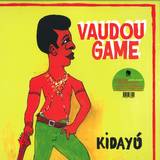
When faced with the decision to take a different direction at the risk of getting lost in a synthetic sound or to further explore the same musical path, Vaudou Game didn't need to consult the oracle for very long when putting together their new album. Since their first acclaimed album, Apiafo and its irresistible single "Pas Contente", these Lyon natives never turned down the heat on over 130 stages across Europe, Africa, America and Asia. Peter Solo has displayed his amulets, charisma and yellow pants around the globe.When time came for them to harness their Afro-Funk sound for the second time, they turned their attention once again to their analog strengths. Vintage material, instruments produced in the 70's and cassette tapes were the "grigris" (or lucky charms) which proved most effective to ward off digital corruption of their music and return them to a tight-knit group with a solid groove.This unbeatable trance rhythm, inherited from James Brown and Fela, icons of Funk and Afrobeat, becomes trident when joined by Mawu, the creative voodoo divinity hidden in each of the group's notes. This inspiration transcends their spirit of communion, plunges them deeply into Mother Earth and results in the telepathic trance which is directly connected to Togo Peter's native Togo.Each song then becomes a celebration where the listener becomes the group's voodoo doll, embraced by the rhythm, submitting itself to the mercilessly metronomic cutting of guitars, struck by the copper-colored flashes of lightning forged by the African voodoo deity Hevioso, pierced by the psychedelic visions generated by the organs and a six-string guitar, cheerful songs, and hypnotic incantations.KIDAYU means "sharing" in Kabye, the language spoken in northern Togo. Sharing, is the philosophy of Vaudou Game - both in their recorded music and on stage.Vintage African funk tinged with voodoo chanting: Togolese Peter Solo and his fellow musicians from Lyon electrify us in a frenzied ceremony" - Télérama
Cerca:lost language
Forbidden Colours is proud to announce the final remix pack for El_Txef_A's sophomore album We Walked Home Together'.
After 2 remix EPs featuring Eduardo De La Calle, The Black Madonna, Lake People, Ada, HRDVSION and Bostro Pesopeo to name a few, the label is wrapping up the remix triptych with yet another impressive run of artists.
Kompakt co-owner Reinhard Voigt delivers a weird, dry yet easy and acid influenced reinterpretation of The Love We Lost'. Dave DK is the first one to rework Mugarrirantz' showing his love for the Basque Country. The song which is written in Euskara, the Basque language is beautifully composed.
Bringing in the analog and classic flavor is Damian Schwartz with a classic mpc sound for Claim Of Planet Earth'. Finally, El_Txef_A also worked on a reinterpretation giving the same track a mystic feel reminiscent of Orbital's first albums.
My love wears forbidden colours
My life believes
My love wears forbidden colours
My life believes in you once again
The vinyl release will be limited to 300 copies.
There have been many different ways in describing the personal stories behind the protagonists of the electronical music scene in the 90ies. It´s in the nature of things that especially producers, whose place of work is the studio, remained rather in the background.
One of them is Ralf Hildenbeutel. He was the producer of Sven Väth´s most important releases such as "L'Esperanza" or "Fusion" and an essential creative part of the Eye Q label in the 90ies. His "Earth Nation" project was the first live act from that genre who was taking a drummer on the live stage, playing on international festivals and stages including the "Montreux Jazz Festival". The vita continues. While many other musicians kept on working on techno, Hildenbeutel composed for artists such as Laith Al-Deen or Phil´s son Simon Collins and wrote filmmusic for movies such as "Hommage á Noir" which won the Goldmedal for music on the New York Filmfestivals. The film adaption of Martion Suter's "Der Koch", "Ausgerechnet Sibirien", TV thriller such as "Kommissarin Lucas" or even the series of "Verbotene Liebe" have been scored by Ralf Hildenbeutel. His filmmusic for the international multi-awarded shortmovie "Momentum" was nominated at the Newport International Filmfestival. On "Moods" Hildenbeutel finds more back to electronical music. Fans of artists such as Ólafur Arnalds, Nils Frahm or Jon Hopkins will enjoy this longplayer. Hildenbeutel mixes complex string-arrangements and piano pieces with clicks & cuts and invents his own coherent language which allows both directions to live in harmony. Elegiac compositions and vivacious, percussive breakouts as in "Spark" (for which an video by award-winning filmmaker Boris Seewald will be made) meet on this album.
An album which grows and gains depth with each hearing.
Producer CRISTIAN VOGEL, born in Chile and in raised in Bristol, England, represents an inner turmoil within the history of electronic music and techno. Like only a few other artists such as Aphex Twin, he personifies the second wave of techno during which authorship, previously pronounced dead, returned in full force. The former punk, who had completed studies in composition (20th century classical music in Sussex) conveyed a powerful force in his music, which now finds its place very naturally as electronic music; back then, it did more than just shake up the concepts of techno. Complex and intricate rhythms (Süddeutsche Zeitung) dig deep chasms in dark (listening) spaces.
In 1996, together with JAMIE LIDELL as SUPER_COLLIDER, he made a final attempt to breathe life into electronic music, which was still primarily seen as dance/rave/club music, and produced clustered break funk music that was so relevant to its time that many considered it more a music of the future: science fiction for the dance floor. Although the project was not a failure, it did not succeed even halfway in meeting the expectations of an artist who was rather perplexed by the lack of interest he perceived in others in music as art and research. Vogel believes that music has a will to unfold, like a jungle from the undergrowth of industrial cities where music is thought of as an attack and a defense.
Seemingly out of disappointment in the predictably declining hedonism of the scene, he moved to Barcelona and bound his explosive ideas to more accessible formats, founded labels, created networks (No Future, Sleep Debt) and, at the same time, revisited his early days by working more and more on formats such as music for ballet and similar concepts. He also sought freedom precisely in what was referred to as functional electronic music through conceptual and serious endeavors in the artistic sense.
Vogel went under for a time and lived in Vienna before arriving in Berlin nearly two years ago, where he made his first new and daring attempt to assimilate everything that electronic music represented to him on one album: 'The Inertials' on SHITKATAPULT. Shortly after that, his mystical, floating ambient work 'Eselsbrücke' was released, which already spoke the language of the new city.
He now presents a new album on SHITKATAPULT entitled 'POLYPHONIC BEINGS' - a true masterpiece in the inimitable Vogel style, as his fans will no doubt claim. 'POLYPHONIC BEINGS' begins, after two minutes of an irritating noise wave, with a surprisingly classic dub track and grows darker and more abstract from track to track, minute by minute. An eerie and unbelievable sound, with all as it should be: every reverb tail, every movement of the fader, every composed note takes the listener piece by piece into Vogel's own cosmos.
He foregoes interwoven elements for swaying towers of rhythm, powerful sound passages, spaces, roads, mirrors and pathways, leading to a stream of ideas that never wants to end. He aptly quotes Karl-Heinz Stockhausen in the liner notes: These are the "atomic layers of ourselves." And so it is. We are what we hear. This is the definitive CRISTIAN VOGEL.


