Die Power Metal Gnome WIND ROSE stürmen in die epische Schlacht auf Warfront! Nach der Veröffentlichung ihres hochgelobten 2019er Albums Wintersaga mit epischen Geschichten und noch epischeren Riffs kehren WIND ROSE, die mächtigsten Gnome des Power Metal, aus der Schmiede zurück und hämmern auf ihrem neuen Album Warfront (10. Juni via Napalm Records) neue Hymnen auf
den Amboss!
Die fünfköpfige Band aus Pisa, Italien, der mit ihrer viralen Neuinterpretation der Minecraft-Hymne ”Diggy Diggy Hole” (bis dato über 30 Millionen Aufrufe auf YouTube) ihr sensationeller Durchbruch gelang, schärft ihre Schwerter und stürzt sich mit zehn neuen heroischen Songs auf die Schlacht. Egal wie groß der Sturm,
wie eisig die Winterkälte, WIND ROSE’s Gespür für sensationelle Hooks und eingängige Riffs - gekrönt von Francesco Cavalieri’s markanter Stimme - katapultiert sie an die Speerspitze des Folk- und Power Metal, ohne ihre einzigartige Härte einzubüßen!
WIND ROSE liefern auf Warfront jede Menge Gnom-Abenteuer, dramatische Orchesterarrangements und puren Spaß - Replay garantiert!
Cerca:mach one
- 1: The Rain Drops
- 2: Another Time
- 3: Melted Car (Feat. Karina Gill)
- 4: Deep In Squalor (Feat. Griffin Jones)
- 5: Hey There Flower
- 6: Cliché (Feat. Kati Mashikian)
- 7: Say It Now (By Françoise Hardy)
- 8: Uneasy
- 9: Ode To Little Bird (Feat. Alexis Harper)
- 10: September Skies (Feat. Karina Gill)
- 11: The Portal
- 12: The Word
- 13: Unled Lives (Feat. Hannah Lew)
- 14: Saint Matthew
Solo bedroom-pop project of Michael Ramos (Flowertown, April Magazine, Hectorine). Mostly recorded between last Christmas and New Year's during a window of isolation at home, “Hey There Flower” preserves Tony Jay’s prowess at making beautifully eerie lo-fi pop; like a hazy memory where your favorite Sixties girl-group melody is perpetually slowed down. Without a band to practice with, Tony Jay recorded the music alone, but recruited a slew of friends to remotely record backing vocals: Karina Gill (Cindy), Griffin Jones (Galore), Kati Mashikian (Mister Baby), Alexis Harper (Al Harper), & Hannah Lew (Cold Beat). "Hey There Flower", the most recent release from the prolific and mysterious Tony Jay delivers real melodies -- both lacey with vocal harmonies and dusty with layered guitars -- as fans have come to expect. This release also carries forward and elaborates on Tony Jay's tradition of songs that express a kind of naked honesty about things we all know -- love and loneliness and all that -- while communicating at the same time a wry edge of skepticism, so that the songs are like coins spinning on edge before landing heads, tails, or lost under the couch. Tony Jay brings us into a nostalgia where we recognize moods from music of the past -- Marc Boland definitely comes to mind, as well as Velvet Underground of the Nico era, and Tony Jay even covers Francoise Hardy on this collection -- but the songs create a three dimensional space with what feels like a thousand layers so that instead of being thrown back in time, it's like stepping into a little world with its own laws of nature, of which the listener gets just a few hints. - Karina Gill, Cindy/Flowertown. “Hey There Flower” is introduced by thudding snare beats eliciting reverb-stained tattered noisy guitar scrapes, to weave abrasive shimmery emotive vibrations, imbued with shattered nostalgic dreams, lit by brittle yet dazzling forsaken keyboard flows, over submerged and distorted male vocal’s whispery deluge of obsessive longing, lonely melancholy, and dark desire to exude a hazy gritty concoction of awkward sadness and brooding unrest.” White Light // White Heat // “What Tony sketches are concise commentaries on love, loneliness and a few things in between. His mode of expression is sparse, intense, and captivating. The arrangements are invariably lo-fi and slow tempo, blanketed with a fuzzy hiss. And it only took one listen to decide that it is a very special album. It has a '60s feel, albeit washed in an eerie slowcore machine. An ace example is "September Skies", which could be the 1965 'last dance' at the prom for the introverted students.” - When You Motor Away
The fourth album from The High Water Marks, a band comprised of
Hilarie Sidney, co-founder of Elephant 6, one of the most influential
musical collectives of the past 30 years and songwriter/drummer of The
Apples In Stereo
Proclaimer of Things is a 39-minute blast of hook-laden numbers that careen and
roll mightily away with jangling precision and indie rock smarts.
Following on from their ground-breaking 1988 self-titled EP, Godflesh's
debut full-length was an absolute game-changer and still stands as one
of industrial metal's most defining documents to this day
Drawing from post- punk and industrial acts like; Swans, Big Black, Killing Joke
and Throbbing Gristle as much as the more metallic and punk influences that
informed guitarist/ vocalist Justin Broadrick's previous band Napalm Death, the
pounding, drum- machine powered sonic assault of 'Streetcleaner' sounded like
nothing else at the time, breaking down people's perceptions of what a metal
band could sound like. You can still feel the album's broad influence everywhere
from the dense atmospheres of post- metal to the abrasive beats of modern
industrial and techno outfits, but despite its many imitators, there's still nothing
else that quite captures the feelings of paranoia, anxiety and urban decay that
'Streetcleaner' so deftly articulates.
The Howling is a collaborative project started by writer Ken Hollings and sound artist Howlround devoted exclusively to their shared love of text, audiotape and trash aesthetics. An intense collision of spoken word and analogue tape effects, the Howling's first performance took place at the Iklectik in September 2019 as part of a special programme to celebrate The Tapeworm's 10th anniversary.
Despite the pandemic, they have managed to continue working and conferring together since then, sharing sound files, texts and mixes online, which has resulted in All Hail Mega Force, their first full-length release for The Tapeworm. The two extended tracks contained on this audiocassette reflect their shared interest in Fluxus and how informal rules and permutations can be set up to work themselves out through loops and repetitions. A straight line connects Terry Riley's tape experiments in Paris from the early 60s with their experimental recordings in the Wimpy Bar on Streatham High Road, one of their favourite meeting places. 'The idea of instant, disposable one-off creations appealed to us a lot at the time,' The Howling explain, 'particularly as both pieces were conceived and developed during different phases of Covid lockdown in the UK.'
The title and source material are derived from the kid's adventure movie MegaForce, starring Barry Bostwik and Michael Beck. Designed to sell a range of Mattel hi-tech action toys, MegaForce tanked at the box office but lives on in the collective consciousness of those who share with The Howling a special love for Trash and Trash Aesthetics.
The two tracks also share similarities in approach and realization.
'All Hail Mega Force' was created by reading combinations of the words 'All Hail Mega Force' into a voice memo recorder, transferring it to tape, cutting the whole thing as a single long loop and then stretching it across three reel-to-reel machines simultaneously, using two pencils and a pint glass full of loose change to try and maintain sufficient playback tension. Over time the loop started to degrade, which accounts for the increasingly slurry and unpredictable playback, plus frequent ruptures caused by the tape becoming jammed and having to be tugged through the machine workings by hand. Twenty-four minutes later and the result was a completed new work and a slight backache.
The text for 'Are You Man Enough For Mega Force?' was recorded live in the Wimpy Bar on Streatham High Road, 28 November 2021. It was cut to tape and looped on 3 December 2021 at Warrior Studios, Loughborough Junction. Dragged by motor and then by hand across two tape machines with copious amounts of closed input feedback provided by a third rushing in to fill the gaps. One take with no effects or overdubs, but one tiny edit in the middle when something fell over.
- A1: Live At The Sahara Tahoe, 1973 (Remaster 2022)
- A2: Farben Says Love To Love You Baby (Remaster 2022)
- A3: Muskeln (Remaster 2022)
- B1: Suntouch Edit (Remaster 2022)
- B2: Farben Says As Long As There's Love Around (Remaster 2022)
- B3: 6Ff (Remaster 2022)
- C1: Beautone (Remaster 2022)
- C2: Farben Says So Much Love (Remaster 2022)
- C3: T Microsystems (Remaster 2022)
- D1: Raute (Remaster 2022)
- D2: Silikon (Remaster 2022)
- D3: Farben Says Love Oh Love (Remaster 2022)
On textstar+ Jan Jelinek brings together the material from the CMYK series, four EPs he released between 1999 and 2002 under the pseudonym farben (the German word for both colours and paints), on a vinyl double LP for the first time. The selection of tracks has been remastered from the original tapes, joined by two additional pieces that appeared on compilations during the same period.
A Polaroid. Still life with tangled leads and consumer electronics, late twentieth century. Black and various shades of dirty white are the dominant non-colours. The image’s spatial depth remains diffuse, the links between its elements speculative. A note stuck to the wall (a legend, perhaps, or an all-explaining blueprint in text form?) is impossible to decipher. You can’t see what connects the picture’s signs. You have to hear it.
farben says: Every sound is a text. A bearer of meaning in search of a reader. Hoping the ideas inscribed in its autonomous existence will be understood as intended. While its beauty lies precisely in misunderstanding, in reading the coded message a new way every time. A thousand colours of sound, a thousand different ways to hear, to see, to understand.
On textstar+ Jan Jelinek brings together the material from the CMYK series, four EPs he released between 1999 and 2002 under the pseudonym farben (the German word for both colours and paints), on a vinyl double LP for the first time. The selection of tracks has been remastered from the original tapes, joined by two additional pieces that appeared on compilations during the same period. Another new element is the Polaroid, showing the origins of a world: Jelinek’s home studio in Berlin at the time.
farben says: Move your body! The project has its roots in Jelinek’s love of house as a reductionist vision of soul. Of four to the floor as a proposition that can be accessed anywhere. Of electronic dance music as a realm of possibility that can be continually expanded. farben was written as contemporary house music. As a text about excitement and euphoria. The arrangements were made directly while recording to DAT, on a twelve-channel mixing desk. Several track titles suggest a link to live concerts, coupled with the context of machine music and bedroom recording. Others affirm pop music’s most extravagant stock phrases about various states of love.
Jelinek produced the tracks with the aim of making music for dancefloors. An idea that failed very productively. In the locations to which it was originally addressed, the project barely figured. But people did listen, and they listened all the more closely to this music that opened up new acoustic and associative scope for house. farben is the opposite of genre: a music spawning new terms (clicks & cuts, micro-house) that never manage to fully capture it.
farben says: Signifiers. The four CMYK EPs are designed as a network of references that cannot be missed but that can also never be precisely deciphered. The vectors of sound, word and image point to Isaac Hayes and Ornette Coleman, to Detroit and the first generation of the Red Army Faction, to Karl Marx and Friedrich Engels. So multifarious that they are distorted to the point of recognition. Overall we hear sonic docufictions whose appealing vagueness derives precisely from this oscillation between clarity and ambiguity, which is also the source of their poetry: the lyricism of the pure circulation of signs.
The artwork is based on photographs of former Red Army Faction members, broken down into the four colours of the CMYK model. The motifs dissolve into individual dots of a single colour, so close to the faces that their expressions are only hinted at. Taken together, the individual colours compose a new whole out of fragmentary material, defying definition and thus maintaining their vibrancy. The same occurs on the level of sound. The sampler Jelinek used for these tracks had to be fed with floppy disks, imposing a memory limit of 1.44 megabytes per audio quotation from soul or jazz records. As a necessary consequence of this, the individual references, like the dots of colour, are dissolved into details and abstractions. They appear as splinters that recombine in new ways to create new meanings. The joy of collapsing metaphors.
farben says: New departures. Even two decades after its original release, textstar+ does not come across as an epitaph to the modern era. Instead, it appears as a euphoric affirmation of the utopias of the twentieth century, translated into new sound texts via the aesthetic strategies of abstraction, collage, networking and speculation. 1.44 megabytes of history, one thousand signifiers, one album. From “Live ...” to “... Love”.
Arno Raffeiner, 2021
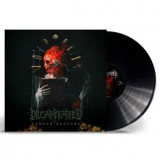
Across eight studio albums, DECAPITATED grew from the adolescent dream of teenagers from a small Central European town to one of the leaders of the metal genre. Each successive album further expands the band’s sound with genre-bending authenticity and integrity. As Metal Injection rightfully observed, “any self-respecting death metalhead knows the name well.”
DECAPITATED’s music is a weapon forged by four young men from a historic medieval-fortified town in Poland, which catapulted them to the top of a worldwide subculture. Like a rose in the devil’s garden, the DECAPITATED story builds triumph from tragedy. The gleeful grotesquery of extreme metal imagery and rifftastic bludgeoning beckons listeners to uncover broader truths.Upon the release of 2017’s Anticult, Metal Hammer declared DECAPITATED “a serious successor to the likes of Pantera and Lamb Of God – a band who can draw new legions into the metal world as its new champions.” Their diverse follow-up, 2022’s Cancer Culture, delivers on that promise.
Instantly recognizable devastation and deceptively sinister hooks abound. Freshly minted DECAPITATED anthems like “Last Supper,” “Hello Death,” “Just Cigarette,” “No Cure,” “Iconoclast,” and “Cancer Culture” shimmer with sonically sharp production and unrelenting bombast. There’s also a newly increased emphasis on melody, even venturing into darkly romantic territory. Wacław "Vogg" Kiełtyka (guitar), Rafał "Rasta" Piotrowski (vocals), Paweł Pasek (bass), and James Stewart (drums) are at the top of their game, delivering the goods at peak performance. Jinjer vocalist Tatiana Shmayluk and Machine Head frontman Robb Flynn make guest appearances.
Set on the descending plains of a mountain range amid a dense forest, Krosno boasts a 14th-century Gothic church, a Subcarpathian museum, and stunning artisan glassware. In this Polish town, teenage music student Wacław "Vogg" Kiełtyka discovered records from bands like Morbid Angel, Cannibal Corpse, Metallica, and Machine Head. The guitarist and his younger brother, drummer Witold “Vitek” Kiełtyka, cofounded DECAPITATED in 1996, inspired by a wide range of technical death, blackened thrash, and local heroes, like KAT and the world-renowned Vader. Death and black metal reigned supreme in the Polish scene of the 1990s, where Behemoth originated as well. In fact, a Vader song called “Decapitated Saints” inspired the band’s moniker.
The organic musical chemistry between the Kiełtykas was akin to the brotherly connectivity and vibe driving Pantera, Gojira, and the classic era of Sepultura. In 2006, Kerrang! praised the first three DECAPITATED albums - Winds of Creation (2000), Nihility (2002), and The Negation (2004) – as “superbly conceived and executed eruptions of technical brilliance and razor-sharp songwriting that turned these youthful Poles into one of the genre’s most widely respected bands.” That year’s Organic Hallucinosis further perfected Vogg’s penchant for blending extremity with catchy hooks.
The rule-breaking ferocity and invention of the first four albums reinvigorated death metal, as DECAPITATED inspired a new generation of bands who followed suit. Sadly, this era came to a shocking end in late 2007. While touring Russia, the band’s bus collided with a large truck near the border with Belarus. Both Vitak and then-singer Adrian “Covan” Kowanek sustained severe head injuries. Tragically, Vitak passed away in a Russian hospital a few days later. He was just 23.Vogg summoned the courage to continue, in honor of his brother and what they created, and returned with a new incarnation of DECAPITATED and the fiercely adventurous comeback album, Carnival is Forever (2011) featuring new vocalist Rafał "Rasta" Piotrowski. Blood Mantra (2014) introduced bassist, Paweł Pasek. Blabbermouth declared it “perhaps the most poised and gutsy” DECAPITATED album, adding “its courageous bends make it a turbulent but pleasurable ride.”
Cancer Culture sounds brilliant, modern, and tasty. “There is no place for any fake, plastic, bullshit drum machine or anything like that,” Vogg insists. “It’s all organic, pure, and clear, showing the true face of the band. Vogg and company entrusted the Cancer Culture mix to David Castillo at Sweden’s Fascination Street Studios / Studio Gröndahl (Sepultura, Carcass, Opeth, Katatonia), and legendary American producer Ted Jensen (Metallica, Slipknot, Pantera, Machine Head, Korn).
The devoted supporters who traveled to see DECAPITATED on international tours with the likes of Lamb Of God, Meshuggah, Soulfly, Fear Factory, and Suffocation over the years will recognize the ever-present pummeling backbone. Longtime fans and newcomers alike will connect to the variety of atmospheric depth throughout Cancer Culture’s ten boundlessly energetic and creative tracks.
“If you told me 25 years ago, in my neighborhood in the South of Poland, that I would be in Machine Head, sharing riffs with Robb Flynn,” Vogg marvels. “It’s simply incredible. It means that everything is possible in your life. That gives me the faith to believe that I can achieve even more in my career. The dreams we have when we are kids, things we can barely imagine, can happen.” Flynn contributes a hauntingly beautiful vocal to the Cancer Culture track “Iconoclast.” “Clean vocal singing is a really new thing in DECAPITATED,” Vogg notes. “It’s really unique and amazing.”
Driven by Vogg’s passion and integrity, the dual emphasis on creative invention and technical prowess maintains DECAPITATED’s stature as genre-leaders in 2022 and beyond. The band’s supporters continually demonstrate confidence and absolute certainty DECAPITATED will deliver.
Across eight studio albums, DECAPITATED grew from the adolescent dream of teenagers from a small Central European town to one of the leaders of the metal genre. Each successive album further expands the band’s sound with genre-bending authenticity and integrity. As Metal Injection rightfully observed, “any self-respecting death metalhead knows the name well.”
DECAPITATED’s music is a weapon forged by four young men from a historic medieval-fortified town in Poland, which catapulted them to the top of a worldwide subculture. Like a rose in the devil’s garden, the DECAPITATED story builds triumph from tragedy. The gleeful grotesquery of extreme metal imagery and rifftastic bludgeoning beckons listeners to uncover broader truths.Upon the release of 2017’s Anticult, Metal Hammer declared DECAPITATED “a serious successor to the likes of Pantera and Lamb Of God – a band who can draw new legions into the metal world as its new champions.” Their diverse follow-up, 2022’s Cancer Culture, delivers on that promise.
Instantly recognizable devastation and deceptively sinister hooks abound. Freshly minted DECAPITATED anthems like “Last Supper,” “Hello Death,” “Just Cigarette,” “No Cure,” “Iconoclast,” and “Cancer Culture” shimmer with sonically sharp production and unrelenting bombast. There’s also a newly increased emphasis on melody, even venturing into darkly romantic territory. Wacław "Vogg" Kiełtyka (guitar), Rafał "Rasta" Piotrowski (vocals), Paweł Pasek (bass), and James Stewart (drums) are at the top of their game, delivering the goods at peak performance. Jinjer vocalist Tatiana Shmayluk and Machine Head frontman Robb Flynn make guest appearances.
Set on the descending plains of a mountain range amid a dense forest, Krosno boasts a 14th-century Gothic church, a Subcarpathian museum, and stunning artisan glassware. In this Polish town, teenage music student Wacław "Vogg" Kiełtyka discovered records from bands like Morbid Angel, Cannibal Corpse, Metallica, and Machine Head. The guitarist and his younger brother, drummer Witold “Vitek” Kiełtyka, cofounded DECAPITATED in 1996, inspired by a wide range of technical death, blackened thrash, and local heroes, like KAT and the world-renowned Vader. Death and black metal reigned supreme in the Polish scene of the 1990s, where Behemoth originated as well. In fact, a Vader song called “Decapitated Saints” inspired the band’s moniker.
The organic musical chemistry between the Kiełtykas was akin to the brotherly connectivity and vibe driving Pantera, Gojira, and the classic era of Sepultura. In 2006, Kerrang! praised the first three DECAPITATED albums - Winds of Creation (2000), Nihility (2002), and The Negation (2004) – as “superbly conceived and executed eruptions of technical brilliance and razor-sharp songwriting that turned these youthful Poles into one of the genre’s most widely respected bands.” That year’s Organic Hallucinosis further perfected Vogg’s penchant for blending extremity with catchy hooks.
The rule-breaking ferocity and invention of the first four albums reinvigorated death metal, as DECAPITATED inspired a new generation of bands who followed suit. Sadly, this era came to a shocking end in late 2007. While touring Russia, the band’s bus collided with a large truck near the border with Belarus. Both Vitak and then-singer Adrian “Covan” Kowanek sustained severe head injuries. Tragically, Vitak passed away in a Russian hospital a few days later. He was just 23.Vogg summoned the courage to continue, in honor of his brother and what they created, and returned with a new incarnation of DECAPITATED and the fiercely adventurous comeback album, Carnival is Forever (2011) featuring new vocalist Rafał "Rasta" Piotrowski. Blood Mantra (2014) introduced bassist, Paweł Pasek. Blabbermouth declared it “perhaps the most poised and gutsy” DECAPITATED album, adding “its courageous bends make it a turbulent but pleasurable ride.”
Cancer Culture sounds brilliant, modern, and tasty. “There is no place for any fake, plastic, bullshit drum machine or anything like that,” Vogg insists. “It’s all organic, pure, and clear, showing the true face of the band. Vogg and company entrusted the Cancer Culture mix to David Castillo at Sweden’s Fascination Street Studios / Studio Gröndahl (Sepultura, Carcass, Opeth, Katatonia), and legendary American producer Ted Jensen (Metallica, Slipknot, Pantera, Machine Head, Korn).
The devoted supporters who traveled to see DECAPITATED on international tours with the likes of Lamb Of God, Meshuggah, Soulfly, Fear Factory, and Suffocation over the years will recognize the ever-present pummeling backbone. Longtime fans and newcomers alike will connect to the variety of atmospheric depth throughout Cancer Culture’s ten boundlessly energetic and creative tracks.
“If you told me 25 years ago, in my neighborhood in the South of Poland, that I would be in Machine Head, sharing riffs with Robb Flynn,” Vogg marvels. “It’s simply incredible. It means that everything is possible in your life. That gives me the faith to believe that I can achieve even more in my career. The dreams we have when we are kids, things we can barely imagine, can happen.” Flynn contributes a hauntingly beautiful vocal to the Cancer Culture track “Iconoclast.” “Clean vocal singing is a really new thing in DECAPITATED,” Vogg notes. “It’s really unique and amazing.”
Driven by Vogg’s passion and integrity, the dual emphasis on creative invention and technical prowess maintains DECAPITATED’s stature as genre-leaders in 2022 and beyond. The band’s supporters continually demonstrate confidence and absolute certainty DECAPITATED will deliver.
A1. DA SHAKE
A synthesizer-based production machine that turns inspiration into sound at maximum speed
recorded or extract (a small piece of music or sound) digitally for reuse as part of a composition or song like this one.
A2. GARDEN OF EDEN
In Abrahamic religions, the Garden of Eden (Hebrew: גַּן־עֵדֶן, gan-ʿĒḏen) or Garden of God (גַּן־יְהֹוָה, gan-YHWH), also called the Terrestrial Paradise, is the biblical paradise described in Genesis 2-3 and Ezekiel 28 and 31.12
The location of Eden is described in the Book of Genesis as the source of four tributaries. Among scholars who consider it to have been real, there have been various suggestions for its location:3 at the head of the Persian Gulf, in southern Mesopotamia (now Iraq) where the Tigris and Euphrates rivers run into the sea;4 and in Amnesia Ibiza
B1. HOLLOW
The foulest stench is in the air
The funk of forty thousand years
And grizzly ghouls from every tomb
Are closing in to seal your doom
And though you fight to stay alive
Your body starts to shiver
For no mere mortal can resist
The evil of the Hollow
B2. REC 4
If the recording is going on, the capture button turns red. In addition, a timer will be displayed, showing how long the recording is done.
Los Angeles-based experimental producer Al Lover will release his new studio album ‘Cosmic Joke’ on May 27th via Fuzz Club Records.
A staple of the global psychedelic scene, Lover has spent nearly a decade fine-tuning a broken, abstracted form of electronica that pools together a tapestry of trip-hop, synthesised krautrock, dub and dark ambient. Utilising an arsenal of samples, drum machine, analogue synths and live instrumentation, Lover’s is a kaleidoscopic sound that’s J-Dilla, DJ Shadow and Lee Scratch Perry by way of Brian Eno, Kraftwerk and Kluster. Central to Lover’s music is a desire to explore the fringes of psychedelic music and the common threads that run through its far-reaching styles, drawing elements from the past and connecting them to the future. Through the years he has released a number of studio albums and beat tapes, remixed the likes of Osees and Night Beats, been resident DJ for the Levitation and Desert Daze festivals and collaborated with the likes of Goat, Anton Newcombe, Cairo Liberation Front and White Fence. Now, Lover returns with his latest studio album, ‘Cosmic Joke’ – a series of synthesised philosophical meditations on modern life, in all its tragicomic absurdity. "'Cosmic Joke' came from observing the rising, compounded absurdity in recent years and seeing structures of normalcy dissolving. It’s my attempt to view these things as part of a higher-order process, through a metaphysical lens rather than an ideological one. It’s been an exercise in holding the paradoxical relationship of comedy and tragedy, joy and pain, growth and decay, scale and decline as part of an interlocked system that, at a deep level, is essential to how we interface with the world.”
Deluxe Edition is on 180g transparent green vinyl, gatefold sleeve, printed inner-sleeve.
Los Angeles-based experimental producer Al Lover will release his new studio album ‘Cosmic Joke’ on May 27th via Fuzz Club Records.
A staple of the global psychedelic scene, Lover has spent nearly a decade fine-tuning a broken, abstracted form of electronica that pools together a tapestry of trip-hop, synthesised krautrock, dub and dark ambient. Utilising an arsenal of samples, drum machine, analogue synths and live instrumentation, Lover’s is a kaleidoscopic sound that’s J-Dilla, DJ Shadow and Lee Scratch Perry by way of Brian Eno, Kraftwerk and Kluster. Central to Lover’s music is a desire to explore the fringes of psychedelic music and the common threads that run through its far-reaching styles, drawing elements from the past and connecting them to the future. Through the years he has released a number of studio albums and beat tapes, remixed the likes of Osees and Night Beats, been resident DJ for the Levitation and Desert Daze festivals and collaborated with the likes of Goat, Anton Newcombe, Cairo Liberation Front and White Fence. Now, Lover returns with his latest studio album, ‘Cosmic Joke’ – a series of synthesised philosophical meditations on modern life, in all its tragicomic absurdity. "'Cosmic Joke' came from observing the rising, compounded absurdity in recent years and seeing structures of normalcy dissolving. It’s my attempt to view these things as part of a higher-order process, through a metaphysical lens rather than an ideological one. It’s been an exercise in holding the paradoxical relationship of comedy and tragedy, joy and pain, growth and decay, scale and decline as part of an interlocked system that, at a deep level, is essential to how we interface with the world.”
Ty Segall meets a new non-rock challenge head-on; soundtrack music for
Matt Yoka’s compelling documentary film ‘Whirlybird’. A variety of synth
sounds, electric keyboards, drums, percussion and saxophone (and yeah, a
few guitars) form a shifting impressionist counterpart, instrumental music that
dialogues with and serves to frame the film’s compulsive themes and
images.
Released to great acclaim in Summer 2021, ‘Whirlybird’ tells the story of
Zoey Tur and Marika Gerrard, former partners and founders of the Los
Angeles News Service, and deftly tracks their extraordinary and oftenreckless pursuit of breaking news throughout the 80s and 90s - a time in
which they pioneered the use of a helicopter to report on Los Angeles at its
most chaotic, capturing historical moments like the 1992 riots and the OJ
Simpson slow speed pursuit.
Through striking interviews and one-of-a-kind archival footage, Yoka’s
documentary expertly tells the story of Zoey and Marika’s unravelling
marriage as they singlehandedly changed broadcast news forever. These
two arcs intertwine to create an electric view of the encroaching intensities of
that era, when the 24-hour news cycle first rose to dominate our national
consciousness.
Ty Segall has previously scored scenes and interstitial bits for film and video
things here and there - but this is his first full-on feature film score, a work
done in collaboration with the director, whose friendship and creative
partnership with Ty has grown over a decade-plus of music videos and other
projects. Working off notes and feels from Matt and responding to the images
and story on screen, Ty crafted some of his most creative arrangements to
date, using synth, drum machine, Wurlitzer keyboard, guitars, drums and
percussion (plus saxes played by Mikal Cronin, who also cowrote the title
track with Ty) to articulate a multitude of tones running through the film.
For a shape-shifter like Ty, this apex of tone colour is no mean feat, an
achievement further highlighted by the full set of pieces. Rather than simply
throw a bunch of songs-with-singing at the project, Ty’s score perfectly
epitomizes the film’s ethos, providing an instrumental counterpart that
dialogues with and helps frame the film’s provocative themes and images.
As both Matt and Ty are natives to the Southern Californian milieu,
particularly the era ‘Whirlybird’ depicts, their collaboration involved a journey
through their past. In realizing the music, they revisited their own Los
Angeles awakenings, adding another personal layer to the deeply felt
meditations and elegies sighted by the remarkable ‘Whirlybird’ - now an
equally thrilling counterpart to be experienced through the original
soundtrack.
- A1: Seventh Mirror
- A2: Ionization
- A3: Cloud Chamber
- A4: Harmonic Oscillator
- A5: Transfiguration
- A6: Urzeit
- A7: Cybernetic Dreams
- B1: Interference
- B2: Computer Garden
- B3: Pyramid
- B4: Halide Crystals
- B5: Integratron
- B6: Imaginary Forces
- B7: Phantom Lfo
- B8: Opticks
- C1: Mannequin
- C2: Mind In Light
- C3: Palantir
- C4: Vertigo Of Flaws
- C5: Exit Syndrome
- C6: Stasi
- D1: Atomic Voyage
- D2: Ultraviolet
- D3: Violence Cascades
- D4: Traumsprache
- D5: Zeitgeber
- D6: Prism
- D7: Threnody
- D8: Mind Oscillation
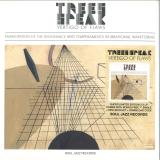
Trees Speak are back!
Speak’s new album, “Vertigo of Flaws: Emancipation of the Dissonance and Temperaments in
Irrational Waveforms” comes as a double-vinyl edition, single CD and digital release. The limitededition first pressing only of the vinyl includes a bonus 45 enclosed in an 8-page 7”x7” booklet
insert housed within the gatefold sleeve with cover artwork created by Soviet Union propaganda
artist Lazar Markovich Lissitzky in 1911.
Trees Speak are back!
This new release is a vast leap into an ocean of space and sound, a quantum leap into cybernetics, biology, anti-gravity,
time travel, dream speech and transfiguration. A seriously next step release!
Showing no signs of slowing down their rapid creative pace – incredibly this is their fourth album in the space of just over
one year – ‘Vertigo of Flaws’ is a mighty 29 tracks, one and a half hours of music across one double album that is surely
going to be a defining point in their musical career, a giant leap into the sonic unknown, an epic exploration of intensity
and sound.
Alongside their now trademark German krautrock motoric-beat rhythms, angular New York post-punk attitude, tripped-out
60s spy soundtrack, psyche-rock, and 70s synthesizers and vocoders, here you will also hear a new cosmic spacial
awareness (both personal inner space and galactic outer space) and a truly wilful pushing of sonic boundaries - as police
sirens, static noise, alarms, radio signals, avant-garde voices, and orchestral string quartets, all collide to add beautiful
dissonance to uber-powerful, intense, addictive and propulsive rhythms - in the process creating a truly unique
soundscape that Trees Speak have made wholly their own.
If you ever wanted to hear Can, Hawkwind, Destroy All Monsters, Pere Ubu, electric eels, John Cage, Liquid Liquid,
Tangerine Dream, Suicide, Neu!, Laurie Spiegel, Art Ensemble of Chicago, John Barry, Mother Mallard’s Portable
Masterpiece Company, Sun Ra, Stockhausen, John Carpenter, Electro-Acoustic and Musique Concrete and Mars in one
band - then this is it!
Trees Speak are Daniel Martin Diaz and Damian Diaz from Tucson, Arizona and their music often draws on the cosmic nighttime magic of Arizona’s natural desert landscapes. ‘Trees Speak’ relates to the idea of future technologies storing
information and data in trees and plants - using them as hard drives - and the idea that Trees communicate collectively.
Special guests from the hyper-creative hub of the Tucson music scene on this release are Gabriel Sullivan, Ben Nisbet, Saul
Millan, Stephani Guilmette, and Davis Jones.
The album Vertigo of Flaws was recorded in Brooklyn, New York, and Tucson, Arizona during the plague of 2021.
Extract from Vertigo of Flaws sleevenotes:
‘As we travel through space and time, avoiding the discarded remains of the industrial period, the
deconstruction of social norms through the expression of art, music, and philosophy guide the human
experience towards the unknown.
All that remains are musical echoes scattered throughout the universe, like ancient vibrations that now
populate the cosmos. These waves now show signs of decay. Melody, beauty, tonality have all but fallen
away as dissonance blossoms. As John Cage wrote in 1937,
“Whereas, in the past, the point of disagreement has been between dissonance and consonance, it will be,
in the immediate future, between noise and so-called musical sounds. New methods will be discovered,
bearing a definite relation to Schoenberg’s twelve-tone system and present methods of writing percussion
music and any other methods which are
free from the concept of a fundamental tone”.
Similarly, George Van Tassel claimed the Integratron as capable of
rejuvenation, anti-gravity, and time travel. So, what remains of the
“people”? We have adopted from them our own Zeitgeber: their pulses
now guide our sun, our planets, our earths, and are the new circadian,
diurnal, and ultradian rhythms of the galaxy. Traumsprache, dream
speech, is now the internal language of trees.
Decaying metal and machines liberated the note unto nature’s table,
and we sip the delicious nectar of music once more irrational, elaborate,
violent, vast. The past is the future, musical disintegration its own rebirth.
We are nature, once more the computer of the Universe.’
Dirty machine gun funk, dripping in fudgy acidic grooves on this twisted heater from native London badass Shy One. Techno collides with Jazz Fusion across three jams recorded straight out the box and cut exclusively onto wax for Eglo Records. This 7" marks the first in a series of releases from the kinetic, undefinable talent.
It started, as it so often does, with two old friends hanging out.
John Shima and C P Smith were joking around one evening in their home city of Sheffield. At some point, Smith challenged Shima that, if the latter could produce a record using nothing more than a small modular synth setup, then Smith would release it on his Central Processing Unit label. As heads will know, while Shima has drops on imprints like FireScope and Subwax Excursions to his name, he had never previously released anything via CPU. Shima accepted, and thus we now have his CPU debut, the four-track EP CPU Modular 1.
The specific setup that Shima worked with for these tracks was Smith's Doepfer A-100P6 Suitcase, a small but mighty combination of modules and programmers. It's no surprise that Shima was able to familiarise himself with the equipment in double-quick time - after all, Shima was an early adopter of the Eurorack modular format back in the day. What emerged from the CPU Modular 1 sessions was a quartet of devastatingly effective DJ tools, mid-set rollers which will get the dance moving something crazy.
Opener '003' kicks the EP off as it means to go on. There's something at once stiff-necked and buoyant about the rhythms here, all thwacking Roland tones and snares which crack like someone whipping a length of sheet metal. While the beat barrels unyieldingly onwards, the programming in the tuned modulars is more exploratory and even trippy, full of delay-laced bleeps and flighty rhythmic motifs. It comes together for a cracking mix in the vein of artists like Jerome Hill and London Modular Alliance. Second A-side cut '010' is no different, the street-beat groove and grumbling low-ends underpinning all manner of modular wizardry.
CPU Modular 1 is really timeless stuff, a set of percussion-heavy, future-focussed beats which recalls Smith's own CPU drop 'DJ Tools Vol.1 - 808 Tracks'. '011' kicks of CPU Modular 1's second-half with a dose of Drexciyan dystopia, playing an atonal loop off of an insistent bass wiggle and neurotic hi-hats. Even when Shima tightens or slackens the modulars here, '011' remains unyielding, a dose of pure 'Wip3out' energy that you could happily groove to all day long. The EP closes out with '005', a gnarled, gurgling production which still retains the dancefloor punch of the rest of the record.
For his Central Processing Unit debut, John Shima was tasked to produce four tracks using a single small modular setup. Unsurprisingly given the pedigree of this seasoned machine-funk pro, Shima aced the assignment.
Sam Gendel and Antonia Cytrynowicz didn't set out to make a record – it just happened. LIVE A LITTLE, a collection of songs resulting from one late summer afternoon in Gendel's Los Angeles home, is less an album and more a moment. The ten tracks here were recorded mostly in one sitting, fully improvised, in the order in which they appear. It was the first and last time the songs have been played – a snapshot of an idea, an artifact of inspiration, at once both a beginning and an end. At the time of recording, Cytrynowicz was only eleven years old. The younger sister of Gendel's significant other and creative partner Marcella, Cytrynowicz is an artist in her own way. She has no formal musical training, but is the product of a creative family and is someone who makes art the way many kids do – in the purest way, simply because they are moved to. On LIVE A LITTLE, she spontaneously crafted all the melodies and lyrics on the spot as Gendel played alongside her. Cytrynowicz's musicality is sophisticated, strange, and other-worldly, and the resulting record is experimental jazz colliding with some sort of fantasy universe. Because of that, LIVE A LITTLE is a stand-out amidst Gendel's extensive and varied catalog. Over the years, the multi-instrumentalist has been known for his prolific musical output as both a sought-after collaborator and as a solo artist. During 2021 alone he collaborated with Vampire Weekend, Maggie Rogers, Moses Sumney, Laurie Anderson, and Mach Hommy, as well as released Notes With Attachments with Blake Mills & legendary bassist Pino Palladino. In the same year he also released the 52-track Fresh Bread, as well as the follow-up to the acclaimed Music for Saxophone & Bass Guitar with Sam Wilkes. Then Mouthfeel / Serene, AE-30, Valley Fever Original Score, and singles "Isfahan" and "Neon Blue." LIVE A LITTLE, though, exists on its own island. For one, the majority of Gendel's work under his own name skews instrumental, but here the playfulness of his saxophone and nylon-string guitar work alongside the twinkle of Cytrynowicz's voice. It’s the sound of unapologetic imagination running amok – and really, more than anything, the sound of having fun. Cytrynowicz is the ideal collaborator for Gendel, who throughout his career has remained largely unconcerned with the pageantry and presentation of the music business, instead focused solely on the music-making itself. Here, he found the purest sort of writing partner – he admires Cytrynowicz' "supreme openness," explaining: "Whatever is happening, she's there with you. We really meet right where we are. She's all ears, I'm all ears. I don't even know how to explain what it is. It just works out somehow." LIVE A LITTLE is a series of "what ifs" cascading into one another, off-kilter and experimental, a kaleidoscope of spontaneity and imagination. It's a sweet distillation of the musical present, of daring to follow through on an impulse – what happens when a project is helmed by someone who doesn't have time for second thoughts or self-doubt. The moment is the thing, and LIVE A LITTLE just happens to capture it.
Four years in making, Voyeurs In the Dark is Toronto artist Barzin’s fifth studio album. That the album is more cinematic in its scope and conceptual in feel than his previous studio albums can be attributed to the time he spent over the past several years composing the soundtrack for the independent film, Viewfinder. Voyeurs In the Dark retains that cinematic quality, and at the same time infuses the music with elements taken from Jazz, electronica, rock and pop. Having primarily explored the quiet side pop and folk in his previous four albums, Barzin has expanded his musical palate, broadening his sound towards a more an experimental direction, while still retaining his preoccupation with exploring the internal landscape. The uniformity of sound that characterized the previous albums has been abandoned for the expression of differing aspects of the self that at times hold opposing views and desires. This is best represented in the image chosen for the cover of the album, which depicts three figures in one body. The album seems to be the expression of not one unified self, but the various aspects of the self. Voyeurs In the Dark sees the artist plot a seductive, contemplative route through city haze, shuttling between graceful glimmering interludes, with wonderfully atmospheric songs at every stop. From opener Voyeurs In the Dark’s first guitar strums and the fizz of its drum machine, the record envelopes itself in a glorious shadow, as shown in the slow waltz of I Don’t Want To Sober Up, dancing around its own swirling guitar chords. On Watching, Barzin plunges himself deeper into a wash of cyclic bass, guitar and synth riffs, as the gloom grooves into light. It’s Never Too Late To Lose Your Life has a much more affirming and urgent tone, shade turning into shapes and motion, while To Be Missed In the End builds its own smoke in a cloud of saxophone and sparse guitar notes, closing out a record full to the brim with scatterbrain beauty and eclectic dusk. Voyeurs In the Dark will be released worldwide on Monotreme Records on May 6th on CD and limited edition180 g black vinyl LP with printed inner discobag and digital download card. Press highlights so far: Video premiere and feature interview on Rumore.IT. Airplay on BBC 6Music, Amazing Radio (UK and US), Glastonbury FM, Shoreditch Radio, Indie Music Discovery, Listen to Discover, Norfolk Radio. Press coverage in V13, Skope, Whisperin and Hollerin, Fame Magazine, High Violet, Indie Midlands, Beehive Candy, Music Won’t Save you. Feature confirmed for Wonderland Magazine. PUBLICITY - UK and North America press and radio Cannonball PR. Europe Five Roses Press
- A1: Dj Ghost - Techno Trip
- A2: Insider - Boots On The Run
- A3: Body-Shock - Invasion Of The Body-Snatchers
- A4: Dj Looney Tune - Workstation
- A5: Body-Shock - Sleepless
- A6: Liquid Overdose - Contact
- A7: Cherrymoon Trax - House House House
- A8: Dj Looney Tune - Beatbox (Acieed Mix)
- A9: Liquid Overdose - Fearsome Bass
- B1: Jan Vervloet & Dj Ghost - Super Dry
- B10: Joyrider - The Deadline (Ny Mix)
- B11: Body-Shock - Attack Of The Body Snatchers
- B2: Jones & Stephenson - The First Rebirth (Dj Ghost & Danny C Remix)
- B3: Push - Universal Nation (Dj Ghost & Danny C Remix)
- B4: Traxcalibur - The Dreamer
- B5: Repulsive 2 - Recactussed
- B6: Dave Davis - Transfiguration
- B7: Blue Alphabet - Cybertrance
- B8: Final Analyzis - El Punto Final (Power Mix)
- B9: Dreamland - Mind Penetration
Our next mixtape features a superb, tight blend of some of the very best tracks to fly out of the speakers at the Cherry Moon Club. At the helm we have DJ Ghost, spinning the grooves to take us on a journey through the ages, through the genres, from twisted acid concepts to hypnotic trance and gut busting hardcore. Ghost aka Bjorn Wendelen has been a stalwart for us at Bonzai since the very early days. He’s delivered several cuts for us over the years and has branched out with his own Ghoststyle brand with great success. The famous Cherry Moon was and remains one of the biggest names in Belgian club-life, with 30 years of embracing club culture. Since the start in 1991, they have brought the best techno, hard-trance and house to the scene. During the 90's and early 00's, Cherry Moon was the place to be for clubbers from all over Belgium, France, the Netherlands and even other European countries. Housed on classic K7 tape, this comp features a host of tracks from the likes of DJ Ghost, Insider, Body-Shock, DJ Looney Tune, Jones & Stephenson, Push, Blue Alphabet, Final Analysis, Joyrider, Dreamland and more. So, dust off your vintage cassette machine and prepare to be blown away by the sound of Cherry Moon.
- A1: Mandrill - Fat City Strut
- A2: The Wild Magnolias - Corey Died On The Battlefield
- A3: Ltg Exchange - Waterbed (Instrumental)
- A4: Allez Allez - African Queen
- B1: Fela & Africa 70 - Everything Scatter (Rere Run) (Rere Run)
- B2: Tony Allen With Afrobeat 2000 - Nepa (Never Expect Power Always) (Never Expect Power Always)
- B3: Lionel Hampton - Them Changes
- C1: Manu Dibango - Super Kumba
- C2: Screaming Jay Hawkins - Africa Gone Funky
- C3: Harold Alexander - Tite Rope
- C4: Jack Ashford & The Sound Of New Detroit - Do The Choo-Choo
- C5: Africa Djole - Wassahoumba
- D1: Niagara - Sangandongo
Second volume of this collection of pure Funk, Afro Beat and African Funk music is out!
This chapter, as previous one, includes highly respected artists such as Mandrill, The Wild Magnolias, Manu Dibango, Fela Kuti, Tony Allen, Buddy Miles and many others, but also includes the very rare and exclusive long version of “Sangadongo” from Niagara.
All these artists guarantee the high quality of this collection, a record that any funk lover can’t miss: the real funk from the origins and the groove in its free form.
After more than two decades flexing his muscles on the local underground scene and gaining a legendary cult status on his Tenerife home turf, the island’s most famous postman, as he’s affectionately known by his consorts, Tomás de la Rosa aka Postman breaks radio silence to bulldoze his way through the canyons surrounding his hometown of Santa Cruz into an unknown and unsuspecting world. We present thus, Postman’s first ever album of original bangers, micro chopped two steppers and rage induced breakbeat anthems.
Constructed over the course of global confinement, Seeds of Light marks a return to creative activity from the man who regularly delivers your post (its not just a random artist name). Postman aka Tomás de la Rosa has taken his time, compiling sketches and unfinished songs, rummaging through the deep ends of his hardrive, stitching early production sketches with recent compositions, revising, reediting and rebuilding with a more mature and concise attitude, eventually completing, almost unintentionally, the perfect self referential retrospective album. Far from being just a compilation album, Tomás managed to create an explosive document, suspended in time, in which styles are intertwined regardless of fashions and fads – letting go of the ‘modern’ or ‘up to date’ burden - so common these days in electronic music.
It is not an easy album, like many of his previous work it demands extra attention to experience the full crystallization of his complex sound structures. We find ourselves in front of a truly surgically precise work of art whose result comes as a waterproof war machine, refined and incisive, resonating deep with soul and groove.
Postman develops his sound palette throughout the album from very basic sound snippets into a concrete dance world of synthetic sounds eventually creating a parallel reality where J. Dilla could be living in Chemnitz instead of Detroit and releasing records for a label called Raster-Throw. Glitch sampladelics!
Incursions into Grime are also abundant with nods to the ineffable East Man, reunions with his beloved Funkstörung or many other stimulating revisions of lifelong genres and breaks populate this multidimensional sound space, see soul, dancehall, breakbeat, two step and the UK hardcore continuum.
Special mention to the magnificent fluid artwork by the very talented Catalan visual artist Alba de Corral. A still photo from one of her kinetic AI systems programmed directly in code, which matches perfectly the essence of Postman's brutalist alien sound.
Vinyl limited to 200 copies