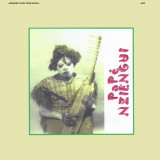
Kadi Yombo, published in 1989, is the most successful album in the quest for a fusion between tradition and modernity in Bwiti harp music of the Tsogho people of Gabon. Combining beating rattles with a layer of synthesizers, Papé Nziengui blends in a contrapuntal dialogue characteristic of harp playing: male song in appeal and female choir in response, male voice of the musical arc and rhythms of female worship. But above all it’s Tsogho ritual music and modern studio orchestration. The result is an initiatory itinerary of 10 musical pieces which are all milestones likely to be simultaneously listened to, danced, meditated on, and soon acclaimed. In the years since, Nziengui has traveled he world from Lagos to Paris, from Tokyo to Cordoba, from Brussels to Mexico City to become a true icon, the emblem of Gabonese music.
Like Bob Dylan, "electrifying" folk and Bob Marley mixing rock with reggae, some purists have criticized Nziengui for having distorted the music of harp by imposing a cross with modern instruments. They even went so far as to claim that Nziengui was just an average harpist covering his shortcomings with stunts that were only good for impressing neophytes; like playing a harp placed upside down behind his back or playing two or three harps simultaneously. Sincere convictions or venomous defamations, in any case, Nziengui never gave in to such attacks, imposing himself on the contrary to pay homage to the elders (Yves Mouenga, Jean Honoré Miabé, Vickoss Ekondo) while instructing the maximum of young people. He is thus the promoter of many young talents, the most prominent of which is certainly his nephew Jean Pierre Mingongué. In a conservative society where the sacred is confused with secrecy, exposing the mysteries of Bwiti in broad daylight can be punished by exclusion or even execution.
Papé Nziengui has always claimed that he faces such risks because he never felt enslaved to a community that governs his life, that regulates his conduct, that has a right of censorship over his activities. Like Ravi Shankar, the famous sitarist, Papé Nziengui is a man of rupture but also of openness, a transmitter of culture. As proof, he has established himself in Libreville, Gabo’s capital, as the main harpist for sessions and concerts, accompanying the greatest national artists (Akendengué, Rompavè, Annie-Flore Batchiellilys, Les Champs sur la Lowé, etc.) as well as foreign artists (Papa Wemba, Manu Dibango, Kassav', Toups Bebey, etc.). In 1988, he was the first harpist to release an album in the form of a cassette produced by the French Cultural Center (Papé Nziengui, Chants et Musiques Tsogho). At the same time, he created his own group (Bovenga), combining traditional music instruments (musical bow, drums, various percussion instruments, etc.) in the framework of a true national orchestra, which gave the first concert and the first tours of a traditional music that was both modern and dynamic, thus "democratizing" the harp, to the dismay of certain purists.
On the other hand, in modern music, dominated by the logic of profit or even commercialism, artistic creation must often be adjusted for a specific audience based on reason rather than heart. But instead of allowing himself to be distorted, Papé Nziengui has always tried to produce music that is not a caricature, worthy in its expression as in its content, of the sacredness and transcendence of the music of the Origins. This is what makes Nziengui not only the musician, but the man someone whose age hasn’t altered any of his freshness or authenticity
quête:man face
Kadi Yombo, published in 1989, is the most successful album in the quest for a fusion between tradition and modernity in Bwiti harp music of the Tsogho people of Gabon. Combining beating rattles with a layer of synthesizers, Papé Nziengui blends in a contrapuntal dialogue characteristic of harp playing: male song in appeal and female choir in response, male voice of the musical arc and rhythms of female worship. But above all it’s Tsogho ritual music and modern studio orchestration. The result is an initiatory itinerary of 10 musical pieces which are all milestones likely to be simultaneously listened to, danced, meditated on, and soon acclaimed. In the years since, Nziengui has traveled he world from Lagos to Paris, from Tokyo to Cordoba, from Brussels to Mexico City to become a true icon, the emblem of Gabonese music.
Like Bob Dylan, "electrifying" folk and Bob Marley mixing rock with reggae, some purists have criticized Nziengui for having distorted the music of harp by imposing a cross with modern instruments. They even went so far as to claim that Nziengui was just an average harpist covering his shortcomings with stunts that were only good for impressing neophytes; like playing a harp placed upside down behind his back or playing two or three harps simultaneously. Sincere convictions or venomous defamations, in any case, Nziengui never gave in to such attacks, imposing himself on the contrary to pay homage to the elders (Yves Mouenga, Jean Honoré Miabé, Vickoss Ekondo) while instructing the maximum of young people. He is thus the promoter of many young talents, the most prominent of which is certainly his nephew Jean Pierre Mingongué. In a conservative society where the sacred is confused with secrecy, exposing the mysteries of Bwiti in broad daylight can be punished by exclusion or even execution.
Papé Nziengui has always claimed that he faces such risks because he never felt enslaved to a community that governs his life, that regulates his conduct, that has a right of censorship over his activities. Like Ravi Shankar, the famous sitarist, Papé Nziengui is a man of rupture but also of openness, a transmitter of culture. As proof, he has established himself in Libreville, Gabo’s capital, as the main harpist for sessions and concerts, accompanying the greatest national artists (Akendengué, Rompavè, Annie-Flore Batchiellilys, Les Champs sur la Lowé, etc.) as well as foreign artists (Papa Wemba, Manu Dibango, Kassav', Toups Bebey, etc.). In 1988, he was the first harpist to release an album in the form of a cassette produced by the French Cultural Center (Papé Nziengui, Chants et Musiques Tsogho). At the same time, he created his own group (Bovenga), combining traditional music instruments (musical bow, drums, various percussion instruments, etc.) in the framework of a true national orchestra, which gave the first concert and the first tours of a traditional music that was both modern and dynamic, thus "democratizing" the harp, to the dismay of certain purists.
On the other hand, in modern music, dominated by the logic of profit or even commercialism, artistic creation must often be adjusted for a specific audience based on reason rather than heart. But instead of allowing himself to be distorted, Papé Nziengui has always tried to produce music that is not a caricature, worthy in its expression as in its content, of the sacredness and transcendence of the music of the Origins. This is what makes Nziengui not only the musician, but the man someone whose age hasn’t altered any of his freshness or authenticity
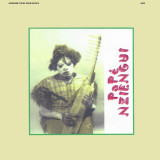
Kadi Yombo, published in 1989, is the most successful album in the quest for a fusion between tradition and modernity in Bwiti harp music of the Tsogho people of Gabon. Combining beating rattles with a layer of synthesizers, Papé Nziengui blends in a contrapuntal dialogue characteristic of harp playing: male song in appeal and female choir in response, male voice of the musical arc and rhythms of female worship. But above all it’s Tsogho ritual music and modern studio orchestration. The result is an initiatory itinerary of 10 musical pieces which are all milestones likely to be simultaneously listened to, danced, meditated on, and soon acclaimed. In the years since, Nziengui has traveled he world from Lagos to Paris, from Tokyo to Cordoba, from Brussels to Mexico City to become a true icon, the emblem of Gabonese music.
Like Bob Dylan, "electrifying" folk and Bob Marley mixing rock with reggae, some purists have criticized Nziengui for having distorted the music of harp by imposing a cross with modern instruments. They even went so far as to claim that Nziengui was just an average harpist covering his shortcomings with stunts that were only good for impressing neophytes; like playing a harp placed upside down behind his back or playing two or three harps simultaneously. Sincere convictions or venomous defamations, in any case, Nziengui never gave in to such attacks, imposing himself on the contrary to pay homage to the elders (Yves Mouenga, Jean Honoré Miabé, Vickoss Ekondo) while instructing the maximum of young people. He is thus the promoter of many young talents, the most prominent of which is certainly his nephew Jean Pierre Mingongué. In a conservative society where the sacred is confused with secrecy, exposing the mysteries of Bwiti in broad daylight can be punished by exclusion or even execution.
Papé Nziengui has always claimed that he faces such risks because he never felt enslaved to a community that governs his life, that regulates his conduct, that has a right of censorship over his activities. Like Ravi Shankar, the famous sitarist, Papé Nziengui is a man of rupture but also of openness, a transmitter of culture. As proof, he has established himself in Libreville, Gabo’s capital, as the main harpist for sessions and concerts, accompanying the greatest national artists (Akendengué, Rompavè, Annie-Flore Batchiellilys, Les Champs sur la Lowé, etc.) as well as foreign artists (Papa Wemba, Manu Dibango, Kassav', Toups Bebey, etc.). In 1988, he was the first harpist to release an album in the form of a cassette produced by the French Cultural Center (Papé Nziengui, Chants et Musiques Tsogho). At the same time, he created his own group (Bovenga), combining traditional music instruments (musical bow, drums, various percussion instruments, etc.) in the framework of a true national orchestra, which gave the first concert and the first tours of a traditional music that was both modern and dynamic, thus "democratizing" the harp, to the dismay of certain purists.
On the other hand, in modern music, dominated by the logic of profit or even commercialism, artistic creation must often be adjusted for a specific audience based on reason rather than heart. But instead of allowing himself to be distorted, Papé Nziengui has always tried to produce music that is not a caricature, worthy in its expression as in its content, of the sacredness and transcendence of the music of the Origins. This is what makes Nziengui not only the musician, but the man someone whose age hasn’t altered any of his freshness or authenticity
Dear is Pauwel's big step forward. His debut album on Unday (due April 2020) is a mature collection of songs about loss in all its different facets. Pauwel openly confronts his demons, without ever losing sight of the essence: rock-solid and captivating folk songs between hope and despair, comforting and disquieting at the same time. Dear turns out a record to cherish and completely disappear into.
Shortly after Pauwel finished his previous EP, his mother passed away. A few weeks later, Europe went into lockdown for a second time. Pauwel wanted to cope with this turbulent episode on his debut on Unday Records, but the isolation during the pandemic only cast more doubts. During the darkest winter months, the 31-year-old songwriter realized that loss comes in many guises: lovers come to leave, suddenly leave or turn out to have become strangers. "Dear" is the account of this dark period in Pauwel's life. A reckoning with all the bad that happened to him and his peers. It is also a bridge to whatever comes next, a hopeful glance at the future.
On 'Dear', Pauwel expands his musical universe considerably, without losing his characteristic melancholy and distinctive voice. With the help of musicians Sander Smeets, Koen De Gendt and David Broeders - his new backing band - the rough folk diamonds were polished into mature songs. The stunning voice of Catherine Smet (aka Bluai) serves as a comforting echo on a handful of songs.
"Dear" was recorded at three different locations by producer Bert Vliegen (Whispering Sons, Sophia). The opening track "Murderer" and the haunting "Bones" were created in a hut in Walcourt. The bulk of the record was recorded during an intense week at the GAM Studio in Waimes. While the TV news showed apocalyptic images of the floods in the province of Liège around the clock, Pauwel and his band finished the songs. Rich, spacy arrangements ("Lazy"), rambling country-rockers ("Deer" & "Sister") or a tearful one-taker on Fender Rhodes ("Mother"): during this session "Dear" finally came together.
Ten years into his role as poster boy for pop soul and peak-hour R&B, Syl Johnson did an unlikely about-face and cut the most inspiring and powerful song he'd ever touch. Issued on 45 in September of 1969, "Is It Because I'm Black" struck an immediate chord within the black community, forcing the song up the charts by sheer volume of call-in requests. It would be Syl's biggest hit for Twinight, climbing as high as #11 on the Billboard R&B chart during its 14-week stay, marking the defining moment of what had become more than just an occupation. Syl had his hands on a career and worked tirelessly rehearsing his next opus, an album of songs reflective of the changing times. With "Is It Because I'm Black" still bolding the pages of Billboard, the coming LP's title appeared to Syl plain as day _ or, in this case, black as night. Issued in April 1970 _ a full 13 months before Marvin Gaye's What's Going On _ Is It Because I'm Black can rightly be called the first black concept album, a distinction few give it credit for. But that factoid, whatever its meaning then or now, failed to inspire music buyers: Johnson's record never got a whiff of the two million copies Gaye's did in its first year of availability. Syl lays the blame squarely on the record's lack of marketability to a white audience. The album's cover didn't exactly move units either. Photographer Jerry Griffith dragged Syl to a burned-out building on 43rd Street to shoot the back cover image, and he finger-painted the iconic title over a stock photo of an eroding brick wall. The title track, coupled with the politically charged "I'm Talking About Freedom" and ghetto conscious "Concrete Reservation" sealed the album's cool reception as the work of an "angry black man." Which is unfortunate, as "Together Forever," "Come Together," and "Black Balloons" are positively uplifting, forming their own pot of gold at the end of a grayscale rainbow. The album's closer burns the brightest. "Right On" devolves into a full-on party track, ending with Syl riffing on the line "I'm gonna keep on doing my thing," as if to answer his critics before their needles reached the run-out groove.
Meaning all things magick and supernatural, the root of the word occult is that which is hidden, concealed, beyond the limits of our minds. If this is occult, then the Occult Architecture of Moon Duo’s fourth album - a psychedelic opus in two separate volumes released in 2017 - is an intricately woven hymn to the invisible structures found in the cycle of seasons and the journey of day into night, dark into light.
Offering a cosmic glimpse into the hidden patterning embedded in everything, Occult Architecture reflects the harmonious duality of these light and dark ener¬gies through the Chinese theory of Yin and Yang.
In Chinese, Yin means “the shady side of the hill” and is associated with the feminine, darkness, night, earth. Following this logic, Vol. 1 embraces and embod¬ies Moon Duo’s darker qualities — released appropriately on February 3, in the heart of winter in the Northern Hemisphere.
According to guitarist Ripley Johnson, “the concept of the dark/light, two-part album came as we were recording and mixing the songs, beginning in the dead of winter and continuing into the rebirth and blossoming of the spring. There’s something really powerful about the changing of the seasons in the Northwest, the physical and psychic impact it has on you, especially after we spent so many years in the seasonal void of California. I became interested in gnostic and her¬metic literature around that time, especially the relationship between music and occult qualities and that fed into the whole vibe.”
Adds keyboardist Sanae Yamada, “the two parts are also intended to represent inverted components of a singular entity, like two faces on the same head which stare always in opposite directions but are inextricably driven by the same brain.”
The Bela Session is a full release of Bauhaus' first studio session from January 26 1979, where the iconic "Bela Lugosi's Dead" was recorded. This is the first and only official reissue of "Bela Lugosi's Dead" on vinyl, and the first time 3 of the 5 tracks have been released. This EP has been produced directly by the band with Leaving Records, in advance of the band's 40th anniversary
UK post-punk pioneers Bauhaus' immensely influential 'Bela Lugosi's Dead' - originally released in 1979 - is considered the original gothic rock record.
The first official vinyl reissue of 'Bela Lugosi's Dead' and first release of complete recording session (including 3 previously unreleased tracks), mastered by Mandy Parnell.
The live version of 'Bela Lugosi's Dead' was in iconic 1983 film The Hunger. It has been covered by Nine Inch Nails, Massive Attack and Nouvelle Vague.
The original version of 'Bela Lugosi's Dead' has never been on streaming services.
180g vinyl. The art is a variation of original 1979 12-inch. Reproduction of original recording session tape on inner sleeve. Includes 50x50cm poster of cover, gold retail sticker.
Please welcome to the Time Is Now family one of the scene's most exciting talents. London-based drum specialist, Bluetoof, brings the heat with a multigenre 4-track EP, featuring a weighty refix from the likes of Manchester badman, and close compadre, Interplanetary Criminal. A multi-faceted EP to keep its listener on their toes. The title track gets things off to a steady start with a minimal bassline and complex percussion, inspired rhythmically by breaks but textured by layers of hollow drums which lend it a more organic sound. Next up, "Perilous" takes things on a darker, more bottom-heavy turn with a traditional two-step beat and a womping bassline, suited to the club's early hours. As to be expected, "That Got Dark" continues in the same vein. The focus remains on percussion with a skipping, half-broken rhythm which is interrupted momentarily by breaks overtaken by a stomping 4/4 beat. Finally, enter Time Is Now family member, Interplanetary Criminal, who extends the 4/4 propulsion to create a pacey speed garage banger.
Embrace is the sixth studio album by Dutch trance DJ and producer Armin van Buuren. The album features hits like “Another You (ft. Mr. Probz)”, “Off The Hook (ft. Hardwell)”, “Looking For Your Name (ft. Gavin DeGraw)” & “Heading Up High (ft. Kensington)”. Other notable collaborators include Angel Taylor, Cosmic Gate, Eric Vloeimans and many others. The album was originally released in 2015 through Van Buuren’s own label Armada Music. Critics noted how the record has a poppy, commercial appeal, but still allows the emotional essence of trance music to shine through.
Embrace is released as a limited edition of 2500 individually numbered copies on black & white marbled vinyl. It comes with a
4-page insert with pictures, lyrics and credits, and the run-out groove contains secret inscriptions.
Possessing one of the most distinctive and recognizable voices on the planet, former Men at Work frontman Colin Hay faces down struggle, loss and the existential questions about mortality on 'Now And Evermore', his first collection of new material since the 2016 release of Fierce Mercy
Written and recorded in Hay's adopted hometown of Los Angeles and at Compass Sound Studio in Nashville, the collection is a defiantly joyful celebration of life and love, one that insists on finding silver linings and reasons to smile through the challenges of recent times. That's not to say the record deludes itself about the realities of our modern world, but rather that it consistently chooses to respond to pain with beauty and doubt with wonder. The music on the new album
brims with fanciful melodies and lush orchestration. Hay's performances are likewise animated and full of life, drawing on vintage pop charm, pub rock muscle, and folk sincerity to forge a sound that's at once playful and profound, clever and compassionate, whimsical and earnest.
- A1: Two Headed Dog
- A2: Don't Shake Me Lucifer
- A3: Bermuda
- A4: The Wind & More
- A5: Starry Eyes
- B1: I Walked With A Zombie
- B2: Stand For The Fire Demon
- B3: Bloody Hammer
- C1: Wait For You
- C2: Wake Up To Rock & Roll
- C3: You're Gonna Miss Me
- C4: Creature With The Atom Brain
- D1: I Think Up Demons
- D2: The Beast
- D3: I've Just Seen A Face
- D4: The Interpreter
- D5: White Faces
- D6: Klbj Radio Ad
Upon completion of the Stu Cook produced Roky Erickson & The Aliens LP in the summer of 1979, Roky decided to return home to Austin from San Francisco
He needed a band and The Explosives came highly recommended to Roky's manager, Craig Luckin - Introductions were made and rehearsals began. Roky & The Explosives immediately hit it off, musically and personally. They played together in Texas and California from 1979-1981 logging in around 50 shows.
13th Floor Elevators drummer John Ike Walton remarked to Explosives drummer Freddie Steady Krc "You guys played more shows with Roky than the Elevators did!" The guys got in the van and barnstormed all over the Lone Star State.
Bootleg recordings began to emerge that were sub- quality live performance recordings that everyone was making money off except Roky and The Explosives.
Craig and Freddie agreed Freddie would review all the recordings they could find from 1979-81. Almost all were in Craig's possession. Upon final review, Freddie would select the best performance of each song they were playing live from that time period. Some like 'Heroin' and 'I've Just Seen a Face' were called on the spot by Roky at a show, performed once and never played again. After the music was selected, Craig and Freddie went through their personal collection of photos,
poster images and added a complete show itinerary from 1979-81.
'Halloween' is a loving collection of performances documenting a time of Roky's re- emergence into the rock music world. It was something most thought they would never see after his final days with 13th Floor Elevators, following drug busts and his plunge into mental illness eventually ending in his stay at Rusk State Mental Hospital. This record is a testimony of Roky's personal strength and will to return to performing and songwriting. Long live his music!
Hooversound hits the ground running with its first 2022 release, this time introducing UK artist RAVETRX to the table with a heavyweight EP that’s been doing the rounds on NTS, BBC Radio 6, and Rinse FM.
If the first track is a raver’s drive into the sunset, cruising through ecstatic trance vocals and euphoric jungle breaks, the rest of the A-side plants the listener right at the heart of the warehouse, where kick drums land chest first and hi-octane acid stabs fill the air. The B-side takes us deeper with eyes-down, knees-up techno slammers, with previous label collaborator Mani Festo making an appearance on ‘Feels Good Inside.’ Wrapping things up, ‘Tribe Sequence Calling’ shakes off the tension with distorted guitar riffs and a slouchy 4/4 beat.
Seit 2017 war Donnelly viel auf Tour. Während eines kalten Winters in Westaustralien, kehrte sie im Juni 2018 zurück nach Hause, um ihr Debüt aufzunehmen. Um das Album noch weiter zu verfeinern, rekrutierte sie eine komplette Band bestehend aus ihren besten Freunden - die Bassistin Jennifer Aslett, den Schlagzeuger Talya Valenti und den Gitarristen George Foster - und arbeitete mit dem Produzenten Dean Tuza zusammen, der die Songs auf abenteuerliche Art und Weise unterstützt, ohne ihnen dabei etwas von der Intimität und Herzlichkeit zu nehmen. "Beware of the Dogs" ist von einem sarkastischem Augenzwinkern und vollem Herzen durchzogen, auf dem Stella Donnelly in 13 lebenserhaltenden Liedern die Kraft beweist, für sich selbst, ihre Freunde und ihre Rechte einzustehen.Ihr Debüt ist ein Porträt, in dem sie sich Donnelly als Künstlerin zeigt, die ihre Stimme vollkommen beherrscht und ihren einladenden Charme und ihren messerscharfen Witz in authentisch rohen Songs einsetzen kann.
Next up from Renegade Hardware's 'From the Vaults' rerelease series we have an EP that might have just celebrated its twentieth anniversary, but still sounds as future-proofed as ever. This is the 'Street Level EP'.
First, a bit of background. By 2001, Q Project and Spinback – or Total Science as they're known in combination – were already well-established pillars of the junglist community. Between the pair of them, they'd delivered anthems like the perennial 'Champion Sound', released on labels as disparate as Reinforced, Good Looking, Hardleaders and Metalheadz, and even dropped a full-length album, 'Advance', on their own CIA imprint.
As we journey from 'Street Level' to 'Rebel Soul' onwards to 'Room Service', we hear the influence of Total Science's junglistic roots, a sound that has remained steadfastly relevant across the generations. Breaks and samples are sliced,
twisted and manipulated into heart-palpitating arrangements, with an expert's ear for rhythm programming keeping us just the right side of insanity.
The EP is closed out with Source Direct's remix of 'Out of Touch', reconfiguring Total Science's break and bass workout into an evolving old skool-tinged surrealist landscape. So, we're shown yet another facet of drum 'n' bass music's possibilities drawn out by Hardware's roster.
And again, Renegade Hardware's 'From the Vaults' series delivers. Many current junglists are actually younger than this EP, which is why it's huge that this music has become available for them in an accessible form. Clearly, this era of stylistic meldings as jungle influence combined with drum 'n' bass technique should be a cornerstone of their musical education.
Legendary Italian musician Sergio Messina serves up his 13 track Sensual Musicology on Hell Yeah this March. It comes a couple of years after he first released on the label's Buena Onda compilation and takes in everything from demented waltz to grown-up jazz, groovy beach music to heart-aching melancholia with artwork by virtuoso Italian AD DeeMo.
Now based in Lombardy, Sergio was there at the birth of pirate radio in the mid-seventies and eventually produced Radio art for national broadcaster Rai. At the same time, his DJ career took off and he helped establish Hip hop in Rome before taking his own live show to the stage with a mix of PCs, samplers and tape recorders as early as 1989. Frank Zappa declared himself a fan and in the years since Sergio has done everything from radio art to producing Neapolitan reggae and hip hop band 99 Posse, producing his own solo albums and writing for monthly music magazine Rumore. On top of this, he has both written books about and delivered lectures on the digital porno revolution, as well as teaching History of Pop Culture at the Istituto Europeo di Design in Milan. All this makes him a truly original creative thinking who has long been immersed in many niche facets of popular culture.
Sensual Musicology took several years and four different locations to happen. Its release has been delayed by the pandemic, during which Sergio lost many friends and relatives close to him. As a result, the album is dedicated to all of them. It is a record that addresses many topics from economic migration to jazz piano, 60s blues motifs to corruption, pollution and racism via Michael Jackson covers, odes to West Coast guitar albums and spaced-out pieces of electronica.
Opening with the beautifully delicate Mingus melodies of 'Goodbye Porkpie Hat' the album roams through the bluesy Italo-American-Jamaican groove of 'Amara,' slow melancholy of 'Sometimes Remember' with classy vocals from chanteuse Valeria Rossi and 'The Way You Make Me Feel', an acoustic rebuild of Michael Jackson's hit song. Then comes the serenade that is 'Just Because You're Dead,' and ‘Sono Stufa di Tutto’ which is based around a protest speech recorded from the radio in the 1980s. Jon Hassell Beach Bar' is a musical hybridisation for dancing pleasure.
The second half of the album takes in 'Ouana Di lambo' which is the Four Twenties taking you to a cocktail bar in the tropics, 'Benjamino Placido' which is a melody for a man who inspired Sergio to start writing his columns, and 'Nowhere Special' which is a tribute to West Coast guitar albums. Closer ‘Switchblade Bolero' has a Zappaesque theme.
Sensual Musicology is a rich and diverse musical world that is as thought-provoking and deep as it is emotionally rewarding.
Early DJ Support:
Leo Mas, Phat Phil Cooper, Calm, Chris Coco, Andy (We are The Sunset), Severino (Horse Meat Disco)
- A1: Iconcentrate On You
- A2: I Get The Blues When It Rains
- A3: I've Grown Accustomed To His Face
- A4: I Got Rhythm
- A5: I'm Confessin (That I Love You)
- A6: I Want To Be Happy
- B1: I Surrender, Dear
- B2: I Found A New Baby
- B3: I Understand
- B4: I Let A Song Go Out Of My Heart
- B5: I An't Got Nobody (And Nobody Cares For Me)
- B6: I Only Have Eyes For You
Singing actors and actresses do not always cut a good figure on the silver screen; play-acting singers, however, are all the better when they draw attention to themselves with great vocals. As did Lena Horne in the days of the black-and-white film, who, with her sultry, versatile voice, was constantly employed by Hollywood. Although she occasionally ventured into the world of jazz, and made music with Teddy Wilson and Benny Carter, she never forayed into the wide world of improvisation. Her musical home was in the American Songbook, which she approached with a natural and entertaining manner. A good example of this is the first number here – the Cole Porter classic "I Concentrate On You", which swings along to the perfectly recorded big-band sound of the Marty Paich Orchestra. A surprise element is the extensive palette of vocal sound-colouring with which the diva enhances her voice to achieve the drama of a Shirley Bassey or the dusky depths of a Dinah Washington. Each and every number on this Grammy-worthy album has been thought out in great detail and guarantees sophisticated entertainment, and a hint of West Coast jazz is perceptible when Jack Sheldon treats us to the sound of his warm and dark trumpet solos.
- A1: Just Because .. (Lp1 Just Because)
- A2: Sticks In My Brain
- A3: Under Nylon
- A4: Take A Look
- A5: Soft Images
- A6: Brittle Hero
- B1: Dirty Hands
- B2: Willy Nilly
- B3: Lovely Monster
- B4: Welcome To The Dissidents
- B5: Pure Delight
- B6: Mouvement
- B7: Bent At The Window
- C1: You Are My Jail (Lp2 Sleep Is A Luxury)
- C2: It's So
- C3: I Met The Best
- C4: Hidden Inside
- C5: Andrei Roublev
- C6: Doron Doron
- D1: Hunted
- D2: Not Waiting
- D3: Broken Memory
- D4: The Light Goes Through My Mouth
- D5: 24 Love On My Side
- E3: Wagui
- E4: Never Never
- E5: I Love The Lovers
- E6: Other Souvenir
- E7: Unchanged (Version)
- F1: Not Such A Joke
- F2: Without Face
- F3: Meine Liebe
- F4: Shake Your Flowers
- F5: Makes Me Blind
- F6: It's No Use
- G1: Moons & Mouths (Lp4 Hot Paradox)
- G2: Hot Paradox
- G3: My Analyst "Assez
- G4: Pressure
- G5: Berlin Wall
- H1: He Saw The Light
- H2: Inside Out
- H3: I Never Tried
- H4: Where To Find It
- H5: Like A Lion
- I1: 22£ (Lp5 Accident Of Stars)
- I2: No Crying
- I3: He Calls The Sky Hector
- I4: Bit Of Smile
- I5: Lonely In His Farm
- E1: Just Because
- J1: Your Passion
- J2: Position
- J3: Searchin
- J4: Top Of The Pyramids
- J5: Lost & Late
- J6: War Game
- J7: Accident Of Stars
- J8: No Hands
- E2: No Hands
Minimal Wave presents The Complete Collection 1980-1988, a five LP box set by the highly lauded French group Martin Dupont. The band formed in Marseille in 1980 and consisted of Alain Seghir, Brigitte Balian, Beverley Jane Crew, and Catherine Loy. They were immensely talented with a rare dynamic between them that was likely inspired by a combination of their magnetic personalities, creative vision and and the home studio where they recorded. The music they made was colorful, enthusiastic and delicate, but also melancholy and mysterious. A mixture of hot and cold, light and dark. They made electronic music that incorporated guitars and clarinets and are described by many as a New Wave band yet they truly transcended genres. They had some mainstream success finding themselves opening for bands like The Lotus Eaters, The Lounge Lizards and Siouxsie and the Banshees, without any intention of ever being a commercial enterprise. In Beverley Jane Crew’s words, “the songs just tumbled out in a completely organic and spontaneous way and as soon as they were recorded on the four track, they were shared with friends on tapes, openly and excitedly.”
They released three studio albums: Just Because, Sleep Is A Luxury and Hot Paradox, one cassette entitled Inédits 1981-1983 and one 7” single entitled Your Passion. In 2008, Minimal Wave released a compilation of selected tracks entitled Lost And Late. Now one decade later, MW releases its first box set for this phenomenal band.
The Complete Collection 1980-1988 consists of all of Martin Dupont’s recorded material to date in the form of five 180 gram vinyl LPs and spans 60 songs recorded between 1980 and 1988. Along with the five LPs, the box contains a 12 page LP-sized full color booklet featuring previously unpublished photographs of the band, their history, and select song lyrics. The box itself is bound in platinum grey linen, with black foil type and both booklet and box are designed by NYC based artist Peter Miles. All five LPs are pressed on black 180 gram vinyl and feature the original artwork of the French artist Yves Cheynet.
'Universal Deluge' marks a significant shift for Ethan P. Flynn and is the by-product of an intensely fruitful creative few years. His unique songwriting craft, ear for production, and versatility have already seen him work with a diverse host of familiar names, including David Byrne, Celeste, and Black Country, New Road. He also co-wrote several songs and performed on FKA twigs' hugely acclaimed album 'Magdalene' and most recently collaborated with esteemed experimental producer Vegyn on the single 'Superstition'. Created over a three-year period, 'Universal Deluge' showcases the depth and breadth of Ethan P. Flynn's distinctive, multi-faceted production methods. Building on the success of his debut album B. Sides & Rarities Vol. 1, the Universal Deluge EP plunges into the darker side of experimental pop. Combining electronic experimentation with stripped-back acoustics, it is a further example of the swirling, psychedelic lo-fi masterpieces Flynn conjures. A sound which has seen him described "as great as Bowie, I'm just waiting for the world to see it... he's a legend in the making" by UK rapper Slowthai. Speaking on the newly released single 'Father of Nine', Ethan P. Flynn says "This song is about complex family relationships between people who haven't met each other. It isn't necessarily a love song at all. There's an urge to feel a kind of affinity with your ancestors but a lot of them were probably really terrible people. I was also thinking about how many weddings had to happen in the past for a person to exist- like an incomprehensible amount of weddings led to your birth."
“Boot licking, piss drinking, finger frigging, tit tweaking, love biting, arse licking, shit stabbing, motherfucking, spunk loving, ball busting, cock sucking, fist fucking, lip smacking, thirst quenching, cool living, ever giving…”
There’s no fairer introduction to ‘Fist’, Joshua James’ latest contribution to Phantasy, than to advise one simply to prepare themselves. Sampling iconic performance artist, club promoter and designer Leigh Bowery, James connects the expert dancefloor pressure he exacts each weekend as one of London’s best-loved club residents with the unapologetic, defiant legacy of a personal hero. None other than Peaches then takes up the remix mantle for ‘Fist’, intertwining the provocations of two radical performers and connecting three generations of underground queer culture in one sonic menage-a-trois, perhaps the straight-up rudest club record in recent memory.
On the original production, James shifts his sound in a heavier direction still since last summer’s euphoric Amber Rush, which was remixed by labelmate and friend Daniel Avery. A bouncing industrial tilt underscores the heavy-duty production, as Bowery, originally recording alongside Richard Torry in their band Minty, espouses a catalogue of sexual acts - some specialist, all sensational - as James pushes dancers further down into the belly of some revolting rave beast.
A multi-faceted match to Bowery themselves, Peaches continues a decades-long journey dedicated to genre and gender deconstruction with her wild and playful take on ‘Fist’. Dripping in cybernetic club juice, Peaches wraps herself around Bowery’s own teaches on the mic, easily matching his demands as she careens towards a system-rattling techno conclusion.
Alt-R&B singer, songwriter, and producer Marshall Vincent announces his new EP 'In No Particular Order', a collection of five tracks on SA Recordings. Inspired by his time living in Berlin, New York, and Chicago, Marshall weaves together a soulful blend of orchestral, electronic, pop and folk elements to tell stories of life and love in vivid colour. Songs that are a mix of heartfelt ballads, haunting basslines, and dramatic strings draw a strong line to the alternative R&B of Moses Sumney, and the folky inspired songs of Kate Bush. Following a series of EPs that have garnered him critical praise - as well as landing him a support set for Kelsey Lu - In No Particular Order draws upon a multidisciplinary background spanning orchestral and theatrical training to explore the idea of ‘provocative healing’ - the use of pain, conflict, and emotional turmoil to create love, honesty, and intimacy. Sonically, Marshall’s music can be defined as intimate R&B, but there are threads of classical, folk, and electronic present, and all woven together with the aim of honest, universal storytelling. More important than genre is the pursuit of clarity and meaning, and as such, the references found within Marshall’s work are abundant. "I have always been quite sensitive, since I was a child. I also experienced hardships that made me closed off, cold and detached. I had to learn to face my pain. This fight manifested itself into creation. The ability and need to create my own world helped me see myself in others. In a way, it feels no different than the creation of a universe… my mania, my intensity, and my stress go into themselves, and they explode in these moments… sonic textures, movements, visual cues… all acting as tools to put me back together." - Marshall Vincent


