After NEF's album in 2019, Ici Bientôt is happy to present today the reissue of Comme Au Moulin by Nyssa Musique.
Paris 1985... ‘Extra-European’ Traditions meet Jazz and Minimal Music. An unusual array of instruments turn music into a dialogue. For a unique record ... vivid, full of texture, somewhere between Midori Takada, Don Cherry and Jon Hassell.
Beginning of the eighties, 5 musicians rehearse in a contemporary dance class hall, upstairs from the ‘’New Morning", renowned Music venue in Paris. Nyssa Musique is born. Passionate for a long time about traditional music, like those of the Middle East, India and East Asia, but also about African traditions, they throw a bridge between Jazz and ‘Extra-European’ traditions, resulting in what would be called "Spiritual Jazz" today, a little bit in the style of Don Cherry's Organic Music or Pharoah Sanders. With the notable difference, however, that their creations are strongly infused by contemporary classical and repetitive music, notably Steve Reich's work with whom they share a great interest for the traditional cultures of Southeast Asia, particularly Indonesia and its gamelans.
In the original group we have Armand Amar, Ballet Music composer and John Boswell. Both specialists of traditional hand percussion which they had been studying for a long time in India and the Middle East, they are also very fond of synthesizers. Three other talented musicians quickly join them: Jean-François Roger, percussionist, marimba and vibraphone specialist, Henri Tournier, multi-flutist and Renaud Garcia-Fons, double bass player, who has a passion for the Middle East and has developed a virtuosic play of the bow, reminding that of Cecil Mc Bee.
Each of them enriches the ensemble with their personality, originality and musical generosity. The rehearsal hall is rapidly invaded by the phenomenal instrumentarium put together by Armand Amar. A great opportunity for the musicians, for the dancers, to have access to an endless choice of instruments, offering infinite possibilities for mixing different colors and timbres. Their sense for being a group and their great capacity for improvising culminates, in 1986, in the composition of their first and only album Comme au Moulin (« As by the windmill"), testimony of years of creating without hidden agenda.
Authentic, free and vibrant, still today, this album has no real equivalent. Even though it recalls the Fourth World current by its combination of traditional instruments with a subtle use of synthesizers, Comme au moulin gives more space to improvisation. It may also recall those of Midori Takada, less the New Age esthetics. An album that should delight as well lovers of "Love Supreme" by John Coltrane, of "Vernal Equinox" by Jon Hassell, as those of Moondog, an artist who, like them, invented a music based on the use of untypical percussions, at the confluence of 'Extra-European' traditions, Jazz and Classical, all together complex and hypnotic.
Cerca:mar tex
- A1: Willie Dunn - I Pity The Country
- A2: John Angaiak - I'll Rock You To The Rhythm Of The Ocean
- A3: Sugluk - Fall Away
- A4: Sikumiut - Sikumiut
- A5: Willie Thrasher - Spirit Child
- A6: Willy Mitchell - Call Of The Moose
- B1: Lloyd Cheechoo - James Bay
- B2: Alexis Utatnaq - Maqaivvigivalauqtavut
- B3: Brian Davey - Dreams Of Ways
- B4: Morley Loon - N' Doheeno
- B5: Peter Frank - Little Feather
- B6: Ernest Monias - Tormented Soul
- C1: Eric Landry - Out Of The Blue
- C2: David Campbell - Sky Man & The Moon
- C3: Willie Dunn - Son Of The Sun
- C4: Shingoose - Silver River (Poetry By Duke Redbird)
- C5: Willy Mitchell & Desert River Band - Kill'n Your Mind
- D1: Philippe Mckenzie - Mistashipu
- D2: Willie Thrasher - Old Man Carver
- D3: Lloyd Cheechoo - Winds Of Change
- D4: The Chieftones (Canada's All American Band) - I Shouldn't Have Did What I Done (Canada's All American Band)
- D5: Sugluk - I Didn't Know
- D6: Lawrence Martin - I Got My Music
- E1: Gordon Dick - Siwash Rock
- E2: Willy Mitchell & Desert River Band - Birchbark Letter
- E3: William Tagoona - Anaanaga
- E4: Leland Bell - Messenger
- E5: Saddle Lake Drifting Cowboys - Modern Rock
- E6: Willie Thrasher - We Got To Take You Higher
- F1: Sikumiut - Utirumavunga
- F2: Sugluk - Ajuinnarasuarsunga
- F3: John Angaiak - Hey, Hey, Hey Brother
- F4: Groupe Folklorique Montagnais - Tshekuan Mak Tshetutamak
- F5: Willie Dunn - Peruvian Dream (Feat Jerry Saddleback - Part 2)
Deluxe 3LP mit 34 neu gemasterten Tracks und einem 60-seitigen Buch mit ausführlichen Linernotes, Interviews, bisher ungesehenen Archivphotos und den Texten (samt Übersetzung) in einem ,Tip On"-Schuber und drei ,Tip On"-Sleeves. Linernotes von Kevin ,Sipreano" Howes. Bisher fast nicht an die Öffentlichkeit gedrungen, kaum dokumentiert, aber im Kern ungeheuer revolutionär, nehmen die Aufnahmen verschiedenster Gemeinden amerikanischer Ureinwohner endlich in Form von ,Native North America (Vol. 1): Aboriginal Folk, Rock, and Country 1966-1985" den Platz ein, den sie verdienen. Eine Anthologie von Musik, die einst fast ausgestorben, aber nun für alle zu hören, ist ohne Frage eins der ambitioniertesten Projekte in der 12-järhigen Geschichte von Light In The Attic. ,Native Norht America (Vol. 1)" versammelt Musik der eingeborenen Völker Kanadas und der nördlichen USA, die in den turbulenten Jahrzehnten zwischen 1966 und 1985 aufgenommen wurde. Die Musik spiegelt die Zusammenführung globaler Popkultur und die Neuerweckung der eingeborenen Spiritualität und Ausdruckskraft wider. Der größte Teil dieses Materials war über Jahrzehnte lang durch fehlende Distributionskanäle und wenig Präsenz in den Massenmedien in Vergessenheit geraten - bis jetzt! Hier versammelt sich Garage Rock vom Polarkreis aus der Nunavik Region des nördlichen Quebec, melancholischer Yup'ik Folk aus Alaska und flüsternder Country Blues aus dem Wagmatcook First Nation Reservat in Nova Scotia. Man vernimmt Echos von NEIL YOUNG, VELVET UNDERGROUND, LEONARD COHEN, CREEDENCE CLEARWATER REVIVAL, JOHNNY CASH und anderen in den Songs, die jedoch mit eingeborenem Bewusstsein, Erzählkultur, Poesie, Geschichte und Zeremonie angereichert werden. Die Compilation ist gewidmet dem legendären Métis Singer/Songwriter und Dichter WILLIE DUNN, der auf der Anthologie auftritt, während der Zusammenstellung des Albums jedoch verstarb. ,Native North America (Vol. 1)" ist nur der Anfang; eine Zusammenstellung von Folk, Rock und Country aus den südlichen 48 Staaten der USA und Mexiko wird momentan in der Light In The Attic Goldmine ausgegraben.
Veteran NYC based Scottish electronic musician Drew McDowall's latest work is his loftiest, most liturgical, and least industrial outing to date —and potentially the apex of his recent discography.Named after an ancient Greek word for votive offering, Agalmaexudes a hooded, devotional aura, creaking and keeling under vast rafters of stone, stained glass, and shredded wires. It's a music of majesty and mystery but also modernity, McDowall's refined modular system shape-shifting strings, piano, pipe organ, and choral masses into disorienting synthetic mirages of the sacred. He cites the intersection of “joy, terror, and the elegiac” as a centering inspiration –or, phrased more bluntly, “that 'what the fuck is going on' feeling.”
As a career collaborator himself, with stints in Coil, Psychic TV, and countless other shorter-lived partnerships, it's telling that McDowall chose this project to gather such an impressive spectrum of peers. Italian synthesist Caterina Barbieri, American drone organist Kali Malone, prolific multi-instrumentalistRobert Aiki Aubrey Lowe, operatic Humanbeast vocalist Maralie Armstrong-Rial, Saudi producer MSYLMA, and warped futurist beat-makers Bashar Suleiman and Elvin Brandhi cameo across the album's 42 minutes, contouring McDowall's nuanced negative spaces with shudders, shadows, and shivering flickers of serenity. Each of them shines in their spotlight, elevating these elusive alchemical states into surreal revelations of texture and transcendence.
McDowall's original working title for the record is revealing: Ritual Music.He speaks of his creative practice in ceremonial terms, negating binaries by seeking the middle path to anuminousequilibrium that erases the distinction between the inner and outer worlds.These compositions feel similarly processional and intuitive, at the crossroads of holiness and hallucination, the sacred vertigo of yawning naves rising into untouchable night skies. It's a vision of industrial music as enigma and invocation, cryptic hymnals of shroudedbeautysummoned in catacombs and crumbling cathedrals.
Despite its depths, Agalmais also an album of immediacy and emotion. Celestial laments of and for times of unrest and suffering. McDowall characterizes his initial intention for this music as an to attempt to convey experiences he felt incapable of putting into words: “To try and approach sublimity, or at least acknowledge it in some way.”Agalmamore than acknowledges the ineffable –it embodies it.
Well known for his tight, aggressively grooving brand of rhythm playing, whether in the service of the Grammy Award-winning band Snarky Puppy, the Fearless Flyers or on his six solo albums, guitarist Mark Lettieri has found the perfect algorithm for the funk.
Merging the influences of ‘70s and ‘80s rhythm and rock guitar icons like Prince and Eddie Van Halen, along with inspiration from George Clinton and P-Funk, Chuckii Booker, Periphery, Stevie Wonder, Steely Dan, and others. This Fort Worth, Texas resident has been insinuating his razor-sharp licks into the consciousness of funkateers since joining Snarky Puppy in 2008. Created during the pandemic, ‘Deep: The Baritone Sessions Vol. 2’ is a triumph of ingenuity built upon Lettieri’s life-long love of funk and rock and showcases the breadth and depth of Lettieri’s nasty, low-end brand of funk.
The guitarist’s Fearless Flyers bandmate, drummer Nate Smith, is also onboard for this cavalcade of groove, along with Bobby Sparks, Justin Stanton and such guests as vocal sensation Jacob Collier, former Prince drummer TaRon Lockett, Rascal Flatts pedal steel guitarist Travis Toy, French harmonica ace Frédéric Yonnet, Lettuce and former John Scofield drummer Adam Deitch, Ghost-Note drummer Robert “Sput” Searight, Snarky Puppy keyboardist Shaun Martin, tenor saxophonist Keith Anderson, and special guest guitar soloist Steve Lukather.
Master craftsman James Welburn’s new LP, Sleeper in the Void, marks the 50th Miasmah release.The six years after his monumental debut have bred six tracks Welburn brings to fruition with the help of past co-conspirators from the Norwegian underground scene - Tomas Järmyr (Motorpsycho, Zu, Barchan), Hilde Marie Holsen (Hubro Records), and vocal artist Juliana Venter (W/V, Phil Winter).
On Sleeper in the Void, Welburn expands the domain of his sound, unveiling surprises until the very end of the album’s 36 minute playtime. While the character of the record is unmistakably his own, the tracks veer into many different territories, including a banging foray to the dancefloor.
The LP begins slowly with Raze, where Järmyr’s ritualistic cymbals introduce layers of Welburn’s signature sculpted bass drones and noise, building into a heart-wrenching epic of a track. This is perhaps the closest we ever get to Hold - Welburn’s previous LP. Falling from Time immediately surprises with it’s subdued mechanical techno beat, stark and cold as a glacier. Welburn’s texture-work is the star of the show, creating curious nooks and crannies of drone adorned with eerie melodies straight out of oblivion. This sense of wonder shines through to the album’s title track as well, where Welburn and Järmyr build another patient, echoing, and deeply cinematic piece, the drum patterns slowly shifting around a metallic hum that evokes the vision of church bells, ringing out under tonnes of seawater.
Sleeper in the Void feels like a story in two parts, rising lethargically, but with gargantuan power. The second begins with the momentous In and out of Blue, where Juliana Venter’s disembodied, spectral dirge takes center stage among the furious drums and bassy riffs, reaching a full crescendo with seconds to go. Parallel marks a release - Hilde Marie Holsen’s nostalgic soundscapes, pristine as glass, meeting the distant thunder of Welburn’s strings on the horizon. And finally, Fast Moon ends the record in a most surprising way - a tribal industrialized banger, complete with vile distorted beats and every other spice in demand on a blackened dancefloor.
Welburn’s Sleeper in the Void is a generous shapeshifter. Every inch of its soundwave breathes emotion and imagery - an invitation to take a dive and linger.
- A1: Pilot: The Fire
- A2: Will I Remember To Remember?
- A3: My New Foster Parents
- A4: No Friends, Just Visions
- A5: Her Love Interest
- A6: His Love Interest
- A7: The Future Is Bright, The Future Is Orange
- B1: I, Robot?
- B2: The Ballad Of Loss And Self-Doubt
- B3: The Domestic Accomplices
- B4: Mastering My Powers
- B5: Infinite Versions Of Myself, Same Old House Fire
- B6: Let’s Run Into The Flames Together
- B7: Epic Plot Twist: Extinguished
For Fans Of: The Burning Hell; Belle & Sebastian; Iron & Wine.
Following swiftly on from last year’s Tiny Men Parts EP, Quiet Marauder re-enter the sonic fray with their latest Bubblewrap Collective long-player, The Gift, on 9th April 2021. Taking a strong divergence from the bombastic pop-punk of its predecessor, The Gift sees backing vocalist Kadesha Drija step to the foreground for the majority of the album, standing afront a richly crafted, multi-instrumental acoustic-folk backdrop.
Recorded pre-pandemic, January 2020, in The Burning Hell’s (Canada) pop-up Snowbird Studios, aka an art deco villa in Riofreddo, near Rome (Italy), this release marks another chapter in the ongoing international collaboration between the bands. For this album, Quiet Marauder’s (Wales) contributions of acoustic guitar, bass, trumpet and layered lead and backing vocals are granted further textural depth from their Canadian counterparts. These include minimalist harmonic splashes of flute, piano, organ (Jake Nicoll), electric guitar, bouzouki (Darren Browne) and bass clarinet (Ariel Sharratt).
Returning to the conceptual songwriting approach of previous releases MEN and The Crack And What It Meant, The Gift charts the narrative of a troubled teenage girl (Willow) haunted by visions of a mysterious house fire. Willow’s path is traced through well-meaning foster parents, teenage love interests, time-bending superpowers, distrust of domestic appliances and, ultimately, her own memories; covering themes of self-identity and the fallibility of human recall. Though the album marks a more overtly serious tone for the band, the sensitive subject matter is delicately handled through their trademark low-key, observational and, sometimes, darkly humorous lyrics.
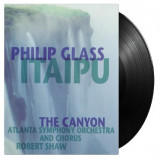
Itaipu, written by American composer Philip Glass, were commissioned by the Atlanta Symphony Orchestra and Chorus. Along with The Light (1987), they marked Glass’s continuation of a symphonic trilogy of “portraits of nature” as he had recently turned to making orchestral music. The composition pays a beautiful homage to the Itaipu Dam, which is the world’s largest hydroelectric dam built on the Paraná River between Paraguay and Brazil. The text was written in Guaraní, and translated by Daniela Thomas. The piece was first performed in 1989. This LP also includes The Canyon on the D-side, which was first performed in 1988 and commissioned by the Rotterdam Philharmonic Orchestra.
Itaipu and The Canyon are available on vinyl for the first time. It comes a in deluxe heavyweight sleeve with gloss laminate, and includes an insert with linernotes as well as the Philip Glass catalogue with info on the MOV Philip Glass series.
Australian award winning producer Plutonic Lab returns with a sophisticated, genre defying Double A Side Single ‘Blind Eyes’ and ‘Give It Up.’
Pluto brings together a strong list of talented artists: The soulful, smoky voice of Natalie Slade, New Zealand based Rwandan rapper Raiza Biza, and multi instrumentalist 8H.
The two tracks mark an intoxicating return for the producer, showcasing how he is able to bring together artists’ of diverse backgrounds and styles to display skills, restraint and synergy in a moment in time.
Plutonic Lab says, “I feel the sound of these two pieces have a great balance between electronic textures, acoustic instrumentation, jazz, tough beats and clout.”
The two songs are an example of Plutonic Lab’s collaborative, versatile nature and his ability to cross genres without limitations.
Plutonic Lab
Plutonic Lab has provided the backdrop for countless artists over a mammoth career spanning over two decades, collaborating with artists locally and internationally including Black Milk, Drapht, Hilltop Hoods, G-Love (US), Lanks, Guilty Simpson (US) and Wiley (UK).
Plutonic Lab’s 2016 LP “Deep Above The Noise” attained feature album status on Double J and Won “Best Hip-Hop Album’ at the AGE Music Victoria Awards 2016. Notably he produced Dialectrix’s 2013 album, “The Cold Light of Day” which was shortlisted for the Australian Music Prize, won the 2009 UK Mercury Prize for his work with Speech Debelle, and was nominated for ‘Best Urban Release’ at the 2008 ARIA Awards as half of the hip-hop duo Muph & Plutonic, who also placed 2 songs in the Triple J’s “Hottest 100.”
Pluto has toured across extensively across Australia, internationally and as tour drummer for Hilltop Hoods in the U.S, Canada, UK & Europe.
There’s something new under the sun. If you look at it closely,
something new is only (and always) created at crossroads –
when different and signi¦cant traditions are connected and
combined. On their own, these traditions have often existed
for a while. However, in this new form they have never
appeared together. The latest manifestation of something
new can now be found on the album “No Future Dubs”, the
interpretations of “No Future Days” – the most recent album
by German band Messer – by Finnish producer and old
friend of the group Kimmo Saastamoinen aka Toto Belmont.
The intentional traditions that merge on this grand and
digni¦ed album are post-punk, dub and techno. A new
chapter in the culturally constant narrative of dub is written
here. Through their past and parallel activities in hardcore
and post-punk bands, Messer drummer Philipp Wulf met and
befriended Kimmo, originally a drummer too. In their
continuous dialogue discussing their musical journey, Philipp
and Kimmo over the years more and more immersed
themselves in the aesthetic possibilities of dub and reggae.
Indeed, lots of musicians do not listen to the type of music at
home that they write and play in their respective projects
(Take me as an example: House is the music that I produce
and put on as a DJ. On my own, I listen to various stuff,
music by Monk and Messer for example). The same applies
to the protagonists involved here. By discussing dub und
through Toto Belmont’s steadily increasing producingexpertise, the idea of creating dub versions of selected
Messer tracks was born. The Messer album “No Future
Days”, released in 2020, proved to contain the perfect raw
material as the songs on this album are already produced in
a much more transparent way than on previous LPs – and
are hence more suitable for dub. Still, it’s a giant leap from
the originals to the dubs. These add a third dimension to the
described character of the post-punk/dub amalgam: techno.
The result is a sound that hasn’t existed before, especially
not with German lyrics (which scarcely, however, carry
meaning or messages here. Hendrik Otremba’s voice is used
more like an instrument, as if he was the ghostly ¦gure which
he often sings about and which now §oats and screams
through the sound space). The history of mutual contact and
in§uence of (post-)punk and dub (reggae), which Messer
have kept on writing, is glorious and reaches back far in
musical history. Still, it has always been a rather marginal
chapter not only in punk but also in dub history. But already
in the beginnings of punk (the British version, less the
American one), the presence and in§uence of reggae was
obvious in many places as both are united in their resolute
attitude as rebel music. This is how the two genres
recognized each other – especially the punks regarded
reggae as rebellious. As is known, already Johnny Rotten
mainly listened to dub in private. By using the name John
Lydon, he then – together with bass player Jah Wobble –
established the group PiL as one of the most exemplary
bands at the crossroads of dub and punk. The Slits, Pop
Group, Killing Joke, The Ruts and last but not least The Clash
along with the Mick Jones offshoot Big Audio Dynamite –
the thriving British music scene in the early 80s was full of
dub-in§uenced acts. The echoes meandered everywhere. In
the USA, it took longer until the in§uence of dub became
noticeable and it has never been as distinctive as in the UK.
The history of US hardcore, however, cannot be told without
bands like Bad Brains from Washington D.C. who on their
albums occasionally inserted conscious reggae and dub
tracks between breakneck hardcore tracks. Another
important group is Blind Idiot God who similarly included
dub tracks on their LPs – the contrast between densely
droning rock tunes and widely breathing dub versions can be
experienced very vividly here. In the 90s, dub’s in§uence on
post-punk decreased while turning up even more distinctively
somewhere else: Techno was in many respects susceptible
to dub, to say nothing of the music from the so-called British
hardcore continuum (jungle, drum & bass etc.), which directlydeveloped from dub and reggae. But also “pure” techno –
meaning techno without breakbeats – discovered its a¨nity
for the possibilities of dub at an early stage, in England for
instance in projects like Left¦eld or The Orb. In addition, the
project Rhythm & Sound was established in Berlin with close
ties to the Hardwax record store. With regard to this project,
you can’t really say where dub ends and where techno begins
(or vice versa) because of the interconnection of the two
genres here – everything is based on the steppers pulse
which links the two styles like a common DNA. With dub
techno a new genre was created. Until the present day, there
are producers who don’t produce anything else and DJs who
don’t put on any other music. The Messer dubs are
characterized by a grand majestic manner and force that
presumably someone like Mad Professor is able to produce
and that is also inherent in many Scandinavian productions
of the last 15 years; a crystal-clear aesthetic which locates
itself far away from Kingston or Brixton, but features a pulse
referring clearly to Berlin and Helsinki. The songs appear in a
completely new and deconstructed form, the instruments are
exclusively used as particles and raw material, not as riffs;
merely glaring guitar textures ¦ll the wide dub space. There
are many new elements that were added by Toto Belmont,
especially synthesizer sounds and drums. The ¦nal result
creates an enormous aesthetic power and dignity, and an
atmosphere you don’t want to leave anymore. “No Future” is
a well-chosen title as a reference to the protagonists’ punk
association; as a main thrust of the album, however, a
comma between these two words is imaginable as well.
Fresh off of their 2020 offering Adult Themes, El Michels Affair is back with a new full-length release. Titled Yeti Season, this newest album has everything we've come to expect from EMA's patented cinematic style of instrumental soul music. Where Adult Themes inspired a soundtrack to an imaginary film, Yeti Season brings us to a different place in time_with new inspirations. Taken with Turkish-styled funk and an almost Mumbai-esque take on soul, El Michels Affair offers us a different kind of drama and imagination with Yeti Season. If you've been following along, this shouldn't be viewed as too far a departure for El Michels Affair. The first single off of Yeti Season showed their hand back in 2018. A double-sided banger, that release brought the musical textures to the fore that dominate this record. The first song, titled "Unathi," is fully realized with the beautifully haunting-yet-hopeful vocals of Piya Malik, formally of 79.5_another Big Crown artist. Singing in Hindi, Piya's ethereal voice is telling us to work and strive together toward progress. Even if you don't understand her language, you can still hear the urgency of purpose, creating a lasting vibe that sits on top of it all. Leon Michels explains that Piya had a vital influence on this record: "When Piya started singing in Hindi, she had a different voice, a different tone. I knew we had to do something together." And so Piya appears on three other songs on Yeti Season: "Zaharila," "Murkit Gem," and "Dhuaan." Each providing particular signatures to the album. "Zaharila" is a building and changing love song punctuated by blaring trumpets, driving drums, and Piya's pleading lyrics. While the more upbeat "Murkit Gem" opens with a fuzzed out, Wu-Tang-esque baseline that buoys Piya's stylings. The psychedelic guitar and Piya's changing tones and textures singing about an all-consuming love are what pushed "Dhuaan" on to the second single from Yeti Season. There is also a vocal appearance from Shannon Wise of The Shacks, yet another Big Crown artist. Her song called "Sha Na Na," lies more in the familiar EMA vein: melodic, hypnotic, soulfully visual. But between Shannon's airy singing, the jumpy baseline, moody vibes, the active drum lines, it sounds like a pensive walk home after a strangely dramatic night. So what is Yeti Season? It could be more of a feeling than an actual place or time of year. It's a heavy album_as evidenced by the signature musicianship and dramatic vocal expressions. But it's also a hopeful record, with phrasings, textures, and chord changes that hint at something better_or fuller_coming our way. You hear it in songs like "Ala Vida," with its stabby, pulsing chords laying a bedrock for EMA's bright, atmospheric horn lines. Or even in "Fazed Out," which leaves you with a feeling of determination, a striving for resolution even though the driving, march-like song structure should accompany some conquering army. This persistence has to come from the fact that Leon Michels and company finished this record during the lockdown. It was a tough and troublesome time. But look at what has come of it: Yeti Season_a record of high and heavy drama, but also one of hope and promise. It may take a year like 2020 behind us to find hope in a winter big footed creature like a Yeti, but that's where we are.
On "Neon Genesis: Soul Into Matter²" Meemo Comma (a.k.a. Lara Rix-Martin) takes Kabbalistic text and Jewish prayer and guides them through twinkling ambient synths, breakbeats and cranking industrial noise, full of strange wonder and drama. You can hear soft synths transmuted into choirs of seraphim and moments of occulted dancefloor rapture, from Aramaic chanting and ravey breakbeats to readings from the Zohar. It is quite beautiful at times. Jewish mysticism is at the root of Western esoteric beliefs and therefore has formed the structure of many films and books that explore the question of humanity. Inspired by the visuals of Evangelion and nineties anime soundtracks such as Ghost In The Shell (and its later Stand Alone Complex series), the new Meemo Comma album is a soundtrack to an imaginary anime that, like its real counterparts (e.g. Full Metal Alchemist), takes the beautiful parts of Kabbalah and sets them to science fiction stories. When asked about the themes that inform her new album, Lara Rix-Martin says "Judaism is filled with many tales and teachings that prevail in science fiction to this day - whether consciously or not. Sci-Fi is the genre best equipped to explore the immensity and challenges of human experience. Something that Judaism has also been attempting for over three thousand years." "I watched Ghost in the Shell when I was 14 and it was so striking, visually and sonically. The soundtrack has acted as a backdrop to explore my Jewish identity. I have been reading the Talmud since last year, discovering a deeper love for Jewish stories and teachings. There are some beautiful, hopeful ideas in Kabbalah too, which were a central inspiration to this album such as the idea that the first human was non-gendered and just this form made up from the qualities of HaShem (God) who performed 'Tzimtzum', contracted their form using their Ein Sof (eternal light) to create 'Adam Kadmon' whose form split into all human souls." Lara playfully subheads her album: "In the year 5781 humanity is ever closer to becoming a singular consciousness. A team of humans are forming an android, Adam Kadmon (CODENAME: UNIT KADMON). First, humans have to gain higher consciousness guided by the Sefirot." While you don't have to know about these influences to enjoy the music, it stands true that the intention is an irreverent love letter to the way grand myths are birthed into the future through new forms, retaining their beauty and elegance.
Hannah Peel’s latest work "Fir Wave" contains re-interpretations of the original music of the 1972 KPM series featuring Delia Derbyshire and the Radiophonic Workshop.
The new album, a sonic shimmer of textures and pulses that switches between raw atmospheric edges and environments, arrives with a fascinating history. As Peel explains, “The specialist library label KPM, gave me permission to reinterpret the original music of the celebrated 1972 KPM 1000 series: Electrosonic, the music of Delia Derbyshire and the Radiophonic Workshop.” This process of re-generation and finding fresh inspiration in pioneering, experimental electronics from the early 1970s is at the core of the album. Peel has made connections and new patterns that mirror the Earth’s ecological cycles through music. Peel explains, “I’m drawn to the patterns around us and the cycles in life that will keep on evolving and transforming forever. Fir Wave is defined by its continuous environmental changes and there are so many connections to those patterns echoed in electronic music - it’s always an organic discovery of old and new.” As Delia Derbyshire revealed in 2000 to BBC sound engineer, journalist and academic Jo Hutton: “I like new things that don’t seem new . . . as though they’ve always been there.” Known more recently for curating and presenting on BBC Radio 3’s Night Tracks, the Northern Irish Emmy-nominated composer and producer’s work is ambitious and forward-looking, adapting and re-inventing new genres and hybrid musical forms.
Recent albums include the solo electronic and pop work of Awake But Always Dreaming, which became an ode to her grandmother’s mind as she lived with dementia; the electronic ruralism of Chalk Hill Blue, an album recorded with the poet Will Burns; and the space and the unparalleled vastness of Mary Casio: Journey to Cassiopeia, scored for synthesisers and a 30 piece colliery brass band. In 2019 she composed and recorded the soundtrack for Game of Thrones: The Last Watch which earned her an Emmy nomination for ‘Outstanding Music Composition For A Documentary Series Or Special (Original Dramatic Score)’.
It has occasionally been assumed that Henry Grimes got this December 28, 1965 recording date as a reward for his long service in the avant-garde of jazz. Having already honed his musical conception with a varied range of players, from Benny Goodman and Arnett Cobb to Lee Morgan, Gerry Mulligan, and Sonny Rollins to McCoy Tyner, Steve Lacy, Albert Ayler (including ESP 1020, Spirits Rejoice), Don Cherry, and Cecil Taylor (to name just a few), the service was certainly there, but he got this gig fully on his merits. For The Call Grimes teamed with highly original clarinetist Perry Robinson (as label owner Bernard Stollman has noted, "a virtuoso who merits far wider recognition...and this recording reflects both of their contributions, in equal measure") and stalwart drummer/ESP-Disk' regular Tom Price. As a bassist, Grimes's melodic style is well up to the task of being co-equal voice with a horn, resulting in a thoughtful and texturally rewarding LP with a level of quality far above the rote sideman session cliche, and far away from equally clichéd ideas of unrelentingly full-bore free jazz. It offers the sound of three excellent musicians listening to each other and responding superbly. The Juilliard-trained Grimes appeared on six other ESP LPs besides those already mentioned. He retired at some point after the last of them, 1967's Marzette Watts LP, and went so far off the scene that it was rumored that he had died. Happily, that was not the case, and he reemerged in 2003, moved back to New York, and returned to his prolific ways until illness slowed him down and then took him from us earlier this year (2020).
Legendary Sun Ra bassist Ronnie Boykins (1935 1980) stepped out on his own for his first and only release as a leader on The Will Come, Is Now. He was invited by ESP in 1964 to record his own album, and in February 1974, he told ESP that he was finally ready, and the session took place later that month. This recording not only features Boykins's solid abilities as a bassist, including his marvelous arco work, but also his talents as a composer and arranger. In addition, one is treated to an all natural bass sound, a rare sound during this particular era of jazz history. In septet format, Boykinss' six originals create a variety of moods and textures that not only evoke the music of Sun Ra but also reflect Boykins's own sensibilities as an artist. Original pressings, made just before ESP Disk' went on hiatus for forty years and thus less common than other ESP LPs, often go for upwards of $150. This limited edition of 500 is on black 180 gram vinyl and features the original artwork.
Nach einer fast sechsjährigen Pause und dem Auseinanderbrechen des audio-visuellen Trios, zu dem sich das Projekt über die Jahre entwickelt hatte, kehrt Origamibiro nun zurück. "Miscellany" bündelt eine Reihe an Arbeiten, die sich seit dem Release von Odham's Standard (2014) angesammelt haben. "Miscellany" umfasst eine abwechslungsreiche Mischung an Tracks, von elektro-akustischer bis hin zu orchestraler Kammermusik. Aufbauend auf dem einmaligen Style, für den Origamibiro bekannt wurde, verfolgt Hill weiterhin seinen DIY-Anspruch des Sampling und Komponieren, das auch heute noch eine zentrale Rolle in seinem kreativen Schaffen einnimmt. Die Erkundung der greifbaren Natur alltäglicher Objekte und Texturen - sowohl innerhalb als auch außerhalb der eigenen Wohnung - markiert ein Thema, das einen hohen Stellenwert in den Arbeiten von Origamibiro genießt. Brombeersträucher aus dem Wald als auch Spielzeug-Eier aus Plastik werden mit chirurgischem Detail untersucht und mit dem Schmutz demolierter Klavierteile vereint, mit dem Ziel, neue und unerwartbare Klang-Potentiale zu entdecken. Obwohl sich Hill auf seine Anfänge konzentriert, hat er seine Palette an Instrumenten erweitert: Viola da gamba, Klavier, Zither, Klangschale, Glockenspiel, Drum-Machines und Gongs ermöglichen es Hill, eine weitaus breitere Klanglandschaft zu kreieren.
- A1: Bring It On
- A2: Guitar In The Corner
- A3: The Wall
- A4: Whenever You Come Around
- A5: Wives And Girlfriends
- A6: I Thought I Left You
- A7: Send Me A Picture
- B1: Used To Her
- B2: The Git Go (With Jamey Johnson)
- B3: Band Of Brothers
- B4: Hard To Be An Outlaw
- B5: Crazy Like Me
- B6: The Songwriters
- B7: I’ve Got A Lo T Of Traveling To Do
Band Of Brothers is the 63rd studio album by country music singer songwriter Willie Nelson. Produced by Buddy Cannon, the album was recorded by Nelson in October 2013 and March 2014. The sessions took place at Nashville’s Sound Emporium Studios with additional recordings at Pedernales Studio in Austin, Texas and The Hit Factory Criteria in Miami, Florida.
Nine of the fourteen tracks of the album consist of newly written compositions by Nelson, the most included in one of his album releases since 1996’s Spirit. The album includes covers of Vince Gill’s “Whenever You Come Around”, Gordie Sampson’s “Songwriter” and a duet with Jamey Johnson of Billy Joe Shaver’s “The Git Go”.
The video for the first single, “The Wall” premiered on May 6, 2014 by Rolling
Stone. The single “Bring It On” was later premiered on June 3 by ESPN Music.
Now available as a limited edition of 1000 numbered copies on transparent blue vinyl.
LTD. CLEAR BLUE VINYL
Fresh off of their 2020 offering Adult Themes, El Michels Affair is back with a new full-length release. Titled Yeti Season, this newest album has everything we've come to expect from EMA's patented cinematic style of instrumental soul music. Where Adult Themes inspired a soundtrack to an imaginary film, Yeti Season brings us to a different place in time_with new inspirations. Taken with Turkish-styled funk and an almost Mumbai-esque take on soul, El Michels Affair offers us a different kind of drama and imagination with Yeti Season. If you've been following along, this shouldn't be viewed as too far a departure for El Michels Affair. The first single off of Yeti Season showed their hand back in 2018. A double-sided banger, that release brought the musical textures to the fore that dominate this record. The first song, titled "Unathi," is fully realized with the beautifully haunting-yet-hopeful vocals of Piya Malik, formally of 79.5_another Big Crown artist. Singing in Hindi, Piya's ethereal voice is telling us to work and strive together toward progress. Even if you don't understand her language, you can still hear the urgency of purpose, creating a lasting vibe that sits on top of it all. Leon Michels explains that Piya had a vital influence on this record: "When Piya started singing in Hindi, she had a different voice, a different tone. I knew we had to do something together." And so Piya appears on three other songs on Yeti Season: "Zaharila," "Murkit Gem," and "Dhuaan." Each providing particular signatures to the album. "Zaharila" is a building and changing love song punctuated by blaring trumpets, driving drums, and Piya's pleading lyrics. While the more upbeat "Murkit Gem" opens with a fuzzed out, Wu-Tang-esque baseline that buoys Piya's stylings. The psychedelic guitar and Piya's changing tones and textures singing about an all-consuming love are what pushed "Dhuaan" on to the second single from Yeti Season. There is also a vocal appearance from Shannon Wise of The Shacks, yet another Big Crown artist. Her song called "Sha Na Na," lies more in the familiar EMA vein: melodic, hypnotic, soulfully visual. But between Shannon's airy singing, the jumpy baseline, moody vibes, the active drum lines, it sounds like a pensive walk home after a strangely dramatic night. So what is Yeti Season? It could be more of a feeling than an actual place or time of year. It's a heavy album_as evidenced by the signature musicianship and dramatic vocal expressions. But it's also a hopeful record, with phrasings, textures, and chord changes that hint at something better_or fuller_coming our way. You hear it in songs like "Ala Vida," with its stabby, pulsing chords laying a bedrock for EMA's bright, atmospheric horn lines. Or even in "Fazed Out," which leaves you with a feeling of determination, a striving for resolution even though the driving, march-like song structure should accompany some conquering army. This persistence has to come from the fact that Leon Michels and company finished this record during the lockdown. It was a tough and troublesome time. But look at what has come of it: Yeti Season_a record of high and heavy drama, but also one of hope and promise. It may take a year like 2020 behind us to find hope in a winter big footed creature like a Yeti, but that's where we are.
- A1: Engineering Systems
- A2: The Latent Space
- A3: Speech & Ambulation
- B1: Thousand To One
- B2: Walking & Talking
- B3: Youmachine
- C1: Doublekeyrock
- C2: Machine Rights
- C3: Go Tick
- C4: The Fear Of Machines
- C5: Artificial Authentic
- C6: Machine Perspective
- C7: Cut That Fishernet
- D1: Tools Use Tools
- D2: Loose Tools
- D3: Seven Months
- D4: Paymig
- D5: Borrow Signs
- D6: New Definitions
- D7: New Life Always Announces Itself Through Sound
Mouse on Mars, the Berlin-based duo of Jan St. Werner and Andi Toma, approach electronic music with an inexhaustible curiosity and unparalleled ingenuity. ‘AAI’ (Anarchic Artificial Intelligence) takes their fascination with technology and undogmatic exploration a quantum leap further.
Emerging from a primordial ooze of rolling bass and skittering electronics, hypnotic polyrhythms and pulsing synthesizers propel the listener across the
record’s expanse. Hidden in the duo’s hyper-detailed productions is a kind of meta-narrative.
Working with AI tech collective Birds on Mars and former Soundcloud
programmers Ranny Keddo and Derrek Kindle, the duo collaborated on the creation of bespoke software capable of modelling speech; text and voice from writer and scholar of African Studies Louis Chude-Sokei and DJ/producer Yağmur Uçkunkaya were fed into the software as a model, allowing Toma and Werner to control parameters like speed or mood, thereby creating a kind of speech
instrument they could control and play as they would a synthesizer.
The album’s narrative is quite literally mirrored in the music - the sound of an artificial intelligence growing, learning and speaking. This exploration of artificial intelligence as both a narrative framework and compositional tool, allowing the duo to summon their most explicitly science-fiction work to date. Original artwork by Casey Reas, inventor of the computer graphics language Processing.
Recently, Mouse on Mars received the 2020 Holger Czukay Prize for Pop Music.
Mouse on Mars have been regularly streaming performances throughout 2020, partnering with organizations like Goethe-Institut, Haus der Kulturen der Welt, Conditions of a Necessity and others and will continue these in 2021.
‘AAI’ is available on grey or black double LP packaged in a single sleeve with full colour insert / lyrics. CD comes with 8-panel poster booklet.
“Andi Toma and Jan St. Werner continue to create soundscapes that blur the line between programming and live musicianship, and sometimes between Earth and outer space.” - AV Club
“Enthralling and impossible to categorize.” - Pitchfork
“Sustained and ephemeral electronic sounds conjure unearthly open spaces… It’s not a song; it’s sound as a temporal phenomenon, a few minutes of sculpted attention.” - The New York Times
Statistique Synthétique draws as much from the history of computer sound synthesis as from its latest developments. But well beyond developing simply as a proof of concept, this piece aims to transcend the abstract status of synthetic sound objects and lead them to a properly hallucinatory state, that is to say to a meeting point where the object and perception dissolve into each other, in a sort of transcendental field. Beyond, also, hylomorphism, to reach the world of matter-form fusions, where perception knows how to see "shoulders of hills", as Cézanne wrote.
Teum (the Silvery Slit) is, as the title suggests, an overture, an opening to the game of multiplications, fragmentations, duplications. But it is also the opening understood as the void that blossoms between two borders, a break from which escapes a double tension, both the pulling force of these two edges which move apart and the opposite force of reconciliation, of compression. Okkyung Lee invites us to a truly telluric moment, a rare moment of expression where tectonic movements and shear stresses become music. If the earthquakes were, as we thought in the 18th century, due to underground thunderstorms, there is no doubt that this piece of music, both celestial and continental, could have been their audible manifestation.
Text by François Bonnet
HeckerStatistique Synthétique2020 / 25'15Computer-generated sound with resynthesized situated texture recordingsWritten and produced by Florian Hecker, 2019 - 2020Texture analysis and resynthesis algorithm: Axel Röbel, Analysis/Synthesis Team, IRCAM, ParisMastered by Rashad BeckerPhoto by Mauricio Guillén, 2019
Thanks to Axel Röbel for his commitment to the project and special appreciation to GRM, Luke Fowler, Mauricio Guillén, Dirk Mayer and Porta33
Location Texture Recordings, using DPA 4060, DPA 4017B, DPA 4021 and DPA 4060 microphones to Sound Devices 702 recorder; except segment 04:31 - 05:37, recorded by Luke Fowler, April 2019 using Sony M10.
00:00 - 02:00 Lopud, Croatia, June 200802:00 - 03:12 Ponta do Sol, Madeira, ER 101, April 201903:12 - 04:14 Prentiss St, Cambridge, MA, February 201504:14 - 04:31 Anjos, Ponta do Sol, Madeira, ER 101, April 201904:31 - 05:37 Atelier Cézanne, Aix-en-Provence, April 201905:37 - 08:31 Anjos, Ponta do Sol, Madeira, ER 101, April 201908:31 - 09:46 Praia dos Anjos, Ponta do Sol, Madeira, ER 101, April 201909:46 - 10:39 Private garden, Kissing, September 200910:39 - 11:15 Praia dos Anjos, Ponta do Sol, Madeira, ER 101, April 201911:15 - 15:11 Porto do Paul do Mar, Calheta, Madeira, April 201915:11 - 16:53 Prinz Eugen Strasse, Vienna, June 200816:53 - 24:27 Risco, Rabaçal, Madeira, April 201924:27 - 25:15 Bois de Boulogne, Avenue du Mahatma Gandhi, Paris, September 2015
:::::::::::::::::::::::::::::
Okkyung LeeTeum (the Silvery Slit)2019 / 20'03Performed, recorded and composed by Okkyung Lee (ASCAP)Mixed by Lasse MarhaugMastered by Guuseppe IelasiPhoto by Lasse MarhaugPart of Re-Imagine Europe, co-funded by the Creative Europe Programme of the European Union.
Cut by Andreas Kauffelt at Schnittstelle, Berlin, September 2020Sleeve design by Stephen O'Malley
Star Composer of the 1960s (Les Tontons Flingueurs, Fantômas, Angélique marquise des anges), Michel Magne was caught in 1974 in the bankruptcy of his recording studio in Hérouville. He then launches to the lyricist Boris Bergman: “Nothing works, let’s make a great religious record!”
The result will be a mystical-psychedelic bombshell, where Magne amalgamates Jewish, Arad and African music with pop rhythms. A year after their collaboration on Roger Vadim’s Don Juan 73, Bergman offers him texts that function like a modern tale, carried by the abrasive voice of New York bluesman Artie Kaplan, creator of the smashing Bensonhorst Blues. Released in indifference in late 74, Moshe Mouse Crucifixion is resurrected today, remastered up close. Its modernity is more contemporary than ever. “All the current
mergers, from north to south, east to west, already seem to be present” confirms Boris Bergman. Moshe Mouse Crucifixion is more than an album, it’s the missing link in French pop.