This very special reissue celebrates the 21st anniversary of the release of Argentinian Juana Molina’s breakthrough album ‘Segundo’ in 2000.
It has been remastered from the original tapes, and augmented with a rich 32-page booklet recounting the eventful start of Juana’s musical career, and containing numerous notes, anecdotes, original drawings and previously unreleased pictures.
Contributors to the booklet include Bruce Springsteen’s producer Ron Aniello, Domino Recording’s Laurence Bell and David Byrne who, when he discovered the album, immediately invited Juana to open for him on his 2003 US tour.
‘Segundo’ started Juana Molina’s international trajectory as a musician. After dropping a highly-successful career as a TV comedian, she turned to music making. Regretting signing with a major company, who got her to record an over-produced debut album, she resolved to find her own direction in music.
The result was ‘Segundo’ that took 4 years to make involving sessions in Argentina and the USA.
Segundo’ finally came out on a small label in Argentina in 2000, found its way to Japan where it spectacularly took off, and was eventually picked up by the Domino label in 2003. Its reception set Juana Molina on course for performing around the globe, garnering a large, devoted fan base, and going on to record five more extraordinary studio albums.
Поиск:ment
Все
With Bending the Golden Hour, the third album from Memphis, Tennessee’s Aquarian Blood, husband and wife team J.B. Horrell (Ex-Cult) and Laurel Horrell (formerly of the Nots) continue the gorgeously stripped-down and atmospheric direction set on their critically acclaimed previous effort A Love That Leads to War.
While Aquarian Blood has roots as a chaotic punk rock six-piece, the band shifted gears after two raucous cassette-only releases on ZAP Cassettes, a pair of seven-inches, and 2017’s Last Nite in Paradise, released on Goner Records. After drummer Bill Curry broke his arm, the Horrells redefined
Aquarian Blood, reemerging in early 2018 as the more intimate, mostly acoustic balladeers behind the staccato, fever dream sound of A Love That Leads to War. Like its immediate predecessor, Bending the Golden Hour was recorded at the Horrell's Midtown Memphis home. The band turned over 43 tracks to Goner co-owner Zac Ives, who handpicked 17 songs for the album.
The final result is shimmering and hopeful; as beautiful and sparse as a Rockwell Kent snowscape. Bending the Golden Hour begins ominously with “Channeling,” which sounds like an outtake from Paul Giovanni’s soundtrack to 1973’s pagan nightmare The Wicker Man. Then the band upshifts for “Time in the Rain,” a sweet duet set to a rigid snare beat. From there, Aquarian Blood zigs to country and zags to psychedelic folk, brooding on one song and soothing listeners with the next. And while the music, feel, and experience is different, Aquarian Blood naturally brings to mind some legendary musical partnerships: Richard and Linda Thompson, Lee Hazlewood and Nancy Sinatra, Johnny and June Carter Cash, Gram Parsons and Emmylou Harris; not to mention similarly-bent-but-beautiful luminaries like Roy Harper, Pentangle circa 1967 -1973, and Jackson C. Frank.
There’s a big middle ground, like folk-psych, or weirder country music,” he says, reeling off names like Skip Spence and Syd Barrett as stepping stones between the genres of punk and folk.
Inspirations for Bending the Golden Hour come from myriad sources that document the milestones and minutiae in a family’s full life. Some lyrics name a time or a place; others reflect the fleeting moments that elapse unnoticed. “Come Home,” which is sung by J.B. and his daughter Ava, was written the day Ava got her driver’s license. “Ava took the car out by herself afterwards, and I wrote the song immediately—she sang her part when she got home that evening,” J.B. recalls. Whether or not the listener knows the backstory, the song rings sentimental, with subtle, supportive instrumentation that underscores guitar and vocals. The bewitching “Rope and Hair,” on the other hand, is less sketched out, with lyrics that are simply a recitation of the talismen found on a silver sabertooth charm that J.B. purchased for Laurel at a Latin strip mall in southeast Memphis. That’s all to be said. “Sometimes when you know too much about what the song is about, it takes away the magic,” says J.B. “Alabama Daughter,” says Laurel, is about a place where a childhood friend lived called Castleberry Holler. “It was really rural, just a lot of shacks without electricity—the kind of place you didn’t go to unless you were invited,” she says. “Probable Gods” is a hazy reflection on the struggle of such a strange year. “It’s been very cathartic to put all of this into words and not have it live
For fans of AMON DÜÜL, CAN, FAUST, NEUBAUTEN, BRIAN ENO, CLUSTER, CULT OF LUNA, NINE INCH NAILS, MASSIVE ATTACK OR - Norwegian for "dizzy, confusing" - is the third album from Italian avant-rock trio OSLO TAPES, and the album keeps what the word promises: a dizzying ride through a feverish dreamscape of imaginary Norwegian highlands painted in cubistic shapes. Hypnotic basslines, repetitive drum patterns, new wave synths and psychedelic guitar textures covering the full width of the stereo room, all seamlessly woven into a gloomy Kraut - tapestry which sounds refreshingly_ modern, while paying tribute to the aged genre. Marco Campitelli, born and raised in Lanciano on the Southern Adriatic coast of Italy, founded OSLO TAPES in the early 2010s after a trip to the Norwegian Capital left him deeply impressed. Under the influence of this infatuation, he composed and produced OSLO TAPES' first record "OT (un cuore in pasto a pesci con teste di cane)" within a week in 2013. Supervised and supported by friend Amaury Cambuzat (faUSt / Ulan Bator), Campitelli's first attempt to capture the mystical vibe of Norway was released on DeAmbula Records (Ulan Bator, The Marigold, 7C). In 2015 he was joined by Mauro Spada and Federico Sergente (Zippo) and together they recorded OSLO TAPES' sophomore album "Tango Kalashnikov", also released on DeAmbula Records. "OR" is a much more collaborative effort for OSLO TAPES than the first two records. Next to Campitelli, the album was co-produced by Amaury Cambuzat (Ulan Bator) and James Aparicio (house engineer for Mute Records and mixing and mastering engineer for Depeche Mode, Mogwai, Nick Cave). During production, Campitelli became friends with Emil Nikolaisen of Serena Maneesh w h o guided him "through the Norwegian imagination". As a result, the record's title is also courtesy of Nikolaisen. During this journey spanning over eight songs, OSLO TAPES, completed by Mauro Spada (bass) and Davide Di Virgilio (drums and percussions) construct a dense and ever so dark atmosphere that is captivating, brooding and imaginative. After a spiraling takeoff with "Space is the place", we find ourselves floating weightlessly above the nocturnal Norwegian highlands through "Zenith" and "Kosmik Feels", an airy circulation of jazzy drums, pulsating bass lines and shimmering guitar clouds. We saddle up, gallop across the sky on "Bodo Dakar" and drift back into the night on "Cosmonaut". The trifecta of "Norwegian Dream", "Exotic Dreams" and "Obession Is The Mother of All" conclude this agitated fever dream journey. There is a sense of solitude in OSLO TAPES' compositions which makes it easy to imagine them as interstellar jam sessions between cosmonauts, each in their own isolated space capsule. Every spin of "OR" brings new discoveries: sometimes it is a noise that we did not notice before, sometimes a slight change in the drum groove, sometimes just a piece of the lyrics, meandering through our mental space. "OR" is a vertiginious journey to be remembered - and repeated. "The focus of Oslo Tapes is to harmonize the noise" says Marco Campitelli.
“Any other singer can sing a love song and the audience will think about lovers lost and found. When I sing a love song it is a metaphor for the yearning of a subjugated people to be free.”
Miriam Makeba’s ‘Keep Me In Mind’ was her last album for Reprise and reflected major changes in both her own personal life and politically within the USA. After becoming a national star globally following the success of ‘Pata Pata’ in 1967, she had fallen out publicly with her mentor and ‘Big Brother’, Harry Belafonte. Makeba made the decision to return to Africa following an invitation from President Sékou Touré of Guinea. In Conakry, Makeba met Stokely Carmichael, President of civil rights organisation the SNCC and they would later marry. “With the Vietnam War, the student protests and the riots in the ghettos, everyone is scared,” Makeba said. “Everyone is afraid that there will be a great black uprising.” Makeba’s concerts were widely cancelled and both her and Carmichael were followed relentlessly by the FBI.
Reprise also terminated her contract but brought in producer Lewis Merenstein for her final recording for the label, best known for his work with Van Morrison on ‘Astral Weeks’. Merenstein suggested two Van songs for Makeba to cover, ‘Brand New Day’ from the ‘Moondance’ sessions and ‘I Shall Sing’ and further songs were added to reflect both the political climate and Makeba’s own memories including Stephen Stills’ ‘For What It’s Worth’ and Lennon & McCartney’s wistful ‘In My Life’. New compositions by Makeba and her daughter Bongi included ‘Lumumba’, a personal tribute to Congolese independence leader, Patrice Lumumba. Reflective of the times, the album is infused with a palpable despair but, as in all of her music, a quiet determination still shines through.
This new reissue of ‘Keep Me In Mind’ is presented in its original artwork and features rare photos and new extensive liner notes by Francis Gooding of The Wire. Remastered from the original tapes by The Carvery.
- Definitive edition of Miriam Makeba’s final album for Reprise in 1970
- Remastered by The Carvery from original reel to reel tapes
- 1LP and 1CD feature brand new sleeve notes by Francis Gooding of The Wire + rare photos
Miriam Makeba's 'Keep Me In Mind' was her last album for Reprise and reflected major changes in both her own personal life and politically within the USA. After becoming a national star globally following the success of 'Pata Pata' in 1967, she had fallen out publicly with her mentor and 'Big Brother', Harry Belafonte. Makeba made the decision to return to Africa following an invitation from President Sékou Touré of Guinea. In Conakry, Makeba met Stokely Carmichael, President of civil rights organisation the SNCC and they would later marry. "With the Vietnam War, the student protests and the riots in the ghettos, everyone isscared," Makeba said. "Everyone is afraid that there will be a great black uprising." Makeba's concerts were widely cancelled and both her and Carmichael were followed relentlessly by the FBI. Reprise also terminated her contract but brought in producer Lewis Merenstein for her final recording for the label, best known for his work with Van Morrison on 'Astral Weeks'. Merenstein suggested two Van songs for Makeba to cover, 'Brand New Day' from the 'Moondance' sessions and 'I Shall Sing' and further songs were added to reflect both the political climate and Makeba's own memories including Stephen Stills' 'For What It's Worth' and Lennon &McCartney's wistful 'In My Life'. New compositions by Makeba and her daughter Bongi included 'Lumumba', a personal tribute to Congolese independence leader, Patrice Lumumba. Reflective of the times, the album is infused with apalpable despair but, as in all of her music, a quiet determination still shines through.
After the first two Earthly Tapes & a handful of EPs, Earthly Measures drops its first full-length album with Mente Organica’s El Espacio - a beautifully crafted album with glorious textures, steady grooves, calming vibes & a dancefloor filler or two.
Born in Bogotá, Colombia – producer & multi-instrumentalist Mente Organica has slowly been making a name for himself within the folktronica/Latin scene. Following multiple album and EP releases over the past few years, El Espacio marks his first release on wax and the music stands out from anything he has done before. These 8 tracks surprise & reward the listener as individual harmonies at first, and finally, as a whole and immersive symphony.
From 'Pablo Bebe’, a track he wrote which is inspired & dedicated to his best friend – to ‘Close the Door’, written in the depths of quarantine, reflecting isolation, loneliness & introspection, & ‘Yoga’ - a song written with his father that can be easily heard filling the dancefloor as well as easy bedroom sessions, this album truly does feel like his most personal work yet.
Eagle’- an utterly unique track born in Pucon, Chile, after meeting opera singer Katy Prado - blends sensibilities of 60s psychedelic rock vocals with Mente’s signature electronica. ‘Dame Un Segundo’ is the lobby track of the album, with Balearic vibes: chilled, jazzy & floaty. Title track ‘El Espacio’ pays homage to Mente’s influences growing up - think Massive Attack, Thievery Corporation & Air - giving us that Trip Hop vibe. ‘Huanini’ is a real groover - a low-key dance track that evokes that ‘start of the night’ feeling of excitement, with heavy experimentation of granular synths.
Finally, rounding the album off with melodies of hope, delight and positivity, ‘Partida’ reminds us that there is always light at the end of the tunnel.
If you mention the name of Metamorfosi in front of any fan of Italian progressive rock, you get a unique effect: awe, wonder, united to the memory of the masterpiece that firmly established them as fundamental exponents of the genre. We are obviously talking of "Inferno", published in January 1973 and inspired by the eponymous first poem of the Divine Comedy by Dante Alighieri.
But the musical maturity of "Inferno" had not come immediately, at least not in discographic terms, as it happened for example in the case of Alphataurus, Biglietto per l’Inferno and Campo di Marte, typical meteors of Italian prog that made their debut with a bang and then dissolved into thin air for decades. In fact, Metamorfosi debuted with a work that was indeed less complete, but not negligible.
“...e fu il sesto giorno” is born after two years of gestation, since the singer Jimmy Spitaleri joined the band I Frammenti in 1970. It is the period of maximum splendour for the music which at the time was called ‘avant-garde pop’ and that only later would be labeled as ‘progressive rock’, a music scene in which the Metamorfosi of the beginning just partially fit in as they were partly still anchored to old beat styles, and as they engaged in the exaltation of the Catholic faith at the textual level. The religious content of the album is substantially unequivocal from the cover, in which Jimmy Spitaleri is portrayed in a symbolic laying on of hands to the rest of the band, his disciples and fellow adventurers.
If it is true that the weakness of the Italian prog scene has always been found in the singing, Spitaleri is a notable exception, who does not show any shortcoming throughout the disc. In addition, some elements - the guitar solos, the interventions of flute and keyboards, a solid rhythmic base, a sometimes unpredictable song structure - anticipate what will come from there after a few months. "...e fu il sesto giorno" is, therefore, contrary to what is often said, a major premise, a flower waiting to bloom and show everyone its own beauty.
- A1: There Is No End
- A2: Rich Black (Feat Koreatown Oddity)
- A3: Coonta Kinte (Feat Zelooperz)
- A4: One Inna Million (Feat Lava La Rue)
- B1: Stumbling Down (Feat Sampa The Great)
- B2: Crushed Grapes (Feat Lord Jah-Monte Ogbon)
- B3: Gang On Holiday (Em I Go We?)
- C1: Mau Mau (Feat Nah Eeto)
- C2: Tres Magnifique (Feat Tsunami)
- C3: Hurt Your Soul (Feat Nate Bone)
- D1: Cosmosis (Feat Okri & Skepta)
- D2: My Own (Feat Marlowe)
The wisdom of Tony Allen's words was as deep as his grooves, and these two sentences, which announce the dozen songs that follow, truly capture the spirit of There is No End. Tony’s motivating concept and desire was to work with younger artists, and especially the new generation of rappers, and give them voice in a time of global turmoil when music has never been more important – not necessarily as a "weapon" for the future in the manner of Fela's violently political songs, but also as medicine to heal a fractured world today.
For all those who knew him, he was a deeply spiritual man whose life's mission was not just to create a new musical language, but to pass it on to subsequent generations. In thinking back on the incredible process of creating this album without Tony physically present to guide him, producer Vincent Taeger remarked that his friend and mentor "was a teacher without speaking... a drummer and a guardian, with a great artistic vision and that vision filled the songs even after he had left us." Ben Okri, like everyone else involved in this valedictory album, had a very similar experience, declaring in awe that "this man could have lived another 150 years and kept creating new worlds. He had become the master shaman of his art. He knew himself and his mind. He wanted the album to be open to the energies of a new generation... but like a great mathematician or scientist who found a code of for a new world, with just a few beats, he created this extraordinary canvas." Featured artists include Skepta, Sampa The Great, Lava La Rue, Danny Brown, Damon Albarn and many others
For our 7th release we are delighted to be reissuing a single that has brought us a lot of joy in recent times. We first came to hear Delores Fuller’s beautiful single One More Chance Lord in the same way we have heard a lot of new music over the last year and a half – through a friend’s lockdown recommendation. Ever since, the single has been a staple in our collection and permanently on our turntable.Perfectly transcending the genres of gospel, modern soul and disco. One More Chance Lord kicks it off with a piano riff that’ll be stuck in your head for days, building to a soaring chorus with lyrics that would fit any uplifting category. My Greatest Desire on the flip, is a ballad reflecting Delores’ vocal talents. Stripped back with only the piano for accompaniment. Delores singing about values of life - “not searching for riches, not hungry for fame”. Perhaps inadvertently explaining why this single has never had the prominence it so deserves.
The single was originally released in 1983 on Intro Records, a US based label predominately active throughout the 1980s. After a little diggin’ we reached out to Dwain Jones who duly licensed us the both sides and informed us that the single features a truly amazing arrange of musicians. Stanley Banks; bassist on classics albums such as George Benson’s Breezin’, Jonathan DuBose, guitarist with renowned gospel group The Clark Sisters and not to mention Pee Wee Ellis; James Browns band leader in the late 1960s who’s sax can be found peppered throughout Delores’ album God’s Love.Remastered and now available again on the teal green label of Miles Away. Limited 500 pressing and set for release on 21st May. Get one quick!
Aparde’s new album, Alliance sees the German
musician retreat from his recent experimentations
with avant-gard pop music back into the world of
deep, and oftentimes dark, electronica. For his
previous album, Hands Rest, Aparde ventured
outside Berlin’s club scene through the use of his
voice, which gave his music a softer and more
intimate edge. Alliance is no less intimate, except
this time the musician’s vulnerability seeps through
the cracks rather than taking center stage.
As impressive sonically as it is technically, Aparde
used a mixture of electronic sounds, analogue
equipment and his own voice either as a sound
element or lyrical component to explore this duality
of sound. “This album was about focusing on
something that calmed me down and brought me
away from reality,” says Aparde. When the musician
says ‘away from reality’, he doesn’t mean into
dreamy, ethereal soundscapes, but rather a deep
dive into dystopian atmospheres of drone sounds
and chewed-up drum machines. Alliance’s second
track, Allies has a dire beginning and one might
even be tempted in skipping it if it weren’t for
Aparde’s hushed voice shining through the
shadows, melancholic yes, but also warm. Despite
the album’s focus on electronic gear the music isn’t
exactly dance-able, tracks have a ruminative pace,brooding even, “I wanted to make the tracks with
more breathing space between the atmosphere
and silence. There are fewer elements but more
impact, I think,” says Aparde.
Things change gears toward the middle of
Alliance, with both Lined and The Shift representing
the colder, club-ier tracks of the album. For
both of these tunes, any emotionality gets
converted into a dense and thumping energy that
is released in a cathartic fashion. It is, as Aparde
describes, music “for you to move to when you
have a good moment or a mental crisis”. But
Aparde doesn’t leave it at that frequency; he closes
off the album courageously by letting listeners in,
once again, to his own world and emotions. While
still a driving electronic track, Hole is framed
around melancholic piano keys that bring the
mood down, and prepare listeners for Know you,
the album’s most intimate, and vulnerable piece. “I
never felt alright,” Aparde admits open-heartedly
on the track.
With Alliance, Aparde brings listeners deep into
his soul, a soul that is at times conflicted and
agitated and at times low-key and solemn. And as
he does so, the listener’s own mood is muted and
lifted in a journey of quest, dance and healing.
Born in San Francisco, Rickey Kelly moved to Los Angeles in 1982.
I first heard Rickey on the local Jazz station and that haunting sound on vibes was just too much to resist. He was working at Hughes Aircraft and didn't have time for gigging in the evening. He had to take care of his family which numbered about six children. I began booking his band soon after meeting him. An artist this blessed should not be working a day job I thought. Rickey soon quit his job at Hughes aircraft and began performing full time. Rickey stayed in his apartment for long periods of time just practising. He often mentioned to me that he needed to stay in isolation to keep his music pure. During Rickey's stay in L.A. he had worked with all the great jazz and R @ B bands. Musicians like altoist Bobby Watson, the legendary drummer Billy Higgins, The Jazz Crusaders, pianist Ahmad Jamal, and one of the most popular artists of his generation Marvin Gaye, often called on Rickey to perform with their bands. As great as these artists were, the addition of Rickey Kelly on vibes seemed to make their music better.Because of his isolation Rickey's music has developed a uniqueness and purity of sound that transcends styles. One reviewer described it as a "childlike quality, a profound innocence”. Relax and listen closely. This is music with a purpose
- 01: There&Apos;S No One Who&Apos;S Got Your Back
- 02: Dancing Takes Away My Anger. That&Apos;S Why I Do It
- 03: We Were Just Being Twats. That&Apos;S All Me And Sam Ever Do
- 04: Something Needs To Go In About Our Kids
- 05: They Told Me I&Apos;D Be In Prison When I Was 16
- 06: I&Apos;D Like To Go To Space Because I&Apos;M Really Curious
- 07: In This Little Container Is A Roll Of Film From The Camera
- 08: The Sky Going Into Three Different Colours
- 09: If You&Apos;Ve Got Money, You&Apos;Ll Make It
INTERMISSION MUSIC is the soundtrack to An Intermission, an artists film by Edwin Mingard made in collaboration with a group of young people experiencing homelessness in Stoke-on-Trent, England. Like the film, the soundtrack was made collaboratively by the group, working with Edwin and composer Tom Haines.
ALL PROFITS from the soundtrack go to a dedicated fund to support the young people as they take their next steps in life. All partners have worked for free or at cost to make sure this is as much of the cover price as possible.
The film won Jury Special Mention at IDFA, the world's most prestigious documentary festival; was selected for New Contemporaries, and longlisted for the Aesthetica Art Prize. In 2021 it is screening at the London Short Film Festival; Future Now Symposium; and is being exhibited at South London Gallery from May 2021.The soundtrack is being showcased on all these platforms.
The Guardian are releasing the film in 2021. Their documentaries consistently receive tens of thousands of views, and the release of INTERMISSION MUSIC will be highlighted here also.
Chronos is the new album by Rostock´s composer Johann Pätzold aka Secret of Elements - a heartfelt, richly visual journey through which the German composer channels personal struggles alongside the social upheavals to which he has dedicated himself as a 'music activist'.
Textextext - (add your write up)
Chronos charts an eventful period during which Pätzold learned to deal with mental illness, travelled to the Mediterranean to save lives during the refugee crisis, fell in love and lost love - ten years is a long time. The album tells of people, moments or phases from the musician's life. It opens with the ominous melodies and immersive choral ambience of 'Grace', which reflects on a friend's suicide attempt, before riding the euphoria of Pätzold's wedding and the birth of his children in 'A Last Waltz.'
Third track 'Memento' narrates the epic journey of a refugee Syrian mother whom Pätzold accompanied from Greece to Germany, its emotive swells and subtle crescendo evoking simultaneously the dawning of a new world and the melancholy of what has been left behind. 'Vinculum', built around an Indian mantra, also dates from the same period and was written as a last tribute to a small child who drowned in the Mediterranean. The piece combines church organ - renown as part of Christian music, and indeed recorded in the Marienkirche in Gnoien on an original 18th century Lütkemüller organ - with a mantra, seeking to unite various religious symbols in an attempt at reconciliation in the face of unimaginable tragedy.
Propelled by mechanical percussion, 'Rage' uses the Shepard scale, a musical phenomenon in which two cyclically rising octaves are played on top of each other in a staggered fashion to create the illusion of an infinitely swelling scale, perfectly mirroring the image of blind spiralling, hysterical anger. When we arrive at 'Aurora, we feel Pätzold musing about the end of the world, but also the end of the self. What remains when humanity is wiped out by a pandemic or something similar? In Johann Pätzold's case, what remains is, among other things, a monumental album, a musical chronicle of his life: Chronos.
1979 gelang mit der Single 'The Nips Are Getting Bigger' und dem Album ‚Get Wet' das erste Mal der Einstieg in die Top 20 der australischen Charts. Für die Single gab es nach Veröffentlichung in Großbritannien eine Platzierung in den Top 40 der Independent-Charts. Die Auskopplung 'Come Around' aus dem 1980er Album Espresso Bongo konnte sich ebenso in der australischen Hitparade platzieren wie '(Just Like) Romeo and Juliet', das jedoch auf keinem Album zu finden war. 1981 erschien das Platin-Album 'Cats and Dogs'. Die daraus ausgekoppelten Songs 'If You Leave Me', 'Can I Come Too?' und 'Too Many Times' waren die ersten Top-10-Hits der Band. 1982 ging Mental as Anything erstmals in den Vereinigten Staaten auf Tour. Dort entstand die Single 'I Didn't Mean to Be Mean', die von Elvis Costello produziert wurde. Mit dem Longplayer 'Creatures of Leisure' und weiteren Auskopplungen. 1985 erschien das Platin-Album 'Fundamental as Anything' mit den Singles 'You're so Strong' und natürlich 'Live It Up'. Für letztere Single gab es einen APRA Award in der Kategorie 'Most Performed Work' und einen 'Countdown Award' für die beste Single. Durch die Verwendung im Soundtrack zum Film 'Crocodile Dundee' wurde der Titel Ende 1986 auch in Europa populär und erreichte rund anderthalb Jahre nach seiner Veröffentlichung hohe Chartplatzierungen in Skandinavien, Deutschland, England, den Niederlanden, Spanien und Italien.
Die Doppel-LP enthält die größten Erfolge der Australier auf zwei farbigen LPs (Red & White Vinyl).
Debut solo album by the Red River Dialect songwriter. Recorded at the Hotel2Tango, Montreal, by Howard Bilerman. Featuring Thor Harris (Swans, Thor & Friends, Shearwater) on drums and Thierry Amar (GYBE!, ASMZ) on bass, with guest appearances from Tom Relleen (RIP) (Tomaga, Melos Kalpa), Catrin Vincent (Another Sky) and Coral Rose (The Silver Field, Red River Dialect).
David has written five critically acclaimed collections of songs under the Red River Dialect name. The last two albums (released by Paradise of Bachelors) achieved a glowing Pitchfork review and a Folk Album of the Month award from the Guardian. Selected press below.
“Folk Album of the Month. Alert, anti-colonialist folk. Songwriter David Morris brings alternate seduction and disquiet on this worldly album steeped in the British landscape... a wide-eyed, curious creature, willingly alert to the world.” – 4/5 The Guardian
“Animated with a new intensity, the Cornwall band’s fifth album may be its most ingenious and immersive mix of folk and rock yet. It’s also Morris’ most compelling set of songs. He invests small sensations with outsize power, finding joy in sensory pleasures as well as in the mystical inquests that music allows. Even as the record is steeped in the long history of British folk music, that balance of the tactile and the spiritual anchors these songs in the present moment.” – Pitchfork
“The most underrated folk-rock band in Britain. The idea of them as a Cornish-born, Buddhist-inclined Waterboys is more potent than ever. Their fifth album of elementally-battered, rueful and rousing folk-rock ... is as stirringly anthemic as they've managed thus far.” – MOJO
“A beguilingly atmospheric record… imagine Steve Gunn transplanted to Kernow.” – Clash
“Gorgeous and moving, anchored by the heft of the physical but reaching for more. The epic spareness, the way it manages to be both still and an enveloping swirl, reminds me most of Talk Talk. There’s a prayerful intensity to the quiet bits, a listening, wondering awe, that makes the rock payoffs more powerful. The album works as a restless, searching, gorgeous whole. Morris and his band have never been better.” – Dusted
“It’s not often that a band comes along and over the course of nine songs both plays to the tradition and stands it on its ear. RRD has taken the challenge of playing with reckless abandon to heart, generating an album that stands on the shoulder of giants showing no fear.” Folk Radio
Monastic Love Songs continues the tradition that David has established over the course of five albums with Red River Dialect: using a song cycle to articulate a relationship with inner and outer landscapes, inspired by the Taoist approach of observing the movement of the heavens in order to understand the cosmos within, and vice versa. The joyful closing track Inner Smile was initially written as a poem of thanks to his Tai Chi teacher Hollis and takes its name from a Taoist practice.
The songs were written during the final weeks of a nine-month retreat at Gampo Abbey, a Buddhist monastery in Nova Scotia where David took ordination as Buddhist monk. The album title is sincere, with a little tongue-in-cheek. The songs mostly explore human relationships within the community, with outliers: Gone Beyond shimmers with cosmic devotion, in Rhododendron a reverie grows from the shadow of a flower. Steadfast concerns the love to be found beyond the urge to like and be liked, when you can’t avoid that difficult person. Leonard Cohen, on his six years living in a monastery:
“You know, there’s a Zen saying: ‘Like pebbles in a bag, the monks polish one another.’
David considers this album to be a follow up to 2015’s Tender Gold and Gentle Blue. The cover of that lp featured an image of him on top of Skellig Michael, in the years before the island was made famous as the home of the Jedi. He considers the visit to that abandoned Celtic monastic site to be one of the influences that stirred up his motivation. Skeleton Key speaks of what was given up to go, and what he was giving up to leave, referencing the Tibetan concept of the ‘bardo of becoming’.
The album came about through a series of fortunate encounters. David’s friend Tom Relleen visited him at the Abbey in May 2019, mentioning a postponed plan to visit the Hotel2Tango. A spark was sown: this studio had long figured in David’s imagination. Many of the releases on Constellation Records, which he had become a die-hard fan of in his teens, were recorded there. Tom contributed some Buchla synthesizer to the opener New Safe, which concerns healing in emptiness and light.
In May David was given permission by the senior monastics to acquire a guitar, which was swiftly baptised as “Malibu Barbie”. Having let the identity of being a songwriter loosen up, not playing an instrument in six months, he was unsure what would happen. In the single hour he was permitted to practice each day, songs began to cascade. The first, Purple Gold, concerns a reacquaintance with first love. David wrote to the Hotel2Tango asking if they had any days available in mid-July?
Engineer and studio co-owner Howard Bilerman replied that they did, and a date was set. Did Howard know any local drummers or bass players who might do a session? He did, too many to choose from, what kind of style? David decided to ask for his ideal: did Thierry from Godspeed ever do sessions? Howard sent him the demos. Thierry was up for it. On the day he went deep into the cover of traditional song Rosemary Lane, his double bass singing on this and on Circus Wagon.
David asked if there were any local drummers he would recommend? Thierry said “many, what style?” David tried his luck again, “two of my favourite drummers are Thor Harris and Jim White.” Thierry said let’s invite them. Thor, having met David a decade earlier, flew from Austin to Montreal for that July day in the studio. Nine months of watching thoughts come and go in meditation helped David recognise this as an opportunity to practice enjoying the day without expectations.
He is, however, grateful that this album came out the way it did, channelling some of what it was like to live those nine months in a monastery overlooking the Gulf of St Lawrence, frozen and flowing.
Mixed by Jimmy Robertson at SNAFU, London, mastered by DenisBlackham.
- 1: I’m An Ohio Boy
- 2: Son Of The South
- 3: 59 Cadillac, 57 Chevrolet
- 4: Wreckless
- 5: Nothing To Lose
- 6: When I Was A Young Man
- 7: If That Ain’t Country (Part Ii)
- 8: Only God Knows Why
- 9: Single Father
- 10: Drank My Wife Away
- 11: A Harley Someday
- 12: Panheads Forever
- 13: Take This Job And Shove It
- 14: The Ride
- 15: You Never Even Called Me By My Name
- 16: Amanda
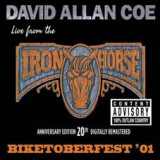
If there’s ever been a way to describe David Allan Coe, it’s got to be his ability to defy categorization. With over six decades of following his musical muse wherever it’s led, this craggy voiced outlaw has crossed the panorama of American roots music. As well as being a singer, guitarist, songwriter, David is also a magician and a ventriloquist, deep sea treasure hunter, and movie star. His movies included Stagecoach, The Last Days Of Frank and Jesse James, Lady Grey, Buckstone County Prison, Take This Job and Shove It, to mention a few. David signed with Sun Records in 1968 and recorded his first album Penitentiary Blues, all songs that David had written in prison. In 1973, Columbia Records bought David’s contract from Sun Records and he recorded his first Columbia album, titled “The Mysterious Rhinestone Cowboy”, several years before Glen Campbell had a hit with the song, “Rhinestone Cowboy.” Much has been written about David’s past and his lifestyle, but not much about his achievements over the years. From performing on Farm Aid to touring with Neil Young, Kid Rock and Willie Nelson. David’s song, “Take This Job and Shove It” has received multi-million airplays certificate from BMI. His “Greatest Hits” album is multi-platinum and his “First Ten Years” album is gold. David has had sixty three songs on the Billboard Singles Charts, including, “Mona Lisa Lost Her Smile”, “The Ride”, “Please Come To Boston”, “Willie, Waylon and Me”, “Jack Daniels If You Please” and “You Never Even Called Me By My Name” to name a few. David has written songs for Johnny Paycheck, Tanya Tucker, George Jones, Willie Nelson, Leon Russell, Charlie Louvin, Del Reeves, Tamy Wynette, Melba Montgomery, Stoney Edwards, The Oak Ridge Boys and Kid Rock. Both “Would You Lay With Me” and “Take This Job and Shove It” are multi- million seller songs penned by David. Johnny Cash has also recorded David’s songs including “Would You Lay With Me” on his chart topping album entitled, Cash. David has been through a lot in his life but has managed to put his past behind him and move forward with his life. This album was recorded in 2001 live from the Iron Horse Saloon in Daytona, Beach Florida and includes the only recorded version of, I’m An Ohio Boy.
No one album could ever capture the claustrophobia-to-catharsis of an Eyehategod show, but this compilation of live tracks and demos comes as close as it gets. Giving you an idea of Eyehategod’s uncompromising, single minded purity of expression and exertion of raw nerve, “10 Year Of Abuse” is a monumental document all the way from the demo era to their later, legendary relentless live tour set. Many other bands have tried unsuccessfully to emulate Eyehategod and have never quite captured their dynamic. Formed in 1988 in New Orleans they have become one of the most well known bands to emerge from the NOLA metal scene. Eyehategod note bands like Melvins, The Obsessed, Discharge, Black Flag, Black Sabbath and Saint Vitus as major influences, but are often mentioned in the same breath as any of these legendary bands. Drawing comparisons to Grindcore, Crust Punk and Sludge Metal, their heavy bluesy, detuned rock and roll has been a lynchpin for the misanthropic and disenfranchised. Eyehategod has released five studio albums to date with a sixth in the works and have toured all over the world in a career spanning over thirty years. Though the band has never released a live album, we are left with “10 Years” as the only official witnessing document to decades of decimating live sonic abuse. Released on May 29, 2001, “10 Years” spans seven live tracks from their European tour in 2000, a live radio show from August 1994 and four songs from an early 1990 demo. The result is a feedback-laced window into that wonderful, brutal Eyehategod “sound”, that addictive, lower-than-low note that nestles somewhere in the pit of your burning, alcohol-soaked, nauseated stomach. The booklet alone is a delight for anyone who worships at the altar of Eyehategod’s oppressively heavy, crushing riffs.
Repress
Released in August 2020 to much acclaim, as well as receiving many accolades as one of the best albums of 2020, Duval Timothy present Help (2021 edition).
This new and limited edition will be released independently by Duval Timothy’s Carrying Colour label, fashion brand and shop. It comes on 2 x 140g milky clear vinyl, with new 2 x 12" square posters and shrink-wrapped.
Help was recorded in London and Los Angeles, and reveals the artists' experience traversing the meshes of the music industry, mental health, YouTube self-help videos, and the healing he discovered through friendship and collaboration. Co-produced by Rodaidh McDonald (King Krule, The XX) and Marta Salogni (Bjork), with collaborations from Lil Silva, Melanie Faye, Vegyn, Desta Haile, Mr Mitch, Dave Okumo, and Twin Shadow amongst others.
Duval Timothy is a multidisciplinary artist, whose practise is centred around colour and involves the use of music, photography, textiles, painting, sculpture, design, cooking and video. In between delivering a celebrated cookbook for Penguin Books, and an interactive installation at Tate Modern Turbine Hall, Duval makes music, which is sampled by the likes of Solange and Loyle Carner and collaborates frequetly with cktrl, Vegyn, Kwes, and Mr Mitch.
Deep spiritual jazz recorded in Germany, performed by Jamaican born saxophone player Fitz Gore and his international group The Talismen, featuring a.o. bassist Gérard Ebbo from Morocco and drummer Philippe Zobda-Quitman from Martinique. This is the first reissue of their second album, released in 1976 by the small private label GorBra from Bonn, including "Delilah" and "Requiem For Julian Cannonball Adderley". The rare LP comes in a newly mastered version with original cover design and sleeve notes. Fitz Gore's music is full of tremendous tension and movement between deep seriousness, inwardness and humility; it affects your life, it liberates and heals.
Original sleeve notes from 1976:
"Soundmagnificat" is the successor to "Soundnitia" (GorBra Records F 665 532), the first release from the Talismen, an international group with Jamaican Tenor saxophonist Fitz Gore (born1935) as founder, spiritual and musical leader, main soloist. "Soundnitia" contained concert performances of June, 1975, including compositions by John Coltrane, Horace Silver and one by Gérard "Prof. Dr. Splüm" Ebbo, bassist of the Talismen.
This second offering from the Talismen is more varied. It has four tracks recorded at four different occasions. It presents Fitz Gore as a singer, a composer, as well as, a tenor saxophonist. The opener, Requiem for Julian "Cannonball" Adderley, is a moving tribute to a great American artist, the late alto saxophonist "Cannonball" Adderley. On this track, Hungarian drummer Janos Sudy is heard with the Talismen, for the first time. The playing by the quartet on this slow lament very adequately illustrates the mood of the composition
For the next piece, a concert performance, Gore selected a gem from the American Negro Song Tradition and he displays a mighty, masculine and soulful voice in Steal Away. An example of a modern artist using an old traditional to express his own inner feelings. Delilah is taken from another concert performance, the same concert as the music on "Soundnitia". It has extensive playing by Gore, a bass solo by Gérard Ebbo, leading into some exciting conga playing by Lamont Hampton.
The final track, A Sinner Kissed An Angel, was recorded by another tenor player, Wardell Gray, in 1950, but this version is all Gore's. After the piano introduction, Gore delivers the melody with authority and with an expressive use especially of the high register of his instrument. In his improvisation, Gore's playing becomes more dissonant. Some of his playing here causes me to think of the way the late Albert Ayler sounded on his first recordings done in Sweden, in the beginning of the 60s. No drums here, but nice accompaniment and solo work of Jochen Paul on vibes.
I met Fitz Gore in Copenhagen in the fall of 1975. We were both listening to the trumpet playing of Harry "Sweets" Edison at the now defunct Café Montmartre. Prior to that time, I did not know Gore and his music, but listening to his playing on this album and the earlier one, has once more widened my musical horizon. His music has struck some chords within me. "Music is communication", John Coltrane once said. I feel sure that as you listen to the music of Fitz Gore and his Talismen, you will get the message.
In these notes, I have mentioned a couple of jazz artists and another one ought to be named primarily, because he has meant a lot to Gore: Sonny Rollins. The two met in Paris in 1966. Gore says of Rollins: "He openend my eyes ...big man … phenomenon … my man". As Sonny Rollins's artistry, the music of Fitz Gore holds many aspects, some being aggressive and even hysterical, others being those of beauty and peace. As life itself … (Roland Baggenaes, June 1976)
The music of Fitz Gore, rooted in the blues, is full of tremendous tension and movement between deep seriousness, inwardness, humility and humor, hardness and tenderness; it affects your life, it liberates and heals - a hopeful, a truly groundbreaking, a timeless, a new music - Newsic!
(Gisela Braasch, 1976)
In memory of Fitz Gore.
Mastered 2020 by Roskow Kretschmann at Audiomoto,
kindly supported by Tom Sky. Vinyl cut at SST.
Producer for reissue: Ekkehart Fleischhammer,
reproduction of original cover design by Gisela Gore:
Patrick Haase aka rab.bit.
Superb Mental acid and tribe records from italy... Pumper !!