Поиск:method
Стили
Все

10
MICK HARRIS (SCORN, QUOIT, PAINKILLER) returns after several years of hiatus with ten tracks of blasting landmine bass and interlocking shrapnel rhythms.I've been asked to write a press piece for the dark lord MICK HARRIS.Where does one even start Especially for someone with decades of releases over various solo projects, collaborations and pseudonyms, whether it's doing blast beats in the original NAPALM DEATH to crushing techno brutality as MONRELLA, or savage drum & bass as QUOIT. Then of course there's the mighty SCORN and his numerous collaborations with fellow luminaries such as JOHN ZORN and BILL LASWELL (in PAINKILLER).Rather than being tied to genres or scenes, MICK HARRIS is one of those producers who creates a whole sonic world uniquely of his own, in which varying tracks, styles and tempos take form, but yet in which everything sounds unmistakably characteristic of the creator. Needless to say his work has influenced legions of producers like SURGEON, REGIS, ONTAL, VATICAN SHADOW / PRURIENT, FAUSTEN, SHAPEDNOISE et al, and pretty much anyone in the world of powerfully dark, abrasive music you could name-drop. And yet after all this time, it is impressive that HARRIS still stands way above his successors and has never been surpassed in his own production/performance game.After a hiatus of several years, he is back with a new album under the guise of FRET.Working at a faster tempo than his SCORN material, the FRET project first surfaced years ago on the DOWNWARDS label, rooting it firmly in the dark, industrial and technoid world, and appeared more recently on Tresor (Kern mix by OBJEKT), maintaining the characteristic colossal bass-heaviness and textural depth.And now a full album on KARLRECORDS, Berlin. HARRIS fans will be delighted to know that despite the 130 bpm tempo, the newest FRET still resolutely avoids any straight four-on-the-floor kickdrums, every track lurches, stumbles, staggers and charges forth with beats in beautifully broken asymmetry.We get 10 tracks of crushing, percussive destroyers, each itself a storm of precision chaos, with colossal low-end frequencies that'll cause stampedes in the right circumstances. The classic HARRIS sound is there, searing waves of feedback distortion, intricate, interlocking rhythms and cold, abattoir atmospheres, especially track 6 "Stuck in the track at Salford Priors" which sounds like you're being continuously suspended in the air from multiple explosions all around, each kickdrum throwing you up in the air, the next one going off before you can fall completely back to the ground.The lazy-minded would probably lump it in with the term "techno", but the disciplined brutality, blasting landmine bass and interlocking shrapnel rhythms are clearly HARRIS' own trademark style, sitting somewhere between SCORN and QUOIT.The tracks appear deceptively chaotic on the surface, yet each is meticulously and masterfully composed with great attention to layering and detail. MICK HARRIS fans rejoice, the dark lord still remains at the top of his game.
(Derek Szeto / Fausten / Combat Recordings)

- A1: Cream
- A2: Method Man (Skunk Mix)
- A3: Protect Ya Neck (Bloody Version)
- A4: Wu-Tang Clan Ain't Nuthing Ta F' Wit
- B1: Can It Be All So Simple
- B2: Shame On A Nigga
- B3: Da Mystery Of Chessboxin
- B4: Reunited
- C1: It's Yourz
- C2: Triumph (Feat Cappadonna)
- C3: Gravel Pit
- C4: Protect Ya Neck (The Jump Off) (The Jump Off)
- D1: Sucker Mc's
- D2: Uzi (Pinky Ring) (Pinky Ring)
- D3: Shaolin Worldwide
- D4: Diesel (Feat Rza, Method Man, U-God, Raekwon & Ol' Dirty)
16

- A1: A Train Is Coming
- A2: One Device, One Method, One Thing
- A3: Rocking From Beginning To End (Feat. Kenny Keys)
- A4: This One Is For The Ladies And Gents (Feat. Miles Bonny)
- A5: The Kids Are Listening Interlude
- A6: Don't Box Me In (Feat. 80S Babies)
- A7: Beware Of The Groove (Feat. Mario Sweet)
- B1: Come With Me And Fly (Feat. Yusef Rumperfield)
- B2: Is There More To Life (Feat. Diggs Duke)
- B3: I Will Never Know (Feat. Moonchild)
- B4: Mario Smith Speaks On (Feat. Daniel Crawford)
- B5: Things Deeper Than My Skin (Feat. Ozay Moore)
- B6: Peace And Love (Feat. Masego & Rommel Donald)
13
'This is a journey into sound...,' These familiar words, accompanied by the rumble of a distant train, signal the opening of 'Let's Take A Trip', the sophomore album from Terrel Wallace aka Tall Black Guy. Since 2013's '8 Miles To Moenart' TBG has cemented his position as a standard bearer for the current hip-hop / beats scene. Born in Detroit and now residing in the UK, Wallace's signature style of incredibly clever sample flips and deft production chops has won fans across the globe including Gilles Peterson, Lefto, Jazzy Jeff and House Shoes.
Since his debut release in 2011 (a daring and addictive flip of Fela Kuti), TBG has become revered for his unique take on soulful hip-hop production. The swing of the drums, the textures of the instrumentation as well as a fearlessness in taking on the classics (his Soundcloud page includes flips and chops of tracks from James Brown, De La Soul and Michael Jackson) have marked him out from the crowd. One of the best-kept secrets in the scene, his singular talent is now beginning to get the recognition it deserves. In the last 12 months he has remixed Little Dragon and been invited to take part in Jazzy Jeff's Playlist Retreat alongside the likes of Eric Lau, James Poyser, Ali Shaheed Muhammed, Questlove and countless others.
For this album Wallace had a simple inspiration: 'This album is all about taking a journey. As simple as that. Be it physical, emotional or spiritual. It's asking and answering personal questions from myself within some of the tracks and also touching on social issues i.e. racism, inequality and privilege...that have been at the forefront of my mind over last three years.' Sonically there is also a shift: 'Jazz has definitely been more of an influence in this project, as I have been really inspired by so many up and coming musicians who I've been blessed to connect with'. Some of these musicians, including Kenny Keys, Miles Bonny, Diggs Duke and Dee Jackson feature on the project as well as regular collaborators Ozay Moore and Mario Sweet and fellow Playlist alumni Daniel Crawford and Masego. But this is one man's vision, and for Tall Black Guy this trip is just the beginning...,.

8
Cute Heels is the solo project of Bogota´ born, experimental producer Victor Lenis. Since the early 2000's Lenis has been working on a myriad of electronic projects, including the management of the labels Black Leather Records and Romance Moderne, in his current home of Brussels. Drawing on the influences of the radical punk scene that surrounded him growing up in Columbia while nurturing his passion for synthesizers and drum machines, Lenis developed the broody, gloomy brand of electro-techno that is Cute Heels. Deemed by Juan Atkins as ''the new blood and spirit for the next step in techno music'' Cute Heels has released various digital only releases over the years, as well as his first vinyl release, an EP on Gooiland Elektro. His debut album Spiritual, rides the line between cold electro-techno and left field electronic body music. Inspired by equal parts Liaisons Dangereuses and Drexciya, Spiritual takes the listener on a journey over 8 tracks and 40 minutes of music. Listening to "Spiritual" you can see why. The songs on this full length reveal a sublime influence from Detroit techno, early Chicago house and new wave; advanced electronics for the dance floor, pumping and sophisticated. The album was recorded and mixed by Victor at Sensorium Studio in Zagreb, Croatia in November 2013. Each song has been mastered for vinyl at Fantasy Studios in Berkeley by George Horn. Each LP is packaged in a custom-made jacket by our in-house designer Eloise Leigh and incorporates the geometry of analog synthesizers and celestial rose patterns.

- 1: Intro
- 2: Bear Hill
- 3: Pomogranite
- 4: Veterans Only Billionaire Rehab (Skit)
- 5: Wild Corsicans
- 6: 1 Life
- 7: Barber Shop Bullies (Skit)
- 8: Open Doors
- 9: 600 School
- 10: The Guy That Plans It
- 11: Da Heavies
- 12: Officer Full Beard (Skit)
- 13: The Omerta
- 14: Get Outta Here
- 15: The Sober Dose Gift (Skit)
- 16: Debra Night Wine
- 17: Mac & Lobster
также имеющийся в продаже
Black Vinyl[22,65 €]
Focus Track: Bear Hill Album Description: Raekwon’s The Emperor’s New Clothes is a sharp return to form, showcasing the Wu-Tang veteran’s lyrical precision and timeless street wisdom. The album is powerful with equal parts - high-quality bars and carefully sculpted production. Raekwon recruits a stacked lineup of guests, including Nas, Griselda, Method Man, Inspectah Deck, and Ghostface Killah, injecting the project with gritty energy and legacy chemistry. Marsha Ambrosius and Stacy Barthe provide smooth, soulful hooks, adding emotional layers to the hard-edged verses. Production comes courtesy of Nottz, Swizz Beatz J.U.S.T.I.C.E League and more. The LP is a reminder of Raekwon’s enduring power as a lyricist and curator. A veteran artist showing that mastery doesn’t need excess. The Emperor’s New Clothes is regal, streetwise, and sharply tailored for those who value craft.

- Kneel
- Where To Look
- Cold Heart
- Treason
Nilüfer Yanya has built a reputation as one of the UK’s mostdistinctive and compelling voices, seamlessly blending indie rock,soul and jazz into a sound uniquely her own. She released her third studio album, ‘My Method Actor’, onSeptember 13th, 2024, via Ninja Tune. The album receivedwidespread critical acclaim, earning the No. 13 spot on Pitchfork’s listof The 50 Best Albums Of 2024. Now, she releases her highly anticipated our-track EP, ‘DancingShoes’, co-written with her frequent collaborator Wilma Archer. Run of UK / EU festivals this summer including Glastonbury on theWest Holts stage (recorded and broadcasted via BBC 6 Music),Green Man, All Points East, Primavera a la Ciutat, Best Kept Secret,Way Out West and Oya Festival. Supporting Alex G on his US tour, and Lorde (90K cap) on her arenatour, with stop offs at the 02 Arena, Utilita Arena and OVO Hydro,plus Michael Kiwanuka in Istanbul for a one-off show (8K cap). Nilüfer Yanya has previously opened for Adele, The xx and Mitski, aswell as selling out her own headlining shows across Europe,Australia, Japan and the US. Previous collaborators include Sampha, King Krule, Nick Hakim,Bullion, Dave Okumu, and more. For fans of Arlo Parks, King Krule, Sharon Van Etten, Helado Negro,Sudan Archives. “It’s a neat, cohesive body of work, one that stretches past theboundaries of her prior album.” - NME
“Over a lo-fi drum machine and eerie guitar figures, ‘Cold Heart’ floatsabout like ‘In Rainbows’-era Radiohead, while ‘Where To Look’’satmosphere is eventually punctured by sonic implosion.”- TheGuardian
“Colored with the London singer-songwriter’s signature smoky voiceand searing guitar riffs” - Pitchfork


- A1: Abay
- A2: Tew Ante Sew
- B1: Mengedegna
- B2: Kahn
- C1: Sew Argen
- C2: Nafekeñ
- D1: Abet Wubet
- D2: Guramayle
- D3: Gud Fella
- D4: Guramayle (Slight Return)
9
180g Heavy double vinyl LP with liner notes by Tyran Grillo. Limited Japanese Obi for the first pressing. Original artwork by Russell Mills and photography by Jean-Baptiste Mondino.
The third Time Capsule is a body of dub reinterpretations by celebrated producer Bill Laswell of Ethiopian singer Gigi. Curated by Tokyo record collector, music researcher and seasoned reissue supervisor Ken Hidaka, it is the first time Illuminated Audio is pressed to vinyl after its CD release in 2003.
Ejigayehu Shibabaw was born in 1974 in Chagni, northwestern Ethiopia and by pursuing a career as a singer, went against her father’s strict, traditional gender roles. As Gigi, she embraced the same musical freedom she had strived for in her personal life, incorporating the Ethiopian church, funk, hip-hop, West and South African music into her work. She first settled in Nairobi, then Addis Ababa, where she quickly established herself as one of the city’s leading singers. A move to San Francisco in 1998 led to a long and fruitful creative partnership with bassist and producer Bill Laswell.
Around the same time, Chris Blackwell had stepped away from Island Records to start the art house film company and label Palm Pictures. He took an interest in Gigi and together with Laswell, pulled together an all-star cast of musicians for her self-titled US debut album, including Herbie Hancock, Pharoah Sanders and Wayne Shorter. It won international critical acclaim, not just for its musicianship but for making Gigi a “defining voice for the Ethiopian expatriate community”, as journalist Tyran Grillo praises in his Time Capsule liner notes. From the nation-defining 1896 victory over Italian invaders to the quiet revolutionaries who wear simple shemma garments, Grillo believes the themes in Gigi make it “a shower of sunlight on her homeland for those ignorant of its struggles.”
After its success, Blackwell encouraged them to go back into the studio to rethink the album and Illuminated Audio was born. “Anyone can make a voice sound worldly”, Grillo remarks, “but rare are those who can make one sound inner-worldly.” Gigi was clear with Laswell to give her vocals a minor role “because it’s already been done.” Instead her Amharic verse is fleeting, exhaling through the textures like ghostly fragments; soaring yet muted. Yet the album is still titled under her name, an assertion by Laswell of her central role in the album’s creation. Not only was it a fully endorsed project by Gigi, but she would be present throughout its development, giving feedback on half-finished ideas as Laswell played them back in the studio. “It works perfectly”, she reflected after the album’s release. “We wanted to capture the whole spirit of each track, and Bill’s remixes create a different music language that really puts you in a pleasant place”.
This new vocabulary takes its lead from a technical approach that Laswell had been perfecting during a furtive creative period at the turn of the millennium. Much like his ambient interpretations of Miles Davis (Panthalassa, 1998), Bob Marley (Dreams of Freedom, 1997), and Carlos Santana (Divine Light, 2001), Laswell approached Illuminated Audio by returning to the original multitrack masters. Gigi wasn’t just reworked, but recomposed into an expansive lattice of instruments, submerged in a watery ambience of dub and trance undercurrents.
Sonically, this new language that Gigi refers to, is manifested by the original album’s more understated parts being pushed to the fore. Explaining his contrasting methods, Laswell saw Gigi as being “put together in a way that fits”. Contrastingly, in Illuminated Audio, “a lot of things that I featured in the remix weren’t as audible in the original.” Instrumentation laying near-dormant, deep in the mix, are brought to the fore: the acid rock guitar and Wayne Shorter’s saxophone on ‘Tew Ante Sew’, Graham Haynes’ flugelhorn on ‘Nafekeñ’, Laswell’s bass on ‘Kahn’, the melodica in Mengedegna or the floating synths and talking drums in ‘Gud Fella’.
Brought to his attention by mentor DJ Nori, Hidaka describes Illuminated Audio as a “masterful sonic exploration into ethereal ambience and dub” and made sure this reissue also contained a full remaster to give its “deep musicality” much better dynamics and density in the overall sound. Hidaka admits that Laswell's music “is sometimes so out-there, it is often misunderstood” and, indeed, to dub album non-believers this might seem like a prolific producer imposing himself on another artist’s work; eternally developing rearrangements that never quite get to its destination. But that’s missing its true power and triumph. This is more than the reissue of a remix, but “a wholly unique musical entity”, as Hidaka describes. Illuminated Audio refers to the illuminated manuscripts that comprise the major part of Ethiopian art and its new compositions stand in proud solitude as a rare body of reworks that both informs and enhances their originals.

7
A few words for the album
Moment’s Aeternity:
a 12/8 composition celebrating the raw power of the “moment”, marked by whirling improvised moments between drums, bass clarinet and Harris P’s Armenian duduk.
Pajko, fire in the forest on the mountain:
in Sokratis own words: “I have a really vivid memory as a child. I was staring at the Djena mountain from my window in Archangellos which sits on the Pajko mountain. A little beam of light shone far in the horizon; it was a fire that in my little eyes looked as if the giants of Almopia were trying to communicate with each other using phryktoria (a way of contacting through fire in Ancient Greece).”
Footprints of some Giant Steps:
While the classic compositions of two true Jazz Giants- Wayne Shorter and John Coltrane- are certainly different, they do both connect in a mystical way. Rearranged in 5/8 combining half of each melody and half of each one’s chord progression, keeping the form of the piece for improvisation, still in 5.
Oson Zeis Fainou (Seikilo’s Epitaph):
found in a tomb stone in the Northeast of Greece, this is the only melody saved from the ancient times. It is accompanied by lyrics contemplating the meaning of life:
Ὅσον ζῇς φαίνου
μηδὲν ὅλως σὺ λυποῦ πρὸς ὀλίγον ἐστὶ τὸ ζῆν τὸ τέλος ὁ xρόνος ἀπαιτεῖ.
‘’While you live, shine
don’t feel blue for anything because our life is short and time demands an end.’’
Here is to Oghene K:
’’Hey man, where is the groove?’’, he would say, just to trigger another wave of inspiration for Sokratis. Oghene was a true force of nature, a well of kindness, a masterful artist that left this world too early. This one is for him.
Balkan Riff (for Milcho Leviev):
Milcho Leviev (1936-2019), was a long-time friend and collaborator and a true inspiration for expression, creativity and colorfulness. Expressing the deep sentiments evoked by the Balkan sound and history, this is a sorrowful dialogue between bass clarinet and contrabass.
Spirits of Djena:
one of the most esoteric and personal moments of the album. Composed and recorded during the challenging times of the COVID-era, you can hear the baritone and tenor saxophone firmly grounded on a crispy, hypnotizing contrabass groove.
Sokratis Votskos Quartet
Kostas Anastasiadis / Giorgos Klountzos - Chrysidis: Drums
Leandros Pasias: Piano
Vaggelis Vrachnos: Contrabass
Sokratis Votskos: Soprano Saxophone, Bass Clarinet and Compositions
Sokratis Votskos is a jazz saxophonist, clarinetist, composer, educator, and bandleader from Greece. Deeply invested in unearthing the folk sounds and heritage music of Greece and Eastern Europe, he weaves these into modern jazz compositions though the use of melodies, polyrhythms, and his reedy, timeless tone. He leads the Sokratis Votskos Quartet, he is one half of Kolida Babo and member of the Reggetiko Project. A highly regarded sideman and ensemble player, he has worked extensively with renowned jazz musicians with several highly acclaimed releases (MiC, Jazzman, Walt Disney and now Fair Weather Friends Records).
He has performed his music in numerous venues and festivals worldwide from Vinterjazz in Copenhagen, to the EFG London Jazz Festival where he performed at the legendary Ronnie Scott’s alongside Greg Foat.
He is also an archaeoacoustics researcher and enthusiast, having completed his Master studies on the field of ancient ritualistic caves of Greece research.
Leandros Pasias was born in Thessaloniki, Greece. At age 10 was introduced to piano, continuing his studies at the Modern Conservatory of Thessaloniki and later at the Conservatorium van Amsterdam in the department of jazz piano.Ηe holds a classical harmony diploma and a BA at the Department of Music Studies at the Aristotle University of Thessaloniki. In 2020 he received jazz improvisation lessons from Aaron Parks.
With a series of appearances in multiple international jazz festivals, Leandros has collaborated with a wide range of musicians from Nicolas Masson and James Wylie to Marina Osk, Ivo Papasov and Haris Lambrakis, among others.
A member of the Yako Trio, he released “OdesSea” on Fair Weather Friends Records (2021).
Vangelis Vrachnos was born in Thessaloniki, Greece, in 1989. While he started playing the bass at the age of 12, alongside his brother, his studies would commence a few years later. Introduced to double bass at the age of 23, he undertook jazz double bass studies at the Codarts Αcademy of Rotterdam. He has participated in several festivals such as the Technopolis and Odessa international jazz festivals. Since returning to his hometown, in 2015, he has been a founding member of Mordana and Yako Trio and has collaborated with a series of musicians like James Wyllie, Sokrates Votskos and Dimitis Agelakis, among others.
Kostas Anastasiadis is a tireless researcher, that has been diligently studying Tradition and its evolution, creating a fresh amalgam of sound moods. His mature improvisational virtuosity highlights a uniquely individual artistic expression and was recognized with the ̈Unique Individual Stylist" award by the PIT (Percussion Institute of Technology) in Los Angeles, California. He has been associated with various ensembles that have garnered significant interest in the global music scene. As an educator, he is the founder of "The Harmony of Rhythm" musical method, which aims to explore and establish the elements that constitute the concept of rhythm.
Giorgos Klountzos-Chrysidis was born in Thessaloniki in 1991. Following studies at the Modern Conservatory of Thessaloniki, he moved to France and the Conservatoire de Nice. With performances at well-known festivals like Nice Jazz Festival, Nuits du Sud and Jazz à Vienne, he had the opportunity to meet the American drummer Leon Parker, who encouraged him to move to Paris, where he spent the next two years under his tutoring and guidance.
In 2016, came a defining moment in his career as he traveled to New York for the first time. He participated in the quartet of saxophonist Diego Rivera for a series of performances and attended lessons by Rodney Whitaker and Randy "Uncle G" Gelispie at Michigan's State University.
Collaborations include Xavier Davis, Ricky Ford, Nicolas Masson, Diego Rivera, Craig Bailey, Baptiste Herbin, Marc Abrams, Pantelis Stoikos, Antonis Anissegos, David Lynch, Ziad Rajab and Ivo Papasov, among others.

6
XKatedral Anthology I is the first in a series of archival releases dedicated to presenting music by XKatedral affiliated composers working within the realm of slowly evolving harmonic and timbral music. This double-vinyl set contains an array of pieces dating from 2010 - 2020. Four of the works included here were originally released on cassette tape early on in the label's history, while the two remaining pieces are presented by the label for the first time.
"The works Ir Himinn, Grooenn by Kristoffer Svensson, Disquiet (Heart) by Marta Forsberg and Lamé by Isak Edberg were first released on the compilation XKatedral Volume II in 2016. Svenssons piece from 2014 combines justly tuned gamelan percussion and prepared piano intricately interwoven in a way that obscures the boundaries between the two instrument groups. Forsberg and Edbergs pieces both use a monolithic form to explore the timbral and harmonic spaces provided by the Düben Baroque organ situated in Tyska Kyrkan in the oldest part of Stockholm. While similar in terms of instrumentation the two works differ formally - Edbergs Lamé composed in 2010 uses the registers of the organ to articulate a seamless spectral transformation while Forsbergs Disquiet (Heart) from 2014 deals in blocks of sound with a varying degree of opacity, saturation and intensity.
Glory for two electric guitars by Caterina Barbieri and Kali Malone was composed and recorded in Tempo Reale in Florence, Italy, and was originally released on the cassette compilation XKatedral Volume III in 2016. This music takes the form of an ever-evolving hypnotic pattern shared by the two instruments articulated through an additive and subtractive canon. Dissolving Ceremony, composed in 2012 by Edberg/Erlandsson/Lisinski, was first presented publicly on the self-released record Stratum. The music contained in that release was formed from a collection of gamelan percussion instruments augmented by two sets of live-electronic instruments tuned to the harmonic framework formed by the partials of the metal percussion. Originally positioned in the center of the record running order between two long monolithic process-based pieces, Dissolving Ceremony now stands on its own as a memory of a time and methodology from the not so distant past.
The newest piece in this set is Shipwrecks by Daniel M Karlsson. While this work is a recent one Karlsson should be considered one of the forerunners of the musical expression contained within this record set. Active within new music for two decades his strongly articulated musical ideas and constantly evolving craftsmanship has resulted in an enormous body of work, and has served as an inspiration for many of his fellow composers. This piece is a celebration of transposition and its immense capacity for timbral transformation using a vast array of instruments performed, recorded and electronically treated by the composer to form a liquid uncanny topography where a deeply personal harmonic language constantly shifts, slides and shivers."
- 1: My Falling Sinks
- 2: Empyrean Flare
- 3: Tesselation
- 4: To Whoever Shall Inherit The Earth
- 5: Smoking Mother
- 6: Att Böja Själarna
- 7: This Will Be My Last Piece For Organ
- 8: Fault Lines
6
Die XKatedral Anthology Series III ist die dritte Ausgabe einer Reihe von Archivveröffentlichungen, die Musik von Komponisten zeigen, die sich mit langsam sich entwickelnder harmonischer und klanglicher Musik beschäftigen. Die hier vorgestellten Stücke konzentrieren sich auf die Verwendung von synthetischen und akustischen Klängen sowie auf algorithmische Komposition als Werkzeuge für präzises Arbeiten im Bereich der spektralen Erforschung. Dieses Doppel-Vinyl-Set erscheint anlässlich des zehnjährigen Jubiläums des Labels und enthält Werke aus den Jahren 2014 bis 2025. Es wird zusammen mit Neuauflagen der XKatedral Anthology Series I-II veröffentlicht. "My Falling Sinks" von Kali Malone ist eine sparsame, absteigende Melodie für justierte Orgel, Cello und Akustikgitarre mit Lucy Railton und Stephen OüfMalley. Das Stück ist eine kompositorische Skizze in septimaler reiner Stimmung, die 2021 während eines Aufenthalts in La Becque auf einer experimentellen Stimmorgel in La Temple de La Tour-de-Peilz entstanden ist. ,Empyrean Flare" von Maria W Horn wurde 2022 für ,The Dawn Chorus" der Choreografin Stina Nyberg komponiert. Dieses Stück nutzt die von Arvo Pärt entwickelte Tintinnabuli-Technik, um vier Supersaw-Oszillatoren in langsamen diatonischen Arpeggios zu animieren, die um eine Moll-Tonika-Dreiklang kreisen, und destabilisiert das harmonische Gerüst durch Glissandi und verstärkt die Summe seiner Teile durch analoge Bandsättigung. ,Tessellation" von David Granstrom wurde im Sommer 2017 mit generativen Synthesemethoden komponiert. Die musikalische Periodizität und harmonische Bewegung, die in dem Stück zu hören sind, entstehen durch feste synthetisierte Bandschleifen, die einen Raum zwischen gegensätzlichen Welten erkunden. "To Whoever Shall Inherit the Earth" ist das erste Solostück von Jessica Ekomane und entstand laut der Komponistin fast zufällig. Das Werk wurde vor einem Jahrzehnt spät in der Nacht aufgenommen und fängt einen flüchtigen, zerbrechlichen und unwiederholbaren Moment ein, der genau so festgehalten wurde, wie er sich ereignet hat. Smoking Mother von Stephen OüfMalley wurde für Gisele Vienneüfs Der Teich / LüfEtang von Robert Walser geschaffen. Es wurde 2018 während eines Aufenthalts im SMEM-Synthesearchiv in Freiburg komponiert und im August 2020 bei EMS produziert. Das Stück greift auf Werke von Zia Mohuiddin Dagar, Krzysztof Penderecki und Popol Vuh zurück und erkundet gleichzeitig die Wurzeln des Minimalismus. ,Att boja sjalarna" von Mats Erlandsson wurde 2018 komponiert und ist Teil von ,On Eternity", einer Sammlung von vier Texten und vier zehnminütigen Kassettenloops, die 2021 von Irrlicht Forlag als limitierte Box-Set-Edition veröffentlicht wurde. Dieses Werk enthält Darbietungen von Gaianeh Pilossian und Sara Fors, jeweils auf der Violine und mit Gesang. This will be my last piece for organ wurde 2025 von Theodor Kentros komponiert und nutzt Gruppen von Cluster-Oszillatoren durch resonante Rückkopplung, um die schwankenden Frequenzen zu synthetisieren, die beim Verstimmen einer Orgel im physischen Raum zu hören sind. "Fault Lines" wurde von Daniel M Karlsson mit generativen Methoden komponiert, wobei ein deterministischer und endlicher Output für diese Veröffentlichung festgelegt wurde. Dieses Stück enthält Gesangsdarbietungen von Sara Fors, Ansis B.ti. und Art.rs C.ukurs.

- 1: Chlorine Fumes
- 2: Twisted Charm Honey
- 3: Caravelle
- 4: Flor En La Sombra
- 5: Marching Clocks
- 6: Circular Rites
- 7: Oruga Encantada
- 8: Sur La Lune
- 9: Brücke
- 10: Photochromic Gaze
- 11: A Rising Year
For if their first album ALLOMBON could be seen as the opening of a secret passage, this second record, FLOWERS TOO, is something else entirely: no longer the discovery of a world, but its methodical exploration, its feverish mapping, its deepening down to the underground layers. At a time when contemporary psychedelia seems at a standstill, when ecstasy has lost its effect, when the vast territories of the imagination have been parceled out, signposted, monetized they keep digging. And deeper still. Esoteric pop the noblest, the most dangerous kind is no longer practiced on the surface. It has abandoned the grand avenues to retreat into hidden laboratories, mental back rooms, basements more deeply buried than those of garage, punk, or black metal. It is there that the secret society Dorian Pimpernel has been working for years, with a stubbornness that feels less like a career than a calling.

- A1: Me Pega
- A2: Tem Carnaval
- A3: Sexy Doce
- B1: Coeur
- B2: Então Tá Bem
- B3: Para Ser Feliz
- B4: Tô Nem Aí
Fresh from releasing projects on Method 808 and Future Classic, landing a huge collaboration with Chloé Caillet, and delivering an official remix for Fatboy Slim, PPJ are entering a new chapter in full force. Their expansive take on global street sounds, ranging from neoperreo to Miami bass, gets a cool re-coating.
Led by the magnetic vocalist Páula, with production from Povoa (individually supported by Four Tet, Ben UFO, and Barry Can't Swim, with recent releases on Live From Earth), the duo operates in maximalist mode: playful, sensual, and slightly unhinged.PPJ’s new era, JOKER, embraces a figure that appears everywhere from card decks to carnival culture as a symbol that mirrors their own DNA: funny, eerie, seductive, unpredictable. The EP leans further into club territory, but rather than polishing their edges, PPJ amplify them.
At the emotional core of the record sits “Coeur,” co-produced with Chloé Caillet. It begins with an MPB-tinged foundation flirting with bossa nova. It’s unmistakably Brazilian, bathed in sunset hues before being sped up and twisted into a dance-floor-ready electronic form. The groove shimmers with tension: warm percussion, elastic basslines, and Páula’s voice hovering between intimacy and tease. It feels like a remix of itself, romantic, but slightly untrustworthy.
If “Coeur” glows, “To Nem Ai” is a slow burner. A very deep and downtempo house cut, it unfolds slowly, almost luxuriously, guided by sensual vocals that feel whispered directly into the ear of the listener. A hypnotizing piano sample that feels like a late-night confession. It’s the kind of record that transforms a dancefloor into something tactile.
Elsewhere, “Me Pega” is a high-energy reinterpretation of the tech-house sounds from Santa Catarina, one of southern Brazil’s most feverish party states, twisted and accelerated for ferocious impact. Drawing direct inspiration from Sarro, a raw and vibrant Brazilian street dance, the track captures physical intensity in its purest form: sweat, bass pressure, collective release.
Its counterpart, “Tem Carnaval” channels Páula’s vivid storytelling into a thunderous ode to Rio’s carnival spirit, euphoric, chaotic, cinematic landed just in time for this year’s celebrations.
On “Sexy Doce,” rugged electroclash melodies collide with unexpected references. “It was inspired by Budots, which is dance music from the streets in the Philippines,” Povoa explains. “Then we mixed it with Páula’s Brazilian vocals. Baile funk is similarly from the streets, so there is a connection.” The result is raw yet futuristic, a cross-continental flirtation that feels both underground and explosive.
With this new EP, PPJ make music like they’re tuning into a dozen pirate frequencies at once. Pirate radio from Rio to Berlin to Manila intercepting fragments of street culture, sensuality, and chaos, and stitching them into something deliriously cohesive.
JOKER doesn’t just nod to club culture. It challenges it, twists expectation and leaves a lasting impression.

10
Returning to Peak Oil for a second expedition, veteran Russian producer Kirill Vasin, aka Hoavi, explores an untrodden path on 'architectonics', drawing from his lifelong appreciation of Indonesian gamelan musics to mastermind a rhythmelodic hybrid sound that's sinuous, subtle and remarkably dubby. Over the last three and a half years, Vasin has used the music's methodologies and rhythmic forms to evolve his existing processes and signatures and transform his musical philosophy. To start the exercise, he knew he needed percussion, so used his phone and a contact microphone to pick up nearby sounds, drumming on various tables, railings, empty glasses and other objects to create a library of textured, tonally complex percussive sounds. But the work wasn't done yet - in fact, it was just the beginning of a long process of trial and error: Vasin created two full versions of the album before 'architectonics' was finished.
There are still echoes of the chrome-plated sci-fi atmospheres and complex, stuttering beatscapes that underpinned 2021's 'Invariant', but 'architectonics' asks very different questions, prompting fresher, more innovative responses. Leaning on his bank of organic percussive sounds, Vasin is able to concoct a tactile aura that he fills with eerie fluctuating repetitions that shift subtly, sometimes imperceptibly. The cavernous reverb and booming bass that supported his last few albums is still present, now employed as scaffolding for different architectures: skittering sequences and ornamented overlapping phrases that owe as much to Steve Reich's hallowed minimalist compositions as they do to Indonesian traditional forms. Lulling, almost hypnotic tessellations appear like fractals on the polished surfaces, morphing from jazz to techno and dub while retaining gamelan's haunting xenharmonic resonances and Vasin's concept becomes crystal clear. 'architectonics' isn't an attempt to make a gamelan album, it's Vasin's way of developing his own artistic process by looking far beyond the traditional boundaries of electronic music.
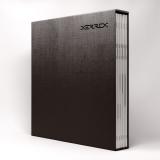
OTON releases limited edition vinyl and CD box set of Alva Noto's Xerrox series.
Pioneering in his approach to digital sound and its materiality, Alva Noto (Carsten Nicolai) began his ongoing exploration of sampling, degradation and recontextualisation with the Xerrox series in 2007. Over the years, the project has evolved into one of the most distinctive bodies of work in contemporary electronic music, situated between minimalism, experimental sound art and digital abstraction.
Across five albums, Xerrox Vol.1 (2007), Xerrox Vol.2 (2009), Xerrox Vol.3 (2015), Xerrox Vol.4 (2020), and Xerrox Vol.5 (2024), Nicolai's method evolves from sample-based work toward original composition as he deconstructs and reassembles source material into precise, sculpted sound worlds that are at once minimal and emotive.
Remastered in collaboration with Bo Kondren of Calyx Mastering, the Xerrox recordings of Volumes 1, 2, and 3 are made available alongside Volumes 4 and 5 on vinyl and CD under the title 'reMASTER', presented in a beautifully designed box featuring original artwork by Carsten Nicolai.

8
Acclaimed producer, DJ, and dancefloor healer Octo Octa (Maya Bouldry-Morrison) announces her fourth full-length album, Sigils For Survival. Following 2013's Between Two Selves, 2017's Where Are We Going?, and 2019's Resonant Body, the new record marks a decade since Maya publicly came out as transgender in November 2015. ''As an autobiographical artist, I set out to write an album that would be a milestone for this past decade of joy and sorrow,'' Maya explains. ''Sigils For Survival is my attempt to encapsulate the intentions and techniques that I used to move through life into a spell.'' For each of the record's eight tracks, Maya drew a sigil. Each is a personal symbol intended to ''bind magic to the song and seal its intention.'' These drawings appear throughout the physical edition's design. Maya's sister, New York artist Hope Morrison, incorporated each sigil into her original paintings, which comprise the album's vivid artwork. Hope Morrison, whose imagery translates the sigils' energy into vivid form; the layout was designed by Jo?o Ervedosa. Created entirely on hardware instruments and later mixed in Logic, Sigils For Survival captures the tactile immediacy of live performance. Maya preserved the feel of MIDI-clock drift and off-grid recording, letting her machines interact in the rhythmic pocket, rather than confirming them to a click. Alongside her signature deep, ecstatic electronics, the album features hand-played dulcimer, hand-pan, and recorder. Her voice also returns, carrying spells of love, protection, and transformation. Across Sigils For Survival, Octo Octa channels the ecstatic house lineage into an intimate ritual space. The music speaks of immediacy, play, and communion -- of magic as method, love as survival, and sound as spellcraft. Sigils For Survival is both a document of ten years lived fully and an invocation for the next chapter -- a glowing testament to music's power to protect, transform, and set the spirit free.


5
Eco Edizioni debuts in 2025 as an Italian publishing and recording project dedicated to mapping radical sound aesthetics. The label explores the territories of unconventional electronic music, giving space to forgotten productions that outline complex soundscapes through the experience of expert synthesis producers. The first vinyl release embodies this philosophy through a dialogue between different generations of the European industrial and electronic scene. The dark atmospheres of Okиho meet the analytical and methodic techno of Andrew Lagowski, taken from his 1995 album Prismatic.
The album Malnovnova is the culminating synthesis of this synergy, presenting itself as a manifesto of avant-garde sound engineering. The work pushes the Okиho duo’s research towards a totalising and hyper-technical electronic abstraction, where granular signal processing is mitigated by Lagowski’s atmospheric industrial layers.