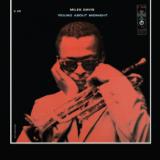
In 1955 Miles Davis played an all-star jam session at the Newport Jazz Festival with Thelonious Monk on piano, Gerry Mulligan on baritone sax and Zoot Sims on tenor sax. This performance immediately drew the attention of Columbia Records' George Avakian, who was so impressed that he immediately offered Davis a contract if he could form a regular band. The group he then assembled would go down in history as Davis' so-called "First Great Quintet", consisting of John Coltrane on tenor sax, Red Garland on piano, Philly Joe Jones on drums, Paul Chambers on bass and of course Miles himself on trumpet. 'Round Midnight is Miles Davis' first record for Columbia and also the first studio recording of the First Great Quintet. The recording sessions began on October 26 1955 but the album wasn't released until 1957 as Davis was still under contract at Prestige at the time. These respective sessions yielded Steamin', Workin', Cookin' and Relaxin'; albums that would go down in history as quintessential blueprints of late 1950s hard bop.
The record is made up of a collection of standards and one traditional song ("Dear Old Stockholm", from the 19th century). Notably, it features what may be considered the most well-known versions of Thelonious Monk's "'Round Midnight" and "Bye Bye Blackbird". That Avakian made a golden signing was sufficiently clear from the start, but no one could foresee that it would be this quintet on Columbia that would go on to change the course of modern jazz forever with Kind of Blue. 'Round Midnight is available as a limited edition of 1500 individually numbered copies on crystal clear vinyl.
Cerca:midnight star
- A1: Orchestral Manoeuvres In The Dark– Telegraph
- A2: Blancmange– That's Love, That It Is
- A3: China Crisis– Tragedy And Mystery
- A4: Adam Ant– Strip
- A5: Divine– Love Reaction
- A6: Yello – I Love You
- A7: Talk Talk– My Foolish Friend
- A8: Japan– Canton (Live)
- B1: Fun Boy Three– The More I See (The Less I Believe)
- B2: Tracie*– Give It Some Emotion
- B3: The Teardrop Explodes– You Disappear From View
- B4: Xtc– Love On A Farmboy's Wages
- B5: The Stranglers– Midnight Summer Dream
- B6: The Kinks– Don't Forget To Dance
- B7: Mari Wilson– Cry Me A River
- C1: Bauhaus– Lagartija Nick
- C2: Marc And The Mambas– Black Heart
- C3: The Glove– Like An Animal
- C4: Freur– Doot Doot
- C5: The B-52'S– Song For A Future Generation
- C6: Wall Of Voodoo– Mexican Radio
- C7: Joe Jackson– Breaking Us In Two
- D1: Oliver Cheatham– Get Down Saturday Night
- D2: Rockers Revenge– The Harder They Come
- D3: Freeez– Pop Goes My Love
- D4: Malcolm Mclaren– Soweto
- D5: Culture Club– I'll Tumble 4 Ya
- D6: The Belle Stars– Indian Summer
- D7: Level 42– Out Of Sight Out Of Mind
- D8: Daryl Hall & John Oates– One On One
- E1: Sparks & Jane Wiedlin– Cool Places
- E2: The Romantics– Talking In Your Sleep
- E3: The Fixx– Saved By Zero
- E4: The Motels– Suddenly Last Summer
- E5: Modern English– I Melt With You
- E6: Missing Persons– Walking In L A
- E7: Naked Eyes– Always Something There To Remind Me
- E8: Taco– Puttin' On The Ritz
- F1: Electric Light Orchestra– Secret Messages
- F2: Men At Work– Overkill
- F3: Pat Benatar– Little Too Late
- F4: Journey– Separate Ways (Worlds Apart)
- F5: Styx– Mr Roboto
- F6: Giorgio Moroder & Joe Esposito– Lady, Lady
- F7: Stephen Bishop– It Might Be You
Celebrating the first year of ‘NOW That’s What I Call Music’ – 1983. ‘Now Yearbook’ presents a stellar selection of 1983’s biggest and best hits… 80 huge chart hits from the year, alongside enduring and well-loved classics on 4 CDs. 1983 saw British artists achieving unprecedented success across the world with ‘Every Breath You Take’ from The Police being the year’s biggest seller in the U.S., and ‘Karma Chameleon’ from Culture Club being the top seller in the U.K. Breakthrough acts, achieving their first big hits – all here – include a staggering line-up of future superstars: U2, Eurythmics, Wham!, Paul Young, The Style Council, Marillion and Thompson Twins, to name a few..' Released on a LTD 4CD SET: This will be a limited run of 5000 4CD units housed in ‘hard-back book’ packaging and featuring a 28-page booklet that includes an overview of the chart music of 1983, a track by track guide including chart stats and fun facts, a selection of original picture sleeves and a quiz. 2CD Standard set and also a limited edition of 3000 units, pressed on 3LP translucent red vinyl...
- Ornithology
- Skylark
- Desafinado
- Joy Spring
- Round Midnight
- Voyage
James Davison, the most startlingly talented UK brass player of his generation, joins this highly experienced team with brilliant results. Charlie Parker's 'Ornithology',Thelonious Monk's 'Straight No Chaser', Billy Strayhorn's 'Satin Doll' and Horace Silver's 'Peace are amongst the gems to be found here. This is the second Woodville Records release to be based solely around the brilliant arranging skills of world class trombonist Mark Nightingale. The first, Alan Barnes plus 11 (WVCD151) featured Mark's adept and characterful handling of a twelve- piece ensemble. Jazz Classics ...with a Twist displays equal inventiveness and imagination, showcasing a sextet line-up in a programme of individually re-thought takes on these ageless tunes. In Mark's hands this band frequently resembles a much larger ensemble such is his skill in manipulating tone colour and voicing.
- A1: Roudi Vagou - Gleisende Lichter
- A2: Roudi Vagou - Halb So Schwer
- A3: Roudi Vagou - So Sueß
- A4: Roudi Vagou - Lila Gibt Es Nicht
- A5: Roudi Vagou - Iss Mich Ganz Auf
- A6: Roudi Vagou - Grenzueberschreitung
- A7: Roudi Vagou - Aufgeben Ist Kein Verzicht
- B1: Läuten Der Seele - Komischer Anruf
- B2: Läuten Der Seele - Punkt Mitternacht
- B3: Läuten Der Seele - Nur Fuer Uns Zwei
- B4: Läuten Der Seele - Mineralwasserflasche 1
- B5: Läuten Der Seele - Glaskopf Mit Watte
- B6: Läuten Der Seele - Rathausdach
- B7: Läuten Der Seele - Ein Kitzeln In Den Graebern
- B8: Läuten Der Seele - Mineralwasserflasche 2
- B9: Läuten Der Seele - Mondraetsel
Across an extensive suite of enchanting miniatures, Matthias Kremsreiter and Christian Schoppik present the hypnagogic vision of Taghelle Nacht. Recording under their respective Roudi Vagou and Läuten der Seele aliases, Kremsreiter and Schoppik combine their distinct but equally accomplished instrumental practices into a new collaboration that weaves swooning samples amongst instrumental passages. They lead us through 16 vignettes that revel in the cognitive dissonance and seductive magic of moonlight at midnight.
Both artists have past form within the folds of contemporary experimental electronic music in Germany. Kremsreiter's work as alibikonkret has manifested on DIY tape releases created with a methodical, technically-minded approach. Debuting his Roudi Vagou pseudonym on Taghelle Nacht, he pivots to a more playful, instinctively felt method that allows the compositions to flow with a natural cadence. Schoppik has been a key figure in the celebrated dark-ambient-folk scene, not least as part of the group Brannten Schnüre. His work as Läuten der Seele includes the acclaimed 'water trilogy' of LPs between 2022 and 2024, with a greater emphasis on instrumental, atmospheric production, and a last, stunning collaborative album with Nový Sv?t's Jota Solo.
On Taghelle Nacht the precise ingredients of each piece soften at the edges as tape loops and swathes of reverb seal the joints between spellbinding melodic refrains. Opening track and lead single 'Gleisende Lichter' sets the tone with ghostly murmurs, spine-tingling string refrains and splashes of cymbal that cut through the gloom with stark clarity. A lilting romanticism stirs at the heart of the orchestral samples that populate the likes of "Grenzu?berschreitung" - old-world beauty sometimes buried in dust, elsewhere rendered with startling clarity. 'So Süß' lets buzzing, sustained drones and dissonant sweeps of extended technique glide in and out of each other. Granular processing subtly breaks apart the mellow swell on 'Komischer Anruf', and forlorn sax calls out into heavy-hearted space on 'Glaskopf Mit Watte'. At every turn a new scene is painted, distinct from the last and yet all bound up in the pervasive, pale blue light cast over the sleeping landscape Kremsreiter and Schoppik have sculpted.
Snatches of song drift by like dreamlike fragments, and achingly tender flourishes fleetingly appear and retreat - ideas and expressions momentarily caught in the light before retreating into the shadows once more. This is the evocative world of Taghelle Nacht - an unsettling depiction of the surreal blend of memories and imagination that merge into each other once the sun goes down.
- Spandrel?
- Pitch Black
- Oil/Too Much
- Closer To Midnight
- Body/Prison
- Lies?
- Eyes/Not Enough
- The Lungs Of A Burning Body
- Xyz/Labyrinth
- Black Hole
In der Evolutionsbiologie beschreibt der Begriff ,Spandrel" die Merkmale eines Organismus, die nicht fürs Überleben wichtig sind und keinen offensichtlichen Zweck haben. Das Wort kommt aus der Architektur und bezeichnet die dreieckigen Räume in den Ecken eines Bogens: kleine ästhetische Elemente, die für Symmetrie sorgen und Grenzen markieren. Die Musikerin und Sängerin Evita Manji stellt auf ihrem Debütalbum eine undurchsichtige Frage und fragt sich angesichts eines großen Verlusts, welche Teile von uns zum Durchhalten beitragen und welche vielleicht nur Deko sind. Ihre Tracks, die aus den Dämpfen zeitgenössischer Clubmusik, Barock-Pop und experimentellem Sounddesign zusammengesetzt sind, sind für Manji eine Möglichkeit, ihre Beziehung zur Welt im Allgemeinen und zu sich selbst im Besonderen zu untersuchen, Kontrollsysteme zu zerlegen und die Vernetzung hervorzuheben. Manji ist seit einigen Jahren eine ätherische Präsenz in der Szene und arbeitet als Soundkünstler und Kreativdirektor mit zahlreichen Künstlern zusammen. Letztes Jahr starteten sie ihre eigene Plattform myxoxym, wo sie zwei Singles aus ,Spandrel?" veröffentlichten und eine ambitionierte Fundraiser-Compilation mit Rainy Miller, Palmistry, Cecile Believe und anderen zusammenstellten, um Geld für den griechischen Tierschutzfonds ANIMA zu sammeln. Manji trat weltweit auf Festivals wie Unsound, Lunchmeat und Rhizom auf, spielte in Clubs in Berlin und London und wurde ausgewählt, die Plattform Shape+ im Jahr 2022 zu vertreten. Diese Erfahrungen fließen in ,Spandrel?" ein und helfen ihnen, ein komplexes künstlerisches Gewebe zu weben, das weit unter die Oberfläche des Daseins blickt und versucht, das Unheil des globalen Klimawandels mit Themen wie Selbstverwirklichung, Liebe und körperlicher Autonomie in Einklang zu bringen. Das Album beginnt mit dem Titeltrack, einer einleitenden Zusammenfassung, die die Zuhörer auf das vorbereitet, was sie gleich hören werden. Manjis Gesang schwingt mit einem eingestöpselten Gefühl kybernetischer Melancholie und filtert die Flut von Rhythmen und harmonischen Themen der Welt zu geschmeidigem, clubtauglichem Pop, der von ihrer fortschrittlichen Klangwelt getragen wird. Von dort aus werden wir in die Traurigkeit des atmosphärischen Klagelieds ,Pitch Black" hineingezogen, einer Meditation über den Tod, die tiefe Bässe unter Schichten von choraler Glückseligkeit versinken lässt und an die Kirche und die Tanzfläche erinnert, ohne die Kraft der beiden gegensätzlichen Elemente zu opfern. Ihre Dunkelheit wird in ,Oil Too Much" von innen nach außen gedrängt, einem Kommentar zur Ölindustrie aus der Perspektive des Tierreichs, der gleichzeitig als neonfarbener Ausdruck der zeitgenössischen Depression dient. Aber in ,Body/Prison" klingt Manji am offensten, spricht ehrlich über die dunkelsten Momente ihres Lebens und gesteht ihre tiefsten Gefühle über sengende, von Trance inspirierte Synthesizer und groteske Percussion. ,Spandrel?" ist ein Album, das Zeit braucht, um sich zu entfalten, und Manjis Themen hallen durch eine Geschichte wider, die älter ist als die Popmusik. Es ist tragisch, romantisch und poetisch und weigert sich entschieden, sich von den drängendsten Themen unserer Zeit abzuwenden.
- A1: All Strung Out Over You
- A2: People Get Ready
- A3: I Can't Stand It
- A4: Romeo And Juliet
- A5: In The Midnight Hour
- A6: So Tired Side
- B1: Uptown
- B2: Please Don't Leave Me
- B3: What The World Needs Now Is Love
- B4: Time Has Come Today
The Chambers Brothers are four biological brothers who cut their teeth in church choirs and on the gospel and folk circuit around Southern California. But, things really picked up halfway the 1960s when they started performing in New York and in 1968 scored their only hit “Time Has Come Today”. This 11-minute opus spent five consecutive weeks at #11 (yes, really!) on the Billboard Hot 100 and really showcased the progressive mindset of the brothers; the group combined American blues and gospel traditions with the effects-laden sound of psychedelic rock that was very much in-vogue around that time. If you’re fan of psychedelic soul such Rotary Connection, you can’t miss this. The Time Has Come is available as a limited edition of 1000 individually numbered copies on red coloured vinyl.
NECK DEEP's second full lenght proper, originally from 2015, reissued in deluxe packaging for its 10 YR anniversary! The simple truth is "Life's Not Out to Get You" is the best Pop-Punk album ever released. December has become the (un)official Pop-Punk Christmas anthem. If it wasn't for this essential album - Blink 182 wouldn't have reunited. Featuring fan favorite songs "December," "Can't Kick Up the Roots," & "Serpents" - DIY wrote the "full-length feels both quintessential and refreshing, a modern classic_The hooks are glorious, the bounce is addictive and it's a little rough around the edges for good measure." In the the years since Neck Deep formed in the Barlow brothers' spare room in Wrexham, Wales, a lot has changed. From the scrappy, naively hopeful beginnings that define the starting of so many teenage bands, the pop-punks have gone on to be one of British Rock music's most successful global exports in recent memory: top 5 records in both the US and UK, global touring, viral hits and over a billion plays, just some of the fruits of ten years spent mastering their craft. - For fans of Blink-182, Green Day & State Champs - Blue coloured vinyl LP in embossed gatefold sleeve w/ cut out O-Card slipcase!
- A1: The Bug – Hooked (Hyams Gym, Leytonstone)
- A2: Ghost Dubs – In The Zone
- A3: The Bug – Believers (Imperial Gardens, Camberwell)
- B1: Ghost Dubs – Hope
- B2: The Bug – Burial Skank (Arches, Vauxhall)
- B3: Ghost Dubs – Dub Remote
- C1: The Bug – Alien Virus (West Indian Centre, Leeds)
- C2: Ghost Dubs – Down
- C3: The Bug – Militants (The Rocket, Holloway)
- D1: Ghost Dubs – Into The Mystic
- D2: The Bug – Dread (Mass Brixton)
- D3: Ghost Dubs – Midnight
When Chuck D proclaimed "Bass, how low can you go?" on Public Enemy's anthemic 'Bring the Noise,' maybe he was pre-empting or inciting the 10,000 fathoms-deep, spine-bending basslines and sub-quake tremors of 'Implosion.'
Implosion is a crushing split album, appropriately released on The Bug's own PRESSURE label. Mapping out a new form of spectral dub, the sound is deliberately immersive, introverted, and yes, definitely implosive. In pursuit of heavy lids, blurred vision, and merciless bass bin punishment, it’s one part meditation, two parts low-end theory, and essentially a confession of devoted sound system addiction.
As expected from a tag team featuring British soundlab explorer and 'London Zoo' composer Kevin Martin, aka The Bug, and Michael Fiedler, aka Jah Schulz—a long-time graduate of Germany's new school of sound system reggae culture—the duo approaches their target differently yet share the goal of keeping their sound "raw" (Fiedler) and "brutally minimal" (Martin). This proves that opposites can attract, even if their tools are different and their methods sometimes diverge.
From such a disparate combo, hailing from different geographical and aesthetic backgrounds, contrasts are certainly on display, even within each artist's own contributions. From the melancholia and transcendence of 'Alien Virus (West Indian Centre, Leeds),' to the duality of ascension and descension on 'Hope,' or the Sunn 0))) in dub, visceral drone of 'Dread (The End, London),' to the tripped-out repetitions of 'Midnight,' which reinvents Chain Reaction for post-millennials, the result is both sacred and narcotic. Each track illuminates the emotional impact and atmospheric pressure being explored across this deceptively sparse album—a mastery of tone and texture.
This collection might be as reduced, minimal, and deep as The Bug has ever gone, perhaps echoing the solemnity of his recent Kevin Richard Martin Black release and invoking the futurist steppas self-pioneered on his previous Pressure album. Alternatively, Fiedler‘s Ghost Dubs project ventures into his most heavyweight direction yet, which is no mean feat considering his previous, the critically acclaimed album Damaged, was a monstrously massive triumph of analogue weight and enviable sound design.
Implosion is ice-cool, a stark contrast to the warmth and sociability of traditional Jamaican roots and the current trends in digi-dub. Instead, the mood is soaked in tension and intense dread, finding an unexpected melting point where classic dub's stark rhythm attack, isolationist ambience's eerie drift, dub techno's floatation strategies, and even the relentless riffs of doom metal collide. As the bass-obsessed pair drop what is arguably the heaviest ambient dub album to emerge from any electronic sector—a moody counterpoint to The Orb's fluffy clouds, etc, Martin has cited The Roots Radics, Black Jade, and On U Sound's Pounding System as heavily influencing his approach to the album, while Fiedler has expressed his admiration for Adrian Sherwood's productions and Rhythm & Sound's enchanting soundscape. Yet, the super heavyweight pulsations, emotive resonances, and bone-rattling vibrations detonated here effortlessly go far beyond these influences.
Shadowy and elusive, there’s a mysteriousness at this record's core. A haunting moodiness oscillating between nostalgia and future shock. Despite the deadly fixation with SLOW and HEAVY, the album maintains a totally hypnotic swing throughout. Implosion and its lead single 'Imploded Versions' are testaments to being enveloped in bass, seduced by bass, submerged in bass, and utterly crushed by bass, as The Bug and Ghost Dubs seek to craft a new form of dub for zonal headz and Babylon seekers.
Mastered by Stefan Betke (a.k.a. POLE) at Scape Mastering studio, this record is heavy as f-ck without resorting to continuous distortion. It’s low-end worship taken to an absolute extreme, yet remains highly listenable and definitely danceable, albeit at the slowest of paces. Sacred and narcotic, this is low-end worship amplified to the max. Dive in if you dare.
The new album The Cinnamon Show by Cinnamon Gum is a juicy journey into the golden era of the 1970s, filled with a warm and rich blend of soul and funk.
Recorded using classic analog instruments, this album is a tribute to authentic sound and musical craftsmanship. A unique approach to sound engineering creates a cohesive and immersive atmosphere that accompanies the listener from start to finish. Each single is enhanced by a vibrant music video inspired by iconic music programs like Soul Train and The Midnight Special.
The artist's vocals shine throughout the album, combining deep, sensual phrases with subtle melodies, drawing inspiration from soul legends such as Marvin Gaye and Curtis Mayfield. The lyrical layer explores both personal stories and universal themes of love, loss, and hope, making the album an exceptionally intimate and authentic experience.
Daniele Baldelli
Considered one of the first DJs in Italy, Daniele Baldelli began his career in 1969 mixing vinyl at the Tana Club in Cattolica (his hometown),
predating the birth of the modern DJ by several years. In the following years, he solidified his talent and technique at histor such as the Tabù Club, Baia degli Angeli, and Cosmic. From 1979 to 1984, Baldelli created his unique and eclectic style, blendi ic clubs ng seemingly distant sounds and musical styles, complementing them with tempo adjustments (bpm) and deliberately extreme equalization,
creating a truly distinctive sound, known as "Afro Disco." Soundscapes and tribal percussion blend with early electronic music experiments, and Baldelli's sets become truly mystical experiences, where, for the first time, the temples are replaced by the dance floor.
The documentary film "A Cosmic Life" has just been released, starring Daniele Baldelli alongside other illustrious guests from the nightclub scene, recounting the history and formation of this movement from the 1970s to the present.
Gaudi
A producer/musician among the most highly regarded on the international dub/electronic scene, over the past 30 years Gaudi, from his
London studio, has contributed significantly to expanding the boundaries of musical genres with high-profile releases and innovative
music production techniques. Recently nominated for a Grammy Award with 'Mass Manipulation', the album he produced for the reggae
band Steel Pulse, and also nominated for a World Music Award with his album 'Dub Qawwali' with Pakistani singer Nusrat Fateh Ali
Khan, Gaudi has collected a series of number 1s on the international charts: Billboard - with the album 'Heavy Rain' by Lee "Scratch"
Perry, 'Vessel of Love' by singer Hollie Cook and with 'Mass Manipulation' by Steel Pulse -, UK Chart n.1 with the album 'Prism' by the
band The Orb (with whom he has collaborated as a producer and keyboardist since 2008), with 'Blue Monday' - by Gaudi himself with
the band Dub Pistols -, UK Dance Chart n.1 with 'Jus Come rmx' produced with DJ Angelino for Cool Jack. He also reached no. 41 the UK charts with the album ‘Midnight Rocker’ by reggae singer Horace Andy (known to the general public for his hits with Massive in
Attack), no. 13 with the album ‘Dubwise 2’ by the band Dreadzone and no. 5 in the Italian charts with the song ‘Lasciala Andare’, written
by him for Irene Grandi. With 19 solo albums and 350 remixes and productions under his belt, Gaudi, with his artistic versatility, has
worked with Groove Armada, UB40, Simple Minds, Brian Ferry, Devo, Big Audio Dynamite, Damian Marley, Seun Kuti, Mad Professor,
Trentemøller, Grandmaster Flash ft KRS-One, Lamb, Don Letts, The Beat, Deep Forest, African Head Charge (in which Gaudi is a keyboardist and dubmaster), Elisa, Scientist, Dub FX, Roedelius, Caparezza, Caravan Palace, EMF, Sizzla, Jovanotti, Sly & Robbie, Piero Pelù, Youth of Killing Joke, and Maxi Priest, to name just a few. Capleton,
Daniele Baldelli & Gaudi
DJ Daniele Baldelli and producer Gaudi first met three years ago at the Jazz Cafe in London. Mutual respect and an innate need to
create new stylistic fusions were the catalysts for Baldelli and Gaudi, leading to a series of subsequent meetings that inevitably culminated in the need to create music together. The project began at Gaudi's Metatron Studio in London using analog equipment and later
moved to Baldelli's studio in Cattolica, where the two organically defined their sound, also inspired by Baldelli's precious record collection. The duo consolidated a powerful compositional symbiosis, and the project, born from a simple initial groove, later transformed
into an entire EP consisting of four original tracks and a highly innovative sound, featuring fusions of psychedelic-funk, tribal-dub,
electronic-disco, and, of course, "Afro-Cosmic"! Daniele Baldelli and Gaudi began their sonic collaboration without setting any stylistic
direction and with the intention of not creating pre-established goals to achieve; it is a project of pure artistic freedom guided by their
compositional instinct and their experience. Constantly active with their evenings and live concerts, Baldelli and Gaudi have performed
individually in many of the best international clubs and festivals.
- 1: Fire And Brimstone
- 2: Burnin' Hell
- 3: Sure 'Nuff 'N Yes I Do
- 4: Fire In The Blood
- 5: White Light / White Heat
- 6: Cosmonaut
- 7: Fire In The Blood / Snake Song
- 8: So You'll Aim Towards The Sky
- 9: Fire In The Blood
- 10: Fire And Brimstone
- 11: Sure 'Nuff 'N Yes I Do
- 12: White Light / White Heat
- 13: End Crawl
- 14: Midnight Run
None other than Nick Cave helped director John Hillcoat with the screenplay for the movie Lawless, while he also took great care of the movie’s soundtrack. Cave and fellow musician Warren Ellis form the core of The Bootleggers, a country and bluegrass ensemble that welcome a string of guests artist like Emmylou Harris, Ralph Stanley and Mark Lanegan. The Lawless soundtrack contains cover versions of artists such as Velvet Underground and Captain Beefheart and also features original compositions by Cave/Ellis and the great Willie Nelson. Lawless is a studded movie by director John Hillcoat (The Road, The Proposition) about a gang of bootleggers in Virginia during the Great Depression. And when we say star-studded, we really mean it: Guy Pierce, Gary Oldman, Tom Hardy and Shia LeBoeuf signed up for the gritty and evocative story about brothers who try to create their own American Dream during Prohibition. Lawless is available as a limited edition edition of 750 numbered copies on smoke coloured vinyl and includes an 8-page booklet with movie pictures and liner notes by Hal Willner and director John Hillcoat.
- A1: Do What You Gotta Do
- A2: Looking For A Fox
- A3: Slippin' Around
- A4: I'm Qualified
- A5: I Can't See Myself
- A6: Wind It Up
- B1: Part Time Love
- B2: Thread The Needle
- B3: Slip Away
- B4: Funky Fever
- B5: She Ain't Gonna Do Right
- B6: Set Me Free
Clarence Carter, blind from birth, was a blues singer with lascivious wit, a talented guitarist, a songwriter with a twinkle in his eye, and a champion of down-to-earth soul grooves who taught himself to play the guitar.
He sang in a gospel choir, completed a degree in music, and grounded the duo Clarence & Calvin but was not however very successful.
After a car crash involving Calvin Scott, Carter started on a solo career and signed a contract with Rick Hall and the Fame label as a soloist.
Among the earliest singles recorded at the Muscle Shoals studio were a few hits. After leaving Fame for Atlantic, he managed to enter the Top 20 of the R & B charts with "Looking For A Fox". His breakthrough came with "Slip Away", which sold a million copies and was awarded a Gold Record.
The legendary Fame Studios in Muscle Shoals remained the home basis, as it were, for Carter during his career with Atlantic. "This Is…" begins with a contemplative, soft sound. "Do What You Gotta Do", written by Jim Webb, is a lovely, melancholic mid-tempo ballad, saturated with Barry Beckett’s keyboard and smothered by lush, plaintive winds.
But the man is primarily funky here … as three danceable, finger-snapping tracks prove; "Wind It Up", with further witty improvisations and a fervid organ solo, the highly syncopated, playful "Thread The Needle", and the smoky, irresistible "Funky Fever" – all written by Carter himself.
Dan Penn’s and Spooner Oldham’s "Slippin’ Around" has an unorthodox bossa nova-like beat that is reminiscent of Ray Charles’s "What’d I Say", while Carter’s unmistakable chuckle is to be heard for the first time on the riotous funk-rock number "I’m Qualified", which has the very same unique, infectious groove as was to be heard on Wilson Pickett’s "In The Midnight Hour". "She Ain’t Gonna Do Right", composed by the same man, brings more Alabama Country to the mix, whereby Beckett contributes a catchy, persistent organ riff in the refrain.
Young Gun Silver Fox are the captains of AM Waves, setting sail towards an isle where melodies soak the shoreline and grooves sway like palm trees. Their route traces a natural progression fromWest End Coast, an album that cast Andy Platts (Young Gun) and Shawn Lee (Silver Fox) as musical virtuosos of SoCal-infused pop. AM Waves does more than duplicate the perfection of West End Coast. It improves it.
Recorded at The Shop in London and Roffey Hall in the English countryside, AM Waves burnishes the blend between the duo's modern aesthetic and their sumptuously crafted homage to '70s-styled pop, rock, and soul. "This music hits a certain spot for me personally that nothing else quite does," says Shawn, who produced the album amidst his projects for Saint Etienne, Shawn Lee's Ping Pong Orchestra, and several other acts. "It's real high-caliber music. It's easy and breezy to listen to but it's really hard to make. Every aspect is A game."
The A game behind AM Waves fuels 43 minutes of Young Gun Silver Fox in peak form. "AM Waves is much more instinctive," says Andy, whose penchant for writing irresistible hooks and melodies also shapes his role as lead singer and lyricist/composer for the band Mamas Gun. "It's more vivid. You can see the clarity to the colors of AM Waves whereas West End Coast is slightly more impressionist, as it were."
Originally issued as a single in September 2017, "Midnight in Richmond" is the anchor of AM Waves. "I hit one chord, which I'd never played before, and the song sort of wrote itself," notes Shawn. "It was intuitive. In many ways, the primary function of what I'm doing is trying to find that chord that opens a door and takes you someplace else. Those chords have magic." Andy embellishes the song's appeal by nimbly juxtaposing wistful emotions with a sun-kissed melody, his voice evoking richly drawn memories. The qualities that make "Midnight in Richmond" an instant classic abound throughout the album.
"Lenny" and "Take It or Leave It" spotlight Andy's versatility as a songwriter. The former was inspired by a dream he had where Lenny Kravitz owned a bar. "It was surreal," he says. "He was polishing the glasses and just serving me hit after hit." Like swimming through moonshine, Andy languorously savors every syllable in the song. "Take It or Leave It" is pure pop bliss. "That was one of those songs that fell out in half an hour," he says. "I had everything and it was done." Shawn adds, "It's such a perfect song in itself. When I listen to it, it's like you've created a record that already existed."
Young Gun Silver Fox introduce a five-piece horn section on "Underdog" that literally trumpets the song's protagonist. Shawn affectionately dubbed them the "Seaweed Horns" in honor of the Seawind Horns, an LA-based unit that recorded with powerhouses like Michael Jackson,Rufus & Chaka Khan,and Earth, Wind & Fire during the late-'70s. Andy explains, "The horns grab another hue of the west coast sound, which is the starting point, but it's also maybe the point where we're injecting a little bit more of ourselves and some outside colors into the familiar west coast palette."
A bounty of treasures course through AM Waves' ebb and flow. "Mojo Rising," which the duo penned with Rob Johnson, is a veritable retreat to paradise. "Sky-bound, heaven sent / Way above the clouds watching shootingstars descend," Andy sings, mirroring the music's celestial undertones. Sensuality contours the notes on "Just a Man," a song that basks in the allure of a woman who leaves "footprints on the water" while "Love Guarantee" is festooned with the Seaweed Horns. "I wanted to bring more of that R&B slickness into the mix," Shawn notes about the latter track. "We hadn't done a tune with that sort of groove." Similar to his work on "Underdog," Nichol Thomson's intricate horn arrangement on "LoveGuarantee"exemplifies another distinction between AM Waves and its predecessor.
"Caroline" occupies a special place on AM Waves, beyond spawning the album title. It tells the story of Radio Caroline, a pirate radio station that broadcast from an offshore vessel during the '60s and '70s. "They played the music that kids wanted to hear, whether it was the old stuff or cutting edge stuff," says Andy. "'Caroline' is about Radio Caroline's eventual capture." Complementing Andy Platts' deft wordplay, which draws parallels between radio airwaves and the station's literal home on the ocean, Shawn Lee layers nearly a dozen different parts on "Caroline," showcasing the vastness of his musicality. "I loved that track as soon as I heard it," Andy continues. "It's a beautiful fusion of me and Shawn."
The Seaweed Horns joinYoung Gun Silver Foxas they detour to the dance floor on "Kingston Boogie." Shawn explains the track's genesis, "I was thinking, what have we not done yet We definitely should get an AOR disco thing happening. I quite like disco. The beat is so metronomic that it allows you to be really sophisticated on top. 'Kingston Boogie' just laid itself out. I call it 'midnight disco.'" With a nod to "Lenny," Andy Platts sets "Kingston Boogie" back at Lenny's Bar, this time revealing a detail or two about its mysterious proprietor as he pours sweet wine and moonshine.
In a sense, AM Waves ends with the beginning. Even before there was Young Gun Silver Fox, there was "Lolita," the first song Andy Platts and Shawn Lee wrote together and a crowd-pleasing staple of the duo's live sets. The tale of a femme fatale who harbors a secret was recorded for West End Coast but instead furnished the B-side to "Long Way Back" as well as a bonus track on the North American edition of the album. Despite the song's checkered trajectory, its infectious chorus sparked the brighter, more buoyant orientation of AM Waves.
Like the moon pulling the tide, Young Gun Silver Fox are a magnet for good songs. "We're both so obsessed and constantly interested in music-making," says Andy. "We're both thinking about it all the time. When you know you have an accomplice with you that's the same as you, it's very liberating. Suddenly, worlds of color start to appear." Indeed, AM Waves is elemental in its power to induce pleasure. Dive right in.
Christian John Wikane
(New York City / February 2018)
- A1: Dead Or Alive - You Spin Me Round (3 19)
- A2: Buggles - Video Killed The Radio Star (3 17)
- A3: John Paul Young - Love Is In The Air (3 23)
- A4: Katrina - Walking On Sunshine (3 54)
- A5: Coolio - Gangster's Paradise (4 02)
- B1: Nik Kershaw - Wouldn't It Be Good (4 45)
- B2: William Pitt - City Lights (3 46)
- B3: Debbie Gibson - Lost In Your Eyes (3 35)
- B4: Robbie Dupree - Steal Away (3 16)
- B5: The Motels - Only The Lonely (3 13)
- C1: Wild Cherry - Play That Funky Music (3 45)
- C2: Limahl - Neverending Story (3 31)
- C3: Color Me Badd - I Wanna Sex You Up (3 53)
- C4: Sisqo - Thong Song (4 14)
- C5: Crazy Town - Butterfly (3 37)
- D1: Spagna - Call Me (4 06)
- D2: Wax - Right Between The Eyes (4 07)
- D3: Stories - Brother Lou (3 56)
- D4: Stevie B - Because I Love You (4 19)
- D5: Maria Muldaur - Midnight At The Oasis (3 33)
"One Hit Wonders" ist eine dynamische Doppel-LP-Zusammenstellung, die die unvergesslichen Songs feiert, die den Äther beherrschten und zu zeitlosen Klassikern wurden. Diese Sammlung vereint legendäre Hits aus verschiedenen Jahrzehnten und Genres, von den energiegeladenen Beats von "You Spin Me Round (Like a Record)" von Dead or Alive bis zum sanften Yacht-Rock von "Steal Away" von Robbie Dupree. Mit Tanzhymnen, gefühlvollen Balladen und genredefinierenden Titeln ist dieses Album eine nostalgische Reise durch Songs, die trotz der Tatsache, dass sie die einzigen großen Chartstürmer ihrer Künstler waren, in der Musikgeschichte unverzichtbar geblieben sind.
Diese sorgfältig zusammengestellte Auswahl umspannt die Welten von Pop, Rock, Funk, R&B und Hip-Hop. LP1 enthält Wohlfühl-Hits wie "Walking on Sunshine" von Katrina and the Waves, den Synthie-Pop-Charme von "Wouldn't It Be Good" von Nik Kershaw und die eindringliche Schönheit von "Only the Lonely" von The Motels. LP2 hält die Energie hoch mit funkgetriebenen Grooves wie "Play That Funky Music" von Wild Cherry, der filmischen Magie von "Neverending Story" von Limahl und sanften Balladen wie "Because I Love You" von Stevie B. Jeder Track auf dieser Compilation ist einkultureller Meilenstein, der von der ersten Note an erkennbar ist.
"One Hit Wonders", herausgegeben von MPO, ist ein Muss für Musikliebhaber, Sammler und Fans von klassischen Hits, die Generationen überdauern. Ob Sie diese Hymnen wiederentdecken oder zum ersten Mal erleben, dieses Album fängt die Magie von Songs ein, die Geschichte geschrieben haben, auch wenn ihre Schöpfer nie wieder denselben Erfolg in den Charts hatten. Sichern Sie sich noch heute Ihr Exemplar und lassen Sie sich von der Musik in die Momente zurückversetzen, in denen diese Titel die Charts beherrschten und und die Welt in ihren Bann zogen.
Tracklisting
- It Is The Time
- Starting To Pretend
- Breathe
- Julie Thru The Blinds
- Are You Inventive?
- For The Lovers
- Brand New Toy
- Beauty In Broken
- Blue New Year
- Loved
- The Deep Dark Night
- This World
- Stupid November
- Rome Wasn't Built In A Day
- Food And Coffee
Mit "Brand New Toy" landeten The Jeremy Days 1988 einen Evergreen, der bis heute gern im Radio gespielt wird. Als "Kinder der MTV - Ära" mit ihrer Mischung aus britischem Pop und amerikanischem Art-Rock brachte The Jeremy Days in zehn Jahren fünf Longplayer auf den Markt. Ihr ersten beiden Alben "The Jeremy Days" (1988) und "Circushead" (1990) wurden von dem bekannten Produzententeam Clive Langer und Alan Winstanley produziert, die auch u. a. für Madness, Kevin Rowland & Dexys Midnight Runners, Elvis Costello, David Bowie und den Hothouse Flowers arbeiteten. Als die Band 1995 auseinanderging, hatten sie mehr als eine Mio. Tonträger verkauft. 24 Jahre später kam es auf der Bühne des Hamburger "Docks" zu einer Reunion, weitere drei Jahre danach erschien 2022 mit "Beauty in Broken" sogar ein neues Album, das eine Woche nach Veröffentlichung auf #21 in die deutschen Albumcharts einstieg. Im Oktober des gleichen Jahres trat die Band im Rahmen des Crossroads-Festivals zum ersten Mal beim WDR - Rockpalast auf. Rechtzeitig zu ihrer aktuellen Deutschland-Tournee im Oktober 2025 kommt der Rockpalast-Auftritt als CD/DVD, auf einer limitierten doppel-Vinyl in zufälliger Farbe und digital auf den Markt. The Jeremy Days Frontmann Dirk Darmstädter: "Ein weiteres Dokument der langen und facettenreichen Reise unserer Band durch diese verrückte Welt."
- A1: I Warned You
- A2: The New Sheriff
- A3: All Right
- A4: Orphan Blues
- A5: Irene Goodnight
- B1: I’m Alabama Bound
- B2: Have A Whiff On Me
- B3: On My Dying Bed
- B4: Midnight Special
- B5: Smoozy Punky Baby
Born in Antwerp in 1939, Ferre became a true icon in the sixties, adored by youngsters and hippies and hated by the establishment. His successful debut album in 1966, which featured the hits “Ring Ring, I’ve Got to Sing,” “Crucified Jesus,” and “Drunken Sailor,” brought him an international breakthrough with concerts in Paris, London, and Hamburg, and led to a contract with the famous French Barclay label. The next three albums did not equal the initial commercial success — a pressure the music business was happy to put on his shoulders. Still, these three albums, reissued in their original packaging and artwork on vinyl for the very first time, are loaded with hidden gems, combining folk, blues, and psychedelics in Ferre’s original songs.
Grignard sadly succumbed to throat cancer in 1982 at the early age of 43.
- A1: Malavoi - Te Traigo Guajira
- A2: Los Caraibes - Donde
- A3: Tropicana - Amor En Chachacha
- A4: Ryco Jazz - Wachi Wara
- A5: Eugene Balthazar - Dap Pignan
- A6: Roger Jaffort - Oye Mi Consejo
- A7: Les Kings - Oriza
- B1: Les Supers Jaguars - Tatalibaba
- B2: Super Combo De Pointe A Pitre - Serrana
- B3: L'ensemble Abricot - Se Quedo Boogaloo
- B4: Henri Guedon - Bilonga
- B5: Les Aiglons - Pensando En Ti
- B6: Los Martiniquenos - Caterate
In Guadeloupe, many people think that jazz and ka music are like a ring and a finger. To some extent, the same could be said about so called Latin music and the music played in the French West Indies.
Both aesthetics were born in the Caribbean and bear so many connections that they can easily be considered cousins. In constant dialogue, there are lots of examples of their fruitful alliance and have been for a while. The English country dance that used to be practiced in European lounges came to be called kadrille in Martinique and contradanza in Cuba. They both featured additional percussion instruments inherited from the transatlantic deportation. Drawing from shared feelings about the same traumatized identity – later to be creolized – it would be hard not to assume that they were meant to inspire each other. The golden age of the orchestras that graced the Pigalle nights during the interwar period further proves the point. As soon as the 1930s, Havana-born Don Barreto naturally mixed danzón and biguine music in a combo based at Melody's Bar. In the following decade, Félix Valvert, a conductor who was born and raised in Basse-Terre in Guadelupe, also worked wonders in Montparnasse with La Coupole, which was an orchestra made up of eclectic musicians. Afro- Caribbean performers of various origins were often hired on rhythm and brass sections in jazz bands, which used to enliven the typical French balls of the capital. In the 1930s and onwards, Rico’s Creole Band was one of them.
Martinican violinist-clarinettist Ernest Léardée, who would become the king of biguine music as well as the main figure of French Uncle Ben's TV commercials (a dark stigma of post-colonial stereotypes), had musicians from the whole Caribbean sphere play at his Bal Blomet – and they all enchanted "ces Zazous-là" (according the words of Léardée's biguine-calypso piece). In les Antilles (French for French West Indies), music history started to speed up in the 1950s, when trade expanded and radio stations grew bigger. The Guadelupean and Martiniquais youth tuned in their old galena radio sets to South American and Caribbean music. As for the women traders, les pacotilleuses, they bought and sold goods across different islands (the "passing of items through various hands" was thought to be most pleasurable) and brought back countless sounds in their luggage. Such was the case of Madame Balthazar, who once returned from Puerto Rico with the first 45rpm and 33rpm to ever enter Martinique.
Out of this adventure was created the famous Martinican label La Maison des Merengues, a music business she opened and undertook with her husband and which proved to be a major landmark. At the end of the 1950s, in Puerto Rico, Marius Cultier competed in the Piano International Contest playing a version of Monk's Round 'Midnight. He won the first prize and this distinction foreshadowed everything that was to come. Cultier, the heretic Monk of jazz, was quickly praised for writing superb melodies, always tinged with a twist that conferred a unique sound to his music. It didn't take long for the gifted self-taught musician to get to play with Los Cubanos, making a name for himself thanks to his impressive maestria on merengues.
The rest is history. Besides, in the late 1950s, Frantz Charles-Denis, born into the upper middle class in Saint-Pierre and better known by his first name Francisco, went back home after working at La Cabane Cubaine – a club located rue Fontaine where he had caught the Latin fever. Francisco's music was therefore heavily marked by his Cuban cousins' influence, which gave the combos he led a specific style and also led to renewal. Things were swinging hard in La Savane, located in the main square in Fort-de-France. He set up the Shango club close by and tested out the biguine lélé there, a new music formula spiced up with Latin rhythms. Soon afterwards, fate had him fly to Puerto Rico and Venezuela.
As for percussionist Henri Guédon (percussions were only a part of his many talents), he was born in Fort-de-France in May 22nd 1944, the day marking the celebration of the abolition of slavery. As an old man, he could remember that in " his father's Teppaz, a lot of hectic 6/8 music was constantly playing...". In the opening lines of his Lettre à Dizzy, a small illustrated collection of writings published by Del Arco, he highlighted the huge impact that cubop had on him as a teenage boy, around 1960. He eventually turned out to be the lider maximo in La Contesta, a big band steeped in Latin jazz. He was also the one who originated the word zouk to describe music which brought the sound of the New York barrio to Paris. It was the culmination of a journey that started in Sainte-Marie: "a mythical place for bélé, the equivalent of Cuban guaguancó". In the early 1960s, the tertiary economy developed to the detriment of agriculture. Yet rural life was where roots music emerged in Martinique and in Guadeloupe.
Record companies played a major part in the process of Latin versions sweeping across the islands – before reaching everywhere else. Producer Célini, boss of the great Aux Ondes label, and Marcel Mavounzy, both the head of Émeraude records - a firm which was founded in 1953 - as well as the brother of famous saxophonist Robert Mavounzy, were big names to bear in mind. Although there were many of them - all of whom are featured on this record - Henri Debs was definitely the major figure in the recording adventure. He proved to be so influential that he even got compared to Berry Gordy. In the mid 1950s, when he acquired his first Teppaz, he worked on his first compositions: a bolero and a chachacha. Then, he became the one man who made people discover Caribbean music, from calypso to merengue. He was among the first ones to rush out to San Juan, Puerto Rico, to buy records and distribute them through a store run by one of his brothers in Fort-de-France. He had members of the Fania All Star come and perform there, which he was madly proud about. He was also the first one to pay attention to Haitian music, such as compas direct and various other rhythms which would soon flood the market. As a result, many of the combos hitting his legendary studio would end up boosted by widespread "Afro-Latin" rhythms. However, he never denied his identity: gwo ka drums were given a major role, although they were instruments which had long been banned from the "official" music spheres. The present selection bears witness to such a creative swarming. Here are fourteen tracks of untimely yet unprecedented cross-fertilization: all types of music rooted in the Creole archipelago have found their way, whatsoever, to the tracklisting. Whether originating from the city or being more rural, they all go back to what Edouard Glissant, in an interview about the place of West Indian music in the Afro-American scope, called "the trace of singing, the one which got erased by slavery." "It is so in jazz, but also in reggae, calypso, biguine, salsa... This trace also manifests through the drums, whether Guadelupean, Dominican, Jamaican or Cuban... None of them being quite the same. They all point to the idea of a trace, seeking it out and connecting to each other through it. This is the hallmark of the African diaspora: its ability to create something new, in relation to itself, out of a trace. It may be the memory of a rhythm, the crafting of a drum, a means of expression which doesn't resort to an old language but to the modalities of it." The opening track features one of the emblematic orchestras of this aesthetic identity, criscrossing many music types from the archipelago. The 1974 Ray Barretto guajira – Ray Barretto was a major New York drummer influenced by Charlie Parker and Chano Pozzo – is magnificently performed by Malavoi, a legendary Fayolais group (i.e from Fort-de-France). Additionally, the compilation ends on a piece by Los Martiniqueños de Francisco. It symbolically closes the circle as it is a genuine potomitan of Martinique culture which also functions as a tireless campaigner for Afro-Caribbean music. Practicing the danmyé rounds (a kind of capoeiria) to the rhythm of the bèlè drum, it delivers a terrific Caterete, a kind of champeta of Afro- Colombian obedience which was originally composed by Colombian Fabián Ramón Veloz Fernández for the group Wgenda Kenya. The icing on the cake is Brazilian Marku Ribas, who found refuge in Martinique in the early 1970s, bringing his singing to the last trance-inducing track. These two "versions" convey the whole tone of a selection composed of rarities and classics of the tropicalized genre, swarming with tonic accents and convoluted rhythms. It is the sort of cocktail that the West Indians never failed to spice up with their own ingredients. For instance, the Los Caraïbes cover of Dónde, a famous Cuban theme composed by producer Ernesto Duarte Brito, has a typical violin and features renowned Martinique singer Joby Valente and his piquant voice.
The track used to be – or so we think – their only existing 45rpm. The meaningful Amor en chachachá by L'Ensemble Tropicana, a band which included Haitian musicians among whom was composer and leader Michel Desgrotte, also recalls how Latin music was pervasive in the tropics in the mid-1960s. They were the ones keeping people dancing at Le Cocoteraie in Guadelupe and La Bananeraie in Martinique. Around the same time, another "foreign" band, Congolese Freddy Mars N'Kounkou's Ryco Jazz, achieved some success on both islands by covering Latin jazz classics – such as their adaptation of Wachi Wara, a "soul sauce" by Dizzy Gillespie and Chano Pozo whose interweaving of strings and percussions can have anyone hit the dancefloor. How can you resist Dap Pinian indeed, a powerful guaguancó by Eugene Balthazar, performed by the Tropicana Orchestra and published by the Martinique-founded La Maison des Merengues? It also acts as a symbol of the maelstrom at work. Going by the name Paco et L'orchestre Cachunga, Roger Jaffory used to play guaguancó too: his Fania-inspired Oye mi consejo is one example of his style. Baila!!!!! Dancing was also one of the Kings' focus points. Oriza is a Puerto Rican bomba and a "classic" originally composed by Nuevayorquino trumpeter Ernie Agosto, which reserves major space for brasses, giving it a special sheen.
Emerging from the New York barrios crucible was also La Perfecta, a Martinique group originating from Trinidad, whose name directly references the totemic Eddie Palmieri figure as well as his own band, also called La Perfecta. Here they borrow Toumbadora from Colombian producer and composer Efraín Lancheros and interpret it by emphasizing percussions, which set fire to the track even more than the wind instruments. The same goes for Martinique's Super Jaguars, who use Tatalibaba – a composition by Cuban guitarist Florencio "Picolo" Santana which was made famous by Celia Cruz & La Sonora Matencera – as a pretext for sending their cadences into a frenzy. In a more typically salsa vein, the Super Combo, a famous Guadelupean orchestra from Pointe-Noire that was formed around the Desplan family and had Roger Plonquitte and Elie Bianay on board, adapt Serana, a theme by Roberto Angleró Pepín, a Puerto Rican composer, singer and musician also known for his song Soy Boricua. Here again, their vision comes close to surpassing the original. In the 1970s, L'Ensemble Abricot provided a handful of tracks of different syles, hence reaching the pinnacle of the art of achieving variety and giving pleasure. They played boleros, biguines, compas direct, guaguancó and even a good old boogaloo - the type they wanted to keep close to their hearts for ever, "pour toujours", as they sang along together in one of their songs. Léon Bertide's Martinican ensemble excelled at the boogaloo which had been composed by Puerto Rican saxophonist Hector Santos for the legendary El Gran Combo.
Three years later, in 1972, Henri Guédon, with the help of Paul Rosine on the vibraphone, tackled the Bilongo made famous by Eddie Palmieri. Such a classic!!!!! And so were the Aiglons, the band from Guadelupe: choosing to execute Pensando en tí, a composition by Dominican Aniceto Batista, on a cooler tempo than the original, they noticeably used a wonderfully (un)tuned keyboard in place of the accordion. On the high-value collectible single – the first one released by Les Aiglons under the Duli Disc label – there is a sticker classifying the track under the generic name "Afro". Now that is what we call a symbol. Jacques Denis
It started like any other day on the cobbled streets of Lyon. The record store was humming, the usual diggers flipping through the usual crates. For Oscar and Anaïs, still new to the city, everything felt pretty normal. But the locals knew something they didn’t.
That’s when he walked in, a quiet humble presence, his magic key in hand. A producer with a daily ritual of one tune a day, every day. No fuss, just low-key consistency and a folder full of heat. We squeezed on as many as we could for his debut EP: a genre-blurring blend of head-turning cuts, all with creepy, classy, and catchy attitudes baked into every groove. Koffi is here.