On Now Where Were We, The Exbats hit the ground running like
a dystopian garage rock version of the Shangri-Las, or like
a message to the future from the pre-Velvet Underground doowop
wannabe Lou Reed. The album rings bright, like a beacon
in the wilderness: eminently, effortlessly catchy, and loaded
with buoyant choruses that rank alongside the best chart-toppers
launched by the Brill Building or Phil Spector’s Wall of Sound.
Kenny McClain and his daughter, vocalist and drummer
Inez McClain, formed the nucleus of the Exbats over a decade
ago, when Inez was just 10 years old; today, Bobby Carlson
rounds out the group on bass. Despite their remote location in
Bisbee, Arizona, just eleven miles north of the U.S.-Mexican
border, the group quickly racked up accolades citing a wealth of
influences that run from cartoon quintet the Archies to punk rock
originators the Avengers, and from the so-sweet-it-hurts 1910
Fruitgum Company to Los Angeles antiheroes the Weirdos.
Truthfully, The Exbats embrace a wider swath of musical styles,
incorporating blue-eyed soul, tongue-in-cheek country, Brit
pop, psych, and R&B into their sound.
The McClains describe this album as “more ambitious” than
its predecessors. They tooled ninety minutes northeast to Tucson
to record, per usual, with Matt Rendon at Midtown Island Studios.
Months later, the Exbats emerged with an album imbued
with harmoniously cautious optimism—the musical equivalent
but psychological antithesis to the Brian Wilson-Tony Asher
masterpiece “I Just Wasn’t Made For These Times.” While Wilson
was looking for “a place to fit in,” The Exbats have found
sanctuary via the brilliant “Ghost In The Record Store,” which
is “for all of us who need the joy of a little bit of plastic making
lots of noise.” Like the best records to croon along with, Now
Where Were We is captivatingly simple, yet hardly simplistic.
The Exbats are singing from their hearts—and they aren’t afraid
to bare their souls.
Cerca:mile one
There’s a mystique in things that appear in threes. In Greek mythology it represents harmony, wisdom and understanding: for Pythagoras it’s the smallest number needed to create a pattern, the perfect combination of brevity and rhythm, while in literature there’s no story without a beginning, middle and end or past present and future. Summed up in the Latin phrase omne trim perfectum, for Southampton based songwriter Ian Miles (Guitarist/Songwriter with UK band, Creeper) the perfect trio presents itself as Degradation, Death and Decay. Inspired by performance art of the 70s and Halloween — taking cues from the visual legacies of Robert Rauschenberg and Serbian film maker Marina Abramovic while musically drawing on bands such as Conor Oberst, Leonard Cohen, R.E.M and The Cure — this first full-length is more art horror project than album. “I never really seen this as a solo project because I’ve been writing and recording acoustic music since I was about 15. I low key released some very old songs way before Creeper started and even during,” says Miles about choosing to step out on his own. “I don’t want to be the focus of this record, it’s not about me so I have decided to hide me. I want people to solely focus on the art.” Layered with haunting vocals and a myriad of rhythmic textures, Miles sets out to explore one of natures most habitual cycles: our individual journeys though life, that life eventually coming to an end and acceptance, striving to give the listener full control over the art rather than focus on the inherently human force behind the mask.
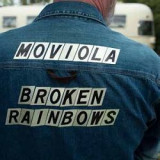
On the fringe of the indie Rust Belt scene since the 1990s,
Moviola has quietly forged a low-key career of high-quality
recorded output over twenty-five years, issuing ten (!) records
and countless 7-inch singles (including splits with Cobra Verde,
Hiss Golden Messenger, Handsome Family and many others).
In this artistic continuum, the band has evolved from everything
from 4-track fuzz to hi-fi country soul. Today, the band steps
forward with Broken Rainbows, its strongest collection of songs
to date, written, recorded, and mixed inside the group’s HQ in
Columbus.
Jake Housh started Moviola in 1993 as a student at “The”
Ohio State University as a noisy, fuzzed out lo-fi noisemakers.
Over the years, the band has morphed into a unique DIY
music and art-making collective with five distinct singers and
songwriters, recalling the creatively democratic lineage of The
Mekons, The Band, Pink Floyd, many others. Moviola is Jake
Housh, Ted Hattemer (Thomas Jefferson Slave Apartments),
Scotty Tabachnick, Greg Bonnell, and Jerry Dannemiller.
Broken Rainbows is a milestone release, showcasing a band
newly energized and assured in its artistry, and supportive of its
members’ songcraft. The eleven-song album hovers over a plot
of ground that’s optimistic in its despair. Album topics range
from the personal to the political, showcasing each member’s
unique songwriting within an overall cohesive band aesthetic.
“Moviola was one of those groups I met early on back in the day
that showed me how to do it. Broken Rainbows is a highlight—
pastoral thumpers, fuzzy indie radness, hooks to spare, pretty
much all the good stuff. Feels like a glorious drive from one
disparate end of Ohio to another. I love this band.”
—Eric Johnson (Fruit Bats)
Founded in Amsterdam in 1967 by saxophonist Willem Breuker, pianist Misha Mengelberg, and percussionist Han Bennink, Instant Composers Pool (or ICP) was an independent free jazz label and orchestra that would go on to release over fifty albums featuring such pillars of the scene as Derek Bailey, Peter Brötzmann, Evan Parker, Jeanne Lee, John Tchicai, and Steve Lacy. Based around the concept that improvisation was, in fact, an act of instantaneous composition, ICP's legacy on improvised and free music is impossible to overstate.
The ICP Tentet's Tetterettet is made up of recordings from 14-17 of September, 1977, cut and spliced together by pianist/composer Misha Mengelberg in a style similar to Teo Macero's work with Miles Davis. The first side is taken up entirely by Mengelberg's multi-part title track that breaks in and out of different tempos, with a loose arrangement style owing more than a bit to Charles Mingus' finest work on Black Saint or Ah Um.
Traversing across decades and styles from free-jazz funereal marches, to carnivalesque excursions, broken piano rolls, and ear-splitting skronk, ICP Tentet show remarkable skill and chops in both their compositional craft and improvisational symbiosis. There's a playful undercurrent here that finds its home in some previously uncharted land between Mingus and Spike Jones.
Featuring numerous ICP regulars along with the brilliant Alan Silva on bass, and a return to the fold of the amazing saxophonist John Tchicai, Tetterettet is one of the best of ICP's larger group recordings; humorous, unnerving, and ultimately, quite beautiful. This limited-edition reissue marks the first time this album has been in print on vinyl since its initial release.
Freestyle Records will release Dan Berkson's debut LP, Dialogues, on September 17th on LP & digital.
Following a move to London and an immersion in the city's deep house scene, Dan Berkson's subsequent rediscovery of his earliest musical foundations and the drawing of inspiration from London's buzzing contemporary jazz scene would lead to Dialogues - an accomplished and rewarding body of work pulled together during his final days in London before relocation to California.
"It was inevitable that Dan Berkson would make a jazz album like Dialogues: joyful, danceable, entertaining, driven by the pleasure principle, and filled with virtuosity. It represents Berkson's experiences in London, where jazz is a living, breathing, dancing scene. It's his love letter to the city, bristling with British talent such as bassist Andrea di Biase (Heidi Vogell, Maria Chiara Argiro, Bruno Heinen) and drummer Jon Scott (Kairos 4Tet, Sons Of Kemet, Mulatu Astatke) and recorded in his final days in the city before relocating to California. It's also rich with history: the musical journey that brought him to this point covers almost 40 years and 4,000 miles.
Berkson received lessons from Chicago boogie-woogie veteran Erwin Helfer - who in turn had learned alongside foundational legends such as Mahalia Jackson and Glover Compton. In 2001 he came to the UK, throwing himself into the deep house scene of East London, his duo with James What signing to Steve Bug's legendary Poker Flat.
But eventually he felt that he'd achieved what he could in the house format. Rediscovering the piano and discovering that jazz provided him the opportunity to keep learning, he enrolled in Trinity College in South London just as South London's jazz scene was exploding into the public consciousness.
Dialogues is a jazz album, not an electronic one – but all the groove-based influences, from the rootsy blues and ragtime of his youth, through the funk he played at college and the house he imbibed in London can be heard, as can his love of the studio as an instrument and mixdowns that suit a club soundsystem. Detroit dons Theo Parrish and Moodymann are every bit as important to this record as Charlie Haden, Carla Bley, Keith Jarrett, Ornette Coleman, Jimmy Giuffre, and Herbie Hancock. There's 50s and 60s cool modernism (just listen to the elegant ripples of "Sketches"), there's 70s funk fusion ("Unity" kicks things off with a spring in its step), and of course there's the pumping blues heart of "Live Bait". Above all else, though, it's a personal document: a life of music and collaboration crystalised in a magical, transitional moment. Where Dan goes next musically is as uncertain as anything in these times... but this one record tells you everything you need to know about where he's been."
Strut return to the rich archives of Black Fire Records for the Drum Message album by Ghanaian master percussionist Okyerema Asante from1977. After playing a short spell early in his career with Ebo Taylor's Blue Monksband at Tip Toe's in Accra, Asante joined the fledgling Hedzoleh Soundz during the early '70s at their Napoleon Club residency in the city. After playing Fela's Shrine, Fela recommended them to Hugh Masekela as an ideal backing band and Hedzoleh joined Masekela on a US tour in December 1973. Sharing the same management company, Charisma, Asante first met Plunky and Oneness Of Juju during an East coast tou rwith Masekela, starting a relationship with the band that has endured until today. Recorded at Arrest Studios in Washington D.C. in October 1977 and featuring musicians from Oneness alongside Gil Scott Heron cohort Brian Jackson on piano, Drum Message represents an important milestone fo rAsante: "This album really came from my heart. I wanted to project the African spirit in the music and come out with some unique African jazz. To be able to record it on Black Fire was extra special." The album also involved some serious physical graft: "The studio was up on the 14th Floor and the elevator was often broken down. I showed up with a van full of African drums and Jimmy Gray from Black Fire and myself had to carry them all the way up there, each day!" The resultant album was well worth the sweat. 'Adowa' adds jazz arrangements to a traditional Asante rhythm and Oneness classic 'FollowMe' is skilfully re-worked ("I used the bass drum in place of the bass guitar so it was all based on rhythms."). New versions of Asante dancefloor favourite 'Sabi' sit alongside the mellow groove of 'Asante Sana' ("I wantedsomething cool like reggae or highlife on that track, a similar vibe. So, Iwent inbetween.").
"Future indie classics that reek of modern New York City Charm” – DIY Magazine
"Captures honest-to-god truths in a new light’ – The Line of Best Fit
“A nostalgia-tinged hit, filled with jangly guitars and contagious melodies” – Wonderland
‘WANDERKID’ is the sophomore album from New York’s next lo-fi legend, JW Francis, and will be released whilst its creator is in the middle of trekking 2000 miles along the Appalachian Trail in the US. The follow up to JW’s critically acclaimed debut album ‘We Share A Similar Joy’, ‘WANDERKID’ will be released on 3rd September by Sunday Best Recordings. “WANDERKID is an album about escape. It’s supposed to be a gut punch of a record about an anti-hero named WANDERKID who wants to get OUT: out of his living situation, out of his head, out of his life. This album is like looking out the car window with an urgent desire to be on the other side. It was finished during the most recent global pandemic, so hopefully folks find it relatable.”
JW is fast making a name for himself as one of the most exciting new artists around. Born in Oklahoma, JW landed in New York City at 19 to study Economics at Columbia University, but not before making stops, stays and stints in Vermont, aged 12 and Paris, aged 13. Whilst at Columbia, the troubadour started music blog Rare Candy and founded student-run recording studio CU Records. Musically, JW takes his lead from the greats of the Downtown scene - Patti Smith, The Velvet Underground, Television, Talking Heads, The Strokes, Yeah Yeah Yeahs - and is fast emerging at the forefront of the next generation.
2021 Nachpressung auf weißem Vinyl. ,Truly She None Other" war lange vergriffen. Die aufgewertete "Expanded Edition"-Version erschien 2013 zum zehnjährigen Jubiläum des grandiosesten Albums von HOLLY GOLIGHTLY. Das würdige Re-Issue enthält zwei Bonustracks! Die Sleevenotes stammen von niemand Geringerem als JACK WHITE! Oft als ihr bestes Album beschrieben wurde ,Truly She Is None Other" 2002/03 mit Liam Watson in den Toe-Rag Studioa aufgenommen und beinhaltet mit ,Tell Me Now So I Know" den Song, der als Titeltrack des Jim Jarmush Films ,Broken Flowers" ausgewählt wurde. Zu den neun HOLLY GOLIGHTLY Originalkompositionen gesellen sich zwei RAY DAVIES Songs ("Time Will Tell" & "Tell Me Now So I Know") zusammen mit "There's An End" (geschrieben von ihrem Freund Craig Fox von THE GREENHORNES). Außerdem mit dabei: eine brillante Version des JESSIE MAE ROBINSON Songs ,Black Night", der durch die Version von MUDDY WATERS unsterblich wurde. Unterstützt von der Crème de la Crème der Toe-Rag Hausmusiker zusammen mit den HOLLY GOLIGHTLY Bandeckpfeilern Bruce Brand (THE MILKSHAKES, THEE HEADCOATS) und John Gibbs (KAISERS, MASONICS) ist HOLLY GOLIGHTLY auf diesem Album in absoluter Höchstform.
A Fable is Tigran Hamasyan’s first solo album after having recorded three previous albums as a leader. Released in 2011 it was hailed for the rare maturity of an all young musician to deliver such a landmark recording. At that time the pianist has been identified as one of the most important jazz revelations by critics impressed by his artistry. Well known for the way he fuses potent jazz improvisation with the rich folkloric music of his native Armenia, Tigran once again borrowed from the rich tradition he inherited and made a giant step with A Fable. Hamasyan gives a stunning one-man show with definite nods to Monk and Miles Davis, to Liszt and Debussy, while creating a space that is distinctly his.
Rakoon, a free spirit from the French electro-dub scene, known for his heavy weighted basslines in concert, comes back this year with his new album "Something Precious".
Since his first hit "Healing Dub" viewed more than 10 million times on YouTube, the producer has pursued his quest for an ever more hybrid and unique sound, combining synths and samples from travels, within pop structures with electronic features. "Something Precious" is a true synthesis of the eagerness of his first works and the power of his previous album, and confirms an even more electronic turn in the artist's career. It’s a bundle of energy carried by bewitching melodies; the travel journal of an enthusiastic musician, strewn with samples collected on the road.
“The musical guideline of this album first came one day when I got out of my studio after working on a track, feeling some kind of ecstasy that I hadn’t felt for years. Something that I used to feel almost every time I made music back when it wasn’t my job, but that had changed afterwards. It was like finding something really precious you thought you had lost forever…” says Rakoon about the genesis of this new album.
Whether it be with the intoxicating sample of "Hoi An" brought back from a trip to Vietnam or the galvanizing synths of "Chapters", a hit cut for the dancefloor, Rakoon treats his early fans to new gems true to his carefully refined recipe. But he also doesn't hesitate to venture into more electronic territories, like on the devastating "The Great Big Elephant", with its catchy sample and its synth’s nods to trance. Or even to surprise, with the use of vocoder on "Rituals" for instance.
"Something Precious" is the result of a significant sound research and an in-depth work on emotions. Its magnificent cover is signed by the English illustrator Miles Tewson, and it can be listened to like a diary that Rakoon shares with generosity and dedication with those who follow him, on and off the stage.
Vacant World is the first studio album by Jacks.3[4] It was released on September 10, 1968. In 2007, Rolling Stone Japan placed it at number 13 on its list of the "100 Greatest Japanese Rock Albums of All Time". Rumored to be a big influence on High Rise, one of their tracks ("Marianne") was covered by Fushitsusha on Tokyo Flashback II. "Here's what is considered one of the best psychedelic records in the world and certainly one of the must-have Japanese rock albums. The Jacks managed to record a very unique album, very dark and introspective, an album full of tension and contained wrath that maintains its power by refusing to fully explode. You'll find fuzz guitars, tremolo, lots of reverb and the occasional use of flute and vibraphone
Originally from Philadelphia, invited to New York by Miles Davis, playing at Antibes in 1960 with Charles Mingus and Eric Dolphy, here is trumpeter Ted Curson in 1971... in Paris. With him, a legendary trio: Georges Arvanitas (piano), Jacky Samson (double bass) and Charles Saudrais (drums). A new transatlantic alliance in the service of jazz of all kinds: classic, modal, fusion and even free... Pop Wine is – between Coltrane and Miles with a nod to roots in the club the Caveau de la Huchette – an explosive cocktail but which leaves no stains!
In 1960, trumpeter Ted Curson played with Charles Mingus and Eric Dolphy on stage at the Antibes jazz festival. Eleven years later he was in Paris to record one of the gems of his discography, with a hard-hitting French trio: Georges Arvanitas (piano), Jacky Samson (double bass) and Charles Saudrais (drums).
Arvanitas was also someone who had travelled widely. Originally from Marseille, he had accompanied visiting American musicians in Paris before moving to the States. It was when he came back that the charismatic trio was created with Samson and Saudrais and who recorded, in 1970 on Futura, the unforgettable In Concert and then, the following year, Pop Wine with Ted Curson.
Pop Wine: don’t be fooled into thinking you are going to hear jazz musicians trying to play pop after uncorking too many bottles. For, although the album occasionally tends toward fusion, it is first and foremost a wonderful jazz recording; and a recording with enough fizz to make your head spin!
There are five tracks in total: Quartier Latin reminds us a little of Olé Coltrane (Curson, like the saxophonist, is originally from Philadelphia), Flip Top where the trumpet and piano play out a chase scene through the streets of Paris, Pop Wine where funk and cool jazz meet on the barricades of black and white, L.S.D. Takes A Holiday which breaks out in a style close to free jazz, and finally Lonely One, with the impression that ends this unclassifiable album. Unclassifiable, unless we decide to elevate Pop Wine to the rank of a great vintage.
A deep dive into the one of most collectable jazz catalogues in the world, a selection of some of the rarest and most sought-after recordings from the 60s and 70s, a time when British jazz began to find its own identity. Drawn from the iconic labels of Decca, Deram, Argo, EMI Columbia/Lansdowne Series, Fontana, Mercury, & Philips. If one were asked to pick an album that represented the best of British jazz in the 1960s, Le Déjeuner Sur l’Herbe by the New Jazz Orchestra would be a serious contender. Recorded in September 1968, it draws together many of the key streams that had developed in British jazz in the preceding years, and also presages much of what was to come. Notwithstanding the line-up, which includes some of the very best British jazz musicians directed by an inventive and ingenious leader in Neil Ardley, the session features pieces written by the most distinctive jazz composers active in Britain at that time alongside idiosyncratic interpretations of works by John Coltrane and Miles Davis. And it’s all captured beautifully by engineer Howard Barrow and producer Tony Reeves and it features a stella cast of some of the greatest musicians, not just from that era or genre but beyond; Jack Bruce, who would become one of the founding members of Cream, Barbara Thompson, Ian Carr, Michael Gibbs, Dave Gelly, Dick Heckstall-Smith and Jon Hiseman, who went on to form one of the greatest jazz/progressive/rock bands – Colosseum.
- A1: Dubbing In The Front Yard
- A2: Judgement Dub
- A3: Gates Of Dub
- A4: Babylon Dub
- A5: Somewhere Dub
- B1: Carry On Dubwise
- B2: Crab In A Barrel Dub
- B3: Hold Them Dub
- 4: Lowdown Dub
- B5: Overdue Dub
- C1: Jumping Dub
- C2: Skilful Dub
- C3: Ethiopian Dub
- C4: Still In Love Dub
- C5: A Rootsy Dub
- D1: I Cant Go On Without Dub
- D2: A Steppin Dub
- D3: A Rocking Dub
- D4: A Mighty Dub
- D5: The Best Dub
Bunny Lee as producer. Prince Jammy as engineer. The Aggrovators making the tracks. A Holy Trinity of Jamaican Music. Throughout the years, recorded music has been shaped by some enduring partnerships between producer and engineer, such as Teo Macero and Fred Plautt for Miles Davis, Jerry Wexler and Tom Dowd for Atlantic Records, and George Martin and Geoff Emerick for the Beatles. But possibly none were as prolific as the collaboration between Bunny 'Striker' Lee and Prince Jammy at King Tubby's Studio between 1976 and 1982.
In 1977 and 1982 respectively, Conflict Dub and Dubbing In The Front Yard were released in London as white labels in extremely limited quantities. The two LPs found the triumvirate of Lee, Jammy and The Aggrovators on perfect form, with driving instrumentals, flashes of vocal beauty, and mixes that ripped apart and rebuilt traditional notions of sonic structure. Due to the nature of their limited release (not to mention the lack of artwork and even titles) the two dub LPs quickly disappeared into that mythic realm of records whispered about by only the most hard-core reggae collectors. This release is the first-ever reissue of these sought after LPs, and contains all the original songs in both vinyl form (double LP set with both albums on the original labels) and a lush double pack cd with 3 extra bonus tracks. The sleeve notes are by Diggory Kenrick with amazing photos by Howard Johnson, director of the influential Channel 4 documentary 'Deep Roots Music'.
The 3 CD bonus tracks are all remixes. Two from Paolo 'Dubfiles' Baldini for the Dubbing in the Front Yard set. One for Conflict Dub by Diggory Kenrick.
In 2018, Pressure Sounds celebrated its 100th album release since it's founding in 1995. In that time, the label has been responsible for unearthing and celebrating some of the rarest, most influential and unique Jamaican records ever cut.
- 1: Madame George Recorded Live At Auditorium Stravinski 0Th July 995
- 2: Broken English Recorded Live At Miles Davis Hall 13Th July 009
- 3: Times Square Recorded Live At Auditorium Stavinski 11Th July 2002
- 4: Guilt Recorded Live At Auditorium Stravinski 3Rd July 1999
- 5: Song For Nico Recorded Live At Auditorium Stravinski 11Th July 2002
- 6: Come Stay With Me Recorded Live At Auditorium Stravinski 3Rd July 1999
- 7: Sister Morphine Recorded Live At Casino Barrière 6Th July 2005
- 8: She Recorded Live At Auditorium Stravinski 10Th July 1995
- 9: Hold On Hold On Recorded Live At Miles Davis Hall 13Th July 200
- 10: Solitude Recorded Live At Miles Davis Hall 13Th July 2009
- 11: Working Class Hero Recorded Live At Auditorium Stravinski 3Rd July 1999
- 12: Tower Song Recorded Live At Auditorium Stravinski 3Rd July 1999
- 13: Strange Weather Recorded Live At Casino Barrière 6Th July 2005
- 14: Why D'ya Do It Recorded Live At Auditorium Stravinski 10Th July 1995
The magnificent and incomparable Marianne Faithfull has performed five legendary concerts at the Montreux Jazz Festival between 1995 and 2009. Each of these historic concerts were recorded.
Marianne Faithfull’s name is synonymous with the authenticity, artistry and individuality of the festival and this collection is a celebration of her unique talent.
The Montreux Years collection will bring together, for the first time, some of the finest moments from Marianne’s most celebrated performances.
Expertly curated by the Montreux Jazz Festival and BMG, restored and remastered in superlative HD audio; The Montreux Years is released on superior audiophile heavy weight vinyl, MQA quality CD and in HD digital.
Montreux Media Ventures (MMV) in partnership with BMG are working together to produce and release a premium series of albums and activities, curated from the unique Montreux Jazz festival archive; one of the finest music collections in the world. As part of this exciting new joint venture MMV and BMG have commenced work to establish a new series of deluxe artist collections under the new official Montreux Jazz records imprint. These initial collections; The Montreux Years will bring together the most iconic performances from the most significant artists to perform in the festival’s impressive five decade history.
The collaboration is an unprecedented curation project. The most extensive exploration of the official archive in the festival’s history. Expertly curated by the MJF and BMG teams and overseen by Claude Nobs’ partner and president of the Claude Nobs foundation, Thierry Amsallem, who will act as executive producer across the series.
The Montreux Years series is a celebration of Claude’s love of the artists and passion for the festival and are a fitting tribute to his legacy.
The BMG and Montreux Jazz music festival design teams will work in partnership to produce new and authentic creative, faithful to the festival’s reputation for iconic artwork.
Fractal City, the latest Cubenx album is a collection of terrestrial jams and arachnean ambient ballads that are particularly apt for urban listening. If its predecessors cracked the musical codes in force and shone by the versatility of their references, this new opus offers its listener an intense and symbolic sound environment.
The raw material of Fractal City was first conceived as a series of sound patches, designed to run in parallel with Canadian digital artist Maotik's installation. Broadcasted in real-time by generative patches reacting to various external and non-human data, those musical excerpts have been rendered in hundreds of nuances and extended over infinite durations. This unusual approach confers to the recording of the finished album's outstanding immersive strength.
Recorded live on a single track over a short period of a few weeks, the nine compositions of Fractal City capture the obsessions of its author for postmodern urban landscapes, and the revelation of new perspectives on the city of Paris.
The opening piece `Ssarg´ seems to hide the figure of the Mexican ambient producer Jorge Reyes. Cubenx built a cocoon of energetic layers, a new home of the mystical kind harmoniously integrated in a flourishing rainforest ecosystem.
`Transect ´refers to the urban development model of the same name, which is based on a division of the city into autonomous "fractal" zones. It also echoes the concept of "metro polarities" which considers the city as a mosaic of social groups. "By cycling in the evening with a friend, we could get away from the city centre to the suburbs of Paris. The contrasts are striking. You move from chic districts to bedroom communities, from industrial zones to improvised caravan camps. But there is a kind of energy in this heterogeneity that pushes you to always pedal further."
A few miles away, it would look like Art and urbanism have tried to level the cultural and social discrepancies of the outskirts of Paris. "Architectural sites like the Arcades of Bofill are splendid. There are completely extravagant projects, which seem to emerge from nowhere."
These buildings with ambitious aesthetics off the beaten tourist track, deteriorate over time and often remain far from the expectations of the local population. A feeling of nostalgic beauty is particularly perceptible on the slowest and most introspective ballads of the album as 'Urban Decay', 'Hagel' or 'Axe Majeur'. The producer leaves nonetheless no room for melancholic emptiness. "Every time, I have the impression that urban culture is taking its rights back and that young people appropriate the places in one way or another."
Just like `Transect', ` Quantified' and `Fractal City' present themselves as mirrors of a daily urban life in constant motion. All three are empowered by an overheated factory, which dispatches hypnotic beats and burst of analogue compressors with a clinical precision and direct them straight away to the reptilian areas of their listener's brains.
The sequencing leaves however space and time to take breath and makes way for aerial sonic excursions of spiritual and enlightened nature. On `Human Dilemma', Cubenx shows some concerns to opening the Pandora's box of transhumanist theories. While a long cosmic wave gives the listener a feeling of perfect fullness, a dizzying guitar distortion cast doubts on long term outlooks. `Smash Other' on the other way alternates gentle dissonances over an ocean of white noise and concludes the album on ethereal note.
With ´Fractal City", Cubenx eludes his irreconcilable love for shoegaze pop song and techno to concentrate exclusively on the production of mutant experimental materials. The result is an uncanny musical object, rich in image and sensation. Cubenx give us a guiding framework, enthralling enough to engage the listener to a tour of town. But he leaves it to the sole listeners to design their own projection of the city.
After his first adventure in the endless universe of instrumental music where he made known “Man With a Plan” in 2018, Minus & MRDolly now presents the new EP Broken Hearts Make Broken Beats. This new work is the result of a recording session at the Groove-Wood studios promoted by João André - who mixes two of the three originals of the EP - to which Hugo Danin joined on drums and Sérgio Alves on keyboards and electric piano. In trio, Minus, Hugo and Sérgio rearranged and explored the original sketches, previously composed by Minus & MRDolly.
Floating, or as if to say, with one “foot inside and the other outside” of his so familiar home that is Hip Hop, “BHMBB” is the reflection of some musical references previous to that house, where “Britfunk” or “Broken Beat” serves as an example. This EP intends to marry the acoustic character of the interpretation with the aesthetic and electronic universe of dance music.
“Salame”, “The Break” and “A Thousand Miles”, the three originals that make up the EP Broken Hearts Make Broken Beats, also count on the participation of percussionists Manu Idhra and Rui Ferreira, the voice of Mary Raisekings, and the Pardal saxophone. The theme "The Break" has remixes by Pedro and Max Graef.
- 1: All I Need
- 2: Kiss Like The Sun
- 3: About Last Night
- 4: Downtown
- 5: Rabbit Hole
- 6: Lost
- 7: Scene
- 8: Lonely Hours
- 9: Maybe It’s Today
- 10: Screaming
- 11: Hold Tight
It may be his fifth album, but Saturday Night, Sunday Morning marks the start of chapter two for Jake Bugg. Arguably his most complete and coherent record to date, Saturday Night, Sunday Morning manages to combine a love of ABBA, the Beach Boys, Supertramp and the Bee Gees, with a contemporary pop sound: one that’s already spawned his most ubiquitous song in years via euphoric lead single, All I Need. “I knew what I was looking for this time around,” the 27-year-old says, firmly. “And I feel like I accomplished it.” It’s almost 10 years since a two-fingered Bugg burst onto the scene with his eponymous debut, one that topped the UK album charts and saw the then 18-year-old from Nottingham fêted as the next Bob Dylan. A Rick Rubin-produced follow up, Shangri La, quickly followed. But progress stalled with Bugg’s third, largely self-produced, record, On My One, in 2016. “I was having a hard time on that third record,” Bugg admits, five years removed. “The support from the industry wasn’t what it was. All those people telling you how great you are weren’t there anymore. It does feel like the rug’s been swept from under your feet.” What that record provided, however – along with its comparatively stripped-back follow up, Hearts That Strain (2017) – was a much-needed course corrector: one that set Bugg on the upward trajectory he finds himself on today. “When I came to terms with that was when I left the ego at the door,” he says. “It didn’t work out. But it led here. And this is probably my strongest record." It’s testament to Bugg’s rediscovered confidence that Saturday Night, Sunday Morning – a nod to the debut novel by Nottingham author Alan Sillitoe – sees him working with some of his highest profile collaborators to date, most notably American songwriters Andrew Watt and Ali Tamposi, best known for their work with pop heavyweights Post Malone, Dua Lipa, Miley Cyrus, Camila Cabello. “I was looking for how I can incorporate my sound for a more modern era. And I kind of struck gold working with Andrew Watt and Ali Tamposi,” Bugg says. Convening in LA, the first track the trio wrote together is the jealousy-inflected About Last Night, a song about the “insecurities you go through as a young person in a relationship with someone.” “It’s got such dark undertones, which I love,” Bugg says, of a song that showcases a newly discovered, Beach Boys-esque falsetto. “But it’s also very, very pop. That’s what I’ve always loved. With ABBA, with Supertramp. I love pop music. But when you can get it to be dark, I love it even more.” It’s a trick the trio repeated again on Scene, Bugg’s personal favourite from the album and a song that best encapsulates the combination of old and new: Watt’s George Harrison-esquire guitar brushing up against contemporary melodic choices by Tamposi. “I love writing with her,” Bugg says of the Havana hitmaker. “She brought that women’s perspective. And I knew that I’d got that balance of what I wanted. That old school chorus with contemporary verses. That to me was my favourite song when I wrote it, and it still is.” Perhaps the biggest example of Bugg’s newfound ego-less approach to writing, however, came in the shape of Downtown, a song that grew from an idea by Jamie Hartman (Celeste, Lewis Capaldi, Rag'n'Bone Man), and sees Bugg deploy the higher range of his voice to ethereal, ’60s Bee Gees effect. “Usually, the initial spark of an idea comes from me. And when it doesn't, it sometimes loses my attention,” Bugg admits. On Downtown, however, he relished his role as arranger: “Because there were a lot of moving parts and chords, it was almost like a puzzle,” he says. “I’d never approached a song like that before. “What I’ve been enjoying on this record is the collaborative process,” he continues. Working with people, writing with people. Because I’ve realised all I really want to achieve is to be the best writer I can possibly be. And I think by working with other people, it allows you to learn a lot as well.” It’s a theory Bugg has put to the test during lockdown, when he was approached by his manager about writing the soundtrack to an upcoming documentary, The Happiest Man In The World, about Brazilian footballer Ronaldinho. “It’s kind of a completely different experimental outlet,” Bugg explains of his first ever score. “I approach my own work quite professionally. But with this I can just switch off and go into a different world. And it’s been brilliant – I’ve had to learn different styles of guitar: bossa nova, samba. It’s a bit Vangelis, who’s probably my favourite artist – which may surprise people.” Possibly. But you get the impression that surprising is what Bugg likes to do. “I don’t like to be stuck doing the same thing,” he admits. “And that’s what this record Saturday Night, Sunday Morning was. I wanted to push myself. I’m always learning new influences. I’m careful not to get stuck on the same thing. “It’s not going to be right every time. It’s not going to be good every time,” he continues. “But if that’s the process it takes to get to this record, where people are loving the songs again, then that’s the journey we have to take.” For Jake Bugg, chapter two starts now. New album ‘Saturday Night, Sunday Morning’ is out August 20th on RCA Records
‘321?’ is the debut EP from MILYMA, released on foundation.fm’s freshly minted label foundation.fm Records.
MILYMA is the multi-instrumentalist and multi-linguistic musician, vocalist and producer with a bright year ahead of her.
Real name Milena Mayordomo, the rising star is based in the creative city of Basel in Switzerland and was born in Germany to Spanish parents. Her music explores the experimental fringes of pop that nods to hip-hop as well as classical, with her cascading arpeggios at the heart of her music making. Her world building capabilities with both music and visuals, place her amongst avant-pop creators like FKA Twigs and Smerz. Her intricate and intoxicating productions show us that MILYMA is already a master of her craft, bringing her thrilling EP ‘321?’ to the table, this Basel based artist is proving to be one of the most exciting acts to burst on the scene. After launching a new era for foundation.fm, both label and artist are sure to go from strength to strength.
This 4-track EP is printed on 140 gram 12” black vinyl, in 200gsm printed card sleeve.
Guitarist Kenny Burrell debuted on Blue Note Records in 1956 and over the following seven years made a series of excellent albums for the label that culminated with his masterwork Midnight Blue. Recorded in 1963, the album waded deep into the blues, conjuring an alluring late-night vibe with a profoundly soulful cast including tenor saxophonist Stanley Turrentine, bassist Major Holley, Jr., drummer Bill English, and Ray Barretto on congas. Burrell originals including “Chitlins con Carne,” “Midnight Blue,” “Saturday Night Blues,” and the stunning solo guitar piece “Soul Lament” set the tone for this timeless classic adorned by one of the all-time great Reid Miles cover designs This Blue Note Classic Vinyl Edition is all-analog, mastered by Kevin Gray from the original master tapes, and pressed on 180g vinyl at Optimal.