A deep dive into the one of most collectable jazz catalogues in the world, a selection of some of the rarest and most sought-after recordings from the 60s and 70s, a time when British jazz began to find its own identity. Drawn from the iconic labels of Decca, Deram, Argo, EMI Columbia/Lansdowne Series, Fontana, Mercury, & Philips. Kenny Wheeler was born Canada in 1930 and, with encouragement from his father - himself a trombone player - began playing trumpet at age 12. After studying at Toronto’s Royal Conservatory, he arrived in London in 1952, his playing enveloped in the sounds of Miles Davis, Booker Little, and Fats Navarro. In 1959, Wheeler joined the Johnny Dankworth Orchestra and stayed there until 1963, although he returned frequently for shows and other projects in the years that followed. He quickly become a distinguished soloist in the Orchestra and appeared on Dankworth’s key sixties albums. Wheeler met and played with the rising artists of London’s free jazz scene. Players such as Trevor Watts, Derek Bailey, and Evan Parker, musicians who would challenge the conventions of the day, eschewing formal composition and structure to embark on group improvisation. For a musician thoroughly schooled in all the conventions of charts and dance bands as Wheeler was, this was a radical departure. Wheeler’s contributions proved his ample flexibility and showed he was capable of inhabiting both the free environment and the more formal and controlled settings of a big band and orchestra. This was shown most clearly on his debut album, Windmill Tilter, recorded for Fontana with the John Dankworth Orchestra. The album features a young John McLaughlin on guitar along with bassist Dave Holland and a roster of talented and well respected musicians playing on one of the greatest modern jazz big band and orchestral albums.
Suche:mile one
No ballads here.
These two brothers started with a group called “The Rock N’ Roll Trio” and one listen to those tracks lead into one direction - authentic, powerful, and dynamic rock n’ roll. And successfully, I may add.
Essentially, there was no need to change their entertaining formula when composing for Ricky Nelson and most of Ricky’s rockers came directly from the Burnette Brothers. So they continued their success for Ricky, to much critical acclaim and considerable esteem with some of Billboard’s significant achievements and milestones.
James Burton cut his teeth on the guitar solos he would create from these Burnette rockers, with the guitar break on “Believe What You Say” to be arguably one of the finest. James Burton credits the Nelson family for his success to this day.
There were a total of 19 songs that Ricky recorded by the Burnette Brothers; 8 of which Johnny had written/co-written until his early passing in August, 1964 at the age of 30 years old. His brother Dorsey died in August, 1979 at the age of 46 years old but not before writing/co-writing the remaining 11 tracks that Ricky recorded.
A few special notes here are worth mentioning:
“Hey Daddy” cut by Billy Burnette (at age 7) is the son of Dorsey. Billy fondly recalls cutting his first record with Ricky Nelson and his band, with Ricky singing harmony along with Billy. He was absolutely thrilled.
“Tired Of Toein’ The Line” written by Rocky Burnette (at age 27) is the son of Johnny. Released in 1980, song hit big overseas and number 1 in Australia. Ricky had recorded it at the same time but didn’t release it, respectful of Rocky’s potential success. Rocky still remembers Ricky’s consideration and kindness to this day.
“Lucky Boy” was written by Johnny & Dorsey Burnette and Ricky recorded it during his final Curb Sessions in September, 1985 as a tribute to the Burnette family - as well as it being a great rocker!
The album follows Stevenson’s 2019 career milestone The Big Freeze,
celebrated for its ‘finely detailed, wrenchingly intimate songwriting’
(All Songs Considered), and a 2020 NPR Tiny Desk
(counted as one of the year’s 20 Best).
Produced by John Agnello (Sonic Youth, Dinosaur Jr., Kurt Vile,) at The Building in Marlboro, NY, Laura Stevenson is an altogether beautiful record, a sincere portrait of a human heart in all its vibrant colors.
More than anything, it is about bearing one’s whole self in the face of those you love’uncomfortable, and exposed, but vital, present. Here.
- A1: Branko Over There (Feat. Miles From Kinshasa)
- A2: Branko - Movimento
- A3: Branko - Stand By (Feat. Umi Copper)
- A4: Branko & Sango - Hear From You (Feat. Cosima)
- A5: Branko & Pedro - Mpts (Chords Version)
- B1: Branko - Sempre (Feat. Mallu Magalhães)
- B2: Branko - Amours D'été (Feat. Pierre Kwenders)
- B3: Branko - Tudo Certo (Feat. Dino D'santiago)
- B4: Branko - Bleza
- B5: Branko - Agua Con Sal (Feat. Catalina García)
- B6: Branko & Dengue Dengue Dengue - Lucuma
The first thing that strikes you when hearing 'Nosso' is its feeling of intimacy and warmth. The title, which means 'Ours' in Portuguese, is apt since he sees the record as the result of letting a wild variety of people into his world. João notes that 'I didn't know most of the collaborators before meeting up with them in a studio somewhere in the world, so most of these songs are coming from a very immediate and honest sense of collaboration where you spend an afternoon with someone learning about each other at the same time as you're making music. It's a shared experience, a moment where two or more people came up with ideas together, that they probably wouldn't have had if they were in their comfort zone.' These meetings were turned into songs at home in Lisbon once the main ideas were created collaboratively elsewhere. 'On this album, like in everything else I did so far, the focus on the instrumental side of things was experimenting with rhythmic patterns and genres from the Portuguese-speaking universe while applying them to songs created with other artists from completely different backgrounds and places.' There's something in this process that has left the album sounding super fresh as this is a sound without borders that pulls you in. It's music everyone can be a part of, where even the most rugged up-tempo cut sounds welcoming. It's an overwhelmingly positive and joyous experience to immerse yourself in 'Nosso.' It's no wonder that the central motif of the album artwork shows a less common view of Lisbon, one where instead of looking at the historic city centre we face the suburbs, where these musical and cultural experiments have been and still are occurring, undeniably shaping the musical and cultural landscape of Lisbon in the process. As much a soul record as it is a record infused with the beats of the Portuguese-speaking world, 'Nosso' is a reflection of Branko's ongoing musical explorations and his vision of Lisbon as a privileged cultural hub for the Portuguese-speaking world and beyond. Branko fuses local rhythms from kizomba to baile funk and afrohouse through European electronic genres with a clear accessible pop sensibility and the aim of creating a unified sound that puts all these individual musical expressions in perspective as part of a greater whole. For João, this is the logical next step in his musical evolution.
- Tales Facing Up
- One Of These Days
- Easy On Yourself
- Feb. 14
- Aftermath Usa
- Gravity’s Gone
- Sink Hole
- Outfit
- My Sweet Annette
- Marry Me
- A World Of Hurt
- Why Henry Drinks
- The Day John Henry Died
- Wednesday
- Shut Up And Get On The
- Plane
- Ronnie And Neil
- Moonlight Mile
- Let There Be Rock
- Zip City
- Goddamn Lonely Love
- 18: Wheels Of Love
- Nine Bullets
- Daddy’s Cup
- Decoration Day
- Lookout Mountain
On July 13, 2006 the Drive-By Truckers set up
shop at Plan 9 Records in Richmond, VA. It was
the 25th Anniversary of the store. The band
performed to a packed house and played a
blistering set of fan-favourites, featuring the songs
‘18 Wheels of Love’, ‘Let There Be Rock’,
‘Goddamn Lonely Love’ and ‘Daddy’s Cup’.
The performance was also set up to benefit the
Bryan and Kathryn Harvey Family Memorial
Endowment. The foundation provides, among
other things, music scholarships in the Richmond
area. Lead vocalist and songwriter Patterson Hood
ended up writing the song ‘Two Daughters and A
Beautiful Wife’ about Bryan Harvey and his family.
The updated packaging includes original artwork
from acclaimed artist and long-time collaborator
Wes Freed.
Originally available as a very limited and long sold
out vinyl-only pressing. Now available on CD for
the very first time.
- North American version on CLEAR vinyl (2XLP) - Limited DOUBLE 180g Vinyl Edition (500 copies) with obi strip - Rare Dutch studio recordings, one of Art's last sessions before he passed away - Comes with insert/liner notes // Art Blakey (1919-1990) actually needs little introduction, the American Jazz drummer and bandleader made a name for himself in the 1940s & 1950s playing with contemporaries such as Miles Davis, Dizzy Gillespie and Charlie Parker. He is often considered to have been Thelonious Monk's most empathetic drummer (he played on both Monk's first recording session in 1947 and his final one in 1971). In the decades that followed Blakey recorded for all THE labels that mattered in the field of jazz (Columbia, Blue Note, Atlantic, RCA, Impulse!, Riverside, Prestige, Verve, etc.). His collaborations were numerous and include working with equally legendary artists such as Sonny Rollins, Max Roach, Chet Baker, John Coltrane_.and countless others.Art Blakey was a major figure and a pioneer for modern jazz, he assumed an aggressive swing drumming style early on in his career and is known as one of the inventors of the modern bebop style of drumming. His signature polyrhythmic style was amazing, exuding power and originality, creating a dark cymbal sound punctuated by frequent loud snare and bass drum accents in triplets or cross-rhythms. A loud and domineering drummer_but Blakey also listened and responded to the others in the band. He was an original, an important drummer you'd hear_and would recognize immediately.Art Blakey was inducted into the Downbeat Jazz Hall of Fame (1981), the Modern Drummer Hall of Fame (1991), the Grammy Hall of Fame (1998 and 2001) and was awarded the Grammy Lifetime Achievement Award posthumously in 2005. He was sampled and remixed by renowned acts such as Raekwon, Black Eyed Peas, A Tribe Called Quest, Digable Planets, Buscemi, KRS-One and Madlib.In the mid-1950s he and Horace Silver formed `The Jazz Messengers': a group that Blakey would perform and record with for the next 35 years. Originally formed as a collective of contemporaries_but over the years the band became known as an incubator for young talent that included artists such as Freddie Hubbard, Wayne Shorter, Cedar Walton, Chuck Mangione, John Hicks_and MANY others. Art Blakey went on to record dozens of albums with a constantly changing group of Jazz Messengers. Blakey's final performances were in July 1990. He died on October 16 of lung cancer. The legacy of Art Blakey and his band is not only the music they produced, but also the opportunities they provided for several generations of jazz musicians.Released on the legendary Dutch jazz label Timeless Records and one of his final recordings_on the album we are presenting you today (Chippin' In) you'll find ten sublime tracks recorded at Rudy van Gelder's Recording Studio in February 1990. Art Blakey passed away just 8 months after these tracks were cut and you can't hear any signs of him slowing down at all. For these specific recordings, The Jazz Messengers were expanded from its usual quintet or sextet into a septet and they showcase their energetic signature sound with remarkable style, musical knowledge, a dash of good humor and camaraderie you'd expect from a world class band who have entertained, thrilled and amazed for almost five decades. The line-up on these fantastic sessions includes non-other than Essiet Okon, Geoff Keezer, Dale Barlow, Javon Jackson, Frank Lacy, Steve Davis and Brian Lynch_impressive to say the least!Chippin' In sounds as successful, young and vibrant as ever! Expect supercharged hard bop with striking notes, no-holds-barred musicianship, high swinging solos, screaming choruses and plenty of solid virtuosity to spare. This electrifying set of tracks contains both originals and several eclectic versions of standards_making this release a bonafide hit and a must have for any self-respecting jazz fan or collector.
- A1: The House Song - Lee Hazlewood
- A2: If Only She Had Stayed - Chris Gantry
- 3: Endless Miles Of Highway - Jerry Reed
- A4: The Back Side Of Dallas - Jeannie C Riley
- A5: Way Before The Time Of Towns - Hoyt Axton
- A6: Strawberry Farms - Tom T Hall
- B1: Down From Dover - Dolly Parton
- B2: July 12, 1939 - Charlie Rich
- B3: What Am I Doing In L.a.? - Nat Stuckey
- B4: Mr Stanton Don’t Believe It - Rob Galbraith
- B5: Saunders’ Ferry Lane - Sammi Smith
- B6: Four Shades Of Love - Henson Cargill
- C1: Drivin’ Nails In The Wall – Waylon Jennings & The Kimberlys
- C2: Ruby, Don’t Take Your Love To Town – Kenny Rogers & The First Edition
- C3: Why Can’t I Come Home - Ed Bruce
- C4: Mr Walker, It’s All Over - Billie Jo Spears
- C5: Harlan County - Jim Ford
- C6: Widow Wimberly - Tony Joe White
- D1: Belinda (Alt Take) - Bobbie Gentry
- D2: Joanne - Michael Nesmith & The First National Band
- D3: Mr Jackson’s Got Nothing To Do - John Hartford
- D4: Alone - Lee Hazlewood & Suzi Jane Hokom
- D5: Fabulous Body And Smile – Sir Robert Charles Griggs
- D6: I Feel Like Going Home - Charlie Rich
• “Choctaw Ridge” explores a new country sound, one that emerged at the end of the 60s in the wake of Bobbie Gentry’s ‘Ode To Billie Joe’, a shock number one hit in 1967. When singers like Gentry, Jimmy Webb, Michael Nesmith and Lee Hazlewood moved from the south to Los Angeles to make it in the music business, they were not part of the Nashville in-crowd and they forged a new direction.
• ‘Ode To Billie Joe’ was the tip of the iceberg, and its success helped a bunch of singers and storytellers to emerge over the next three or four years. Some of the tracks on this collection bear that song’s stamp more clearly than others: Sammi Smith’s moody ‘Saunders’ Ferry Lane’ had a similar mystery lyric, and Henson Cargill’s ‘Four Shades Of Love’ is a portmanteau, with one (or possibly two) of the theoretically romantic situations ending in death.
• Suddenly, character sketches of southerners became a lot more rounded – women didn’t have to stay home, or take abuse at the office, and darkness wasn’t only found at the bottom of a bottle. Storytelling is the link between all of the songs on this collection. We have cautionary tales about what could happen to someone who heads for the bright lights and doesn’t make it, ending up in the grasping hands of ‘Mr Walker’ (Billie Joe Spears), or on the ‘Back Side Of Dallas’ (Jeannie C Reilly), or on a mortuary slab in the case of the songwriter with the ‘Fabulous Body And Smile’ (Robert Charles Griggs). And there are stories about wanting to go home – Nat Stuckey’s ‘What Am I Doing In LA?’ and Charlie Rich’s ‘Feel Like Going Home’ – and others from Ed Bruce and Lee Hazlewood, who know that their home isn’t home anymore.
• The tracklist and fulsome sleeve notes have been put together by Bob Stanley (Saint Etienne) and Martin Green (Smashing, The Sound Gallery), who have been collecting these records for decades.
• The voices are resonant and relatable, and the productions take in the best of what pop had to offer in the late 60s and early 70s. Before the factionalism between smooth pop-conscious Nashville and the hedonistic ‘outlaws’ made it look inward again, this was a golden era for an atmospheric, inclusive and progressive country music. It began on the third of June, another sleepy, dusty Delta day.
- 1: Roll Alabama
- 2: 10,000 Miles Away
- 3: Parsonos Farewell
- 4: Cold Blows The Wind
- 5: Cross-Eyed & Chinless
- 6: Captain Wedderburn
- 7: Betsy Baker
- 8: Yarmouth Town
- 9: Haul Away
- 10: Little Sally Racket
- 11: The March Past
- 12: Rosemary Lane
- 13: Sloe Gin
- 14: Roll The Woodpile Down
- 15: London Town
- 16: New York Girls
- 17: Frogs Legs & Dragonos Teeth
Yellow Vinyl[29,37 €]
Ltd Edition, Double LP!
After 12 amazing years together, the UK’s most successful folk band
Bellowhead called it a day in 2016 going out in characteristic style with a
sell-out show at the London Palladium.
It took a few years and a global pandemic, but to the delight of their many fans,
the band reassembled for a one-off worldwide concert stream in December
2020, marking the 10th anniversary of their 3rd album ‘Hedonism’.
Hudson Records are excited to release the release of that live session recording
- ‘Reassembled’ - which will be the bands’ first release on double vinyl LP and
will also be available on CD and digital.
The band re-connected online during the lockdown in 2020 and for the sheer
fun of it remotely made and released ‘New York Girls At Home’ - all from their
respective homes around the UK.
This unplanned performance was warmly received and ignited another idea: to
reunite in person for a one-off broadcast performance. ‘Reassembled’ features
a host of favourites, including New York Girls, Roll Alabama, London Town and
Roll the Woodpile Down
- 1: ) Songs To Die For
- 2: ) Things That Make Me Happy
- 3: ) Revolt Against An Age Of Plenty
- 4: ) Losing Faith In The Wall
- 5: ) Giving Back Is Good For You
- 6: ) Debra 2021
- 7: ) Words On Fire
- 8: ) Can You Kanreki?
- 9: ) A Life More Ordinary
- 10: ) It’s A Wonderful Life
- 11: ) My World Is Not My Own Anymore
- 12: ) When Our Kingdom Comes
- 13: ) Songs To Die To Reprise
Double vinyl on blue and orange transparent vinyl in gatefold sleeve with download code.
Former bIG*fLAME singer and bassist Alan Brown returns with his long term solo project The Great Leap Forward, releasing a powerful and trademark new album ‘Revolt Against An Age Of Plenty’.
Vigorous, scintillating and life-affirming, this 13-song album sees Brown reach a milestone birthday, as explored in 'Can You Kanreki?’ - the Japanese concept of second childhood and re-birth. Then there are the trademark political and social vignettes, such as the title song of the album 'Revolt Against An Age Of Plenty' – railing against mass consumerism and media control; the wistful 'dEBRA 2021' (a re-working of the bIG*fLAME classic 'Debra'); and the ascerbic 'It's A Wonderful Lie' – a scathing attack on the lack of openness, honesty and humility of our political leaders.
Brown featured on the legendary and influential C86 NME cassette as singer and bassist with Manchester agit-post-punk trio bIG*fLAME, and recorded nine John Peel sessions for BBC Radio One in the 1980’s with bIG*fLAME (4), The Great Leap Forward (2), A Witness (2) and Inca Babies (1).
Formed by Brown following the disbandment of bIG*fLAME in 1986, The Great Leap Forward is essentially a solo project in which Brown writes all songs and lyrics, and plays / programs all instruments on recordings.
The style and sound is more melodic and accessible than bIG*fLAME, but still with overtly political lyrics and a socialist / humanist ethos: incisive political and social commentary layered over sharp yet melodic guitar pop – and with a touch of electro and humour thrown in for good measure…
Stuart Maconie, writing for NME, summed up the band's sound: "First there's the jagged guitar melodics, sweet but never tacky. Then there's the ferocious rhythmic drive. But best of all there's the stylish and witty use of found voices...snatches and snippets of speech and propaganda that are integral to the songs."
Little wonder that as with McCarthy, The Great Leap Forward were loved by a young James Dean Bradfield.
Brown writes- “This album is the culmination of four year's writing, and it has a much more varied approach than previous releases. Whereas previously I've concentrated on a political approach, this album takes a wider view of the world. Of course I still provide the trademark political and social vignettes - how could I not - such as the title song of the album 'Revolt Against An Age Of Plenty' – named after a collection of works by the English writer Jack Common in which I rail against mass consumerism and media control; the wistful 'dEBRA 2021' (a re-working of the bIG*fLAME classic 'Debra'); and the ascerbic 'It's A Wonderful Lie' – with what I think is a scathing attack on the lack of openness, honesty and humility of our political leaders.
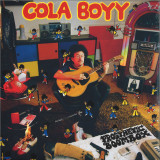
There’s liberation on the dance floor in the songs of Matthew Urango – glimpses of revolution that glimmer beneath the disco ball. “I want my music to bring people together,” says the Californian pop innovator, best known as Cola Boyy. “Because standing together is our best chance at fighting this shit show.” The shit show in question is a broken, brutal system the acclaimed multi-instrumentalist has witnessed up-close. Urango was born with spina bifida and scoliosis in Oxnard, California: a town in which almost 30,000 are estimated to live in poverty. Prosthetic Boombox, his eagerly awaited debut album, might at first glance seem a joyous confetti-burst of pop eclecticism, engineered to sound like “scanning between stations on a car radio, landing on all these different sounds and styles” as Urango puts it. Dig deeper, though, and you’ll discover a simmering sense of rebellion. “The working class are injured, struggling to pay rent and struggling to put food on the table,” he says. “I want to represent that.” Prosthetic Boombox
achieves that goal in a thrilling flurry of inventive indie, funk and soul: take Urango’s car radio analogy, place it in a time-travelling Delorean with Prince in the passenger seat, and you’re half-way there.
Look no closer than Prosthetic Boombox’s euphoric opener, the Avalanches-assisted ‘Don’t Forget Your Neighbourhood.’ The track – which Urango says mixes “the Beach Boys, French disco, house keys and ragtime piano, kinda like the Cheers soundtrack!” – ends with lyrics urging listeners to “fight for your town with your fist closed, strike it and make it more than just a memory.” It’s a reminder that the working classes need to “turn our fists against our oppressors instead of each other,” he explains. After that emphatic introduction comes a horn-laced funk wig-out titled ‘Mailbox’ – a song that gives Dua Lipa’s Future Nostalgia a run for its Studio 54-themed money, featuring rising Londoner JGrrey. Elsewhere, ‘Song for the Mister’ ventures into smooth R&B territory, before ‘Roses’ – a collaboration with Myd of Ed Banger fame – offers a bouquet of bustling disco guitars and infinite bisous of Connan Mockasin’s band drops in on the immaculate ‘Go the Mile’. Urango saves his most introspective moment for the album’s starry closer. ‘Kid Born in Space’, a cosmic collaboration with MGMT frontman Andrew VanWyngarden, sees the artist reflect on what he once had to overcome as a disabled person of colour. “I see them looking down on my dreams of being,” he sings tenderly. “I hear them making fun of my voice, but I keep on moving forward, I refuse to live in anyone else’s shadow.” Prosthetic Boombox, on this subject, is more than an album title – it’s a statement of intent.
“The message of my music is that our class is exploited, oppressed and murdered on the daily. That’s not right, and the system that enables that deserves to be wiped off the face of the earth,” he says. “The only way that happens is if we’re united. That’s the point of my music – to relate to people and unite them.” And what unites more than raucous, irresistibly danceable pop? Prosthetic Boombox is a riot of joyous grooves and catchy hooks for good reason. “I want to reach and spread my message to as many people as possible. You can’t do that if you’re some obscure motherfucker, you know?” he laughs. Don’t bet on him being an “obscure motherfucker” for long.
Wackelkontakt are the trio that currently spearheads the Jerusalem scene, playing music that's precise yet eclectic, cruel and abrasive even when vulnerable. An unholy mixture of trap, industrial, experimental and power electronics. Wackelkontakt have already made a global mark with the sensory overload of their live multimedia performances and the scintillating presence of frontwoman Tomer Damsky AKA MC Slice, backed by Eyal Lally Bitton (electronics, visuals, scenography) and Marco Milevski Tomasin (drums and electronics). Wackelkontakt's wildly eclectic approach, bound by an impossibly consistent sound, is a direct result of the band living a minute away from The Old City's Damascus Gate and recording in the ultra-orthodox neighbourhood of Me'a She'arim; Jerusalem is present in the music, not in the shape of touristic exotica but in a sense of conflict, paranoia and isolation. The lyrics are equally contradictory, schizophrenic and chaotic. Emotional manipulation clashes with a desire to shake and be shaken, to allow oneself to become sucked as far as possible from self-loathing. When self-reflection arises it is bitter, ridiculous, pathetic, interweaving with philosophical texts lifted directly from the likes of Deleuze & Guatarri, Foucault, Artaud, WJT Mitchell and others.
A first-time replica re-issue of a highly sought-after, rare Brazilian MPB / Funk nugget from 1974.
Brazilian 7" singles or compacts sometimes get a bit overlooked outside of the world of avid Brazilian collectors and DJs, but here are where some of the most exquisite jewels of Brazil's rich musical tapestry lie.
This release has been a long time in the works, but now finally we are thrilled to present a replica version of one of our favourite Brazilian 7”s - the outstanding 'Morro Do Barraco Sem Água' by Lemos E Debétio (aka Toninho Lemos & Paulo Debétio). Discovering tracks like 'Morro Do Barraco Sem Água' makes you want to go the extra mile. You spend that little bit more time than is rational examining and dusting off a stack of 7”s hunting for an elusive gem, or end up disappearing down an Internet wormhole eating into time you don’t have before you need to be up for work again in the morning. This is a calculated effort, as the reward of the revitalising musical vitamins that you've stumbled upon are the big pay off.
'Morro Do Barraco Sem Água’ was originally released on Odeon Records in 1974, and even though this was a major record label it remains extremely hard to find. From the first moment the needle hits the groove with its guitar and drum break intro you know the song is special. A feel-good addictive melody with fantastic swooping arrangements and a pulsating funk backbeat, which is over all too soon. We hope you enjoy this audio treasure as much as we do!!!
Composer, multi-instrumentalist, poet, griot, improviser and community
leader William Parker presents a pair of brand new trio albums which
further expound on his limitless vision.
One of the iconic and enduring music leaders to emerge in the world over the
last half century, William Parker continues to raise the bar higher.
‘Painters Winter’ features the trio of Daniel Carter (reeds, trumpet, flute) William Parker (bass, trombonium, shakuhachi) and Hamid Drake (drums). Carter
& Parker have been perpetual space-ways traveling companions since first
meeting & immediately beginning to channel music together in early 1970s
NYC. Here, Carter again brings the full assembly of instruments he has for decades been a master of: trumpet, alto & tenor saxophones, clarinet and flute.
Likewise, Hamid Drake is a musician’s musician; one of the most in-demand
drummers in the world. He is in command of a vast lexicon of drum languages,
learned and absorbed directly. His frequent flyer miles could get him a ticket to Saturn and back. Drake & Parker launched their devoted “two-man big
band” partnership in 2000 and haven’t stopped since. In trio with Daniel Carter,
they’ve created one previous album together, ‘Painters Spring’, released that
same year.
Drake has made mention of his awe that William could pick up any new instrument and make beautiful music with it from jump. The title track of ‘Painters
Winter’ features Parker on trombonium, one of those many instruments that
he plays beautifully on. The track “Painted Scarf” features Parker on shakuhachi, upon which he has clearly become a master.
William Parker: bass, trombonium, shakuhachi
Daniel Carter: trumpet, alto & tenor saxophones, clarinet, flute
Hamid Drake: drums
The third release from Fred Laird was recorded during the period June 2020 and January 2021 on 24trk home studio recording. It is also the first album recorded purely as a solo artist with the occasional guest and draws more from a roots style music (trad it isn’t) than previous more psychedelic releases.
‘Inspiration for the album came from listening to the self-recorded primal music of Hasil Adkins and the first solo Link Wray album for Polydor. The idea of these guys just doing what they wanted back of beyond seemed more akin to me sat in a box room during lockdown feeding off a diet of Billy Chong Kung Fu horror flicks, David Lynch, Noir crime movies, Jean Cocteau and the works of Yukio Mishima.
Musically the sound draws from early Bad Seeds or Crime and the City Solution, Gallon Drunk, Bohren and Der Club of Gore, The Cramps, Hasil Adkins and various other trash inspired twilight creatures. I also wanted to try and create that spooky organ sound that dominates the midnight movie classic ‘Carnival Of Souls’, so there’s quite a lot of organ and piano going on. I also got my hands on a baritone guitar to give the songs more of a deep growly twang!
Vocals are provided by Daisy Atkinson for the Jean Cocteau dedication ‘Orphee’ which is the nearest thing to a pop song on the album and the echoey almost Sister Lover’s sound of the title track. I got sick of my own shit voice and I just thought a female voice would give it a more fragile ethereal vibe.
Mike Blatchford provides formidable saxophone to the album’s last three tracks which were recorded on his mobile phone 300 miles away and synched into the music. The big blasted swing blues of ‘The Big Duvall’ is a dedication to Andy Duvall of Carlton Melton – a big guy who needed a big song. Who knows how big the song could have been in a proper studio. I could have dedicated it to John Wayne but Wayne couldn’t chop down trees with his bare hands like Andy can….’
Multi-instrumentalist/vocalist Dan Friel is unrivaled in his capacity to inject blistering noise and energy into ferocious pop songs. A champion and mainstay of the NYC underground, Friel the has played alongside the likes of Lightning Bolt and Black Dice as well collaborated with acclaimed string quartet ETHEL. Upper Wilds channels Friel's unbreakably ebullient spirit into mountainous rock music dripping with molten fuzz. The trio's exploration of the interstellar expands in parallel to their increasing levels of bombast and precision. Venus synthesizes the experimentation of debut Guitar Module 2017 and the thunder of 2018's Mars into ten lean chunks of cosmic rock laden with scorching hooks. On Venus, Upper Wilds rocket lovestruck anthems centered around the planet named for the Roman goddess of love at full tilt from the moment "Love Song #1" makes liftoff. The album's incendiary opening trilogy crashes with a relentless vigor and addictive melodies. The rhythm section of bassist Jason Binnick (who also mixed the album) and drummer Jeff Ottenbacher tear through off-kilter riffs that pound with meteoric impact. Friel's guitar sputters and froths beneath his voice before soaring into frenetic leads that pack every moment with powerful melody. Alien croons and glitching spasms spill out of Friel's wild, filtered humming, amplified into oblivion. Venus' few moments of respite lay bare the raw efficiency and beauty of Friel's songwriting, like transmissions home to loved ones thousands of miles away slipping through the crackle and chaos of space. Venus traverses the havoc, mystery, and joy of humanity's countless follies in both space and love. Both cosmic and human, Venus is a deeply affecting celebration of the wonders of what is beyond comprehension internally and externally. Upper Wilds' Venus is an exhilarating odyssey of tremendous exuberance and a testament to human resilience in the face of the unknown.
onny Rollins had already been a regular member of the celebrated Max Roach Clifford Brown Quintet for half a year when he entered the studio on June 22,
1956 to record Saxophone Colossus, one of his most acclaimed albums as a
leader. Age 26, Rollins was already a well-known jazz figure.
He had recorded some albums as a leader but, above all, he had been part of
some of the most outstanding combos of the period: the Miles Davis Quintet
and the Max Roach-Clifford Brown Quintet. The present album introduced his
famous composition “Saint Thomas”
This album is a sequel to trumpeter/bandleader Red Rodney’s ‘One For Bird’ recorded live at the Tivoli Gardens 1988. The band he brought from USA includes then up-and-coming young players: Dick Oats (alto saxophone), Garry Dial (piano), Jay Anderson (bass) and John Riley (drums), musicians that have become regular SteepleChase recording artists. Red Rodney (1927-1994) succeeded Miles Davis’ post in the Charlie Parker Quintet from 1949 to 51. This indelible experience enabled him to be an adviser on Clint Eastwood’s 1988 Golden Glove awarded film “Bird”, which featured Red’s character extensively. The publicity that came with the film seemed to have given a boost to his career. Red started to play professional at the age 15 but slowed down during early and mid- 70s due to his addiction. He made a successful come back later and toured the world with his band. “Rodney rockets through most of his solos here, ascending into high-register terrain with the audacity if youth. At 62, he plays with the ebullient spirit more typical of men half his age.” - Mark Stryker, Cadence
Ungodly War is one of the many stand outs from our 2020 reissue of Lamont Butler’s one and only album It’s Time For A Change. Taking inspiration from jazz, soul and funk, Ungodly War is a dynamic track recorded some 50+ years ago in Lousiville, Kentucky.
“People have always loved that track (Ungodly War), people would always want to talk to me about it and you know it’s more relevant now than ever before…it’s stood the test of time” Lamont Butler.
7" of this funk classic re-issued for the first time from recently discovered Master Tapes.
Funky Soul (originally titled "Going To See The Man") was a routine crowd pleaser during live shows that even had its own dance "rock the ship." This was the part two of the song. It was part one that was created in the studio as a riff off of part two. The raw energy of this song when performed live created hysteria and drove spectators into a frenzy. It didn't take long for word to get around and catch the attention of the famous WYLD DJ Larry McKinley. McKinley wanted to capture this magic onto record and helped arrange the session at Cosimo Matassa's studio. He drove Isaac Hayes down from Memphis to New Orleans in 1968 and organized Issac Hayes to arrange the horn section on this record while he was working with the Okeh label and developing an emerging artist named Margie Joseph. It was during this time that Margie recorded two singles Why Does A Man Have To Lie/See (Okeh, 4-7304) and Show Me/A Matter Of Life Or Death (Okeh, 4-7313).
David Batiste & The Gladiators were a band David Batiste and several of his brothers formed while they were in High School in New Orleans back in 1961. The band won a talent show in 1965 at Harlem's famous Apollo Theater and are the pioneers of what is now known as "Funk." David Batiste & The Gladiators were legendary mainstays of every bar in New Orleans that every band was hustling trying to get booked at.
It's no wonder that this song was famously complied on BBE Records and Ubiquity in the 1990's, rediscovered and performed by Miles Tackett & The Breakestra in the early 2000's. Those compilations contained audio sourced only from the vinyl record originally pressed up twice in the early 1970s and sought after by collectors and DJs for years and years. This version is from a direct master tape transfer from recently discovered NOLA tapes. But wait… The party's just started. An entire album's worth of 1960s previously unreleased David Batiste & The Gladiators material from recently discovered master tapes is in the works and forthcoming on Family Groove Records.
Thirty years after his disappearance, Miles Davis, both the man and his character, is still a subject for debate and controversy. And haven’t we heard that before with all artists? But when it comes to the importance of his contribution to music in the 20th century there is only unanimity.
Everyone says, sure, he was the greatest trumpeter. Other opinions are that he left the world of jazz behind him in 1965. It’s also said he was the catalyst of every decade from 1949 to 1989; that he revolutionised jazz, and brought it out of the ghetto; that he buried jazz; that he was the most important musician of his century... Each of those statements has its share of truth. Whichever way
you look at him, he remains a major figure in jazz and in 20th century music overall. Miles surpassed (or at least equalled) the importance of both Louis Armstrong and Duke Ellington for the simple reason that he addressed not only the jazz world but all worlds of music, and that he created (among other things) a fusion of the spheres people knew as jazz, blues, rock and pop, and spoke to every audience, either in turn or collectively.
There was a dinner at the White House during which a perfectly respectable lady, married to a politician no doubt, asked Miles what he did for a living. With some annoyance Miles replied, “Well I’ve changed music five or six times, so I guess that’s what I’ve done ... now tell me what have you done of any importance, other than be white? [...] You tell me what your claim to fame is.” The provocative tone in Miles’ words lifted the veil over his refusal to be hassled, his revulsion against America’s treatment of Black people, and Miles’ awareness of his own importance in the world of music. Even when speaking, Miles maintained the art of synthesis.
In the beginning – this was 1944 – there was a concert in St Louis, Missouri where Miles heard Charlie Parker and Dizzy Gillespie for the first time. “Man, that shit was terrible, I mean Dizzy Gillespie, Charlie ‘Yardbird' Parker, Buddy Anderson, Gene Ammons, Lucky Thompson and Art Blakey, all together in one band [...] that shit was all up in my body and that’s what I wanted to hear [...] and me up there playing with them.1” Miles was 18, he’d been playing trumpet for years and now he knew that this was what he wanted to play, and nothing else: to play with Bird! A year later he’d turned 19 and he was in New York, where he learned it all, up there alongside Bird and Dizzy.