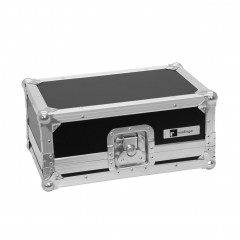
PRO flightcase for one Omnitronic TRM-202 Rotary mixer MK3
Interior and cover (not removable) upholstered with foam
Removable lid
High-quality workmanship with multiplex birch wood, dark brown laminated
Aluminum profile frames with rounded edges
Three-leg steel ball corners
2 high-quality butterfly locks
1 case handles
Made in Europe
Maximum load: 25 kg
Color: Dark brown, laminated
Width: 24 cm
Height: 18 cm
Depth: 38 cm
Weight: 3.20 kg
Cerca:mixer case
- 1
King Tubby the Dub Master, who's output was as prolific as it is sought after, and who's presence is surely missed. We would like to take you on another dub excursion. This time through some essential cuts made for the Producer / DJ Tappa Zukie. King Tubby always added something a little special to the tracks he worked on. Producers would often bring their already recorded tracks to his home studio at 18 Drummlie Avenue in the Kingston district of Waterhouse. The backing tracks which were laid at various other studios around Kingston. Like Channel 1and Randy's Studio 17, would then be voiced/Re-voiced at King Tubby's. Tubby and his team which included Prince Jammy and Philip Smart would be left to create the version cut.
Having listened to the track it would be striped back to the bone of bass and drums and rebuilt. Sprinkling his magic over the track by dropping the bass in and out, adding echo and emphasising various elements of the song. In some cases, dubbing the cut into something unrecognisable from its original sound.
The tracks would be aired on Tubby's Hometown Hi-Fi Sound System. Which acted much like a pre-release for the record to gauge the crowd’s reaction, before the tracks would be unleased on the public. We think we have sourced another fine collection of Tubby Cuts see also King Tubby's Lost Treasures JR001, comprising of work with Mr Tappa Zukie. Lost cuts to some of his own tracks like 'First Street Rock', alongside productions he undertook with the great Prince Allah, Junior Ross and the Spears. Also, the much-overlooked vocal group Knowledge. Some great rhythms, some great tracks, worked over by the greatest dub mixer of them all. Hope you enjoy the set as much as we have compiling it...
Respect Jah Floyd.
The apartheid boycott In the 80s, the world – rightly - stepped up its boycott against South Africa’s apartheid government. But this had unexpected and sometimes adverse consequences for South Africa’s music professionals and consumers. Musicians still needed to work live shows both at home and abroad, and to make and sell records. The youth still aspired to clubbing and partying at the weekend after hard, poorly paid jobs under the thumb of an oppressive government. Music was their sanctuary: specifically, African- American inspired soul, jazz, boogie, disco and funk. Unique diversity Producing musical excellence was nothing new for South Africa, even in the 80s: both traditional and jazz music of various genres had been performed, showcased and recorded for decades with the assistance of some of the most skilled and ingenious sound-engineers and producers in the world, the jazz players rivalling their American peers in many cases. But what makes Mzansi 80s popular music unique is that it had to – and for the most part, did- appeal to a multi-ethnic, multilingual population almost like no other in the world, for its geographical size. There may have been many tribal and political differences between Zulu, Sotho, Xhosa, Tsonga and others day-to-day, but when it came to the weekend, those differences often melted away for a while on the dancefloor. Paul Ndlovu had kwaZulu fans as well as Shangaan followers; Black Moses and the Soul Brothers had followers and fans with everyone..and so on. And everyone- detractors and lovers alike- were content to settle on the monicker ‘Bubblegum’ as a general description. Mzansi took disco- and slowed it down a bit.. ..exactly as 90s and early 2000s South African DJs and mixers took House- and slowed it down a bit to develop Kwaito, Gqom and – later – Amapiano. The Roland TR-707 sampler came along in 1985- at just the right time for the flowering of Mzansi disco and boogie. And in the artful hands of arrangers, engineers and producers such as Peter “Hitman’ Moticoe, whose work figures on several of the tracks here, it became something unique to South Africa. 'Yebo! Rare Mzansi Party Beats from Apartheid's Dying Years' compiled by John Armstrong is out BBE Music on x3 vinyl set in a gatefold sleeve, CD, and across digital platforms for download and streaming.
For over a decade, Names You Can Trust has presented a variety of new music that has grown from a prolific network of talented musicians in Colombia's capital city. Frente Cumbiero, Romperayo, La Boa, and Meridian Brothers are some of the important names to have reached a well-deserved global audience. The scene itself in Bogotá has been on the cutting edge for some time, and this new generation of musical spirit has naturally become a beacon in the tropical music community, not only as a standard bearer for honoring tradition but as well as the ability to flip that tradition on its head, with thoughtful modern and technological experimentations. The good news is that there are no signs of this particular renaissance slowing down, as some of these marquee names in the aforementioned list have expanded their creative output as producers, engineers and mixers.
In this case, Meridian Brothers creator and musical savant, Eblis Álvarez lends his expertise to a new emerging septet of tropicalistas, La Sonora Mazurén, named after a northern neighborhood in Bogotá. The group's mission is best described as an exploration into the many influences of tropical music that have thrived in Colombia for decades. Thinkcumbia,chicha,charangaandvallenatoto name a few, and that's where we land on with the group's debut single for NYCT. It's an apt illustration of the band's range, starting with the A-side's quintessential "Charanga Mazurén," a throwback to pure dancefloor accordion bliss, a pulse that is synchronized with the aura of Colombia's legends such as Landero, Meza, or Gutiérrez. The B-side "Cachicha" is a take on the all-importantchicha, which has become an inescapable and essential part of Peru's nationalcumbia, and likewise a staple within Colombia's borders since the advent of the popular style on record back in the day. That tradition continues here, the familiar pluck of the psychedelic guitars mixed with an array of synthesized sonics, the palette of Peru mixed with that of producer Álvarez's wizardry and the group's talented players.
On 22nd June, 1971, Joni Mitchell released Blue, concluding her prolific four album run for Reprise Records with an album considered by many to be one of the greatest of all time. Its stirring, confessional songs have been celebrated by music lovers and critics alike for decades while inspiring a wide variety of artists as diverse as Prince and Taylor Swift. Even today, its stature as a masterpiece continues to grow. Just last year, the album was named #3 on Rolling Stone’s list of the “500 Greatest Albums of All Time.”
To celebrate the album’s 50th anniversary, Rhino is releasing THE REPRISE ALBUMS (1968-1971), the next installment of the Joni Mitchell Archives series, featuring newly remastered versions of Blue (1971) and the three albums that came before it: Song To A Seagull (1968), Clouds (1969), and Ladies Of The Canyon (1970). In the case of Song To A Seagull, the original mix has been recently updated by Mitchell and mixer Matt Lee. “The original mix was atrocious,” says Mitchell. “It sounded like it was recorded under a jello bowl, so I fixed it!”
THE REPRISE ALBUMS (1968-1971) will be available on 25th June in a 4-LP 180-gram vinyl boxset (Limited Edition Of 10,000).
The cover art for THE REPRISE ALBUMS (1968-1971) features a previously unseen self-portrait Mitchell sketched during the time period. The collection also includes an essay by Grammy winning singer-songwriter Brandi Carlile, another artist who’s been influenced greatly by Mitchell. She writes: “In my opinion Blue is the greatest album ever made. Blue didn’t make me a better songwriter. Blue made me a better woman… No matter what we are dealing with in these times we can rejoice and know that of all the ages we could have lived through, we lived in the time of Joni Mitchell.”
- 1


