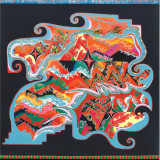
More recently best regarded as soundtrack composer, Ben Frost here follows work with interdisciplinary sound artist Francesco Fabris on the »Dark« OST with a plunge into purest rock music, as in the actual sound of molten material rising to the surface and solidifying. With an impressionistic-artistic license also found in work by Chris Watson, Jana Winderen or Giuseppe Ielasi, the duo uncompromisingly revel in the sounds of nature’s biting point, using various production methods to make audible the sound of the earth beneath our feet in the process of creation, on location at Fagradalsfjall, Reykjanes Peninsula Iceland.
»As stable as we might choose to think it is, this planet is anything but that. A paper thin crust, the zone in which we find ourselves, and mostly concern ourselves with, exists as a modest veil cloaking a dynamic seismic turbulence that is as powerful as it is unknowable. There are moments though where ruptures occur. The pressure from within carves its way to, and through, the surface of the planet simultaneously delivering destruction and virgin landscapes, as primordial as any we might care to imagine. It is here, in these places, where we can literally see the living planet, that geologic time is condensed and world building is made visible, and audible to us, in an unrestrained and provocative detail.
These volcanic ruptures, such as those captured on Vakning by Francesco Fabris and Ben Frost, speak to the very living geology of Earth. These recordings, captured at close range, exist at a nexus where liquid rock becomes solid. They capture moments of transformation, of obliteration and of creation, often all at once. These are recordings of a living, material planet, dynamic and unrestrained«. (Lawrence English)
Suche:modes
The next chapter of the Natural Information Society is here. Since Time Is Gravity, credited to Natural Information Society Community Ensemble with Ari Brown, presents a newly expanded manifestation of acclaimed composer & multi-instrumentalist Joshua Abrams nearly 15 year, 7 albums &-counting flagship ensemble. Joining the core NIS of Abrams (guimbri & bass), Lisa Alvarado (harmonium) Mikel Patrick Avery (drums) & Jason Stein (bass clarinet) are Hamid Drake (percussion), Josh Berman & Ben Lamar Gay (cornets), Nick Mazzarella & Mai Sugimoto (alto saxophones & flute), Kara Bershad (harp) & Chicago living legend of the tenor saxophone Ari Brown. Recorded live to tape at Electrical Audio & The Graham Foundation, cover painting Vibratory Cartography: Nepantla, by Lisa Alvarado. 2xLP on Eremite USA, 2xLP & CD on Aguirre/Eremite Europe. Out 14-04.
Since first developing Natural Information Society in 2010, Joshua Abrams has been gradually expanding the group’s conceptual underpinnings, its musical references & the sheer number of the group’s members. Its music is, in a sense, an expansive form of minimalism, based in repeated & overlaid rhythmic patterns, ostinatos & modality. Its roots, its scale & its meaning become clearer in time. If time is gravity, it also allows us to carry more. Having begun as fundamentally a rhythm section with Abrams’ guimbri at its core, the version here can stretch to a tentet, including six horns.
Abrams has been expanding his minimalism gradually, but he has long understood a key to minimalism’s potential: the breadth of its roots in the late 1950s & early 1960s, ranging from the dissatisfaction of young European-stream composers with the limitations of serialism to the simultaneous dissatisfaction of jazz musicians with the dense harmonic vocabulary of bop & hard bop. The former began exploring rhythmic complexity & narrow tonal palates in place of harmonic abstraction (Steve Reich’s Drumming, Philip Glass’ Music with Changing Parts; perhaps above all Terry Riley’s In C & his late ‘60s all-night organ & loop concerts); the later reduced dense chord changes to scales (signally with Miles Davis' Kind of Blue, but rapidly expanding with John Coltrane’s vast project). In the 1950s the LP record opened the world with documentation of Asian & African musics, key influences on both minimalists & jazz musicians. If John Coltrane’s soprano saxophone suggested the keening shehnai of Bismillah Khan, the instrument was rapidly taken up by two key minimalists, LaMonte Young & Riley, similarly appreciative of its flexible intonation, the same thing that kept it out of big bands.
If the guimbri, the North African hide-covered lute that Abrams plays with NIS, involves a rich tradition of hypnotic healing music associated with the Gnawa people, Abrams’ music also touches on other musics as well — other depths, memories & healings, different drones, rhythms & modes. As the group expands on Since Time Is Gravity, he has made certain jazz traditions in the same stream more explicit as well. If there is a mystical & elastic quality involved in the experience of time, both in direction & duration, you will catch it here. The parts for the choir of winds expand on the roles of Abrams’ guimbri, Mikel Patrick Avery & Hamid Drake’s percussion & Lisa Alvarado’s harmonium: at times, the winds are almost looping in the tentet version, each hitting a repeating note in turn, at once drone & distinct inflection on temporal sequence. The brilliance of the work resides in Abrams’ compositions, the NIS’ intuitive execution & in Ari Brown’s singular embodiment of the great tenor saxophone tradition, including the oracular genius of Eddie “Lockjaw” Davis, & Yusef Lateef. The three pieces by the expanded NIS featuring Brown —the opening “Moontide Chorus” & “Is” & the ultimate “Gravity”— have an immediate impact, & togther might be considered a kind of concerto for tenor saxophone. Here Brown presses almost indistinguishably from composed melody to improvised speech, getting so close to language that he might have a text. Everything here is a sign. Note the tap of the Rhythm Ace that links “Moontide Chorus” to “Is”, the attentive heart always present, even when signed by a machine. There’s a link here to the methodologies & meanings of dub music & the linear & vertical collage of beats, textures & tongues: treated with reverence, a sample of a beat-box can be as soulful, as hypnotic, as a mbira or a tamboura. If those pieces with Brown are heard as a suspended concerto, the three embrace & enfold the other works, like the sepals of a flower. That placement will also touch on the mysteries of our perception of time.
Particularly in “Is”, but elsewhere as well, a phenomenon of transcendence arises in which time appears to be tripartite, at once moving backwards & forwards & standing still. This is an act of technical brilliance certainly, but also an illumination of music’s ability to represent temporal consciousness through polymetrics. This particular listener has only heard it before in a few places, including the horn shouts & bowed basses of Coltrane’s Africa, in moments of Charles Mingus’ The Black Saint & the Sinner Lady, in certain pieces where tapes were literally running backwards, & earlier still in Dizzy Gillespie’s Cubana Be, Cubana Bop, in which the composer George Russell & conguero Chano Pozo found a music that spoke at once in the voices of Stravinsky’s Rite of Spring & the vestigial rites, rhythms & songs of the Yoruba language & Santeria religion of inland Cuba.
In Joshua Abrams’ compositions & the realization of them by the NIS, in the time of one’s close listening & memory thereof, distinctions between the “natural” & the “social”, the “quotidian” & the “transcendent” are erased, suspended or perhaps irrelevant. Consider two of the ensemble pieces, one named for nature, the other social science. In “Murmuration” the repeated wind figures of flute & alto saxophone combine with the interlocking patterns of harp, guimbri & frame drum (tar) to create a perfect moving stillness, not an imitation but a witness to the miracle of the starlings’ astonishing collective art, a surfeit of beauty that might be the ultimate defense tactic.
“Stigmergy” takes its name & concept from the Occupy movement’s Heather Marsh, who proposes a social system based on a cooperative rather than competitive models, one in which ideas are freely contributed & developed as ideas rather than an individual’s property. In its form, Abrams’ “Stigmergy” is the closes thing to traditional jazz, a series of accompanied solos by each of the wind players. However, the composed accompaniment is a radically collectivist notion: a repeated rhythmic figure, call it ostinato or riff, in which the different winds each play only a note or two of the figure, a concept both more collectivist & individualistic in its conception than any typical unison figure. It suggests another of the underlying recognitions that propel the Natural Information Society, the group as social organism, the teleology of hypnotic anarchy, all parts in place, functioning systematically, evolving & expressing itself, its nature & society, as a transformative organism.
George Lewis has described music as “a space for reflection on the human condition”. This suggests that, rather than a “distraction”, at least some music might serve as a distraction from distraction. It’s a focus, a clarity, a awareness, an external invitation to interiority, as if music itself is a model for form & contemplation, an organism contemplating for us or as us. If that is a possibility, & I am sure I have heard such musics, than this music is among them. How many of our rhythms, melodies & harmonies (cultural, historical, biological, psychic) might such music carry, translate & transform in the particulate ecstasy of our own murmuration? (Stuart Broomer, April 2022)
`Oh Me Oh My' is both elegant and ferocious. It is stirring in one moment and a balm the next. It details histories both global and personal. Lonnie Holley's harrowing youth and young manhood in the Jim Crow South are well-told at this point _ his sale into a different home as a child for just a bottle of whiskey; his abuse at the infamous Mount Meigs correctional facility for boys; the destruction of his art environment by the Birmingham airport expansion. But Holley's music is less a performance of pain endured and more a display of perseverance, of relentless hope. Intricately and lovingly produced by LA's Jacknife Lee (The Cure, REM, Modest Mouse), there is both kinetic, shortwave funk that call to mind Brian Eno's `My Life in the Bush of Ghosts' and the deep space satellite sounds of Eno's ambient works. But it's a tremendous achievement in sonics all its own. It's also an achievement in the refinement of Holley's impressionistic, stream-of-consciousness lyrics. On the title track which deals with mutual human understanding", Holley is able to make a profound point as ever in far fewer phrases: "The deeper we go, the more chances there are, for us to understand the oh-me's and understand the oh-my's." Illustrious collaborators like Michael Stipe, Sharon Van Etten, Moor Mother and Justin Vernon of Bon Iver serve as not only as choirs of angels and co-pilots to give Lonnie's message flight but as proof of Lonnie Holley as a galvanizing, iconoclastic force across the music community.
- A1: Vampire Weekend - A-Punk
- A2: The Cribs - Another Number
- A3: Razorlight - Golden Touch
- A4: Mystery Jets - Young Love (Feat Laura Marling)
- A5: Klaxons - Golden Skans
- A6: Modest Mouse - Float On
- A7: Kaiser Chiefs - Ruby
- B1: The Ting Tings - Shut Up & Let Me Go
- B2: Electric Six - Danger! High Voltage (Soulchild Radio Mix)
- B3: Lcd Soundsystem - Daft Punk Is Playing At My House
- B4: Hard-Fi - Hard To Beat
- B5: Editors - Blood
- C1: Mgmt - Kids
- C2: Basement Jaxx - Where's Your Head At
- C3: The Rapture - House Of Jealous Lovers
- C4: The Futureheads - Hounds Of Love
- C5: Interpol - Slow Hands
- C6: The Fratellis - Chelsea Dagger
- D1: Kasabian - Club Foot
- D2: Yeah Yeah Yeahs - Heads Will Roll (A-Trak Remix Radio Edit)
- D3: Bloc Party - Banquet
- D4: The Wombats - Moving To New York
- D5: The Libertines - Don't Look Back Into The Sun
- D6: Jet - Are You Gonna Be My Girl
Legendary New York band M'lumbo distil experiences from their pre-pandemic shamanic travels into their stunning new album The Summer Of Endless Levitation. The eight-track vinyl LP is an avant-garde take on folk music informed by painter and sculptor Jean Hans Arp's 'Biomorphic' works and it serves as a sonic renewal of self.
The cult M'lumbo collective has been a legendary and groundbreaking act since first forming in the mid-80s. They cross genre boundaries as they draw on jazz, world, electronic, rock and experimental music that escapes the commercial world and take you into another realm entirely. There is no limit to their sound; each member brings their own cultural background to the mix, making the band all the more unique.
As the coronavirus pandemic struck, three members of the band Rob Ray Flatow, Paul-Alexandre Meurens and Brian O'Neill under-took a regimen of shamanic traveling in New York City. The experiences led them to spontaneously compose and perform a suite of pieces, informed and inspired by Jean Hans Arp's works but also by the feelings of isolation and indefinite exile yet to come in their urban environment.
Compared to the works they have done as part of the larger M'lumbo band, this album is a more modest and naive affair that is "a vehicle for the renewal of feeling using only a few instruments - acoustic and electric guitar, keyboard, flute, small percussion, kalimba and clarinet - and locating a sense of both the deep sadness and uplifting powers of reverie."
'There Are No Words' kicks off with heavenly chords and organic percussion that recalls the jungle jazz of Don Cherry, then 'Shoreline' is a five-minute dub with percolating rhythms and new age melodies before the soul-soothing acoustic guitar of 'The Afternoon Levitation' blisses you out on a sunny day. The perfectly entitled 'Swoon' is another gloriously uplifting piece of musical spirituality that fuses the electronic and synthetic with the ancient and ritualistic. There is more jungle jazz, big-band horn work and cosmic synth modulations of 'Open The Heavens' while 'Quanta' is a shuffling, jumbled mix of radiant chords, wigged-out electronic lines and celestial charm. 'Planetfall' goes from free-form jazz to double-time techno and back to cathartic ambient. The final trio of tracks conjures up everything from the transcendental jazz of Alice Coltrane to the cinematic downtempo of Calm.
1st Science (Henrik Helenius) Has Been An Online Man Of Mystery For Some Time, And You'd Better Believe He Supplies The Goods Whenever He Resurfaces!
In The Early 1990s, Out Of The Uk's Rave Scene, 2 Genres Known As Breakbeat Hardcore And Jungle Were Spawned. A Decade Later, And A Modest Online Community Began To Try And Revive The Genres In The 2000s Within A Scene Dubbed "Hardcore Breaks". Henrik Became One Of Its Most Influential And Creative Contributors, Bagging Himself Appearances On The Likes Of Right Touch Records, Bat Beat Recordings (The Precursor To Renegadegenius's Paranoid Recordings) And Hardcore Lives, As Well As Becoming One Of The First Serious Juggernauts Of Sharing Music Online.
Based In Stockholm, In The Words Of Strictly Nuskool Blog, Henrik Swiftly Earned Himself The Title Of "The Swedish King Of Hardcore" Amongst Junglists... And That's A Tough Title To Pinch!
Skip Ahead To The Year 2023, And 1st Science Is Far From Done. Hell, Didn't You Know He's Only Just Started Tuning Up The Bunsen Burner? From The Ones Who Brought You "You Time" And "First Sign Of Trouble", Yes Yes, Erupt Proudly Presents A Shiny New Ep From The Man, Featuring 5 Of His Finest Tracks On Wax For The First Time. If You're Familiar With The Earlier Digital Release Of This Ep, Don't You Worry, For Being Patient You Get The Exclusive Bonus Track "Everlasting Night" Here.
So What Are You Waiting For? 1st Science Invites You To Participate In An Experiment Which Requires Your Subwoofers. An Absolute Treasure Trove For Any Techno, Breaks, Or Uk Retro Rave Lover.
Heralding 2023 from way out west, Monde UFO land on Quindi with a distinctive album of dream pop vignettes and outer rim punk exotica.
Hailing from the same Californian heat haze as recent Quindi signings Bondo, Monde UFO have manifested in the past four years through a series of DIY releases including their 2021 album 7171 and last year's set of Fugazi covers, 4 Songs. The loose fit project centres around the singing, playing and songwriting of Ray Monde and Kris Chau and features Kern Haug on drums. The resulting sound arrives as a resourceful analog of plush 60s pop captured through the modest means of a truly independent musical endeavour.
The sound rendered on Vandalized Statue touches on dubby atmospherics, the lilting breeze of bossa nova and the introverted muse of US indie rock, but the end result is a natural, cohesive whole centered around the songwriting. Imagine the girl from Ipanema sat toking in a comfortable spot in the corner of the dive bar while someone weaves her a tall tale or two, and you might be somewhere in the right direction. The stories in the lyrics unfurl as meandering narratives taking you through everyday exchanges and far-fetched, cosmic scenarios alike. At every turn the cosy musicality gives everything a relatable, homespun charm, even as the mixing desk becomes a mess and the lo-fi FX crash into each other.
The album will be fronted by three singles which reflect the wide reach of Monde UFO's sound. 'Visions of Fatima' is one of the more melancholic pieces on the album, fronted by laconic organ and centring on cracked vocals with an off key charm that indirectly evokes Jeffrey Lee Pierce. 'Government Employee' is a sun-kissed trip of low-key lounge surrealism, bizarro storytelling and shuffling exotica splendour which broadly defines the woozy mood of Vandalized Statue. 'Garden Of Agony' is a more delicate but no less dreamy piece matching electric tremolo with acoustic fingerpicking balladry which hides its considerable depths behind a seemingly simple arrangement.
At once intimate and projected into the cosmos, Monde UFO add to the particular path Quindi is taking through hidden corners of independent music with a romantic, restless spirit.
Coming from the city of Gao, on the edge of the Saharan desert, Malian producer Baba `'Babsy'' Konate is one of the key figures in the development of "Gao Rap", a regional genre of modern autotuned Songhoi music. Tounga is Babsy Konate's debut mixtape, collecting a decade of tracks that merge sweet autotuned vocals, crunchy drum loops and plucked digital harpsichord, in a playful testament to 2000s PC music, with the sample packs of a modest FruityLoops project. The result is familiar yet otherworldly, drawing from an abundance of distinct cultural expression: folkloric takamba from the Songhai, Hausa film soundtracks from Northern Nigeria, Hip Hop from Bamako and Ragga from Niamey.
Red Vinyl
180 g, Side D etched, matte UV Poster, Trifold Jacket, red foil debossed "D"&"M", Poster
"Memento Mori" stellt Depeche Modes insgesamt 15. Studioalbum dar, während Gahan und Gore nach dem tragischen Tod von Bandmitgründer Andrew "Fletch" Fletcher im Jahr 2022 den ersten Longplayer in zweiköpfiger Besetzung vorlegen. Produziert von James Ford mit Unterstützung von Marta Salogni reifte "Memento Mori" während der Frühphase der weltweiten Covid-Pandemie heran; eine Periode, die auch einen thematischen Einfluss auf die Songs hatte. Die 12 Albumtracks schlagen die Brücke zwischen einer Vielzahl von Stimmungen und musikalischen Texturen - angefangen beim bedrohlichen Opener bis zur Auflösung am Schluss spannt sich das Gefühlsspektrum von Paranoia und Besessenheit bis hin zu psychischer Befreiung und Freude sowie zahllosen emotionalen Zwischentönen. Mit der Single "Ghosts Again" geht der Albumveröffentlichung von "Memento Mori" ein eindrucksvoller Vorbote voraus. Der Song stellt schon jetzt nicht weniger als einen lupenreinen Depeche Mode-Klassiker dar: Dave Gahans bilderstarke Lyrics wie "wasted feelings, broken meanings... a place to hide the tears we cry" verbinden sich über einem erhebenden, optimistischen Groove mit einer hypnotischen Gitarrenfigur von Martin Gore. "Für mich fängt `Ghosts Again` das perfekte Gleichgewicht zwischen Melancholie und Freude ein", so Gahan. "Es kommt nicht allzu oft vor, dass wir einen Song aufnehmen, den ich mir nicht nur immer und immer wieder anhören kann - ich freue mich auch riesig, ihn mit der Welt teilen zu dürfen", ergänzt Gore.
Das Debütalbum des Electro-Punk Musikerkollektivs aus Teesside im Nordosten Englands um Frontmann Kingsley Hall.
Gegründet 2019, schloß sich die Band - bestehend aus Hall (Gesang und Gitarre), Robbie Major (Synthesizer), Hugh Major (Bass und Sequenzer) und Jonny Snowball (Schlagzeug) - aus "einem kollektiven Misstrauen gegenüber den politischen Entwicklungen" heraus zusammen. Nails ist ein wütendes, an Dringlichkeit kaum zu übertreffendes Statement, brutal und minimalistisch, in dem Hall über Beats, Drone Noises und Gitarrenfeedback mit seinem unverkennbaren Sprechgesang gesellschaftliche Mißstände lauthals anprangert. "a shit-hot artist" (NME). Darüber sind sich auch Anhänger der Band wie Sleaford Mods, Black Francis (Pixies), Steve Albini und Modeselektor einig.
Für Fans von Idles, Sleaford Mods, Divide And Dissolve, Bob Vylan und Billy Nomates!
Tokyo based producer and City-2 St. Giga label owner DJ Trystero arrives on Incienso with his debut LP “Castillo”. Over nine tracks Trystero explores uniquely spontaneous modes of rhythm and sound - turning ambient, breakbeat, electro, techno and house into blurred sonics that expand on their own time.
We’re still harvesting the fruits of those past days in seclusion, the cabin fever induced creative outbursts, ideas that would probably have never surfaced without these enforced trips to our inner minds. Lockdown transcendence.
“Don’t Cry” by Italo-Brazilian DJ producer Stephan Barnem and Futuristant is another impressive testament of those days. Secluded in Stephan’s studio in Northern Italy, the duo subconsciously conjured the spirits of one of their mutual favorite bands, Depeche Mode and created a fierce, boombappy Neo New Wave smasher contrived to send rays of hope into the darkest corners of this mad world. We had to add a gratuitous beatless version to the EP that amplifies the cinematic depth and healing potency of this song.
If “Don’t Cry” echoes the dark brooding euphoria of Depeche Mode’s “Music For The Masses” era, the flipside cut “Elysium” harks back to the synthwave happy days of their debut “Speak & Spell”. It’s a wonderfully careless track that’s bringing a dearly needed breeze of fresh air to today’s discerning dancefloors.
Boys don’t cry for me Argentina. Save your tears for another day.
Wir ernten immer noch die Früchte jener vergangenen Tage in Abgeschiedenheit, der vom Lagerkoller verursachten kreativen Ausbrüche, Ideen, die ohne diese erzwungenen Reisen in unser Inneres wahrscheinlich nie entstanden wären. Lockdown-Transzendenz.
„Don’t Cry“ des italo-brasilianischen DJ-Produzenten Stephan Barnem und Futuristant ist ein weiteres beeindruckendes Zeugnis jener Tage. In der Abgeschiedenheit von Stephans Studio in Norditalien, beschwor das Duo unbewusst die Geister einer ihrer gemeinsamen Lieblingsbands, Depeche Mode, herauf und schuf einen wilden, boombappigen Neo-New-Wave-Smasher, der Licht in die dunkelsten Ecken dieser verrückten Welt senden wird. Wir mussten der EP eine Beatless-Version von “Don’t Cry” hinzufügen, die die filmische Tiefe und heilende Kraft dieses Songs noch verstärkt.
Wenn „Don’t Cry“ die dunkle, grüblerische Euphorie von Depeche Modes „Music For The Masses“-Ära widerspiegelt, erinnert der Flipside-Cut „Elysium“ an die Happy Synthwave-Tage ihres Debüts „Speak & Spell“. Es ist ein wunderbar sorgloser Track, der den dringend benötigten frischen Wind auf die anspruchsvollen Tanzflächen von heute bringt.
Boys don’t cry for me Argentina. Save your tears for another day.
Red Vinyl
The Cinematic Orchestra haben anlässlich des 20-jährigen Jubiläums die erste Reissue ihres Klassikers, „Every Day“, angekündigt. Auf 3 LPs auf transparentem rotem Vinyl finden sich die Bonustracks „Oregon“ und „Horizon“ (feat. Niara Scarlett) sowie die beiden bisher unveröffentlichten Tracks „Semblance“ und „Flite“ (Original Version). Die Veröffentlichung enthält ein neues Artwork vom Designer des ursprünglichen Artworks von „Every Day“, Openmind, und eine Klapphülle mit Gilles Petersons Original-Linernotes. Außerdem wird eine Auswahl von bisher unveröffentlichten Fotos auf einer 12“-Karte präsentiert, darunter die Band im Rivoli Ballroom in London (fotografiert von Carl Fox) und J. Swinscoe mit Fontella Bass in der Nähe des Genfer Sees in der Schweiz (von Peter Williams).
In den zwei Jahrzehnten seit der bahnbrechenden Veröffentlichung des Albums ist der Einfluss der Band unüberhörbar geworden; Jazz ist überall um uns herum, mit gefeierten Künstler:innen, von Kamasi Washington über Tau5 und Koma Saxo bis hin zu Sons of Kemet und unzähligen mehr, London, Berlin und L.A. haben in letzter Zeit eine Szene hervorgebracht, die produktiver ist, als irgendjemand erwartet hätte. BADBADNOTGOOD haben Jazz-Soundtracks zu großen Modeschauen geliefert, und Kendrick Lamar hat - über den Rap-Umweg - das Genre an die Spitze der Charts gebracht. Die Art und Weise, wie sich The Cinematic Orchestra über ihre anfänglichen Jazz-Einflüsse hinaus zu einer Art transzendentaler Orchestrierung entwickelt hat, kombiniert mit der zeitgenössischen eleganten Elektronik, die heute von Künstler:innen wie Ólafur Arnalds und Floating Points verwendet wird - Künstler:innen, denen sie geholfen haben, den Weg zu ebnen - begann mit der Veröffentlichung von „Every Day“ wirklich Früchte zu tragen. Auf den sieben makellosen, schwebenden Tracks nimmt die Gruppe (angeführt von Gründungsmitglied J. Swinscoe und seinem langjährigen musikalischen Mitarbeiter Dominic Smith) die Hörer mit auf eine Reise durch klassischen Soul, Jazz, Chorsätze, versinkenden Horn-Riffs, pochenden Harfen-Linien, Minimalismus und vieles mehr - mit einer Seele, die tiefer als der Ozean ist. Und mit Gästen vom Kaliber eines Fontella Bass (Autor und Interpret des 60er-Jahre-Soul-Meisterwerks, „Rescue Me“ und Mitglied der Free-Jazz-Abtrünnigen, Art Ensemble of Chicago) und der britischen Rap-Legende Roots Manuva (dessen hochfliegender, philosophischer Beitrag zu „All Things To All Men“ ein absoluter Fan-Favorit ist) weiß man, dass man sich auf etwas Besonderes freuen darf. Pitchfork stimmte dem seinerzeit zu und bewertete das Album bei Veröffentlichung mit 8,6 von möglichen 10 Punkten.
Format: Limitierte rot-transparente Vinyl im Gatefold Sleeve mit vier Bonus Tracks von welchen einige bisher nicht auf Vinyl erhältlich waren inklusive 12” Fotokarte und Downloadcode
Following in the footsteps of "Mind Palace" and "Lost Spirits", respectively issued in 2018 and 2021, Hidden Empire return to Stil vor Talent with their eagerly anticipated third studio full-length, "Momentum". Going the same route that came to define their sound throughout the years, Branko Novakovic and Niklas Schäfers cook a savvy mix of deep electroid flavours and prog techno magnitude which flourishes in the long-playing format. Orbiting the frontier between proper no-nonsense, floor-focussed effectiveness and a trademark exploratory take on electronics, Hidden Empire here delivers one of their most accomplished slices to date, which not only spans the largest span of their many-faceted influences, from tribal anchorage to hypermodern escapology, but breathes a truly epic wind into it.
Draped in luscious, silken envelopes and easternmost ambiences, "Dawn" gets the ball rolling on a mystique-imbued note, halfway meditation-friendly material and square-shouldered club busting wares. Moving into Afro-infused house grounds, "Modesty" finds Branko and Niklas heading for the deeper end of the spectrum, as they pull out a clinically precise blender of rattling percussions, opaque incantations, lush synth swashes and verbed-out machine talk, tailored for nightly boogie rituals in the forest. "Avalanche" opts for a more brooding, deadlier approach. Cutting its path away from prying eyes, this one finds Hidden Empire pulling the stealth weaponry to absolute hypnotic effect - perfect for serious in-between peak time business with its thick, thriller-like tension, mist-shrouded atmosphere and surgical focus. Featuring Felix Raphael on vocals, "Who We Are", is a pop-influenced chugger that perhaps best defines Hidden Empire's ambivalent style, both hi-NRG and innervated with a melancholy that infuses down to the bass and most functional elements. Geared up for big-room traction with its seesawing synths and clinical drumwork, Raphael's moving timbre does more than offer a sensible counterpoint to the track's overall sturdy backbone, it takes it to a whole other dimension completely.
"Repeat The Good" ft. Wolfson balances out a fast-ticking groove with those subtle melodic lines Hidden Empire champion to astounding vibrancy, offering a particularly satisfying glimpse into their vortical imaginarium, whereas "Last Call" has us journeying to straight out Moroder-esque territories, flush with the aptly configured palette of fuzzy space disco bass, fast-paced Italo churn and vocodized talk for good measure. All in breaks and chopped-up euphoria, "Vivid" runs the hoodoo down in muscular fashion and with impressive levels of energy throughout, all set at cranking up the heat one notch further, while "Rebel" provides us with the kind of rough-around-the-edges EBM horsepower and neon-clad synth engineering that'll get the basement in a state of alert. Encompassing all of the pair's idiosyncratic merger of styles - from pop-laced Italo to spaced-out techno wares, through jagged motorik and heavily mecched-out jacking house, "Alright" shows off Hidden Empire's wide arsenal of pyrotechnics under the most compelling of lights. A more openly jagged and quirky weapon that hatches into a full-fledged solar number around the half, "Momentum" roars up the club's highway at full throttle, proving a formidable asset when it comes to plunging dancers into a state of weird, left-of-centre euphoria.
A stroboscopic eclipse is predicted as "Dark Sun" enters the room, deploying its obscure wingspan over the ravers, not quite a bad omen as it lets more light in with every bar, its brittle piano lines and heart-wrenching vocals cutting a path into the crowd's pulsating hearts. Graceful as Hidden Empire's music can be, a moment of utter exhilarating beauty. "Savasana" wraps up the voyage with a pure slab of cyphered 4x4 seduction, as an ASMR-like voice guides us across the soul-questioning haze that blankets our pathway onto a luminous finale. A piece of elusive nature, clearly designed for the club and yet telling a tale of off-piste initiation through twelve fascinating movements, "Momentum" will undoubtedly etch on the listeners' mind as one of the German pair's most strikingly powerful emanations.
Download:
1. Hidden Empire - Dawn Interlude
2. Hidden Empire - Modesty
3. Hidden Empire - Avalanche
4. Hidden Empire & Felix Raphael - Who We Are
5. Hidden Empire & Wolfson - Repeat the Good
6. Hidden Empire - Last Call
7. Hidden Empire - Vivid
8. Hidden Empire - Rebel
9. Hidden Empire - Alright
10. Hidden Empire - Momentum
11. Hidden Empire - Dark Sun
12. Hidden Empire - Savasana
13. Hidden Empire & Felix Raphael - Who We Are (Instrumental)
Calisthenics is the first album by Institute for Certified Nomadic Illicit Sonic Practices (ICNISP), the Berlin-based duo of Brazilian musicians Marina Cyrino (flute) and Matthias Koole (el.guitar).
With a mixture of electronic and acoustic sound sources, objects and preparations, inside amplification and no-input mixing, the duo leads guitar and flute towards a common hybrid terrain. Sound perspectives are shifted, instrumental identities are displaced. The piccolo can function as a noise generator and a percussion instrument, the guitar can sound like a bird, the alto flute can be played by an external balloon that moans. Partly inspired by drawings of the Handbook of Calisthenics and Gymnastics: A Complete Drill- book with Music to Accompany the Exercises by J. Watson, first published in 1864, ICNISP came up with a series of musical exercises to stay healthy and fit during the several lockdowns over the past few years. In a playful way, the title Calisthenics also translates an agitation present in many of the duo's energetic playing modes.
On Side A, Calisthenics comprises 7 tracks - or exercises - of different lengths, with a focus on specific instrumental materials or preparations. Side B consists of one track in which a larger form unfurls, with elements of the exercises concatenated into a Full Arch.
No cuts or overdubs.
Marina Cyrino - Amplified Piccolo and Alto Flute.
Matthias Koole - Electric Guitar.
Recorded and mixed by Rabih Beaini at Morphine Raum in Berlin.
Mastered by Paulo Dantas in Rio de Janeiro.
Cover art by Sara Lambranho.
180 g, Side D etched, matte UV Poster, Trifold Jacket, red foil debossed "D"&"M", Poster
"Memento Mori" stellt Depeche Modes insgesamt 15. Studioalbum dar, während Gahan und Gore nach dem tragischen Tod von Bandmitgründer Andrew "Fletch" Fletcher im Jahr 2022 den ersten Longplayer in zweiköpfiger Besetzung vorlegen. Produziert von James Ford mit Unterstützung von Marta Salogni reifte "Memento Mori" während der Frühphase der weltweiten Covid-Pandemie heran; eine Periode, die auch einen thematischen Einfluss auf die Songs hatte. Die 12 Albumtracks schlagen die Brücke zwischen einer Vielzahl von Stimmungen und musikalischen Texturen - angefangen beim bedrohlichen Opener bis zur Auflösung am Schluss spannt sich das Gefühlsspektrum von Paranoia und Besessenheit bis hin zu psychischer Befreiung und Freude sowie zahllosen emotionalen Zwischentönen. Mit der Single "Ghosts Again" geht der Albumveröffentlichung von "Memento Mori" ein eindrucksvoller Vorbote voraus. Der Song stellt schon jetzt nicht weniger als einen lupenreinen Depeche Mode-Klassiker dar: Dave Gahans bilderstarke Lyrics wie "wasted feelings, broken meanings... a place to hide the tears we cry" verbinden sich über einem erhebenden, optimistischen Groove mit einer hypnotischen Gitarrenfigur von Martin Gore. "Für mich fängt `Ghosts Again` das perfekte Gleichgewicht zwischen Melancholie und Freude ein", so Gahan. "Es kommt nicht allzu oft vor, dass wir einen Song aufnehmen, den ich mir nicht nur immer und immer wieder anhören kann - ich freue mich auch riesig, ihn mit der Welt teilen zu dürfen", ergänzt Gore.
Previously only available as a digital release, Lucid Express’ Floret, has been remastered and expanded to include remixes from a host of
international, acclaimed shoegaze and dream pop artists. For the first
time on vinyl, the limited (500) edition orange vinyl will be released March
3, 2023 (Kanine Records).
Lucid Express is five young dreamers who create a stunning airy blend of shoegaze and indie pop amongst the skyscrapers, mountains, and packed alleyways of Hong Kong. The name itself a modest mission statement of the band’s intent: lucid in the poetic sense of something
- 1: Sea Breeze
- 2: Hercules
- 3: Heat Haze
- 4: Bicycle Ballet
- 5: The Downs
- 6: Ramblers' Dance
- 7: Greyfriars
- 8: Blackfriars
- 9: St Nicholas
- 10: St Katherine
- 11: St Leonard
Oliver Cherer is back with a new Gilroy Mere record which follows on from his other much lauded Clay Pipe releases (The Green Line, Adlestrop and last year’s D Rothon collaboration, Estuary English).
Over the last two decades Ollie has released numerous collections of music in an ever shifting array of modes, from folktronic, singer-songwriter styles through psychogeographic electronica to jazz-tinged, confessional ghost-pop and most recently, the “guitar tainted machine rock disco” of Aircooled.
Gilden Gate is an album of two halves. Side 1 ‘Rising’ celebrates the sun-drenched beaches, pastures and heaths of rural Suffolk, whereas Side 2 ‘Falling’ explores the underwater world of the lost city of Dunwich and its five church spires.
Oliver says:-
“A few years ago I discovered the lost city of Dunwich. I’d made a trip to Suffolk to shoot a short film about Sizewell Nuclear Power Stations and stayed in the old Coastguard’s Cottage on Dunwich Beach within sight of Minsmere Nature Reserve and the power plants. It’s a wild, sleepy place of pines and heath and North Sea winds and a strangely mysterious air – Sutton Hoo is nearby and Eno’s reference to the very beach that I was staying on made perfect sense. In the small museum at Dunwich I learned that this tiny hamlet had once been a major medieval city of international trade. It seemed unlikely and even now, knowing Dunwich as a small village, I find putting what I know about the place into perspective as a city a certain kind of impossible.
It seems that over a period under the influence of the weather, natural erosion and market rivalry the thriving harbour port was inundated by the North Sea and eventually slipped into and under it. The city of churches was lost and all the spires engulfed and toppled. What remains are the few houses, and the ruin of Greyfriars crumbling inexorably down the cliff and exposing the bones of buried monks as the graveyard follows the building’s stones into the sea.
There are local legends surrounding the site including stories of fishermen hearing the bells of lost churches and seeing the ghostly, lighted city beneath their boats as they return to the shore.
Gilden Gate is named for one of the entrances to the old city and is a musical meditation on Dunwich past and present. Frances Castle’s beautiful sleeve art depicts the surface and the sub-marine, the warm and the cold, the past and the present. The glass rises and the glass falls and in the background there are sirens, fog horns, church bells and Eno, and on the sea bed there are the scattered remains of a once great city.”
CLEAR BLUE VINYL
`Oh Me Oh My' is both elegant and ferocious. It is stirring in one moment and a balm the next. It details histories both global and personal. Lonnie Holley's harrowing youth and young manhood in the Jim Crow South are well-told at this point _ his sale into a different home as a child for just a bottle of whiskey; his abuse at the infamous Mount Meigs correctional facility for boys; the destruction of his art environment by the Birmingham airport expansion. But Holley's music is less a performance of pain endured and more a display of perseverance, of relentless hope. Intricately and lovingly produced by LA's Jacknife Lee (The Cure, REM, Modest Mouse), there is both kinetic, shortwave funk that call to mind Brian Eno's `My Life in the Bush of Ghosts' and the deep space satellite sounds of Eno's ambient works. But it's a tremendous achievement in sonics all its own. It's also an achievement in the refinement of Holley's impressionistic, stream-of-consciousness lyrics. On the title track which deals with mutual human understanding", Holley is able to make a profound point as ever in far fewer phrases: "The deeper we go, the more chances there are, for us to understand the oh-me's and understand the oh-my's." Illustrious collaborators like Michael Stipe, Sharon Van Etten, Moor Mother and Justin Vernon of Bon Iver serve as not only as choirs of angels and co-pilots to give Lonnie's message flight but as proof of Lonnie Holley as a galvanizing, iconoclastic force across the music community.