Analog cut from "Lovers Covers J-Pop 2", a reggae cover compilation of J-Pop hits.
Side A is a reggae cover of Chisato Moritaka's evergreen classic "Rain"(1990), sung with a vibrant and clear voice by Akiko Morishita. Side B features a reggae cover of Original Love's biggest hit "Primal,"(1996) also performed by Akiko Morishita.
Suche:mori ra
Ni A Nhw (‘Us And Them’) is a new collection of songs by Carwyn Ellis, sung mostly in his native Welsh. Drawn from his catalogue under four different guises - Colorama, Rio 18, Bendith and solo as Carwyn Ellis - it features songs spanning over a decade, most of which have not been available to stream before. Or on vinyl for that matter!
The music itself is mostly in a folk-pop / singer-songwriter vein so although it spans a number of years and projects, it holds together well. There are seasoned favourites - ‘Llythr Y Glowr’, ‘Gall Pethau Gymryd Sbel’ and ‘Ti’ have been staples on BBC Radio Cymru over the last 5 years or so. Covers include’Gorffennaf’ (‘Luglio’ in it’s original Italian) which was released with Rio 18 this Summer, and ‘Cân Am Gariad’ (Lesley Duncan’s ‘Love Song’) and ‘Hwiangerdd Takeda’ (‘Takeda no Moriuta’ in it’s original Japanese), both recorded with Bendith for their long-sold out 12” EP on Manchester’s legendary Aficionado label in 2017. Some of the songs on the album were previously only released digitally via Bandcamp as fund raisers during the Covid era - ‘Gair O Gysur’ as Rio 18 and ‘Drudwen’, ‘Cardigan Bay’ and ‘Ti’ as Carwyn Ellis himself.
As the album draws to its close, the tunes take a slightly more electronic turn, beginning with ‘Kerro’, from the Colorama mini album ‘Llyfr Lliwio’ originally released in 2011. The CD and streaming versions of the album close with the Begin remix of ‘Hapus?’ By Colorama, an epic Balearic chill out tune if ever there was one!
As Carwyn finishes work on the next Rio 18 album (due in 2024) this is a welcome reminder of his varied skills as a singer, songwriter, arranger, producer and collaborator - a colourful chameleon, comfortable working in any number of musical styles, and never prepared to sit still. This collection, following on from 2014’s ‘Dere Mewn’ CD, brings together all of Carwyn’s remaining Welsh rarities, whether solo, as a bandleader or as a collaborator. Ni a Nhw. Us and Them.
- A1: Ellen Allien - Kyiv (4 13)
- A2: Andree Bohlin - Revival (Billie Jo Remix) (4 28)
- A3: Sept - Can I Taste The Sin (4 29)
- B1: Dj Physical - Scary Night (4 32)
- B2: Wtchcrft - Unusual Photograph (5 47)
- B3: Rhys Fulber - Running Out Of Sand (5 33)
- C1: Naix - Current-Gen (3 53)
- C2: Lucinee - Turn On (4 40)
- C3: Ayako Mori, Raul Alvarez - Departure To (360 Mix) (5 17)
- D1: Reäkttor - Il Oscuro (Original Mix) (7 40)
- D2: Lady Maru - Don't Cross The Line (4 27)
- D3: Under Black Helmet - Stargazer (4 48)
Für die siebte Ausgabe der beliebten WE ARE NOT ALONE Compilation-Serie kuratieren Ellen Allien und BPitch Berlin eine unübersehbare Sammlung von zwölf neuen Tracks, die den globalen Underground feiert, der das Label seit seiner Gründung beeinflusst hat.
BPitch baut sein grenzenloses Roster weiter aus und bietet ein Spiegelbild der Künstler, die an der WE ARE NOT ALONE-Eventreihe aus der ganzen Welt teilgenommen haben. Diese Veranstaltungen werfen einen kaleidoskopischen Blick auf die elektronische Musik aus aller Welt und vertreten eine Vision von Kultur, die sowohl im Geist als auch im Sound weitreichend und integrativ ist. Mit Beiträgen von aufstrebenden Talenten und etablierten Helden gleichermaßen ist WE ARE NOT ALONE Vol. 7 ein Zeugnis für den Pluralismus eines der beliebtesten Plattenlabels für elektronische Musik und die Familie der Künstler, die es zu dem machen, was es ist.
Zweites Album des Berliner FRONTALANGRIFFes mit den illustren Gästen Walli, Sucker und Henne & Justin als Knüller obendrauf! FRONTALANGRIFF spielen Berliner Hardcore-Punk. Dreckig und schnell, so wie die Stadt ist, aus der sie kommen. Was bei einem Filmprojekt als fiktive Punkband begann, wurde Mitte 2020 real. Ralle (Rawside, Troopers), Pete (Cut My Skin, Soul For Sale) & Dima (Cut My Skin, Tilidin) holten sich Sascha (Darwins Rache) ans Mikro und es konnte losgehen. Im legendären Görli-Proberaum (Vorkriegsjugend, Jingo de Lunch) entstand in nur wenigen Wochen das erste Album. Bei Sascha in den Trailerpark Studios aufgenommen, von Matze Wendt gemastert und bei Break the Silence / Attack Records Ende 2021 erschienen. Es folgten Konzerte mit EXPLOITED, SUBHUMANS, TOXOPLASMA, RAZZIA, RAWSIDE, M.D.C., DISTURBANCE, LOIKAEMIE, OPERATION FOXLEY u.v.a.m. Das neue Album "Blutige Hände" kommt nun über Smith & Miller Records und setzt da an, wo Ihr Debütalbum endete: 17 Stücke in 34 energiegeladenen Minuten. Dringlichster Hardcore-Punk - ohne Umweg frontal nach vorn! Oxymoron's Sucker, Toxoplasma's Walli sowie Henne und Sohn Justin von Rawside lassen es sich als Gastschreier nicht nehmen, der Bande ihren Segen zu geben und Respekt zu erweisen. Starkes Stück! 500 Stück weltweit auf klassisch schwarzem 180gr schwerem Vinyl, plus A2-Poster und Insert, durchnummeriert.
Zweites Album des Berliner FRONTALANGRIFFes mit den illustren Gästen Walli, Sucker und Henne & Justin als Knüller obendrauf! FRONTALANGRIFF spielen Berliner Hardcore-Punk. Dreckig und schnell, so wie die Stadt ist, aus der sie kommen. Was bei einem Filmprojekt als fiktive Punkband begann, wurde Mitte 2020 real. Ralle (Rawside, Troopers), Pete (Cut My Skin, Soul For Sale) & Dima (Cut My Skin, Tilidin) holten sich Sascha (Darwins Rache) ans Mikro und es konnte losgehen. Im legendären Görli-Proberaum (Vorkriegsjugend, Jingo de Lunch) entstand in nur wenigen Wochen das erste Album. Bei Sascha in den Trailerpark Studios aufgenommen, von Matze Wendt gemastert und bei Break the Silence / Attack Records Ende 2021 erschienen. Es folgten Konzerte mit EXPLOITED, SUBHUMANS, TOXOPLASMA, RAZZIA, RAWSIDE, M.D.C., DISTURBANCE, LOIKAEMIE, OPERATION FOXLEY u.v.a.m. Das neue Album "Blutige Hände" kommt nun über Smith & Miller Records und setzt da an, wo Ihr Debütalbum endete: 17 Stücke in 34 energiegeladenen Minuten. Dringlichster Hardcore-Punk - ohne Umweg frontal nach vorn! Oxymoron's Sucker, Toxoplasma's Walli sowie Henne und Sohn Justin von Rawside lassen es sich als Gastschreier nicht nehmen, der Bande ihren Segen zu geben und Respekt zu erweisen. Starkes Stück! 400 Stück weltweit auf blutrotem 180gr schwerem Vinyl, plus A2-Poster und Insert, durchnummeriert.
Vehement reagiert der Trompeter aus Tel Aviv auf den turbulenten Geist einer unruhigen Zeit und führt seine
Band durch eine fünfteilige Suite, die eine ganze Bandbreite an Emotionen durchwandert – abwechselnd
hoffnungsvoll, verzweifelt, erzürnt und zutiefst melancholisch. Die melodische Direktheit des abschließenden
Stücks „The Seventh“, komponiert von Avishai Cohens Teenager-Tochter, bietet einen tröstlichen Kontrast
zur Intensität der Suite. Dazwischen wendet sich Cohen dem eindringlichen Adagio assai aus Ravels GDur-Klavierkonzert zu, das seit langem zu den Höhepunkten des Live-Sets der Gruppe gehört. Ashes to
Gold wurde im November 2023 in den Studios La Buissonne in Südfrankreich aufgenommen.
The trio of Japanese Saxophone legend Akira Sakata with the scandinavian rhythm section presents already his fifth album! While the trio was on a Japan tour in 2019, Sakata arranged for a handful of special collaborations, with some of Japan's most important artistic figures. Featuring the avantgarde dancer Min Tanaka, the pianist Yuji Takahashi and a heavyweight veteran of Japanese experimental music - drummer Takeo Moriyama. Moriyama was playing with Sakata in the Yosuke Yamashita Trio and is his unflinching sparring partner on the explosive 2022 Trost duo recording Mitochondria.
- Despertemos En America
- Querida Miusi
- Sabor De Amigo
- Como Aprendi A Soportar Tus Inseguridades
- Tema De Los Titulos
- Transeuntes
- El Revolver Es Un Hombre Legal
- Lo Mas Bello Esta En Cualquier Lugar
- Tu Vas A Ser (Youre Gonna Be)
- El Secreto De La Vida (O Segredo Da Vida)
- Brians Coral (Dedicado A Brian Wilson)
- Buscando En El Bolsillo Del Alma
- En La Tierra, El Sol
- Cuecas Song
- El Casamiento De Los Musicos
- La Palabra Desnuda (The Naked World)
- La Mascara Se Encendio
- Cancion Para Domingo Cura
- Para Mi Suerte
- Titulos Para Un Documental No Realizado
- Tierra, Viento & Fuego
Amazing compilation of Litto Nebbia's recordings from 1971-1988, a magical and prolific time in the career of the Argentine artist and in the history of his record label, Discos Melopea, including different sounds, from jazz to Brazilian rhythms or experimental textures. Hip-hop artists and producers such as The Alchemist, Jay Electronica and DJs such as Gilles Peterson have openly declared their admiration for Nebbia, generating great interest in his records among collectors around the world. This double-LP compilation, first one ever released in Europe, comprises twenty one recordings taken from some of his best-known albums and also rarities, tracks previously unavailable on vinyl and songs taken from his most obscure albums, the vast majority never reissued on vinyl before. This compilation, the first to be released in Europe, is a subjective look into his fascinating work. It has no historical biographical pretensions or completist aspirations. The selection includes forays into different sounds, from jazz to Brazilian rhythms or experimental textures, which show the rich variety present in Litto Nebbia's vast discography. This collection of songs extends throughout the period 1971-1988, a magical and prolific time in the career of Litto Nebbia and in the history of his record label, Discos Melopea. It comprises twenty one recordings taken from some of his best-known albums, "Bazar de los milagros", "Canciones para cada uno", "Toda canción será plegaria" and also rarities, tracks previously unavailable on vinyl and songs taken from his most obscure albums, the vast majority never reissued on vinyl before.
"Following the resonating success of their initial collaboration, the TLF Trio—comprising Danish cellist Cæcilie Trier (CTM), pianist Jakob Littauer, and guitarist Mads Kristian Frøslev—reunites on Latency with electronic music legend Moritz von Oswald for the follow-up to their debut album, 'Sweet Harmony.'
TLF Trio, along with Moritz von Oswald, once again delves into the realm of chamber music, this time with two new songs further exploring the intricate acoustic dynamics of their instruments with electronics. As the second instalment in this musical journey, 'New Songs & Variations' builds upon the minimalistic, sculptural, and narrative qualities of its predecessor, weaving a tapestry of expressive and plural voices.
Moritz von Oswald, a central figure in the electronic music scene since the early '90s, brings his wealth of experience to the project, reinterpreting two of TLF Trio's previous works. From his early days as a classical percussionist to groundbreaking collaborations in the techno sphere, von Oswald's influence has left an indelible mark. His role in co-founding Basic Channel/Rhythm & Sound and contributions to the Berlin-Detroit-Chicago axis have defined various strains of modern music.
'New Songs & Variations' not only captures the rich history and influence of Moritz von Oswald but also showcases his ongoing exploration into classical, experimental, and improvisational contexts. From recomposing Ravel and Mussorgsky’s music for Deutsche Grammophon to acclaimed collaborations with jazz trumpeter Nils Petter Molvær, composer Laurel Halo, or Afrobeat pioneer Tony Allen, von Oswald's versatility continues to evolve.
TLF Trio and Moritz von Oswald invite listeners to embark on a sonic journey that bridges the past and the present, mirroring the transformative essence of Louise Lawler's distorted image, which graces its cover—a testament to the delicate fluidity and shape-shifting nature of the music contained within.
Compossed by Moritz von Oswald, Cæcilie Trier, Claus Haxholm (beat on Chrome), Jakob Littauer and Mads Kristian Frøslev.
Mastered by Kassian Troyer at Dubplates & Mastering.
Artwork by Louise Lawler. Formica (adjusted to fit, distorted for the times, slippery slope 2), 2011/2012/2015/2017. Courtesy the artist and Sprüth Magers. As adjusted for Latency.
The Singularity is an epic rock concept album, graphic novel, and concert experience from the mind of Grammy-nominated, and Emmy and BAFTA Award-winning composer Bear McCreary. The album features an extraordinary lineup of rock talent, including Slash, Serj Tankian, Rufus Wainwright, Corey Taylor, Jens Kidman, Joe Satriani, Buck Dharma, Asdru Sierra, Griogair, Kim Thayil, Scott Ian, Brendon Small, Billy Boyd, Eivør Guthrie Govan and Bryan Beller (The Aristocrats), Mike Keneally (Frank Zappa), Ben Weinman (The Dillinger Escape Plan), Steve Bartek and John Avila (Oingo Boingo), Warren Fitzgerald (The Vandals), Esjay Jones (We Are PIGS), Sigurjón Kjartansson (HAM), Raya Yarbrough (Outlander), rapper Mega Ran, and legendary metal drummer Gene Hoglan (Strapping Young Lad, Dethklok). McCreary’s brother, Brendan McCreary, also co-wrote and co-produced the album, and sings lead vocals on eight songs.
Though undeniably hard rock, the music also bursts with cinematic energy from use of live orchestra, choir, and international colors including morin khuur, bagpipes, and nyckelharpa.
Filipovich is one of a kind. The Belarus-born, Paris-based artist works in a multitude of media - found footage films, painting, silkscreening and performance to name a few. It's her musical output that has caught the attention of late, though, with Filipovich dropping a run of releases in recent years which began with 2021's Magnificat on Time Released Sound. Filipovich takes as much of a novel approach to her music-making as she does with her other artistic endeavours - Magnificat was centred around treated samples of Sergei Rachmaninov's All-Night Vigil, and she's also combined classical composition with contemporary electronic techniques on her subsequent drops.
For Idealized, Filipovich's debut on Sheffield's Central Processing Unit, she maintains the gothic air which characterised her previous releases and applies it to a record of widescreen contemporary techno joints. These tracks represent something of a gear shift for CPU, a label which has long made its name by delivering top-quality electro and machine-funk jams, but such is the quality of Idealized that these superbly-executed techno productions are sure to win over label fans both old and new.
Idealized is very much schooled in the German tradition of minimal/dub techno. Tracks like 'Physical', 'Wave' and 'Dance Minor' all anchor themselves on single, steady drum pulses and delay-drenched single-chord loops. Filipovich generally lets the central idea of these tracks play out across several minutes while introducing increasingly disorientating elements into the rest of the mix - wiccan atmospherics, clashing chords, spiralling delays and so forth. It's an approach at once respectful of Filipovich's predecessors - Basic Channel, Deepchord, Ellen Allien and so on - but also full of idiosyncrasies and individuality.
Many of the club cuts here hardwire us into the moody, murky environs of the darkest Berlin Basements. 'Ultra Red' rides forward on a crisp drum machine snap, a menacing burble of bassline and an eerie single-note synth whistle in the upper end of the mix; 'Dance Minor' shows off a bit of KiNK in the brain-bending modular loop that waxes and wanes at its centre; the second-half run from 'Wave' to closer 'Small Cave' travels ever-further out into deep space - the kick drums remain insistent, yet the textural elements are delivered with an edge and flair that evidences Filipovich's ability to think outside the box.
Filipovich's unusual methods, and the influence of sound art and electroacoustic composition on her music, are drawn out further when Idealized steps away from the dancefloor. 'Hydra' comes off like a more gothic version of Pole - its central pulse draws from dub techno but never quite settles into a danceable groove, and this beat is combined with the kind of unnerving keyboard work that would make John Carpenter proud. Although closer 'Small Cave' eventually locks into another dark-room techno roller, the opening section of the track delivers a weightless soundscape of bright, tinny chords and a scene-setting field recording.
Idealized, the first drop on Central Processing Unit from Paris-based Belarusian Lina Filpovich, broadens the label's horizons with a selection of finely crafted minimal/dub techno joints.
RIYL: Andy Stott, Deepchord, Ellen Allien, Moritz von Oswald
"Are Possible" is a spark-throwing, undulating fusion of styles played (mainly) on banjo, upright bass and drums, made possible by the individual perspectives of Nathan, double-bassist Casey Toll (Jake Xerxes Fussell, Mt. Moriah) and drummer Rex McMurray (CAVE) work together in an easy-rolling manner, but one that contains an expansive, ass-shaking confabulation of ideas. Music is time in redux: Are Possible"s many moments in time carry details from all over the place. Rex brought a rhythm to the table after drumming on buckets at work, Casey provided a bassline that redirected a previous jam, Nathan brought in a song he"d been fucking with forever and they figured it out together. Their diversity of sources moves easily within the arrangements, rendering a far-ranging set of feels, from transcendental to new country funk to good ol" jazz and the folk-rock, even - all of it drawn out exquisitely when they mixed at Electrical Audio in Chicago with the delicate hands of Cooper Crain upon the faders. The Nathan Bowles Trio have done their due diligence, passing their music through time and space on their way to now.
Vol 1[14,24 €]
Come Play With Me and Breed Media are excited to present Come Play With Breed, Vol. 2. Featuring D5, Graft, Hannah Rowe and Mica Sefia, the 10” compilation spotlights the Northern Hip Hop and Soul scenes respectively. On the A-side, D5’s upbeat UK Rap opener, “What’s That”, is followed by Graft’s reflective Jazz-influenced Hip Hop track “Vows To The Art.” Hannah Rowe opens the B-side with an addictive fusion ballad for old souls. Finally, Mica Sefia closes the release with a powerful narration on her experiences as a black woman.
Artist Bios:
D5
Hailing from Leeds, West Yorkshire, D5 draws influence from the likes of Drake, Skepta and Brent Faiyaz and his sound flits between moody R&B and upbeat Rap that oozes a calm confidence. Elements of genres such as Garage, UK Rap and US Hip-Hop intertwine neatly to create his signature style. A style that crystalised on his 2020 EP Channel 5. Consisting of 8 songs, all helmed by producer and close friend CSHARP, the project is D5 at his most personal and led to the video for lead single ‘Silence’ premiering on Link Up TV and garnering him his highest streams to date. However, before ‘Channel 5’ D5 had created the EP If Only We Could Go Outside during the height of the pandemic. The track ‘Movies’ received airplay from the esteemed BBC Radio 1 Presenter Melvoin Odoom. With backing from the likes of GRM Daily and DJ Target spinning 2022 single ‘What’s Up’ on BBC Introducing, D5’s star is surely set to rise as he continues to develop his artistry. In addition to this, he has opened up for the likes of Novelist and fellow hometown hero Graft, proving with every successive performance and release that he is worthy of being a headline act.
Graft
Graft, winner of MOBO Unsung and BBC Three's The Rap Game UK, has propelled himself to national recognition for his unwavering sense of self and musical talent. Hailing from the vibrant city of Leeds, Graft’s topical and poetic approach to songwriting takes inspiration from genres such as Hip Hop, Neo-Soul, Jazz and Alternative Rap. This fusion of inspiration has seen him grace the stage at the acclaimed Reading and Leeds Festival, and has collaborated with esteemed brands such as Adidas, Virgin Media, Boohoo and Leeds United. Now with this national acclaim, Graft prepares for the release of his highly anticipated EP, Golden Child.
Hannah Rowe
Hannah Rowe’s emotional range transcends generations; the young singer writes about experiences and shifts in life, offering all listeners a sense of reflection within her rich, authentic, jazz-infused sound. Hannah is backed by a group of highly accomplished musicians who happen to be her adored closest friends. After finding one another at university, Sam Hughes on guitar, Luke Harrison on bass, Owen Moriarty on keys and Charlie Tanner on drums intertwined their varied influences to paint their own alluring and soulful sound - one difficult to define, but has been said to resemble the likes of Raye, Lianne La Havas, Moonchild and Yebba.
Mica Sefia
Liverpool born, Leeds-based future-soul Queen Mica Sefia endorses the interpretive nature of music as an art to be studied and related to by the public. Mica’s own exploration of self-expression solidified her passion in the production of a timeless and authentic style of music. Preferring to keep her lyricisms and narrative open to interpretation, Mica relates to a balanced approach to songwriting, in which her music remains subjective, but retains its emotive sensitivity. Mica’s music leans into the genres of Alt Soul, Rock and Jazz intertwining them to create atmospheric sounds and textured layers.
2025 Repress
Operation Sole like the summer, hopefully, imminent; “Operazione Sole” like the 1967 song by Peppino Di Capri, considered, perhaps wrongly, the first ska in Italy, but certainly the first to talk about Jamaica and upbeat rhythms.
The record you have in your hand is intended to be a testimony to how much the sounds born in Kingston between the '60s and '70s had a significant influence on local pop.
With the first explosion of reggae in England between 1968 and 1970, as well as with the rise of Bob Marley to a worldwide cult phenomenon, parallel to the all-English phenomenon of Two Tone and the ska revival, Italy, always attracted by the new trends not only English, he certainly couldn't stay on the sidelines.
Therefore these innovative and unknown upbeat sounds, derived from the blues of the 1950s and mixed with a Caribbean sauce, have also taken hold in the Bel Paese.
It began as early as 1959 with the song “Nessuno” by Mina, considered to all intents and purposes a Jamaican shuffle, to arrive in a few years at blue-beat (I4 di Lucca, Claudio Casavecchi) and ska (Margherita, Peppino Di Capri , Silvano Silvi, Renzo and Virginia) and be exposed to the first reggae (for example Jo Fedeli and his Italian version of “Israelites” by Desmond Dekker). Thus, we quickly reach the end of the decade of the economic boom and the culture, styles, references change: everything becomes more busy (on a cultural, artistic and political level).
After a stalemate phase that lasted more than five years, Bob Marley's reggae (considered a sort of new Messiah) conquers the planet, including Italy: the producers and artists, even at a high level, for a few years do not remain at all indifferent to this novelty and decide to introduce the "upbeat", primarily reggae, into the various pop repertoires: well-known names such as
Loredana Bertè, Mario Lavezzi, Rino Gaetano, Ivano Fossati, Ilona Staller, Adriano Celentano, Edoardo Bennato throw themselves headlong into new sonic adventures, in a pioneering way, but often with excellent results.
The "Operazione Sole" collection wants to take the credit, instead, of proposing and discovering lesser-known artists (with the exception of Gino Santercole, former associate and relative of Il Molleggiato), often real meteors in the Italian musical panorama, who have tried to achieve (or achieve again) success by adapting the pop that was so popular in those years to the new black sounds prevailing in the West.
We are in the early 80s and we range from the most classic reggae, to Italo-disco contaminated by dub up to the true Neapolitan style which, on more than one occasion, in its being endemically "black" and full of groove, has wrung out the watch out for agreements made in Kingston and London.
“Operation Sun”: a pleasant philological work, but surrounded by an equally pleasant aura of disengagement.
BBE Music is thrilled to present J Jazz: Free and Modern Jazz From Japan 1954-1988, a
remarkable large-format book covering some of the deepest, rarest, and most innovative
jazz music released anywhere in the post-war era. Compiled by Tony Higgins and Mike
Peden, co-curators of BBE Music's acclaimed J Jazz Masterclass Series, the book also
features a foreword by Japanese jazz icon, Terumasa Hino.
This is the first time a book of this type has been published outside of Japan and the first
anywhere of this size and scale. It is a unique collection of over 500 albums of free and
modern jazz released in Japan during a period of radical transformation and constant
reinvention. An era that saw Japan return from the ravages of World War Two to become a
global economic power and emerge as both a technological leader and an international
cultural force.
Through a unique gallery of albums, J Jazz charts the development of jazz in Japan from the
first stirrings of the modern jazz scene in the mid to late 1950s and on through the hard bop
and modal jazz of the 1960s. It steers the reader into the radical directions of the 1970s when
free jazz, fusion, post-bop, and jazz-funk opened up a growing number of Japanese jazz
artists to a new global audience before consolidating in the mid to late 1980s with a musical
scene that laid the path for the contemporary jazz generation to follow.
Over 500 full-colour sleeves from many of the leading names in Japanese jazz sit alongside
rare and private pressings that tell a story of constant change and musical exploration. J
Jazz includes profiles of several leading record labels such as East Wind, Frasco, King
Records, and Nippon Columbia as well as critical independents such as Three Blind Mice,
ALM, and Aketa’s Disk.
J Jazz includes interviews with celebrated jazz photographer Tadayuki Naito, and pianist
Tohru Aizawa, bandleader on the totemic spiritual jazz album, Tachibana Vol 1, as well as
free-jazz record collector and jazz musician Mats Gustafsson.
The book also features a chapter on albums by non-Japanese artists that only received a
Japanese release, with collectible, rare, and obscure releases by figures such as Herbie
Hancock, Miles Davis, Mal Waldron, Steve Lacy, and Art Blakey. J Jazz includes Japanese
jazz charts from some of the world's leading jazz DJs including Gilles Peterson, Toshio
Matsuura, Paul Murphy, and Shuya and Yoshihiro Okino. Among the specialist content is a
feature on obi strips by record dealer and Japanese jazz expert, Yusuke Ogawa, plus a
special article on Japanese Blue Note albums.
Across its 300-plus pages, J Jazz includes a detailed introduction contextualising the music,
tracing the story of Japan's fascination with jazz back before the war. It also features
biographical information on many of the key artists involved in shaping the post-war
Japanese jazz scene including Sadao Watanabe, Toshiko Akiyoshi, Masabumi Kikuchi,
Masahiko Togashi, Terumasa Hino, Yosuke Yamashita, Fumio Itabashi, Masayuki
Takayanagi, Takeo Moriyama, Isao Suzuki, and many more
NAKID presents the first album in years from Max Loderbauer (Sun Electric) and Tobias Freund’s cult Non Standard Institute. Delving deep into the aether with a double LP - almost an hour and a half in length - featuring ruined, vaporous and engrossing ambient variations on a theme.
Planing axes between iridescent new age ambient, sublime folk and avant-classical, to miasmic drone and plangent shoegaze; ‘A Day or Two’ charts the Non Standard Institute’s first actions in 6 years and serves as a compelling reminder of their intuitive work in abundance. Expanding and contracting their sound across 18 parts, they arc from heaving, oddly-tuned drones to smoggy, surreal soundscapes, bringing a wealth of fine-tuned instincts to the table. With Max Loderbauer’s 35+ years as Berlin ambient pioneer with Sun Electric, jams with Villalobos, and roles in Vladislav Delay Quintet and the Moritz von Oswald Trio, he’s matched by Freund’s 40 years of deep engineering expertise embedded in the experimental industrial and techno trenches.
The melancholy, Satie-laced piano meditations that grounded 2018's '5863' are gone, and the human touch that's been present since their very first collaborations is placed under the microscope, enhanced by their use of the Haken Continuum Fingerboard, a gestural synth that was developed to open up new modes of playing. Loderbauer's experience with the piano helps him make the most of the instrument's touch-sensitive 3D surface, while Freund uses two multi-channel loopers, piping the sounds through his arsenal of pedals.
The 18 tracks are billed as "unplanned atmospheres" that arc from sombre, drone-heavy material to humid, tape-saturated imaginary-island jams such as 'Listening To Cells' and 'Are You One Of Them'. On the latter, the duo work patiently, letting dusted string plucks tumble across each other while warbling pads hum below, bending like flutes. On 'Unlikely Events', anxious didgeridoo-like wails are ruptured by environmental rattles, before ominous voices lead us into a pocket of industrialised resonance. In time, the skies open up and the sounds morph into pastoral song, the drone blurring into hopeful pads almost as lucid and eloquent as AFX's 'SAW Vol. II', with sonorous synths that float over formless strings. Reflective, cinematic arrangements for flute and silvery ambient give way to diffusions of denser, resonant polychromatics and pucker up in outernational, alien ambient impulses recalling Connor Camburn jamming with dirashe folk pipes.
- A1: The Soul Stirrers - Wade In The Water (Chatter - Lp1)
- D4: Sam Cooke - Yield Not To Temptation (Chatter)
- D5: Sam Cooke - Yield Not To Temptation
- D6: Sam Cooke - Couldn't Hear Nobody Pray
- D7: Sam Cooke - Somewhere There's A God
- D8: Mel Carter - That's Heaven To Me
- E1: The Simms Twins - You Send Me (Demo)
- E2: The Simms Twins - Just For You
- E3: The Valentinos - Somewhere There's A Girl
- E4: Johnnie Taylor - You Were Made For Me
- E5: Johnnie Taylor - When A Boy Falls In Love
- E6: Johnnie Taylor - Soothe Me
- E7: The Valentinos - That's Where It's At (Chatter)
- E8: Lc Cooke - That's Where It's At
- E9: Johnnie Taylor - Everybody Wants To Fall In Love
- F1: Billy Preston - Keep On Loving You
- F2: The Simms Twins - I'll Always Be In Love With You
- F3: Johnnie Morisette - Baby We've Got Love (Chatter)
- F4: Johnnie Taylor - Baby We've Got Love
- F5: Johnnie Morisette - Baby, Lots Of Luck
- F6: Johnnie Morisette - Put Me Down Easy
- F7: Johnnie Morisette - Rome (Wasn't Built In A Day) (Wasn't Built In A Day)
- F8: Johnnie Taylor - Greazee (Part 1 & 2)
- G1: Johnnie Morisette - I Gopher You
- G2: The Simms Twins - I Gopher You (Chatter)
- G3: Lc Cooke - You're Always On My Mind
- G4: The Valentinos - I Need Lots Of Love
- A2: The Soul Stirrers - Wade In The Water
- G5: The Valentinos - Don't Throw Your Love On Me So Strong
- G6: The Valentinos - Black Night
- G7: The Valentinos - Damper
- G8: The Valentinos - You Can Run (But You Can't Hide) (But You Can't Hide)
- G9: Meet Me At The Twisting Place (Chatter)
- G10: Meet Me At The Twisting Place
- H1: Good Good Loving
- H2: The Wobble
- H3: Lookin' For A Love (Chatter)
- H4: Lookin' For A Love
- H5: I've Got A Love For You
- H6: I've Got A Girl (Chatter)
- H7: I've Got A Girl
- H8: Tired Of Living In The Country
- H9: It's All Over Now
- A3: The Soul Stirrers - I'm A Pilgrim
- A4: Rh Harris & His Gospel Paraders - Praying Ground
- A5: Rh Harris & His Gospel Paraders - Somebody (Chatter)
- A6: The Soul Stirrers - Somebody
- A7: Rh Harris & His Gospel Paraders - Sometimes
- A8: The Soul Stirrers - Amazing Grace
- B1: The Soul Stirrers - Pass Me Not (Lp2)
- B2: The Soul Stirrers - Oh Mary, Don't You Weep (Chatter)
- B3: The Soul Stirrers - Oh Mary, Don't You Weep
- B4: The Soul Stirrers - Since I Met The Savior
- B5: The Soul Stirrers - God Is Standing By
- B6: The Soul Stirrers - Lead Me To Calvary (Rehearsal)
- B7: The Soul Stirrers - Listen To The Angels Sing
- B8: The Soul Stirrers - Don't Leave Me Alone
- C1: The Soul Stirrers - Stand By Me Father
- C2: The Soul Stirrers - Jesus Be A Fence Around Me
- C3: Rh Harris & His Gospel Paraders - Lead Me Jesus
- C4: Rh Harris & His Gospel Paraders - Free At Last
- C5: The Soul Stirrers - Looking Back (Chatter)
- C6: The Soul Stirrers - Looking Back
- C7: The Womack Brothers - Born Again
- D1: The Womack Brothers - Wait On Jesus
- D2: The Womack Brothers - Time Brings About A Change
- D3: Sam Cooke - Must Jesus Bear The Cross Alone
Sam Cooke’s SAR Records Story 1959-1965 gathers significant recordings of SAR Records – the label Sam Cooke co-founded, produced the majority of records for and was instrumental in operating. Groundbreaking artists such as The Soul Stirrers, Johnnie Taylor, Billy Preston, and Bobby Womack’s group The Valentinos are all featured, in addition to Sam himself. “The whole SAR Records Story is infused with Sam Cooke’s rapturous sense of how sacred gospel and sexual soul flow together, unbroken,” stated Milo Miles on NPR’s Fresh Air upon the set’s initial release almost three decades ago. In an era where black-owned labels were a rarity, Los Angeles based SAR Records was founded at almost exactly the same time as Motown, its Detroit counterpart. SAR was established in 1959 by Sam Cooke, music publisher J.W. Alexander, and S. Roy Crain, Cooke’s road manager and founder of gospel group The Soul Stirrers. The acronymous name standing for Sam Alex Roy, SAR sought to keep gospel music alive while simultaneously crossing over to pop audiences in the secular world. LPs 1 and 2 of the set focus on the former, while LPs 3 and 4 encompass the latter. From choosing talent, to writing a great number of songs, to producing, SAR was entirely the fulfillment of Cooke’s vision on a musical/creative level. The superstar singer, who had already crossed over from the gospel world himself, tirelessly coached the vocalists during SAR recording sessions, emphasizing diction. His methods are heard throughout the collection, as he is heard speaking to artists between takes. “And by Sam being there with you and just giving you that special attention, you wanted to give it to him like it was supposed to be. I think that’s what made SAR, SAR. Because he was selling himself through different artists.” – Bobby Womack. VERY LIMITED 1-2 COPIES ONLY PER SHOP
Die schwedischen Power Metaller von BLOODBOUND feiern Geburtstag! Zwanzig Jahre Bandbestehen und zwanzig Jahre vollgepackt mit Studioalben und einer Liternei an großen Festivalauftritten und Tourneen. Nun ist es an der Zeit mit einem Livealbum die Band zu huldigen, welche durch Songs wie "Battle in the Sky", "The Warlock's Trail" oder "Drink with the Gods" einen nicht mehr weg zu denkenden Platz auf dem Power Metal Thron und ein Standing als grandiose Liveband erarbeiten konnten.
"The Tales of Nosferatu - Two Decades of Blood" ist das zweite Livealbum der Band und das Paket ist picke packe voll. Neben der 2LP Variante im passenden Blood Splatter-Design wird es ein CD Earbook geben, welches eine extra Blu-Ray mit verschiedenen Liveauftritten und allen Musikvideos beinhaltet. Beide Konfigurationen werden einen Comic beinhalten, welcher extra für dieses Album entworfen wurde und die fiktive Entstehungsgeschichte des Bandmaskottchens Nossen darstellt. Wer sich für das CD Earbook entscheidet, darf sich ebenfalls über Liner Notes jedes Bandmitgliedes freuen, wo auf zwei Dekaden Bandgeschichte reflektiert wird.
Es ist also nicht einfach nur irgendein Livealbum. Es ist eine Collage aus allem was BLOODBOUND so gut macht: ihre Shows, ihre Songs & ihre Kreativität.
- Ein Moment Sind Zwei Sekunden
- Der Regen Tropft
- Tanzende Kakteen
- Fleissige Ameisen
- Sechs Fingen An
- Das Insekt
- Denn Alles War Nur Ein Trick
- Schwarzwald
- Schauet Her
- Buback
- Gummitwist
- Space Bob
- Sirius Und Alpha Zentauri
- Rapwalz
- Alte Pizza
- Hey Baby Hop
- Glitzergleiter
- Junger Mann
- Gummitwist (Instrumental)
- Gorck Fock
- Elektro Platinum Saturn Gott
wieder auf Lager Der Plan gelten als zentrale Wegbereiter der Neuen Deutschen Welle: Mit minimalen Mitteln produzierten Moritz Rî, Frank Fenstermacher und Pyrolator experimentelle elektronische Musik, verspielt und mitunter dilettantisch anmutend, aber immer mit Humor. 1984 wurde Der Plan von der japanischen Kaufhauskette Seibu für sechs Konzerte nach Tokio eingeladen. Anlass war die von Seibu ausgerichtete deutsche Woche. Ausgerechnet Der Plan? Warum nicht eine Oktoberfestkapelle oder die Scorpions? "Damals war in Japan die NDW sehr beliebt", so Moritz Reichelt. "Man kannte sich dort besser damit aus als hierzulande. Außerdem war an diese Kaufhauskette der Plattenladen und Vertrieb Wave angeschlossen, und die kannten sich richtig aus." "Japlan" dokumentiert die Setlist dieser Tokio-Auftritte. Neben Songs von den Vorgängeralben "Normalette Surprise" und dem Soundtrack "Die letzte Rache" und von der Doppelsingle "Golden Cheapos" enthält "Japlan" auch seltsame Instrumentalstücke, die extra für diese Konzerte produziert wurden. Und einen der bekanntesten Songs des Plans: "Gummitwist". Das Album erscheint mit Bonus-Tracks.
Omit’s in/Sec is “new,” but not new. Recorded in 2013, the masters lost in the label’s murky somewheresville that always shows up when moving. For those who don’t know, Omit is an experimental electronics artist from New Zealand’s south island who, since 1990, has released thirty-some xerographed cassettes and CDrs in the Dead C orbit for those who do. It’s not enough to say that in/Sec is an ambient masterpiece bringing to mind a John Carpenter soundtrack performed by the Hub because listening to it engineers new species. The infectious and corrupting sounds synthesize new life forms in your brain's enzymes. If you specialize in a niche too much, you are prey to predators outside, but Omit never goes for low-hanging fruit and isn't simulating anything. I can vomit a better looking face than the ones on these little fuckers eating my brain right now. In this century that flatters itself to be of drinking age, it is a queer thing we haven’t come face to face with aliens. There is a time for everything and they're all intermixed. Besides the xenobiological effects, Omit constructs your sentiment through timbral concepts that repeat and shift with minimal reference to harmony, melody, key, or mode. Streams jump and skitter, knitting tightly high and low in a dense rattling driven to the long and most plaintive tones amongst the countless gizmos (that’s including you, but not “you”). This one is for big fans of Anode/Cathode, Ikue Mori, Papa Srapa, Fronte Violeta, and Insignia refrigerators.
tapetopia 004 The Leipzig band Neu Rot represented a singular phenomenon within the alternative music reservoir of the GDR. As with so many bands that cultivated a more sophisticated sound in the late 80s, Neu Rot’s beginnings had been in punk rock. But, with a remarkable rigour against itself, the band steadily worked its way towards post-rock. This thorough process came to fruition in 1988 with the production of the tape “Halt An”. It had been preceded by the band’s struggle for its very own means and their technical feasibility. Neu Rot’s pilgrimage to its own centre was not unimpeded. The band’s name was perceived by the GDR’s cultural watchdogs as an erratic chain of associations between the suspicious word “Neu” and the ideological signal colour red. The band was legal, but its lyrics were deemed illegal. The edition of “Halt An” was somewhere between over fifty and under one hundred copies. Jörg Stein (voc, g, casio sk-1, yamaha ps-2) Karsten Maaß (bg, voc) Anke Mehlhorn (vl, casio sk-1) Henrik Eiler (dr, voc, casio sk-1) Produced by Mike Stolle & Jörg Stein Lyrics by Jörg Stein, except „Sometimes“ and for „Die Schlange“ by Christoph Wielepp Tape artwork by Daniel Schörnig Tape cover photos by Daniel Schörnig Published by Henryk Gericke Liner notes by Henryk Gericke Remastered by Black Flag Mastering/ Friedemann Kootz © Music by Neu Rot except „Sometimes“ (traditional) recorded Oktober 1988, Leipzig Thanks to: Mike Stolle, Adrian Neumann, Nikolaus Michael, Horst Pfaff, Andreas Berger, Christoph Wielepp, Daniel Schörnig and to the unknown roommate Lachmund Christian Andersen, Michael Barthel, Sarah Baumann, Ralph Gabriel, Ronald Galenza, Jakob Geisler, Ulrike Geisler, Gerd Gericke, Elke Grabinski, Gabriele Herzog, Egmont Hesse, Sabine Jansen, Siegfried Männer, Bettina Matten-Gericke, Christian Morin, Frank Siewert, Philipp Strobel, Christoph Tannert, Stefan Widdess, Margarete Wohlan In memory of Michael Pfaff.
**Reissue 2024 w/bonus cut Updated and newly remastered LP edition of this January 1993 ALL-TIME PUNK-ROCK CLASSIC, NOW with a BONUS CUT, "OUT Of MY MIND" from the original Destroy-Oh-Boy session (previously only available on a 3" CD included in French zine Abus Dangereux). This bonus cut and new master is "thanks" to the assholes at the pressing plant in Eastern Europe for THROWING OUT the original D-O-B metal mothers*, so luckily MORITZ at DUOPHONIC in Augsburg baked and transferred the original reel-to-reel tapes and lovingly re-cut a beauty of a new master! **Comes with a 2-page 30cm x 30cm insert crammed with pix & liners by John Petkovic (Death Of Samantha) and a slew of musician/fan ravings.
Mega rare soundtrack to the obscure Venezuelan sexploitation film “Sobre la Hierba… Virgen” originally released in 1976 and almost impossible to find in any condition. The album includes a wide variety of music to enjoy, from thrilling psychedelic jazz-funk to spacey experimental tracks, killer drum-breaks or romantic instrumental tunes. Composer and keyboard player Schneider had an outstanding body of work for the TV/film industry and recorded with the likes of Baby Bell, Grupo Syma, Vytas Brenner as well as huge mainstream artists like José Luis Rodríguez and Pecos Kanvas. He was also producer to Phirpo Y Sus Caribes’s highly collectable only LP, a brilliant Afro-Latin funk masterpiece. His much sought-after 1975 solo album on Polydor anticipated the sounds comprised on “Sobre la Hierba… Virgen”, featuring a variety of exotic arrangements ranging from Latin mood to jazz funk to electronic psychedelic. “Sobre la Hierba… Virgen” is one of the best recordings of Pablo Schneider at the peak of his career.
Van Halen did more than announce to the world the earthshaking arrival of a revolutionary guitarist. Performed by an enterprising California quartet that took its name from two of its principal members, the 1978 debut ripped headlines away from punk, injected fresh energy into a then-moribund rock 'n' roll scene, reimagined how heavy music and throwback pop could coexist, and invited everyone to experience the top-down pleasures of a beach-front Saturday night every day of the week no matter where they lived. Painstakingly restored by Mobile Fidelity Sound Lab, and the first of a multi-album series in an exciting partnership between the famous reissue label and Van Halen, Van Halen delivers feel-good thrills and hormonally charged desires like never before.
Limited to 12,000 numbered copies, pressed on dead-quiet MoFi SuperVinyl at RTI, and mastered from the original analogue master tapes, Mobile Fidelity's ultra-hi-fi UltraDisc One-Step 180g 45RPM 2LP collector's edition pays tribute to the record's merit and allows fans to experience Van Halen's original blend of raw power, Hollywood flair, and vaudeville fun for generations to come. Playing with reference-setting sonics that elevate a 10-times-platinum landmark whose importance cannot be quantitatively measured, this definitive version provides a clear, clean, transparent, balanced, and turn-the-volume-up-to-11 view of an album that birthed entirely new styles. Since MoFi's unique SuperVinyl compound allows you to crank the decibels to your wildest desires without risking noise-floor interference, prepare to not only hear but feel Van Halen in your chest, no fifth-row concert seat necessary.
The premium packaging and gorgeous presentation of the UD1S Van Halen pressing befit its extremely select status. Housed in a deluxe box, it features special foil-stamped jackets and faithful-to-the-original graphics that illuminate the splendor of the recording. No expense has been spared. Aurally and visually, this UD1S reissue exists as a curatorial artefact meant to be preserved, touched, and examined. It is made for discerning listeners that prize sound quality and production, and who desire to fully immerse themselves in the art – and everything involved with the album, from the iconic cover art to the meticulous finishes and, yes, of course, Eddie Van Halen's pioneering fretwork and his brother Alex's double-bass percussion.
Indeed, could a piece of music that transformed how countless guitarists approached their instrument be more fittingly named than "Eruption"? Likely not, and in just 102 seconds, Eddie Van Halen rewrote, reimagined, and reconfigured a vocabulary last significantly updated a decade earlier by fellow six-string wizard Jimi Hendrix. Akin to the Washington State legend, Eddie Van Halen developed his own techniques and tones all the while making his seismic accomplishments seem effortless. Devoid of the pretence, ego, and showiness that infected many of his imitators, the Dutch native sticks to a straightforward approach that underlines the authority, prowess, and visionary scope of his playing and then-unheard-of finger-tapping skills. Throughout Van Halen, he establishes himself as an instant idol – a savant whose otherworldly combination of breadth, poise, feel, speed, force, and melody seems beamed in from another galaxy.
As does nearly every song on the record, whose cohesiveness and dynamic put into perspective the advanced chemistry and one-for-all spirit the youthful band had out of the gates. Having paid its dues for years in bars and clubs – going as far as recording a 24-track demo for Kiss bassist Gene Simmons at Village Recorders only to be spurned by management companies that felt its music wouldn't go anywhere – Van Halen finally got a deserved break when Warner Bros. executives signed the group in 1977. The subsequent recording sessions further testify on behalf of the band's synergy and alignment. Completed in just a few weeks with producer Ted Templeman, Van Halen was primarily cut live in the studio with minimal overdubs and edits. The explosiveness, energy, and electricity remain definitive, and as heard on this UD1S set, put the group on a private stage – humming amplifiers, Frankenstrat guitar, bright spotlights, sweaty headbands, and then some.
Van Halen yielded just one hit in the form of a Top 40 single (a breathless cover of the Kinks' "You Really Got Me") but practically every song on the revered LP has become a staple. Named the 202nd Greatest Album of All Time by Rolling Stone and considered by countless experts as one of the best debuts in history, the record displays what can happen with four distinct talents gel and strive for the same purposes. In Van Halen's case, the latter almost always involved partying, freedom, sex, and, in the immortal words of singer David Lee Roth, living "life like there's no tomorrow." The celebration manifests from the opening notes of the strutting "Runnin' with the Devil" – announced with the blare of droning car horns, Michael Anthony's robust bass line, and Alex Van Halen's thumping drumming – and continues through the conclusion of the white-hot "On Fire," goosed by Eddie Van Halen's race-track-ready lines, Roth's flamboyant deliveries, and the rhythm section's cat-like pounce.
Picking out individual highlights on Van Halen is akin to trying to count all the stars in a clear nighttime desert sky: There are far too many to identify, once you see one you notice another dozen you didn't spot before, and the cluster is best enjoyed as a whole. What's evident over repeat listens is the sheer diversity, a fact that's often overlooked: The high harmonies and background funk of "Jamie's Cryin'"; the insistent cane-and-a-tophat shuffle and doo-wop shoo-bop vocal break on "I'm the One"; the throwback acoustic blues that spreads into fast-paced, single-entendre wildfire on the Roth-led standout interpretation of John Brim's "Ice Cream Man." Like the man says, on Van Halen, all the flavours are guaranteed to satisfy.
More About Mobile Fidelity UltraDisc One-Step and Why It Is Superior
Instead of utilizing the industry-standard three-step lacquer process, Mobile Fidelity Sound Lab's new UltraDisc One-Step (UD1S) uses only one step, bypassing two processes of generational loss. While three-step processing is designed for optimum yield and efficiency, UD1S is created for the ultimate in sound quality. Just as Mobile Fidelity pioneered the UHQR (Ultra High-Quality Record) with JVC in the 1980s, UD1S again represents another state-of-the-art advance in the record-manufacturing process. MFSL engineers begin with the original master recordings, painstakingly transfer them to DSD 256, and meticulously cut a set of lacquers. These lacquers are used to create a very fragile, pristine UD1S stamper called a "convert." Delicate "converts" are then formed into the actual record stampers, producing a final product that literally and figuratively brings you closer to the music. By skipping the additional steps of pulling another positive and an additional negative, as done in the three-step process used in standard pressings, UD1S produces a final LP with the lowest noise floor possible today. The removal of the additional two steps of generational loss in the plating process reveals tremendous amounts of extra musical detail and dynamics, which are otherwise lost due to the standard copying process. Every conceivable aspect of vinyl production is optimized to produce the most perfect record album available today.
MoFi SuperVinyl
Developed by NEOTECH and RTI, MoFi SuperVinyl is the most exacting-to-specification vinyl compound ever devised. Analogue lovers have never seen (or heard) anything like it. Extraordinarily expensive and extremely painstaking to produce, the special proprietary compound addresses two specific areas of improvement: noise floor reduction and enhanced groove definition. The vinyl composition features a new carbonless dye (hold the disc up to the light and see) and produces the world's quietest surfaces. This high-definition formula also allows for the creation of cleaner grooves that are indistinguishable from the original lacquer. MoFi SuperVinyl provides the closest approximation of what the label's engineers hear in the mastering lab.
Black Truffle is pleased to announce the first LP documenting master khene player Sombat Simla, the label’s first collaboration with Japanese sound artist, field recordist, and researcher Yasuhiro Morinaga. Simla is known in Thailand as one of the greatest living players of the khene, the ancient bamboo mouth organ particularly associated with Laos but found throughout East and Southeast Asia. His virtuosic and endlessly inventive renditions of traditional and popular songs have earned him the title ‘the god of khene’, and he is known for his innovative techniques and ability to mimic other instruments and non-musical sound, including, as a writer for the Bangkok Post describes, ‘the sound of a train journey, complete with traffic crossings and the call of barbecue chicken vendors’. Aided by a group of Thai friends, in 2018 Morinaga travelled to the Maha Sarakham province in the Isan region, arranging to meet Simla in a remote spot surrounded by rice fields. Then and there, Morinaga recorded the solo performances heard on the LP’s first side. At Morinaga’s request, Simla began with a rendition of the train song ‘Lot Fay Tay Lang’. Beginning with long tones that seem to mimic a train horn, the performance soon moves into a rapid chugging rhythm, interrupted at points by vocal exclamations and the remarkable timbre Simla produces by singing through the khene. To listeners unfamiliar with Thai music, the pentatonic scales and rhythmic chug of many of the pieces can have surprising echoes of the rawest American blues. The range of Simla’s performance is astonishing, moving from compulsive rhythmic workouts on single chords and rapid-fire runs of single notes to gentle sing-song melodies, and using a fascinating array of techniques, including a rapid tremolo that sometimes sounds almost electronic. Later the same day, Morinaga followed Simla to a cattle shed where he met percussionist Mali Moodsansee to play some molam (folk songs found in Isan and neighbouring Laos), with Pattardon Ekchatree joining in on cymbal. At times, these molam songs have a wistful, romantic character quite different from the solo pieces. Backed up by the propulsive hand drums, Simla again dazzles with his melodic fluidity, rhythmic drive, and wild displays of unorthodox technique. As Morinaga writes, ‘It felt like they had been playing together so long that their breathing was perfectly in sync, and it was like listening to the precision of James Brown’s funk’. Accompanied by extensive liner notes by Morinaga detailing the day of recording, this is a stunning document of a master musician, seamlessly integrating tradition and innovation.
With J Jazz volume 4, the BBE J Jazz Bullet Train continues its journey traversing the expansive landscape of modern Japanese jazz. Volume 4 is the latest in the universally praised compilation series exploring the best, rarest and most innovative jazz to emerge from the Far East. Please take your seats for a first-class ticket to J Jazz central. This latest station stop off is with the famed Nippon Columbia label, one of the biggest labels in Japan, whose jazz output embraces every possible style imaginable. Focussing on the key years 1968-1981, J Jazz volume 4 sees compilers Tony Higgins and Mike Peden dig even deeper into their record collections and pull-out tracks that span styles ranging from solo to big band, jazz classical interpretations and heavy jazz rock, to febrile post-bop, white hot samba fusion, and modal psychedelic wig-outs. J Jazz volume 4 features icons such as drum master Takeo Moriyama, keyboard magi Hiromasa Suzuki, Fumio Itabashi, and Masahiko Satoh, and guitar wizards Kazumi Watanabe and Kiyoshi Sugimoto, alongside big band maestros and innovators Nobuo Hara and his Sharps and Flats, and Toshiyuki Miyama’s New Herd. Thunderous basslines nestle alongside glistening runs of electric piano, bubbling synths and air-tight drumming as the heavy psychedelic modal blues of Jiro Inagaki flows with the infectious samba grooves of Takashi Mizuhashi featuring Herbie Hancock; Shigeharu Mukai’s fusion funk epics take the music to another level and Mikio Masuda’s driving keyboard rhythms brings the heat to an incendiary dancefloor zone.
Jazz fusion legend Bob Holz is back with Holz- Stathis: Collaborative. This album features John McLaughlin , Jean Luc Ponty, Darryl Jones, Randy Brecker, Ralphe Armstrong, Brandon Fields, Dean Brown, Billy Steinway, Airto Moreira, Joey Heredia, Alex Acuna, Rob Stathis, Elliot Yamin, Ric Fierabracci, Ada Rovatti, Karen Briggs, Diana Morira, Jamie Glaserand Ben Shepherd.
Introducing the 2nd Volume of Super Biton of Segou’s Afro.Jazz.Folk collection, led by Malian conductor Amadou Bah, also known as “The Armstrong Malian”.
Deviation Records is thrilled to present this collaboration with The Mieruba Label Team, showcasing the diverse musical roots of 1970s Mali, combining Afro-Latin percussion, Mandingo songs, jazzy brass, and funky guitar. The album also features the captivating ArtCollage of Emma Margo incorporating visuals of Segou, Mieruba Art Center, and Françoise Huguier.
The graphic design is conceived by Les Mouches Graphic Design, with a selective varnish made from traditional Bogolan fabric of the Segou area. The audio was remastered by Raphael Jonin and cut by MB Mastering Studio in Aubervilliers.
Get ready for a full sensory experience!
Ltd Edition! Mit seinem dritten Album Diagnosis dreht der in Chicago lebende Multiinstrumentalist Sen Morimoto das Rad der Zeit zurück. Die 12 Tracks, die in Chicagos Friends Of Friends Studio aufgenommen wurden, wechseln zwischen funkigem, hellem Jazz-Pop ("Bad State"), vertrackten gitarrenbasierten Tracks mit Radiohead-Feeling ("What You Say") und orchestralen Wunderlandschaften wie "Forsythia". Sen Morimoto ist ein wandlungsfähiger Musiker: Er kann ein Saxophon-Solo herausreißen, tief in intimes Singer-Songwriter-Territorium eintauchen und massive, brüllende Alt-Pop-Songs mit gleicher Souveränität anführen.
- A1: Saludo A Chango (Feat. Khaled)
- A2: Fidelidad (Feat. Silvio Rodríguez)
- A3: Lágrimas Negras (Feat. Cesária Evora)
- B1: Chan Chan (Feat. Eliades Ochoa)
- B2: Viejos Sones De Santiago (Feat. Dúo Evocación)
- B3: Virgen Del Pino (Feat. Santiago Auserón)
- B4: La Juma De Ayer (Feat. Pío Leyva)
- C1: Frutas Del Caney (Feat. Felix Valoy)
- C2: Morir De Amor (Feat. Charles Aznavour)
- C3: Linda Graciela (Feat. Basilio Repilado)
- C4: Macusa (Feat. Pablo Milanés)
- D1: La Pluma (Feat. Omara Portuondo)
- D2: Juliancito Tu Novia Te Botó (Feat. Martirio, Raimundo
- Amador)
- D3: Beautiful Maria Of My Soul (Bella Maria De Mi Alma)
- D4: Tente En Pie (Feat. Los Compadres)
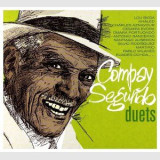
Compay Segundo war der Godfather der kubanischen Musik. Im Alter von 88 Jahren erlangte er internationalen Erfolg und war der größte Künstler des Buena Vista Social Club-Phänomens.
Compays Musik ist in der Lage, einem ein Lächeln ins Gesicht zu zaubern, und einige seiner Lieder ("Chan Chan", "Sarandonga", "Yo vengo aquí") gehören zu den Klassikern des Son Cubano, des Genres, das er in der ganzen Welt verbreitet hat. Auch einige seiner Coverversionen klassischer kubanischer Lieder wie "Guantanamera", "La Negra Tomasa" oder "Lágrimas negras" gehören zu den besten der lateinamerikanischen Musik. Wir feiern sein Werk mit Vinyl-Veröffentlichungen im Jahr 2023, "Duets", "Las flores de la vida" und "Calle salud"
Takeo Moriyama, Japan’s leading jazz drummer, loved by many new and old fans. Since the late 1960s, he has swept the free jazz world with the Yosuke Yamashita trio. After leaving the group, the radiating heat was condensed into an ensemble, evolving and deepening the musicality in a more melodic and rhythmic direction. And that activity will reach a peak in this work “Smile”.
Seit ihrem Auftauchen Mitte der 1990er Jahre haben beide eine starke Präsenz im Kontext der amerikanischen experimentellen Musik und beide jeweils seitdem einige der fesselndsten Originalwerke produziert. Kenney ist eine experimentelle Vokalistin, Komponistin und Lehrerin, die sich auf die transformativen Kräfte der Stimme und die Beziehung des Klangs zu mystischen Erfahrungen konzentriert. Neben ihrer Zusammenarbeit mit Oren Ambarchi, Tashi Wada, Avey Tare, Alvin Lucier, Sarah Davachi, dem Ensemble Nist-Nah, Sunn O))) und zahlreichen anderen ist sie bekannt für ihre Aufführung indonesischer Vokalmusik (Sindhenan) und persischer Vokalmusik (Radifs) sowie für ihre eigenen Kompositionen, die Elemente beider Musikrichtungen aufgreifen. Kang, ein Komponist und Multi-Instrumentalist, der für seine einzigartige Herangehensweise an die Bratsche hoch angesehen ist, hat auf zahlreichen Gebieten gearbeitet und auf Alben von Bill Frisell, Joe McPhee, Sun City Girls, Wayne Horvitz, Ikue Mori, Laurie Anderson, Aki Onda, John Zorn, Blonde Redhead, William Hooker, Animal Collective, Lou Reed, Oren Ambarchi und zahlreichen anderen mitgewirkt sowie eine Reihe von Solowerken geschaffen, die Elemente seiner isländischen, dänischen und koreanischen Herkunft enthalten. Azure ist eine hypnotische Rückkehr zu Kenneys und Kangs einzigartigem Ausdruck von "Unisono-Musik" und gehört zu den am stärksten reduzierten und minimalistischen Arbeiten des Duos seit mehr als einem Jahrzehnt. Die fünf Kompositionen werden durch Anspielungen auf die natürliche Welt unterstrichen.
'New World Artifacts' is the debut album from Rouen, France-based group Unschooling, arriving following their 2021 'Random Acts of Total Control' EP and 2019's 'Defensive Designs' tape. Out October 6th via Bad Vibrations, it's a collection of lo-fi post-punk clocking in at 30 minutes, underscored with subtle pop melodies and structures but never far away from bouts of chaotic no-wave dissonance. Here, Unschooling claim loud and clear their desire to return to a sound which is less calibrated, less obvious. As they themselves write, "New World Artifacts is an ode to the unexpected, a tribute to many art rock bands who are always where you least expect them." Already heralded as one of the most exciting up-and-comers in the new school of post-punk revivalists, having spent the last couple of years playing to busy crowds and festival fields across the continent, 'New World Artifacts' might just mark them out as the best in class. The Unschooling quintet, as referred to on the album's collage artwork, is made up of Vincent Fevrier (Vocals/Guitar), Damien Tebbal (Bass), Paul Morvant (Guitar), Marc Lebreuilly (Guitar/Synth) and Thomas Fromager (Drums). Although their music might revel in discord, it is a calculated one. The musicianship is complex and meticulous, hardened by their time spent together playing on the road. For 'New World Artifacts', additional musicians were also brought in to expand the sound in new ways, including saxophonists Levi Gillis (The Dip, Beat Connection) and Emeline Morisset (Les Agamemnonz), and Kyleen King (Stephen Malkmus & The Jicks, My Morning Jacket) on strings. Pressing Info: 180g blue vinyl, limited to 300 hand-numbered copies ww, download card included.
- Chor Und Orchester Des Sender Freies Berlin - Ouvertüre (Sie
- Werden Jetzt Eine Oper Für Bettler Hören)
- Chor Und Orchester Des Sender Freies Berlin - Zuerst Hören Sie
- Eine Moritat Über Den Räuber Mach (Die Moritat Von Mackie Messer)
- Chor Und Orchester Des Sender Freies Berlin - Jonathan
- Jeremiah Peachum Hat Einen Laden Eröffnet (Der Morgenchoral Des
- Peachum)
- Chor Und Orchester Des Sender Freies Berlin - Polly Peachum
- Ist Nicht Nach Hause Gekommen (Anstatt-Dass-Song)
- Chor Und Orchester Des Sender Freies Berlin - Tief Im Herzen
- Soho‘s (Hochzeitslied Für Ärmere Leute)
- Chor Und Orchester Des Sender Freies Berlin - In Der
- Erinnerung An Ihre Gemeinsame Jugendzeit (Kanonensong)
- Chor Und Orchester Des Sender Freies Berlin - Siehst Du Den
- Mond Über Soho (Liebenlied)
- Chor Und Orchester Des Sender Freies Berlin - Durch Ein
- Kleines Lied (Der Song Vom Nein Und Ja - Barbara-Song)
- Chor Und Orchester Des Sender Freies Berlin - Herr Und
- Frau Peachum Raten Ihrer Tochter (Die Unsicherheit Menschlicher
- Verhältnisse)
- Chor Und Orchester Des Sender Freies Berlin - Lied Eines
- Kleinen Abwaschmädchens (Die Seeräuber-Jenny Oder Träume Eines
- Küchenmädch
- Chor Und Orchester Des Sender Freies Berlin - Macheath Und
- Die Hure Jenny (Die Zuhälterballade)
- Chor Und Orchester Des Sender Freies Berlin - Ihr Herrn
- Urteilt Jetzt Selbst (Die Ballade Vom Angenehmen Leben)
- Chor Und Orchester Des Sender Freies Berlin - Erste Wolken Am
- Himmel (Das Eifersuchtsduett)
- Chor Und Orchester Des Sender Freies Berlin - Eifersucht, Wut
- Liebe Und Furcht (Kampf Um Das Eigentum)
- Chor Und Orchester Des Sender Freies Berlin - Was Ist Denn
- Das? (Das Lied Von Der Unzulänglichkeit)
- Chor Und Orchester Des Sender Freies Berlin - Ihr Saht Den
- Weisen Salomo (Salomon-Song)
- Chor Und Orchester Des Sender Freies Berlin - Verfolgt Das
- Unrecht Nicht Zu Sehr (Dreigroschen-Finale)
- Chor Und Orchester Des Sender Freies Berlin - Und So Kommt
- Zum Guten Ende (Die Schluss-Strophen Der Moritat)
„The Threepenny Opera“ is a timeless masterpiece that
combines social commentary, satirical elements and
stirring music. This LP captures the energy and spirit of the
performance while bringing the distinctive characters and
dramatic action to life.
Whether you are already a fan of the play or discovering it for
the first time, this piece of music will transport you to a world
of drama, emotion and musical brilliance.
Japan has produced some exceptionally talented jazz drummers and among them is Tatsuya Nakamura, who joins the BBE Music J Jazz Masterclass Series with his album ‘Locus’ from 1984, a session covering several bases, from heavy percussive samba to meditative avant-ambient. This is the album’s first ever reissue, although a track from ‘Locus’, ‘¼ Samba’, was included on J Jazz vol. 3. Nakamura began his drumming career as a teenager, inspired after seeing the documentary film “Jazz on A Summer’s Day” and listening to his idols Art Blakey and Miles Davis. By his early twenties, Nakamura was working with such luminaries as free jazz guitarist Masayuki Takayanagi, pianist Masaru Imada and band leader & composer Mitsuaki Kanno. In the mid-70s, like several other Japanese jazz players, Nakamura decided to make the move to New York where he studied drumming with Roy Haynes, and performed with members of the AACM and players from the loft and free jazz scenes including Richard Davis, George Adams, John Hicks, and Pharaoh Sanders. Returning to Japan, Nakamura continued playing as leader of his Japanese band The Jazz Fellows and in 1979, he went into the studio as leader for the classic “Where Is The Quarter” session featuring Masaru Imada, Hideto Kanai and Kenji Mori. This session includes the original percussion heavy version of ‘¼ Samba’ and was followed by a period back in NYC during which he recorded the funky/free session ‘Rip Off’ in 1980. 1984 saw Nakamura working as leader of a heavy-duty fusion septet and in February of that year he led them in a performance at Audio Technica Hall. The album ‘Locus’ on Sea Horse Records is the label’s one and only release. On ‘Locus’, Nakamura is joined by a stellar line-up. On trumpet is Shinobu Fujimoto and he’s joined by seasoned bass player Hideto Kanai (1931 -2011) who began playing in the mid-1950s, appearing on King Recs All-Star Jazz Series before going on to be a regular fixture on the legendary Three Blind Mice (TBM) label, backing many of its leading artists. He even released his own album on TBM, ‘Ode to Birds’ in 1975. On guitar is Kazumasa Akiyama. Born in Tokyo in 1955, he taught himself guitar at 10 years old and was influenced initially by The Beatles and Ray Charles, and later Jimi Hendrix, Cream, Chicago Blues, and jazz. When he was a student, he got a chance to appear on Sadao Watanabe's radio program ‘My Dear Life’, which led him to join the Isao Suzuki Group and Mikio Masuda Group. Akiyama released his first leader album ‘Dig My Style’ in 1978 and is still an active musician. On keys is the incredible Jun Fukamachi (1946-2010). Born in Harajuku, Tokyo, Fukamachi started playing the piano at the age of three, showing an extraordinary talent, recognised as a child prodigy. He became a professional musician while still in school and released his first album ‘Portrait of a Young Man’ on Polydor in 1971.
The seventh release of Sasaki Hiroaki's Yotsume-Music sees Hisashi Ito aka Hulot (Raum...musik, BELOW, FROGMAN/U.S.B.) welcomed to the fray, quite possible, given the EP's title, taking influences from Mr Hulot, the hero of Jacques Tati classic film 1953 'Les Vacances de Monsieur Hulot'.
Like said hero, there's a kooky, loveable eccentricity to his two productions - he counts Herbert and Moritz von Oswald among his main influences - with Tom Ellis Remix and Sasaki Hiroaki Remix adding a remix, one on either each side.
Ein einzigartiges Album, das 1999 seiner Zeit weit voraus war und ein absoluter Klassiker ist! Dieses Album ist eine Mischung aus Folk, Death Metal und Pagan Metal. Zum ersten Mal auf Vinyl!Ich lernte Hollenthon 1999 kennen, als "Domus Mundi" veröffentlicht wurde. "Domus Mundi" ist seitdem ein Lieblingsalbum, das ich mir immer wieder gerne anhöre, weil es einen unendlichen Wiederspielwert hat und eineneinzigartigen Stils, den keine andere Metal-Band nachahmen kann. Umso erstaunlicher, dass alles von einem Mann geschaffen und arrangiert wurde, nämlich von Martin Schirenc, der vor allem durch seine Arbeit bei Pungent Stench bekannt ist.Dieses Album lässt sich am besten als orchestraler Extrem-Metal beschreiben, aber auch episch, volkstümlich und mittelalterlich sind angemessene Adjektive für dieses Werk. Schirenc beweist, dass er nicht nur ein
großartigerSchirenc beweist, dass er nicht nur ein großartiger Gitarrist ist, sondern auch ein brillanter Arrangeur, der gregorianische Gesänge, Spoken Word, ethnische Musik aus dem Nahen Osten, neuseeländische Kriegsgesänge und jede Menge klassische Musik in seine Musik integriert.
Die Samples reichen von Rimsky-Korsakoffs "Sheherezade" bis zu einem Dudelsackfilm aus dem Film Braveheart, zu gesprochenen Samples aus Ridley Scotts Legend und vielem mehr. Diese Samples verleihen dem Album eine einzigartige Note und machen es extrem abwechslungsreich, etwas, das man so noch nie gehört hat. Schirenc verwendet einfache Songstrukturen und setzt Hooks in seiner Gitarrenarbeit ein, um lange Songs und sich wiederholende Strukturen interessant zu halten.
I Shall Die Here / Earth Triumphant is an expanded edition of the fourth full-length album by The Body, first released to widespread acclaim, and terror, in 2014. Sharing their moribund vision with Bobby Krlic, aka The Haxan Cloak, the tried and true sound of The Body is shred to pieces on I Shall Die Here, mutilated by process and re-animated in a spectral state by the collaboration.
This double album set is expanded with the previously unreleased Earth Triumphant, a full-length companion album that would become I Shall Die Here, showcasing The Body's brutality in its most primal form. With both albums revisited by The Body and Seth Manchester at Machines With Magnets and remastered by Matt Colton at Metropolis Studios, this is the definitive edition of a shocking classic of unbridled bleakness and innovation. Formed by drummer Lee Buford and guitarist Chip King in Little Rock, Arkansas in 1999, The Body soon relocated to Providence, Rhode Island. The duo remained in Providence for a decade before moving west to their current home of Portland, Oregon. Their debut self-titled album (Moganano, 2003) and on the widely-acclaimed, classification curtailing of All the Waters of the Earth Turn to Blood (At A Loss, 2011) readied the band for even more experimentations. The employment of the Assembly of Light Choir's classical chorales on All the Waters, alongside more industrial music techniques such as vocal sampling and drum programming, prompted RVNG to inquire with King and Buford which darker corners of the electronic universe they were presumably interested in exploring.
The undertaking of I Shall Die Here was aided by Seth Manchester and Keith Souza, The Body's long standing engineer and creative collaborator, and noted producer Bobby Krlic. Krlic's own work as The Haxan Cloak struck a similarly despairing chord to The Body with the celebrated Excavation (Tri Angle, 2013), itself a minimalist evocation of the afterlife. I Shall Die Here shares similar nether space with the morbidly deviating darkness of Excavation, but remains sculpturally frozen in a sort of earthen purgatory.
The Body's musical approach, engraved by Buford's colossal beats and King's mad howl and bass-bladed guitar dirge, became something even more terrifying with Krlic's post-mortem ambiences serving as both baseline and outer limit. I Shall Die Here sonically serrates the remains of metal's already unidentifiable corpse and splays it amid tormented voices in shadow. This expanded edition gives us a window into the creation of a classic with the inclusion of its in utero twin, Earth Triumphant. Recorded as a nearly finished album by Buford and King before The Haxan Cloak's transformation, it stands as a raw statement of intent, the original DNA for what would soon mutate into something wholly new.
Fans of I Shall Die Here will find familiar sonic fragments in a more primitive state - like seeing an out-of-context photograph of a family member taken well before you knew them - but the album stands on its own in its minimalist brutality, a natural bridge to what The Body was soon to become. The Body's I Shall Die Here / Earth Triumphant will be released in digital and vinyl formats on June 30, 2023. On behalf of The Body, The Haxan Cloak, and RVNG Intl., a portion of the proceeds from this release will benefit Intransitive, an organization that works to advance the cause of Trans liberation in Arkansas through art, education, advocacy, organizing and culture in order to create effective systemic change and on-the-ground impact.
I Shall Die Here / Earth Triumphant is an expanded edition of the fourth full-length album by The Body, first released to widespread acclaim, and terror, in 2014. Sharing their moribund vision with Bobby Krlic, aka The Haxan Cloak, the tried and true sound of The Body is shred to pieces on I Shall Die Here, mutilated by process and re-animated in a spectral state by the collaboration.
This double album set is expanded with the previously unreleased Earth Triumphant, a full-length companion album that would become I Shall Die Here, showcasing The Body's brutality in its most primal form. With both albums revisited by The Body and Seth Manchester at Machines With Magnets and remastered by Matt Colton at Metropolis Studios, this is the definitive edition of a shocking classic of unbridled bleakness and innovation. Formed by drummer Lee Buford and guitarist Chip King in Little Rock, Arkansas in 1999, The Body soon relocated to Providence, Rhode Island. The duo remained in Providence for a decade before moving west to their current home of Portland, Oregon. Their debut self-titled album (Moganano, 2003) and on the widely-acclaimed, classification curtailing of All the Waters of the Earth Turn to Blood (At A Loss, 2011) readied the band for even more experimentations. The employment of the Assembly of Light Choir's classical chorales on All the Waters, alongside more industrial music techniques such as vocal sampling and drum programming, prompted RVNG to inquire with King and Buford which darker corners of the electronic universe they were presumably interested in exploring.
The undertaking of I Shall Die Here was aided by Seth Manchester and Keith Souza, The Body's long standing engineer and creative collaborator, and noted producer Bobby Krlic. Krlic's own work as The Haxan Cloak struck a similarly despairing chord to The Body with the celebrated Excavation (Tri Angle, 2013), itself a minimalist evocation of the afterlife. I Shall Die Here shares similar nether space with the morbidly deviating darkness of Excavation, but remains sculpturally frozen in a sort of earthen purgatory.
The Body's musical approach, engraved by Buford's colossal beats and King's mad howl and bass-bladed guitar dirge, became something even more terrifying with Krlic's post-mortem ambiences serving as both baseline and outer limit. I Shall Die Here sonically serrates the remains of metal's already unidentifiable corpse and splays it amid tormented voices in shadow. This expanded edition gives us a window into the creation of a classic with the inclusion of its in utero twin, Earth Triumphant. Recorded as a nearly finished album by Buford and King before The Haxan Cloak's transformation, it stands as a raw statement of intent, the original DNA for what would soon mutate into something wholly new.
Fans of I Shall Die Here will find familiar sonic fragments in a more primitive state - like seeing an out-of-context photograph of a family member taken well before you knew them - but the album stands on its own in its minimalist brutality, a natural bridge to what The Body was soon to become. The Body's I Shall Die Here / Earth Triumphant will be released in digital and vinyl formats on June 30, 2023. On behalf of The Body, The Haxan Cloak, and RVNG Intl., a portion of the proceeds from this release will benefit Intransitive, an organization that works to advance the cause of Trans liberation in Arkansas through art, education, advocacy, organizing and culture in order to create effective systemic change and on-the-ground impact.