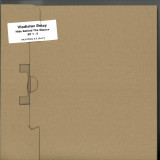
Vladislav Delay presents the fifth and last EP in his "Hide Behind The Silence" series. Intuitive and raw music, momentary and reflective, released on Ripatti's own label "Rajaton".
--
Stillness is a myth. Consider concepts such as ”still water”, or ”still air” for that matter. Go to a restaurant, ask them for a glass of still water, hold it against the light and see where we’re at. Even though the water itself has been captured and imprisoned in the glass, it never stops breathing. It’s filled with tiny particles, dancing. Everything can be explained on a molecular level, but since we’re not scientists – and even if you happen to be – it’s the natural world of perception that moves me.
Still air is very similar. A hot summer’s day with zero wind feels completely still. It’s the closest I have felt to complete stillness. Or for a more urban adaptation, imagine the same vibe inside a normal apartment. In those moments, revelations and mind- blowing experiences can be had with experiments in stillness.
Try this: Just sit down for a minute on a sunny day, making sure there’s enough natural light. Do absolutely nothing. Try not to breathe for a bit. (If you need a mental anchor, you can play Cage’s 4’33” in your head but nothing else.) Watch the tiny dots of dust dancing :..’ ̈.:; ́ ́*°.,’:,. ̈ ̈ ̈ ̈:,.’
The movement is crazy, but the feeling of stillness comes from witnessing how subtle it is. In (perceived) complete stillness, every act of microscopic mobility seems to speak volumes. Yet, it feels both reassuring and oddly threatening that the stillness is never complete. What if we would need absolute stillness? Or is it just enough that we can perceive something as such? Extremes attract, so for both water and air, extraordinary movement is equally fascinating. That is also a luxury item of sorts. For us to enjoy a very ”loud” body of water or air, we need to be safe, in enough control of the situation. So when you are, it’s worthwhile to pay attention and take it all in.
A rapid flowing free with extreme strength and just barely in control. Look at that water go! No still water on this one, only ”sparkling”. A windy day when birds seem surprised how hard it is to fly, but in the end they make it. Trees bend but don’t break. The wind shows you its movement but doesn’t hurt you. It feels friendly, like a big clumsy dog that doesn’t quite understand its size.
It’s beautiful to be a guest of the elements, but not at the mercy of them. A new kind of dialogue forms.
Search:my everythi
- A1: The Universe Is Weeping
- A2: I Am Nothing, I Am Everything
- A3: Unto Becoming
- B1: Final Push Into The Sun
- B2: Dancing On The Emptiness
- B3: Facing The Incomprehensible
- C1: A Brief Return To Physical Form
- C2: A Bond Broken By Death
- C3: Break In The Clouds (In The Darkness Of Our Minds)
- D1: Soul Metamorphosis
- D2: Swimming In The Absence
- D3: The Endless Road Home
Spring Green Vinyl[32,98 €]
Die progressiven Sludge-Meister LORD DYING aus Portland verwandeln Tragödien in Triumphe. Zwei Alben, angetrieben von zermalmenden Riffs und konfrontierendem Howls haben die Doom Dogs der Welt vorgestellt. Im Jahr 2019 lieferten sie Mysterium Tremendum ab, ein Album, das Kerrang!
als "Prog-Metal-Meisterwerk" bezeichnete.
Die berauschende und abenteuerliche existenzielle Meditation über den Tod bildete den Auftakt zu einer Trilogie. Diese Geschichte wird 2023 mit einem zunehmend ambitionierten Nachfolger fortgesetzt, dem treffend benannten Clandestine Transcendence.
"Letztlich geht es auf dem Album um Selbstfindung und darum, das zu werden, was man angesichts von Hindernissen werden will, egal wie die Karten gegen einen gestapelt sind", sagt Olson. "Ich bin nicht wirklich ein spiritueller Mensch. Aber ein Text auf dem Album handelt von der Umwandlung von Energie und davon, dass Materie weder geschaffen noch zerstört werden kann. Das ist vom issenschaftlichen Standpunkt aus betrachtet." Er lacht. "Aber vielleicht ist die Wissenschaft spirituell."
- A1: Main Title
- A2: The Giant Tail
- A3: Facing Fear
- A4: A Close Call
- A5: Godzilla Appears In Nemuro
- A6: In The Ocean Depths
- A7: A Sleeep Of 60 Million Years
- A8: The Object From Outer Space / Unusual Phenomenon
- A9: The Self Defence Force Mobilizes
- A10: Godzilla’s Theme 2000
- A11: End Title – The Feared God Godzilla
- B1: The Object From Outer Space Flight
- B2: Eerie Silence
- B3: Eerie Silence Ii
- B4: Ominous Premonition
- B5: The Wonder Of G Revealed
- B6: The Flight Of The Giant Ufo
- B7: The Earth Invasion
- B8: Before The Explosion
- B9: Millennium
- B10: Thinking Of Dad
- B11: Millennial Kingdom
- C1: Miraculous Survival
- C2: Organizer – Godzilla’s Theme
- C5: Extraterrestrial Life/The Metamorphosis
- C6: Astonishing Resurrection
- C7: Millennial Kingdom
- C8: G’s Decision
- C9: The Space Monster Ironic Fate
- C10: End Title – The Feared God Godzilla
- C11: End Title – The Feared God Godzilla Ii
- C3: Extraterrestrial Life /The Birth
- C4: Rising Tension
He's back - again! Years after the end of the Heisei era, the big G came back to film in 1999 with the first of a new era: GODZILLA 2000: MILLENNIUM. Directed by Takao Okawara (GODZILLA VS. DESTOROYAH), a new look Godzilla is still harassing Tokyo, with the Godzilla Prediction Network out there trying to figure out where he'll show up next. To make matters worse, the government's Crisis Control Intelligence care more about firing missiles, but everything changes when they discover a mysterious meteor has a UFO inside. All of this results in Orga, a kaiju made from Godzilla's DNA, and of course it's up to the Big G to kick its ass back to space. Scoring GODZILLA 2000 was Takayuki Hattori, who had previously composed 1994's GODZILLA VS. SPACEGODZILLA. Hattori's music is very much about mood; the composer brings a sense of lyricism to proceedings, but of course, he also knows how to get us excited for Godzilla's appearances. Hattori does that with a spectacular new theme for the Big G that perfectly captures the creature's grandeur and immense power. There's also a fantastic piece for the UFO that has a wonderfully primevil beat, and of course, Akira Ifukube's classic theme for Godzilla returns in a big way. A perfect start to the Millennium era! (Charlie Brigden)
Artwork by Matt Ryan Tobin
2X 140gram Eco-Vinyl
The Sex featuring members of Mercenary God and No Suicide. A mixture of different elements with a rock substrate for an uncategorized result. Another Post-Punk gem from the 80's Italian North-Eastern scene.
My adventure buddies? The silent, enigmatic Patti, former singer of the mysterious No Suicide, and the young, faithful Chris, a passionate Police fan, we met on the battlefield and he immediately became my brother. For him, learning to play the bass was a way to get close to Sting, in other words, just one step below Paradise. Patti instead played keyboards as an extension of her mysterious and glacial presence, so still and distant that the audience sometimes wondered if she was real. And then there was my fixation for the drum machine, a futuristic device which could transform the drumming sweat into an invisible, yet physical, dreamlike pulsation. A particular combination of characters and a special astral conjunction, that’s what you need to get a nucleus source of sonic emotions, and in some ways this is what we were. You could clearly feel it during the concerts. When at the end of ‘81 My Mercenary God lost their drummer and had to disband, I felt clearly that the music had already changed.
Our old 70’s rock ‘n’ roll sound was no longer representative of the day. We were like some sort of yesterday’s newspaper. Thus I Sex was born (later The Sex). According to Freudian thought that sees sexual instinct as the driving force behind every (creative or destructive) human act. And in fact we immediately started creating, destroying, assembling and deconstructing our sound. Suddenly “tomorrow became now”. It was an outburst of creative independence in the form of homemade cassettes put together with makeshift tools, at least until the arrival of the legendary 4 track recorder. I was 19 years old, Chris was only 17. Nothing more than kids after all. Yet we were already veterans, veterans of a lost war. Wise, naive, disillusioned dreamers, everything and the opposite of everything. But, above all, we were totally devoted to our creative delirium up to the point of losing touch with reality, crossing limits, breaking down barriers and almost bordering on madness. Perhaps we were just too involved, especially if in relationship with what we could receive in return. We always spread our energies as if there was no future. We unconsciously felt that we had to live in the moment, now or never, and in retrospect it really was like that, and this is why these songs exist now. Songs created with the intent to tell an inner universe that is, now as then, far from any convention.
What Do We Do Now is the fifth solo studio LP recorded by J Mascis since 1996. This is obviously not a very aggressive release schedule, but when you figure in the live albums, guest spots, and records done with his various other bands (Dinosaur Jr., The Fog, Heavy Blanket, Witch, Sweet Apple, and so on), well, to paraphrase Lou Reed, "J's week beats your year." What Do We Do Now began to come together during the waning days of the Pandemic. Utilizing his own Bisquiteen Studio, J started working on writing a series of tunes on acoustic with a different dynamic than the stuff he creates for Dino. "When I'm writing for the band," he says, "I'm always trying to think of doing things Lou and Murph would fit into. For myself, I'm thinking more about what I can do with just an acoustic guitar, even for the leads. Of course, this time, I added full drums and electric leads, although the rhythm parts are still all acoustic. Usually, I try to do the solo stuff more simply so I can play it by myself, but I really wanted to add the drums. Once that started, everything else just fell into place. So it ended up sounding a lot more like a band record. I dunno why I did that exactly, but it's just what happened." Two guest musicians are playing this time out; Western Mass local Ken Mauri (of the B52s) plays piano on several tracks. Since J himself has some experience with keys, when asked why he needed a hired gun, he says, "Ken is great, and he plays all the keys. I tried playing some keyboards on the first Fog album, but I'm really only comfortable playing the white notes, so it's kind of limiting. laughs Nowadays, I could just turn the pitch on a mini Mellotron to play different sounds, but black keys just seem hard. For whatever reason, I just like banging on the white ones. Seems like it's harder to figure out how to stretch your fingers around the other ones." Mauri has no such qualms and plays all the keys very damn well. He sounds especially great on "I Can't Find You," where he is Jack Nitzsche to J's Neil Young, creating one of the album's loveliest tunes. The other guest musician, Matthew "Doc" Dunn, is also prominent on this track. Dunn's steel guitar manages to both widen and soften the musical edges of the music, giving it a full classicist profile. Dunn is an Ontario-based polymath who J met through Matt Valentine. After J played on Doc's great 2022 Sub Pop single, "Your Feel," he figured it was time for payback. Both Dunn and Mauri add beautifully to the songs here, helping to transform them from acoustic sketches into full-blown post-core power ballads. What Do We Do Now is the finest set of solo tunes J has yet penned, and the way they're presented is just about perfect. Asked if he would be touring to support the album, J says he'll be doing some weekend dates, but he probably won't be putting a band together. And I'm sure these songs will sound great solo and acoustic, but the arrangements on this album are truly great and put a cool, different spin on Mascis' instantly Recognizable approach to making music. So, what do we do now? Not sure. But apparently, what J does is to make one of his most killer records ever. Hats off to him. - Byron Coley
Now-Again Records presents catalog-wide reissues of Latin music propellant Joe Bataan’s legendary Ghetto Records. Next up in the series - Joseph “Candido” RodrÌguez - Candido was mentored by Tito Punete, and his debut features a fantastic mix of fiery Salsa, Latin Jazz and Sweet Latin Soul. Ghetto Records was Joe Bataan’s way to get over on “The Man” and out of the ‘hood, a bold move by an artist looking for independence and creative control in an industry that had exploited his talents and treated him like chattel. As Bataan puts it today, “Ghetto Records was part of my journey, a stepping stone to everything else that I’ve done. I learned enough that it enabled me to get out of the box with my thinking, it showed me how to deal with adversity.” Like many dreams and schemes born of the street, this one was audacious, perhaps even reckless to a fault. Hatched from desperation yet full of hope Ghetto Records came crashing down shortly after its inception. The seven albums in its discography languished out of print - until now. These are the definitive reissues of these albums, licensed from Joe Bataan, with his oversight and input into a 16 page oversize book by Pablo Yglesias that details Bataan’s larger-than-imagination life and his little Latin label that could.
toechter is an all-female trio operating from Berlin. toechter’s 2nd full-length album »Epic Wonder« sees its classically trained members blend elaborate string arrangements with ethereal indie pop and delicate rhythms. Katrine Grarup Elbo, Lisa Marie Vogel and Marie-Claire Schlameus exclusively use analogue sound sources (such as violin, viola, cello, and their voices), which were then electronically processed.
Named after the Greek god of the wind, toechters 2022 album »Zephyr« exhaled deeply with concurrently invigorating and confusing sounds. »Epic Wonder«, their second album, was created in the spring and summer of 2023. Playing with forms and contours, the music sounds like the awakening of something new. One seems to be listening to an ongoing conversation, an exchange about what music could be, where it wants to go and how it contributes to our view of life. It all rests on a simple premise:
»Every sound you hear in our universe comes from us. The string trio is the core of toechter, the starting point of all our work.«
Those looking for new worlds of sound can find them in the work of this classically- trained musicians. Whether they add voices or percussive instruments, sample the sounds, or manipulate them electronically; ultimately they are exploring the string trio's place in a world shaped by the digital.
»Prelude« opens the album, seemingly a conversation, yet not only between humans. We catch the word ›love‹ which soon morphs into pure sound images, while a violin theme tentatively takes over. Is it the dawning of a new day? The chorus of sound transforms into a fascinating rhythmic figure, creating a club-like experience that fades out in delicate structures. A perpetual transformation.
According to toechter, »Epic Wonder« is all about making connections. Connections between people, animals, plants, fungi, rocks, soils, oceans, ice caps, stars, and planets. One imagines oneself in a folk-pop song of the 60s, or even blown around by Morricone's desert wind:
»The world as we see it is in desperate need for a deeper understanding; for compassion, for empathy. We have to understand that we are all part of the same organism. Epic Wonder is a dream, a wish, a longing for kinship between all species that share the world - all that is alive.«
The acoustic throbbing and knocking in »Sea Of Serenity« makes you think of encounters with mythical creatures or planetary oceanography; and out of the mechanically clacking groove of »Shift Souls« a gentle, but steady movement awakens with voices that seem to sound from the depths of the sea. Everything is in flux, floating in and out of dimensions and elements.
The album ends with »Mercury«, spherically elegant and almost science fiction-like. Here, a pizzicato melody leads us back to the baroque, simultaneously representing a detail of intertwined sonic worlds, while the steady, housy baseline develops its driving theme.
»Creating the music for the album, we allowed ourselves to waft away with the aspiration that connections are possible. Sometimes dwelling on subtle, yet marveling phenomena like the evening fog covering a valley on Midsummer, sometimes on grandiose splendors like the genesis of mountains or the birth of a child - letting interactions and encounters with other beings float through the musical universe as drips of emotional perceptivity.«
For the visual manifestation of »Epic Wonder«, toechter has engaged with Finish up-and-coming lens-based artist Aino Kontinen. Her work will grace both the cover art of the album and accompany the first single and video as an ephemeral tale in motion.
- A1: Dreamlover
- A2: Hero
- A3: Anytime You Need A Friend
- A4: Music Box
- A5: Now That I Know
- B1: Never Forget You
- B2: Without You
- B3: Just To Hold You Once Again
- B4: I’ve Been Thinking About You
- B5: All I’ve Ever Wanted
- B6: Everything Fades Away
- C1: All I Live For (Extended Version)
- C2: Endless Love (Duet With Luther Vandross)
- C3: Do You Think Of Me
- C4: Workin’ Hard
- C5: My Prayer
- D1: Hero (2009 Version)
- D2: Anytime You Need A Friend (Extended Mix)
- D3: Music Box (A Capella)
- D4: Dreamlover (Live From Top Of The Pops)
- D5: Without You (Live From Top Of The Pops)
- E1: Dreamlover (Def Club Mix)
- E2: Anytime You Need A Friend (C&C Club Version)
- F1: Anytime You Need A Friend (Soul Convention Remix)
- G1: Emotions (Live At Proctor’s Theater, Ny – 1993)
- G2: Hero (Live At Proctor’s Theater, Ny – 1993)
- G3: Smeday (Live At Proctor’s Theater, Ny – 1993)
- G4: Without You (Live At Proctor’s Theater, Ny – 1993)
- G5: Make It Happen (Live At Proctor’s Theater, Ny – 1993)
- H1: Dreamlover (Live At Proctor’s Theater, Ny – 1993)
- H2: Love Takes Time (Live At Proctor’s Theater, Ny – 1993)
- H3: Anytime You Need A Friend (Live At Proctor’s Theater, Ny – 1993)
- H4: Vision Of Love (Live At Proctor’s Theater, Ny – 1993)
- H5: I’ll Be There (Featuring Trey Lorenz) (Live At Proctor’s Theater, Ny – 1993)
- F2: I’ve Been Thinking About You (Terry Hunter Remix)
- F3: Workin’ Hard (Terry Hunter Remix)
Mariah Careys 30-jähriges Karrierejubiläum geht weiter! Nach der Veröffentlichung der Doppel-CD "The Rarities" am 2. Oktober erscheinen am 6. November ihre Alben "Emotions", "Music Box", "MTV Unplugged EP" (erstmals auf Vinyl), "Daydream", "Butterfly" und "Rainbow" - neu gemastert - auf schwarzem Vinyl.
An F-bomb saturated hip-hop call & response club cut...from Sun Ra?! While the most renown track in this omniversal opus is the atomic expletive-filled repartee 'Nuclear War,' there is so much more to this dark mysterious journey through the mind of Sun Ra. The sprawling, suite-like 20-minute title track sustains a lyrical edge in spite of an open framework and textures, which encourage sonorities to surface and emerge from the band as if there was no human intention behind them. In opposition to 'Nuclear War,' Ra's organ playing here was built less on bombast and sonic terror than it is on whispers, stutters, shivers, and swells. Fireside Chat offers a wide stylistic array, as was the artist's intent, reflecting his eclectic, seemingly irreconcilable approach to compositional extremes. With Sun Ra you get everything... except predictability. First ever reissue of this iconic album!
A Fireside Chat With Lucifer by Sun Ra, released 2 February 2024, includes the following tracks: "Makeup" and more.
This version of A Fireside Chat With Lucifer comes as a 1xLP.
The vinyl is pressed as a yellow disc.
Daniel Land's new album, "Out of Season", is his most ambitious record to date, a series of reflections on history, memory, and post-Brexit Britain, which was inspired by his return to the landscapes of his youth – the rugged, underpopulated west coast of Somerset. The album was written and partly recorded in Daniel’s studio in a static caravan, overlooking the coast, during the period when the UK was tearing itself apart over its relationship to Europe. "I didn't set out to write about Brexit", Daniel says, "I have a kind of horror of political music. But I couldn’t escape the atmosphere of the time – this strange, distorted version of ‘Englishness’ in the national psyche. I’ve always been interested in memory and nostalgia; Brexit illustrates the dangers of taking seductive, possibly false memories at face value”. Songs like “White Chalk”, “Island of Ghosts”, and the album’s title track, represent a series of attempts to reclaim an older, more peculiar idea of England which, Daniel says has been “Lost in the nationalist mythmaking of the past decades” – the island of misfits and outsiders exemplified by the works of Derek Jarman, for example, whom Daniel was rediscovering while working on the album. “I must have read 'Modern Nature' ten times over the years”, Daniel says. “What I love about Jarman is that he had a deep, abiding love for England, but it was a very complicated, critical and a very queer kind of love. That was very much my mood, going into the making of this album”. Like Jarman’s work, "Out of Season" probes national identity whilst also displaying resolutely queer themes throughout. Daniel’s voice – once described by The Guardian as "The spawn of Elizabeth Fraser and Anthony Hegarty” – is less heavily reverbed than before, bringing to the fore his often-confessional lyrics, inspired by the frankness of modern queer poets like Andrew McMillan, Seán Hewitt, and Ocean Vuong. A lyrical highlight is the gorgeous “Southern Soul”, a deceptively straightforward recounting of a decades-old hookup with a closeted guy from his hometown which, Daniel says, “Serves as a metaphor for everything I’m talking about in the album”. And in keeping with the album’s nods to the heroes of gay literature, Daniel’s self-styling of the album as a “Dream Pop Album on National Themes” deliberately references the full title of Tony Kushner’s era-defining play "Angels in America", whose central character is namechecked in the hook-laden “Lemon Boy” – a song which must surely stand as Daniel’s most deliciously pop moment yet. Lauded by Mark Radcliffe, Guy Garvey, Tom Robinson, and many others, Daniel Land makes music that, in the words of BBC Radio 1, "You can't help but think the late John Peel would have loved".
- A1: Grana
- A2: Vorsichtig - Mutiger - Verloren
- A3: The Idea Of A Horizon
- A4: View From My Parents House
- B1: Folie
- B2: X-Pulse
- B3: Ungeheuer Ist Vieles
- B4: Seance
- B5: Nexus Ii On The Beach
- B6: Langsame Bewegung
- B7: Zwischen Luft
- C1: Chez Charles
- C2: P-Analyse
- C3: La Caduta Degli Dei
- C4: Aavikon (No Water)
- C5: Что Такое Человек
- D1: Dark Matter Art Cabinet
- D2: Hatch On A Hunch
- D3: Theban Constitutional
- D4: Kismet
- D5: No Noosphere
ESP Institute artist Bartellow, one third of the project Tambien and otherwise known in the Contemporary Classical sphere as Beni Brachtel, returns to the label with his second full-length release, Noosphere. While currently heading the SVS label and residency series out of Munich, Beni’s resume expands well beyond electronic music to include immersive sound installations such as The Adven- ture Of The Empty House (solo live performance across seven floors of Walter Henn’s Deckelbau building), a slew of compositions for the Bavarian State Opera (for which he doubled as conductor), and a prolific career of over twenty-five theater scores for institutions such as the Münchner Kammerspiele, Schauspiel Basel, Maxim Gorki Theater Berlin, Berliner Ensemble, Schauspiel Köln, Schaus- piel Graz and with directors Ersan Mondtag, Alexander Eisenach, Jessica Glause and Tobias Staab among others.
Noosphere is a compendium excerpting from theatrical scores WUT (Elfriede Jelinek, at Schauspielhaus Köln, directed by Ersan Mondtag, 2020), Ödipus and Antigone (Maxim Gorki Theatre Berlin, directed by Ersan Mondtag, 2017), Der Zauberberg (Thomas Mann, Schauspiel Graz, directed by Alexander Eisenach, 2017), Hass Tryptichon (Sybille Berg, Wiener Festwochen / Maxim Gorki Theatre, directed by Ersan Mondtag, 2019), Wonderland Ave. (Sibylle Berg, Schauspielhaus Köln, directed by Ersan Mondtag, 2018), Die Verdammten (after Visconti ́s film, Schauspielhaus Köln, directed by Ersan Mondtag, 2019) and Roi Ubu (Alfred Jarry, Theater Neumarkt, Zurich, directed by Alexander Eisenach, 2018).
The work traverses homages, infusing everything from Baroque to Impressionism, and while these types of references are certainly built into the canon of Theatre as a discipline, here we gather histor- ic layers in an even wider net. Under the self-referential thumb of Contemporary Classical music, this sort of "hindsight" approach has been largely avoided, however, in today’s all-access arena, the constant stream of historic causal-chained events has opened a delta where anything is possible. This defines Bartellow’s stance among his colleagues as well as his cultural position as a composer.
Beni considers beauty a fleeting objective in the arts, that expression is often expected to follow notions of Destructivism or the unfulfilled. Art will pore over wounds, collective angst, mourn- ing a loss of natural habitat or a fear of technological invasion, yet there is a bitter irreverence for the friction or salvation in beauty itself. Acknowledging this subjectivity — what one audience considers superficial pleasure may be deeply profound to another — he leans into musical instinct as if composing via divine conduit.
Noosphere conjures a array of suspense, ecstasy, melancholy, and dread, but in isolating the work from its theatrical component, Brachtel directs our focus toward formal qualities, clearing unim- peded space to conceive fresh narratives and examine dynamism and interconnectivity. In sympathy with often difficult theatre pieces, the passages can be dark and transgressive, but more importantly they remain relative to Brachtel’s circumstances at their time of creation. The title Noosphere speaks to the evolution of human thought and knowledge, opening a door to subjective points-of-view. For example, Nexus II On The Beach refers to both Roberto Musci’s Water Messages On Desert Sand as well as the film Bladerunner, invoking the image of an android enjoying the sunset, but whether or not this abstraction may be considered beautiful depends the listener’s cumulative life experience and perspective.
This is hybrid chamber music, augmented by electro-acoustic layers, juxtaposing various periods and successively processing their residual themes into a trans-generational rendering of “now.”
In der zweiten Hälfte des Jahres 2022 widmete Neal Morse seine kreativen Bemühungen der Erarbeitung einer neuen Rock Oper, nach der
erfolgreichen Veröffentlichung von "Jesus Christ the Exorcist". Die Inspiration floss und das Ergebnis ist eine fast zweistündige Musik, die die
Geschichte von Joseph, der für seinen bunten Mantel bekannt ist, durch die Brille des progressiven Rock in einem ganz eigenen Stil erzählt.
Anstatt beide Teile gleichzeitig als Doppelalbum zu präsentieren, entschied sich Neal dafür, die neue Oper in zwei separaten Bänden zu
veröffentlichen. Er war der Meinung, dass die Stärke sowohl der Musik als auch der Geschichte diesen Ansatz rechtfertigten, da jedes Album für sich
als Zeugnis seines inneren Wertes steht. "Der Träumer - Joseph: Part One" endet mit Joseph, der zu Unrecht eingekerkert wird. In "Die
Wiederherstellung - Joseph: Part Two" wird die biblische Erzählung fortgesetzt, in der beschrieben wird, wie Josephs Weisheit und Intelligenz ihn zum
Vizekönig von Ägypten und schließlich zur Wiedervereinigung seiner Familie führt. Erneut übernimmt Neal Morse die Rolle des Leadsängers, während
eine beeindruckende Reihe von Gastmusikern, darunter Ted Leonard (Spock's Beard, Pattern Seeking Animals), Matt Smith (Theocracy), Ross Jennings
(Haken) und Jake Livgren (Proto-Kaw, Kansas), sich ihm in diesem zweiten Kapitel anschliessen. Sie arbeiten mit Mitgliedern der Neal Morse Band
zusammen, wie Bill Hubauer und Eric Gillette, um nur einige zu nennen. Gemeinsam hauchen sie dieser bekannten Geschichte neues Leben und
Musik Leben ein, die verspricht, Progressive-Rock-Fans erneut zu begeistern.
- You're All I Need To Make It
- Who Knows
- I'm Gonna Keep On Loving You
- Sock It To 'Em Soul Brother
- Too Far Gone
- You Can't Blame Me
- Number One
- Row My Boat
- Without Love
- I Want To Be Ready
- Your Love Keeps Drawing Me Closer
- Hot Grits!!!
- I Can't Take It
- Can We Try Love Again
- You're My Desire
- A World Without You
- Go On Fool
- Pure Soul
- It To 'Em Soul Brother (Inst.)
- All I Need To Make It (Inst.)
Where everything Numero begins. Three guys in a purple Saturn station wagon drove down to Columbus, Ohio, and came back to Chicago with a lost label - the rest is history. In the early '70s, Bill Moss' Capsoul imprint could barely break wind in the larger music marketplace, and yet today the label's output can stand shoulder-to-shoulder with any classic soul of its era. Isolated in central Ohio and lacking the funds to back them, groups like the Four Mints and Johnson, Hawkins, Tatum & Durr might've easily withstood ten rounds against the Temptations, Smokey, or Otis. The scrappy Capsoul writing team of Dean Francis, Jeff Smith, and Norman Whiteside would've thrown blow-for-hook-filled-blow with any Gamble & Huff or Holland/Dozier/Holland thrown at them. From Bill Moss' civil rights meditation "Sock It To 'Em Soul Brother" to Marion Black's future hit about the future "Who Knows" to Kool Blues bounding "I'm Gonna Keep on Loving You," Eccentric Soul: The Capsoul Label remains dollar-for-dollar the best soul compilation of its century and the perfect primer for anyone piqued by the Eccentric Soul series - otherwise known around here as the "budding Numero enthusiast."
Few bands have burst quite so brilliantly onto the scene as Clap Your Hands Say Yeah. Fewer still can say their debut album defined a scene, a time, and marked a paradigm shift in the music industry. But the then five-piece, fronted by the enigmatic Alec Ounsworth, managed all this and more; no wonder their self-titled record is still considered one the finest, and most influential, indie releases of the 2000s.A heady blend of left-field pop and melodic, exuberant indie rock, the record repurposed a number of classic new wave references for a new generation of music fans. Fun-loving and quirky, the band achieved that rare alchemy - synthesising a dizzying array of styles and influences into something wholly their own. And that something was utterly glorious, full of buzzing synths, trebly guitars, bustling drums, and lilting, wailing vocals. The record's raw, ramshackle sound was an integral part of its appeal; time has merely magnified that charm. In `The Skin Of My Yellow Country Teeth' and `Upon This Tidal Wave Of Young Blood' Ounsworth wrote two of the most uplifting, celebratory tracks of this millennium, obvious highlights on an album of consistent excellence, and one rightly lauded for re-writing the rules of what indie bands could be.
MRG223LP is black vinyl in a jacket + printed sleeve + printed insert for full album download. File Under: Alternative. In 2003, everything broke open for Ward with the release of Transfiguration of Vincent. Critically lauded and long beloved, Pitchfork hailed it as an album that “broadcasts timelessness and defies genre constraints,” and Slant placed it on their list of the best albums of the 2000s.
On Transfiguration of Vincent, Ward’s elegant fingerpicking, evocative croon, and heartrending lyricism came into full bloom, casting a spell so powerful that even a song as universal as David Bowie’s “Let’s Dance” felt not only new but irrevocably his.
One of the most cherished albums in the Merge catalog, Transfiguration of Vin- cent is both a great place to begin your love affair with M. Ward and a deep, stunningly realized work that listeners have returned to over and over again for 20 years. Tracklisting: SIDE A. 1 Transfiguration No. 1 2. Vincent O’Brien 3. Sad, Sad Song 4. Undertaker 5. Duet for Guitars No. 3 6. Outta My Head 7. Involuntary. SIDE B. 8. Helicopter 9. Poor Boy, Minor Key 10. Fool Says 11. Get to the Table on Time 12. A Voice at the End of the Line 13. Dead Man 14. Let’s Dance 15. Transfiguration No. 2
"Javelin" verbindet musikalischen Schwung mit emotionaler Weite. Manchmal hat man das Gefühl, dass das Album von einem großen Team produziert wurde - aber das ist es ganz und gar nicht: Fast jeder Sound hier ist das Ergebnis von Stevens zu Hause, der selbst etwas geschaffen hat, das sich manchmal wie ein Zeugnis der Studio-Opulenz der 70er Jahre in Los Angeles anfühlt. Die Beiträge stammen von einem engen Freundeskreis - Adrienne Maree Brown, Hannah Cohen, Pauline Delassus, Megan Lui und Nedelle Torrisi -, die bei vielen Songs Harmonien beisteuern, sowie von Bryce Dessner, der bei "Shit Talk" akustische und elektrische Gitarre spielt. Der zärtliche und mystische Abschluss des Albums, "There's A World", wurde von Neil Young geschrieben. Während "The Ascension", das von der New York Times als "ein Schrei der Verzweiflung und ein Gebet um Erlösung" gelobt wurde, eine kunstvolle, aber dringliche Elektronik verwendet, um sich dem Moment zu nähern, beginnt "Javelin" wie ein Selbstporträt, detailliert und doch schlicht. Dies ist Stevens' intimstes Werk, das an "Seven Swans" oder "Carrie & Lowell" erinnert und den Hörer in die Nähe seiner inneren Abrechnung ruft. "Javelin" wird von einem 48-seitigen Booklet mit Kunst und Essays begleitet, die alle von Stevens geschaffen wurden, darunter eine Reihe von akribischen Collagen, zerschnittenen Katalogfantasien, Puff-Paint-Wortwolken und sich wiederholenden Farbfeldern. Die 10 kurzen Essays - abwechselnd lustig, tragisch, ergreifend, stumpfsinnig und spezifisch - bieten kleine Einblicke in Lieben und Verluste, die ihn und diese Lieder geprägt haben.
- Skull Snaps– My Hang Up Is You
- Touch Of Class– Love Means Everything
- The Fantastics– Me And You
- The Inspirations– Your Wish Is My Command
- Gladys Knight & The Pips*– Stop And Get A Hold Of Myself
- Eddie Wilson– A Toast To The Lady
- Chuck Ray– I, Don't Mind
- Thelma Eden– All I Want Is You
- Candace Love– Wonderful Night
- The Impalas– Speed Up
- The Shadows– My Love Is Gone
- Soul Inc.– What Goes Up Must Come Down
- The Profiles– A Little Misunderstanding
- Les Watson And The Panthers– Occasionally I Cry
7 inch[19,75 €]
Vladislav Delay's complete "Hide Behind The Silence" series. Intuitive and raw music, momentary and reflective, released on Ripatti's own label Rajaton.
Stillness is a myth. Consider concepts such as ”still water”, or ”still air” for that matter. Go to a restaurant, ask them for a glass of still water, hold it against the light and see where we’re at. Even though the water itself has been captured and imprisoned in the glass, it never stops breathing. It’s filled with tiny particles, dancing. Everything can be explained on a molecular level, but since we’re not scientists – and even if you happen to be – it’s the natural world of perception that moves me.
Still air is very similar. A hot summer’s day with zero wind feels completely still. It’s the closest I have felt to complete stillness. Or for a more urban adaptation, imagine the same vibe inside a normal apartment. In those moments, revelations and mind- blowing experiences can be had with experiments in stillness.
Try this: Just sit down for a minute on a sunny day, making sure there’s enough natural light. Do absolutely nothing. Try not to breathe for a bit. (If you need a mental anchor, you can play Cage’s 4’33” in your head but nothing else.) Watch the tiny dots of dust dancing :..’ ̈.:; ́ ́*°.,’:,. ̈ ̈ ̈ ̈:,.’
The movement is crazy, but the feeling of stillness comes from witnessing how subtle it is. In (perceived) complete stillness, every act of microscopic mobility seems to speak volumes. Yet, it feels both reassuring and oddly threatening that the stillness is never complete. What if we would need absolute stillness? Or is it just enough that we can perceive something as such? Extremes attract, so for both water and air, extraordinary movement is equally fascinating. That is also a luxury item of sorts. For us to enjoy a very ”loud” body of water or air, we need to be safe, in enough control of the situation. So when you are, it’s worthwhile to pay attention and take it all in.
A rapid flowing free with extreme strength and just barely in control. Look at that water go! No still water on this one, only ”sparkling”. A windy day when birds seem surprised how hard it is to fly, but in the end they make it. Trees bend but don’t break. The wind shows you its movement but doesn’t hurt you. It feels friendly, like a big clumsy dog that doesn’t quite understand its size.
It’s beautiful to be a guest of the elements, but not at the mercy of them. A new kind of dialogue forms.
Q&A with Sasu Ripatti:
1) Tell us something about the EP series ”Hide Behind the Silence”, what’s the idea and what can we expect?
Exploration of inaction. Of many kinds. In arts and in personal life, or at bigger and more serious levels. Questioning myself as a human being as well as an artist. Acknowledging the growing activism all around, and the very clear need for it, and how it reflects my own inaction.
Musically speaking, after Rakka, Isoviha and Speed Demon, I finally found some relief, but more importantly lost the need to go musically ever more outward and intensive. I felt quite strongly certain periods/moods from the past and they made me revisit some musical ideas or states of mind I was exploring early on.
It’s about live moments being captured, not much premeditation or editing. More intuitive and raw, even though the end result (to me) feels and sounds quite introspective and calm. It’s not very ambitious. Momentary and reflective.
2) Your music doesn’t sound very silent. Does it come from somewhere behind the silence?
Oh, this time to me it sounds quite quiet and playing with space if not silence. I don’t know what’s actually behind silence, but I think silence is the source of everything. We just don’t understand it yet.
3) What kind of thoughts or experiences gave inspiration to this series?
Writing this in Nov ’22, it’s not a stretch to say the world has been really unwell. Sometimes, like Mika Vainio put it, the world eats you up. I feel a bit like that. And I try to hide in my studio and stay away from it all, but it’s getting harder by the day. I’ve been questioning myself and thinking if what us artists are doing is worth anything, and whether it’s just a selfish thing I’ve been doing for the past 25 years, running away from everything. I haven’t come to a conclusion yet.
4) Is it easy for you to be in silence, or around silence?
Absolutely. I not only hide behind silence but I also love silence. It’s only since I started going back to nature as a grown-up person that I sensed and was enveloped by silence, true silence. I have begun to appreciate it a lot. I think all the people should spend more time in silence.
All tracks composed and produced by Sasu Ripatti.
Artwork by Marc Hohmann, photography by Shinnosuke Yoshimori.
Mastering by Stephan Mathieu for Schwebung Mastering.
Vinyl cut by SST Brueggemann.
Publishing by WARP Music Ltd.