COS might not be the first genre defying progressive music group you’ve heard who share both wordless onomatopoeic vocals and a snappy three letter title (complete with philosophical leanings and alchemic penchants) but on listening to this first ever custom Cos compendium you might have just discovered a new favourite!
Perhaps it’s no coincidence that COS share close spiritual, stylistic or social connections to the aforementioned bands, as one of the few long-withstanding single-syllable ensembles to remain utterly idiosyncratic and incomparable within their hyper-focussed and impenetrable creative bubble. But as a 1970s group that effortlessly MIX head-nod prog, synth-driven jazz, cinematic sound-designs, dislocated disco, arkestral operatics and high-brow conceptual anti-pop grooves, it’s easier to remember the name COS than thumb the vast amount of genre-dividers in your local record shop which COS COULD occupy. With the crème de la crème of Belgian jazz/prog/psych/funk within their ranks, their combined idea-to-ability ratio litters the Cos-ography with concepts that aficionados, future fans, collaborators and critics still haven’t began to unravel.
With their earliest roots in the compact jazz group Brussels Art Quintet the group spent their sapling years creating art-school prog under the name Classroom, this flourishing collective, cultivated by multi-instrumentalist mainstay Daniel Schell, would soon shed its leaves, dropping band-members and typographics reducing its moniker to simply COS (a multi-purpose, globally recognised word, with links to Alchemy and philosophy, with a hard phonetic delivery to suit the groups heavier rhythmic approach). In it’s new skin COS also shed all forms of orthodox language to find its true exclusive voice. Fronted, in the conventional sense, by the daughter of author and part-time jazz player Jean De Trazegnies, the bands wordless singer changed her name to Pascale SON, to accentuate the French word for “sound”. Drawing comparisons with sound poets like Polish jazz legend Urszula Dudziak or Hungarian Katalin Ladik, but retaining the crystalline femininity (and funk) of Flora Purim, while effectively sharing an imaginary lyric book of non-words with Damo Suzuki, Magma or a future Liz Fraser... To use the word “unique” would, by COS academic standards, be lazy journalism.
Buscar:name one
- A1: Memento Moria / Die Welt Brennt
- A2: Schwarzmaler
- A3: Ausguck
- A4: Patronen Aus Schuld
- A5: Get The Fuck Up (Das Bisschen Totschlag)
- A6: Haeuser Versus Traeume
- A7: Dass Es Besser Wird
- A8: So Weit Von Zuhaus
- A9: Unverfa¼Gbarkeit (Interlude)
- B1: Schattenboxen
- B2: Wa¼Ste Des Vergessens
- B3: Der Kapitalismus. Wachkomapatient 2020
- B4: Vive L'utopie
- B5: Daloy Politsey
- B6: Ich Hab Das Meer Geseh'n
- B7: Santa Maria
- B8: Frei & Geborgen
Jan Hertel, so CHAOZE ONE bürgerlicher Name, ist ein gesellschaftskritischer Rapper, Autor und Theaterschauspieler aus Mannheim. In seiner ersten aktiven Phase von 2000 bis 2009 veröffentlichte er zahlreiche Alben und EPs. Die Musik war immer Vehikel für seine politische Arbeit, die im Vordergrund seines künstlerischen Schaffens steht. 2019 veröffentlichte Hertel das Buch "Spielverderber - Mein Leben zwischen Rap & Antifa", in dem er seine musikalische wie politische Sozialisation beschreibt. "Venti" von CHAOZE ONE erscheint auf dem Hamburger Label Grand Hotel van Cleef. Auf dem Album finden sich 17 Stücke in knapp 70 Minuten. Als Gäste sind u.a. Torsun Burkhardt von Egotronic, Mal Éléve, Shana Supreme sowie Autor Jan Off und zahlreiche mehr zu hören. "Venti ist die erste Hip Hop-Platte auf GHvC, und der Opener Memento Moria / Die Welt brennt der erste echte Rap-Track auf unserem Label. Aber Genres sind egal. Denn beim Hören dieses Songs - auch beim vierhundertsten Mal - fangen und Gehirne und Herzen an zu glühen. Der Song und diese Platte umfasst all das, was wir denken und fühlen, wie wir Dinge sehen und was wir fordern. Und zwar ohne Zeige-, dafür ab und an aber gern mit Mittelfinger", lässt sich das Hamburger Label zitieren.
- 1: Anything To Say You’re Mine
- 2: My Dearest Darling
- 3: Trust In Me
- 4: A Sunday Kind Of Love
- 5: Tough Mary
- 6: If I Can’t Have You *
- 7: My Heart Cries *
- 8: Next Door To The Blues *
- 9: I Just Want To Make Love To You
- 10: At Last
- 11: All I Could Do Was Cry
- 12: Stormy Weather
- 13: Girl Of My Dreams 2:23
- 14: Spoonful *
- 15: It’s A Crying Shame *
- 16: Something’s Got A Hold On Me *
Contains new specially prepared liner notes by Penguin Guide To Jazz’s writer Brian Morton and by Paris’ prestigious Jazz Magazine.
6 bonus tracks (Green Vinyl) “The question of whether Etta James became a pop singer, a jazz singer, or a blues singer needn’t detain you long. She was all of those, as At Last bears out, and more besides. James touched on gospel, doo-wop and rhythm’n’blues
with equal facility. “Dance With Me, Henry” was a hit, but renamed “The Wallflower” and covered by Georgia Gibbs. Because James had a composition credit, it made her some money, but she didn’t like to be bested. She made sure that the next time it would be her name on the label.“ Penguin Guide to Jazz “At Last!, her debut LP, made for the celebrated Chicago label Chess, certainly is one of her most memorable. It’s impossible to not be moved by the power of her voice, beginning with the opening notes of “Anything to Say You’re Mine”.
Every phrase, every word is attacked with an energy that commands respect. But beware, this young woman (she was only 22 at the time) could also take on the sweetest forms of a melancholy ballad, such as “Stormy Weather”, and manage to achieve tenderness. At Last! is one of the key soul music albums of the early 1960’s.” Jazz Magazine ETTA JAMES, lead vocals; The Riley Hampton Orchestra. Arranged and conducted by Riley Hampton. Recorded in Chicago, Illinois, 1960 and 1961. Original sessions produced by Phil and Leonard Chess.
"Certain loud guitar rock records serve as brain erasers, a form of shock therapy zapping through aural inputs and (to mix metaphors) cleaning the proverbial clock. Lightning Bolt is one such thing." - LA Times Since their first moment it seems like they've been as electric as their name suggests. Lightning Bolt, their first album, captures that energy in a raw form. Famously lo-fi, this is the album that's been described as most feeling like being at one of their shows. It's difficult to listen and not want to jump with the crowd it feels like must be huddled around the amp producing an incredible wave of noise, astonishingly coming from just two musicians. You can hear the threads of their later work; use of repetition, a sense of grinding and building, noise melting to guitar solos. This album is loud, and the riffs repeated become mesmerizing as they warp slowly thru the songs. Long saught after, this record has not been available new on vinyl since it's first pressing. This edition includes songs which have never before been released on vinyl. A must have for any Lightning Bolt fan, or really anyone who loves noise.
The ethereal harmonies of Eve were ever present, but the psychedelic girl group feel of their previous band, Honey Ltd, was replaced with funky grooves and a stoned country rock vibe that permeated Los Angeles in the early 1970s. In the late 1960s, four teenage girls from Detroit hitch-hiked to Los Angeles to follow their dream. Known as the Mama Cats, their combined voices, created a magical instrument, a holy harmonic vehicle built upon the inspiration and improvisation of four close friends. Their ethereal voices and heavenly harmonies sounded like no one. Upon meeting Lee Hazlewood in Los Angeles, he was bowled over, offering them a recording contract on his label, Lee Hazlewood Industries (LHI), renaming them, Honey Ltd. Their sole 1968 LP never saw the light of day. Out of the ashes of the group, the three remaining members continued on under the name Eve. In the spring of 1970, Eve and producer Tom Thacker went into the studio to record "Take It And Smile". The ethereal harmonies were ever present, but the psychedelic girl group feel of the Honey Ltd album were replaced with funky grooves and a stoned country rock vibe that permeated Los Angeles in the early 1970s (Think John Philips "Wolfking Of L.A.). Backed by another amazing group of musicians, the recording sessions included members of the Wrecking Crew, Elvis' TCB band, Ry Cooder, Sneaky Pete and Glenn Frey from the Eagles. Featuring songs by James Taylor, Fred Neil, The Gibb Brothers, Burt Bacharach, Bob Dylan, Mac Davis and a handful of amazing originals including the beautiful "Dusty Roads" and the title track "Take It And Smile," co-written with Glenn Frey. Upon its release, the album failed to find an audience. After recording one last song, "So Tired" for The Vanishing Point soundtrack, the girls went their separate ways, each continuing to sing professionally with artists that include Bob Seger, Neil Young, Tina Turner, Loretta Lynn and countless others. Remastered from the original analog tapes by GRAMMYr-nominated engineer John Baldwin, the reissue is complimented by a new Q&A interview with Eve members Laura Creamer, Temmer Darigan & Joan Glasser and GRAMMYr-nominated reissue producer Hunter Lea. This record is the first release in a new series of full albums reissues from the LHI (Lee Hazlewood Industries Records) catalogue that Munster will be releasing over the next months. All the releases include liner notes and exclusive interviews with the artists, rare photos, and restored original artwork
Before there was Rimarimba, Suffolk-born, Felixstowe-based musician and home recording enthusiast Robert Cox assembled a cast of friends, some musicians and some not so much, for an experiment in group exploration and ecstatic expression under the name The Same. Sonically and gravitationally defined by Cox’s collaboration with guitarist Andy Thomas (a partnership which formed in 1976 to record as General Motors), Sync or Swim, The Same’s one and only album, also featured keyboards by Florence Atkinson and Paul Ridout, and vocals by Robert’s sister Rebecca.
Originally released in small cassette and vinyl quantities on Unlikely Records, Cox’s imprint and a meeting point for many other musicians found at the fringe, the back cover of the original album jacket is as much a map of the personnel, place, and process
fundamental to Sync or Swim as it is a table of contents for DIY music-making at the beginning of the 80s: “Recorded in peaceful Wiltshire between September 18th and October 6th 1981 (using a miscellany of home made devices) onto a Teac A-3300SX via a Teac A-3440. No noise reduction systems were used.”
The additional equipment listed – a combination of consumer technology and DIY innovation – speaks to an unpretentious, improvisational ethos that pilots Sync or Swim, and Cox’s career as a whole. Rimarimba, whose near complete discography Freedom To Spend made available again in 2019, showcased Cox’s simultaneously hermetic and prolific creative process, while The Same celebrates making sound for sound’s sake and the serendipity surrounding those moments.
Wiltshire, home to the Stonehenge stone circles and a county of empty plains in the southwest of England, is worlds away from the commerce and industry of Glenn Branca’s New York City or Neu’s Düsseldorf. While The Same may feel in some ways like a British blend of these minimalist and motorik machinations, Cox and Thomas were curiously fascinated with The Grateful Dead and Frank Zappa’s brand of psychedelic music.
Cox’s own definition of British psychedelia is “folk music meeting technology and going bonkers.” It’s by this definition that Sync or Swim takes unexpected forms, from tape-speed tomfoolery, concrète sound collage and analog delayed marimbas, to the colorful spectrum of interwoven guitar play between Cox and Thomas reminiscent of Ghanaian Highlife but more accurately indebted to Jerry Garcia.
Three years ago Danish guitar player and highly acclaimed session musician Jacob Gurevitsch made his solo debut with 'Lovers In Paris', a sweetly melancholic single which conquered sunsets worldwide and earned a place in many quality compilations and has over 10 million views on Youtube. Roll forward to 2018 and this stunning track now heads up the Danish guitarist's first vinyl album, on Kenneth Bager's renowned Music For Dreams label. The original album of 'Lovers In Paris' album entered the iTunes chart at #1 position in Denmark and was (back then) being hailed as one of the Records of the Year by the Balearic Community. And the success story continues. With over 2 million monthly streams Jacob Gurevitsch is a name to watch.
This vinyl debut album 'An Introduction' consists of selected works from the 'Lovers In Paris album, a few from his 'Cinematica' Ep and some from his forthcoming album 'In Search Of Lost Time.'
One could say A kind of Greatest Hits.!
10 melodic and beautiful originals.
'Mexican Margarita' is a truly impressive piece of guitar work with superb bongos and bass - already an essential tune for any Balearic collector - and the recently released single 'Spanish Inquisition' a current DJ Harvey fave, shows his technical and compositional ante into the world of Flamenco. 'Mapa De Soledad' and 'Poesia Del Mar' both gorgeous and moving Mediterranean-flavoured ballads full of emotional keyboards, soulful strings and accordions. The indelible upbeat of 'Motive Loco' and elegiac cinematic 'In Search Of Lost Time' remains memorable long after listening and this hits the nail on the head.
Jacob Gurevitsch the guitar player and composer has a unique sensibility to write themes and melodies that transcend time and sound like divine interventions.
Director David Lynch once said "I long for a kind of quiet where I can just drift and dream. I always say getting inspiration is like fishing. If you're quiet and sitting there and you have the right bait, you're going to catch a fish eventually. Ideas are sort of like that. You never know when they're going to hit you." Inspired by this quote in both name and spirit, Hollie Kenniff's The Quiet Drift is an ambient gallery of cloudlike synths, seraphic strings, echoing guitars, and other celestial textures guided to cohesion by Hollie's own wordless singing. Though the album certainly creates (and originates from) the kind of space where Lynch's proverbial "fish" can be caught, The Quiet Drift is a fitting title for Hollie's own history, both recent and distant. During the course of the album's creation, Hollie and her family moved cross-country from an island in Washington state, to an island in Maine before ultimately relocating to Canada. "As a child I visited Ontario year-round," she explains in her own words. She continues "More than any other landscape, I think the lake, rivers, and woods there left the most enduring impression on me. The landscape and pace of life of these places will always stay with me." But the reverberant spaces Hollie crafts need no physical headquarters. Instead of conjuring views of nature at the ground level, her sound more readily evokes a top-down perspective, with the distinct features of the land shrinking underfoot as the listener becomes untethered from geography altogether. The Quiet Drift belongs more to the liminal spaces between life and afterlife, memory and fantasy, landscape and dreamscape, than any mappable locale. Describing her formative years, Hollie says "As a dual US/Canadian citizen who spent my childhood in a rural town-- one that I haven't returned to in many years - I have a sense of not entirely belonging anywhere. When I was a teenager my close friends were male musicians, so I was also an outsider to the degree that they were wild and anarchic in a way that I wasn't. I was a quiet book reader and avid music listener who enjoyed being around a creative group. I was also a radio DJ for alternative and punk music throughout high school." In this light, The Quiet Drift attests that creativity is placeless, and calls into question the stereotype of artists as scene-centric city dwellers. Having come of age in the absence of metropolitan sensory overload, Hollie learned to spot the muse in nature, and within herself, instead of the echo chamber of a frenzied peer group. On The Quiet Drift Hollie Kenniff wholly escapes from such pop-culture feedback loops into transcendent, shimmering realms, and she brings the listener along with her. In this age in which we have all been called to reevaluate our relationship to indoor spaces, and seek refuge in the great outdoors, The Quiet Drift provides an apt soundtrack for such rebalancing.
Before there was Rimarimba, Suffolk-born, Felixstowe-based musician and home recording enthusiast Robert Cox assembled a cast of friends, some musicians and some not so much, for an experiment in group exploration and ecstatic expression under the name The Same. Sonically and gravitationally defined by Cox's collaboration with guitarist Andy Thomas (a partnership which formed in 1976 to record as General Motors), Sync or Swim, The Same's one and only album, also featured keyboards by Florence Atkinson and Paul Ridout, and vocals by Robert's sister Rebecca. Originally released in small cassette and vinyl quantities on Unlikely Records, Cox's imprint and a meeting point for many other musicians found at the fringe, the back cover of the original album jacket is as much a map of the personnel, place, and process fundamental to Sync or Swim as it is a table of contents for DIY music-making at the beginning of the 80s: "Recorded in peaceful Wiltshire between September 18th and October 6th 1981 (using a miscellany of home made devices) onto a Teac A-3300SX via a Teac A-3440. No noise reduction systems were used." Cox's own definition of British psychedelia is "folk music meeting technology and going bonkers." It's by this definition that Sync or Swim takes unexpected forms, from tape-speed tomfoolery, concrète sound collage and analog delayed marimbas, to the colorful spectrum of interwoven guitar play between Cox and Thomas reminiscent of Ghanaian Highlife but more accurately indebted to Jerry Garcia. On the album's culminating final track, "E Scapes," all of these elements are brought together in twenty-minute journey through layers of chiming guitar loops and spritely solos, keyed percussion, and tape experiments, all played as though the sun were rising over the standing stones of Salisbury Plain. Cox would later go to similarly greath lengths with certain solo sound endeavors, but the confluence of musicians on "E Scapes" pushes the piece to exceptional, unforgettable heights. Transferred and remastered from the original tapes, The Same's Sync or Swim arrives on LP July 16th, 2021 on Freedom To Spend, just in time for the album's 40th anniversary.
7" of this funk classic re-issued for the first time from recently discovered Master Tapes.
Funky Soul (originally titled "Going To See The Man") was a routine crowd pleaser during live shows that even had its own dance "rock the ship." This was the part two of the song. It was part one that was created in the studio as a riff off of part two. The raw energy of this song when performed live created hysteria and drove spectators into a frenzy. It didn't take long for word to get around and catch the attention of the famous WYLD DJ Larry McKinley. McKinley wanted to capture this magic onto record and helped arrange the session at Cosimo Matassa's studio. He drove Isaac Hayes down from Memphis to New Orleans in 1968 and organized Issac Hayes to arrange the horn section on this record while he was working with the Okeh label and developing an emerging artist named Margie Joseph. It was during this time that Margie recorded two singles Why Does A Man Have To Lie/See (Okeh, 4-7304) and Show Me/A Matter Of Life Or Death (Okeh, 4-7313).
David Batiste & The Gladiators were a band David Batiste and several of his brothers formed while they were in High School in New Orleans back in 1961. The band won a talent show in 1965 at Harlem's famous Apollo Theater and are the pioneers of what is now known as "Funk." David Batiste & The Gladiators were legendary mainstays of every bar in New Orleans that every band was hustling trying to get booked at.
It's no wonder that this song was famously complied on BBE Records and Ubiquity in the 1990's, rediscovered and performed by Miles Tackett & The Breakestra in the early 2000's. Those compilations contained audio sourced only from the vinyl record originally pressed up twice in the early 1970s and sought after by collectors and DJs for years and years. This version is from a direct master tape transfer from recently discovered NOLA tapes. But wait… The party's just started. An entire album's worth of 1960s previously unreleased David Batiste & The Gladiators material from recently discovered master tapes is in the works and forthcoming on Family Groove Records.
Etruria Beat founder Luca Agnelli unveils his long-awaited debut album, ‘Source Drops’ – presenting a ten-track journey through techno and beyond.
A name at the centre of Italy’s rich house and techno scene for over a decade, Etruria Beat head-honcho Luca Agnelli continues to showcase his talent as a leading DJ, producer and label boss on the international stage. With releases via a host of globally renowned labels, plus standout remixes including Moby’s iconic ‘Porcelain’, the Tuscany native’s reputation has seen him become of the genre’s leading artists when combining energetic, entrancing productions throughout his powerful DJ sets. Yet, the core of his work has always found a perfect home on his own Etruria Beat imprint, with July now welcoming the arrival of his highly-anticipated debut album ‘Source Drops’ – an in-depth musical story presenting growth, development, self-reflection and raw emotions via a collection of ten tracks ranging from powerful peak-time anthems through to EBM influenced cuts and slower, hypnotic productions.
“This is the journey that traces my musical evolution of the last 20 years, discovering more conceptual, deeper musical territories; taking inspiration from what influenced me in my career as a DJ and from my continuous research without musical barriers. A journey always in equilibrium, at times dark and sharp, solar and fluid, that develops a different creative vision in each track trying to convey my most intimate and strongest emotions". – Luca Agnelli
Opening via the slow-blooming builds and atmospheric and waves of ‘Black Mirror’, before diving into the heady and menacing tones of ‘Mutant Circle’, the ten-track project quickly showcases a wide-reaching range of influences and nuances central to Agnelli’s development as an artist over his career. Productions such as ‘Balance’ and ‘Oxigen’ contrast with one another whilst bringing space to proceedings, guided by breaks-influenced percussion, minimal arrangements and warping leads, whilst the driving ‘Resistance’ harnesses classic techno tendencies to provide an energetic and lively, snaking journey through rich soundscapes.
Title cut ‘Source Drops’ brings that trademark Luca Agnelli energy to the heart of the project, merging scintillating melodies, acid-tinged stabs and icy hats to unveil a high-octane ride into the peak-time, whilst ‘Raw Surface’ keeps the tempo high with sweeping leads, oscillating basslines and resonant lasers. Next, ‘Omega’ spirals into an off- kilter ride through glitchy echoed vocals, crunchy percussion and rumbling low-ends, with the epic ‘Losing Control’ welcoming an infectious lead melody at its core guided by punchy kicks and slick drum licks. To close, the package veers to an eerie yet ethereal close as hazy, celestial vocal chants meet panning sirens and swooping electronics – punctuating an expansive and diverse offering from the Italian favourite and shaping up an impressive debut LP in the process.
Book + CD
In the year 2018 visual artist Ken Verhoeven (1991, lives and works in Antwerp) presented his Friendship Paintings, a collection best described as “deconstructed designs for friendship bracelets”, at Trampoline gallery in Antwerp.
The subject: the friendship bracelet. A wristband infused with meaningful (?) symbols. Symbols crafted thread after thread. One pulls a string, and ... friendship happens. Or ... friendship is being manipulated by symbolism. Not unlike a fetish.
Ken Verhoeven upcycled this vulgar object and brought it inside the art gallery. Where he showed not only the designs, but also the schematics for how to craft each bracelet. Like exposing the crystals of friendship.
It is a recurring storyline in Ken Verhoeven’s work. In the words of gallerist Stella Lohaus “he constantly interprets curiosities that casually present themselves in the world around him.”
Friendship Songs For this book, Ken Verhoeven structured ten works as a dramatic narrative.
He invited me to translate these works to music. To treat them as sheet music. Graphic scores. From here on, the Friendship Paintings become Friendship Songs.
On the accompanying CD, i recorded 10 arrangements of the 10 scores. Not unlike how Ken Verhoeven only used an existing DIY online generator to create the designs – i stuck to very limited tools while arranging the music. Namely one Roland Sound Canvas module for the sounds, Christian Schubart’s seminal book about the aesthetics of the tonal arts – to determine the tonality of each score, and the Spectrotone Instrumental Tone-Colour Chart for the instrumentation. The latter being a system invented a century ago in Hollywood, to apply different colours to the various instruments and registers of an orchestra.
We arrive at objective musical interpretation. However, since we are not dealing with heartless content here, the arranger does need to take subjective decisions, to bring the arrangements home. These small musics can / should (who is the manipulator now?) be played as a friendship bracelet. Thus: as endless loops. Every song repeats itself as long as you wish for. Like the symbol on the bracelet is being repeated until the circular object is finalized. Once, twice, 10, 20, 100, ?? times. Enjoy, Friend!
Lieven Martens, Deurne 28 june 2021
More excellence from the Basin Rock label following albums from Nadia Reid, Julie Byrne, Aoife Nessa Frances, Jim Ghedi, Alex Maas..
With a special knack for balancing bright pop melodies with a drifting sense of melancholy, LA based Johanna Samuels new album Excelsior! is a tender, honest document of the importance of companionship above all else. Named after Dylan’s “Visions of Johanna”, Samuels grew up on the classic songwriters of yesteryear (George Harrison, Tom Petty, Neil Young) and after a healthy dose of Elliott Smith and Jon Brion, has spent the best part of the last decade honing her craft.
her band and producer Sam Evian but it's songs are full of West Coast sunshine. It's Evian's first full album production at his own Flying Cloud Studios. Recorded mostly to tape, the album is as a gorgeous combination of vintage instrumentation, strong melodic hooks, killer harmonies and Samuels’ elegant voice.
Samuels seeks those answers through companionship, exploring the depths of her relationships and then calling upon a handful of womxn to provide the album’s backing vocals - a task she’d always performed herself until now. As such, Excelsior! makes a space for the voices of Courtney Marie Andrews, Hannah Cohen, Lomelda’s Hannah Read, A.O. Gerber, Louise Florence and Olivia Kaplan.
The album takes its name from the signature that Samuels’ grandpa would use before he sadly passed away last December. “He was a very important person to me and he helped raise me,” Johanna explains. “He signed all of his letters and emails ‘Excelsior!’, including the exclamation point. It means ‘ever upward’ and that’s what I wish for everyone: to grow from listening with more empathy and from hearing each other out. I hope this record makes people want to be gentler with each other and themselves.”
Pianist McCoy Tyner was an acknowledged force of nature. On the aptly-named Expansions, Tyner fronts a remarkable band consisting of Woody Shaw on trumpet, Wayne Shorter on tenor saxophone, Gary Bartz on alto saxophone, Ron Carter on cello, Herbie Lewis on bass, and Freddie Waits on drums. Stand-out tracks in a program of four Tyner originals and one standard include the timeless masterpiece “Peresina” and the immersive opening track “Vision.” Blue Note Records’ Tone Poet Audiophile Vinyl Reissue Series is produced by Joe Harley and features all-analog, mastered-from-the-original-master-tapes, 180g audiophile vinyl reissues in deluxe gatefold packaging. Mastering is by Kevin Gray (Cohearent Audio) and vinyl is manufactured at Record Technology Incorporated (RTI).
Joey Negro! Michael Gray! Moplen! Massivedrum! David Penn! Mighty Mouse! Ben Liebrand! They are all there!
Thirty-Five years after the release of Volume 4, High Fashion Music are back with the aptly named – Vol 5! And Ben Liebrand returns once again to flawlessly mix these remixed pieces together in one continues mix.
“High Fashion Dance Music” mix-albums were incredibly popular in the during the ’80s, showcasing essential cuts from legendary dance artists from the time.
Volume 5 is back pumping and loaded with the recent remixed and timeless cuts from Blueboy (David Penn remix), T-Connection (Moplen remix), Karen Young (Joey Negro remix), Disco Dandies, Ashford & Simpson (Joey Negro remixes) and Johnny Guitar Watson (Ben Liebrand remix) are joined on the Dancefloor by hot new versions of classics like Bucketheads’ “The Bomb” and is the at the same time presenting the new and upcoming singles from contemporary artists including S.O.S Band (remixed by Ben Liebrand), Bucketheads (Remixed by Massivedrum) HP Vince, and Who’s Who (remixed by Mighty Mouse).
Volume 5 also has the eye-catching retro styling with detail from OG’s in the scene. Curated by experts, Volume 5 will also be available on various music formats, each having it’s unique playing-time, including Vinyl LP, Compact Disc, the good old MusiCassette and even on DCC! (Such in close cooperation with the DCC Museum in Los Angeles)
Mix Tracklist:
A-1 The S.O.S. Band – Just Get Ready (Remix – Ben Liebrand) 4:29
A-2 Delia Renee – You're Gonna Want Me Back (Remix – Joey Negro) 5 :49
A-3 Disco Dandies – Inside Your Love 1:36
A-4 Johnny Guitar Watson – Real Mother For 'Ya (Go To A Disco) (Remix – Ben Liebrand) 3:30
A-5 Advance – Take Me To The Top (Remix – Michael Gray) 3:28
A-6 T-Connection – Do What You Wanna Do (Remix – Moplen) 5:16
A-7 Ashford & Simpson – Over & Over (Remix – Joey Negro) 3:34
A-8 Roog – If Everything Went My Way (Remix – Earth N Days) 2:52
A-9 Blue Boy – Remember Me (Remix – David Penn) 3:49
A-10 Ashford & Simpson – Found A Cure (Remix – Joey Negro) 4:29
B-1 Brooklyn Express – Sixty-Nine (Remix – H.P. Vince) 3:17
B-2 Viola Wills – If You Could Read My Mind (Remix – Massivedrum) 5:43
B-3 Karen Young – Hot Shot (Remix – Joey Negro) 4:10
B-4 Michael Gray – The Weekend (Remix – Michael Gray) 5:28
B-5 Ashford & Simpson – Love Will Make It Right (Remix – Joey Negro) 4:25
B-6 Johnny Hammond – Los Conquistadores Chocolates (Remix – Moplen) 4:02
B-7 The Bucketheads – The Bomb (Remix – Massivedrum) 3:19
B-8 Who's Who – Palace Palace (Remix – Mighty Mouse) 3:25
B-9 H.P. Vince – We Came Here To Party 2:47
B-10 Delia Renee– You're Gonna Want Me Back (Reprise) (Remix – Ben Liebrand) 1:40
Velvett Fogg are a psychedelic rock band hailing from Birmingham, England. Active during the late 1960’s, Velvett Fogg were one of the many new bands from the Birmingham underground scene trying to take pop and rock music to a higher level of creativity. They were given a record deal by Pye Records, through which they released their first and only studio album, the self-titled Velvett Fogg. The original package was accompanied by a quote from U.K. disc jockey John Peel, who commented that “there is a lot of good music on this record. Remember Velvett Fogg - you will hear the name again.” However, despite favourable reviews, the album didn’t become as commercially successful as expected and the band soon broke up. The album has since become a much sought after title.
Available now as a limited edition of 1000 individually numbered copies on purple coloured vinyl.
- A1: Eat Static - Kothluwalawa
- A2: Magic Mushroom Band - Aravinda
- A3: The Ullulators - Zulu Proons
- B1: Ozric Tentacles - Secret Names
- B2: Revolutionary Dub Warriors - Dread V1
- B3: Junkwaffel - Substrata
- C1: The Ullulators - Simply Conscious Dub
- C2: Magic Mushroom Band - Squatter In The House
- C3: Ozric Tentacles - Sploosh!
- D1: Divine Soma Experience - Music Is Magic
- D2: Extremadura - Epsilon
Musique Pour La Danse is proud to present SPACED OUT!, a compilation curated by Belgian artist and producer DJ Athome (Front de Cadeaux) which focuses on psychedelic dub, space rock, and early electronica created in the UK's festival scene between 1986 and 1996, the result of a life long passion and 30 years of following artists from the festival scene.
It was a loosely organized British musical movement born in the early 80s and focused on free festivals in Stonehenge and other countercultural sites across the country. It represented a continuation of the psychedelic spirit of the 60s, with altered states of consciousness, dub production techniques, non-Western influences as well as instruments featuring heavily, along with a desire to side-step mainstream venues, labels, and attitudes.
Musically, it took on many forms, from mind-expanding space rock to third eye-opening electronica to shattering psychedelic dub. Visually, the zines, cassettes, LPs, and CDs created by this scene also displayed heavy influences from 60's psychedelia, updated for the late 80s and early 90s.
In the 90s, the zines and cassettes reached the eyes and ears of DJ Athome, then a young DJ living in Liège. After meeting a group of like-minded individuals organizing local gigs which was single-handedly responsible for putting Liège on the map for many British bands, he dived headfirst into the sights and the sounds of this festival scene, gathering as many albums as possible and joining local collectives involved in the organization of events.
This compilation is in equal amounts an introduction for newcomers and a confirmation for those who already know that this was without a doubt one of the trippiest and most compelling psychedelic musical movements of the last decades, notable for its hybridity, its sincerity, and above all its wonderfully life-changing effects for listeners and performers alike.
The compilation is presented in 2LP format, along with a limited edition Riso printed scene which features a foreword by acclaimed philosopher Timothy Morton, along with liner notes by David Borsu, one of the key players of Liège's musical collectives in the 90s and illustrations by designer Andrew Beltran.
The first release from Toronto’s newest and most exciting Record Label, EastSide Edits! Limited run pressing of hand-stamped white labels, exclusive to release 001. Blessed by some of the top DJ’s in the world, this is sure to sell out fast! Donuts for the 45 slingers, and donuts for the House DJ’s, EastSide Edits brings a unique twist to the 45’s world by catering to both markets on each release. Carefully selected familiar Edits that work well in both environments is the name of their game! This first release has gained a lot of attention, with the test pressings being championed by some of the top turntable legends in the game. DJ Koco’s recent doubles routine and feature play of the B-side to this record has his massive following asking where to find it.
Side A is brought to you by the young wonder from New York, Pinto NYC. Pinto has been making quite the name for himself, signing music to some stellar House labels across the world, including the legendary Nervous Records, Glasgow Underground, and Simma Black. His upbeat and funky edit of “Rock with you” brings familiarity and energy sure to light the dance floor on fire! Creative sampling and pumping drums are his signature sound. This one hooks the listener early and smashes it home!
Side B is brought to you by the incredibly talented Toronto Disco duo, LeBaron James. LeBaron James are at the top of their game, pumping out high quality Disco Edits to a whole host of successful labels. Home base for them has been the incredibly successful Spacedisco label, run by Juno award winning Toronto artist, Hatiras. Their super catchy Disco edit of “Never gonna give my love again” will have you singing at the top of your lungs, feeling like you’re front and center at Studio 54! The vibe gets pushed even further into overdrive with the onset of a smooth and sexy sax solo that carries through the tail end of the record. This one has already proven to catch the ears of some major players across the globe! Don’t sleep on this white label. House DJ’s have responded overwhelmingly, and after watching DJ Koco’s Instagram routine we are confident that every 45 slinger in the UK will be digging for doubles on this one!
I first discovered khroniky – Ukranian folk songs – in the Highlands of Scotland. I was watching a screening of Bajka, a mesmerising documentary made by the filmmaker Lucia Nimcová and sound artist Sholto Dobie. I knew nothing about these ballads beforehand, but I was fascinated by these odd, beautiful songs, especially the easy way in which they mixed misery and levity, where gentle melodies blend with tales of dark violence. The folk songs describe hardship, murder, torture, death in gulags, heavy drinking, outsmarting men, love affairs. But they’re often very funny too – many of the songs make fun of marriage, and there’s an amazing subcategory of khroniky songs called potka (vagina) songs.
The khroniky have never been properly documented because they were considered too crude, or contained lyrics that were problematic, politically. When Ukrainian folk songs have been archived in the past, it’s normally a sanitised, more polite version of the ones that Lucia remembers from her childhood. Lucia grew up on the other side of the Ukrainian border in Slovakia. She is part of the Rusyn (Ruthenian) minority ethnic group found in the borderlands of Slovakia, Hungary, Romania, Ukraine and Poland. Rusyn is a centuries-old Slavic language, looked down upon as a poor, uneducated dialect by the neighbouring Ukraine and Slovakia. It was forbidden to talk about Rusyn culture at Nimcova’s primary school, but the khroniky stayed in her memories.
“I remember weddings when I was young,” says Lucia, who now lives in Addis Abeba, Ethiopia. “At the end of the night, when everyone was drunk and the young couple would go around their guests, people would sing in Rusyn. There was singing and dancing, and songs about being in prison or falling in love. I picked up the lyrics and sometimes my mum would make my sister and I sing them for people we met on the train. I was about five or six but the lyrics still come back when I sing to my kids.”
Determined that these rich, nuanced, unique songs shouldn’t be forgotten, she decided to record them. Over two years, Lucia, joined by experimental musician Sholto Dobie, visited Rusyn villages high in the Carpathian mountains to rediscover the songs and make the documentary. It was at the beginning of war breaking out in Ukraine in 2014.
“The Rusyn community is a very closed one,” explains Lucia. “Sometimes we’d have to wait several days to hear someone sing; we had to earn their trust before they shared something very personal to them. We’d stay up ‘til 5am at a wedding, then go straight to a morning baptism, or collect haystacks with the villagers, hoping they’d sing while they were working.”
DILO is named after an important independent Ukrainian daily newspaper that was shut down when the Red Army entered Lviv in 1939. The four long tracks on DILO blur field recordings with song; an unpolished, privileged glimpse into a private world. We hear dogs barking and insects buzzing in the summer heat, then a blast of hurdy gurdy or violin will drift in, or a plaintive song soars softly over the rural background noise, with casually harrowing lyrics about a cuckoo, “lifeless in a world of misery”, as translated in the album’s booklet.
For both Lucia and Sholto, it was important not to tamper too much with what they heard. “When you think about ethnography,” Lucia explains, “you have to have a lot of time, love and respect to document it with sensitivity.”
“The songs all have their own atmosphere and intimacy from the spaces they were recorded in and it was important to maintain these particularities and move with them,” adds Sholto, who now lives in Vilnius, Lithuania. “They guide and sometimes interrupt a journey between interiors – domestic spaces; in kitchens, by the fire – and exteriors; marketplaces, cow sheds. We used contact microphones to record metal bridges and fences, and we spent one afternoon recording a wool processing machine, the details of the rattling and tuning wheels are the ground layer for the third track.”
Lucia took rough notes and diary entries during the recording process, which are now shared in the booklet alongside a selection of lyrics, loosely translated, but revealing the depth and astonishing beauty that sometimes lies in the language of these folk songs.
The feel of the album is intimate, flipping between laughter, where a woman sings about selling her pussy to buy a cow in one track, then shifts to a raw, painful truth; an adult son asks his mother why his dad won’t be back for dinner, as he’s gone to war.
Since Lucia and Sholto began working together in 2014, they have shared the audio recordings on radio and film and shown photos in gallery spaces, making sure these special, smutty, poignant songs don’t get lost. This new record and booklet joins that same continuum, another glorious fruit from the same rare tree.
- A1: Africa Is My Root - Osayomore Joseph And The Creative Seven
- A2: Ta Gha Hunsimwen - Akaba Man The Nigie Rokets
- A3: Popular Side - Akaba Man And The African Pride
- B1: Iranm Iran - Victor Uwaifo And His Titibitis
- B2: Sakpaide No 2 - Victor Uwaifo And His Titibitis
- B3: Ta Ghi Rare - Akaba Man The Nigie Rokets
- C1: My Name Is Money - Osayomore Joseph
- C2: Ogbov Omwan - Akaba Man The Nigie Rokets
- C3: Aibalegbe - Victor Uwaifo And His Titibitis
- D1: Who Know Man - Osayomore Joseph And The Ulele Power Sound
- D2: Obviemama - Victor Uwaifo And His Titibitis
- D3: Ororo No De Fade - Osayomore Joseph And The Ulele Power Sound
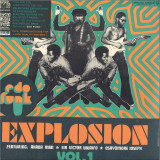
Analog Africa Presents Edo Funk Explosion Vol. 1, available on
2xLP/Gatefold LP with 20-page booklet / CD with 36-page booklet. It was
in Benin City, in the heart of Nigeria, that a new hybrid of intoxicating
highlife music known as Edo Funk was born.
It first emerged in the late 1970s when a group of musicians began to experiment with different ways of integrating elements from their native Edo culture
and fusing them with new sound effects coming from West Africa s night-clubs.
Unlike the rather polished 1980 s Nigerian disco productions coming out of the
international metropolis of Lagos Edo Funk was raw and reduced to its bare
minimum.
Someone was needed to channel this energy into a distinctive sound and Sir
Victor Uwaifo appeared like a mad professor with his Joromi studio. Uwaifo
took the skeletal structure of Edo music and relentless began fusing them with
synthesizers, electric guitars and 80 s effect racks which resulted in some of the
most outstanding Edo recordings ever made. An explosive spiced up brew with
an odd psychedelic note known as Edo Funk.
That’s the sound you’ll be discovering in the first volume of the Edo Funk Explosion series which focusses on the genre’s greatest originators; Osayomore
Joseph, Akaba Man, and Sir Victor Uwaifo: Osayomore Joseph was one of the
first musicians to bring the sound of the flute into the horn-dominated world
of highlife, and his skills as a performer made him a fixture on the Lagos scene.
When he returned to settle in Benin City in the mid 1970s - at the invitation of
the royal family - he devoted himself to the modernisation and electrification
of Edo music, using funk and Afro-beat as the building blocks for songs that
weren’t afraid to call out government corruption or confront the dark legacy of
Nigeria’s colonial past.
Akaba Man was the philosopher king of Edo funk. Less overtly political than Osayomore Joseph and less psychedelic than Victor Uwaifo, he found the perfect
medium for his message in the trance-like grooves of Edo funk. With pulsating
rhythms awash in cosmic synth-fields and lyrics that express a deep personal
vision, he found great success at the dawn of the 1980s as one of Benin City’s
most persuasive ambassadors of funky highlife.
Victor Uwaifo was already a star in Nigeria when he built the legendary Joromi
studios in his hometown of Benin City in 1978. Using his unique guitar style as
the mediating force between West-African highlife and the traditional rhythms
and melodies of Edo music, he had scored several hits in the early seventies,
but once he had his own sixteen-track facility he was able to pursue his obsession with the synesthetic possibilities of pure sound, adding squelchy synths,
swirling organs and studio effects to hypnotic basslines and raw grooves. Between his own records and his production for other musicians, he quickly established himself as the godfather of Edo funk.
What unites these diverse musicians is their ability to strip funk down to its
primal essence and use it as the foundation for their own excursions inward to
the heart of Edo culture and outward to the furthest limits of sonic alchemy.
The twelve tracks on Edo Funk Explosion Volume 1 pulse with raw inspiration,
mixing highlife horns, driving rhythms, day-glo keyboards and tripped-out guitars into a funk experience unlike any other.