Cerca:nature born

Generi
Tutto
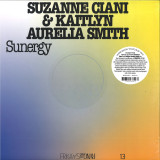
Kaitlyn Aurelia Smith & Suzanne Ciani - Frkwys Vol. 13: Sunergy

Sunergy brings together synthesists Kaitlyn Aurelia Smith and Suzanne Ciani for the thirteenth installment of FRKWYS, RVNG Intl.'s intergenerational collaboration series. For this edition, a panorama of the Pacific Coast provides the place and head space for a musical appreciation and consideration of a life-giving form vast and volatile with change. Fortuitously (as is the freaky way), Smith and Ciani were discovered to be neighbors in the small coastal community of Bolinas, California. The two had become close friends, bonding over their experience as woman musicians and, more unusually, their shared passion for the Buchla synthesizer. The music of Sunergy embraces this kinship, with Ciani and Smith respectively performing on the Buchla 200 E and the Buchla Music Easel, two modern configurations of the innovative instrument developed in the '60s by Don Buchla.
Sunergy was recorded in the Bolinas home where Ciani has lived for the last twenty-four years. Her living room overlooks the Pacific Ocean from a cliffside perch, creating an idyllic, inspired setting for music making. Setting up their synths side-by-side, Ciani and Smith took turns keeping time and freely improvising for the album sessions. As a complete piece, Sunergy is shaped by slow, pulsing forms and sinuous, melodic sequences that conjure both an oceanic world and the unlimited sound made possible by modular processing.For her part, Ciani has long been a Buchla voyager. Suzanne proselytized the potential of Don's synthesizer instruments in the '60s and '70s, performing her own compositions before introducing synthesized jingles and sound effects to household audiences. Ciani then achieved wide recognition for her debut album Seven Waves, a collection of colorful, classical song-like melodies fluidly working with harmonic textures and sounds of the ocean shore. Since its 1982 release, Seven Waves has become an important chapter of the ambient canon within which contemporary artists like Smith have developed their own synth syntax. Smith was born just a few years after the appearance of Seven Waves, growing up in Orcas Island, Washington. A place of profound natural beauty, the islands would inform Tides, her first instrumental collection from 2014. Smith composed Tides as an accompaniment for Yoga classes, ultimately freeing her from conventional songwriting into the exploratory, synth-based compositions demonstrated in ecstatic variety on 2016's Ears. Despite the serene setting where Sunergy was realized, the album does not romanticize a complete oneness with nature. Smith and Ciani use their collaborative ground to reflect on the unstable forces at play across the Bolinas horizon. Sunergy takes stock of Bolinas in the 21st century, a once-thriving artist's refuge now vulnerable to real estate pressure extending from affluent San Francisco, and more irreparably, the specter of climate change erasing its many waterfront habitats.
A diametric dynamic is present in Sunergy, a somber meditation amidst the intense cultural and solar forces transforming the landscape, and a hopeful assertion of the surviving creative culture of Bolinas. Far from rehashing the gentle grace of the artists' seminal works, Sunergy instead seeks to awaken and bear witness, employing the Buchla waveforms to mirror the infinite rhythms of the ocean and our essential relationship to it.
Kaitlyn Aurelia Smith and Suzanne Ciani's Sunergy will be released on September 16, 2016 on LP, CD, and digital formats. An accompanying documentary by Sean Hellfritsch will be offered in tandem.

non in magazzino

Ordina ora e ordineremo l'articolo per te presso il nostro fornitore.

28,53

Last In: 3 years ago

TENO AFRIKA - AMAPIANO SELECTIONS

South Africa's reputation for expanding dance music again with Amapiano.
The past five years have seen amapiano, South Africa’s electronic music movement born in the townships of the country’s Gauteng province, evolve from an underground sound to a nationwide mainstream staple. Even with its commercial success though, amapiano’s DIY ethos has continued to disrupt music creation and distribution in the country. Most amapiano commercial successes today began their careers on cracked versions of production software like FL Studio, distributed their work through file sharing platforms like datafilehost and marketed it using social media pages they controlled and influenced. Amapiano Selections, the debut album by DJ and producer Teno Afrika, gives listeners outside the movement’s online release economy an insight into the high-burn nature of amapiano that has spawned a distinct typology under its larger umbrella. Twenty-one-year-old Lutendo Raduvha has spent the bulk of his life moving between different townships on the outskirts of Johannesburg and Pretoria in the Gauteng province. The palette of amapiano styles on the album reflect these influences.

But at first, South Africa’s youngest electronic music movement lived underground with a small, loyal following. “Amapiano is a genre that I chose because I have a passion for it,” says Teno “I started following amapiano in 2016 because I wanted to explore how it’s produced. It was not taken seriously in our country.” Interestingly, Teno Africa only gives vocals prominence on the closing track “Chants of Africa.” As a way of making their music recognizable and relatable for broadcast, amapiano producers have sometimes overly relied on vocals in the form of singing, catch-phrases and party refrains for the purpose. “It was my decision not to use vocals on this project,” says Teno “The reason is I wanted people to feel my instrumentals and style because this is my first album.” On his closing track the young producer gives a glimpse of the considered approach to music which buoys anticipation for greater things from his future releases.

non in magazzino

Ordina ora e ordineremo l'articolo per te presso il nostro fornitore.

20,46

Last In: 3 years ago

Later - Walking on the Line

Later

Walking on the Line

12inchCOOKIE002LP
Cookie Records
17.03.2023

Born in the privacy of their studio on the outskirts of Paris, the album “Walking on the line” is the product of 2 years of composition. While the group's first 2 EPs invited you to daydream away from the daily hustle and bustle, the album 'Walking on the line' presents itself as a celebration of the instability of life. This new disc reflects the magnificently winding path we all travel: from the violent return to reality with the opening track 'Back to Heaven' through the multiple tumults of the stories of passion 'Woman', chaos 'Eye of the Storm', of loneliness 'When She's Gone' to end up finding peace through the contemplation of nature with 'Lemon Trees'.

pre-ordina ora17.03.2023

dovrebbe essere pubblicato su 17.03.2023

20,88
Bai Kamara Jr. & The Voodoo Sniffers - Traveling Medicine Man LP

Three years after the release of his critically acclaimed album "Salone",
Bai Kamara Jr returns with "Traveling Medicine Man", a 13-track
collection of blues songs portrayed in Bai's unique style
In a descriptive, provocative and sometimes suggestive way, the tales of love, life,
relationships, politics and innuendo are meticulously explored by the
raconteur.''Traveling Medicine Man is the continuation of my introspective journey
through my roots and my perpetual quest to make my two homes, Africa and
Europe, coexist within me. The title was inspired by my maternal grandfather
Tinka Tanner Kargbo, born in 1901 in the Northern Province of Sierra Leone. He
was educated by the Wesleyan Missionaries and later traveled with them across
the country to help provide medical care to villagers and townspeople. I was
fortunate enough to have spent some time with my grandfather when I was still a
child, and one of the things that fascinated me the most about him was his ability
to reconcile his Christian beliefs with his traditional African beliefs and
customs.'' (Bai Kamara Jr)For the making of this album Bai brought his touring
band, The Voodoo Sniffers, into the studio; these exceptional musicians
contributed to Bai's unique and evolving sound. With a percussive nature at the
heart of the arrangements this rootsy blues is spiced up with an afro vibe, making
you want to get up and dance more often than not. May your listening experience
be soothing and pleasurable with a healing effect

pre-ordina ora10.03.2023

dovrebbe essere pubblicato su 10.03.2023

30,04
Hanakiv - Goodbyes LP

Hanakiv

Goodbyes LP

12inchGONDLP058LE
Gondwana Records
08.03.2023

Gondwana Records announces 'Goodbyes' the debut album from Estonian pianist and composer, Hanakiv, a deeply beautiful, meditative piano album featuring special guest Alabaster dePlume

"This is an album about healing. It is about saying your goodbyes to everything that doesn't serve you anymore. Each of these songs has a little goodbye in it. So, these are very beautiful and necessary goodbyes".

Hanakiv is a young composer and musician from Estonia (now based in London) who creates meditative piano-based ambient music with elements from classical and electronic music. 'Goodbyes' is her debut recording and draws on influences as diverse as Tim Hecker, Björk "Vespertine", Kara-Lis Coverdale, Arvo Pärt, Erkki-Sven Tüür and Aphex Twin as well as her own cultural heritage. Music has an important part in Estonian culture, especially choir music and its traditions, but Hanakiv also draws on her love of nature – the beautiful Estonian seaside and forests - and on her time in Iceland. However, it was moving to London that gave her the freedom to make her own music: "London gave me the freedom and courage to really be who I am (as a person and musically)" and her heritage and her new home both offer inspiration to Goodbyes, as Hanakiv moves between these two opposite places, a bustling metropolis and a small country full of nature, drawing inspiration from both as she sculpts her own voice.

Hanakiv had an unconventional music education – she started studying music at a school for handbells when she was nine and was part of a handbell ensemble for eight years. Starting on piano at the same time she went on to study composition at high school, and later at the Estonian Academy of Music. Eventually switching to electroacoustic composition, she studied in Reykjavik, and did internships in Malmö, and again Reykjavik before moving to London. She grew up in a musical family and her grandmother was a piano teacher and choir conductor.

"I would always ask her to take me to her choir rehearsals. I remember sitting under the grand piano, listening to the choir and just being mesmerised by the sounds. She also teaches in a local music school in the south of Estonia with about ten pianos, and I'd spend a lot of time there as well. I believe this was the starting point for me to get to where I am now. The last two pieces on the album (Home II and Home I) are composed in this same music school, so it feels like a full circle.

An early influence was Regina Spektor "the first artist who made me really want to play piano" alongside dream pop and Sigur Rós' as well as Estonian contemporary composers such as Erkki-Sven Tüür and Arvo Pärt. Later her studies took her to Reykjavík: "There is this amazing record shop called 12 Tónar in Reykjavik where you can drink espressos and listen to all their vinyls. I spent quite a lot of time there. There is something about Icelandic music that really excited me (the mixture of contemporary electronic sounds with melancholy, emotionality). This is when I started getting more into electronic music, and experimenting outside of classical music". Following a year long break from studying and inspired by making an electroacoustic soundtrack for a friend's abstract video, she was inspired to complete a masters in electroacoustic composition, diving fully into the worlds of sound recording and mixing and focusing on surround sound and how to position and move sounds in space, eventually doing an internship with composer Kent Olofson in Malmö, who works with multi-speaker systems for theatre productions. "I learnt a lot from him and he introduced me to some of my favourite plugins I've used a lot on this album as well."

Hanakiv moved to London just as the pandemic hit and found herself trapped, in a big new city, without any network or family and so just concentrated on making music. "I stayed in my room with my basic equipment - keyboard, Korg minilogue, SM 58 and Rode nt1-a microphones, laptop and speakers. I was reading about mixing, and trying out different things and listening to a lot of music to get the sense of the mixes and production and finishing a commission piece for 5.1 multi speaker system at that time so I set up four speakers for quadrophonic surround sound in my room!". She also found her way back to piano - my instrument – and started practicing again, playing the pieces she used to play, but also just improvising, and this was the beginning of what would become her debut album, 'Goodbyes'.

"I started appreciating everything about music again (even melody!), and everything just came together naturally, and I arrived to a point where I finally found my voice, and I had something that I wanted to say and share. I composed "Meditation I" first and started with "Goodbye", and all the other pieces are derived from that. Without "Meditation I" there wouldn't be this album. If you listen closely, "Meditation I" starts where "Goodbye" ends; "Meditation II" is born from "Meditation I".

But it was meeting Fi Roberts, a sound engineer based at the legendary Strongrom Studios in Shoreditch, London in December 2020 that really brought the album into focus. The pair bonded over an interest in prepared piano and a similar approach to production ideas (a balance of not overdoing it, and letting the songs speak for themselves, but being open to explore) and Fi became a friend but also a confidant and eventually co-producer

"Fi has a big impact on this record but I don't know how to really explain that properly. Of course, this album is sonically stunning thanks to her amazing mixes and recording skills, but she also believed in this music so much and it created something very special - that's difficult to measure with words. She just works with heart, and I really appreciate that"

This then is 'Goodbyes', the first offering from a major new voice, who offers us a meditative work full of space and tranquillity but also life and friendship and meaning. And we are very proud to welcome her to the Gondwana family.

non in magazzino

Ordina ora e ordineremo l'articolo per te presso il nostro fornitore.

22,48

Last In: 3 years ago
Anne Bisson - Be My Lover

Anne Bisson

Be My Lover

2x12inchCAMLP5287-45
IMPEX Records
27.02.2023

Anne's 7th Opus in 13 Years, Containing 6 Fantastic Covers and 6 of Her Own Songs, Recorded in One of the Most Prestigious Studios in Montreal with Her Original Blue Mind Team

Fresh from the success of her single "Killing Me Softly" from her previous album Keys to My Heart, Anne Bisson, singer-songwriter and jazz pianist, decided to perform and record more standards from the American jazz songbook, as well as new arrangements of classic songs that were so much a part of her teenage years.

Be My Lover, Anne's seventh album is, therefore, a savoury feast of original compositions and classic songs in her own bold new arrangements for acoustic trio. While still in the 'Smooth Jazz' genre, the presence of a Fender Rhodes, the legendary '70s keyboard, along with an electric bass, impart the album with quite a unique tone.

After over 18 months of musical experimentation and other creative endeavours, Anne once again brought together master drummer Paul Brochu (Gino Vanelli, Michel Legrand, UZEB) and proficient bassist Jean-Bertrand Carbou from France, for a series of informal sessions to explore the songs that were being considered for this seventh release.

These two musicians have been valuable collaborators for several years now. Paul has been featured on many of Anne's albums, notably Blue Mind, which made a huge splash when it appeared, with over 35,000 hard copies sold, while Jean-Bertrand's playing has also graced several of her albums.

Since 2009, the three have performed at several important venues, including Le Festival International de Jazz de Montréal, as well as other festivals in the United States and Mexico.

What holds them together is an evident complicity which is present from the very first notes. Their musical contributions are precise and deeply heart-felt. Their virtuoso playing greatly enhances these songs without turning them into mere technical exercises.

With precision playing, subtlety and attention to detail, as well as being recorded in impeccable High Definition, these songs will definitely please Anne's audiophile fans, while also appealing to a wider audience.


All About Ultimate High Quality CD (UHQCD)
Many years have passed since the birth of the Audio Compact Disc (CD) back in 1982. By use of High-Quality materials and a totally different manufacturing method, the definitive version of audiophile audio CD was born. Playable on any CD player, the Ultimate High Quality CD greatly surpasses all previous CDs before it!

The Ultimate High Quality CD (UHQCD):
UHQCD is a radical change to the CD manufacturing process itself. The conventional wisdom about CD manufacturing, which had remained largely unchanged across the world for over 30 years, has been exhaustively questioned. Through this effort, the ultimate in quality was attained - a level of quality that is certainly impossible to achieve with existing CD discs.

The Ultimate High Quality CD was developed through an effort to improve audio quality by simply upgrading the materials used in ordinary CDs to higher quality materials. For the substrate a high-transparency and high-fluidity polycarbonate (a type of plastic) of the type used for LCD panels was used, while for the reflective layer, low-cost, common aluminium was replaced with a unique and expensive alloy of high-reflectivity.

Differences in manufacturing methods:
Conventional CDs are produced using the technique of injection moulding to form "pits" of data on polycarbonate material. Metal plate on which "pits" representing audio source data are formed is used as a die. This is called the "stamper." Polycarbonate is melted at high temperature and poured into the die to duplicate the pit patterns on the stamper.

This method is efficient because it enables high-speed production, but it does not enable totally accurate or complete duplication of the pits on the stamper. As a melted plastic, polycarbonate is inevitably viscous, so it cannot penetrate completely into every land and groove of the tiny pits of the stamper.

The Ultimate High Quality CD photopolymer is used instead of polycarbonate to replicate the pits of the stamper. In their normal state, photopolymers are liquids, but one of their characteristic properties is that they harden when exposed to light of certain wavelengths. The advantage of this property, perfect replication of very finely detailed pits was achieved. Photopolymers in the liquid state are able to penetrate into the tiniest corners of pits on the stamper so that the pattern of the pits is reproduced to an extremely high level of accuracy. The Ultimate High Quality CD reproduces audio with greater precision and at a level that is impossible to achieve using conventional CD production technology!

pre-ordina ora27.02.2023

dovrebbe essere pubblicato su 27.02.2023

111,30
BIG|BRAVE - Nature Morte

Big|Brave

Nature Morte

12inchTHRILL5801
Thrill Jockey
24.02.2023

The title, nature morte, is the French term for still life paintings whose literal translation is "dead nature." BIG|BRAVE color the songs of nature morte with unease, creating an air of beauty in decay, chords suspended in contemplative stillness. Robin Wattie"s experiences structuring lyrics and song forms on The Body & BIG|BRAVE"s Leaving None But Small Birds informed her work on nature morte, creating stories that, like many folk tales, are at once specific and universal. Wattie"s voice manages to be commanding and vulnerable with impressive range and intimacy. Even her gasps carve their way through the tidal crash of Mathieu Ball"s distortion wail and the pummel of Tasy Hudson"s drums. The momentum of nature morte conjures the image of a beast collapsing beneath its own weight before resiliently staggering upright to thunder onward. BIG|BRAVE convey heft from silence as deftly as they do from swaths of feedback and distortion to cathartic ends. "Distortion is key," notes Ball The three members recorded primarily live over the course of a week at Machines with Magnets with Seth Manchester, pushing the potential of their instruments beyond expectations. For each song, the trio"s songwriting and attention to detail deliver its simple but devastating emotional power. Across the album"s six pieces BIG|BRAVE create a tension between immediacy and patience, invoking the essence of disquiet, while conveying anguish through inventive arrangements and nuanced performances. nature morte captures BIG|BRAVE at their heaviest and their mournful fury is at its zenith, an album where each moment is so immense and consuming that it possesses its own gravitational pull.

pre-ordina ora24.02.2023

dovrebbe essere pubblicato su 24.02.2023

29,79
BIG|BRAVE - Nature Morte Limited Lavender Color Vinyl

The title, nature morte, is the French term for still life paintings whose literal translation is "dead nature." BIG|BRAVE color the songs of nature morte with unease, creating an air of beauty in decay, chords suspended in contemplative stillness. Robin Wattie"s experiences structuring lyrics and song forms on The Body & BIG|BRAVE"s Leaving None But Small Birds informed her work on nature morte, creating stories that, like many folk tales, are at once specific and universal. Wattie"s voice manages to be commanding and vulnerable with impressive range and intimacy. Even her gasps carve their way through the tidal crash of Mathieu Ball"s distortion wail and the pummel of Tasy Hudson"s drums. The momentum of nature morte conjures the image of a beast collapsing beneath its own weight before resiliently staggering upright to thunder onward. BIG|BRAVE convey heft from silence as deftly as they do from swaths of feedback and distortion to cathartic ends. "Distortion is key," notes Ball The three members recorded primarily live over the course of a week at Machines with Magnets with Seth Manchester, pushing the potential of their instruments beyond expectations. For each song, the trio"s songwriting and attention to detail deliver its simple but devastating emotional power. Across the album"s six pieces BIG|BRAVE create a tension between immediacy and patience, invoking the essence of disquiet, while conveying anguish through inventive arrangements and nuanced performances. nature morte captures BIG|BRAVE at their heaviest and their mournful fury is at its zenith, an album where each moment is so immense and consuming that it possesses its own gravitational pull.

pre-ordina ora24.02.2023

dovrebbe essere pubblicato su 24.02.2023

32,40
Jaimee Harris - Boomerang Town

Sophomore album from the singer who NPR are calling "the Next Queen Of Americana Folk." Boomerang Town marks a bold step forward for this country-folk-leaning singer-songwriter. It is an arresting, ambitious song-cycle that explores the generational arc of family, the stranglehold of addiction, and the fragile ties that bind us together as Americans. This is a record that understands that love and grief are two sides of the same coin. Jaimee Harris turned 30 during the pandemic. It’s a milestone that is a rite of passage even during normal times. But for this Texas-born singer-songwriter, it came in the midst of one of the strangest and most tumultuous periods in American history. When the world stopped during lockdown, Harris, like many others, found herself gazing back into the past, ruminating on the nature of her hometown and family origins, and reckoning with their imprint on her. The term ‘nostalgia’ derives from the Greek words nostos (return) and algos (pain), and if Harris’s Boomerang Town can be regarded as a nostalgic album, it is only nostalgic in the sense that the longing for home is a desire to return to the past and heal old wounds. For Harris, the album began gestating around 2016, a time of great loss for many in the Americana community, with the songwriter losing several musicians close to her. The shift in the nation’s political landscape had ushered in a new level of polarization that saw whole swaths of cultural life being demonized. For someone who grew up in a small town outside of Waco, Harris believed the values instilled in her by her parents were not entirely in line with how many on the left were viewing — and vilifying — Christians, citing them as responsible for the new change in leadership. As a person in recovery, Harris has had to re-evaluate her own connection to faith and find strength in a higher power (“Though he’s not necessarily a blue-eyed Jesus,” she laughs), though she certainly knows what it’s like to “be told how to vote” in a Southern church setting. It was from the intersection of these social, personal, and political currents the album was born. And while much of the material on Boomerang Town was inspired by personal experience, the songs on this collection are far from autobiographical xeroxed copies. More than anything, they come from a place of emotional truth. “My goal is to just write the best possible song I can write,” Harris says, “and I wanted to have ten songs that made sense together sonically.

pre-ordina ora17.02.2023

dovrebbe essere pubblicato su 17.02.2023

26,68
Otto Sidharta - Kajang

Otto Sidharta

Kajang

12inchSR532V
Sub Rosa
17.02.2023

Unreleased before music by Otto Sidharta, pioneer of Indonesian electronic music. Inspired by Indonesia's multifarious styles of traditional music, that he tries to preserve, the four pieces on Kajang express a contemplation of the self.

Otto Sidharta loves to travel, everywhere within Indonesia, in order to collect almost any environmental tones and harmonies he can gather, as an endless source of composition. He is also deeply inspired by Indonesia's multifarious styles of traditional music, that he tries to preserve, as in some remote places, they keep their own tradition very strongly.

What really interests Sidharta is musicians not interacting with other kinds of music, as in those deep villages, where one might find sounds that feel like very "natural". It results in works expressing Sidharta's personal impression from their music: "I just use my own feeling, with no calculation", not using the tribals motif or style.

Kajang is the name of a tribal people living in the south of Sulawesi, a giant island in eastern Indonesia, a closed community, that Sidharta visited twice: "They cut off their communication with the outside world. They live in a very traditional way and try to avoid any new development in culture that might impact their way of life."

Sidharta's previous album collected early pieces under the title Indonesian Electronic Music 1979-92, released on Sub Rosa in 2017. Kajang gathers a quartet of compositions from 2015 to 2020.

Otto Sidharta is born in Bandung, Indonesia November 6, 1955. In the late 1970' he studied first in Jakarta, under guidance of Slamet Abdul Sjukur, later at the Sweelinck Conservatorium in Holland. In 2015 he accomplished his doctoral study at Institute Seni Indonesia Surakarta and finished in 2016. For years he felt isolated as a composer, not only because of living in Indonesia, but because the nature of his music lay outside the mainstream of electronic composition. Until 2019 he taught for many years in the music departments of several Indonesian universities. He also managed an Indonesian symphony orchestra for five years, a job that included setting up a tour of Japan.

pre-ordina ora17.02.2023

dovrebbe essere pubblicato su 17.02.2023

18,07
Rudimentary Peni - Cacophony

Cacophony is the second Rudimentary Peni album. Released after the band returned from their first hiatus following a series of personal events that changed the band forever. The thirty track LP keeps turning heads 34 years after its release. Far from writing another “Death Church” the band embarked on a truly bizarre quest - to record an album based on the life and writings of horrors absolute king H.P. Lovecraft. A dense cacophony of total free songwriting. Dark, gothic, intricate, unexpected head-scratching punk. The short bursts of music twist and turn at every corner - the vocals are part classic Blinko and part spoken word, the guitar is full of distorted awkward tones and the very inventive bass and drums are locked together creating a truly unique album. Cacophony is the benchmark of outsider Punk and the influence and cult nature of this album grows with every passing year. This reissue stays close to the original version, with Nick Blinko’s incredible cover art, including a 11” x 11” 8-page lyric booklet.

pre-ordina ora27.01.2023

dovrebbe essere pubblicato su 27.01.2023

26,68
Rudimentary Peni - Cacophony

Rudimentary Peni

Cacophony

CassetteSEAL-020K7
Sealed Records
27.01.2023

Cacophony is the second Rudimentary Peni album. Released after the band returned from their first hiatus following a series of personal events that changed the band forever. The thirty track LP keeps turning heads 34 years after its release. Far from writing another “Death Church” the band embarked on a truly bizarre quest - to record an album based on the life and writings of horrors absolute king H.P. Lovecraft. A dense cacophony of total free songwriting. Dark, gothic, intricate, unexpected head-scratching punk. The short bursts of music twist and turn at every corner - the vocals are part classic Blinko and part spoken word, the guitar is full of distorted awkward tones and the very inventive bass and drums are locked together creating a truly unique album. Cacophony is the benchmark of outsider Punk and the influence and cult nature of this album grows with every passing year. This reissue stays close to the original version, with Nick Blinko’s incredible cover art, including a 11” x 11” 8-page lyric booklet.

pre-ordina ora27.01.2023

dovrebbe essere pubblicato su 27.01.2023

26,68
R.A. The Rugged Man - Die, Rugged Man, Die (Reissue) LP 2x12"

When R.A. The Rugged Man dropped his first album, it seemed like he'd been around for years...and, well, he had. The Rugged Man's storied background includes early 90s collaborations with legends like Mobb Deep and The Notorious B.I.G., plus a few epic appearances on the seminal "Soundbombing" compilations. But until this 2004 masterpiece, he had never released a proper album. Thankfully, R.A. delivered "Die, Rugged Man, Die", a defiant opus that kick-started his journey from industry outcast to independent hip-hop icon. Featuring the classic single "Chains", "Die, Rugged Man, Die" proved R.A. could deliver on a full-length album, and remains an impressive body of work. Now, the previously out-of-print collection is available again on vinyl, complete with new updated artwork. Despite the efforts of doubters, R.A. The Rugged Man lives.

pre-ordina ora20.01.2023

dovrebbe essere pubblicato su 20.01.2023

38,61
Britta Virves - Juniper

Britta Virves

Juniper

12inchLPHCR16
HEARTCORE
13.01.2023

Britta Virves is a pianist and composer born in Saaremaa, Estonia - Her
piano compositions are narratively clear and harmonically modern
meditations on the wonder of nature, ecological webs of interconnectedness, and the people and places she calls home

pre-ordina ora13.01.2023

dovrebbe essere pubblicato su 13.01.2023

30,04
ERNEST HOOD - BACK TO THE WOODLANDS LP

Written and recorded between 1972 and 1982 in Western Oregon, Back to the Woodlands is a previously unreleased, and nearly lost, album made by Ernest Hood during the same era as his near mythical album Neighborhoods . A visionary combination of field recordings, zithers, and synthesizers, Back to the Woodlands offers an unprecedented depth of access to this singular artistic mind. Born into a musical family, Ernest Hood began a promising career as a jazz guitarist during the 1940s, touring internationally with his brother Bill Hood and the saxophonist Charlie Barnet , before contracting polio in his late twenties. The disease left Ernest unable to play the guitar and confined him to a wheelchair for the rest of his life. It also forced him to adapt and innovate around his musical practices in the face of adversity; Hood's value of sound matured with a remarkably democratic and nonhierarchical approach and application. Taking up the zither, a less physically-demanding stringed instrument to the guitar, embarking upon the unprecedented process of incorporating field recordings into his work as early as 1956, and eventually discovering the synthesizer, Hood's music became imbued with optimism and subtle cultural critique. This ethos and technique - refined over the coming decades - would lay the groundwork for a sprawling body of radio work, mail order recordings for homebound listeners, and Neighborhoods , self- issued as a small vinyl edition in 1975. Where Neighborhoods , a nostalgic opus, drawing from a well of collective memory of the 1950s, is defined by traces of human activity, Back to the Woodlands leaves the modern world behind, delving into Hood's love for nature. Only recently discovered in his archives, the album dramatically expands his concept of "musical cinematography," imagistically triggering states of sensory memory from within its zither and synthesizer melodies, intertwined with field recordings made during Hood's extensive travels throughout Oregon. If Neighborhoods is a retreat into the gauzy joys of a romanticized past, Back to the Woodlands is an immersion in the timeless sanctuary of the natural world. A fascinating counterpoint to its predecessor, Back to the Woodlands brings us even closer to Hood's belief in the transportive qualities of sound; that field recordings could serve as a vehicle for the imagination and liberation, particularly for those with similar mobile disabilities as his own. Across the album's twelve compositions, the rippling instrumental harmonics - shifting between abstraction and playful melody - fold so seamlessly into the birdsong, bubbling brooks, and other environmental ambiences, that they often give the impression of having been recording within the landscapes toward which they whisper. Falling somewhere between the immersive calm of healing music and New Age, the creative field recording practices of sound ecologists world building for Folkways, and the jazz infected ambiences during Obscure / Editions EG's highest heights, Back to the Woodlands sculpts an singular proximity of music for its moment; a form of ambient sonic realism that draws the consciousness toward its surroundings as much as within. Working closely with his estate to maintain his original vision, Freedom to Spend has restored and remastered this never before released, lost masterpiece by Ernest Hood from the original tapes. Ernest Hood's Back to the Woodlands will be issued on vinyl, as well as on CD in combination with its contemporary Where the Woods Begin , with new liner notes by Michael Klausman . On behalf of Ernest Hood and Freedom To Spend, a portion of the proceeds from this release will benefit Oregon Wild, an organization dedicated to protecting and restoring Oregon's wildlands, wildlife, and waters as an enduring legacy for future generations.

non in magazzino

Ordina ora e ordineremo l'articolo per te presso il nostro fornitore.

22,48

Last In: 3 years ago
Ernest Hood - Neighborhoods

Ernest Hood’s Neighborhoods was released some two decades after the Portland, Oregon born and raised musician’s first forays into field recordings. These very recordings, and those captured over intervening years, define the universal sound and aural images of childhood, a theme memorialized by Hood’s privatelypressed opus of 1975.

Sprawling through a haze of zither, synthesizer melodies, and foraged pedestrian sound, Neighborhoods is both a score and documentary composed and directed by Hood to offer, in his words, joy in reminiscence. Hood’s nostalgic impulse ran parallel to the developments of other artists, writers, and filmmakers of the 1970s who were looking back to the 1950s to convey a collective memory of childhood. Unlike some of the widely embraced work of this nature, the music of Neighborhoods eschews irony or detachment for lucidity, striving above all for a dream-like return to the details of sensory memory.

Born into a musical lineage, Hood’s early, promising career as a guitarist in a globetrotting jazz outfit was cut short when he contracted polio in his late twenties. Moving from guitar to less physically-demanding stringed instruments in the late 1940s, Hood first began implementing field recordings in his jazz ensemble collaborations as early as 1956. In 1961, Hood and trumpeter Jim Smith collaborated on a local Portland television program, with their large, tight ensemble providing breakneck contemporary jazz for an action painting by famed West Coast modernist painter Louis Bunce. Hood incorporated his own field-recorded sounds of birds in the performance – an element that would resurface in Neighborhoods with great abundance among other found sounds.

non in magazzino

Ordina ora e ordineremo l'articolo per te presso il nostro fornitore.

28,53

Last In: 6 years ago
Akselsen/Carstensen/Kvernberg - Horta

Akselsen/Carstensen/Kvernberg

Horta

12inchHO7400
Heilo
25.11.2022

A slice of Norwegian cultural history in album form – a unique
interpretation of traditional Norwegian Travellers' songs.Elias Akselsen,
Ola Kvernberg and Stian Carstensen take us on a journey through
Norwegian music history
The album's title, "Horta", means "authentic" in the language of the Travellers,
Romani. Elias Akselsen (74) is a member of the oldest generation who knew and
can remember the "authentic" life of the Travellers, and is today one of the
foremost representatives of the musical heritage of the Norwegian Travellers/
Roma. He was born on the road and learned to play and sing the traditional songs
while gathered around the bonfire with his relatives. He has a deep and inborn
appreciation of these songs. Musician/producer Stian Carstensen and musician/
arranger Ola Kvernberg join him in raising these old songs to a new level. With the
addition of guest artists Anita Kleppe and Sara Wilhelmsen, three voices from
three generations of Travellers meet one another. Together they have recorded
their unique interpretations of nine Travellers' songs, some known and some
unfamiliar, with the aim of preserving and carrying on the rich, but partly hidden,
cultural heritage of the Travellers, and of making it more widely accessible.
The musical tradition of the Travellers is vivid and complex, featuring elements
from a variety of countries and cultures – from broadside ballads and folk songs
to Russian folk tunes and Balkan rhythms. In many ways this music bears
witness to the way the Travellers drew musical inspiration from their travels. In
addition to the treasure trove of songs the Travellers have kept alive, they have
also had a strong influence on Norwegian folk music. Many traditional fiddle
tunes that are well known today can be traced back to the Traveller fiddler FantKarl, and one of Norway's most famous fiddlers, Myllarguten, often learned tunes
from Travellers passing by.
This is the Norwegian equivalent of blues and soul, and has at least as much
authenticity as the American genres we know so well. But it belongs to us
Norwegians, and to the Norwegian landscape, nature and people. Today Akselsen
is the leading practitioner of the musical heritage of the Norwegian Travellers/
Roma. He was born on the road, with genuine Travellers on both sides of his
family; he was the great-grandchild of the "Traveller king" Stor-Johan on one side,
and of "sea vagabonds" in Bergen on the other. Today he is the last remaining
representative of the original song tradition, and also practises traditional
handicrafts, making knives and whisks.
The album was produced by Skøyerstaten Teater, a voluntary organisation that
works to present the cultural treasure trove of the Travellers/Roma in an artistic
form

pre-ordina ora25.11.2022

dovrebbe essere pubblicato su 25.11.2022

19,54
ADIEL & TAMBURI NERI - ARRESTO TEMPORANEO EP

Arresto Temporaneo was born very spontaneously as the natural continuation of a collaboration that has lasted for over a year with Tamburi Neri, Adiel and Danza Tribale.

It is pure magic when seemingly different worlds meet and create a dialogue which is the foundation of successfully bringing the creation of this record into fruition. The EP functions as the fusion between the past and the present of the musical experiences of all of us.

Arresto Temporaneo was born by cutting a text "Prepariamoci ad un arresto temporaneo" that the artists liked. The sentence is free to interpret as any of the listeners wish, there is a deliberate reason why the subjective interpretation is avoided.

The EP is filled with the voice and lyrics of A.B. The track "Silenzio" symbolises a moment with which all of us, in spite of ourselves, had to deal with, the deafening noise of silence that can sometimes be devastating and for this reason it is important to understand it and not be afraid of it when it resonates within us.

"Nella penombra" refers to something that moves inside us, not too deep but just important enough to understand, with sounds that nature emits at dawn, when the light still reigns in the dim light, we must learn to move with skills and lightness without harming ourselves and especially others.

non in magazzino

Ordina ora e ordineremo l'articolo per te presso il nostro fornitore.

10,88

Last In: 3 years ago
ERNEST HOOD - BACK TO THE WOODLANDS LP

Written and recorded between 1972 and 1982 in Western Oregon, Back to the Woodlands is a previously unreleased, and nearly lost, album made by Ernest Hood during the same era as his near mythical album Neighborhoods . A visionary combination of field recordings, zithers, and synthesizers, Back to the Woodlands offers an unprecedented depth of access to this singular artistic mind. Born into a musical family, Ernest Hood began a promising career as a jazz guitarist during the 1940s, touring internationally with his brother Bill Hood and the saxophonist Charlie Barnet , before contracting polio in his late twenties. The disease left Ernest unable to play the guitar and confined him to a wheelchair for the rest of his life. It also forced him to adapt and innovate around his musical practices in the face of adversity; Hood's value of sound matured with a remarkably democratic and nonhierarchical approach and application. Taking up the zither, a less physically-demanding stringed instrument to the guitar, embarking upon the unprecedented process of incorporating field recordings into his work as early as 1956, and eventually discovering the synthesizer, Hood's music became imbued with optimism and subtle cultural critique. This ethos and technique - refined over the coming decades - would lay the groundwork for a sprawling body of radio work, mail order recordings for homebound listeners, and Neighborhoods , self- issued as a small vinyl edition in 1975. Where Neighborhoods , a nostalgic opus, drawing from a well of collective memory of the 1950s, is defined by traces of human activity, Back to the Woodlands leaves the modern world behind, delving into Hood's love for nature. Only recently discovered in his archives, the album dramatically expands his concept of "musical cinematography," imagistically triggering states of sensory memory from within its zither and synthesizer melodies, intertwined with field recordings made during Hood's extensive travels throughout Oregon. If Neighborhoods is a retreat into the gauzy joys of a romanticized past, Back to the Woodlands is an immersion in the timeless sanctuary of the natural world. A fascinating counterpoint to its predecessor, Back to the Woodlands brings us even closer to Hood's belief in the transportive qualities of sound; that field recordings could serve as a vehicle for the imagination and liberation, particularly for those with similar mobile disabilities as his own. Across the album's twelve compositions, the rippling instrumental harmonics - shifting between abstraction and playful melody - fold so seamlessly into the birdsong, bubbling brooks, and other environmental ambiences, that they often give the impression of having been recording within the landscapes toward which they whisper. Falling somewhere between the immersive calm of healing music and New Age, the creative field recording practices of sound ecologists world building for Folkways, and the jazz infected ambiences during Obscure / Editions EG's highest heights, Back to the Woodlands sculpts an singular proximity of music for its moment; a form of ambient sonic realism that draws the consciousness toward its surroundings as much as within. Working closely with his estate to maintain his original vision, Freedom to Spend has restored and remastered this never before released, lost masterpiece by Ernest Hood from the original tapes. Ernest Hood's Back to the Woodlands will be issued on vinyl, as well as on CD in combination with its contemporary Where the Woods Begin , with new liner notes by Michael Klausman . On behalf of Ernest Hood and Freedom To Spend, a portion of the proceeds from this release will benefit Oregon Wild, an organization dedicated to protecting and restoring Oregon's wildlands, wildlife, and waters as an enduring legacy for future generations.

pre-ordina ora11.11.2022

dovrebbe essere pubblicato su 11.11.2022

22,48
Ernest Hood - Back to the Woodlands /& Where the Woods Begin

Written and recorded between 1972 and 1982 in Western Oregon, Back to the Woodlands is a previously unreleased, and nearly lost, album made by Ernest Hood during the same era as his near mythical album Neighborhoods. A visionary combination of field recordings, zithers, and synthesizers, Back to the Woodlands offers an unprecedented depth of access to this singular artistic mind.

Born into a musical family, Ernest Hood began a promising career as a jazz guitarist during the 1940s, touring internationally with his brother Bill Hood and the saxophonist Charlie Barnet, before contracting polio in his late twenties. The disease left Ernest unable to play the guitar and confined him to a wheelchair for the rest of his life. It also forced him to adapt and innovate around his musical practices in the face of adversity; Hood’s value of sound matured with a remarkably democratic and nonhierarchical approach and application.

Taking up the zither, a less physically-demanding stringed instrument to the guitar, embarking upon the unprecedented process of incorporating field recordings into his work as early as 1956, and eventually discovering the synthesizer, Hood’s music became imbued with optimism and subtle cultural critique. This ethos and technique - refined over the coming decades - would lay the groundwork for a sprawling body of radio work, mail order recordings for homebound listeners, and Neighborhoods, self-issued as a small vinyl edition in 1975.

Where Neighborhoods, a nostalgic opus, drawing from a well of collective memory of the 1950s, is defined by traces of human activity, Back to the Woodlands leaves the modern world behind, delving into Hood’s love for nature. Only recently discovered in his archives, the album dramatically expands his concept of “musical cinematography,” imagistically triggering states of sensory memory from within its zither and synthesizer melodies, intertwined with field recordings made during Hood’s extensive travels throughout Oregon. If Neighborhoods is a retreat into the gauzy joys of a romanticized past, Back to the Woodlands is an immersion in the timeless sanctuary of the natural world.

pre-ordina ora11.11.2022

dovrebbe essere pubblicato su 11.11.2022

24,33
Articoli per pagina:
N/ABPM
Vinyl
