Beyond the Bridge proudly presents the latest EP from Dutch sonic architect Spekki Webu, titled "Neural Network," set to release on April 15, 2025. As the founder of Mirror Zone, Webu masterfully conjures a spectral world where time collapses and frequencies bend, inviting listeners on a mind-expanding journey through sound. His ritualistic compositions transcend conventional boundaries, merging past, present, and future into a singular, fluid moment. The eight-track EP delves into an abstract landscape of high-intensity frequencies and textural flux. Webu's sonic manipulations challenge linearity, evoking cyclical movements that oscillate between chaos and order. Each track serves as a kinetic force, pulsating with raw energy and enveloping the listener in immersive sonic architecture. The release also features two transformative remixes from Beyond the Bridge label head K.O.P. 32 and acclaimed producer Feral, each expanding the boundaries of interpretation into new dimensions. credits releases April 15, 2025 All tracks written, produced, and mixed by Spekki Webu at Into The Unknown in The Hague. Additional production by Feral and K.O.P. 32. Mastering by K.O.P. 32 at Pacific Sound Network in Seoul. Visuals by Anton Braun. ? Beyond the Bridge 2025.
Cerca:neural network
- 1
On behalf of re:discovery records, it is with great excitement that we announce the 3rd and last EP of the set highlighting the music of 1990's Norwegian electronic act Neural Network. Part 3 hones in on their unreleased album that was never formely named. The band and those in the industry who heard it felt it was their best music yet. There were label suitors for this album including a top tier Belgian label but sadly things did not work out as that label folded. And this project was left on DAT's.
Of the 9 tracks we chose, there were 4 we felt would most fit the vinyl medium and the theme of the first 2 EP's. These fit in with music like B12, Stasis and As One for some lofty comparisons and we think it fit's perfectly in that esteem company. The Detroit-esque beautifully somber 'Lambent' sounds almost 'Tedra' like from Kenny Larkin. 'Jetstream' is pure melodic robotic funk from the future. The side B track 'Floatation' coming in at just over 18 minutes and is a prime example of the sci-fi music they so wonderfully produced. This 3 record series is a great example of re:discovery records' mission to present the past for the future. All feature amazing artwork from UK's Grid Pattern complete with insert that features info on the music and their history. Bring back the Chill Out Rooms!
On behalf of re:discovery records, it is with great excitement that we announce the 1st of a 3EP set highlighting the music on 1990's Norwegian electronic act Neural Network. In 1993-1995 they released 2 full albums or Origo Sound that featured label mates Biosphere. In 1993 they opened up for Prodigy and shared the bill with other seminal acts like AFX, Autechre, Orbital and H.I.A among other heavyweights. However, their 2 full albums 'Brain-State-In-A-Box' & 'Modernité' did not get picked up by any other label or distributer and their popularity stayed regional. In fact a 3rd album was never released (Until part 3 comes from this series!) and sadly they went their separate ways to form other electronic acts in 1997. We hope to shine a bright light on their early music. Side A features the wonderful aquatic adventure in 'Aqueous' followed by a shift into the sci-fi realm with the mysterious 'Mechanical Heart'. Two great examples that show off the group's deep post rave sound for the future. A real melding of styles. All 3 EP's have inserts where the band shares their memories of the early days.
All these tracks in the series are placed on vinyl for the first time with fantastic artwork by UK's Grid Pattern. Dare to Dream! Its not only our credo at re:discovery records but it's also our goal in hearing music that was made for the stars.
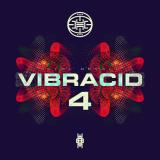
The Vibracid network reaches its fourth phase — the moment of awakening.
What was once hidden beneath layers of programming now resurfaces: the total recall of collective memory.
Encrypted memories from multiple worlds are decoded through sequences of electro-bass, acid warfare, and cinematic techno tension.
Six sound engineers from the Galactic Confederation synchronize their signals to reassemble what was erased — transmitting across psychic fields, dancefloors, and forgotten neural corridors.
Calagad 13 opens the operation with Mad Flava, pure raw energy — the ignition spark that reactivates the buried code.
5ZYL follows with To Your Knees, a dark and heavy descent into pressure and distortion.
Saigg brings the direct, high-voltage electro of Procesos Continuos, channeling precision and drive.
On the B-side, Lups Digga delivers Just Dance, a floor-oriented electro-bass detonator built for propulsion.
Roi expands the field with Despoiled — cinematic, tense and electrified, balancing techno discipline with emotional depth.
Finally, Cliff Dalton closes with Snowbirds, an introspective and elegant comedown: the calm after total awakening.
Mastered and crafted with precision for a strictly limited edition of 150 copies on purple vinyl.
In 2045, researchers at MindTech discovered an anomaly in neural networks used for direct data transmission into the human brain. They called this phenomenon “Phantom Scripts” — mysterious glitches in the code that activate when a person falls asleep or closes their eyes. Deprived of visual stimuli, the brain becomes more receptive and starts responding to internal impulses from the neuro-interface, generating unexpected images and phrases, as if creating messages from the void.
Analysis revealed that these scripts are particularly active during deep sleep or meditation, when the mind is most vulnerable to external influence, as though an intelligent force is attempting to communicate through the subconscious. What lies behind these messages and why they appear remains unknown. Perhaps the answers are hidden in the darkness itself.
- A1: Scattered Cipher
- A2: Divagation With Pavel Milyakov & Mizu
- A3: Take It All With Dorothy Carlos & Muein
- A4: Residue With Mizu
- A5: Greg's Thesis With Kevin Eichenberger
- B1: Chimera With Scott Li
- B2: Surrender Your Will With Mizu
- B3: Quake
- B4: Trace With Ryan Easter
- B5: Image / Player
- B6: Splinter With Sarilou & Aliya Ultan
H.D. Reliquary is the first eponymous release from Ben Shirken a.k.a. Ex Wiish, and finds him returning home to his own label, 29 Speedway. The songs sparked during sessions with close collaborators - across 11 pieces, artists such as Pavel Milyakov, MIZU, Dorothy Carlos, Kevin Eichenberger and Muein breathe personality into the record. H.D.R. coaxes beauty from a serrated, raw, yet subdued palette drawn from improvised recordings of trumpet, violin, upright bass, cello, and modular synthesis.
The title references the hard drive as a sacred container for relics, contemplating how digitally archived fragments of one’s existence can burn eternally after death. Archives, and in this case recordings, splinter and warp. Some distort what they contain. Some vanish, and others are eternally preserved, immune to deletion. Your information on these digital drives becomes archival shrapnel, the music that survives the remnants of collaboration. Pieces of recordings were fed into a series of proprietary neural networks, generating MIDI information and audio that reacted to on-the-fly soloing, imaginary sessions between players and algorithms invented posthumously (in post).
Shirken will release H.D. Reliquary alongside a sound installation on April 11. Where his prior work was geared towards dissociation, H.D. Reliquary invites us to contemplate how our tools for understanding and containing the world fundamentally alter our relationship with it. He has performed in spaces such as The New Museum, Pioneer Works, Public Records and Nowadays in New York City; Dripping Music And Arts Festival in New Jersey; La Station in Paris; and Cafe Oto in London.
After Prince Istari finished the Dub Encounter with Erik Satie, he
immediately set to work on expelling the evil curse of artificial intelligence. While the encounter with Satie was guided by the original
compositions, this album delves deeper into dub science.
The opening track is "Curse Of Machine Learning," a grinding cumbia dub track that sucks you into the curse of machine learning. It's followed by "Artificial Neural Network," arguably the album's most nerve-wracking track, with wild snare rolls colliding with offbeat echoed riddim sections. "Large Language Models" offers a more relaxed, arabesque one-drop riddim with speech synthesis vocals. "Fake Image" closes the first side with a full trombone solo contributed by Eugene Rosebud.
Side B starts with the one-drop killer tune "Haunted By Delusion,"
featuring an organ solo by Prince Istari. Drum and bass in your face.
"Evil Forces," on the other hand, is a fusion of jazz and dub; after the
brass section breakdown, it rolls into a crazy synth solo. Then next „I
Want Your Data" pulls your data into the AI's guts with a vibraphone.
This is maybe the ambitious tune on the record speaking of chord
progressions. The final track sees Eugene Rosebud return with a double trombone solo in "Transhuman Feedback Rock" assisted by a saz cooling the blues pattern with a hookline. Here we have beautifull springreverb and harmonizer dub effects on the snare twirrling around the trombone solos.
All tunes composed, arranged, conducted and engineered by Prince Istari and played by his house band The Virtualistics. Trombone Solos by Eugene Rosebud. Packaged in a nice cover drawn by Markus Schäfer and frequency shift and cut by LXC.
- A1: Ale Hop - Head Transplant
- A2: Daniela Huerta - Tza Tun Tzat
- A3: Debashis Sinha - For The Waters Ever Taste The Heavens Up Parts I-V
- B1: Hexorcismos - ¿Acaso De Veras Se Vive Con Raíz En La Tierra?
- B2: Hexorcismos & El Irreal Veintiuno - Interferencias
- B3: Jessika Khazrik - Gebera
- C1: Khyam Allami - Mix V6
- C2: Kloxii Li - Anhaga
- C3: Kmru - Hidden Options
- C4: Maf - What's Heard Once Entered (Nommo)
- D1: Portrait Xo - Mutualism_151122
- D2: Simina Oprescu - Granularities
- D3: Visions Of Lizard - Barranca Del Muerto
For the last seven years, sound artist, technologist, and electronic musician Moisés Horta Valenzuela (aka Hexorcismos) has been studying artificial intelligence and generative art, wondering how these new technologies might be augmented into his musical process. Born in Tijuana and currently based in Berlin, Hexorcismos has long attempted to break down the permeable borders between musical styles and expressions, using the spaces in between to reinforce his politics and worldview. And on 'MUTALISMX - becoming sonic network', he expands his vision, inviting artists from across the globe to collaborate on work that questions the biases inherent in AI models, offering a collective alternative that could serve as a blueprint for further research.
The majority of AI art at this stage works with "big data", taking ideas from the cultural canon and muddying them with our contemporary reality. But if we accept that mass culture is always politically biased, always swaying towards historical prejudices, then there must be a counter-narrative. Hexorcismos began to develop a bottom-up approach, using "small data" to interrogate his idiosyncratic approach to art; he built a tool called SEMILLA.AI based on neural audio synthesis that could not only mimic his sonic fingerprint but transform it into another. So when he offered the synth to his network of collaborators, he gave them the option of either using only their data or sharing the signatures of each other artist involved in the project, blurring their identities into a mutual voice.
The result is a compilation that unspools with the coherence and fluidity of a single-artist album or adventurous DJ mix, genreless and boundless but unified by a singular message. Hunanese-American artist Kloxii Li for example takes rugged percussion and tense, industrial ambience, smudging her soundscape into a swirling gust of ghostly dissonance. Hexorcismos himself contributes two compositions: the lengthy, hypnotic 'Acaso de veras se vive con raíz en la Tierra', an AI-powered scramble of his pointed tribal guarachero experiments; and 'Interferencias', a collaboration with Mexican club veteran Bryan Dálvez, aka El Irreal Veintiuno that drives intense dancefloor rhythms into a dense haze of frozen drones and radio static. Elsewhere, Berlin-based Lebanese artist and writer Jessika Khazrik dissolves her voice into a mesh of obscured rhythms and dissociated whirrs, blending the organic with the artificial but retaining an overpowering sense of humanity.
Some artists were drawn to the nebulous aspects of the technology, searching for truth in a soup of different sounds, while others, such as KMRU, used Hexorcismos's synthesizer the examine their output. On 'hidden options', the Kenyan sound artist fed his immense catalog into the neural net, bringing out his mannerisms and tendencies in the process. Each track is singular but myriad, prompting both mutual respect and a sonic becoming, a feedback process between the artist and the tool, the individual and the collective. Data sets are made by people, and by engaging directly with musicians, Hexorcismos suggests a new way of utilizing a technology demonized and glorified without careful examination. Each artist owns their AI model, and alongside the album Hexorcismos will release SEMILLA.AI to the public (with custom-made models to start the process), allowing anyone to access this revolutionary technology.
Even the album's artwork reflects the political message, conceptualized by Chilean duo hypereikon, who used AI processes to develop a visual reflection of the technology and its possibilities. Operating outside of academia and capitalist enterprises, MUTUALISMX proposes an alternative future - one without borders that's not beholden to the Western canon, where independent labor can be prioritized and celebrated, and where creativity can truly flourish.
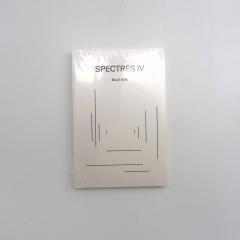
Fourth issue of Shelter Press' annual publication series »Spectres« (in association with INA GRM), this time themed around ›voice‹. Featuring contributions from/about François J. Bonnet, John Giorno, David Grubbs, Yannick Guédon, Lee Gamble, Sarah Hennies, Haela Ravenna Hunt-Hendrix, Stine Janvin, Joan La Barbara, Youmna Saba, Akira Sakata, Pierre Schaeffer, Peter Szendy and Ghédalia Tazartès.
The book includes an essay about the essence of improvisation by Joan La Barbara, Lee Gamble looking at neural networks and vocal simulation systems, an untitled anecdote from Ghédalia Tazartès (RIP) and Stine Janvin on the necessity of singing, plus much more.
»The voice is everywhere, infiltrating everything, making civilisation, marking out territories with infinite borders, spreading from the farthest reaches to the most intimate spaces. It can be neither reduced nor summarised. And accordingly, when taken as a theme, the voice is inexhaustible, even when seen in the light of its very particular relation with the sonic or the musical, as is the case in most of the texts collected in this volume. There is no point therefore in trying to circumscribe or amalgamate the multiple avatars of the voice. We must rather try to apprehend what the voice can do, to envisage its landscape, its potential effects.«
— Extract from the editors' foreword.
"There could barely be a better figurehead for Belgrade's simmering multi-limbed music scene than Jan Nemeèek" The Quietus `Dissolved', a new album by Serbian synthesist and sound designer Jan Nemeèek, began its life cycle in a studio live room. It unpacks the paradigm of the individualistic act of computer music creation, transporting it into the communal setting of a band, its performers contributing elements ranging from prepared piano to Turkish lyre. The album opens with an unexpected falter, a false start that imbues the album with a sense of vulnerability. It's as if the album itself is finding its footing, mirroring the dissonance of an orchestra tuning. This digital ensemble, an assembly of electronic voices, seems to search for its harmony, its discord, its pitch, its timbre - much like a traditional counterpart would. As it unfolds, `Dissolved' further taps into the raw tonalities of partially defunct digital synthesizers, ranging from early 2000s' attempts at neural networks to precursors of oscillator-laden software synthesizers, in order to build its cloud of suspended tension and alternate histories. Through this clash of wistful piano and biting frost of digital pads with the iridescent hum of tube amps, the album reflects New Age tropes through the prism of metal (machine) music. Hailing from Belgrade, Serbia, Jan Nemeèek has been releasing electronic music since 2005, with a particular focus on ambient and bass-heavy electronic compositions. Nemeèek's music is characterized by his use of a wide range of sound generating tools, including neural networks, analog synthesizers, and granular synthesis. His approach to music production allows his work to unfold with patience, influenced by borderline dub sub-bass movements and heavily based on deconstructed recordings. Jan has released several albums, most notably 2014's Fragmented and later Recurrences. Prior to that, he co-founded the Creative Commons-based net label Norbu. `Dissolved' is set to be released on vinyl and digital on 10th November 2023 via Refractions, a new imprint founded by Nemeèek.
ele
This mini album was originally published on Semantica Records in 2010 as a extremely limited 100 copy only reference. 12 years later we recover this for the Drivecom’s catalogue and fans of the label. This is a re-press edition with a new mastering and cutting, focused in the audio quality more than trying to get a maximum volume or gain. So this is one of the reasons that the side A cutting is trying to keep the tracks in the outside area of the vinyl in the most possible way, trying to avoid distortions or other artifacts from the inner vinyl curvature.
This 12” contains the same tracks on vinyl as the original edition but a couple of bonuses as a digital download. Those tracks called "Axonal Destruction (1999 Rework)" and "Automatic Reconstruction" were never released.
Note: For the people who purchase a physical copy in the shops, please take a picture of your purchase and share it on social networks, then we’ll send you a special download code.
In the musical eld, this reference was introduced with minimal and repetitive mental synth lines, mainly triggered from TB303 sequenced lines as the vertebral spinae, slow and progressive cadence rhythms with a touch of experimental electro and vocoders on board, exception is the rst tittle “Ultralink” which gives the name to the reference and it’s also the most club-oriented track in the mini album. About the thematic is all surrounded of such as mental driving musical lines so all the tittles were focused in the neuroscience
Born from ten-hour jam sessions in peeling Brighton bedsits, the
technical parameters of a bootstrap recording process and the osmotic, multi-genre influence of internet music archives, quintet Ebi Soda have been steady-cultivating a unique sound amidst the exploding UK jazz scene.
Despite their steep rise – the Brighton outfit have preserved as much as possible of their unique recording process, originating from their very first sessions. With just a two- track recorder around, the band would lay down whole takes, one instrument at a time, then immediately transform the overdub, digitally reshaping the sound with the same mischievous, adderall energy as the musical performance.‘Honk If You’re Sad’, their sophomore full-length album, stays true to these foundations, while bringing more ambitious experimentation, technical mastery and a stellar lineup of guest players to the studio including Yazz Ahmed, Deji Ijishakin and Dan Gray.In typical Ebi style, while recalling jazz pioneers in playing style, ‘Honk If You’re Sad’ draws from a vast neural network of influences:
the Ebi Brain has been marinating in a digital soup of trap, drill, dub, post-punk and no wave to name but a few. The result is a mercurial record that beams in psychedelia, dissonance, serene ambient passages, tough, neck-snapping beats and lush textures, all underscored by the intersection of jazz, hip hop and electronic music.
With the new SERWED III on Flaty's promising ANWO RECORDS, Flaty and OL set out to explore and celebrate the altered visions of today's mundane futurism with a kind of keen aesthetic intuition that could only be enabled by the vast volume of their listening, production, and teaching experience.
Following the first two SERWED albums on Asyncro and West Mineral Ltd., the current fruits of the flourishing long-time collaboration between OL and Flaty comprise an oddly coherent kaleidoscopic set of free-wheeling journeys across varied pseudo-desolate soundscapes full of anomalies and sometimes thrills. Beyond the now seamless blending of the artists' individual styles, a whole bunch of other boundaries get blurred on the record, whether it be between the human and computer data processing algorithms, originality and referentiality, anxiety and euphoria, signal and noise.
SERWED III postmodern world is the one where the orbital space is just another littered parking lot, neural networks are appreciated mostly as a source of absurd imagery, and delivery drones are used as designer drug mules. The sonic collection is fittingly complemented by the visuals based on Regula Bochsler's The Rendering Eye, an art project capturing the "erroneous" yet "picturesque" renderings found in the 3D world of Apple Maps.
► One half of duo Lumisokea and persistent sonic explorer ANDREA TAEGGI (Opal Tapes, SM-LL, Type, Präsens Editionen) debuts on OOH-sounds with a new solo album under-the-influence of mushrooms.
► Recorded at Willem-Twee synthesis studios in Holland, Mycorrhiza is a lucid excursion into a new form of 'ritual-computer-music' — gamelan from the future.
►Master + Cut by Helmut Erler, D&M Berlin. Limited Edition of 200, 12" black vinyl housed in gold cardboard sleeve with 'ad-hoc' fluo sticker.
Of course this is not the first album born under-the-influence of mushrooms, but apparentlyTaeggi doesn't take them here as he rather observes the cognitive and intelligent behavior of mycorrhizal fungal roots—one of the great mysteries inhabiting the forest soil, and from which a network of beneficial underground relationships with plants sprouts. Known as Mycelium, this fascinating wood-wide-web very much resembles the intricacy of the human neural system—transporting carbon, water and nutrients from one tree to another. A mutualistic symbiosis that Taeggi similarly establishes with the rather rare arsenal of sound machineries he had access to at Willem-Twee synthesis studios in Holland—a center for experimentation inspired by Berio and Maderna's Studio di Fonologia RAI in 1950s Milan.
In the process of tweaking and feeding electric impulses and sound signals into instruments of the likes of the iconic ARP 2500/2600 and a number of testing/measuring units from the 50/60s—originallynot conceived as musical instruments—Taeggi engages into an exchange of nutrients and information, while abruptly sabotaging un-welcome elements, hence accelerating the sound superhighway towards spectral psychedelic tension—a process he seems to be extremely in control of. Taking a step aside from his usual minimal approach to address more complex structures and augmented mind-sets, Mycorrhiza sounds at times like gamelan from the future: a lucid excursion into a form of "ritual-computer-music" with a conspicuous penchant for detail,alluding to a continuitybetween pseudo-cerimonial and laboratory-like computer music, steering clear from any reference to a specific creed or religion—imagine Stockhausen drinking the Amazonian sacred brew Ayahuasca..
The swarming micro-movements of "Cuttleburrs" multiply in a series of crescendos marked by sudden falls, saturated drums incursions and tense sonic clusters, introducing the more explicit gamelan percussive tones and compositional forms of "Kodama" and "Icaro". Recorded on the ARP 2500, "Mycorrhiza" uses white noise generators, resonant bass and spring reverb to conjure up a magical fungal diorama, which expands into the spooky shadows of skeletons and demons of "Phantasmagoria" and the spectral mystics of "Oculus Cordis"—the Eye of the Spirit — in which Taeggi grapples with the same sine-wave generators that Stockhausen used in his seminal "Studie I" and "Studie II".
LYBES DIMEM is a project by visual artist and musician Lukas Rehm. With a focus on digital sound-de- sign, elaborate beat structures and the use of error, the music plays with cognitive phenomena and abstraction while maintaining an emotional refuge. LYBES DIMEM is presented in formats ranging from spatial sound experiences to sy- nesthetic shows complementing the auditive layers with visualiza- tions of real-time data, computer graphics and moving image. Lukas Rehms installative art, and compo- sitions have been internationally presented and awarded with multi- ple emerging arts prices.
SYNCLEFT CHRONEM is the first album released by LYBES DIMEM in both digital and vinyl format and accompanied by a moving image artwork. The title reflects the pro- jects interest in the potential of difference, cognitive frictions and exertion: sync = variability in the processing of auditive and visual signals, syncleft = the synaptic cleft, which is a crucial empty spa- ce in biological neural networks, chronem = the chroneme as a the- oretical unit to measure the time of
an articulated sound. Mathemati- cally clean sounds juxtapose pat- terns and transitions familiar from the realm of organic acoustics. Multi-layered noise textures ex- plore the simulated space. A tem- porary continuity is provided by percussive and melodic elements, right until the next escalation, eventually awaiting a concluding resolution.
The visual language explores dif- ferent phenomena and techniques of cognition inspired by the rhe- torics of big science (computer graphics, discontinuity of materi- al, pop cultural references). Both the moving image artwork and the graphic design of the release pay tribute to the multi-layered appro- ach of the music. The design of the vinyl cover by studio BNAG.cc uses subtractive colour synthesis to interchange between abstract for- mality and representationalism.
SYNCLEFT CHRONEM is the first release by LYBES DIMEM on SVS Records following a first encounter at the SVS residency at the 4D Spa- tial Sound Institute in Budapest.
&apos's music veers between abstract, experimental compositions and more beat driven tracks, all held together by a defined aesthetic of sonic impurities and random patterns thrown up by algorithmic computations. In &apos's music compositional decisions are not merely reliant on himself but also on a range of processes from constrained randomness to full fledged neural networks. That is to say, the 'instruments' he creates have -to a certain extent- a mind of their own. There will always be a dynamic between the musician and something else that triggers, proposes or decides what will happen to the music.It is exactly from this human-machine interaction that &apos extrapolates his musical ideas that are both intricate and detailed while never losing an overall sense of emotional value.
His first solo project 'Lichtdrank' is a selection of four tracks made during his time studying Sonology at The Hague's Royal Conservatory and the time following. It is the third and final installment of bepotel's startupLabel trilogy. Previously, he has released music together with Walrus and Sagat under several musical projects like smaakwaterval and bepotel. The artwork of the Lichtdrank EP is based on screenshots from an interactive multiplayer video game where the musical universe of &apos can be explored.
- 1