2024 Repress
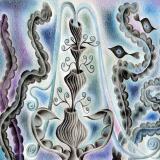
“Nostalgia Por Mesozo´ica” is an exploration of "experimental exotica" consisted of synthesized tropical attributes — an artificial landscape isolated behind the glass frame. Reminiscent of recording techniques and sonorities ubiquitous in the 60’s and 70’s, it could conceivably have been intended as a soundtrack for the Mesozoic Era exhibition at your favorite Natural History museum.
quête:nikolaienko
- 1
Cassette[16,77 €]
"It’s an album where I’ve limited myself to using only two instruments—a metallophone and a four-track tape recorder. Explorations of the metallophone and tape sounds are deconstructed and reintegrated into tracks with cassette loops. This release is part of this year’s Muscut label series, dedicated not to electronic but to electro-acoustic music focusing on analog recording and production."
Taken from the Shape platform interview (March 2024)
"Four years in the making, Nikolaienko’s retrogarde take on mid-20th century tape music is a loping, whirling fuzzy felt oscillator odyssey. If Louis and Bebe Barron had been asked to create electronic tonalities for a Czech animation based on EM Forster’s The Machine Stops, the results may have turned out like this. Only, for all its nods to Parmegiani and the BBC Radiophonic Workshop, one can’t quite see this album coming out in 1956 – or even 1976. Something about the slightly off kilter rhythms, the loose feel and wheezing sound effects make this very much a post-Dilla take on Raymond Scott and his successors." - The Wire
"...The album, pitched as “a tribute to early-electronics’ golden era,” takes on a fragmented aesthetic of bleeps, thunks and jolts that secrete the concentrated focus of a fantastical laboratory...” Tiny Mix Tapes
"...The Sounds Of Pseudoscience is a perfect cocktail of space ambient with ice, delicate percussions, under-water rhythms and echoes of Soviet 60s..." Krossfingers
Limited to 50 copies cassettes in Riso printed J-cards
"Four years in the making, Nikolaienko’s retrogarde take on mid-20th century tape music is a loping, whirling fuzzy felt oscillator odyssey. If Louis and Bebe Barron had been asked to create electronic tonalities for a Czech animation based on EM Forster’s The Machine Stops, the results may have turned out like this. Only, for all its nods to Parmegiani and the BBC Radiophonic Workshop, one can’t quite see this album coming out in 1956 – or even 1976. Something about the slightly off kilter rhythms, the loose feel and wheezing sound effects make this very much a post-Dilla take on Raymond Scott and his successors." - The Wire
"...The album, pitched as “a tribute to early-electronics’ golden era,” takes on a fragmented aesthetic of bleeps, thunks and jolts that secrete the concentrated focus of a fantastical laboratory...” Tiny Mix Tapes
"...The Sounds Of Pseudoscience is a perfect cocktail of space ambient with ice, delicate percussions, under-water rhythms and echoes of Soviet 60s..." Krossfingers
Cassette[20,13 €]
It’s an album where I’ve limited myself to using only two instruments – a metallophone and a four-track tape recorder. Explorations of the metallophone and tape sounds, deconstructed and reintegrated into tracks with cassette loops. This release is part of this year’s series, dedicated not to electronic but to electro-acoustic music with a focus on analog recording and production.
12" LP (300) 'Nostalgia Por Mesozoica' is an exploration of "experimental exotica" consisted of synthesized tropical attributes — an artificial landscape isolated behind the glass frame.Reminiscent of recording techniques and sonorities ubiquitous in the 60’s and 70’s, it could conceivably have been intended as a soundtrack for the Mesozoic Era exhibition at your favorite Natural History museum.
Fortunately for us, Dmytro Nikolaienko agreed to open up the jewellery boxes of his tape-loop archive for his debut album on Faitiche. What came to light was a collection of dreamy glittering gems, masterfully presented using the compositional possibilities of analogue tape machines. Some may consider a tape machine to be limited as a musical instrument, but Rings makes a convincing case with its sure-handed use of the available parameters – moving tape over the tape head mechanically and manually, cutting loops, manipulating timbre and creating noise by means of saturation. The results are eleven blurred, repetitive, rhythmic patterns that can be understood as an intervention against digital precision, as mechanical irregularities and background noise become musical events.
For those familiar with Nikolaienko’s work, his nostalgic approach here will come as no surprise: born in Ukraine and now based in Estonia, he has chosen a historical medium (that has been enjoying a renaissance for some years now) to record historical-sounding sequences. The way he manages his own back catalogue is similarly archival, documenting the chronology of his tape loops in such a way as to leave no doubt as to their advanced age. And then there are his two wonderful labels Muscut and Shukai, the latter being an archival project releasing electroacoustic obscurities from the Soviet past. Which brings us back full circle …
The first time on vinyl reissue of Nikolaienko's four tracks from his debut album "Loops & Cuts Soup" originally releases as a digital download on Nexsound records in 2010.
Restored from the single copy of dubplate record.
Nikolaienko's "The Sounds Of Pseudoscience" LP from 2015 (originally released by Muscut/ Graphical Recording) gets 5 Years Anniversary Limited Edition on cassettes. 30 copies only. Includes 10 never published before pseudoscience illustrations.
- A1: Wildstyle Crew - Intro (Edit)
- A2: Bryozone - Juicy Quiddity
- A3: Ratti Nielsen Nikolaienko - M2
- A4: Mark Templeton - Soft Education
- A5: Andrew Pekler - Underwater Nocturne
- B1: Native Instrument - Thud
- B2: Nisantashi Primary School - Flaneur
- B3: Aem Rhythm Cascade - Biruza
- B4: Ol - Nutmeg
- B5: Vakula - Afromadness
Ukrainian label Muscut celebrates its anniversary - Muscut X (10) Test Pressign II - is the tenth record in a row. The first release was published in 2012 on 7 inches and was called simply Test Pressing. Like six years ago, the current vinyl is a compilation of Muscut's 'residents', as well as new friends of the label. Test Pressing II is 12 inches on which there are exactly ten tracks. Both sides are significantly different in color of mood. Party A starts with dub-drone sketches of key figures of the Odessa underground - Wildstyle Crew and Bryozone. Then we hear the mantra-like M2 - the work of the creative union of Nicola Ratti, Mads Emil Nielsen together with Nikolaenko. The Canadian sound-artist Mark Templeton continues the line of rhythmic textures crowned with unhurried percussion - it is in all senses of Soft Education at number four. The first part is completed by an exquisite curtsy from the Andrew Pekler label frequenter called Underwater Nocturne as a soundtrack for the perfect tea ceremony.
The second side confidently sets a completely different compilation rhythm from the very start - the tribal tribal dance from the Berlin project Native Instrument instantly introduces into a trance. It is followed by a warm, enveloping minimal synth track from the Ukrainian trio Nisantashi Primary School. The middle of the second side is decorated with the pensive house-ballad of St. Petersburg producer Fadeev known as AEM Rhythm Cascade. Another Russian settled next to him - Muscovite Oleg Buyanov, aka OL, with a massive broken dub Nutmeg. The final composition consists of burning afrosint motifs from luminary Odessan Vakula.
Recollection V-VI marks the third in a planned series of 7” releases, each built from Glonti’s expanding archive of Soviet-era recordings. The artwork by Dmytro Nikolaienko (Day Night) once again reflects the utilitarian aesthetic of Soviet-era record design.
In 2018, Glonti started collecting LPs of Soviet-era Georgian composers at Tbilisi’s “Dry Bridge” flea market.The records mostly consisted of classical and chamber music released on Melodiya, the singular, state owned record label of the USSR. It was through this process that the idea of Recollection was born, as Glonti aimed to create an album that would utilize samples from his growing collection.
Recollection III-IV marks the second in a planned series of 7” releases, each built from Glonti’s expanding archive of Soviet-era recordings. The artwork by Dmytro Nikolaienko (Day Night) once again reflects the utilitarian aesthetic of Soviet-era record design.
Ajukaja unfurls a new chapter in his Sunda School saga. This 7-inch vinyl breathes a spirit of deliberate carefree abandon, a poignant, mournful dissent against the world's pervasive shadows.
At the heart of the Sunda School chronicle sits the Yamaha Sunday school organ, residing in Ajukaja's island sanctuary on Hiiumaa. Its keys have served as the wellspring for previous sonic offerings by Tapes, Nikolaienko, and the collective spirit of LLL (Denzel, Nikolajev), all woven into the fabric of this distinctive series.
New Environments & Rhythm Studies finds Andrew Pekler returning to the humid zones he explored on previous albums such as Sounds From Phantom Islands and Tristes Tropiques. Split between longer immersive compositions and shorter glimpse-like sketches, these 12 tracks feature new juxtapositions of Pekler's familiar palette of synthetic field recordings, warm, undulating electronic textures, shifting percussion patterns and serene melodies.
As with much of his recent work, Pekler's compositions here are structured around the beguiling effect of synthetic and non-synthetic sounds mirroring, mimicking and modulating one another. The teeming atmospheres within tracks such as Globestructures, Cymbals In The Mist or Globestructures: Option II are, despite their seemingly anthropogenic nature, entirely synthetic. Elsewhere, the lopsided grooves of Cumbia Para Los Grillos or Fabulation For K are derived from recordings of crickets and other insects which Pekler loops and uses to trigger electronic percussion – producing a pleasantly skewed rhythmic base for the fragments of melody which are layered on top. The six Rhythm Studies also follow the same principle – a playful interweaving of the organic and synthetic.
New Environments & Rhythm Studies is a further attempt to re-describe past tropes which laid claims to authentically represent music and sound from beyond the Western world (exotica, ethnomusicology, field recording) as undertakings of the imaginary.
Written and produced by Andrew Pekler, mastered by Giuseppe Ielasi, artwork by Morgan Cuinet, graphic design by Dmytro Nikolaienko.
In 2018, Glonti started collecting LPs of Soviet-era Georgian composers at Tbilisi’s “Dry Bridge” flea market.The records mostly consisted of classical and chamber music released on Melodiya, the singular, state owned record label of the USSR. It was through this process that the idea of Recollection was born, as Glonti aimed to create an album that would utilize samples from his growing collection.
Recollections I-II will be the first release in a series of 7’’ records, followed by three more releases which together will make up a full length album. The artwork by Dmytro Nikolaienko of Day Night reflects the generic qualities of Soviet-era cover art.
For a few years until 2014, Indirect’s rehearsal studio was located at the abandoned Odesa drugstore “Аптека No326”, whose stained glass window is depicted on the album cover. The many hours spent there practicing and recording have ended up as a 7” Walts and a digital LP Ab Pharmacy in 2014 on Muscut and Diskultura labels.
Indirect:
Hennadii Boichenko: compositions, organ, keyboards, synth, programming, guitar, bass guitar Anton Ostromezkii: compositions, drums
Taras Panteleichuk: compositions, bass guitar, guitar
Oleksii Volusunov: compositions, guitar
Nadiia Shoshina: flute
Vasyl Notkin: additional guitars
Composed and recorded by Indirect in Odesa Mastered by Kassian Troyer
Produced by Dmytro Nikolaienko and DJ Mavr Cover illustration by Anna Makarchuk (Waltz, 7”) Cover photo by Taras Panteleichuk
(P)(C) Muscut / Diskultura, 2014 Muscut 2C, 2024
7” vinyl, mono, direct master tape to vinyl cut, 33rpm
This is the 3rd appearance of Odesa-based Hennadii Boichenko (ex-Indirect) on Muscut, after his contribution as a part of the Indirect band (Ab Pharmacy / Waltz - 2014, Ode To The Sea 7” single, “Sea Songs,” - is a record mixed and tape mastered by Dmytro Nikolaienko. This is also the first episode of a newly started series of analog production chain releases with master reel tape transfer to lathe cut (the label has only been sending digital master files to the record plant before that). This year, Muscut twists from electronic music to instrumental and eclectic ones with more similar releases in the queue - Cukor Bila Smert's recordings from 1990-1993, Nikolaienko's "Meta" (exploration of metallophone on tape loopings), Fleischesmarkt's - disbanded Odesan punk/kraut band from the late 2000s.
- A1: The Great Hen-Yuan’ River
- A2: Summer Will Not Come
- A3: Six Coral Devils (Part Ii)
- A4: Six Coral Devils (Part Iii)
- A5: Six Coral Devils (Part Iv)
- A6: Six Coral Devils (Part V)
- A7: Six Coral Devils (Part Vii)
- A8: Definitely That Ketsal
- A9: The Waltz Windows On The Floor
- B1: Blue
- B2: Kwolyj Twist (Slow Twist)
- B3: Argolida (Part I)
- B4: Argolida (Part Ii)
- B5: Argolida (Part Iii)
- B6: Argolida (Part V)
- B7: Argolida (Part Vi)
- B8: Argolida (Part Vii)
- B9: Argolida (Part Viii)
- C1: All Secrets Of A Poem (Part Iii)
- C2: All Secrets Of A Poem (Part Iv)
- C3: All Secrets Of A Poem (Part Vi)
- C4: All Secrets Of A Poem (Part Vii)
- C5: Poliuwannia (The Hunt)
- C6: Smilywo Chodit’ Do Zymy (Walk Brave To The Winter)
- D2: Widen Spyt’ (Vienna Is Sleeping)
- D3: Wartowyj (The Stand Guard)
- D4: Procesija Mertwych (Dead Ceremony)
- D5: Na Skryni (On The Basket)
- D6: Untitled (Bonus Track)
- C7: Zradnyky (The Traitors)
- D1: Obminaj Misce (Around This Place)
The founders of Cukor Bila Smert’ (Ukrainian: Цукор– Біла Смерть, English: Sugar – White Death) band were Svitlana Okhrimenko (a.k.a. Svitlana Nianio), Oleksandr Kohanovs’kyi, and Tamila Mazur, who studied at the Reinhold Glier Kyiv Academy of Music in 1984-1988. In the summer of 1988, they got acquainted with Eugene Taran, a young guitarist and artist. He joined the band and also became the ideologist of Sugar – White Death. Moreover, Eugene coined the name for the band: the irony towards the Yellow Press. The musicians gathered at Kohanovs’kyi’s house, where they spent their free time not only playing music but also listening to and discussing new records and thinking about the conception of their new project.
For two years, the band recorded a few home-made albums, such as “Rhododendrons Coral Aspides” in 1988 (which is considered lost), where Kostyantyn Dovzhenko took part as a guitarist and sound engineer. He also replaced Taran during the recording session because Eugene was passing an exam at that time. The band also recorded another album – “Lilies and Amaralises,” in 1989, which is also considered lost. Eugene remembers that the band made a lot of recordings but did not pay so much attention to them. Sugar – White Death played live occasionally but spent more time creating their own sound, which was named by Oleksii Dekhtyar (a founder of “Ivanov Down”) as a “sugar calypso sound.” At that time, the music was mostly created by Oleksandr Kohanovs’kyi, and the lyrics were written by Svitlana Okhrimenko and Eugene Taran.
In February 1990, a quartet came to the Scientists House Studio in Kyiv, where they had one studio session only, recorded by Valerii Papchenko. Musicians played live for about one take. This session was represented on the “Mannered Music” compilation by several blocks – “Venus with Long Neck,” “The New Sissies,” and “Rhododendrons Coral Aspides,” which was shortened to “Rhododendrons” on the cassette (two songs from which – “Summer Will Not Come” and “The Great Hen-Yuan’ River,” dedicated to Grigorii Khoroshylov, the sinologist from Kyiv). The compilation cover design was created by Eugene Taran. Later, this tape got to Vlodek Nakonechnyj, the founder of Koka Records, a young Polish label, who released “Mannered Music” on cassettes and made efforts to invite Sugar – White Death to play several gigs in Poland.
In November 1990, Sugar – White Death played their last gig as a quartet in Kharkiv. They were invited by Sergii Myasoyedov, who curated the art association “Nova Scena” (The New Scene). The band played selected tracks from the albums “The New Sissies” and “The Shellfishes in Gold Wrappers” (the last one is also considered lost). Due to Sergii Myasoyedov's efforts, the performance was documented: he saved a lot of photos and fragments of soundboard recordings on reel-to-reel tape.
Later, Oleksandr Kohanovs’kyi and Tamila Mazur left Sugar – White Death: Oleksandr founded his own project Pan Kifared, and Tamila became a bass player of Shake Hi-Fi (whose co-founder was Eugene Taran). Sugar became a duo of Svitlana and Eugene. They started to focus on their next work: “Antinoy Is Leaving” in late 1990.
In 1992, they were also invited by Sergii Myasoyedov for a studio session in Kharkiv, where due to the efforts of Oleksandr Vakulenko, Sugar recorded the new album called “All Secrets Of A Poem”. Some tracks from the work (“Dead Ceremony,” “Vienna Is Sleeping,” and “Untitled”) were released on their next and last album, “Selo” (“The Village”). The rest compositions were published as a part of the compilation for the first time.
In the autumn of 1992, the musicians went to Poland, where Vlodek Nakonechnyj, who wanted Sugar to come to a “real” studio, organized their last recording session. Although the journey’s beginning was unsuccessful (Eugene’s guitar was taken away by a customs officer when crossing the border), the musicians worked fast during the session at the Arek Was studio at Marki on an 8-track reel-to-reel machine. Boleslav Blazhchyk took part as a cellist, playing the parts created by Svitlana. The album was completed in three days – the musicians spent two days recording and one-day mixing, mostly done by Eugene Taran. In 1993, this work was released as “Selo” (“The Village”) album on cassette tapes by Koka Records (remastered by Tadeusz Sudnik). Later, Sugar – White Death was disbanded.
Credits:
Cukor Bila Smert’: Svitlana Okhrimenko (lyrics, keyboards, piano, vocals), Eugene Taran (lyrics, keyboards, guitar), Oleksandr Kohanovs’kyi (piano, A1-B2), Tamila Mazur (cello, A1-B2), Boleslaw Blaszczyk (cello, C5-D6)
Cover photo by Vlad Urazovs’kiy
Photo archive courtesy: Vlad Urazovs’kiy, Vlodek Nakonechnyj (Koka Records),
Oleh Yuhrinov, Sergii Myasoyedov
Audio archive courtesy: Vlodek Nakonechnyj (Koka Records), Guido Erfen,
Sergii Myasoyedov
Liner notes: Vlad Yakovlev
Compiled by Dmytro Nikolaienko, Dmytro Prutkin and Sasha Tsapenko
© ? Shukai / Cukor Bila Smert’
2024
- A1: Memotone - False Cobra
- A2: Giuseppe Ielasi - Untitled, February 2023
- A3: Andrew Pekler - Neon Nocturne
- A4: Rome´o Poirier - Haut Lieu
- A5: Nikolaienko - Ambianta Vi
- A6: Felix Kubin - Spukflattern
- B1: Jake Muir - Spindle
- B2: Felicity Mangan - Wings
- B3: Star Searchers - Previsual Stingray Motion Fx
- B4: Tarotplane - We Stutter Between
300 (hand-stamped, hand-numbered) The fourth episode of the Test Pressing series compilations includes tracks from such artists as Memotone, Giuseppe Ielasi, Andrew Pekler, Rome o Poirier, Nikolaienko, Felix Kubin, Jake Muir, Felicity Mangan, Star Searchers, and Tarotplane.
This compilation is a research project commissioned by Urvakan with the support of the Goethe-Institut. It archives a selection of recordings contributed by some of the artists from post-Soviet countries who were meant to play at Urvakan 2020 - a festival that never really happened. The artists were asked to explore the idea of "collective memories" in sound by using aural techniques capable of evoking reminiscences in the subconsciouses of people from fairly different locations, but that are in some ways similar in their cultural codes. The submissions we received were not only inspiring, but also quite accurately fell in line with Urvakan's declared focus on "hauntological" music practices, referenced in the festival's name itself - "urvakan" is the Armenian word for ghost, phantom, or spirit.
Arthur Mine is a keyboardist and electronic musician from Kyiv, Ukraine. An ex-member of several live bands from punk to indie and experimental. In 2017 Nikolaienko's collaborator on the Nostalgia Por Mesozoica 7” single.
For the collectors of New Age cassettes to put somewhere between Sven Grünberg and Vangelis.
Muscut celebrates its twentieth release in a row with a compilation which includes label’s residents, guests and beloved "similar artists" such as G.E.S. (aka Jan Jelinek, Faitiche), Andrew Pekler (Faitiche, Kranky), Hanno Leichtmann (Dekorder, Entr'acte), S A D (Udacha, 12th Isle), Nikolaienko (Muscut), Koyil (DIG), Mårble (Natural Selections, Not Not Fun), KWJAZ (Not Not Fun), uon duh (Muscut) and Ahnnu (Leaving Records)
- 1