Low Company presents Yuta Matsumura’s Red Ribbon, a sequence of introspective, lavishly melodic dream-songs and amphibian atmospheres recorded in scattered periods over 2018-21. Having played in bands like Low Life, M.O.B. and Orion, and the duo Jay & Yuta (with Jay Cruikshank), Red Ribbon is Matsumura’s first solo outing, and represents a conscious effort to move away from guitar-based songwriting. He composed its nine tracks mostly on piano - layering vocals, bass, keyboards, flute (courtesy of Maeve Parker), violin/cello (Laurence Quinn) and clacking drumbox rhythms into dynamic, dubwise avant-pop structures which are supple and spacious but fizzing with detail and vivid inner life. The laconic 4/4 pulse, heat-warped synth-tones and haunting vaporous melodica of opener ‘Box Garden’ set the tone: its surreal psychedelic patternings barely concealing a deep sting of longing and regret. The cryptic lyrics suggest chance encounters, hidden logic, missed opportunities, fatalism, serendipity. A city submerged: everyone else paused mid-movement, while you’re allowed to swim free and fish-like through the streets, over the rooftops...‘Tangled Orchid’ is a tense night-drive through dry desert heat and into the unknown, running away from your old life, chased down by dust-devils of half-baked schemes and abandoned plans, while ‘Myth Machine’ drops the tempo and something mind-altering, guiding us on a tripped-out dub-disco scuba among alien flora and fauna, a world of impossible shapes and sensations. At which point, the mood of the album decisively shifts, firstly with ‘Sake No Otoh’, sung in Japanese by Haruka Sato: an instant-classic, breathtakingly intimate lover's lament that sounds like it got lost on its way to heaven and is now doomed to orbit the earth forever. The songs that follow continue in this more confessional, imploring mode. As if the travelling's done, the baggage has been cast off, and we’ve arrived at our destination, where the real process of rebirth and repair can begin. The music’s textures become less overtly dubby and electronic, with more of an organic, earthy, chamber-pop/avant-folk feel, at once sad and hopeful-sounding. Three songs in particular bear the influence of Eno’s 70s work (and its mutant bedsit offspring Lifetones, Flaming Tunes, etc): ‘‘E. Potential’, where baroquely chorused vocals - half-agonised, half-beatific - teeter on top of simple oscillating piano loops, and the stately, dawntreading ballads ‘Tabula Rasa’ and ‘No Sleep For Birds’. The bulk of the album was made prior to lockdowns and all of that; its themes of reset, self-examination, the need to f**k it all off and take spiritual stock, are timeless. Though they perhaps have a more bittersweet resonance now the world has returned pretty much to how it was, only worse. Track list: 1. Box Garden 2. Tangled Orchid 3. Myth Machine 4. Red Ribbon 5. Soko No Ato 6. Tabula Rasa 7. E. Potential 8. No Sleep For Birds 9. Zookeeper's Trial
quête:nine l
Max Loderbauer’s career in music spans the last 3 decades, yet he’s still managed to keep his listeners hungry by releasing only 3 solo albums to date. Two of those releases (Transparenz, 2013 and Donnerwetter, 2020) were on Tobias Freund’s label Non Standard Productions - his long time collaborator and Templehof studio mate. In between those releases, Loderbauer graced Marionette with Greyland in 2016, revealing a previously unheard youthful and sentimental side. Now in 2022, the seasoned mind voyager is back with Petrichor, making yet another rare and treasurable solo appearance.
Petrichor distills the elements of Loderbauer’s work that are fundamental to the initiation of the label. With his Buchla, modular synth, and Haken fingerboard, Loderbauer’s improvised studio maneuvers dilate into imagined journeys from glacial peaks into the exosphere. This is Maxi at his most exhilarating state, morphing through bittersweet and optimistic soundscapes to bleak moments of throbbing unease - all while maintaining a sense of grace and elegance. Petrichor is a reflection of Loderbauer’s impactful trips to the mountains, and returning from these summits with an electrifying urge to paint this mighty perspective. The harmonies and melodies on the tracks simulate emotional peaks and valleys, with vibration and rhythm rooted in the foundation of the sound, as though it's woven into the fabric of the fauna and flora.
Legendary collaborations like Vilod (with Ricardo Villalobos), the Moritz Von Oswald Trio, Non Standard Institute, Sun Electric in the early nineties, and the newly formed Ambiq ensemble have gained this unique artist the respect of the underground and avant garde scenes alike.
Freedom – the debut album from Leah Weller – a modern soul soundtrack to her head spinning twenties turning into empowered, contented thirties. Completed last year, Weller’s first complete album follows a decade-long career on catwalks, in front of cameras and making dancefloors shake, constantly on the move and with music as a constant companion. Finding the escape route out of anxiety-inducing mix-and-match career moves with the stability of love, the slowdown of repeated lockdowns and, finally, motherhood, Weller’s race is now to be run at her own pace with a collection of songs set perfectly to her flow.
Gathering nine, finely-tailored songs together with a drum beat of support from producer and collaborator, Steve Craddock, the collection speaks, much rather than screams, of finding the sweet spot between the need for hope, however naïve, and the truths that only experience can spell out.
Freedom – the debut album from Leah Weller – a modern soul soundtrack to her head spinning twenties turning into empowered, contented thirties. Completed last year, Weller’s first complete album follows a decade-long career on catwalks, in front of cameras and making dancefloors shake, constantly on the move and with music as a constant companion. Finding the escape route out of anxiety-inducing mix-and-match career moves with the stability of love, the slowdown of repeated lockdowns and, finally, motherhood, Weller’s race is now to be run at her own pace with a collection of songs set perfectly to her flow.
Gathering nine, finely-tailored songs together with a drum beat of support from producer and collaborator, Steve Craddock, the collection speaks, much rather than screams, of finding the sweet spot between the need for hope, however naïve, and the truths that only experience can spell out.
Das siebte Studioalbum der ehrwürdigen Rock-Institution Titus Andronicus wurde produziert von Titus Andronicus Singer-Songwriter Patrick Stickles und dem preisgekrönten kanadischen Produzenten Howard Bilerman (ARCADE FIRE, LEONARD COHEN, THE WHOLE NINE YARDS) in dessen hotel2tango Aufnahmestudio in Montreal. Mit "The Will To Live" laden Titus Andronicus den Hörer auf eine Reise von der Angst zum Glauben, von der Wut zur Akzeptanz, von der Trauer zur Dankbarkeit ein, immer auf der Suche nach dem mythischen Ideal des ultimativen Rock. In Anlehnung an maximalistische Rock-Epen von "Who's Next" bis "Hysteria" hat die Band ihr bisher reichhaltigstes, dichtestes und härtestes Album geschaffen, das die Weite und den Umfang ihres meist gefeierten Werks erreicht und gleichzeitig ihren ehrgeizigen Angriff effektiver als je zuvor gestaltet. "It may strike some as ironic we had to go to Canada to record our equivalent to "Born In The USA," sagt Stickles, "but the pursuit of Ultimate Rock knows no borders." Titus Andronicus kehrten im November 2021 auf die Bühne zurück, um den Jahrestag ihres bahnbrechenden zweiten Albums "The Monitor" von 2010 zu feiern. Die Tatsache, dass sie dieses Material vor einem ekstatischen Publikum spielten, ließ Stickles entschlossen zurück, ein Album abzuliefern, das dieselben Höhen erreichen würde, wobei sie sich diesmal weniger auf das unbekümmerte Feuer der Jugend verließen, sondern mehr auf die Erfahrung und die Perspektive, zu der eine Band erst mit tausend Shows im Gepäck gelangt. Um diesen Grad an Konzentration und Klarheit zu erreichen, musste Stickles an der Schnittstelle zwischen Triumph und Tragödie stehen. Er schreibt seine neu gefundene häusliche Glückseligkeit und seine unerschütterliche mentale Gesundheit für seine persönliche Stabilität in letzter Zeit ebenso zu wie die Ausdauer der mittlerweile am längsten bestehenden Besetzung von Titus Andronicus - Liam Betson an der Gitarre, R.J. Gordon am Bass und Chris Wilson am Schlagzeug - die alle auf dem 2018er Album "A Productive Cough" und dem 2019er Album "An Obelisk" vertreten sind. Auf der grausameren Seite der Medaille entstand "The Will To Live" zum großen Teil als Versuch, den vorzeitigen Tod von Matt "Money" Miller, dem Gründungs-Keyboarder der Band und Stickles' engstem Cousin, im Jahr 2021 zu verarbeiten. Das Ergebnis erweist sich als Meilenstein für Titus Andronicus, ein ehrgeiziges, nach vorne gerichtetes Werk, das an der Schnittstelle von Triumph und Tragödie steht, angetrieben von neu gefundenem Fokus und Klarheit, und das eine einzigartig begabte Rock'n'Roll-Band auf dem Höhepunkt ihrer kreativen Kräfte zeigt.
„Techno. Simply Techno. The way I see it and like to hear it.“ is the simplistic idea behind RICO PUESTEL's new album THE VERGE, THE ROPE & THE ROOFTOPS. And that's what is delivered on this LP – 12 high density Techno productions following his highly anticipated 2021 album OBI THINE XI.
Besides the two special Electro jams OUT OF THE BOUNDS and SAVED AGAIN, all tracks deliver a coherent forward motion that have an inner connection while being able to work seperately and individually in a functional as well as special-moment-way throughout any Techno DJ set.
While there happens to be a deeper connection within, RICO PUESTEL himself recorded an album DJ mix, giving another perspective on how these tracks are intertwined.
As the opening of the CD is declaring: „This sound is relentless. It knows no stops. Standing on the verge. Climbing on the rope. Echoes from the rooftops.“
Perpetual Doom proudly presents the new album from Austin Leonard Jones: Dead Calm. On this collection of nine new tracks, the Texas-based troubadour channels his eclectic talent into a melancholy country groove. Full of signature tumbleweed melodies and his deadpan wit, it is an essential addition to Jones’ unique and varied catalog.
Like any good country record, Dead Calm starts with a joke and ends in tears. “A werewolf walks into a bar,” Jones sings on opener “Cape Fear,” where vampires pour drinks and no one seems to escape. The town might be full of the undead, but it could be anywhere—after all, as Jones says, “It’s hard on the living in Cape Fear.” The slide guitar and faint bright keys set the tone for an album that mixes domestic sorrow with a touch of kitsch, like Conway Twitty at a seasonal Halloween outlet. “I’m the sole survivor of the all-night show,” he sings on “Back in the Black Lagoon,” “and it cost a thousand tears for every episode.” Somewhere between a funeral and a costume party, Dead Calm bursts with classic songwriting sure to get you on the dance floor and crying.
All these ghost towns, desert bars, and haunted capes emerge from the small town outside Austin where Jones wrote and recorded the album. Alongside producer Jesse Woods, he crafted a sound based on the traditional country palette of acoustic and slide guitar, organ and gentle drums. Songs like “Night Parrots” and “Demon Sands” take stock of life’s disappointments as Jones’ maudlin voice and Jesse Siebenberg’s pedal steel twist tighter around each other. “The Australia Song” puts autobiographical storytelling first, while “Exotics” laughs at our tendency to seek satisfaction in far-off places and things. It all comes together on “Its Treachery,” where Jones confronts the intimate betrayals of “a whole life not working out as planned.”
Sound familiar? Austin Leonard Jones invites you to join the club.
Simple Minds return with eighteenth studio album Direction of the Heart, set for release on 21st October 2022 and including lead single ‘Vision Thing’.
Direction of the Heart is Simple Minds’ first album of new material since 2018’s outstanding UK Top 5 album Walk Between Worlds. Throughout its nine tracks, Direction of the Heart finds the band at their most confident, anthemic best on an inspired celebration of life, and which manages to perfectly encapsulate the essence of past and present Simple Minds, a band whose reascent over the past 10 years has seen them, once again, capture the magic and critical praise of their early days
- A1: Rock This Mother
- A2: Talk To Me Girl
- A3: You Can Find Me
- A4: Check This Out
- A5: Jesus Going To Clean House
- A6: Hope You Understood
- A7: Is It What You Want
- A8: Love Is Everlasting
- A9: This Is Hip-Hop Art
- A10: Opposite Of Love
- A11: Do You Know What I Mean
- B1: Saving All My Love For You
- B2: Look Out Here I Come
- B3: Girl You Always Talking
- B4: Have A Great Day
- B5: Take My Hand
- B6: I Need Your Love
- B7: Your Town
- B8: Talk Around Town
- B9: Booty Head/Take A Little Walk
- B10: I Love My Mama
- B11: I Never Found Anyone Like You
Vinyl LP[23,49 €]
As the sun sets on a quaint East Nashville house, a young man bares a piece of his soul. Facing the camera, sporting a silky suit jacket/shirt/slacks/fingerless gloves ensemble that announces "singer" before he's even opened his mouth, Lee Tracy Johnson settles onto his stage, the front yard. He sways to the dirge-like drum machine pulse of a synth-soaked slow jam, extends his arms as if gaining his balance, and croons in affecting, fragile earnest, "I need your love… oh baby…"
Dogs in the yard next door begin barking. A mysterious cardboard robot figure, beamed in from galaxies unknown and affixed to a tree, is less vocal. Lee doesn't acknowledge either's presence. He's busy feeling it, arms and hands gesticulating. His voice rises in falsetto over the now-quiet dogs, over the ambient noise from the street that seeps into the handheld camcorder's microphone, over the recording of his own voice played back from a boombox off-camera. After six minutes the single, continuous shot ends. In this intimate creative universe there are no re-takes. There are many more music videos to shoot, and as Lee later puts it, "The first time you do it is actually the best. Because you can never get that again. You expressing yourself from within."
"I Need Your Love" dates from a lost heyday. From some time in the '80s or early '90s, when Lee Tracy (as he was known in performance) and his music partner/producer/manager Isaac Manning committed hours upon hours of their sonic and visual ideas to tape. Embracing drum machines and synthesizers – electronics that made their personal futurism palpable – they recorded exclusively at home, live in a room into a simple cassette deck. Soul, funk, electro and new wave informed their songs, yet Lee and Isaac eschewed the confinement of conventional categories and genres, preferring to let experimentation guide them.
"Anytime somebody put out a new record they had the same instruments or the same sound," explains Isaac. "So I basically wanted to find something that's really gonna stand out away from all of the rest of 'em." Their ethos meant that every idea they came up with was at least worth trying: echoed out half-rapped exhortations over frantic techno-style beats, gospel synth soul, modal electro-funk, oddball pop reinterpretations, emo AOR balladry, nods to Prince and the Fat Boys, or arrangements that might collapse mid-song into a mess of arcade game-ish blips before rallying to reach the finish line. All of it conjoined by consistent tape hiss, and most vitally, Lee's chameleonic voice, which managed to wildly shape shift and still evoke something sincere – whether toggling between falsetto and tenor exalting Jesus's return, or punctuating a melismatic romantic adlib with a succinct, "We all know how it feels to be alone."
"People think we went to a studio," says Isaac derisively. "We never went to no studio. We didn't have the money to go to no studio! We did this stuff at home. I shot videos in my front yard with whatever we could to get things together." Sometimes Isaac would just put on an instrumental record, be it "Planet Rock" or "Don't Cry For Me Argentina" (from Evita), press "record," and let Lee improvise over it, yielding peculiar love songs, would-be patriotic anthems, or Elvis Presley or Marilyn Monroe tributes. Technical limitations and a lack of professional polish never dissuaded them. They believed they were onto something.
"That struggle," Isaac says, "made that sound sound good to me."
In the parlance of modern music criticism Lee and Isaac's dizzying DIY efforts would inevitably be described as "outsider." But "outsider" carries the burden of untold additional layers of meaning if you're Black and from the South, creating on a budget, and trying to get someone, anyone within the country music capital of the world to take your vision seriously. "What category should we put it in?" Isaac asks rhetorically. "I don't know. All I know is feeling. I ain't gonna name it nothing. It's music. If it grabs your soul and touch your heart that's what it basically is supposed to do."
=
Born in 1963, the baby boy of nine siblings, Lee Tracy spent his earliest years living amidst the shotgun houses on Nashville's south side. "We was poor, man!" he says, recalling the outhouse his family used for a bathroom and the blocks of ice they kept in the kitchen to chill perishables. "But I actually don't think I really realized I was in poverty until I got grown and started thinking about it." Lee's mom worked at the Holiday Inn; his dad did whatever he had to do, from selling fruit from a horse drawn cart to bootlegging. "We didn't have much," Lee continues, "but my mother and my father got us the things we needed, the clothes on our back." By the end of the decade with the city's urban renewal programs razing entire neighborhoods to accommodate construction of the Interstate, the family moved to Edgehill Projects. Lee remembers music and art as a constant source of inspiration for he and his brothers and sisters – especially after seeing the Jackson 5 perform on Ed Sullivan. "As a small child I just knew that was what I wanted to do."
His older brother Don began musically mentoring him, introducing Lee to a variety of instruments and sounds. "He would never play one particular type of music, like R&B," says Lee. "I was surrounded by jazz, hard rock and roll, easy listening, gospel, reggae, country music; I mean I was a sponge absorbing all of that." Lee taught himself to play drums by beating on cardboard boxes, gaining a rep around the way for his timekeeping, and his singing voice. Emulating his favorites, Earth Wind & Fire and Cameo, he formed groups with other kids with era-evocative band names like Concept and TNT Connection, and emerged as the leader of disciplined rehearsals. "I made them practice," says Lee. "We practiced and practiced and practiced. Because I wanted that perfection." By high school the most accomplished of these bands would take top prize in a prominent local talent show. It was a big moment for Lee, and he felt ready to take things to the next level. But his band-mates had other ideas.
"I don't know what happened," he says, still miffed at the memory. "It must have blew they mind after we won and people started showing notice, because it's like everybody quit! I was like, where the hell did everybody go?" Lee had always made a point of interrogating prospective musicians about their intentions before joining his groups: were they really serious or just looking for a way to pick up girls? Now he understood even more the importance of finding a collaborator just as committed to the music as he was.
=
Isaac Manning had spent much of his life immersed in music and the arts – singing in the church choir with his family on Nashville's north side, writing, painting, dancing, and working various gigs within the entertainment industry. After serving in the armed forces, in the early '70s he ran The Teenage Place, a music and performance venue that catered to the local youth. But he was forced out of town when word of one of his recreational routines created a stir beyond the safe haven of his bohemian circles.
"I was growing marijuana," Isaac explains. "It wasn't no business, I was smoking it myself… I would put marijuana in scrambled eggs, cornbread and stuff." His weed use originated as a form of self-medication to combat severe tooth pain. But when he began sharing it with some of the other young people he hung out with, some of who just so happened to be the kids of Nashville politicians, the cops came calling. "When I got busted," he remembers, "they were talking about how they were gonna get rid of me because they didn't want me saying nothing about they children because of the politics and stuff. So I got my family, took two raggedy cars, and left Nashville and went to Vegas."
Out in the desert, Isaac happened to meet Chubby Checker of "The Twist" fame while the singer was gigging at The Flamingo. Impressed by Isaac's zeal, Checker invited him to go on the road with him as his tour manager/roadie/valet. The experience gave Isaac a window into a part of the entertainment world he'd never encountered – a glimpse of what a true pop act's audience looked like. "Chubby Checker, none of his shows were played for Black folks," he remembers. "All his gigs were done at high-class white people areas." Returning home after a few years with Chubby, Isaac was properly motivated to make it in Music City. He began writing songs and scouting around Nashville for local talent anywhere he could find it with an expressed goal: "Find someone who can deliver your songs the way you want 'em delivered and make people feel what you want them to feel."
One day while walking through Edgehill Projects Isaac heard someone playing the drums in a way that made him stop and take notice. "The music was so tight, just the drums made me feel like, oh I'm-a find this person," he recalls. "So I circled through the projects until I found who it was.
"That's how I met him – Lee Tracy. When I found him and he started singing and stuff, I said, ohhh, this is somebody different."
=
Theirs was a true complementary partnership: young Lee possessed the raw talent, the older Isaac the belief. "He's really the only one besides my brother and my family that really seen the potential in me," says Lee. "He made me see that I could do it."
Isaac long being a night owl, his house also made for a fertile collaborative environment – a space where there always seemed to be a new piece of his visual art on display: paintings, illustrations, and dolls and figures (including an enigmatic cardboard robot). Lee and Issac would hang out together and talk, listen to music, conjure ideas, and smoke the herb Isaac had resumed growing in his yard. "It got to where I could trust him, he could trust me," Isaac says of their bond. They also worked together for hours on drawings, spreading larges rolls of paper on the walls and sketching faces with abstract patterns and imagery: alien-like beings, tri-horned horse heads, inverted Janus-like characters where one visage blurred into the other.
Soon it became apparent that they didn't need other collaborators; self-sufficiency was the natural way forward. At Isaac's behest Lee, already fed up with dealing with band musicians, began playing around with a poly-sonic Yamaha keyboard at the local music store. "It had everything on it – trumpet, bass, drums, organ," remembers Lee. "And that's when I started recording my own stuff."
The technology afforded Lee the flexibility and independence he craved, setting him on a path other bedroom musicians and producers around the world were simultaneously following through the '80s into the early '90s. Saving up money from day jobs, he eventually supplemented the Yamaha Isaac had gotten him with Roland and Casio drum machines and a Moog. Lee was living in an apartment in Hillside at that point caring for his dad, who'd been partially paralyzed since early in life. In the evenings up in his second floor room, the music put him in a zone where he could tune out everything and lose himself in his ideas.
"Oh I loved it," he recalls. "I would really experiment with the instruments and use a lot of different sound effects. I was looking for something nobody else had. I wanted something totally different. And once I found the sound I was looking for, I would just smoke me a good joint and just let it go, hit the record button." More potent a creative stimulant than even Isaac's weed was the holistic flow and spontaneity of recording. Between sessions at Isaac's place and Lee's apartment, their volume of output quickly ballooned.
"We was always recording," says Lee. "That's why we have so much music. Even when I went to Isaac's and we start creating, I get home, my mind is racing, I gotta start creating, creating, creating. I remember there were times when I took a 90-minute tape from front to back and just filled it up."
"We never practiced," says Isaac. "See, that was just so odd about the whole thing. I could relate to him, and tell him about the songs I had ideas for and everything and stuff. And then he would bring it back or whatever, and we'd get together and put it down." Once the taskmaster hell bent on rehearsing, Lee had flipped a full 180. Perfection was no longer an aspiration, but the enemy of inspiration.
"I seen where practicing and practicing got me," says Lee. "A lot of musicians you get to playing and they gotta stop, they have to analyze the music. But while you analyzing you losing a lot of the greatness of what you creating. Stop analyzing what you play, just play! And it'll all take shape."
=
"I hope you understood the beginning of the record because this was invented from a dream I had today… (You tell me, I'll tell you, we'll figure it out together)" – Lee Tracy and Isaac Manning, "Hope You Understand"
Lee lets loose a maniacal cackle when he acknowledges that the material that he and Isaac recorded was by anyone's estimation pretty out there. It's the same laugh that commences "Hope You Understand" – a chaotic transmission that encapsulates the duality at the heart of their music: a stated desire to reach people and a compulsion to go as leftfield as they saw fit.
"We just did it," says Lee. "We cut the music on and cut loose. I don't sit around and write. I do it by listening, get a feeling, play the music, and the lyrics and stuff just come out of me."
The approach proved adaptable to interpreting other artists' material. While recording a cover of Whitney Houston's pop ballad "Saving All My Love For You," Lee played Whitney's version in his headphones as he laid down his own vocals – partially following the lyrics, partially using them as a departure point. The end result is barely recognizable compared with the original, Lee and Isaac having switched up the time signature and reinvented the melody along the way towards morphing a slick mainstream radio standard into something that sounds solely their own.
"I really used that song to get me started," says Lee. "Then I said, well I need something else, something is missing. Something just came over me. That's when I came up with 'Is It What You Want.'"
The song would become the centerpiece of Lee and Isaac's repertoire. Pushed along by a percolating metronomic Rhythm King style beat somewhere between a military march and a samba, "Is It What You Want" finds Lee pleading the sincerity of his commitment to a potential love interest embellished by vocal tics and hiccups subtlely reminiscent of his childhood hero MJ. Absent chord changes, only synth riffs gliding in and out like apparitions, the song achieves a lingering lo-fi power that leaves you feeling like it's still playing, somewhere, even after the fade out.
"I don't know, it's like a real spiritual song," Lee reflects. "But it's not just spiritual. To me the more I listen to it it's like about everything that you do in your everyday life, period. Is it what you want? Do you want a car or you don't want a car? Do you want Jesus or do you want the Devil? It's basically asking you the question. Can't nobody answer the question but you yourself."
In 1989 Lee won a lawsuit stemming from injuries sustained from a fight he'd gotten into. He took part of the settlement money and with Isaac pressed up "Saving All My Love For You" b/w "Is It What You Want" as a 45 single. Isaac christened the label One Chance Records. "Because that's all we wanted," he says with a laugh, "one chance."
Isaac sent the record out to radio stations and major labels, hoping for it to make enough noise to get picked up nationally. But the response he and Lee were hoping for never materialized. According to Isaac the closest the single got to getting played on the radio is when a disk jock from a local station made a highly unusual announcement on air: "The dude said on the radio, 107.5 – 'We are not gonna play 'Is It What You Want.' We cracked up! Wow, that's deep.
"It was a whole racist thing that was going on," he reflects. "So we just looked over and kept on going. That was it. That was about the way it goes… If you were Black and you were living in Nashville and stuff, that's the way you got treated." Isaac already knew as much from all the times he'd brought he and Lee's tapes (even their cache of country music tunes) over to Music Row to try to drum up interest to no avail.
"Isaac, he really worked his ass off," says Lee. "He probably been to every record place down on Music Row." Nashville's famed recording and music business corridor wasn't but a few blocks from where Lee grew up. Close enough, he remembers, for him to ride his bike along its back alleys and stumble upon the occasional random treasure, like a discarded box of harmonicas. Getting in through the front door, however, still felt a world away.
"I just don't think at the time our music fell into a category for them," he concedes. "It was before its time."
=
Lee stopped making music some time in the latter part of the '90s, around the time his mom passed away and life became increasingly tough to manage. "When my mother died I had a nervous breakdown," he says, "So I shut down for a long time. I was in such a sadness frame of mind. That's why nobody seen me. I had just disappeared off the map." He fell out of touch with Isaac, and in an indication of just how bad things had gotten for him, lost track of all the recordings they'd made together. Music became a distant memory.
Fortunately, Isaac kept the faith. In a self-published collection of his poetry – paeans to some of his favorite entertainment and public figures entitled Friends and Dick Clark – he'd written that he believed "music has a life of its own." But his prescience and presence of mind were truly manifested in the fact that he kept an archive of he and Lee's work. As perfectly imperfect as "Is It What You Want" now sounds in a post-Personal Space world, Lee and Isaac's lone official release was in fact just a taste. The bulk of the Is It What You Want album is culled from the pair's essentially unheard home recordings – complete songs, half-realized experiments, Isaac's blue monologues and pronouncements et al – compiled, mixed and programmed in the loose and impulsive creative spirit of their regular get-togethers from decades ago. The rest of us, it seems, may have finally caught up to them.
On the prospect of at long last reaching a wider audience, Isaac says simply, "I been trying for a long time, it feels good." Ever the survivor, he adds, "The only way I know how to make it to the top is to keep climbing. If one leg break on the ladder, hey, you gotta fix it and keep on going… That's where I be at. I'll kill death to make it out there."
For Lee it all feels akin to a personal resurrection: "It's like I was in a tomb and the tomb was opened and I'm back… Man, it feels so great. I feel like I'm gonna jump out of my skin." Success at this stage of his life, he realizes, probably means something different than what it did back when he was singing and dancing in Isaac's front yard. "What I really mean by 'making it,'" he explains isn't just the music being heard but, "the story being told."
Occasionally Lee will pull up "Is It What You Want" on YouTube on his phone, put on his headphones, and listen. He remembers the first time he heard his recorded voice. How surreal it was, how he thought to himself, "Is that really me?" What would he say to that younger version of himself now?
"I would probably tell myself, hang in there, don't give up. Keep striving for the goal. And everything will work out."
Despite what's printed on the record label, sometimes you do get more than one chance.
Ask any of the great guitar pickers who have emerged over the last four
decades to name a primary influence and the response is likely to be
"Tony" or "Rice" or, to avoid confusion, "Tony Rice
" There can be no doubt that Tony Rice's footprint on the time- line of guitar
playing in bluegrass music is monumental.
"Guitar" was Tony Rice's first venture into recording and it still holds up as one of
the great bluegrass guitar records ever issued. The album came to Rebel in a
roundabout way. It was recorded in Lexington, Kentucky, first appeared on a
record label in Japan, made its way back to Kentucky for release on a regional
label that was later acquired by Rebel in the late 1970s. As Tony was working in
banjo-great J. D. Crowe's band at the time, it was quite natural for Crowe, Tony's
brother and mandolinist Larry Rice, and bassist Bobby Slone to provide the
instrumental backing. Recorded at a time when progressive sounds and styles
were treading on the traditional framework of bluegrass, "Guitar" was praised for
walking the fine line of spotlighting Tony's prowess on the instrument while
remaining very much a "band" recording.
With Tony in fine form vocally and his amazing guitar work on full display, this is
where you will find his signature versions of "Freeborn Man," "Doing My Time,"
"Nine Pound Hammer," and "John Hardy" – plus the closing track, a nine-minute
tour-de-force rendition of "Lonesome Reuben."
For Fans Of : The Black Keys, Otis Rush, J.B. Lenoir, The Ramones, Hound Dog Taylor, Christone Kingfish Ingram, Magic Sam. GA-20 clearly is on to something big. It’s a movement, a new traditional blues revival. The dynamic, throwback blues trio are disciples of the place where traditional blues, country and rock ‘n’ roll intersect. “We make records that we would want to listen to,” says guitarist Matt Stubbs. “It’s our take on the song-based traditional electric blues we love.” Stubbs, guitarist / vocalist Pat Faherty, and drummer Tim Carman have been at the forefront of this traditional blues revival since they first formed in 2018. It’s no wonder they skyrocketed to the top of the Billboard Blues Chart. According to Stubbs, “Since we started the band we’ve focused on the story, the melody, and on creating a mood. Playing live as much as we do, we’re finding more and more that people are discovering how cool it all is. Traditional country, soul and funk music have all had these massive recent revivals, but traditional blues so far has not.” With their new Colemine album, Crackdown, and an intensive tour schedule, that’s all about to change. On Crackdown, GA-20’s third full-length release, the band creates an unvarnished, ramshackle blues that is at once traditional and refreshingly modern. Expanding on their previous releases (2019’s Lonely Soul and 2021’s Try It…You Might Like It! GA-20 Does Hound Dog Taylor) GA-20 finds inspiration on the edges of the genre, where early electric blues first converged with country and rock ‘n’ roll. The album’s nine original songs include the loping, Louisiana-flavored Dry Run, the dirty, and bare-bones Easy On The Eyes and the melodic, garage-tinged Fairweather Friend. With tight, propulsive performances and a brevity and punk energy reminiscent of The Ramones, Crackdown is rowdy and fun, filled with instantly memorable, and well-crafted songs. Tracks: 1. Fairweather Friend 2. Dry Run 3. Easy On The Eyes 4. Crackdown 5.Just Because 6. By My Lonesome 7. I Let Someone In 8. Double Gettin' 9. Gone For Good 10. Fairweather Friend (Final Goodbye)
Two leading Norwegian jazz artists have put together an excellent album
with just a microphone and a grand piano
On 'Movies & Stories Like This' they present nine self- composed songs about
intangible love. Hilde Louise's voice is elegantly accompanied by Anders Arums,
they cover everything from bolero and tango to French waltz and jazz ballads.
Piaf, Brell and Weill are evident sources of inspiration. Hilde Louise's lyrics span
both the minor and the major kinds of love, from everyday relationships, the ones
about which no films are made, but nevertheless carry with great drama, to the
big love stories.
Hilde Louise Asbjørnsen has released 11 albums since 2004 and continues to be
an important part of the Norwegian jazz scene. Her previous album 'Red Lips,
Knuckles and Bones' was released on Ozella Music to great reviews. She has
been described as "three parts Monroe and one part Holiday", and has nurtured
an extensive career as a cabaret- artist and a musical actress. Her latest solo
performance and book by the name of 'Stardust' is a tribute to 8 female legends
from last century. The show is a great success in Norway, and is to visit
Edinburgh Fringe Festival in 2023.
Freestyle dig out another rarity in the form of a DIY brit-funk 7" from Highway Motion aka David Humphrey (a session drummer who played with Sparks, and with PiL on the iconic Metal Box LP & Death Disco 12"). Tinged with raw post-punk edge and 70s library music-style synth leads, this 45 is quite simply massive amounts of fun.
------------
David Humphrey's professional career as a drummer began aged 19 with Public Image Ltd, providing some of the drum tracks on their iconic Metal Box album and Death Disco single. Humphrey would then go on to work with Mike Oldfield and then Sparks, playing with the latter on their Number One Song in Heaven tour, Top of The Pops and recording sessions for Beat the Clock and Tryouts for the Human Race (those sessions were included and featured in Edgar Wright's recent film 'The Sparks Brothers).
In 1980, Clap Hands and Double O One Disco were recorded under the name 'Highway Motion' - intended by Humphrey as "raw experimental tracks" they were both laid down on a 4-track and subsequently released on the DIY Star Records imprint. Rough, grooving, candid and playful; these two tracks seem to somehow simultaneously meld the burgeoning brit-funk sound of the early 80s with a riotous post-punk edge, along with a good dollop of synth-led library music.
Following it's release David formed the group Reflex, recording and releasing the Funny Situation 7" in 1981 - forming the only other title in the Star Records catalogue. A more straight-up brit-funk dancer yet still pressed and sold in small quantities, Funny Situation became a sought-after record on the second hand collector's market, and finally saw reissue last September 2020 on the start-up Paint A Picture label - garnering plays from from Gilles Peterson on BBC 6 Music and Worldwide FM, StreetSounds radio and reaching No 1 in Juno records Chart. David has now started to working on new music using the name Davey H, and released his first new material in decades recently on Six Nine Records.
- 1: The Ending
- 2: Evil World Machine
- 3: Wolf Totem (Feat Jacoby Shaddix Of Papa Roach)
- 4: This Is Mongol
- 5: If Tomorrow Never Comes (Feat Spencer Charnas Of Ice Nine Kills)
- 6: Blow (Feat Spencer Charnas Of Ice Nine Kills)
- 7: Scars That I'm Hiding (Feat Anders Fridén Of In Flames)
- 8: Burn It Up
- 9: Who's That Playing On The Radio? (Feat Danny Worsnop And Mick Mars)
- 10: Faded Out (Feat Within Temptation)
- 11: Tops (Feat Push Push)
- 12: Blame It On The Double (Feat Tyler Connolly Of Theory Of A Deadman And Jason Hook)
- 13: For The Glory (Feat Hollywood Undead)
- 14: Classless Act (Feat Vince Neil Of Mötley Crüe)
- 15: Retaliators Theme (21 Bullets) (W/Mötley Crüe, Asking Alexandria, Ice Nine Kills, From Ashes To New)
- 16: Darkness Settles In
- 17: Tired Of Winning
THE RETALIATORS MOTION PICTURE SOUNDTRACK is the high-octane original soundtrack from the award-winning horror-thriller THE RETALIATORS. It includes special appearances from some of the biggest names in rock music such as Five Finger Death Punch, Tommy Lee, Papa Roach, The Hu, Ice Nine Kills, Escape The Fate and more, both on screen and on the original soundtrack. The album is available on a limited collectors edition 180gm red & black splatter vinyl pressing housed in a gatefold sleeve with exclusive movie stills, a 24x36 movie poster collectable, blood spattered o-card and including a digital download. It is also available on digipak CD and cassette formats.
Seine Alben sind Welten, die Musikvideos legendär: Seit zehn Jahren ist Action Bronson der unverwechselbare HipHop-Held der Herzen. Heute veröffentlicht der in Queens geborene Rapper mit albanischen
Wurzeln, der zweifache ”New York Times”-Bestsellerautor, ehemalige Küchenchef und TV-Koch sein neues Album ”Cocodrillo Turbo” mit Features von u.a. Conway the Machine und Roc Marciano. Physisch erscheint das Album am 7. Oktober auf Vinyl &CD.
Auf dem Album ”Cocodrillo Turbo” kann man den neuen Hunger des 38-Jährigen spüren, der aufgrund gesundheitlicher Probleme während der Pandemie eine Bosstransformation absolvierte, über 160 Pfund abund das Kampfsporttraining aufnahm – und es so bis zum spielbaren Charakter in EA Sports ”UFC 4” schaffte. ”Ich habe nicht das Gefühl, dass mir der verdammte Respekt entgegengebracht wird, den ich verdiene”, erklärt Bronson, der auf ”Cocodrillo Turbo” seine Lines über Prog-Rock-Samples und gut abgehangene Beats von Produzenten wie Daringer und The Alchemist spuckt. ”Es gibt nicht viele da draußen, die mein verdammtes Suspensorium anfassen können.”
Auf ”Cocodrillo Turbo” taucht er tief in die psychedelische Schattenseite der amerikanischen Kultur ein. Wie ein Soziologe auf Säuretabletten. Wie Slavoj Žižek nach einem verdammt dicken Blunt. Das reptiloide
Albumcover stammt erneut vom Meister höchstpersönlich: ”Vertrau mir, wenn ich sage, dass es für keines
der Tiere da draußen sicher ist. Der alte Apexprädator ist wieder auf Beute aus.”
Seine Alben sind Welten, die Musikvideos legendär: Seit zehn Jahren ist Action Bronson der unverwechselbare HipHop-Held der Herzen. Heute veröffentlicht der in Queens geborene Rapper mit albanischen
Wurzeln, der zweifache ”New York Times”-Bestsellerautor, ehemalige Küchenchef und TV-Koch sein neues Album ”Cocodrillo Turbo” mit Features von u.a. Conway the Machine und Roc Marciano. Physisch erscheint das Album am 7. Oktober auf Vinyl &CD.
Auf dem Album ”Cocodrillo Turbo” kann man den neuen Hunger des 38-Jährigen spüren, der aufgrund gesundheitlicher Probleme während der Pandemie eine Bosstransformation absolvierte, über 160 Pfund abund das Kampfsporttraining aufnahm – und es so bis zum spielbaren Charakter in EA Sports ”UFC 4” schaffte. ”Ich habe nicht das Gefühl, dass mir der verdammte Respekt entgegengebracht wird, den ich verdiene”, erklärt Bronson, der auf ”Cocodrillo Turbo” seine Lines über Prog-Rock-Samples und gut abgehangene Beats von Produzenten wie Daringer und The Alchemist spuckt. ”Es gibt nicht viele da draußen, die mein verdammtes Suspensorium anfassen können.”
Auf ”Cocodrillo Turbo” taucht er tief in die psychedelische Schattenseite der amerikanischen Kultur ein. Wie ein Soziologe auf Säuretabletten. Wie Slavoj Žižek nach einem verdammt dicken Blunt. Das reptiloide Albumcover stammt erneut vom Meister höchstpersönlich: ”Vertrau mir, wenn ich sage, dass es für keines
der Tiere da draußen sicher ist. Der alte Apexprädator ist wieder auf Beute aus.”
Originally released in 1979 by Salsoul Records, Instant Funk is the self titled debut of Philadelphia’s nine piece group Instant Funk.
Orignially released as a single in 1978, their chart topping hit ‘I Got My Mind Made Up (You Can Get It Girl)’ synthesized the group’s racy, unstoppable sound with their fun-loving approach to funk and disco.
The 8 tracks on Instant Funk deliver the bombastic horns, hopped up guitars & impeccable vocal harmonies that earned the group a gold record and a spot on every dancefloor in New York City.
Re-issued for the first time since it’s original release, Instant Funk is available on 23rd September on limited edition red translucent vinyl.
Following the release of their critically acclaimed self-titled debut EP in 2021, Antwerp's Lucid Lucia are set to release their debut album 'Ever-changing Light' on the 7th October via the groove-obsessed Belgian tastemaker label, Sdban Ultra.
Searching to unwrap the mystery that is a human life, across nine tracks of jazz and space funk-infused grooves, Lucid Lucia look to the sound of Herbie's 'Head Hunters' and Miles' acid funk of the mid-70s for inspiration.
'Ever-changing Light' is a mind-expanding celebration centered on freedom and rhythm. Free-spirited saxes, futuristic-sounding keys, monstrous bass lines and shifting drum beats unite, resulting in an uplifting and joyous celebration of jazz, funk and groove. From the loose, laidback stylings of 'Mumpsimus' and the jazz-funk odyssey that is 'Pigeons' to the sonic wonders of 'Reminiscence' and urgent flow of 'Quanked', Lucid Lucia is a marvelous journey of luminous sounds and vibrant rhythms. Elsewhere, the warped aesthetics of 'Oneironauts' and improv 'Pukti part 1' showcase a tight rhythm section, inventive horns, funky keys and guitar while the spiritual magnum opus 'Voor Pieter A.' is a magical example of the virtuosity of Lucid Lucia.
Born from the ashes of fusion outfit BRZZVLL, Lucid Lucia were founded by saxophonist Vincent Brijs, a household name in Antwerp and the Belgian jazz scene. Former winners of the Jong Jazztalent Gent, BRZZVLL released their debut album 'Days of Thunder, Days of Grace' in 2008 and would go on to release five more albums including teaming up with Trinidad-born poet, novelist and musician Anthony Joseph on the 2014 critically acclaimed album 'Engines' and with hip-hop MC, writer and producer Amir Sulaiman on the 2016 album 'First Let's Dance'. The 2017 album 'Waiho', the band's first instumental album and final album received glowing praise from numerous tastemakers including UNCUT magazine, The Line of Best Fit, XLR8R and Record Collector magazine.
To the present day and Lucid Lucia marks a brighter, clearer sound for the sextet. Consisting of Vincent Brijs: saxophones and EWI, Bart Borremans: saxophones, Stijn Cools: drums, Dries Laheye: bass, Dries Verhulst: guitar, Jan Willems: keys and James Williams: drums and percussion, they have honed their skills performing with numerous artists from home and around the world including Ursula Rucker, Joseph Bowie (Defunkt), Amir Sulaiman, Anthony Joseph, Zena Edwards, Ayanna Witter Johnson, Baloji, Mo & Grazz, Kain the Poet (The Last Poets), Marie Daulne, Dizzy Madjeku, Ida Nielsen and many others.
- A1: Careful What You Wish For
- A2: Ayor
- A3: Nature Is A Language
- B1: Fire Of The Green Dragon
- B2: Algerian Basses
- B3: Copacaballa
- C1: Paint Me As A Dead Soul
- C2: Backwards
- C3: Princess Margaret's Man In The D'jamalfna
- D1: Ayor (Live Pornmod)
- D2: Ambient Basses (Hijack Mix 1)
- D3: Wur Click Wur Ruff 1994
- E1: Backwards Dist Vox
- E2: Drone Geff Master
- E3: Carny Master
- F1: Drone Skellies
- F2: Choir Droney Skellies
- F3: Backwards (Live Wip)
"“The New Backwards” was conceived by Peter “Sleazy” Christopherson in 2007, revisiting stray tracks which hadn’t seemed to gel with the material he had chosen for the more somber “Ape of Naples” from 2005, COIL’s initial posthumous release, a sort of requiem and a kiss-goodbye to his then recently deceased partner John Balance.
Significantly different to its sister release, this album collects the brilliantly chaotic and outrageously rhythmic material from the original sessions for the album that was begun as early as 1993 and had originally been conceptualised as the follow-up to “Love’s Secret Domain”. These songs are as diverse and wild as the places they originated from, partly infamously spawned in Sharon Tate’s former home in the Hollywood Hills, the Nine Inch Nails home base in New Orleans and London’s Swanyard, remixed and restructured with the help of long-term friend Danny Hyde in Thailand, this collection has its own unique flow and an atmosphere not found on any other COIL release.
Both “AYOR” and “Backwards” had by the time the album was first released already become favourites in COIL’s manic live performances. Some of the other tracks had only leaked in demo versions and are here presented updated and polished as Christopherson and Hyde intended them to be heard. It is interesting to consider Balance’s vocal contributions, too. Whilst on the albums COIL did release at the time this material was first put aside (“Black Light District” and “ElpH”) his voice is all but absent, his vocal performances and his lyric writing here are arguably more closely indebted to the previous “Love’s Secret Domain” era, especially the epic “Copacaballa” is noteworthy in that respect.
The New Backwards” effectively became the final official COIL studio release of all new material whilst Peter was still alive and is here presented for the first time fully supervised by Danny Hyde, its co-creator.
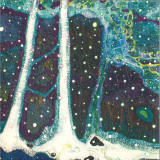
The stunning cover uses a detail from artist Ian Johnstone’s “Cubic Raven” painting, licensed from the estate of IJ..
It is high time to rediscover this timeless album with the Infinite Fog release boasting eight further tracks of previously unheard material from the same sessions, rough working stages and surprising remixes which will surely delight the dedicated COIL archaeologists, as they shine yet another light on the creative process and on what could have been.
Recorded at Swanyard, London and at Nothing Studios, New Orleans, 1996.
Thanks to everyone there, especially Trent Reznor who made it all possible.
Written & Produced by Coil & Danny Hyde.
Remixed by Peter Christopherson & Danny Hyde, Bangkok 2007.
For that session Coil were: Peter Christopherson, Jhonn Balance & Drew McDowall.
Mastered by Jessica Thompson.
Front artwork by Ian Johnstone.
Artwork licensed from The Estate of Ian Johnstone.
Layout Cold Graves and Oleg Galay."