Search:no use for a name

Styles
All
Len Faki - Fusion 8x12" BOX

Len Faki

Fusion 8x12" BOX

8x12"-VinylFIGURELP10
Figure
08.09.2023

EACH COPY Personally SIGNED BY LEN FAKI

Len Faki has always been a defining character of the techno underground. His unique approach to DJing, the consistent work as a producer and the quality output of his label Figure has all shaped the current environment.
Starting out as a clubber in the 90's, his inspirations have always reached back to the first encounters with electronic music, when new worlds opened and everything seemed possible.

While these experiences have always influenced Faki's productions and used to be released under many different aliases back in the day, they have been waiting since to be made into a proper album under the Len Faki moniker.

After quickly climbing to the top of the international DJ circuit, busy touring schedules never quite allowed for it. Finally faced with the opportunity of a long overdue creative break, Faki decided tackle the life-time venture with the necessary dedication and focus.

Excited about the new project, he also took the time and energy needed to expand his production methods. Finding new techniques allowed him to truly bring all his different influences to the surface. The process was one of following his own heart, occasionally challenging and surprising himself. Naturally the result emerged as two parallel experiences, which are now presented across two discs. Both still carry all the signature features of Faki's style but with added layers of depth and detail. There's that special contrast of dark and heady grooves, paired with dreamy melodies that transport the listener to places beyond the mind. But we also see all strains of his previous work being incorporated, mixed and molded into something new altogether.

While the first disc focuses on the kind of techno, which Faki has been brought up by and given back to for so many years of his life, the second is more loose and experimental, with forays into house, ambient and broken beats - the sounds he has always kept very passionate about.

It creates two distinct experiences, showcasing the entire breadth of Faki's cosmos. Where some ideas stay straight and kick hard, like the neon bleep opener Tor 8 or joyfully booming Astra, others take the newfound freedom to inspire a wistful broken beat ballad such as Hymn (In the Name of Fantasy) or the soulfully subdued Drum & Bass closer Voices.
Many songs even exist as pairings, with their respective counterpart on the other disc. For example, the duo of Shri Yantra/Yantra, where similar soundscapes have been looked through different lenses, making for a more straight-laced or shuffled rhythm. Also noteworthy are Faki's appearance as a veritable house producer on Hymn (In the Name of Freedom) as well as the inclusion of two very personal pieces:
The Halide tracks were made in remembrance of Faki's late mother, who passed away during the final production stage of the EP. These delicate tracks capture the intense sadness Faki was feeling at the time and helped him to process his grief and eventually to finish off the album.

By doing so Faki has given us a complete artistic statement, one that proves him to be as curious and driven now as ever, taking his sound to all-new realms.

out of Stock

Order now and we will order the item for you at our supplier.

131,05

Last In: 7 months ago
A.R. Kane - A.R. Kive LP 4x12"

A.r. Kane

A.R. Kive LP 4x12"

4x12inchRGIRL133
ROCKET GIRL
08.09.2023

A.R. Kive collates the three most astonishing works from that most miraculous of duos - A.R. Kane - comprising the ‘Up Home’ EP from 1988 that signified the band’s dawning realisation of their own powers and possibilities, their legendary debut LP ‘sixty nine’ (1988) and its kaleidoscopic, prophetic double-LP follow up ‘i’ (1989).

In founder-member Rudy Tambala’s new remastering, the music on these pivotal transmissions from the birth of dream pop, have been reinvigorated and re-infused with a new power, a new depth and intimacy, a new height and immensity. Vivid, timeless and yet always timely whenever they’re recalled, these records still force any listener to realise that despite the habits of retrospective myth-making and the
safe neutering effects of ‘genre’, thirty years have in no way dimmed how resistant and dissident to critical habits of categorisation A.R. Kane always were. Never quite ‘avant-pop’ or ‘shoegaze’ or ‘post-rock’ or any of those sobriquets designed to file and categorise, A.R. Kive is a reminder that those genres had to be coined, had to be invented precisely to contain the astonishing sound of A.R. Kane, because
previous formulations couldn’t come close to their sui generis sound and suggestiveness. This is music that pointed towards futures which a whole generation of artists and sonic explorers would map out. Now beautifully repackaged, remastered and fleshed out with extensive sleeve notes and accompanying materials, ‘A.R. Kive’ reveals that 35 years on it’s still a struggle to defuse the revolutionary and inspirational possibility of A.R. Kane’s music.

A.R. Kane were formed in 1986 by Rudy Tambala and Alex Ayuli, two second-generation immigrants who grew up together in Stratford, East London. From the off the pair were outsiders in the culturally mixed (cockney/Irish/West Indian/Asian) milieu of the East End, with Alex and Rudy’s folks first generation immigrants from Nigeria and Malawi, respectively. The two of them quickly developed and fostered an innate and near-telepathic mutual understanding forged in musical, literary and artistic exploration. Like a lot of second-generation immigrants, they were ferocious autodidacts in all kinds of areas, especially around music and literature. Diving deep into the music of afro-futurist luminaries such as Sun Ra, Miles Davis, Lee Perry and
Hendrix, as well as devouring the explorations of lysergic noise and feedback from contemporaries like Sonic Youth and Butthole Surfers, they also thoroughly immersed themselves in the alternate literary realities of sci-fi and ancient history (the fascination with the arcane that gave the band their name), all to feed their voracious cultural thirsts and intellectual curiosity.

It was seeing the Cocteau Twins performing on Channel 4 show the Tube that spurred A.R. Kane into being - “They had no drummer. They used tapes and technology and Liz Fraser looked completely otherworldly with those big eyes. And the noise coming out of Robin’s guitar! That was the ‘Fuck! We could do that! We could express ourselves like that!’ moment”, recalls Tambala - and through a mix of
confidence, chutzpah, ad hoc almost-mythical live shows and sheer innocent will the duo debuted with the astonishing ‘When You’re Sad’ single for One Little Indian in 1986. Immediately dubbed a ‘black Jesus & Mary Chain’ by a press unsure of WHERE to put a black band clearly immersed in feedback and noise, what was immediately apparent for listeners was just how much more was going on here - a
tapping of dub’s stealth and guile, a resonant umbilicus back to fusion and jazz, the music less a conjuration of past highs than a re-summoning of lost spirits.
The run of singles and EPs that followed picked up increasingly rapt reviews in the press, but it was the ‘Up Home EP’ released in 1988 on their new home, Rough Trade that really suggested something immense was about to break. Simon Reynolds noted the EP was: Their most concentrated slab of iridescent awesomeness and a true pinnacle of an era that abounded with astounding landmarks of guitar-reinvention, A.R. Kane at their most elixir-like.

If anything, the remastered ‘Up Home’ that forms the first part of ‘A.R. Kive’ is even more dazzling, even more startling than it was when it first emerged, and listening now you again wonder not just about how many bands christened ‘shoegaze’ tried to emulate it, but how all of them fell so far short of its lambent, pellucid wonder. This remains intrinsically experimental music but with none of the frowning orthodoxy those words imply. A.R. Kane, thanks to that second generation auto-didacticism were always supremely aware about the interstices of music and magic, but at the same time gloriously free in the way they explored that connection within their own sound, fascinated always with the creation of ‘perfect mistakes’ and the possibilities inherent in informed play.

‘sixty nine’ the group’s debut LP that emerged in 1988 had
critics and listeners struggling to fit language around A.R. Kane’s sound. As a title it was telling - the year of ‘Bitches Brew’, the year of ‘In A Silent Way’, the erotic möbius between two lovers - and as originally coined by the band themselves, ‘dream pop’ (before it became a free-floating signifier of vague import) was entirely apposite for the music A.R. Kane were making. Crafted in a dark small basement studio in which Tambala recalls the duo had “complete freedom - We wanted to go as far out as we could, and in doing so we discovered the point where it stops being music”. There was an irresistibly dreamy, somnambulant, sensual and almost surreal flow to ‘sixty nine’s sound, but also real darkness/dankness, the ruptures of the primordial and the reverberations of the subconscious, within the grooves of remarkable songs like ‘Dizzy’ and ‘Crazy Blue’. Alex’s plangent vocals floated and surged amidst exquisite peals of refracted feedback but crucially there was BASS here, lugubrious and funky and full of dread, sonic pleasure and sonic disturbance crushed together to make music with a center so deep it felt subcutaneous, music constructed from both the accidental and the deliberate, generous enough to dance with both serendipity and chaos. ‘sixty nine’ remains - especially in this remastered iteration - ravishing, revolutionary.

The final part of this ‘A.R. Kive’ contains 1989’s astonishing double-LP ‘i’ which followed up on ‘sixty nine’s promise and saw the duo fully unleash their experimental pop sensibilities over 26 tracks, plunging the A.R. Kane sound into a dazzlingly kaleidoscopic vision of pop experiment and play. Suffused with new digital technologies and combining searingly sweet and danceable pop with perhaps the duo’s strangest and boundary-pushing compositions, the album did exactly what a great double-set should do - indulge the artists sprawling pursuit of their own imaginations but always with a concision and an ear for those moments where pop both transcends and toys with the listeners expectations. Jason Ankeny has noted that “In retrospect, ‘i’ now seems like a crystal ball prophesying virtually every major musical development of the 1990s; from the shimmering techno of ‘A Love from Outer Space’ to the liquid dub of ‘What’s All This Then?’, from the alien drone-pop of ‘Conundrum’ to the sinister shoegazer miasma of ‘Supervixens’ — it’s all here, an underground road map for countless bands to follow.” Perhaps the most overwhelmingly all-encompassing transmission from A.R. Kane, ‘i’ bookended a three year period in which the duo had made some of the most prophetic and revelatory music of the entire decade.

After ‘i’ the duo’s output became more sporadic with Tambala and Ayuli moving in different directions both geographically and musically, with only 1994’s ‘New Clear Child’ a crystalline re-fraction of future and past echoes of jazz, folk and soul, before the duo went their separate ways. Since then, A.R. Kane’s music has endured, not thanks to the usual sepia’d false memories that seem to maintain interest in so much of the musical past, but because those who hear A.R. Kane music and are changed irrevocably, have to share that universe which A.R. Kane opened up, with anyone else who will listen. Far more than other lauded documents of the late 80s it still sounds astonishingly fresh, astonishingly livid and vivid and necessary and NOW.

pre-order now08.09.2023

expected to be published on 08.09.2023

105,84
Tangerine Dream - Recurring Dreams LP

Tangerine Dream

Recurring Dreams LP

12inchKSCOPE1215
KSCOPE
08.09.2023

Tangerine Dream laid the foundations for the birth of multiple electronic music genres that include ambient & electronica & exploring artists that are as varied as The Future Sound of London to Porcupine Tree.

Tangerine Dream have been embedded in popular culture & were featured in the widely popular smash hit TV show "Stranger Things" as well as aiding to write the soundtrack of the household video game name "Grand Theft Auto V".

The group's accolades extend to receiving seven Grammy nominations & have written over 100 studio albums alongside being led by Froese who was a pioneer in electronica. The collective developed an instantly recognisable synth- based style of music that draws on a meditative musical experience that came to prominence in the 1970's & 1980's.

Fast forward to the modern day where synthesisers & sequencers are seeing a huge resurgence & still Tangerine Dream are at the forefront of an ever-evolving electronic music scene.

With 'Recurring Dreams', the new incarnation of Tangerine Dream pay homage to select classics, such as "Phaedra", "Stratosfear", "Tangram" & "Yellowstone Park".

Not only are these recordings re- recorded covers but heartfelt & individual interpretations, featuring new arrangements, new generations of synths & sequencers. 'Recurring Dreams' also includes the new version of 'Claymore Mine Stalking' that was used in the 2018, popular Black Metal movie "Lords of Chaos".

The band are currently set to tour the US in September until October & then take their "From Virgin to Quantum Years 2023" tour to Germany & the UK.

pre-order now08.09.2023

expected to be published on 08.09.2023

43,49
Baby T - Shee Punk 01

Baby T

Shee Punk 01

12inchBSHEE01
Banshee
05.09.2023

Banshee is the new record label from internationally renowned DJ/producer Brianna Price (B.Traits/Baby T). Drawing “esoteric aggressive feminine energy” from the folkloric figure that gives Banshee its name, the imprint will focus on the output of Price’s Baby T alias.

Brianna knows her way around a dance. Years spent producing, DJing, and touring under the B.Traits alias have given Price a vast knowledge of rave culture. Now, all of that experience has been put to good use as part of Baby T’s “hardcore junglist shit only” approach. Anyone who has encountered a Baby T tune in a dark basement over the years should know that there will be no messing around with Banshee’s output. Baby T specialises in hardcore rave tackle schooled by junglism, electro and darkside techno, the project’s sound was honed via releases on labels like Samurai Music and Central Processing Unit. It’s a style at once wild yet focused, untamed yet laser-precise - This is music that will make the hairs on the back of your neck stand up – not unlike a banshee’s shriek, in fact…

The first Banshee release is not a collection for the faint of heart. Each of these four cuts is primed for deployment at the point of the party when things really kick into overdrive. Fiercely danceable, and unapologetically abrasive, Baby T’s productions here can school any challenger in the electro, techno, and jungle fields yet also carry themselves with a punkish spirit that sets them apart from the pack.

out of Stock

Order now and we will order the item for you at our supplier.

15,92

Last In: 2 years ago
Blueboy - Singles 1991-1998 LP 2x12"

"One Sunday afternoon in 1990, I had a phone call from Keith saying that Sarah Records had received the demo cassette the two of us had recorded on a 4-track in a friend's shed and were interested in putting out two of the songs as a single. T

hey were Clearer and Alison. Delighted by this news, we booked some recording time with a studio we'd regularly used in our previous incarnation as Feverfew, the White House in Weston-super-Mare.

This was the first time we'd ever played a note of music that was using someone else's money, so the pressure was being felt. We recorded Clearer, Fearon and Chelsea Guitar, with Clearer becoming Sarah 55, the first of eight singles for the band across two labels. At that time, we were still toying with a name for ourselves and had settled with the Art Bunnies.

While driving us back home from Weston, though, I declared that I really couldn't see how people would take us seriously with a name like that. Disappointed, Keith (Girdler) then got out a piece of paper upon which he'd written several other contenders. These included Opal Trumpet, the Smiling Monarchs and (thankfully) Blueboy."

A Colourful Storm presents Blueboy's singles collection and the band's final retrospective release. Beautiful gatefold sleeve designed by Sarah Records' own Matt Haynes with original artwork insert, postcard and liner notes by Paul Stewart.

out of Stock

Order now and we will order the item for you at our supplier.

23,95

Last In: 2 years ago
Darrell Scott - Old Cane Back Rocker LP

i am fortunate to play with amazing musicians - always have had my ear to the 6 winds to assess players and their strengths and the music we would make...
electric or acoustic, 2 or 5 people, country, folk, blues, string players, grass,
rocking, quiet or loud - WHATEVER the category does not matter (as it is just a category) - there has always been a group of great musicians near to help me get there - and yes, i am lucky

on this recording MATT FLINNER (mando and banjo), SHAD COBB (fiddle)
and BRYN DAVIES (double bass) & ALL folks on vocals and me on dobro/piano/banjo and guitar -mostly ben bullington's 1933 D18- we had been playing anytime a festival wanted a fiddle/banjo/mando/double bass/acoustic guitar instrumentation sound from me- in one way, it can easily be called "bluegrass" -( not a big stretch )- i kinda think "string band " is as good or a better name (certainly less used)... so enter this DARRELL SCOTT STRING BAND
(a rose by any other name)

HERE'S HOW THIS RECORD CAME ABOUT- we had 2 consecutive weekend gigs (arkansas and colorado) and rather than sending us... more

pre-order now01.09.2023

expected to be published on 01.09.2023

24,79
4E - Ask Isadora EP

4E

Ask Isadora EP

12inchFIT023
FIT SOUND
01.09.2023

Under the alias 4E, producer Can Oral created his own unique sound of raw, futuristic acid-electro. The A-Side tracks "Ask Isadora" and "Conga Banana" first appeared on the album, Blue Note, released on Home Entertainment in 1996. On the flip are two unreleased tracks picked from his extensive archive and edited by FIT Siegel. These were also recorded during this era, which Can describes below:

"In the 90s I moved to NYC to start a band with Jimi Tenor. I had a small flat in the East Village with the apartment number 4E and that became my artist name for the downtempo and electro material I was working on. The style I called Futuristic Electro because I didn't want to relate to the old school with this. I had my studio on the kitchen floor and pretty much only used EMU SP-1200, TB-303, TR-808 and SH-101 by good ol’ Roland. In a way NYC was still developing because it was all about house music. In 1995, I opened Temple Records in Manhattan with Dr Walker from Air Liquide and DJ DB from Smile Communications. The record shop was inside the Liquid Sky clothing store. After a fire in the shop, along with a falling out with the owner I decided to talk to a fortune teller to find out what the future held. Her name was Isadora, and she had a TV show called "Ask Isadora." She told me on live television to move out, have my own shop and be independent, so I did. Thanks Isadora!"

out of Stock

Order now and we will order the item for you at our supplier.

14,24

Last In: 2 years ago
Earl Sweatshirt - SICK!

Earl Sweatshirt

SICK!

12inch0093624868286
Warner UK
01.09.2023

Los Angeles rapper Earl Sweatshirt releases his new project SICK!, out now via Tan Cressida / Warner Records. The new 10-track project includes previously released singles "2010," "Tabula Rasa (feat. Armand Hammer)," and "Titanic" and features collaborative contributions from artists and producers Zelooperz, Nak-el Smith, Armand Hammer, Black Noi$e, and The Alchemist.

Speaking about the new project, Earl says:

"SICK! is my humble offering of 10 songs recorded in the wake of the worldwide coronavirus pandemic and its subsequent lockdowns. Before the virus I had been working on an album I named after a book I used to read with my mother ('The People Could Fly'). Once the lockdowns hit, people couldn't fly anymore. A wise man said art imitates life.

People were sick. The People were angry and isolated and restless. I leaned into the

chaos cause it was apparent that it wasn't going anywhere. these songs are what happened when I would come up for air. Peace and love to Zelooperz the enigma, The Armand Hammer, and my good friends Alchemist and Black Noi$e. Peace and love to u."


Following the project's release, Earl Sweatshirt will embark on his North American 2022 NBA Leather Tour later this month with Action Bronson, and The Alchemist with Boldy James. The 19-date run will see stops in Los Angeles, Chicago, and New York City before wrapping up in Austin in February. Tickets are available here.


Listen to SICK! above and find full album details and upcoming live dates below. Stay tuned for more from Earl Sweatshirt coming soon.

pre-order now01.09.2023

expected to be published on 01.09.2023

33,57
SVITLANA NIANIO - TRANSILVANIA SMILE (1994) LP

Svitlana Okhrimenko (artist name: Svitlana Nianio) is a Ukrainian artist, musician, and signer. She is one of the most prominent representatives of the independent music scene of Kyiv in the late 1980s — early 90s. She has repeatedly recorded and performed in collaboration with other musicians and bands, such as Oleksandr Yurchenko, Sugar White Death (Cukor Bila Smert’), Ivanov Down, GeeNerve & Taran, and Blemish. Svitlana still performs and publishes new recordings today.

“Transilvania Smile” is one of the first solo works recorded in 1994. During this time, Svitlana repeatedly visited Germany, where she had the experience of playing in parks and on the streets, gathering contacts of the local art scene. Her cooperation with the international choreographic group Pentamonia, based in Cologne and consisting of several girls who performed in theaters, took part in various performances, and were engaged in music. They met in the 1990s during joint performances with "Sugar-White Death." After that, they corresponded, and the idea of doing something together arose. Svitlana attended several of their performances, which inspired her to write music for a new project, and the band members helped to realize their creative ideas. Later, they started rehearsing together.

The name “Transilvania Smile” was invented by the project participants, and it symbolized the mold on the mirror and the reflection of a smiling vampire. However, shortly before the premiere, they changed it to “Firefox”, as the participants actively used flashlights and the play of light and shadows in the scenography.

The premiere occurred in the local Urania theater, previously a gallery. Isabel Bartensein directed the choreography, and Svitlana played, sang, and improvised. She said it was an excellent experience for her and the band. Besides Cologne, they also performed in Aachen.

Later, Michael Springer offered Svitlana to record this material in his "Phantom" studio. They had already worked together and recorded music for their project (Svitlana Okhrimenko / Phanton). Michael was also interested in the Ukrainian independent scene and participated in the creation of several compilations that featured bands from Kyiv and Kharkiv. Svetlana played the piano and harmonium in the studio and also sang. After the recording, the material was never released in its entirety. Two compositions appeared on the cassette compilation “Shovaisia” (Hide) in 1995, some episodes were re-recorded for the “Kytytsi” album in 1999, but for a long time, the full version of this recording remained practically unknown to listeners and was kept in Svitlana's and Michael’s archives.

This album is one of the most personal and insightful works of Svitlana Nianio from the 90s, which you can now get to know in its original form and sound.

out of Stock

Order now and we will order the item for you at our supplier.

22,90

Last In: 5 months ago
MINUS & MRDOLLY - GIANT STOPS LP

Minus&Mrdolly

GIANT STOPS LP

12inchJAZZEGO007
Jazzego
25.08.2023

As time moves forward, it becomes increasingly clear that the need for emotional expression through artistry is more important than ever, especially in the wake of emerging AI technology that threatens to replace human creativity. Minus & MRDolly's new album, "Giant Stops," is a testament to the enduring power of art to connect with audiences on a deep emotional level.

Named in direct reference to arguably one of the greatest albums ever created, "Giant Steps" by John Coltrane, "Giant Stops" pays homage to the rich legacy of jazz while pushing the boundaries of the genre with a contemporary twist. The album seamlessly blends jazz, hip-hop, and electronic elements to create a unique sonic landscape that is both nostalgic and modern.

For Minus & MRDolly, "Giant Stops" represents a new chapter in his evolution as a musician, showcasing his growth and commitment to pushing boundaries in his genre-bending style. Taking inspiration from the creative process of Makaya McCraven, the album features dynamic instrumentals backed by a live band, with Minus & MRDolly's signature lyricism and storytelling shining through both the instrumentals and the lended work of guest musician such as Meta_ or Luca Argel. By using this production method the album takes a bold stand for the importance of sampling as an art form hoping to encourage listeners to appreciate the rich history and evolution of hip hop and to recognize the essential role that sampling has played in shaping the genre.

As a nod to his Portuguese roots, "Giant Stops" represents a deeper exploration of the artist's identity and a commitment to looking inward to find creative inspiration. With this album, Minus & MRDolly hopes to inspire others to embrace their own unique perspectives and use them to create art that connects with audiences on a deeply emotional level.

In a world where technology threatens to replace human creativity, "Giant Stops" is a reminder that the power of art to connect with people on a fundamental level is enduring and will continue to shape our world for generations to come.

out of Stock

Order now and we will order the item for you at our supplier.

25,00

Last In: 2 years ago
Becca Mancari - LEFT HAND

Becca Mancari

LEFT HAND

12inchCTLPC1363
Captured Tracks
25.08.2023

Featuring contributions from Brittany Howard, Daniel Tashian (Kacey Musgraves, Demi Lovato), Julien Baker + more. Since moving to Nashville to start their music career in 2012, Becca Mancari has been lauded for their dextrous songwriting and prodigious guitar playing. Their sophomore album The Greatest Part, released in 2020, was an indie rock opus that garnered acclaim from The New York Times, NPR, and more. After its release, however, Mancari was despairing. An illness in their family, coupled with a realization that their alcohol dependency had become untenable, led Mancari to begin the hard work of taking ownership of their existence by mending broken relationships and investing in their mental health. "I didn't realize it then, but looking back, I was a passenger in my own life," Mancari says. The transformative period of self-reckoning was the catalyst that ultimately steered Mancari to write and produce their triumphant new album, Left Hand. After a disheartening studio session with an outside producer, Becca became convinced that they were capable of rendering their vision independently. Close friend and musical ally Juan Solorzano, who has played on all of Mancari's albums since the debut of Good Woman in 2017, joined them in the studio to co-produce the majority of the record. In addition, Daniel Tashian (Kacey Musgraves, Demi Lovato) co-wrote and co-produced the song "Don't Close Your Eyes," encouraging Mancari to track every instrument on the initial demos. As much as self-producing this album was an act of resilience and growth in one's own craft, Mancari brought trusted friends like Brittany Howard, who they play with in Bermuda Triangle, Julien Baker and Zac Farro into the process. Insecurities that had dogged Mancari since childhood couldn't weather the force of energy in that studio, where they executed decisions with newfound certainty. The title track, "Left Hand," is named for the Mancari family crest. After a lifetime spent feeling like they didn't belong, Mancari unlocked a perfect metaphor in the crest: "In many cultures children born with a dominant left hand were taught not to use that hand, and were told that using the right hand was `normal' and `correct.' Similarly, queer children are often times told that it's not `normal' for them to love who they love and that they need to `change.'" On Left Hand, Mancari offers the listener a collection of songs that should be played in moments when we are in need of reassurance and encouragement. No song exemplifies this better than the ebullient track "Over and Over," which is a reminder to friends that happiness doesn't need to be fleeting. "I wanted to write a queer pop song that has meat on its bones," they say. Inspired by one of many reckless and joyful hangs with dear friends in Nashville, the enlivening pop song makes a promise to them, and to the greater community Mancari embraces on this album. "There is something to the feeling/ Head hanging out of the window/ Being ok that we don't know," sung on the chorus over a beat replete with congas and shakers. What follows is a promise to anyone who ever feels like the greatest moments of their life are disappearing in the rearview: "We can have it like we used to, over and over and over and over again." For Fans of boygenius, Phoebe Bridgers, Julien Baker, Julia Jacklin, Caroline Rose, Miya Folick, Molly Burch, Widowspeak.

pre-order now25.08.2023

expected to be published on 25.08.2023

24,79
Sven Väth - Catharsis Remixes 3x12"

The life-affirming energy at the heart of Sven Väth‘s recent album Catharsis is revisited, reanimated, and remixed by some of the most exciting names around, closing the circle on a superlative burst of
recent work that has not only given us the epic original LP, but also the extraordinary compilation What I Used To Play.

Roman Flügel, Benjamin Damage, Robert Hood, Planetary Assault Systems, Mano Le Tough… do we need to go on? This hand-picked list of luminaries have answered the call and certainly don’t disappoint, each fusing their signature sound with Sven‘s DNA to create a wild, uncompromising companion piece to the original album.

True to form, the running order is very much rooted on the dance floor, Silvi‘s Dream, revisited by Damiano von Erckert, explodes like a Balearic sunrise. Dreamy strings with a touch of Detroit create a lovely atmosphere while the beautiful piano sound goes right into your heart and appears as if you could feel the warm sun on your skin. Roman Flügel’s acidic rework of What I Used To Play is a homage to the 80s and the early sound of electronic music which creates nostalgic feelings and offers a greatly produced retro soundscape à la Kraftwerk. Staying close to the original, but with the perfect amount of spin, it’s a symbiotic interplay of synthetic bass pads, and a tiny bell melody. Robag Wruhme’s cranking minimal funk takes us down The Worm-hole. A concise interference sound builds
up sustained tension, tangled but structured, deep and yet driving. Robag took over the deep and dirty rhythms of the original perfectly and delivers a versatile piece. This opening salvo oozes quality and
sets things up perfectly for the electrified celebration of hi-octane technology come.

Jonathan Kaspar‘s growling interpretation of We Are provides a melancholic atmosphere with fascinating percussion parts. Zaps shoot through the air like small laser pistols while we let ourselves
be carried away by the bass, the frisky vocal stutter effect is the icing on the cake. Speeding things up, the euphoric trance that engulfs Krystal Klear’s epic version of Feiern. Expansive strings increase up
to ecstasy and guide us to a love-filled unity. This remix is sure to be an excellent peak-time smasher for the open-air season. On to a wild ride of pure techno with Benjamin Damage, who delivers a dry and uncompromising Berlin Techno version of Mystic Voices. Harder pace but the string synthesizer harmony brings light to an otherwise gloomy environment. Next up is Luke Slater’s PAS Deep Heet Mix to add a retro nineties vibe to proceedings on Nyx. Entering a rough space with gigantic clap impacts, we are blessed with straightforward Techno. Shimmering and spooling, this groove hits the
mark. Then, as if it was ever in doubt, Sven‘s lofty place in the techno firmament is underlined by a peak-time contribution by non-less than Detroit legend Robert Hood. Unmistakable, you must recognize the signature Robert Hood drive on Butoh. Chord stabs fulfill the Detroit feeling with offtaking string elements and high-energy vocal transformations. It’s a warm embrace that triggers emotions. Planetary Assault Systems then blasts things ever deeper into the cosmos on a second outing of Nyx. Reduced and to the point but of course, true to form, with powerful tribal percussion parts and intensive cutting hi-hats.

From there on in, the collection gradually re-enters the atmosphere, burning with a phosphorescent, melancholy glow. Harald Björk extrapolates Being In Love into a hypnotic groove for the early hours. A playful and atmospheric electronica interpretation to soothe our souls due to disharmonious synth pads and a dreamy deformation of the original melody. Mano Le Tough harnesses the ethno-rhythms
and brooding energy of Catharsis into a low-slung, tribal stomper. Anomalous organ parts ring out and link up with a trance-like sequence, summer feelings arouse as you feel like you can almost smell Ibizan air. The collection comes full circle with a second equally seductive interpretation of Silvi‘s Dream by Florian Hollerith. Stripped-down and hypnotic, the homage to Sven's girlfriend Silvi is extended as a reverence to Sven himself. Sven's profound vocal clearly infuse time and space and leave a forever-lasting memory of love.

By accident or design, it somehow leaves us with the reassuring sense that, although this specific part of the journey may be drawing to a close, the mission of the man behind it all most definitely isn't.

written & produced by: Sven Väth & Gregor Tresher

out of Stock

Order now and we will order the item for you at our supplier.

32,35

Last In: 2 years ago
Attarazat Addahabia & Faradjallah - Al Hadaoui LP

Attarazat Addahabia & Faradjallah's album came to us as quite a mystery. Our friends from Radio Martiko got access to the studio archive of the Boussiphone label and a reel labeled “Faradjallah” was among the items they had found there. After listening to the selection of reels they borrowed, Radio Martiko felt it was not a fit for their label and helped us licensing it from Mr. Boussiphone instead. We knew nothing about the band. We just had the reel with the music but very little information. What we knew was that the music was incredible and very unique. Gnawa sounds were combined with funky electronic guitars, very dense layers of percussions and female backing vocals more reminiscent of musical styles further south than Morocco. We started asking around whether anyone knew the band with no immediate success until we asked Tony Day, a musician from Morocco who helped us during our search for Fadoul’s family. His sharp memory came through once again, remembering all the names of the Attarazat Addahabia band members and even how to contact the bands singer and leader Abdelakabir Faradjallah. After visiting him at his home in Casablanca with our Moroccan colleague Sabrina multiple times, he shared his personal story. His father arrived in Casablanca from Aqqa at the age of six and his mother came from Essaouira. Abdelakabir was born in the neighbourhood of Benjdia in 1942. Abdelakabir Faradjallah studied fine arts in Casablanca, graduating in 1962. He also played soccer in the second team of "Jeunesse Societe One". His brother-in-law Ibrahim Sadr worked for one of the biggest football teams of the time in Morocco called "Moroco Sportive Union", which allowed him to travel to France occasionally. While Ibrahim was never part of the band he brought along a few instruments from trips.


Yet the majority of the instruments they could not afford to buy were build by Faradjallah and Abderrazak, Faradjallah's brother who passed away early. For instance they had built a Spanish guitar and a drum made of wood barrel and sheepskin by themselves.During the 1950s Faradjallah was booked as a singer for surprise parties with friends. He started to write his first songs including "L’gnawi" in 1967 and wanted to make people discover Gnawa culture, or maybe rather his take on the culture to be more exact. Faradjallah recalls his first interaction with the genre in the streets of the Dern neighbourhood, where he used to go to elementary school. Gnawa is one of the essential musical genres of Morocco. It combines ritual poetry with traditional dances and music linked with a spiritual foundation. Musically a lot of influences originated from West Africa as well as Sudan. Gnawa is usually played by a selection of specific instruments such as the qaraqab (large iron castanets centrally associated with the music), the hajhouj (a three string lute), guembri loudaâ (a three stringed bass instrument) and the tbel (large drums). People would put shells on their clothes and instruments and use incense at their parties. "Sidi darbo lalla - lala derbo khadem..." came from Gnawa verses Faradjallah used to sing when he was 14. The lyrics tackle a global (im)balance of power and the question of social status in this course. The band Attarazat Addahabia was formed in 1968. The original line-up included 14 members, all from the same family. They played their first small concerts here and there starting in 1969. Later in 1973 they performed bigger shows for instance at the Municipal Theatre followed by the "Al Massira Show" at Velodrome Stadium in downtown Casablanca. Their first album "Al Hadaoui" (the one you are listening to) was recorded at Boussiphone studios in 1972 and was never released before. Nobody seems to remember the exact reason why Boussiphone ended up deciding not to put the album out. The album's title track also served as the basis for Fadoul's "Maktoub Lah", who frequented the same circles as the band for some time.

Their shows sometimes could go as long as 12 hours, starting at 5pm in the afternoon, with an occasional break here and there. In the 1980s the band took a brief break. Faradjallah recalled the reason for that break like this: "Zaki, the bands drummer, had fallen in love with a young girl from Mohammedia. Soon after, he fell very ill. The group members were convinced that the girl had given him ‘s'hor’ (a kind of local Moroccan version of "black magic"). For four years, the whole group stopped playing. It was unthinkable to find another drummer to replace Zaki, even temporarily." So they waited four years for Zaki to "get back on his feet" before going back on stage. Apart from very few gigs here and there Faradjallah stopped playing music in the mid 1990s. Some members from the younger generations formed a new band and still play frequently to this day. Faradjallah runs a television repair shop coupled offerings beverages and snacks in the Belevedere /Ains Sbaa district of Casablanca. While Faradjallah was primarily a musician, he would work for the local cinema and paint their posters for new movies by hand and he designed all artworks and cover posters of the band.

And this eventually led to him participating actively in our first exhibition dealing with Habibi Funk’s work in Dubai 2018. He helped us by creating calligraphic complementations on large photo prints for that show.

out of Stock

Order now and we will order the item for you at our supplier.

22,06

Last In: 6 years ago
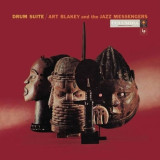
Art Blakey and the Jazz Messengers - Drum Suite

One of the inventors of the modern bebop style of drumming, Blakey is known as a powerful musician and a vital groover; his brand of bluesy, funky hard bop was and continues to be profoundly influential on mainstream jazz.

For more than 30 years his band, Art Blakey & The Jazz Messengers included many young musicians who went on to become prominent names in jazz. Recorded in 1956, Art Blakey's Drum Suite is a wonderful hybrid of African, Latin, and hard bop rhythms that prefigures the concept of Afro-beat by at least a decade. The sheer energy, not to mention its very special and fresh-sounding intimacy, make it especially astounding.

Even more amazing is that the three parts of the suite -- Blakey's "The Sacrifice," Ray Bryant's "Cubano Chant," and Oscar Pettiford's "Oscalypso" -- were recorded straight through live, and were only intended to be a pre-take run-through. As is obvious here, Blakey and company nailed the whole thing right out of the box.

Groundbreaking for its time, and still sounding vital, powerful, and visionary, the Drum Suite album is somewhat of a lost masterpiece that deserves a fresh audience.

"Art Blakey's first release for Columbia Records is essentially two records. Side one is a percussion ensemble playing what would, ten years later, be called Afro-Cuban drumming. Side two is the mid-fifties version of the Jazz Messengers featuring Jackie McLean on saxophone. Side one features Blakey, Jo Jones and Charles Wright on drums, Candido and Sabu on bongos, and Oscar Pettiford and bass and cello. The group plays three compositions, one by Blakey, one by Pettiford and one by Ray Bryant, fusing African, Cuban, and calypso percussion into a well-integrated suite.

"The group recorded a run through and it was so perfectly executed that they used the practice run for the release, unedited except to add some Swahili chants by the percussionists during a few passages. One cannot help but think of Olantunji's Drums of Passion, another Afro drumming landmark, here. Blakey's drum suite was recorded at Columbia's 30th Street studios in New York in 1957 and is in mono. The almost stereoscopic image is truly remarkable. Mastered by Kevin Gray and pressed at RTI, Drum Suite is a valuable record of one of the most important figures in jazz history. Recording: 9/10. Music 9/10." - Dennis Davis, Hifi+

"...The three-part suite was laid down in one take with no arrangements, and begins with a few tympani thwacks followed by an African chant. Soon the ensemble kicks in and the group takes off an a sweaty Afro-Cuban-bop journey that will leave you breathless, as the thing crackles with terrific energy. Side Two is more conventional hard bop, but given this group's mastery of if not invention of the style, these tracks are extremely satisfying. Kevin Gray's remastering is detailed and immediate, with plenty of bit and air, if not the widest dynamic range. For anyone interested in percussion of this genre, this is not to be missed." - Wayne Garcia, The Absolute Sound

pre-order now14.08.2023

expected to be published on 14.08.2023

57,77
DIGABLE PLANETS - BLOWOUT COMB LP 2x12"

* Clear with Purple Center Vinyl * Fully printed inner sleeves * Liner notes by Larry Mizell Jr. // The album is named for the combs used to maintain an Afro hairstyle, and that's significant. The group's Ishmael "Butterfly" Butler said it summed up what they wanted to do with it: "It means the utilization of the natural, a natural style," he has said. Like with 1993's debut _Reachin' (A New Refutation of Time and Space)_, 'utilizing the natural' meant creating hip hop that blended jazz with the formidable rap skills of the aforementioned Butterfly, Craig 'Doodlebug' Irving and Mary Ann 'Ladybug Mecca' Vieira. Unlike that debut, it meant broadening to include guests such as Gang Starr's Guru, Jeru the Damaja, and Jazzy Joyce. Following the gold-selling commercial success of their debut, they here set out to prove their artistic prowess. This is intelligent, alternative hip hop that sounded like party music. Its lyrics are dense with wit, social commentary and politics - and its original inner sleeve was modeled on the newspaper of the Black Panther movement.

out of Stock

Order now and we will order the item for you at our supplier.

68,28

Last In: 2 years ago
Jorge Ben - Solta O Pavão

Jorge Ben

Solta O Pavão

12inchSVVRCH009CV
Survival Research
04.08.2023

A reissue of Jorge Ben's Solta o Pavao, originally released in 1975. Jorge Ben is one of Brazilian music's iconic and best-loved figures. Born Jorge Duilio Lima Menezes in Rio in 1942, he took the stage name, Jorge Ben, in deference to his mother's Ethiopian roots, and later used Jorge Ben Jorge for further distinction. Playing tambourine and singing in a church choir from an early age, Ben began playing in Carnival blocos and was performing in nightclubs as a teen. Signed to Philips in 1963, his "Mas Que Nada" became an instant international sensation that has never waned, despite being sung entirely in Portuguese. Beginning in samba, Ben's openminded approach saw him embrace aspects of bossa nova, the "Jovem Guarda" rock movement of the mid-1960s and the experimental Tropicalia form, the broad palette and diverse influences yielding a number of adventurous and abstruse albums during the 1970s, of which Solta o Pavao is one of the most rated by connoisseurs, though somewhat overlooked in general; its title translates roughly to "Unleash the Peacock" and apparently concerns the outward expression of inner beauty. Against a backdrop of lushly produced samba rock with shades of MPB, highlights include opener "Zagueiro", in which Ben salutes football center-backs in typically playful and poetic language; closing number "Jesualda" is a heady ballad of a chance encounter leading to a girl's social climbing and "Para Ouvir No Radio (Luciana)" a love song with striking flute and string arrangements; Dadi Flavi's bubbling bass and occasional string synths help keep the sound non-standard.

pre-order now04.08.2023

expected to be published on 04.08.2023

19,54
Covet - Catharsis

Covet

Catharsis

12inchTCR015VLGD
Triple Crown Records Inc.
21.07.2023

Covet is fronted by Yvette Young who is revered by guitarists around the world for her mastery of the innovative two-handed tapping technique. Yvette says of the album - "I'd like to be honest - this album process was one of the most challenging ever, and none of the reasons for that was related to the actual music. There was a moment where it felt like it might not come out ever...but I think having patience and faith does pay off. I named this record "catharsis" because the word to me feels like a triumphant exodus. No matter the dire circumstances, music is one of those things that I’ve always needed to create to survive (in all senses of the word), and time and time again, I turn to guitar and songwriting as my outlet to uplift and feel like I have control over something in this chaotic universe. The overall theme of the album is escapism and fantasy, which also feels fitting because in a lot of ways, we use music and art to escape our anxiety, our pain, and our sometimes oppressive realities...to travel to universes that we so badly wished existed. Music is so powerful for this reason because it can be so transformative- it uplifts and empathizes with you without needing to say a single word. With this music, I wanted to tell a concise but dense story that goes many places- not necessarily all joyful. I have been working on it down to the last minute, and in less than 30 minutes, I'd like to take you to all the magical places I’ve been and show you all the highs and lows that I've had the privilege of experiencing during the last 2 years of creating this body of work."

pre-order now21.07.2023

expected to be published on 21.07.2023

23,95
PANBERS - INDONESIAN CITY SOUND: PANBERS’ PSYCHEDELIC ROCK AND FUNK 1971 - 1974 LP

Indonesian City Sound: Panbers’ Psychedelic Rock and Funk 1971-1974

The Pandjaitan Brothers or Panbers came from the North Sumatra minority Christian group, the Bataks, whose ancestry traces back to an island at the center of Lake Toba. As a minority group within Indonesia's Muslim-dominated society, this ethnic minority has produced top military generals, celebrity lawyers, and a legion of pop and rock superstars.

Suffice to say, some of the biggest names in the country's pop history were Bataks. Panbers fit the bill perfectly.

The band's strong Christianity belief looms heavily in the music they produce. The prominent use of the Hammond organ in their early materials is evocative of church music the band members have been around in their whole life. Bandleader Benny Pandjaitan's fills his characteristic wail with existential dread, with many utterances of the word "mengapa" (why).

Guilt is another central theme Pandjaitan repeatedly comes back to in his lyrics. But they balance it with joy, on songs such as "Come on You Dance" "Let's Dance Together" or "Haai" (a play on the word high), where references to recreational substances are plentiful.

Although they modeled themselves after the era's rock bands Beatles and fellow countrymen Koes Plus, Panbers had a unique aversion to the electric guitar. In "Jakarta City Sound," a fiery three-note guitar solo is laid so far down in the mix that they are barely audible. In "Haai" they modify the guitar to sound like a jungle instrument playing traditional North Sumatran music. In "Rock and the Sea," arguably their most well-known song globally, they decided to ditch electric guitar altogether and replace it with a sitar.

In the absence of an electric guitar, Panbers had to rely on Doan's inventive bass playing and Asido's drum works to do the heavy lifting - and boy, do they deliver (Their 1971 debut "Volume 1" saw plenty of drum breaks). In this compilation, listeners will hear recordings from Panbers' fertile four-year period - a time that produced in some of the grooviest and hardest-sounding psychedelic music in Indonesia's rock history.

For those uninitiated on the glory Panbers, consider this compilation an introduction to some of earliest and heaviest rock sound to come out of Indonesia.

out of Stock

Order now and we will order the item for you at our supplier.

22,90

Last In: 2 years ago
Lindstrøm - Everyone Else Is A Stranger LP

‘Lindstrøm returns with his sixth studio album Everyone Else is a Stranger, and the first since 2019’s On a Clear Day I Can See You Forever. The title of the album was inspired by John Cassavetes’ original title for his 1984 film Love Streams, and contains four tracks of his signature chord-stacking disco epics and freeform cosmic voyages, stretching across nearly 40 minutes. An album that in many ways sums up his career, and gathers his different musical paths into one sound and one album.

Where his previous album had a slower and more mellow feel, 2023’s Everyone Else is a Stranger sees Lindstrøm take on a much more rhythm-oriented and uptempo approach, containing tracks that fit perfect with the artist’s revered live sets. That said, this album also contains the unexpected twists and turns that has become the Norwegian producer’s trademark, including recordings of him playing a cheap Chinese cello and violin for the first time alongside the old Solina String-Ensemble he has used on essentially every track since his debut.

Named «the king of space disco» by The New Yorker, Lindstrøm has always made a virtue of his obsessive work ethic, turning his city center studio into a factory floor for churning out monster tracks. He has collaborated with the likes of Todd Terje, Prins Thomas and Todd Rundgren, has remixed a slew of acts including LCD Soundsystem, Lana del Rey, Haim, Grizzly Bear, Flume, RAC, London Grammar and more.’

out of Stock

Order now and we will order the item for you at our supplier.

28,15

Last In: 2 years ago
Mokoomba - Tusona: Tracings in the Sand LP

Five years after the release of ‘Luyando’, Zimbabwe’s most celebrated music export returns with their long-awaited follow-up album ‘Tusona: Tracings in the Sand’. The six musicians from Victoria Falls are refining their unique sound: infectious Afro grooves deeply connected to Zimbabwe’s cultural DNA. ‘Tusana’ is their most danceable album to date, a DIY production recorded in Zimbabwe. It features horns by Ghanaian highlife outfit Santrofi.

Every Sunday, there is a gathering in the sweltering heat on grounds of an old local beer hall in the Chinotimba township in Mosi-o-Tunya (Victoria Falls). Entertainment is provided by various traditional groups including the Luvale Makisi masquerade. It is a day full of singing, drumming, dancing and storytelling. Mokoomba’s lead vocalist Mathias Muzaza can often be found here singing with a voice both soaring and vulnerable. In the course of the afternoon the other band members - guitarist Trustworth Samende, bass player Abundance Mutori, keyboard player Phathisani Moyo, percussionist Miti Mugande and drummer Ndaba Coster Moyo - often join in with singing. The drum driven song “Bakalubale” featured on their new album invites you to this gathering.

Mokoomba recorded ‘Tusona: Tracings in the Sand’, the follow-up album to ‘Luyando’ (2017, Outhere), in Zimbabwe during the pandemic. Instead of working with outside producers like Manou Gallo or Steve Dyer as they have in the past, this album was entirely recorded in a DIY fashion by Mokoomba. The collective from Zimbabwe put in all the experiences made over the previous years and have forged their music into a unique Zimbabwean sound. On popular demand from their fans in Zimbabwe they have even re-recorded three songs from their last more acoustic album ‘Luyando’ turning them into dancehall bangers (featured on the CD and digital versions of the album). In short, this album is more Mokoomba than any of the ones before.

On the album Mokoomba are singing about love, loss, courage in a changing society. The first single “Nzara Hapana” means “no money” in Shona. The song talks about a man who wants to ensure the future of his wife and family and is trying to protect them against the greed of his relatives. The danceable up-tempo song “Nyansola” praises the goddess of harvest and asks her for rain. “Makisi” is sung in Luvale. It celebrates the beauty of the initiation ceremony for which the whole community comes together. “Manina” is a song about losing a loved one. It was written during the pandemic and features the young singer Ulethu from Harare. Mokoomba sing in many different local languages. Their songs are in Tonga, Luvale, Shona, Nyanja and even Lingala used in “Makolo” when they team up with Congolese singer Desolo B. (The album also features horns by Nobert Wonkyi Arthur (trumpet), Bernard Gyamfi (trombone) and Emmanuel Arthur (sax) from Ghanaian highlife outfit Santrofi.)

The title of the album is a nod towards their immense respect for tradition. ‘Tusona’ refers to an ancient system of signs and symbols, drawn in the sand and used for instruction during initiation ceremonies by the Luvale in Southern Africa. Another important part of the Mukanda initiation ceremony is the incredible Makisi masquerade. Since 2008 the Makisi dances are on the UNESCO list of intangible heritage. The Makisi are masked characters, representing the spirit of deceased ancestors. During the yearly initiation ceremony the Makisi return to the living world to teach the young children to become responsible adults among the Lubale people of Southern Africa. In the last decade the interest - especially among the young people – has faded and the Makisi dances have nearly died out.

“Our inspiration comes from these gatherings”, Trustworth Samende explains, “from listening to and playing pure traditional music with everyone in the township. We then add influences from music that we listened to in our homes growing up and the sounds we experience travelling around the world.” It is the connection with the cultures around them that gives Mokoomba’s music its spiritual power. When you hear Mathias Muzaza singing and you watch closely, you will see the music carrying him away to a different sphere, a place where he is singing with the ancestors. Only a split second later though Trust Samende’s sparkling guitar riffs kick in, blending Congolese influences from neighbouring Kasai with Zamrock and Mbira inspired Chimurenga music, making you want to hit the dancefloor. It is this unique blend of local musical styles with contemporary dance music that is at the heart of Mokoomba’s music. The strong reference to tradition is also reflected in the cover illustration by young Zimbabwean visual artist Lomedy Mhako.

It has been nearly 10 years since this young energetic band from Zimbabwe has exploded onto the international music scene. Since then they have shared their music with fans all over the world: Mokoomba have performed in over 40 countries, rocking audiences in places like Roskilde festival (Denmark), WOMAD festival (UK), Sziget festival (Hungary), SXSW (USA), Apollo Theatre (New York) to name but a few.

Like anywhere in the world Africa’s musical output has become more and more producer based. Mokoomba are the living proof that Africa’s great guitar band heritage is well alive and ready to set any dancefloor on fire. Most important though is that deep below the surface of Mokoomba’s sound - flowing like the Zambezi River - you can still hear the heartbeat and the rhythm of a community connected by its music. Like ‘Tusona’, it is a source of rejuvenation, resilience and strength in these changing times. May the tracings in the sand not fade.

pre-order now15.07.2023

expected to be published on 15.07.2023

19,71
Items per Page:
N/ABPM
Vinyl