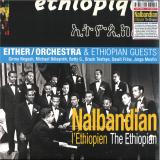
The Éthiopiques series returns! Essential archive recordings from an extremely fruitful period in Ethiopian music.
Before “Swinging Addis” took over the world, there was Moussié Nerses Nalbandian — the Armenian-born composer who shaped modern Ethiopian music. Mentor, arranger, and pioneer, he laid the foundations of Ethio-jazz.
This Éthiopiques volume revives his forgotten legacy, recorded live by Either/ Orchestra First issue ever with new exclusive photos and in depth liner 8-page insert.
“Ethiopian jazzmen are the best musicians that we have seen so far in Africa.
They really are promising handlers of jazz instruments.”
Wilbur De Paris
(1959, after a concert in Addis Ababa)
አዲስ፡ዘመን። *Addis zèmèn* **A new era.**
The time is the mid-1950s and early 1960s, just before "Swinging Addis" bloomed – or rather boomed – onto the scene. Brass instruments are still dominant, but the advent of the electric guitar, and the very first electronic organs, are just around the corner. Rock’n'Roll, R’n’B, Soul and the Twist have not yet barged their way in. Addis Ababa is steeped in the big band atmosphere of the post-war era, with Glenn Miller's *In the* *Mood* as its world-wide theme song, neck and neck with the Latin craze that was in vogue at the same period. Life has become enjoyable once again, with the return of peace after the terrible Italian Fascist invasion of Ethiopia (1935-1941). The redeployment of modern music is part and parcel of the postwar reconstruction. *Addis zèmèn* – a new era – is the watchword of the postwar period, just as it was all across war-torn Europe.
The generation who were the young parents of baby boomers** were the first to enjoy this musical renaissance, before the baby boomers themselves took over and forever super-charged the soundtrack of the final days of imperial reign. Music is Ethiopia's most popular art form, and very often serves as the best barometer for the upsurge of energy that is critical for reconstruction. Whether it be jazz in Saint-Germain-des-Prés or the *zazous* who revolutionised both jazz and French *chanson* after the *Libération*, be it Madrid's post-Franco Movida, or Dada, the Surrealists and *les années folles* that followed World War I, the periods just after mourning and hardship always give rise to brighter and more tuneful tomorrows. Addis Ababa, as the country's capital, and the epicentre of change, was no exception to this vital rule.
**Two generations of Nalbandian musicians**
Nersès Nalbandian belonged to a family of Armenian exiles, who had moved to Ethiopia in the mid-1920s. The uncle Kevork arrived along with the fabled "*Arba Lidjotch*", the** "*40 Kids*", young Armenian orphans and musicians that the Ras Tafari had recruited when he visited Jerusalem in 1924, intending to turn their brass band into the official imperial band. If Kevork Nalbandian was the one who first opened the way of modernism, pushing innovation so far as to invent musical theatre, it was his nephew Nersès who would go on to become, from the 1940s and until his death in 1977, a pivotal figure of modern Ethiopian music and of the heights it. Going all the way back to the 1950s. Nothing less. And it is Nersès who is largely to thank for the brassy colours that so greatly contributed to the international renown of Ethiopian groove. While the younger generations today venture timidly into the genealogy of their country's modern music, often losing their way amidst a distinctly xenophobic historiographical complacency, many survivors of the imperial period are still around to bear witness and pay tribute to the essential role that "Moussié Nersès" played in the rise of Abyssinia's musical modernity.
Given the year of his birth (15 March 1915), no one knows for sure if Nersès Nalbandian was born in Aintab, today Gaziantep (Turkiye/former Ottoman Empire) or on the other side of the border in Alep, Syria... What is certain is that his family, like the entire Armenian community, was amongst the victims of the genocide perpetrated by the Turks. Alep, the place of safety – today in ruins.
Before Nersès then, there was uncle Kevork (1887-1963). For a quarter of a century, he was a whirlwind of activity in music teaching and theatrical innovation. *Guèbrè Mariam le Gondaré* (የጎንደሬ ገብረ ማርያም አጥቶ ማግኘት, 1926 EC=1934) is his most famous creation. This play included "ten Ethiopian songs" — a totally innovative approach. According to his autobiographical notes, preserved by the Nalbandian family, Kevork indicates that he composed some 50 such pieces over the course of his career. This shows just how much he understood, very early on, the critical importance of song as Ethiopia's crowning artistic form. Indeed, for Ethiopian listeners, the most important thing is the lyrics, with all their multifarious mischief, far more than a strong melody, sophisticated arrangements or even an exceptional voice. (This is also why Ethiopians by and large, and beginning with the artists and producers themselves, believed for a long time — and wrongly — that their music could not possibly be exported, and could never win over audiences abroad, who did not speak the country's languages).
Last but not least, one of Kevork's major contributions remains composing Ethiopia's first national anthem – with lyrics by Yoftahé Negussié.
Nersès Nalbandian moved to Ethiopia at the end of the 1930s, at the behest of his ground-breaking uncle. Proficient in many instruments (pretty much everything but the drums), conductor, choir director, composer, arranger, adapter, creator, piano tuner, purveyor of rented pianos,... he was above all an energetic and influential teacher. From 1946 onwards, thanks to Kevork's connexion, Nersès was appointed musical director of the Addis Ababa Municipality Band. In just a few years, Nersès transformed it into the first truly modern ensemble, thanks to the quality of his teaching, his choice of repertoire, and the sophistication of his arrangements. It was this group that would go on to become the orchestra of the Haile Selassie Theatre shortly after its inauguration in 1955, which was a major celebration of the Emperor's jubilee, marking the 25th anniversary of his on-again-off-again reign.
At some point or other in his long career, Nersès Nalbandian had a hand in the creation of just about every institutional band (Municipality Band, Police Orchestra, Imperial Bodyguard Band, Army Band, Yared Music School…), but it was with the Haile Selassie Theatre – today the National Theatre – that his abilities were most on display, up until his death in 1977. To this must be added the development of choral singing in Ethiopia, hitherto unknown, and a sort of secret garden dedicated to the memory of Armenian sacred music, and brought together in two thick, unpublished volumes. Shortly before his death (November 13, 1977), he was appointed to lead the impressive Ethiopian delegation at Festac in Lagos, Nigeria (January-February 1977).
His status as a stateless foreigner regularly excluded him from the most senior positions, in spite of the respect he commanded (and commands to this day) from the musicians of his era. Naturally gifted and largely self-taught, Nerses was tirelessly curious about new musical developments, drawing inspiration from the very first imported records, and especially from listening intensely to the musical programmes broadcast over short-wave radio – BBC *First*. A prolific composer and arranger, he was constantly mindful of formalising and integrating Ethiopian parameters (specific “musical modes”, pentatonic scale, and the dominance of ternary rhythms) into his “modernisation” of the musical culture, rather than trying to over-westernise it. It even seems very probable that *Moussié* Nerses made a decisive contribution to the development of tighter music-teaching methods, in order to revitalise musical education during this period of prodigious cultural ferment. Flying in the face of all the historiographical and musicological evidence, it is taken as sacrosanct dogma that the four musical modes or chords officially recognised today, the *qǝñǝt* or *qiñit* (ቅኝት), are every bit as millennial as Ethiopia itself. It would appear however that some streamlining of these chords actually took place in around 1960. It was only from this time onward that music teaching was structured around these four fundamental musical modes and chords: *Ambassel*, *Bati*, *Tezeta* and *Antchi Hoyé*. A historical and musical “details” that is, apparently, difficult to swallow, especially if that should honour a *foreigner*. Modern Ethiopian music has Nersès to thank for many of its standards and, to this day, it is not unusual for the National Radio to broadcast thunderous oldies that bear unmistakable traces of his outrageously groovy touch.
Search:november reign
- 1
- A1: Dekalog - Nymphea
- A2: The Secret Garden Suite
- A3: Mouvements Du Desir- L'amour
- B1: Forgotten We'll Be - Letter From The Father
- B2: Damage
- B3: When A Man Loves A Woman - Homecoming
- B4: Aberdeen
- B5: The Double Life Of Veronique - Van Den Budenmayer Concerto En Mi Mineur
- C1: Twilight- Transient
- C2: The Funeral- The Waltz
- C3: The Double Life Of Veronique - Les Marionnettes
- C4: Eminent Domain
- C5: Lost And Love
- D1: Queen Of Spain - End Credits
- D2: Three Colours Blue- Song For The Unification Of Europe
- D3: Requiem For My Friend - Lacrimosa
- D4: Love Song 1980
Album "My Life - Preisner's Music is a live recording from a concert held in November 2024 in Bielsko-Bia?a, marking the occasion of Zbigniew Preisner receiving Honorary Citizenship of his hometown, Bielsko-Bia?a.
This year, on May 20th, Zbigniew Preisner will celebrate his 70th birthday, and the album is a his gift he made to himself.
The album includes 17 iconic themes composed by Zbigniew Preisner among others from Three Colours, Decalogue, The Secret garden, The double life of Veronique, Damage, When a man loves a woman, Eminent Domain, Aberdeen, Mouvements du desir, Lost and Love, but also Lacrimosa from Requiem for my Friend in the interpretation of Dominik Wania.
Few words from Zbigniew Preisner:
"For years, I've been thinking about reducing my orchestral themes to a single instrument. As a composer, I pay special attention to melody-each of my compositions always has melodic themes.
Ten years ago, I met Dominik Wania, now a jazz star and a brilliant pianist who records albums for ECM. I knew he was the perfect person to bring my idea to life.
The concert you are about to listen to is the result of our collaboration, which has given me great satisfaction. Dominik Wania's interpretation went beyond my wildest expectations. I hope you will enjoy the album."
Reviews of the album:
"When I teach the films of Krzysztof Kieslowski at Columbia University, I always mention that Zbigniew Preisner is one of the world's greatest film composers. He has many fans among my students. And now there is a new album, a haunting distillation of his movie scores into solo piano performances. It demonstrates how he is the master composer of the tritone, trill and tremolo. Listening to his compositions in their own terms - separate from the cinema screen - foregrounds his distinctive and often plaintive melodies.
Because orchestration, lyrics and narrative function are absent, the listener can focus on the richness of the "standalone" music, beautifully performed by Dominik Wania. For example, the memorable score from Kieslowski's "Double Life of Veronique" now feels more ominous than lyrical. From "Mouvements du desir," the tinkling piano sounds grow into cascading notes that envelop the listener. Whether classical (as in "When a Man Loves a Woman" and "The Waltz from The Funeral") or jazz ("The Secret Garden"), the music reigns when there is no movie screen to distract us. This is equally true of the minor-key gems like "Dekalog" and the briskly upbeat "Transient from Twilight" (which invokes for me the joy of Jon Baptiste's compositions).
In addition to Preisner's scores, the mournful "Lacrimosa" is stripped down from a public performance - which included a choir - to a more personal evocation of grief via solo piano. Finally, listening to "Lost and Love" suggests that if Frederic Chopin and Keith Jarrett had an heir together, it would be Zbigniew Preisner".
Annette Insdorf, Film Professor Columbia University
- A1: ?1 – §2
- B1: ?3 – §4
- C1: ?5 – §6
- D1: ?7 – A Story Never Told
Opeth are one of the biggest acts in the Prog Metal genre with numerous top 10 albums worldwide, ”The Last Will and Testament” is their new album set for release November 22. Guest vocals by Joey Tempest (Europe), and guest flute by Ian Anderson (Jethro Tull). “A restless musical journey in a way mirroring my own relationship with music as a consumer of it," narrates band leader Mikael Åkerfeldt. "I pick up something here, dismiss something there. I worship and I hate music at the same time. This ambivalence leads me down some type of creative path of my own and then, all of a sudden, a collection of songs has been written. Best case scenario, these songs are good enough to impress the band. Good enough for the ”powers that be” in terms of the industry. Good enough for ”you”?! I love this record. I have to say it (write it). Maybe I’m proud even? There are some familiar ingredients in there I suppose. Most of our music has sprung from the same source, so I guess it’s not much of a shocker if it’s going to sound like ”us”. I’m a bit in awe of what we did with ”The Last Will and Testament”. It feels like a dream. There is some ”coherence" and ” songwriting skills” I hope, but what do I know? I tend to favour the ”strange” over the ”obvious”, but I feel like I’m in the minority, and that’s fine. So…fair warning! Don’t expect an instant rush (as per usual), but if you do ”get it” (have you got it yet?) right away, that’s ok too!"
Keiji Haino/Jim O'rourke/Oren Ambarchi
With pats on the head, just one too few is evil one too many...
- My “Watashi Dake?” Is Definitely Not Included In This Unequal Treaty, Is It?
- Right Brain, Left Brain; Right, Left; Right Wing, Left Wing. Just How Many Combinations Can Be Made From These?
- “Critical Consciousness?” That’s Been Abandoned In Corner Of A Shower Room In A 53-Storey Apartment Building Inhabited By Extra-Terrestrial Lifeforms…
- I Thought I Had Pulverized It Summarily But There Are Just Too Many Who Lack Reality Or Who Are Cowards So I Cannot Change A Thing
- E1: Still Divided Into Pieces? Let’s Reconnect Them Recognise That You Are A Point And The Longest Line Let It Become Light
- I Can No Longer Sense That Sacred Feeling Of Expression Just The Loitering Of Vulgar Vibrations That Can Only Be Described As A Half-Hearted Class Reunion Will You Consent To This?
- There Are Always Things I Wish To Say But I Can Only Convey Them In This Language August 6 August 9
The heavyweight trio of Keiji Haino, Jim O’Rourke and Oren Ambarchi return with their 12th and most epic release to date, the triple LP With pats on the head, just one too few is evil one too many is good that's all it is. Documenting the entirety of their final performance at the dearly departed Roppongi home of Tokyo underground institution SuperDeluxe in November 2018, the music spread across these six sides splits the difference between the guitar-bass-drums power trio moves and experiments with novel instrumentation that have defined the trio’s decade of working together. Containing some of the most delicate music the three have committed to wax since the gorgeous 12-string acoustic guitar and dulcimer tones of Only wanting to melt beautifully away is it a lack of contentment that stirs affection for those things said to be as of yet unseen (BT011), this wide-ranging release also offers up some of their most blistering free rock performances yet.
The side-long opening piece finds Haino on a single snare drum in duet with O’Rourke on unamplified electric guitar, playing in the lovely post-Bailey vein heard on his classic 90s recordings with Henry Kaiser and Mats Gustafsson. Spiky dissonance and ringing harmonics interweave with flowing melodic fragments as Haino single-mindedly explores the resonance of the snare like an untutored Han Bennink. On ‘Right brain, left brain; right, left; right wing, left wing. Just how many combinations can be made from these?’, O’Rourke moves to synth and electronics, joined by Ambarchi on drums, who at first focuses on sizzle cymbals before hypnotic cycles of gentle tom rhythms combine with electronic burbles and flutters to suggest a dream collaboration between Masahiko Togashi and Jean Schwarz. Ambarchi’s percussion is then joined by Haino on wandering, overblown flute, before the man in black switches back to the snare for a bizarre, stuttering drum duet.
For the first trio performance, Haino makes another new addition to his seemingly infinite catalogue of instruments, this time a homemade contraption he refers to as ‘Strings of Dubious Reputation’. Joined by O’Rourke on increasingly spaced-out electric guitar and Ambarchi on skittering percussion, Haino’s wonky, slack strings adds a definite ‘musique brut’ edge to this side-long performance, certainly one of the most enchantingly odd in the trio’s discography. When the group reconvene for the second set, spread out across the final three sides, they seem ready to breathe fire from the first instant. O’Rourke slashes distorted chords on the six-string bass, Ambarchi breaks into his signature irregular caveman thump, and Haino squeals and squawks on heavily delayed oboe before unleashing an overpowering electrical storm when he first picks up the guitar. For over half an hour, the trio pound out one of their most relentless performances, a constantly rearranging kaleidoscope of tortured fuzz guitar, insanely busy bass riffing and propulsive, tumbling drums. A hushed atmosphere initially reigns on the final long piece, given the mournful title ‘There are always things I wish to say but I can only convey them in this language August 6 August 9’. Haino’s clean guitar strumming calls up the shimmering tones of his PSF classic Affection, gradually building to a surging wall of sound, bass and drums lumbering through a roar of jet-engine guitar. Arriving in a deluxe trifold package with photos by Lasse Marhaug alongside inner sleeves with extensive live images, this epic release is perhaps the most remarkable document yet of this unique trio’s stamina and continuing inventiveness.
Robert Hood's techno and Femi Kuti's Afrobeat intertwine in a new form where jazz-grooves reign supreme. For the fourth season of La Compagnie des Indes & Sourdoreille "Variations" live series of creations for France TV, the duo were united around the singer and producer James Brown, performing a tribute to the legendary Godfather of Soul who passed away in 2006. This "Variations" album is the live recording of this unique collaboration and performance, capturing a very special moment in time.
The evening witnessed a meeting of two icons in their own genres: one with synths and drum machines, the other on saxophone: Robert Hood and Femi Kuti embody excellence in their respective fields and the pair combined to make something truly unique, soulful, funky and spontaneous. Recorded in one 30+ minute take, "Variations" is embellished by Femi's exquisitely free-flowing yet restrained saxophone, whilst Hood anchors the groove with layers of pads and kicks with the long-time mastery of a true DJ.
Alongside Jeff Mills and Mad Mike, Hood is one of the original members of Detroit techno group Underground Resistance. His style is characterised by minimalist and experimental tones with an assertive groove. Throughout the '90s, he helped pave the way for techno to flourish - giving birth to minimal techno with his seminal album "Minimal Nation". Since then, he has been consistently forwarding electronic music culture with ground-breaking productions, sensational performances and his M-Plant label.
Alongside him, Femi Kuti takes on every musical style with his saxophone, which he plays with a virtuoso touch: pop, soul, electronic music and Afrobeat, of which he is one of the leading exponents. The son of Afrobeat singer and political activist Fela Kuti, he has inherited his father's zeal for both music and activism, where he continues to highlight the plight of most Nigerians living conditions in the oil rich state.
With "Variations" the duo capture an explosive combination on a special night in Paris 4 years ago, November 2019, filmed at the ADP Group headquarters (Paris Aéroport - Charles de Gaulle (CDG) - Roissy).
"It is so amazing when a vision comes to fruition. I enjoyed collaborating with the legendary Femi Kuti for this special project." Robert Hood
- A1: T Raumschmiere - Eterna 2
- A2: Mikkel Metal - Octarine
- A3: Yui Onodera - Cromo 7
- A4: Triola - Bergfreiheit Silbach, Glück Auf!
- A5: Thore Pfeiffer / Niko Tzoukmanis - Kontur
- A6: Joachim Spieth / Głós - Panta Rhei
- B1: Sono Kollektiv - Ever Last Thing
- B2: Blank Gloss The Replacement Wheel
- B3: Reich & Würden - Orbit (Feat Alex Linster; Joel Jaffe)
- B4: Segensklang - Bergfrieden
- B5: Ümit Han - Nirgends
Dear gourmets of audio-aesthetic rapture, dear sound poets, please welcome - Pop Ambient 2024. Twenty-four. Twenty-four can be divided by two, four, six, eight, twelve and itself. If something can be divided by itself, it is not really divisible. Truthfulness knows no formulas. Beauty knows no formulas. Beauty saves the world for no reason whatsoever. “Beauty is a promise that beyond mediocrity there is something where calmness reigns. Beauty calms the nerves. Beauty is not a good intention but a fact. Beauty is provocation, rigor, responsibility. And beauty has its price”.
In addition to the official version of Pop Ambient 2024, there will be an art/music edition limited to 10 pieces, consisting of an exclusive mini bonus album (vinyl dubplate) from Blank Gloss, in combination with 10 individual fine art print artworks by Veronika Unland. The edition will be available via kompakt.fm/art exclusively on November 24th, 2023.
Ladies and Gentlemen please welcome, Pop Ambient 2024
Liebe Gourmets audio-ästhetischer Verzückung, liebe Klang-Poeten, please welcome - Pop Ambient 2024. Vierundzwanzig. Vierundzwanzig lässt sich durch zwei, vier, sechs, acht, zwölf und sich selbst teilen. Wenn sich etwas durch sich selbst teilen lässt, ist es nicht wirklich teilbar. Wahrhaftigkeit kennt keine Formeln. Schönheit kennt keine Formeln. Schönheit rettet die Welt ohne jeden Grund. „Schönheit ist ein Versprechen, dass es jenseits der Mittelmäßigkeit etwas gibt, wo Ruhe herrscht. Schönheit besänftigt die Nerven. Schönheit ist keine gute Absicht, aber eine Tatsache. Schönheit ist Provokation, Strenge, Verantwortung. Und Schönheit hat ihren Preis“.
Neben der offiziellen Ausgabe von Pop Ambient 2024, wird es eine auf 10 Stück limitierte Kunst/Musik Edition geben, bestehend aus einem exklusiven Bonus Mini-Album (Vinyl Dubplate) von Blank Gloss, in Kombination mit 10 individuellen Fine-Art-Print Artworks von Veronika Unland. Die Edition wird am 24.11.2023 exklusiv über kompakt.fm/art erhältlich sein.
Ladies and Gentlemen please welcome, Pop Ambient 2024
TOP PRIORTY RELEASE. Escape Music is delighted to announce the release date for the long awaited Jelusick debut album title “Follow The Blind Man” featuring Dino Jelusick the most well loved and respected vocalist in the Rock World! will be available on CD, Vinyl, and digital platforms! The Vinyl will be limited edition to 500 copies only! “Blade Bullet” colour and all will be numbered 1-500.Jelusick is: Dino Jelusick – vocals, keyboards, guitar / Ivan Keller – guitar / Luka Broderick – bass, backing vocals / Mario Lepoglavec – drums, backing vocals / Produced by Dino Jelusick, Mixed and Mastered by Simon Jovanovic, Executive Producer Dario Jelusic - JELUSICK played on 4 European tours during 2021- 2023 which also included Guitar Scene festival 2021 where they played with all star band together with John Norum and Gus G. The same line up also played there in 2022 and shared the stage and jammed with Airbourne, Johnny Depp & Jeff Back, Black Label Society, and Beth Hart. Dino Jelusick, born 4 June 1992, is a Croatian rock singer, musician, and songwriter. He was the founder, principal songwriter and lead singer of hard rock band Animal Drive, which was formed in 2012. and dissolved in 2020. Since 2016 Dino became a permanent member of American rock band Trans-Siberian Orchestra. He also worked with Gus G, Mike Mangini, George Lynch, Will Hunt, Michael Romeo, Jeff Scott Soto, Joel Hoekstra, Steve Smith, Jon Oliva, Kip Winger, John Macaluso, Deen Castronovo, Phil Demmel, Mike Portnoy, Henrik Linder, Justin Johnson, Tony Franklin, Kyle Hughes, Virgil Donati, Kiko Loureiro, Jordan Rudess, David Coverdale, Tommy Aldridge, Reb Beach, Michele Luppi, Lachy Doley etc. On July 27th, 2021, upon direct phone call from David Coverdale shortly after that David announced that Dino had become the new member of Whitesnake! In 2009 he started recording a new studio album in Melbourne, Australia which was finalised with producer Robert Ahrling in Malmö, Sweden. The album named “Living My Own Life” was released in August 2011. Between 2012 and 2013 Dino was hired to take part in an international project in South Africa named “Synkropation” where he was featured in several songs and played to an audience of 50.000 people in Johannesburg and also participated in two rock operas. In 2015, American drummer John Macaluso (Ark) invited him as singer and the keyboardist for his new American-Croatian band Stone Leaders. During this time, Dino was also a member of Croatian metal band The Ralph with whom he released the album “Enter Escape” in February 2017. In February 2016 he was noticed by American rock band Trans-Siberian Orchestra. After auditioning and meeting with producer Paul O’Neill and Dino was chosen to join the group. 2018 his band Animal Drive released debut album, “Bite!”, to critical acclaim. April 2019, they released a covers EP titled “Back to the Roots”. Dino was also featured singer on two songs on Magnus Karlsson “Free Fall” album. 2020 Dino Joined ex-Krokus members and Mandy Mayer (Gotthard, Asia, Unisonic…) for a concert project named Gotus and they released a video for the song “Souls Alive” (Unisonic). July 2021 Michael Romeo, guitar master from NY insisted that Dino should sing on his new album “War of the Worlds part 2” and it became a great and successful collaboration. 2022 Dino toured Europe with Whitesnake. As the last part of the EU tour was cancelled due to some DC health issues, Dino joined The Dead Daisies tour replacing Glenn Hughes who got unwell at the end of November 2022.A 2 year long legal battle with Dino’s ex-label was over and he immediately started recording new songs for his band JELUSICK…Welcome back Dino!
Das Debütalbum von Sheffield's Heaviest aus dem Jahr 2013 ist nun endlich als 10th Anniversary Re-Issue wieder erhältlich. MALEVOLENCEs "Reign Of Suffering" ist eine erfrischend old school klingende Platte, die die Genres Thrash, Death Metal und Beatdown-Hardcore unbeschwert überspannt. Bösartig groovig, schwerer als Beton und für den Pit gebaut! Nach der Veröffentlichung ihres dritten Albums "Malicious Intent" im Jahr 2022, das in Deutschland auf Platz 32 der offiziellen Albumcharts einstieg, tourten MALEVOLENCE zuletzt mit Heaven Shall Burn & Trivium durch Europa, sind derzeit mit Beartooth & Trivium in ganz Nordamerika unterwegs und werden im November/Dezember mit Sylosis, Guilt Trip und Justice For The Damned erneut in Europa headlinen. "Reign Of Suffering (Re-issue 2023)" ist als Jewelcase CD oder als Ltd. Edition auf transparentem, grün gefärbtem 180g Vinyl über Century Media Records erhältlich.
First Time On Black vinyl. A lot has happened to the Magic Castles since this was released in April 2021 this release took over a year to be manufactured, the band have toured with the Brian Jonestown Massacre & the Warlocks in the USA in 2022 & the the track “Lost Dimension” was used in the HBO series “Succession” so not a bad 2022 for the band. Sun Reign is the band’s fourth release on Anton Newcombe's label ‘A’ Recordings Ltd. Ironically similar to BJM, the Magic Castles have been plagued by lineup changes over the years. In November of 2019, tragedy struck and Edmonds was seriously injured in a car accident that required hospitalization and surgery. Friends started a Go Fund Me that raised over $20k USD for the uninsured musician’s hospital bills, showing an incredible outpouring of love and support for him and his family. Fortunately, Edmonds has made a complete recovery from his injuries and has bounced back remarkably well. In early 2020, Edmonds managed to finish the remaining work on the album “Sun Reign”, including a previously unreleased song, “Surmise'' penned by guitarist Jermiah Doering, and a rare cover of a moody 1966 garage rock song “Ode to the Wind” by Danny and the Counts. Edmonds also began working with a booking agency, planning a return tour to Europe with the band to support the new album. Unfortunately, it was not to be. Due to the global pandemic crisis of Covid-19, the album was delayed until 2021, and the promising tour was cancelled. In May of 2020, Minneapolis police killed George Floyd two blocks from Edmonds’ home, which incited riots across the country. The protests led to the burning of Minneapolis, where a long time music venue and many other buildings were lost. Edmonds’ studio was not destroyed although many nearby buildings were. Edmonds is a known supporter of Black Lives Matter Tracklisting:- 1) Sunburst , 2) Lost Dimension , 3) Ode to the Wind , 4) Asuras , 5) World of Time , 6) Valley of Nysa , 7) Magna Mater , 8) Surmise , 9) Gates of the Sun , 10 ) Relax Your Mind
Das 2021 erschienene Dream Unending-Debütalbum "Tide Turns Eternal" stellte für Derrick Vella (Tomb Mold) und Justin DeTore (Innumerable Forms, Sumerlands) eine deutliche Veränderung ihrer musikalischen Ambitionen dar. Obwohl das Album fest im Death/Doom-Bereich angesiedelt war, zeichnete es sich durch eine weitaus höhere Zielsetzung und Progressivität aus und distanzierte sich damit von anderen Vertretern dieses Stils. Jetzt, nur ein Jahr später, kehrt die Band mit dem atemberaubenden "Song of Salvation" zurück und lässt diesem Erkundungseifer wesentlich mehr Raum, sich zu entfalten und zu glänzen.
Der 14-minütige Opener des Titeltracks beginnt wie ein morgendlicher Sonnenaufgang über einem ruhigen Meer, bevor er sich zu ätherischer Schwere steigert wie die reich strukturierten Wellen eines plötzlichen Meeressturms. Der Schwung des Songs zieht sich nie in mühsame Wiederholungen zurück, sondern öffnet immer wieder neue Türen, ebbt und fließt wie das Wasser eines Flusses aus seiner Quelle.
Wie ein einsamer Blick aus dem Fenster eines abgedunkelten Zimmers auf die nächtlichen Lichter der Stadt, so bietet "Secret Grief" die Gasttalente des Sängers Phil Swanson und Leila Abdul-Rauf an der Trompete, was die Bandbreite der beteiligten musikalischen Talente und die Tragweite der unverwechselbaren Erzählung von "Song of Salvation" noch weiter vergrößert.
Das ruhige Zwischenspiel "Murmur Of Voices" weicht dem beschwörenden "Unrequited", das mit einem einsamen Gitarrensolo beginnt, bevor es in eine treibende Nachmittagsträumerei und unterbewusste Meditation übergeht.
Schließlich kommt das epische Ende des Albums, der 16-minütige Abschluss 'Ecstatic Reign'. Es enthält die vielleicht schwersten Doom-Momente des Albums sowie die Rückkehr von "Tide Turns Eternal" mit den Gaststimmen McKenna Rae und Richard Poe. Tomb Mold-Schlagzeuger / Kehlkopf Max Klebanoff taucht ebenfalls auf und liefert sich ein beeindruckendes Vocal Battle mit DeTore. Die cineastische Vision des Albums und die akribische, farbenfrohe Detailtreue bringen diese fesselnde Reise zu ihrem dauerhaften Höhepunkt.
Nur ein Jahr nach "Tide Turns Eternal" bieten Dream Unending auf dem grenzenlosen Panorama von "Song of Salvation" eine fortgesetzte Abkehr von begrenzenden Genre-Normen - und gleichsam eine geschickte Neudefinition derselben.
- Decibel Magazine Album des Monats November 2022 Ausgabe
- Gastauftritte von Phil Swanson (Solemn Lament, ex-Sumerlands, ex-Hour of 13), Leila Abdul-Rauf (Vastum, Ionophore) und Max Klebanoff (Tomb Mold, Death Kneel)
- Die Vinyl-Edition enthält ein riesiges 24x36-Zoll-Poster
- Aufgenommen von Sean Pearson und Arthur Rizk. Gemischt und gemastert von Arthur Rizk (Gravesend, Daeva, Eternal Champion, Power Trip, Kreator).
- Wunderschönes Cover-Artwork von Benjamin A. Vierling (Joanna Newsom, Nightbringer, Aosoth)
- Hauptmitglieder sind Derrick Vella (Tomb Mold) und Justin DeTore (Innumerable Forms, Sumerlands, Solemn Lament)
- FFO: Anathema, Evoken, Tiamat, Opeth, Trouble, Blue Nile, Live, Alice In Chains, Kings X
On High Flying Man, the third LP by Matt Berry’s pseudo-eponymous project The Berries, loss and desire take center stage. Berry delves deep into 21st century malaise, crafting densely layered songs which project an unshakable yearning for deliverance from the world’s shortcomings. Each track extends an outstretched palm towards universal connection, blending a complex of mix of pop hooks, rock swagger, and psychedelia into dejected populist anthems. Faced with the perils of an isolating world, High Flying Man reignites the tradition of great American songwriting, speaking in the voice of the longing masses. At heart, Berry demands more life, rejecting both arty cynicism and nostalgic escapism.
Berry cut his teeth at a young age playing in the bands Happy Diving (Topshelf Records) and Big Bite (Pop Wig), and has since regularly served as a touring member for bands like Angel Dust and Dark Tea. His early work with Happy Diving and Big Bite solidified his position as an upcoming star in the world of fuzzed-out indie rock, earning him tours and opening slots with the likes of Turnstile, Dinosaur Jr., Nothing, The Swirlies, and The Coathangers. With The Berries, however, Berry turns the Big Muffs down (although not off), creating sonic space to stretch his wings as a burgeoning pop songwriter. The psychedelic-surrealist textures of his earlier output are not gone, per say, but rather find themselves folded into more expansive, rock-oriented arrangements, becoming accoutrements as opposed to the driving force of each song itself.
High Flying Man follows The Berries’ previous releases, 2018’s Start All Over Again and 2019’s Berryland. While longtime listeners will undoubtedly recognize Berry’s disaffected drawl and melodic sensibility, High Flying Man’s complex arrangements and expansive sonic landscape place it well apart from its predecessors. Berry enlisted live band members Danny Paul (drums), Emma Danner (backing vocals), and Lance Umble (bass) during the recording of High Flying Man, as well as the mixing talents of Rob Schnapf (Elliott Smith, Beck, Guided by Voices), breaking from the self-produced home recording ethos of the previous Berries LPs. The collaborative nature of High Flying Man’s recording process is reflected in the quality of each song’s arrangement. Freed from the pressure of being individually responsible for every detail committed to tape, Berry was able to focus his attention more fully on the creative demands of constructing a dynamic and cohesive record. High Flying Man pivots away from any sort of obvious nod to Americana tropes, baggy British attitude, or Neil Young-esque riffing, leaning head on into a lush, idiosyncratic grandeur.
Each track evokes the irreverent and flashy style of a songwriting voice finding itself for the first time. Berry’s guitar heroics extend towards new heights, channeling the simple pop mastery of Lindsay Buckingham (“Prime”) and the wicked emotion of a 21st century “November Rain” (“High Flying Man”). Unusual stylistic juxtapositions give certain songs an almost timeless quality: Bert Jansch-esque crooning finds its counterpoint in sweeping, distortion-soaked riffs (“A Drop of Rain”), the primitive rhythms of Amon Duul are given an arena-sized, Britpop facelift (“Life’s Blood”). On High Flying Man, however, the ballad reigns supreme. “Down That Road Again” drips with sentimentality, powered by soft, undeniable pop melodies and pared-down chord progressions. Album-centerpiece “Eagle Eye” teeters between pure grace and extreme sorrow, unfolding into a massive, immediately memorable tide of melancholic beauty.
Lyrically, High Flying Man is both simple and direct. Although often bitter about the state of the world, Berry has no overtly political axe to grind. In some instances, he takes jabs at the moral laziness of aging millennials, expressing his yearning for a return to vitality and conviction (“Prime”). In other instances, Berry turns his criticism inwards, examining his longing for a better life and his repeated tendency to self-sabotage (“Down That Road Again”). These two poles balance each other out, creating a thematic tenor which is more so self-implicating and empathetic than critical. If anyone is to blame, it is the world we have been saddled with, not the people left to pick up its pieces. Although often personal, Berry’s words evoke a universal experience of continued belief in the face of loss. “High Flying Man” chronicles the growing distance between Berry and an old friend who has been shipwrecked by the weight of trauma, evoking the sorrow of trying to love someone who is no longer able to keep up with reality. Even the most somber passages of “Eagle Eye” (“long before I become aware of it, my friend/it’s 6 AM and I’m gonna die”) find their redemption in a burning devotion towards something worth living for (“If there’s one thing I can depend on/it’s my old friend/my shining light/my eagle eye”).
With High Flying Man, Matt Berry embraces undying love in the face of isolation. Daring to want more life becomes a spiritual rallying cry against a world that has failed to make life either meaningful or beautiful. At their core, these songs are not about revolution, but they are about the faith that gives something like revolution a purpose in the first place.
In November 2020, with the entire world locked down at home, Amir
Bresler was itching to create - He'd spent years onstage, but never
released a full solo album
A friend's invitation brought him to a rural village outside Tel Aviv, and the move lit a spark: Bresler set up shop in the village's local auditorium named 'The House of Arches', and planned single-day sessions with different combinations of Tel Aviv's finest, including keyboardist/ producer Rejoicer, Yemen Blues frontman Ravid
Kahalani, bassist Gilad Abro, pianist Nomok and trumpeter Sefi Zisling. For nearly a week, crews of friends drove north and dug into psychedelic jazz and funk, all built upon Bresler's polyrhythmic beats. They captured spontaneous bursts of energy ' free-form jams in the morning reigned into tight, mesmerizing grooves in the afternoon. Those six compositions ' each recorded live in one day ' make up
House of Arches, Amir Bresler's first solo LP, out on Raw Tapes, with grooves as deep as the Mediterranean where it was conceived.
- 1