quête:nzo

Genres
Tout
  • 1
NZO - Come Alive

NZO

Come Alive

12inchDDS084
DDS
15.07.2025

NZO goes sick on a standout debut album for Demdike Stare’s DDS, distilling 2-step UKG, R&B and computerised funk within whirring mechanisms adjacent to mutant jungle and footwork - the proper good stuff.

On ‘Come Alive’ SoYo’s NZO bruks wild but tight on nine tunes chiselled from a distinctive percussive palette cut into fidgety, soulful samples. She dances in and around the cracks of myriad styles with a canny grasp of limb-animating, rhythmic diffraction; all stop/start rhythms and stuttering diva-vocaloids arranged with a rudely shatterproof, grooving pliability. More simply put: it’s dance music for those who like to get super loose and freaky with it.

Chopped up and stitched together over six months in Sheffield, it’s not hard to hear a lineage of advanced Afro-American rhythm science that also feeds into SND’s jerky-but-sexy angularities, and subsequently Rian Treanor’s rugged pugilism, now morphing back to the source, but heavily skewed with it. Her judicious sampling of R&B gems is offset in obliquely funked-up structures in ways that knowingly mess with conditioned anticipations yet never lose sight of the ‘floor, and we’re here for it.

Jumping in with the writhing darkside tekkerz of ‘Rolling Around’ and clocking out with a standout downbeat pearl ‘Looking For’, we hear her displace amapiano closer to halfstep D&B in ‘AXMM’, and decimate 2-step like Akufen on ‘CFML’, while ‘K-space baum bap’ appears to dart in the spaces between UKG and singeli, and the sloshing congas, bass motifs and dub chords of ‘Deadweight’ settle to a sort of aqueous UKF.

En stock

Disponible en stock et prêt pour l'expédition

28,99
NZO - Concentrate

Nzo

Concentrate

12inchDDS069
DDS
10.09.2024

DDS presents the debut EP from unknown entity NZO, whomever she may be, dancing in the gaps between amapiano, Afrobeats, broken beat and R&B with a rare guile and flavour.

The 4th in the DDS 12” series, NZO helps stake the label’s 15th year of operations with a typically Janus-faced approach to classic >< contemporary club ruffage. Tune to tune, she decimates and distills familiar tropes in singular, whirring syncopations designed to prompt bodies to move in fresh new ways. It’s all primed for proper animist magick, bound to snag rhythm fiends with its shape-cutting manoeuvres.

Working deep in the hardcore ’nuum’s 30 odd year tradition of concrète sampler chicanery, the four tracks find fractured vocals and echoes of club classics revitalised and reset with advanced drum ingenuity. 160BPM opener ‘Concentrate’ appears like Hessle Audio’s Joe stripped for parts, whilst ‘Mallet’ swivels like SND remodelling Afrobeats’ palette of tuned percussions, next to what could almost be a lost Various Production edit in the sublime tension of syrupy R&B and frothing drums on ‘Come Alive’.

The EP ends with its standout, ‘Body & Soul’, an undulating ama simmer punctuated by dub chords like some lost Basic Channel production re-cast for the lovers.

pas en stock

Commandez maintenant et nous commanderons l'article pour vous chez notre fournisseur.

22,65

Last In: 16 months ago
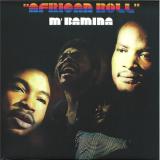
M’BAMINA - AFRICAN ROLL

Gatefold Sleeve

M’Bamina – African Roll (1975)
The story of an album born between Africa, Italy, and the nightclub culture of the 1970s
In the heart of 1970s Italy — a country undergoing profound social change and a music scene just beginning to open itself to distant sounds and cultures — an extraordinary, almost improbable story took shape. It is the story of a group of young African musicians who found their way to Europe, of a Turin nightclub that became a crossroads for communities and experimenters, and of an album which, released in small numbers and largely unnoticed at the time, is now considered a rare jewel of Afro-fusion.
The band called themselves M’Bamina — an ensemble of musicians from Congo, Cameroon, and Benin, who arrived in Italy in the early Seventies. Settling between northern Italy and the Pavia area, they began performing in small clubs and community events, bringing with them a vibrant rhythmic heritage: African polyrhythms, call-and-response vocals, funk-infused bass lines, and Caribbean or Afro-Latin colours absorbed along their musical journeys. Their raw, contagious energy on stage quickly drew attention.
Meanwhile, in Turin, another story was unfolding. There was a venue becoming almost legendary: Voom Voom, one of the city’s liveliest nightclubs, run by Ivo Lunardi. The club attracted an eclectic crowd — students, artists, foreigners, night owls — and Lunardi quickly understood that the dancefloor wasn’t just a place for music, but a melting pot for a new kind of cultural energy. Out of this vibrant atmosphere came his idea: to turn the club’s name into a small independent record label, Voom Voom Music, capable of capturing the spirit of those years and giving voice to unconventional projects.

When Lunardi heard M’Bamina, he immediately sensed that this was the sound he had been searching for: fresh, different from anything circulating in Italy at the time, and capable of blending African tradition with funk and European sensibility. He brought them into the studio.
Production was handled by Lunardi along with Christian Carbaza Michel, while the engineering was entrusted to Danilo Pennone, a young sound technician with a sharp, intuitive ear.
The recording sessions — held in Turin in 1975 — produced a remarkably warm and direct sound. The music feels almost live: grooves rooted in African tradition, but open to funk-rock structures and modern arrangements. It is a natural fusion, never forced. Tracks move between tribal rhythms, funk basslines, light electric guitars, congas and Afro-Latin percussion, with call-and-response vocals and melodies that echo both Congolese tradition and the lineage of Latin jazz. Not by chance, one of the album’s most striking tracks, Watchiwara, reinterprets a Latin standard through M’Bamina’s own rhythmic language.

The album was titled African Roll — a name that was already a statement of intention. It is African music that “rolls,” that moves, adapts, transforms within a new geographic and cultural setting. It is not strictly Afrobeat, nor Congolese rumba, nor Western funk: it is a spontaneous, hybrid blend, shaped more by lived experience than by any calculated aesthetic program.
When African Roll was released, the world around it barely noticed. Distribution was limited, and 1970s Italy had yet to develop a cultural framework for receiving such music. The national music press rarely paid attention to African or “world” productions. The album slipped into silence — though the band’s own story did not.

M’Bamina continued performing across Europe and Africa, even sharing a stage in Cameroon with none other than Manu Dibango. By the late Seventies, they moved to Paris, signed with Fiesta/Decca, and recorded a second LP, Experimental (1978). Meanwhile, the peculiar record they had made in Turin began to resurface quietly among vinyl collectors, Afro-funk enthusiasts, and DJs hunting for forgotten grooves.
That is when the album’s fate began to shift.

Over the decades, African Roll emerged as an almost unique document: a snapshot of an intercultural Italy before the word “intercultural” even existed, a fragment of migrant history, a spontaneous experiment in musical fusion born far from major industry circuits but rich in authenticity. Original copies began commanding high prices on the collector’s market, and the album became recognized as one of the hidden classics of European Afro-fusion from the 1970s.
Today, more than fifty years later, this reissue finally restores visibility and dignity to a project that deserves to be heard, studied, and celebrated. It is not simply an album: it is the testimony of a rare cultural encounter, born in an Italy unaware of how fertile such exchanges would one day become.

It is the story of a visionary producer, an extraordinary band, and a fleeting moment in which music, migration, and nightlife came together to create something genuinely new.
African Roll is — now more than ever — the sound of a bridge: between continents, between eras, between cultures. A record that, after rolling far and wide, has finally come home.

En stock

Disponible en stock et prêt pour l'expédition

23,49
Various - I-ROBOTS PRESENTS: TURIN DANCEFLOOR EXPRESS, THE AGE OF VOOM VOOM MUSIC LP 2x12"

Daniele Baldelli
"A pleasant surprise to find in this release various atmospheres and sounds that have always been part of my DJing. It even made me rediscover M’Bamina, whom I used to play back in 1974 at the Tabù Club in Cattolica.
There are afro vibes as well, with Black Line – Myele, which is featured on one of my Cosmic tapes, and Nowhere by the Stratosferic Band recalls a track I used to play at the Baia degli Angeli…
Excellent work!"

Voom Voom Music was an independent Italian record label based in Turin, founded and managed by record producer Ivo Lunardi (Turin, December 6, 1940 – December 9, 2010). A pivotal figure in the Piedmont music scene, Lunardi was active both as a DJ and as the owner of several disco clubs.

The label operated for several years in the latter half of the 1970s, releasing mainly productions connected to the Italian dance and pop scene.
Since 2016, the original master tapes from the Voom Voom Music catalog have been owned by Gianluca Pandullo (I-Robots), a close friend of Ivo and Luca Lunardi. Through his labels Opilec Music and Turin Dancefloor Express, Pandullo oversees their preservation and historical enhancement.

The artistic direction of Voom Voom Music was marked by a distinct sonic identity — eclectic yet visionary. The Turin-based label founded by Ivo Lunardi embraced a sound that blended disco, pop, and rock influences, interwoven with African American grooves in a pioneering, international perspective.

Voom Voom Music was among the first Italian labels to introduce this kind of musical language in the country. A prime example is the Italian edition of the debut album by B.T. Express, Do It ('Til You're Satisfied), released in LP, 8-Track Cartridge, cassette, and 7" single formats.
The label’s productions clearly reflected the influence of black and funk music, as evidenced by the references and inspirations running through its catalogue. The track “Lady Pick-Up”, for instance, includes direct nods to “Do It Good” by KC & The Sunshine Band and Manu Dibango’s iconic “Soul Makossa”, revealing a musically refined and contemporary sensibility.

Among the label’s most representative works is Splash (1977) by the Stratosferic Band, a project conceived by Luigi Venegoni — producer, songwriter, and guitarist of Arti e Mestieri. Venegoni’s artistic journey spanned from progressive rock to space and Italo disco. The album artwork was designed by Piero D’Amore (1944 - 2022), a charismatic and multifaceted figure of Turin’s art scene (one of his works was even acquired by the MoMA in New York).
The record includes a disco reinterpretation of Van Morrison’s classic “Gloria”, and “Splashdown”, a track fusing the disco-rock energy of Rockets and Space. In contrast, “Nowhere” revisits the 1975 single by Hokis Pokis, a soul/disco band from Nassau County (New York), transforming it into a vibrant disco-funk number.

Another significant expression of the label’s catalogue is the afro-rock sound of M’Bamina, an Italo-Congolese group whose rhythmic energy and dialogue between African percussion and Western funk evoke the style of international formations such as Osibisa — themselves linked to a rich artistic history in Italy.

En stock

Disponible en stock et prêt pour l'expédition

27,69
Konono No 1 - Konono No 1 Meets Batida

For this album, the legendary Congolese band Konono N°1 has joined forces with acclaimed Angolan/Portuguese artist Batida aka Pedro Coquenão. Deluxe double LP with colour innersleeves and download code.

Along with producer Vincent Kenis, they convened in Batida's garage-cum-studio in Lisbon with a series of collaborators and friends of Batida's, reflecting the city's vibrant, cosmopolitan music life: guitarist Papa Juju (the leader of Lisbon's foremost Afro-fusion band Terrakota), vocalist Selma Uamusse (one of the best young African singers currently residing in Portugal) and MC AF Diaphra, a distinguished slam poet and an artist/producer in his own right.

As we all know by now, Konono N°1 are based in Kinshasa, DRC, but originate from the Bakongo ethnic group, which lives in a region straddling the border between the Congo and Angola. Hence certain similarities between Konono's rhythms and some types of Angolan music from which Batida has drawn inspiration for his albums and shows.

This encounter was obviously bound to happen... but was nevertheless quite an adventure: blending the worlds of electronics beats and organic grooves was a challenge to which the parties have risen beautifully to create this exciting, unheard-of new strain of Afro-electro music. The album was jointly produced by Vincent Kenis and Pedro Coquenão.

pas en stock

Commandez maintenant et nous commanderons l'article pour vous chez notre fournisseur.

26,77

Last In: 7 years ago
  • 1
Articles par page:
N/ABPM
Vinyl