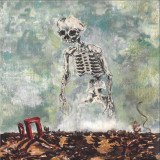
David Wrench and Evangeline Ling - aka audiobooks - threw
absolutely everything at their 2018 debut album, ‘Now! (in a
minute)’, a hectic, head-spinning blast of freewheeling freak-pop
genius. On its follow-up, ‘Astro Tough’, via Heavenly
Recordings, they’ve somehow found a way to ramp things up
even further, concentrating their chaotic energy and inherent
weirdness into a record that’s bigger, deeper and more powerful
han even its predecessor.
“The first album was a photograph of the beginnings of the
project, recorded without any overall plan,” Wrench explains.
“‘Astro Tough’ is more scripted, but a script that still allowed for
ots of improvised scenes. There was more intention behind the
songs, and a lot more refining. We weren’t precious about
everything being spontaneous and a first take, like on the first
record, even though some of it ended up being that. We made a
ot more material for this record, but chose the tracks that best
worked together as an album.”
Multi-instrumentalist and super-producer Wrench is as
comfortable unleashing monolithic psychedelic wig-outs and
heavy dub-driven monsters as he is crafting irresistible synthpop bangers. Writer, vocalist and visual artist Ling is as
chameleonic as she is charismatic, able to jump from
detachment to rawness to aggression to tenderness to hilarity to
oe-curling awkwardness, sometimes within the same song.
Though the record is a product of increased refinement, the pair
were physically together only in bursts, cramming sessions
around their respectively hectic calendars. “We had much less
time together than on the first record, but every time I did see
David that thirst and the ability to come up with something was
there. I think this record is better than the first record, and I
think we’re dying to make more. We’re going to try and better it
again,” says Ling.
Eco-mix colour vinyl. Black vinyl format (HVNLP183) will be
made available once coloured vinyl is sold out.
quête:oe
Meditative tropical soundscape of the Hawaiian Islands
Originally pressed in 1980 in limited quantities
Meticulously restored and remastered by Jessica Thompson
A lost gem from the exotica pioneer's catalog: the rarest of all Arthur Lyman releases — and his last recorded album — Island Vibes a meditative tropical canvas of the Hawaiian Islands’ natural beauty.
A welcomed sonic transport to paradise, much needed in these times of chaos. Originally recorded with Broad Records, who’s responsible for Phase 7’s Playtime and other important 1970s and 80s-era local records.
Blissful ambient scapes alternated with dark tones and spacious IDM trips: Nous'klaer proudly present the third album by the Rotterdam via Sydney producer Nadia Struiwigh. After her Oooso EP earlier this year, Nadia returns with nine healing tracks to dream to. Artwork courtesy of Yan Cook.
Not Waving renders his pop soul on a definitive album opus ‘How To Leave Your Body’, starcrossed with guest appearances by Jim O’Rourke, Jonnine Standish, Marie Davidson, Spivak and Mark
Lanegan
An escapist parable for the times, Alessio Natalizia marks a career high with his most sensitive production and songwriting illuminated by a coterie of notable collaborators. Its 11 songs deal with the necessity of friendship, the fragility of loss and spiritual transcendence via a spectrum of strategies that ultimately arrive at a mutual conclusion: love is the message. It packs sample amounts of nostalgia into a fantasy sequence of elegiac pop, skewed rave and midnight lullabies that fine-tune over 20 years of devotion to his craft, perfectly matching experimental restlessness with enduring pop appeal.
Perhaps unavoidably, circumstances had a hand in the creation of ‘How To Leave Your Body’, forcing Natalizia to work with collaborators remotely. Yet the strength of his bonds bleeds through in the album’s handful of poignant vocal pieces, none more so than the hushed intimacy of Marie Davidson on the bewitching downbeat trance hymn ‘Hold On’, but also in the bruised blush of ‘My Sway’ featuring Jonnine’s spine-tracing lilt over hovering organ and dembow bumps, while the hook-up with Mark Lanegan once again yields bittersweet fruit on ‘Last Time Leaving Home Part 2’, with gravelly blues vox diffused into detuned, miasmic cello that really tugs.
Effortless and made for rinsing, the whole album is testament to the humility and pathos of Natalizia’s oeuvre, which has gotten better with age. It plays out like a lovingly crafted mixtape, decanting all original material with a classic cadence and fleeting play of styles, from aerial jazz notes in ‘You Are Always Younger Than The Future’, to the gnawing club grind of ‘Define Normal’, a noisily gurning ‘Self-Portrait’, and the lushly resolved admittance of ‘My Best Is Good Enough.’
Comparisons don’t really work with this one, it’s just Not Waving.
Papiro’s approach to music is never technical, but always personal. Since the mid-Nineties, he has released a handful of noteworthy albums, each carefully put together and seemingly self- contained, yet all sharing an unmistakable musical language and a certain escapist aura.
La finestra dentata (The Toothed Window), is no exception. It includes both studio and concert recordings from 2016–2020. The sounds on this album appear infinite and full of marvels, ingenious in portraying imaginary creatures and environments.
The title track and Anelli take up most of the first side and include live outtakes. Papiro likes to describe his performances as therapeutic. These swirly symphonies are specifically intended as immersive deep-listening experiences for concert venues, and have been edited for this album to meet the physical demands of vinyl and domestic use. Imagine the younger cousins of Laurie Spiegel’s Concerto Generator performance, or Terry Riley’s Shri Camel.
However, those who know Papiro only from the stage might be unaware of a different side to his oeuvre; starry-eyed miniatures that may appear frivolous in comparison to the more heady stuff, but are nonetheless well worth discovering. Each piece adds a chapter to a phantasmagoric world populated by such characters as "Giant Duckling", "King Hard-Beard", or the "Bodulator". Tracks like the opener Odilon or Il triciclo nascosto, meanwhile, emanate a candor rarely found in the domain of serious music, and revisit Papiro’s early days of instrumental storytelling.
About Papiro:
Marco Papiro is a Swiss-Italian musician, composer and graphic designer. He teaches at the Schule für Gestaltung in Basel and is known for the posters and album covers that he's created for a number of prolific artists (Sun Araw, Sonic Boom, Panda Bear, Oren Ambarchi)
- A1: Pandemonium
- A2: Dawn Of Corruption
- A3: Hellmouth
- A4: Cryogenesis
- A5: The Void
- A6: Temple Of Taglaroth
- A7: The Eternal Lament
- A8: Aeons Of Oblivion
- A9: Graveborn
- A10: Dusk Of Anguish
- A11: The Offering
- A12: Oedipism
- B1: Ritual I : Cyklus
- B2: Argent Debt (Bonus Track)
- B3: Ritual Ii : Ravka
- B4: Ritual Iii : Vermillion Rivers
- B5: Ritual Iv : Hull Of Crows
- B6: The Tyrannt's Covenant
- B7: Maledictus
The conclusive chapter of the two part EP series by DISTANT, which started with 'Dawn of Corruption' in October 2020, was follwed by 'Dusk of Anguish' in March 2020 and is now full embodied in its final form with AEONS OF OBLIVION. Taking the material from both EPs, arranged in the order of the lore accompanying the project - a hellish hour of punishing Downtempo Deathcore.
- A1: Pandemonium
- A2: Dawn Of Corruption
- A3: Hellmouth
- A4: Cryogenesis
- A5: The Void
- A6: Temple Of Taglaroth
- A7: The Eternal Lament
- A8: Aeons Of Oblivion
- A9: Graveborn
- A10: Dusk Of Anguish
- A11: The Offering
- A12: Oedipism
- B1: Ritual I : Cyklus
- B2: Argent Debt (Bonus Track)
- B3: Ritual Ii : Ravka
- B4: Ritual Iii : Vermillion Rivers
- B5: Ritual Iv : Hull Of Crows
- B6: The Tyrannt's Covenant
- B7: Maledictus
The conclusive chapter of the two part EP series by DISTANT, which started with 'Dawn of Corruption' in October 2020, was follwed by 'Dusk of Anguish' in March 2020 and is now full embodied in its final form with AEONS OF OBLIVION. Taking the material from both EPs, arranged in the order of the lore accompanying the project - a hellish hour of punishing Downtempo Deathcore.
Ulna’s OEA is a “bar-rock getting sober record.“ The first full length solo record of Ulna, aka Adam Schubert of Cafe Racer, OEA is an ode to reinvention. Along with the release comes a rebranding--formerly Ruins, Schubert’s new pseudonym ULNA is a reference to a pivotal moment in his childhood. At the age of 14, Schubert shattered the bone on the inside of his forearm in a skating accident, and took up the guitar. “That’s what made me serious about playing music,” says Schubert.
This name change also accompanied Schubert’s shift towards sobriety--OEA was created right as Schubert reconfigured his life without drugs or alcohol. With the exception of the final track, “Dead Friends,” the whole album was written while in a recovery program. “You have to reinvent your whole personality, you have to be a different person,” says Schubert.”Who am I if I’m not the crazy drunk dude who’s doing drugs in the bathroom?”
OEA is an intensely personal record, in subject matter but also quite literally--Schubert plays every instrument, though the record feels far from a home-demo, recorded and mastered by Robby Hanes at Strange Magic Recording in Chicago’s Logan Square. Schubert’s songs are ambling and full of picked guitar and retro harmonies, a stylistic sensibility he attributes to a love for the Beatles and “acoustic rock with a weird punk edge,” a-la Big Thief and Kurt Vile. Though instrumentally sunny, his vocals hint at something else - there’s an underlying ache. OEA is an easy listen, but with a depth of emotion that demands listeners’ attention.
OEA explores the range of emotions experienced in the transition to sobriety, from fear to backslide to self doubt. At first listen, “Turn The Record On” feels almost like a love song, with a chorus of “turn the record on/ you’re my favorite song,” but in actuality the song is the story of an empty encounter rather than romance. “It’s kind of about this sad hookup with someone else who is equal in your addiction, you’re just using each other because you don’t want to be alone in your using,” says Schubert. “We both have this problem and we can have fun in it together because we both understand. They know the score.”
While “Turn The Record On” speaks to a moment of shared addiction, other tracks examine what comes after sobriety. “And I took the pill like I should / and I stayed clean just like I said I would,” begins “Last Song,” which Schubert cites as one of the hardest tracks to write. “I got sober and I take medication and - I’m doing all this stuff now but nothing’s changed,” says Schubert. “ I think that’s pretty common in people who get sober. I did all this stuff and now what?”
The penultimate track on the album, “Last Song” fades into a noisy interlude that gives listeners the feeling of motion, like entering a tunnel and emerging into a quieter, lo-fi recording, the closing track “Dead Friends.” The only non-studio track, “Dead Friends” was recorded in Schubert’s home, and carries with it a warm intimacy. “I wanted it to sound like you’re outside somewhere, you're walking, and you step inside somewhere that feels safe,” says Schubert.
This closing track embodies the mood of OEA- warm but with a melancholy edge, like coming in from the cold but still feeling a lingering chill. It’s an album that feels comfortable and cohesive--though individual tracks stand alone, OEA works best when listened through start to finish. It’s a record to put on while cooking dinner and let sink in.
Available on CD and DVD or LP and DVD.
Doris Wishman was one of the most prolific female filmmakers that most
people have never heard of.
The pint-size sleaze queen helmed a variety of oddball exploitation classics that
featured unique gimmicks and unusual, sometimes shocking subject matter.
The Best Of Doris Wishman features audio from theatrical trailers, original
theme songs, as well as some jazzy incidental library music from legendary
exploiteers in the Something Weird world that are cherished and adored for
the body of work they created, plus a booklet insert and a DVD filled with Doris’
outrageous oeuvre!
In many ways, DJ Black Low's debut album, Uwami, shows the signs of an artist's first offering in any musical genre. Showcasing fluency in a broad range of styles and stuffing a number of ideas to the record's brim is the 20 year-old producer's attempt to both introduce himself to a wide listenership and stamp a recognizable sound in their minds. In other ways, somewhat out of the young South African producer's control, Uwami goes against the grain. The album comes at a time when South African electronic music is being fundamentally disrupted. Amapiano, the electronic music movement which first gained popularity with a small, core group of followers, now dominates the mainstream. Well-known and pervasive, amapiano borrows from a diverse palette of musical styles which are popular in South Africa's largely Black townshipsjazz, kwaito, dibacardi, deep and afro house among them. Instead of pandering to the seemingly insatiable local appetite and growing global penchant for amapiano though, on Uwami DJ Black Low seeks out the limits of the sound du jour and tries to stretch them. On his solo productions, he uses the samples and compositional norms that make amapiano hits the bedrock on which to experiment and improvise. With collaborators, DJ Black Low improvises within the boundaries of listener-friendly grooves. The sound he creates has foundations of what could easily have progressed into captivating amapiano songs on their own. But he uses improvised but structured electronic percussion and distortion sounds to drive the tracks in a particular direction. What remains is something like a deconstructed amapiano. For a young producer living in the townships of the greater Pitori area of South Africa's Gauteng province, there were few avenues available for Radebe to pursue a career in music. His trajectory shows the vulnerability of this pursuit. "I had started producing in 2013 and it so happened that I lost my equipment in 2014. I couldn't afford to buy equipment. In 2017, a friend of mine who had been making music found a job and decided to quit music. He gave me his equipment and I was able to start producing again. That's when I started getting back to it. I tried to pick up where I had left off, with hip hop and commercial house but I found that amapiano was the popular music. I liked it, so I started producing it."
On Board Music kicks off 2021 with Point C, the third in a series of Various Artist 12-inches. It continues Laura BCR’s exploration of the heady atmospheres between techno, dub and ambient, where the boundaries between the dancefloor and headphone introspection are blurred. Foreign Material’s opens Point C with a depth charge bassline and cavernous swells. It sets up the ethereal, light-footed skip of Hiver’s “Time Lapse” and Sylve’s dreamy “Cloudless Raindrops”. Alan Backdrop delivers pristine techno voodooism on the B-side, followed by the tunnelling shimmer of Hironori Takahashi’s “Exars”.
- A1: A Je Mie Mist (Live 2020)
- A2: Tid Van Ton (Live 2020)
- A3: Jen (Live 2020)
- A4: Levensgevaarlijk Gewond (Live 2020)
- B1: In Den Begunne (Live 2020)
- B2: Stempel (Live 2020)
- B3: Kom Bie Mie (Live 2020)
- B4: De Onvolledigen (Feat. Stefanie Callebaut) (Live 2020)
- C1: Peis Je Nog Aan Mie (Live 2020)
- C2: Gie, Den Otto En Ik (Live 2020)
- C3: Niets Doen Is Geen Optie (Live 2020)
- C4: Benauwd (Live 2020)
- D1: Ploegsteert (Live 2020)
- D2: Ier Bie Oes (Live 2020)
- D3: Ouder Komen (Live 2020)
"...a swirl of the bedrock elements that make up modern music, his LP lifts from Soul, Funk and Hip-Hop to create this ode to Detroit House."
A NATION OF MILLIONS
EARLY SUPPORT FROM ALEXANDER NUT ("Tight beats from Snips as always. Dexters Pain is my fave here. Big ups"), KARIZMA ("Proud to hear a friend grow musically, great work on the album my friend...Full Support. K'), RED RACK'EM, SK VIBEMAKER
SNIPS delivers the first vinyl release on Houseology. The Barbershop LP is a tongue in cheek play on the production techniques Todd Worsnip aka Snips normally uses when making his Hip-Hop work. This 8 track LP is meeting of the two worlds of House and Hip-Hop tapping into Snips' raw ability to find the best cuts and chops needed for any genre.
DJ Snips began his career at legendary London record store Deal Real', where he ran the open mic night alongside British host and comedian Doc Brown, Snips' years at Deal Real saw him DJ'ing alongside performances from several US heavy hitters including Kanye West, Mos Def and the Black Eyed Peas.
Snips' knack for manoeuvring through a wide range of Hip Hop oeuvres has seen him play around the world, Specifically in NYC where he has been a guest at legendary parties including Everyday People, Bible Study, Mobile Mondays and Ginny's Supper Club. As well as being a regular in NY, Snips has also headlined events in The Philippines, Australia, Germany, Hong Kong, The Netherlands, Qatar, France, Norway and Spain. When Snips isn't touring or on the Club circuit, he's known for churning out beats for some of the most talented MCs on both sides of the Atlantic. His production work includes tracks for several major US recording artists including M1 (Dead Prez), Capadonna (Wu Tang), Sean Price.
Work on the Houseology record label allows Snips the opportunity to articulate himself even more so within his skilled production, by drawing a definitive line between the House/Hip-Hop relationship which has existed for years.
First-ever official re-issue of the Ecuadorian composer's stunning electroacoustic composition "Oeldorf 8" on vinyl and CD. Remastered by KASSIAN TROYER at D&M, Berlin.
MESÍAS MAIGUASHCA (b. December 24th, 1938 in Quito / Ecuador) is a composer of Neue Musik, especially electroacoustic music, who studied at the Conservatorio Nacional de Quito, at the Eastman School of Music in Rochester, NY (1958–65), with ALBERTO GINASTERA at the Instituto di Tella in Buenos Aires, at the Hochschule für Musik in Cologne and, after a short return to Ecuador, attended the Internationale Ferienkurse für Neue Musik in Darmstadt and the Fourth Cologne Courses for New Music in 1966–67 where he studied with KARLHEINZ STOCKHAUSEN. From 1968 to 1972, MAIGUASHCA worked closely with STOCKHAUSEN in the Electronic Music Studio of the Westdeutscher Rundfunk in Cologne and joined STOCKHAUSEN's ensemble for performances at the German Pavilion at the Expo '70 in Osaka. In 1971 he became a founding member of the OELDORF GROUP of composers and performers, and began work at the Centre Européen pour la Recherche Musicale in Metz, at IRCAM in Paris, and at the ZKM in Karlsruhe. From 1990 – 2004 MAIGUASHCA was Professor of Electronic Music at the Musikhochschule of Freiburg im Breisgau where he still lives today.
The OELDORF GROUP, named after the small village 40 km away from Cologne where they lived and worked in a rented farmhouse where they set up their own studio for electronic music and studio productions, was a musicians' collective active during the 1970s. In the adjacent barn, the group held concerts for audiences up to 300 people with an emphasis on live-electronic music and other kinds of new and avant-garde music. Thanks to a long-standing contact with the Westdeutscher Rundfund, the core members of the OELDORF GROUP (PETER EÖTVÖS - electronics and keyboards, the violinist/violist and composer JOACHIM KRIST, electronics specialist and composer MESÍAS MAIGUASHCA, who also played keyboards, and his wife GABY SCHUMACHER – cello) received commissions for compositions, invitations to perform in the Musik der Zeit concert series, as well as having many of their summer concerts recorded for the late-night broadcasts of WDR3.
One of these commissioned compositions is "Oeldorf 8": a retrospective portrait of the OELDORF GROUP consisting of a series of ten short pieces for four instrumentalists (clarinet, violin, cello, electric organ/synthesizer) and tape which may be played either simultaneously or continuously without a break. It premiered in 1974 at the Darmstädter Ferienkurse and was released on LP two years later and turned into a sought-after, but not very well-known rarity achieving collector's prices., and was later unofficially reissued on KEITH FULLERTON-WHITMAN's Creep Pone CDr label.
Conceived as a sonic diary with an edge to encompass radical electronic synthesis, the 48 minute composition proves " … a thing of wonder; from the outset, MAIGUASHCA's spoken introduction of the players & concept gets slowly eroded by errant, pointillist electronic sound … which then lets loose for a good 10 minutes before a swarm of slowly rising held tones c/o the players acoustic arsenal slowly comes to the fore. On the second side, the acoustic sounds - patiently, elegantly state their cases across a good half of the segment until a rising pulse-wave drone essentially annihilates the more nuanced phrasing & slowly builds to an almost ROLAND KAYN-esque climax of raw oscillator gristle" (Soundohm).
44 years after its original release, MAIGUASHCA's stunning album finally sees its deserved and overdue re-release on CD and LP, carefully remastered by KASSIAN TROYER at D&M, Berlin.
"Maiguashca … is part of the first generation of South American maverick sound explorers that in the 1960s paved the way for a tradition of innovation that persists in the present noise and psychedelic scenes of the continent. Along with Edgar Valcárcel, César Bolaños, Beatriz Ferreyra, Mauricio Kagel or José Vicente Asuar, he contributed to expand the possibilities of musical language beyond the dominant Western canon …"
David Jarrin / Kraak Festival
Mira Lu Kovacs ist als vielfach ausgezeichnete Künstlerin und ihrer Mitwirkung in Projekten wie 5K HD, Schmieds Puls oder My Ugly Clementine eine zentrale Figur der brodelnden Wiener Indie/Songwriter-Szene. 2021 veröffentlicht sie erstmals ein Album unter eigenem Namen und unterstreicht mit ihrem einzigartigem Timbre und starkem Songwriting, dass sie - ganz in der Tradition von Ani di Franco, Aldous Harding oder Adrianne Lenker - zu den herausragenden Stimmen der Gegenwart zählt. Produziert wurde "What Else Can Break" von Aushängeschildern dieser "Zelle" in Wien, nämlich maßgeblich von Sophie Lindinger (My Ugly Clementine), in Teilen (bei "Stuck") Marco Kleebauer (Leyya, Oehl, Bilderbuch) oder der mehrfach Grammy-nominierte Yakob (bei "Pull Away").