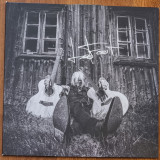
Tracked in April of 2021 at Dial Back Sound in Water Valley, Mississippi
with Bronson Tew and Matt Patton at the helm, and drums and bass,
respectively
Ernie was able to stretch out his guitar prowess and rip every solo on the album
with Jimbo Mathus on keys and leading the band along with his Squirrel Nut
Zippers' horns and strings, Taylor Hollingsworth on some extra guitar, and
Schaefer Llana with AJ Haynes on the backing vocals. What's left is a fiery
offering of funky blues with equal measures of soul and rock'n'roll interspersed
for a delectable bayou audible feast. Funkier than last weeks gumbo with a psych
blues side order.
Поиск:out of the blue
Все
Stars and Satellites is an album by Minnesota-based bluegrass group Trampled by Turtles, released April 10, 2012, on their label BanjoDad Records. According to Dave Simonett, the creation of their sixth studio album started in the fall of 2011. Their studio was a log home outside Duluth, where they moved furniture aside, set up microphones and started to develop the album. The album has been on Billboard's bluegrass charts since April 18, 2012. It was also No. 14 on the Billboard Folk Album Chart, and peaked at No. 32 on the Billboard Top 200 Chart.
Transparent Blue Vinyl
Queens Of The Circulating Library stands alongside Time Machines and Nurse With Wound's Soliloquy For Lilith as a post-industrial pinnacle of sensory-warping long-form drone. Crafted by the distilled duo of Thighpaulsandra and John Balance, the 49-minute piece unfurls in swirling, cyclical waves, tidal as much as textural, channeling the spirit of levitational minimalism pioneered by La Monte Young. Touted as the first part in "a continually mutating series of circulating musickal compositions" upon its initial release in 2000, the album remains a compelling case study in Coil's exceptional capacity for mutation and extremes. The theatrical introductory monologue delivered by Thighpaulsandra's mother - a career opera singer, in her 80's at the time of recording - sets the stage for a grandiose ascension. Written by Balance, the text is declamatory but dreamlike, refracted through megaphone echo: "Return the book of knowledge / Return the marble index / File under "Paradox" / The forest is a college, each tree a university." As her voice fades, the lulling synthetic infinity deepens, congealing into transient crests of volume and haze, like slow-motion surf misting in moonlight. Thighpaulsandra describes their aesthetic intention as a "bliss out," static but shape-shifting, an amniotic drift towards an eternal vanishing point. A supreme sonic embodiment of the slogan on the sleeve of Time Machines, two years prior: "Persistence is all.
Billy Nomates, the project of the Bristol-based songwriter, producer
and multi-instrumentalist Tor Maries, announces the release of her
much anticipated second studio album, ‘CACTI’, via Invada Records.
Recorded at her flat and Invada Studios, ‘CACTI’ is a huge step up
for the artist, who received widespread critical acclaim for her
eponymous 2020 debut album, with heavy airplay across BBC Radio
6 Music and support from luminaries such as Iggy Pop, Florence
Welsh and Steve Albini.
Though every bit as unrepentant as Billy Nomates’ debut, ‘CACTI’
comes from a much more exposed place and sees Tor further
develop her instinctive, inventive songwriting and production.
Unafraid to wade into the traumas of the past two years and the eerie
sense of apathy that lingers, alongside heartache and more political
themes, the 12-track collection openly confronts uncomfortable truths,
as Tor puts it, “70-80% of being bold is about being vulnerable as
hell.”
Maries said: “Writing ‘CACTI’ took just over a year. I wrote very
intensely and then none at all. (This seems to be the way I work
best). I picked up old drum machines, mapped out things in my
kitchen with the same small micro keyboard I always use and then
raided the cupboards and rooms at Invada Studios, to play and
experiment with old synths, an upright piano, this weird organ thing. I
hope everyone finds their own narrative in ‘CACTI’. I think it’s about
surviving it all.”
‘CACTI’ features ‘blue bones’ and ‘balance is gone’, both of which
have been playlisted at BBC 6 Music.
‘Fuxsake, what a great ride this album is... …Somewhere John Lee Hooker is smiling and stampin' his foot to 'Runnin' Till I'm Done'! Love the 12 string riffing so much - You just don't hear that enough these days - Brings to mind Stevie Ray on killing it on acoustic. Ledfoot on the Goodfoot got some serious mojo'. - Winter Lazerus, mastering master This record was recorded and mixed in two days - live - straight to tape… no edits, no punching in…just me… honest for better or worse – honesty - What a precious thing ‘ - Ledfoot - In short: 10 tracks recorded analogue live to tape during two magic days at Studio Studio Nyhagen. No bullshit, just a unique artist spitting out his soul in the most naked and real setting possible. Gothic blues! Still, the sound, the lyrics and the performance are very much a product of today. Ledfoot aka Tim Scott McConnell is a 12-string guitarist who plays with fitted heavy strings,
a brass slide, steel fingerpicks and a stompbox. He has been touring and releasing music since the late 1970’s and written for artists as varied as Highasakite and TnT to Sheena Easton. In 2014, Bruce Springsteen recorded ‘High Hopes’ as the title track of his album, written by Tim Scott McConnell for the Havalinas debut album in 1990. It debuted as #1 in over 10 countries including the U.S. and the U.K.
Repress auf babypink w/ blue splatter Vinyl, limitiert auf 200 Exemplare. Be Well - ein Zusammenschluss bekannter Gesichter der Hardcore Szene! Ins Leben gerufen von Brian McTeran, Gründer der ikonische Straightedge-Hardcore-Band Battery und ergänzt durch Mike Schleibaum von Darkest Hour und Battery, Aaron Dalbec von Bane sowie Peter Tsouras und Shane Johnson von Fairweathe, wurde Be Well gegründet um McTeran einen neuen Output für seine Emotionen zu geben. Nach der Auflösung von Battery im Jahr 2000 lenkte McTernan seine Energie zunächst in eine arbeitsreiche Karriere als Produzent um. Er hinterließ auf wegweisenden Alben von Bands wie unter anderem Thrice, Hot Water Music, Circa Survive und Turnstile seine Spuren. Bis er 2014 schließlich eine radikale Kehrtwende machte und eine Projektmanagement-Funktion für ein Bauunternehmen übernahm. Anfangs fühlte sich der Wechsel in Tempo und Karriere gesund an. Doch nachdem er oft zwischen Baustellen hin und her und reiste und dabei 400 Meilen pro Tag fuhr - traten größere Probleme in McTernans psychischer Gesundheit hervor. Eine Zeit schwerer Depressionen verlief laut McTernan jahrelang unkontrolliert, bis sich Battery 2017 vorübergehend wiedervereinigten und ihren ersten neuen Song nach 17 Jahren schrieben. Der Song, "My Last Breath", unterschied sich deutlich von allem, was vor ihm kam. In vielerlei Hinsicht diente der Text als spiritueller Vorläufer dessen, was schließlich zu Be Well wurde. Also schrieb McTernan weiter, began seine Erfahrungen durch Texte zu verarbeiten und eine neue Band zu formen. The Weight And The Cost ist das Ergebnis dieser gesammelten Erlebnisse. Ein Album das weit über die Grenzen dessen hinausgeht, was man über die früheren Bands seiner Mitglieder weiß. Die Vergangenheit der Be Well-Mitglieder könnte sogar das Uninteressanteste an diesem Projekt sein. Wo die meisten Hardcore-Platten ihren Inhalt an die Form der Genrekonventionen anpassen, zeigt dieses Album, was möglich ist, wenn der Inhalt die Form schafft: The Weight and the Cost folgt McTernans zutiefst persönlicher Erfahrung.
Dorothy Moore's 1976 soul classic 'Misty Blue' became an Ibiza chill-out anthem in 2002. As 'Misti Blu' it got high-profile plays by Mary Anne Hobbs, Pete Tong and Mixmaster Morris and even David Mancuso charted in his end-of-year highlights. Now the sundown gem gets reissued here on a tidy 7" as a superb rework from the newly reformed amillionsons. The crooning vocals remain the highlight with sultry trumpets and lavish downtempo rhythms. What's more, we're told that a new live disco and house version are coming in 2023, so watch this space.
-European fall tour is sold out across all venues, with a U.S. tour set for 2023. Supported by fans and listeners of Thundercat, Silk Sonic, Jungle and Steely Dan. Album single, “Rolling Back” has been featured across multiple editorial playlists via major DSPs, including Spotify’s Soul ’n’ the City, Retro Pop, Stay Tuned!, Happy Stroll and Ready for the Day. Young Gun Silver Fox, the acclaimed indie duo from the UK with yacht-rock tendencies comprising of Andy Platts of Mamas Gun and Shawn Lee (vagabond award-winning video game composer) announce their highly anticipated fourth studio album Ticket to Shangri-La. The album showcases a band at the very top of their game, fine-tuning their potent brew of sun-kissed pop-soul, west coast AOR and natural groove with a skill for composition and production that sees them forging ahead down a musical highway blessed with blue skies and positive vibrations. For both participants, the chance to make a new record together is always a liberating experience, as Andy explains; “I always come back to Young Gun Silver Fox like taking a drive to the coast and I just smell the ocean and the air and it’s like ‘wicked I’m back here again’ and I can just kick back and enjoy it.” The chemistry and craftmanship on Ticket to Shangri-La means that Young Gun Silver Fox do exactly as the title suggests, transporting the listener to a magical, mythical world of sunshine and good vibes, a musical and spiritual ethos born from the minds of two gifted musicians that stand as the embodiment of all they do best, whilst providing the perfect invitation into their unique world.
Strictly limited to 500 copies on transparent blue vinyl. The Swedish AOR band HOUSTON is back with their 5th album and 3rd of their series of self-titled releases, this one, simply called “III”. Houston has been around since their self-titled debut album in 2010 and landed the number one in Classic Rock Magazine’s AOR chart that year, up against outfits such as Unruly child, CrashDiet, H.e.a.t and Nelson.
Repress! Little Barrie And Malcolm Catto Team Up For Seven Tracks Of Breaks And Sci-Fi Fuzz For Maverick Producer Madlib's Label
Quatermass Seven, the meeting of minds between guitarist Barrie Cadogan, bassist Lewis Wharton and drummer Malcolm Catto represents a re-birth of sorts for Little Barrie, with these their first recordings since 2017’s Death Express and the untimely passing of their gifted drummer and friend Virgil Howe. As Lewis explains, the sessions played a part in the healing process, a way to re-connect through music without any intentions to necessarily come away with a finished record. “It was good to get in the studio again after such a long break especially as we didn’t go in with any agenda or expectations,” he explains. There was no preconceptions that we would make a new Little Barrie record, it was just an opportunity to work on some things Barrie had written for fun with zero pressure.” With most tracks recorded live with minimal overdubs, and produced by Malcolm at his Quatermass studios, The Heliocentrics’ main man brings new flavour to the band’s rhythm section by blending his power behind the drum kit and his expansive skills behind the mixing desk to take Little Barrie’s music forward into new territories. Recorded on Catto’s treasure trove of analogue gear, and mastered onto ¼” tape, the overall effect is guitar, bass and drums finding a sweet spot where genres collide, delivering a record that takes the influences of the past and pushes them towards somewhere more contemporary. “I definitely hear in Barrie’s songs a lot of common musical ground’” explains Malcolm. “It felt like a great thing to do, work with Malcolm while we’re figuring out what we wanna do,” Barrie concludes, “let’s just go in and do some playing and see what happens, and we came out with more than we ever intended.” Quatermass Seven delivers a dark, deep and expansive set of grooves, layered with frazzled and flawless guitar and flowing melodies, as well as pointing toward a future of exciting new musical opportunities. “Still here, so fine, just a little darker state of mind” sings Cadogan on ‘Steel Drum’, words which sum up hope in times of uncertainty, whilst unintentionally offering a perfect description of Quartermass Seven.
VINYL COLOUR IS SNOW WHITE! As a founding member of Bauhaus, David J helped spearhead the post-punk scene of the early ‘80’s with a string of innovative work, including Bauhaus’ defining moment, a bona fide classic and feasibly the pinnacle of the entire goth scene: the nine minute plus epic slab of industrial dub “Bela Lugosi’s Dead,” featuring David’s lyrics and bass guitar work. Bauhaus propelled to the upper echelons of the UK charts before reaching their zenith in the summer of ’83 and imploding – shattering into fragments of individual talent. This implosion gave rise to David's wide-ranging solo career. The first of Bauhaus’ members to actively release music outside of the band, David went on to put out solo work and collaborations with various authors, poets and infamous indies such as 4AD. In 1985, David regrouped with two former Bauhaus members to form the hugely successful Love and Rockets. Since then, David has continued to produce his trademark brand of deeply heartfelt and darkly sophisticated music. Highlights of What The Patrons Heard include a timely rendition of Neil Young’s “Vampire Blues” delivered with penetrating intensity; “Gimme Some Truth,” which brings new urgency and potency to the John Lennon classic; and “Lay Over And Lay,” which delivers folk-punk that only musicians from the British Isles can get right.
The old adage about Elvis Presley is that his soundtrack work never held a candle next to his studio albums. Though true for a majority of his film-related outings, the traditional notion is forever disproved by his Blue Hawaii set. Originally released in 1961 in support of the film in which he starred, the triple-platinum LP spent nearly five months at the top of the Billboard album charts; outsold his two prior studio efforts; and ultimately, remains the second-best-selling soundtrack of the musical-dominant 1960s. And now, it has received sonic treatment befitting rock royalty.
Recorded before the King started to burn out on soundtracks and go into a creative tailspin, Blue Hawaii presents him in tremendous voice. The newly uncovered layers of detail, body, emotionalism, and tonality on this SACD bring that treasured element – as well as the brilliance of the arrangements and accompaniment – to light like never before. Presley's warm crooning alone warrants unmitigated attention. It's not for nothing that this record – replete with panache, whimsy, romance, and seriousness – forever altered the course of his career.
Much like the film itself, the music on Blue Hawaii subscribes to a feel-good aesthetic. Presley plunges into a stylistic deep end with equal parts fearlessness and fun. He delves into early rock ‘n' roll ("Rock-A-Hula Baby"); touching balladry ("Hawaiian Wedding Song"); playful rumba ("Beach Boy Blues"); relaxing luaus ("Hawaiian Sunset"); and naturally, island-inspired fare ("Ku-U-I-Po"). It becomes immediately evident that the King is enjoying himself and committed to the mission. Is Blue Hawaii all serious art? No, but it was never intended to be. Rather, it serves as a showcase of Presley's outgoing personality and chameleon-like ability – like that of Frank Sinatra – to inhabit different roles and entertain.
Of course, Blue Hawaii remains timeless for another reason: The inclusion of the timeless, gorgeous, and still-untouchable staple "Can't Help Falling in Love." Penned by Hugo Peretti, Luigi Creatore, and George David Weiss, the love song quickly transformed into an international standard – with Presley's definitive version hitting No. 2 on the charts and ultimately becoming the closing song to his concerts. Ranked among the 500 Greatest Songs of All Time by Rolling Stone, its conviction, sentiment, and depth testify on behalf of why Presley still reigns as the King.
However subtly, the staple also underscores another reason Blue Hawaii should never be overlooked in Presley's canon: the ace musicians involved in its creation. Guitarists Scotty Moore and Hank Garland; drummer D.J. Fontana; percussionist Hal Blaine; pianist Floyd Cramer; bassist Bob Moore; and iconic gospel backing vocalists the Jordanaires all contribute masterful performances. Hearing them with such expressiveness, openness, and realism on this 2LP 45RPM & SACD should forever alter how Presley's 1961 soundtrack – the finest of his career – is viewed. As he sings in the title track, dreams come true, indeed.
“On Des Demonas’ new seven-track EP Cure For Love
there’s a whalloping drum beat driving everything. But
the throbbing, pumping bass, clanging, slashing guitar and
whirling, swirling Farfisa are no mere passengers in this
vehicle! I’m told by the other band members Paul Vivari,
Joe [Halladay], Mark [Cisneros] and Ryan [Hicks] that
vocalist Jacky Cougar Abok is the loudest drummer
they’ve ever heard.
“But here he sings! In motifs. He sings out a beat, he
sings minimalist melodic hooks. He half speaks/half shouts
his lyrical content in rapid fire that is closer to beat poetry
than rap. His voice is insistent and demanding to be heard!
And it is! By having it slightly submerged, the listener is
forced to strain to hear the words because they won’t wanna
miss something important!
“The sonic fuel of the band is a blend of post-punk,
punk, funk, blues, psych-rock, Afrobeat, even bubblegum—
but the noise you hear is pure Des Demonas!
“Titles like the ‘Ballad Of Ike & Tina’ and ‘Black Orpheus
Blues’ add to the intrigue rather than explain the content.
The listener is both confronted and lured by something
bigger than themselves! Desire, intrigue, fear and exuberance
are the rewards to those unable to resist! But will yout
love be cured?
“You could look to Shakespeare, or simpler, you could
buy this record and find out!” —Kim Salmon
Over the last decade-and-a-half, C Joynes has ploughed a singular furrow through solo guitar, with a body of work incorporating English folk-tunes alongside North & West African music, and lifting proto-minimalist and improvised techniques from the European classical and avant-garde traditions.
His new release, ‘Poor Boy On The Wire’, is his first full album dedicated wholly to the electric guitar. Through a typically wide-ranging set, Joynes exploits the instrument’s potential by placing intricate parlour music alongside overdriven garage blues throw-downs, wiry electric folk and the brittle ringing tones of free improvisation. However, these explorations of the tones and timbres of close-mic’d guitars and amplification retain an overall coherence and unity through the deliberate use of a limited palette of budget instruments and vintage equipment.
With ‘Poor Boy On The Wire’, Joynes has released 9 albums to date, including ‘The Borametz Tree’ (2019), recorded with long-term fellow travellers Dead Rat Orchestra, and ‘The Wild Wild Berry’, a collaboration with singer Stephanie Hladowski (MOJO Top 5 Folk Albums 2012, fROOTS Editors Choice Album Of The Year 2012). He has played extensively across the UK, Europe and the USA, sharing bills with performers including: Shirley Collins, Martin Carthy, A Hawk And A Hacksaw, Marc Ribot, Alasdair Roberts, Richard Dawson, Jack Rose, Josephine Foster, Sir Richard Bishop, Six Organs Of Admittance and 75 Dollar Bill.
“As much Conlon Nancarrow and Ali Farka Toure as Blind Lemon Jefferson, the compositional mind at work here can take apparently disparate threads of modernism and ethnic tradition and treat them as though they were all archaic blues styles learnt from dusty 78s.”
BRUCE RUSSELL, THE WIRE
“An inheritor to Davy Graham; a lone operator prone to unexpected collaborations, with a repertoire that crosses continents and timezones with consummate ease, and dashed off with a phenomenal, yet lightly applied technique.”
ROB YOUNG, THE WIRE
“His epigrammatic re-castings and re-readings of widely-travelled folk melodies and rhythms from a variety of traditions suggest shared memories that might be intensely universal while seeming strangely out of reach.”
KEVIN MACNEIL BROWN, DUSTED MAGAZINE
In an age where most contemporary bluesmen strive to mimic the past and pattern their music after the greats, Keb' Mo' is content to be himself. Original, charismatic, and immensely gifted, the guitarist/vocalist (born Kevin Moore) brings country blues in the late 20th century on his stunning self-titled Epic debut, which quickly climbed the charts and turned the former backing instrumentalist into a household name. Replete with gritty textures, close-up vocals, and resplendent acoustics, Mobile Fidelity's scintillating version of this 1994 set finally possesses the fidelity that brings Mo's Delta strains out of the backwoods and onto a lively back porch.
Half-speed mastered from the original tapes, this numbered edition 180g LP represents the very first time that Mo's watershed album has been given a much-needed sonic facelift. Gone are the hazes that obscured his singing, artificial ceilings that blunted the highs, and digital fog that interfered with the multitude of illuminating tones, details, and notes. What's revealed is startling intimacy and soothing emotion, Mo's gorgeous vocal timbres and inflections given equal space with his guitar, harmonica, and pace. Finally, a great-sounding contemporary blues record that doesn't resort to derivative recycling and bland revivalism.
The son of Southern parents, Mo' channels his heritage via a batch of superb folksy songs that relax, refresh, and regale. While he's since traveled in a more commercialized pop-oriented direction, Mo's initial salvo is nothing but raw, pure blues played with unbridled passion, tremendous conviction, and what is best deemed the essence of heart and soul. Keb' Mo' engages with a compelling mix of tradition and modernity, the headliner refraining from any attempt at assuming an artificial personality and instead basing his reputation on quality songs. As such, Mo's material resonates with deep, mellow vibes and extraordinary National steel guitar work, which complements his fluid, acoustic finger-picking and soulful strumming.
Mo' occasionally teams with an ensemble. But this record is mostly all about the basics: guitar, voice, and harmonica. Tunes such as "Victims of Comfort" and "Angelina" testify on behalf of his phenomenal country-blues songwriting; his covers of Robert Johnson's "Come On In My Kitchen" and "Kindhearted Woman Blues" speak to his reverence for the past. Shuffles, ballads, dance songs – Mo nails them all.
Keb' Mo' remains one of the finest blues albums made in the post-Stevie Ray Vaughan era. Don't miss this American gem that so many have since tried to copy.
The trashed hotel room and communal living depicted on the cover of the J. Geils Band's sophomore album tell you all you need know about the music, spirit, and energy spilling from within The Morning After. Shot through with raw, lean rock n' roll sparked by juke-joint blues and loose rhythms, the 1971 set comes on like the most fun, party-still-raging hangover any group in the 70s enjoyed. And now it rolls with an abandon that takes you inside the sweaty, smoky roadhouses and wall-to-wall-packed clubs the group dominated in its heyday.
Mastered from the original master tapes, pressed at RTI, and limited to 3,000 numbered copies, Mobile Fidelity's 180g vinyl LP achieves a sonic acumen that brings you face-to-face with the sextet's white-hot instrumental prowess and magnetic personalities. It's always been difficult to single out just one member of the band given the cohesive bluster the ensemble achieves as a whole, but this collectible audiophile edition allows you to do just that if you so choose, by way of superb imaging and separation. As for the band's trademark dynamics? Here, they feel like they're on the verge of exploding.
So go ahead. Twist the volume knob to the right as much as you want. You'll lose none of the focus, detail, placement, or presence no matter how high the decibels climb. The Morning After spills forth with previously unheard tonalities, ranging from the distinctive swells of Seth Justman's slow-burn organ to the live-wire spark of Geils' own downed-power-line-jumpy guitar work to the mooring hi-hat/cymbal/snare combinations of arrangement-steadying drummer Steven Bladd. Friends, this is raw rhythm n' blues, this is how it should feel, and, man, this is how it should sound.
Not for nothing did the Massachusetts-based collective name the album The Morning After. The music within doesn't abide by rules, ignores speed limits, flips the bird at curfews, and digs deep down into America's blues roots to yield organic material at once fresh, exciting, traditional, and original. The back-porch punch provided by the combination of "Magic Dick" Salwitz's searing, melodic, snake-like harmonica and vocalist Peter Wolf's animated, barely controlled deliveries is alone enough to make anyone with a faint pulse to stomp their feet, climb atop a kitchen table, and kick their boot heels until the neighbors call the cops.
Just witness the deceptive smoothness of the snake-like "So Sharp" or Maxwell Street zest of the aptly titled Magic Dick showcase "Whammer Jammer," which will leave you gasping for breath before it even ends. J. Geils Band also knew its way around deep-cut soul. The ensemble's Top 40, howling, adrenaline-to-the-heart rendition of the Valentinos' "Looking for a Love" and swirling, romantic take on Don Covay's "The Usual Place" seamlessly balance drive and emotion. Coupled with rafter-shaking originals such as "Floyd's Hotel" and the riff-propelled "I Don't Need You No More," sent up with typical Wolf vocal flair, and the record parks the band's all-night festivities and go-for-broke attitudes right on your front lawn.
One last word of warning to the uninitiated: The Morning After is not the slick-pop J. Geils Band of "Centerfold." And that is a very good thing.
What a privilege to start a new record label with an album of such quality. As we're sure most of you will know, Tom was the front man of the legendary US psychedelic/folk band PEARLS BEFORE SWINE. Recording for the ESP label in the 60s, then moving to Reprise, PBS left us a legacy of strange, beautiful music. In the early 70s Tom went solo, recording more albums for Reprise and Blue Thumb. As a schoolkid he came third in a talent show in which fellow schoolboy, Bobby Zimmerman (yes, that Bobby Zimmerman), came fifth! He played gigs with Pink Floyd, Crazy Horse, Patti Smith and many more before calling time in 1976, and becoming a Civil Rights lawyer. Renewed interest in Tom and PBS in the late 90s led to him making some staggeringly good live appearances. Then in 1999 he released his first album for over 25 years. The prophetically titled 'A Journal Of The Plague Year'. Featuring appearances from Damon Krukowski and Naomi Yang (of Galaxie 500 fame) and Masakai Batoh of Japanese band Ghost, came out on the British label Woronzow to great acclaim. This is the first ever reissue of 'Plague Year' and it comes with the original artwork and lyric insert, as a limited vinyl edition of 400 and a CD version of just 200. Tragically, Tom died in 2018 aged 70. It was a joy to count him as a friend. Blue Matter would like to thank Lynn Madison-Rapp & Ade Shaw for their help with making this reissue a reality.
A double treat for those who love timeless Southern Soul flavoured with some of those good ol’ down home blues. Memphis born, and Minneapolis based, Willie Walker can comfortably be included in the pantheon of grittiest soul singers along with Wilson Pickett, Syl Johnson, Lou Rawls, James Carr, Eddie Floyd, Tyrone Davis and L.V. Johnson, to name but a few, but there has always been speculation about other Willie Walkers. The recordings on Eutor and Hi in the 70’s are not by the same Willie as those on Goldwax and Checker in the 60’s. He did, however, also record as Wee Willie Walker.
He was a member of The Rhythm Harmonizers, The Val-Dons, The Exciters, The Bound Band, Willie & The Bumblebees (although that Willie is actually Willie Murphy of The Val-Dons), and Canoise, spanning a long and varied career before hooking up with the Minneapolis based band The Butanes in 2004, with whom he made the next three albums. The first of these was mainly cover versions, but "Right Where I Belong" (2004) and "Memphisapolis" (2006) are notable for each providing the tracks that make up this latest Jai Alai release, a label that differs from sister label Soul4Real by featuring 21st century tracks previously CD only but now released on 7” vinyl for the first time. It also has to be noted that all the tracks on both these albums were written and produced by Curtis Obeda, who managed to track down Willie after so many years.
“I Feel It” will have been missed by most as it was on the CD "Right Where I Belong" which was released in 2004 on the most unlikely of UK imprints, the Wirral based One On One Records run by Colin Dilnot. The album is a lavish display of real instruments from a band that once backed John Lee Hooker and Little Johnny Taylor and the perfect setting for Willie’s powerful vocals.
Just tipping five glorious minutes, "Cry, Cry, Cry" is a perfect example of why soul music is inextricably linked to the blues, and when the gospel styled chorus joins in towards the end, you realise that this could, maybe should, have carried on for just a little bit longer. Perhaps a fuller length version exists? Sadly, Willie died peacefully in his sleep in November 2019, but to complete his story check out the two albums on Blue Dot as Wee Willie Walker & The Anthony Paule Soul Orchestra. To quote the great Quinton Claunch…”Willie was one of the best to come out of Memphis in the 60’s”.
Steve Hobbs
(Solar Radio, Totally Wired Radio)
The Belgian minimal synth band's three releases – a cassette and two vinyl EPs – were all titled »Against The Dark Trees Beyond«. This compilation collects the songs from these records.
"They were interesting times, the early eighties. Against a backdrop of cold war and economic crises, the DIY attitude of the earlier punk movement had spawned near countless new genres where artists and bands broke the three-chord guitar mould and experimented with new content matter, singular song structures and – in many cases – new instruments. Synthesizers became affordable and were no longer the sole privilege of rock millionaires. All around the globe, musical creativity boomed as never before, and Belgium was no exception: Digital Dance, Snowy Red, The Names, Pseudocode, Marine, 1000 Ohm, De Kommeniste, M.Bryo & D.M.T., De Brassers, Struggler, Siglo XX are but a few legendary names of bands and artists who started making a name for themselves.
In Leuven, things were happening as well. Until then, the music scene in this rather provincial town had been dominated by straightforward rock and blues acts. Not for much longer, though: in places like Arno'z and (later) The Gladhouse, where young budding artists met with kindred spirits, bands were often formed on the spot and, more importantly, started to make ripples.
Ludo Camberlin and Karel 'Bam' Saelemaekers already had a certain track record in Leuven's burgeoning music microcosm. But what they shared would become the cornerstone of A Blaze Colour (Against The Dark Trees Beyond): a fascination for new forms and instruments, a penchant for sonic adventure and a profound love for gripping songs. The full band name, by the way, was inspired by a phrase from the Irish-American novelist J.P. Donleavy, a writer who belongs in the definitely-worth-checking-out section.
After appearing on the first No Big Business LP (1981) with the instrumental 'Fisk', A Blaze Colour's first proper release, as was so often the case in those days, was a self-produced cassette. The music – which would later be dubbed 'minimal' – was characterized by the use of basic rhythm machines (Boss Dr. 55, mainly) and analog synthesizers (for the synth geeks: Korg Delta and MS20, Roland SH-2 and Jupiter IV, and the infamous Casio VL-1). Camberlin’s vocals, meanwhile, displayed an aloofness totally in sync with the zeitgeist. Equally important, though: all five tracks on this cassette were bona fide songs with a clear sense of structure, aided by a sonic mastery that demonstrated a high level of experience: 'Means To An End' started out as a proto-industrial track before bursting out into a moroderesque finale. The remix of 'Fisk' was as sprightly as the next river salmon, while 'Or Lie Again' proved the perfect soundtrack to a nightly walk through wet deserted streets. On the other hand, 'Through With Life', rife with disturbing sound effects countered by a slow portamento, could have been a prize track on a post punk 'Lamb Lies Down On Broadway'. And in true dramatic fashion, 'Follow The Signs' was the perfect ending of this five-song cycle: a driving sequencer and gripping chord progression coupled with a simple but powerful vocal line. Considering the limited technical means the duo was working with, this was no less than a triumph.
A few months later, the band released a seven-inch single on its own ABLACO label. 'Dark Trees Beyond', a quirky pop song, was coupled with 'Addict Of Time', a dark and brooding spoken word piece. Not the kind of single to storm hit parades, but it didn't go unnoticed. The Minny Pops' Wally van Middendorp, who had founded the Plurex label in 1978, invited A Blaze Colour to his studio in the Netherlands, to record an EP. It would prove to be a massive step forward: recording in a semi-professional studio offered great possibilities, the recently acquired TR-808 drum machine allowed for a broader rhythm palette, and the three new tracks (next to the re-recording of 'Through With Life') showed a band on the top of their game: 'The New Ones' was a wry and haunting song built around a live drum loop and an ominous bass pattern, while 'Nowhere Else' was a near-pop track with very un-minimal vocal harmonies. And it's a mystery why 'Altitude' – another instrumental – was never used in a stylized, high-profile detective soundtrack.
Another song from these sessions, the revved-up 'Cold As Ever' turned up on the high-profile Plurex "Hours" compilation, where it shone brightly, next to songs of a.o. X-Mal Deutschland, Nasmak, Minny Pops and Section XXV.
Meanwhile, Camberlin had already carved out a bit of a reputation for himself as a producer, while Saelemaekers was a respected graphic designer. It remains uncertain if this played a big part in the end of A Blaze Colour, but the fact remains: as studio recordings go, 'The Ultimate Fight' on the "No Big Business 2" compilation, was to be their swan song. What a way to go, though: maybe their best song ever, this was a synthetic bastard funk groove, complete with shout-out chorus and punch-drunk middle-eight. It shut a door, for sure, but it did so with a resounding bang.
So there it is and there it was. Short, sweet, visionary, pioneering and highly influential. And as anybody listening to this first ever compilation will be able to assess probably one of the most colourful electronic acts of its time.
On a more a personal note, A Blaze Colour proved to be instrumental in my own coming of age as a lyric writer, when Ludo and Bam graciously adopted some of my earlier writings, warts and all. To hear them translated into songs was no less than magic, and it certainly gave me the confidence to start our own band a bit later. And the magic continued when Ludo became our producer and Bam designed our record sleeves. But that’s another story, obviously. Because this is the place and the time to dive back into the wondrous world of A Blaze Colour!"
Bart Azijn (Aimless Device)