Eight years passes like nothing for Birds of Maya. Their fourth
album kicks out the Philly jams with every bit as much fervour
as their earlier releases - in fact, as it was recorded in 2014, it
kind of is one of their earlier releases.
A long era of dull ringing and nothing else in our ears is over.
Once again, winds of warm guitar and humid thunderheads of
bass and toms rumble all around. With ‘Valdez’, Birds of Maya
are back in flight. And like the first song title explicitly states, this
latest is a soaring blast of riffers, rife with punk rock abandon,
sludge, treble, distortion, neck-throttling rock ‘n’ roll solos,
pummelling drums and bass and half-shouted/half-gargled
vocals, all of it half on and half off the mic.
‘Valdez’ was recorded in 2014 at Black Dirt Studios in otherstate New York. After a Purling Hiss session there, Birds of
Maya got a bunch of tunes they liked into shape - that is,
different shapes on different days. But nice shapes. Once they
got to the studio, they loaded in and set up, curious to see how
they felt playing in a different room. Pretty good as it turned out
- running through the songs that first night, they accidentally
recorded the whole album. Then they finished up the next day,
mostly. Trading the crushed harmonics of their basement tapes
for studio-grade mics, overdubs in the mix and only slightly lessbruised harmonics, their roiling essence not only survives but
thrives, non-stop, on ‘Valdez’, stuttering, screaming and
stomping through six circuitous numbers.
At the time this was recorded, Birds of Maya were standing on
the other side of ten years kicking around town, suddenly far
away from the primordial ooze they’d flopped forth from. The
streets where all this had happened on were changing, with new
money rolling in, but they were the same old Birds, content with
their libations and ear-splitting variations on old favourite
Stooges chords. The cover art of Valdez is a couple of images
from those days, glimpses at the old grass roots before they
were ripped up by developers to build condos. But nothing ever
really goes away. ‘Valdez’ is a totem of the wildness that refuses
be tamed
quête:overdub
180g audiophile vinyl pressing. Tip-On Gatefold packaging.
A fascinating solo album from the Swiss pianist, composer and
conceptualist best known as leader of the bands Ronin and Mobile,
‘Entendre’ offers deeper insight into Nik B rtch’s musical thinking.
As the album title implies ‘Entendre’ is about hearing as a creative process,
referencing the patient unfolding of B rtch’s modular polymetric pieces, with
alertness to the dynamics of touch, finding freedom in aesthetic restriction,
serving the flow of each piece’s development while also taking the music to
new places.
Recorded at Auditorio Stelio Molo RSI, Lugano, in September 2020, and produced by Manfred Eicher.
Nik Bartsch: piano
Press:
“Entendre - his first album entirely played on solo acoustic piano, with no
overdubs - might be his finest yet.” - **** The Guardian
“Nik Bärtsch feels a long way from jazz, but a lot closer to a freewheeling
rhythmic spontaneity on this unexpectedly action-packed set.” - **** (Editor’s
Choice) Jazzwise
“There is nothing lost when Nik Bärtsch, bandleader, becomes Nik Bärtsch,
solo pianist. It’s the same, captivating music, only played through the single
vessel of a piano. Through this prism, more is revealed about the genius of
Bärtsch’s ‘ritual groove music,’ not less.” - Somethin’ Else
“Entendre is a fascinating solo album from Swiss pianist, composer and conceptualist Nik Bärtsch... In these six solo realisations, Bärtsch’s creative music
unfolds with heightened alertness and dexterity as the pieces develop and unfurl with texture and subtlety of touch. The pianist finds freedom in aesthetic
restriction, while also seizing opportunities to guide the music to new places
of discovery.” - UK Vibe
“Manfred Eicher’s production captures the sound of the piano and the room
with forensic clarity. Entendre is, literally, classic Bärtsch. It is also classic
ECM.” - All About Jazz
Excelsior! It’s the hail of yore that one should go ever onward and upward. And so, fittingly Onwards and Downwards is the occultist Swedish band Alastor’s clever call to arms... and also a reflection of our collective dark state of mind these days.
“If our last album Slave to the Grave were about death, this record is more about madness,” says guitarist Hampus Sandell. “You can look at the whole record as one person’s gradual slip into insanity. An ongoing nightmare without end. It also sums up the state of the world around us as this year has clearly shown.”
Alastor is heavy doom rock for the wicked and depraved. Drenched in heavy, distorted darkness and steeped in occult horror that will make your skin crawl and ears cry sweet tears of blood, the band is revitalized in 2021 with meticulously crafted songs and new drummer Jim Nordström bringing a hard-hitting and precise energy.
“It’s a more focused record but at the same time it’s more personal and naked. More raw emotion and pain,” Hampus says. The band recorded the album with the help of Joona Hassinen of Studio Underjord, who has helped with mixing since their ”Blood on Satan’s Claw” EP in 2017. Christoffer Karlsson of The Dahmers also assisted with overdubs and encouraged the band to demo the material early on, aiding in the album’s more deliberate and tighter feel.
From the first note of opener “The Killer In My Skull” the guitars are far thicker and out front than ever, and Nordström pummels the snare and kick like a young Dave Grohl. Bassist/vocalist Robin Arnryd’s chorus-drenched voice soars above it all like a one-man choir, at times harmonizing beautifully with shimmering Hammond organ notes. Nary a moment is wasted on the droning navel-gazing of lesser bands. Particularly, the driving anthem “Death Cult” which sounds like it would fit comfortably on QOTSA’s Songs For The Deaf, though there’s considerably more heft here. The title track pays its due to the Devil’s tritone in a marvelously woven framework of intertwining melodies befitting the album’s theme of descent into madness.
The quartet released its epic 3-song debut album Black Magic in early 2017 via Twin Earth Records, followed by the 2-track “Blood On Satan’s Claw” EP on Halloween the same year. Joining forces with RidingEasy Records in 2018, Alastor summoned the 7-track hateful gospel Slave To The Grave, which was packed with dynamic twists and turns, and funereal girth. It was met with considerable praise, setting the stage for the band’s greatest step onward (and upward... or downward, depending on your preferences.)
Excelsior! It’s the hail of yore that one should go ever onward and upward. And so, fittingly Onwards and Downwards is the occultist Swedish band Alastor’s clever call to arms... and also a reflection of our collective dark state of mind these days.
“If our last album Slave to the Grave were about death, this record is more about madness,” says guitarist Hampus Sandell. “You can look at the whole record as one person’s gradual slip into insanity. An ongoing nightmare without end. It also sums up the state of the world around us as this year has clearly shown.”
Alastor is heavy doom rock for the wicked and depraved. Drenched in heavy, distorted darkness and steeped in occult horror that will make your skin crawl and ears cry sweet tears of blood, the band is revitalized in 2021 with meticulously crafted songs and new drummer Jim Nordström bringing a hard-hitting and precise energy.
“It’s a more focused record but at the same time it’s more personal and naked. More raw emotion and pain,” Hampus says. The band recorded the album with the help of Joona Hassinen of Studio Underjord, who has helped with mixing since their ”Blood on Satan’s Claw” EP in 2017. Christoffer Karlsson of The Dahmers also assisted with overdubs and encouraged the band to demo the material early on, aiding in the album’s more deliberate and tighter feel.
From the first note of opener “The Killer In My Skull” the guitars are far thicker and out front than ever, and Nordström pummels the snare and kick like a young Dave Grohl. Bassist/vocalist Robin Arnryd’s chorus-drenched voice soars above it all like a one-man choir, at times harmonizing beautifully with shimmering Hammond organ notes. Nary a moment is wasted on the droning navel-gazing of lesser bands. Particularly, the driving anthem “Death Cult” which sounds like it would fit comfortably on QOTSA’s Songs For The Deaf, though there’s considerably more heft here. The title track pays its due to the Devil’s tritone in a marvelously woven framework of intertwining melodies befitting the album’s theme of descent into madness.
The quartet released its epic 3-song debut album Black Magic in early 2017 via Twin Earth Records, followed by the 2-track “Blood On Satan’s Claw” EP on Halloween the same year. Joining forces with RidingEasy Records in 2018, Alastor summoned the 7-track hateful gospel Slave To The Grave, which was packed with dynamic twists and turns, and funereal girth. It was met with considerable praise, setting the stage for the band’s greatest step onward (and upward... or downward, depending on your preferences.)
Als Matthew E. White an dem Nachfolger seines zweiten Studioalbums arbeitete, wollte er seine Herangehensweise an das Songwriting neu erfinden, zumindest für eine Session. White versammelte eine vertrauenswürdige Truppe von sieben Musikern in Richmond, Virginia. Er dirigierte das Septett durch eine Reihe von lockeren, größtenteils gestischen Kompositionen. Die Klänge waren gewaltig, eine Reihe von Keyboards und Gitarren untermalten den Schwung einer ineinandergreifenden vierköpfigen Rhythmusgruppe. Aber die Ergebnisse passten nicht ganz zu der in Arbeit befindlichen Platte, so dass White die Jams auf Eis legte, bis die richtige Muse kam. Das war, wie sich herausstellte, Lonnie Holley, dessen wunderschön verwelkte Stimme bald eine Art kosmische Weisheit über Whites wartende Arbeit ergoss. Das Ergebnis - Broken Mirror: A Selfie Reflection - ist explosiver und eindringlicher als alles, was die beiden Künstler je gemacht haben. Aggressiv, aber ekstatisch, spielerisch, aber pointiert, ist Broken Mirror eine pointierte, aber einfühlsame Sozialkritik, unterlegt mit einem mächtigen Groove. Holley nahm seine Vocals über Whites Aufnahmen in nur vier Stunden auf. Als Visionär und intuitiver Texter hörte sich Holley 20 Sekunden an und proklamierte die Bilder, die die Klänge hervorriefen. Wenn ihm etwas gefiel, zog er ein Notizbuch zu Rate, das voller lyrischer Einfälle war, und sang dann komplette erste Takes zu Musik, die er noch nie gehört hatte. Abzüglich bescheidener Bearbeitungen und leichter Overdubs wurde Broken Mirror: A Selfie Reflection an Ort und Stelle fertiggestellt, ein Blitz, der einen Platz zum Einschlagen suchte. Holley und White mögen als unwahrscheinliche Kollaborateure erscheinen, da sie durch Jahrzehnte und Disziplinen getrennt sind, aber die beiden teilen tiefe Alabama-Wurzeln. Und was noch wichtiger ist: Holley und White betrachten Musik als ein unheimliches Gefäß für sonst undurchdringliche Vorstellungen von Trauer, Leid und Solidarität. Broken Mirror: A Selfie Reflection ist ein zeitgemäßer Appell an die Kraft der Zusammenarbeit, an verwandte Geister, die sich auch in überfüllten Räumen zusammenfinden.
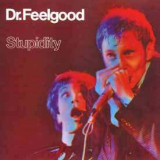
Black heavyweight vinyl pressing The third album / first live album from the British rock band, Dr. Feelgood.
Originally released in 1976, it was the first live album to ever hit number 1 on the UK charts in its first week.
Stupidity captures the relentless, hard-driving energy of Dr. Feelgood at their peak. Comprised of recordings taken from 1975 tours, the music is presented raw and without overdubs, making it clear that the dynamic friction between guitarist Wilko Johnson and vocalist Lee Brilleaux could propel the band toward greatness
LIMITED 180GM OPAQUE ORANGE VINYL.
BUFFET LUNCH are a Scottish group who make it their mission to craft satisfyingly imperfect pop songs filled with imagery and humour.The group’s elementary parts are Perry O’Bray (Vocals/Keys/Guitar), Neil Robinson (Bass), John Muir (Lead Guitar) & Luke Moran (Drums), united by a shared love of music on the ABBA-to-Beefheart axis.
These four ricochet between Glasgow and Edinburgh, creating music that bristles with DIY spirit and upbeat wonkiness. Their tracks are vigorous excursions, meandering into clattersome terrain as often as hiking up into the breezy, melodious foothills.The desire to lead the listener along a curious tale helps tie things together, showcasing a lyrical playfulness that pins down their puzzle of sound.
Having been an active band for a few years, playing regularly north of the border with like-minds such as Irma Vep, Robert Sotelo and Kaputt, Buffet Lunch spent early 2020 working on the follow-up to their two EPs on Permanent Slump.The fruits from such labour bore out as the band’s debut album ‘ThePower of Rocks’, out may 7th on UpsetTheRhythm.
‘ThePower of Rocks’ was recorded in a Crofters cottage/studio on the banks of Upper Loch Fyne in Argyll, over four nights and five days at the beginning of March 2020, before Covid-19 made itself such an ongoing concern. Back then four people could occupy the same space and make music, lunch and dinner together. Days fell into a pattern of long sessions and long meals.The album came together as a luminous mix of Buffet Lunch’s live chestnuts, some sparky recent songs and some new material entirely written and recorded in situ. All tracks were recorded by Neil Robinson acting as the in-house engineer.
As the seriousness of the virus and talk of national lockdowns developed - there was a feeling of anticipation more than fear in the air, but being holed up in cottage in a wild corner of Scotland surrounded by snowy mountains still took on an apocalyptic feel, albeit an apocalypse where the band were safe and overdubbing vocals. After leaving the cottage, reality (as it must) set in and finishing the album became a more remote task.
Over the following months, an extended period of listening awarded the recordings a deeper realisation, as they bounced between band members computers. Perry also started writing on his Casio keyboard and collaborated on a couple of songs (‘Ten Times’ & ‘Ashley’s New Haircut’) with Jayne Dent (of electronic music project Me Lost Me), drawing on her ethereal singing voice as a counterpoint to his own more ‘spoken’ vocals on the album. These gauzy, dreamlike tracks were then sent to other members of Buffet Lunch to add their respective parts, creating evocative new dimensions to close each half ofthealbum with.
The Power of Rocks’ rattles along like a short-story collection, exploring a variety of narratives. When it comes to the music itself, Perry describes their approach as “see what happens” but admits to a preference for simple synth melodies, plenty of percussion, and prickly guitar-parts. ‘Red Apple’ opens the album with a dizzy swagger, guitars and keyboard notes swirling in forays whilst its lyric tackles notions of social bravado. ‘Orange Peel’ follows equally serpentine with its blattering tune and jagged, yet jolly melodic twists.The themes across the album are wide-ranging and personal, from irritation with out of touch politicians (‘Pebbledash’), to love letters to seaside living (‘Bladderwrack’), to even the frailty and confusion of old age (‘Said Bernie’, ‘It Helps to Know’). Title track ‘ThePower of Rocks’ is an ode to the power of nature sunk within a rolling wave of cheery jangle. “Do you believe in the power of rocks when the sun is too hot on your face?” sings Perry as the song zigzags with consequence. ‘He Wore Two Hats’ sports similarly bop-worthy riffs and addictive nods as it deals with its story of savvy man who’d bitten off more than he could chew.
Buffet Lunch’s debut album accomplishes a lot in its brief 38 minutes. It stuns and startles, intrigues and entwines, drawing the listener further into its characterful world. When asked about any intent posed with this debut record Perry confides that “we hope people can hear the joy the band had making the album and the curiosity and frustration that went into the writing. There was no process or design, but there is detail, and deliberateness in our wish to explore and create.” It’s this attentive focus alongside a keen sense of humour that really sets Buffet Lunch apart, with ideas darting wilfully to and from the poignant truths at hand.
“Maestro melodist Christophe Petchanatz (aka Klimperei) and all around music fanatic David Fenech engage remotely in a repetitive exchange of recordings and overdubs on their debut album titled ‘Rainbow de Nuit’, sporadically spanning over the last decade. Evocations of experimental and improvised jazz, chansonesque songs, bluesy folk, and outsider music undulate harmoniously across the record. From music boxes and walkie-talkies down to plastic straws, plucking various stringed instruments such as the charrango and banjo, kazoos and snake-charmer ocarina and flutes, all the way through the sweet accordion and melodica, found and traditional tuned percussion - there is far from a shortage of sound sources on this freakishly inviting record. What germinates as an imaginative and emotional chord progression played by Klimperei, evolves with Fenech layering additional recordings, which would then find their way back home to Klimperei yet again, and so on, and so forth. This recursive compositional and improvisational loop, combined with Fenech’s musique-concrete-like mixing and editing techniques, transforms the acoustic recordings by way of compression, saturation, and reverberation or simple pitch changes - resulting in the duo’s recordings seemingly sound like they may very well be an octet in real time. While the majority of the recordings have been ping-ponged remotely, David and Christophe unite under one roof to record the closing track of the album.
The pieces presented on ‘Rainbow de Nuit’ treat the ears to a carousel ride waltzing through a multiverse made up of surrealist puppet theaters, dramatic film noir act changes, and a mosaic of polyphonic instruments and toys alike. In other words, a score to a fable brought to life with haunting yet charming melodies and occasional hallucinatory voices reminiscent of laughter and infantile epiphanies which we hear on Tarzan en Tasmanie and Madrigal for Lola. This is taken a step further by Fenech, to a brief libretto of incomprehensible tongues on Pocarina. Amid the mysterious and dark (Septième Ciel and Rugit Le Coeur) also lies tender and simple compositions (Rainbow de Nuit and Chevalier Gambette), murky suspenseful melancholy (Levy Attend and Eno Ennio), and casually slipping into pensive psychedelic backdrops (Un Cercueil à Deux Places) - forming a colorful blend of sounds. A world of echoes. A tale of tales. One persistent earworm that you’ll likely be whistling and humming along to on a first listen.”
Real Real World is the first collaborative effort from Nantes-based Australian drummer/percussionist Will Guthrie and Australian keyboardist/composer James Rushford. Primarily recorded in a fluid, spontaneous studio session in Nantes, with overdubs added later in Melbourne and Nantes, Real Real World presents five spacious, unhurried pieces that inhabit a unique sound world characterised by wheezing, half-voiced organ chords, chiming metal percussion, and eruptions of small sounds. Beginning with the eerily beautiful, shakuhachi-esque sound of Rushford performing on detuned portative organ, the opening title track is abruptly transformed by the entry of Guthrie’s sizzling cymbals, deep gong strikes, and rustling hand percussion. On the epic ‘Lumbering’, which occupies the majority of the record’s first side, organ chords define a space in which a kaleidoscopic succession of amplified thuds, chiming bells, rustled and dragged objects, and abruptly silenced clusters advance and recede in an oneiric blur, eventually making way for a passage of Guthrie’s virtuosic polyrhythms, itself unexpectedly overtaken by waves of melting fairground organ. The record reaches an energetic climax mid-way through the second side with the stunning ‘Slakes’, where lugubrious chords in the organ’s lowest register are joined by Guthrie’s skittering rhythms, which somehow manage to call to mind both the most chaotic moments of Balinese Gamelan and the stochastic breakbeats of late-90s Autechre. On this piece, Guthrie and Rushford are joined by Melbourne saxophone maverick Scott McConnachie, who contributes an alto sax solo of burning precision, working with a single-minded palette of piercing long tones and wild intervallic leaps. Though it makes extensive use of overdubbing, Real Real World retains a strong sense of having been performed, rather than constructed: while at times the fleeting succession of events can recall electroacoustic music, its primarily acoustic nature and unhurried pace is also reminiscent of the music of AACM affiliates or Marion Brown’s classic Afternoon of a Georgia Faun. Immediately engaging while also hiding countless details in the folds of its polychrome fabric, Real Real World is a relaxed and joyous document of collaborative musical invention.
Artwork by Patrizia Bach. Layout by Lasse Marhaug. Mixed and mastered by Joe Talia at Good Mixture, Berlin.
Sun Milk was recorded in two months, a much quicker process than the three years spent on their previous release, Flowers. The band recorded the album at the Pharmacy, Vroom’s home studio in Toronto, located above an actual pharmacy. It was the first album to be recorded after Little Kid solidified their live lineup, with Boothby, Vroom, and Germain having played together for over two years. Every song except “Like a Movie” began as a full-band live take, with overdubs performed democratically, with both Boothby and Germain layering guitars. It was also the first record to feature Lunn’s vocals, who joined the band shortly after the album’s release.
The result is a deeply affecting document of personal crisis, mirroring the dramatic changes in Boothby’s life—a breakup, living alone for the first time, beginning a new career. The lyrics have less Christian content and more personal overtones than other Little Kid records. “It was a relief when these songs came out,” says Boothby, “processing recent changes in my life, trying to take ownership of my identity and choices.” This lends a confessional warmth to the songs, a feeling of reconnecting with an old friend, sharing stories. Highlights include the off-kilter opening track “The Fourth” and the lovely, meandering “Ugly Moon.” The centerpiece of the album is “Slow Death in a Warm Bed.” A meditation on why people stay in flawed relationships, the song builds in calming repetitions until the guitars explode in the last minute, climaxing in a full-fledged distorted freakout. It’s one of the most beautiful and harrowing songs in Little Kid’s catalog.
The drifting, gentle “Dim Light Coming Down” features some of Boothby’s best lyrics. The narrator describes a person seeing “the likeness” of their own dead father “floating high above the road,” a mystical encounter rendered in the most plainspoken of terms. But Boothby quickly undercuts the moment: “But you'd been drinking when you saw him/And your mind was moving slow/Like your ears were full of cotton/So what he said you'll never know.” It’s a thwarted encounter that becomes more powerful for that very fact. Just before the song reaches its slow-building climax, Boothby sings, “Coming down/There’s a bright light/A gentle sound/Opening wide.” The transcendence does finally arrive, but it’s in the coming down, the hangover, the regular life that comes after the big moment. There's little wonder why it's become a live staple for the band.
The record is a high point in a remarkably consistent career. Looking back at Sun Milk, Boothby believes it’s one of the strongest in Little Kid’s oeuvre. “It’s probably my favorite,” says Boothby. “In general, I love slow songs, and this album is full of them. I like the structure of seven long songs—can’t think of too many albums with only seven songs. It gives the album an interesting flow.”
Both tracks produced by Robin The Fog at The Sticky Shed, Penge during lockdown 2020. Side A features a recording of a wine glass. Side B is created entirely from closed input sounds of the tape machines themselves. One take, no edits, no overdubs, no artificial FX. Mastered by Steven McInerney. A.H.M.F. and long live the Wyrm.
Robin The Fog is a sound designer, radio producer, audio archivist, educator and occasional DJ based in London. His work falls under the broad term "radiophonics" and includes composition, sound installation, field recording and documentary. Best known as founder and chief strategist of "tape loop quintet" Howlround, he also produces work alongside DJ Food and Chris Weaver as The New Obsolescents and with Ken Hollings as The Howling. Originally described as a "second wave hauntologist", his current obsession is attempting to use closed-input feedback loops to create primitive techno, which is quite a long way from where he started. His biggest fear is being swallowed by a python, but living in South London he appreciates the contingency is a remote one.
Apifera is the new project of Yuval Havkin aka Rejoicer (keys), Nitai Hershkovits (keys), Amir Bresler (drums) and Yonatan Albalak (bass), the latest addition to Stones Throw’s growing roster of talented jazz musicians. Rejoicer has released two albums on Stones Throw. Hershkovits has played in a trio with ECM Records musician Avishai Cohen.
The quartet have previously played together for Rejoicer’s albums ‘Energy Dreams’ and ‘Spiritual Sleaze’ and collaborated with funk legend Steve Arrington on his upcoming album ‘Down To The Lowest Terms: The Soul Sessions’.
Apifera create organic-sounding structures, harmonies and arrangements intended to reflect the rich variety and equilibrium of the natural world.
Working intuitively, the quartet wrote and recorded ‘Overstand’ mostly live in just three days and the final album includes minimal overdubbing.
Drawing on real-life spiritual and psychedelic experiences, often intertwined with nature, as a springboard for their music, Apifera showcase a sound that is free, improvisatory and live.
For fans of Moses Boyd, Teebs, Kamaal Williams, Sam Gendel, John Carroll Kirby, Sam Wilkes, Carlos Niño, Rejoicer.
Remastered Limited Blue Vinyl with Gatefold Sleeve.
Includes A2 poster and 3 art prints of each individual band member.
Way back in 1982, Battersea based mod heroes The Direct Hits had released one single on Dan Treacy’s Whamm! record label, ‘Modesty Blaise’ earlier in the year. This was singled out in the music press as not just one of your average Jam crash / bang /wallop mod revivalist tunes.
Live gigs showed they had a mighty powerful set of catchy mod / pop tunes in the back pocket. Whamm! were struggling to provide the funds to record an album, the songs were too good not to commit to a full 12’ set, so the Direct Hits pooled their limited resources and self financed a very cheap one day recording session in a tiny studio in Tooting, South London called Broadway Sound.
Early on the morning of August 12th 1982 the band, comprising of Colin Swan, Geno Buckmaster, Brian Grover and their trusty roadie ‘Robbo’ assembled at the tiny studio to begin recording as many of their songs as they could get down on tape for the tiny budget they had scraped together. As most of the songs were already well rehearsed thanks to the band’s busy live schedule, the recording of the first nine songs on this disc were finished by mid afternoon without any problems. Throughout the late afternoon and early evening the band toiled over scant overdubs with limited keyboard facilities and a distinct lack of musical ability. The recordings immediately came to life however, when Colin Swan and Geno Buckmaster’s stage-honed tight harmonies were added, there was no time for vocal overdubs, and the mixing was completed by midnight. Tired and worn out, the band ventured out into the cold night air happy with the days work, clutching the precious reel to reel tape.
Two weeks later the band came back with a friend producing, and recorded the three final tracks featured on this album which have a more rounded slightly less raw sound. All three were completed in an afternoon. Almost two years later they re-recorded some of these songs, and along with a handful of new songs from the pen of Buckmaster and Swan, recorded their ‘Blow Up’ debut album at Rendezvous Studios in Sydenham, South East London, released on Whaam! Records in August 1984.
So what you have here are the roots of some of these great songs. A few didn’t make it to the first album those that did, as you will hear, stayed reasonably faithful to the original arrangements.
The Broadway Recording Sessions take you right back to where it all started!
Children Of Tomorrow will celebrate soon its 10 years anniversary. The label was created by Emmanuel Ternois back in the day and being joined by Arnaud Le Texier in 2011. Since then they focused on Techno producing amazing artists, to name few: Terrence Dixon, Zadig, Tensal, Antigone, Oscar Mulero, Jonas Kopp, Samuli Kemppi etc... Children Of Tomorrow is now presenting the first album from Arnaud Le Texier. After almost 30 years Dj-ing around the world and almost 20 years producing. Signing many releases over the years and always busy delivering dance floor releases, it's been a long wait to finally get an album from ArnaudOn his first album we can feel that he wanted to tell a story and to express something deeper with his production experience. There is a different variety of Techno that stretches from ambient / broken beat / hypnotic / raw Techno along with subtles grooves, wondrous atmospheres & sonic textures. On A side the album opens with Dusk, an ambient atmospheric mid-tempo track with sonic sounds that is a perfect intro.Pattern 2 starts with drones and blip sounds and a broken beat groove follows with a pad that sounds like a voice coming from the space. The track ends with some modular click sounds that make the whole track clever. Followed by the album title Granular Therapy, a deep techno track with modular bass line and melancholic pad. A perfect track to play in after or to warm up a party.The B Side is more dedicated to the dance floor with Black Nympheas that is a proper dark modern techno with a grinding bass line and magic drones. A simple beat makes the track evolve in a nice way. Blade Pass frequency is 4/4 effective Techno with a 909 kick, a syncope acid bass line and a pad that sends you to another dimension. It is a powerful track but with a sense of deepness and sensibility that Arnaud can achieve sometimes. This side closes with Binary Sun Dawn which is an ambient track with melody that has a jazz feeling mixed with dark atmospheres, sonic drones and water drops. The C side opens with Mono Driver, a minimal track with a little synth that stays until the end repetitively until it makes you travel and lose your mind. Deep and dance floor at the same time.
Then Snapper is a more percussive track with some shinning bells and a grinding modular bass line.
The last track Virgo Consortium is a cosmic broken beat with dark atmospheric drone, simple bass and phasing efx. The D Side starts with Midi overdub which is a beauty. A mix between ambient and broken beat. The pad has the deepness that transports you somewhere else with an angel choir on top. The beat is spacial and groovy at the same time with smart high hats. This reminds Arnaud's past ambient production but with a modern approach. Surely a special track of the album.
Hideous Engine is more dance floor with metallic bass line and 4'4 beat going towards a sonic pad that closes the track.The last track Dawn is ambient with drones and blip sounds and an acid bass line modulate. A perfect end of the album.This album is an accomplished journey that makes you dance and travel from dusk till dawn. Arnaud Le Texier shows a coherent vision and illustrates his vast diversity in the techno world. Hopefully we won't have to wait 20 years to get another one.
Freestyle Records are proud to present the first ever reissue of this rare Black Ark-era Lee "Scratch" Perry production on LP & CD w/ bonus tracks. Both formats feature liner notes from author of the acclaimed People Funny Boy: The Genius of Lee 'Scratch' Perry and Solid Foundation: An Oral History of Reggae, David Katz.
The late Bunny Rugs was best known as the frontman for legendary reggae band Third World, but prior to that he completed an apprenticeship at Lee Perry's Black Ark resulting in this solo LP, originally released in 1975 and credited to Bunny Scott.
The album captures the laid-back sessions of the early Black Ark, with a few surprising innovations lurking amongst the soul covers and love ballads. Highlights include the sought after Blaxploitation-influenced funk track 'Kinky Fly' featuring members of The Chi-Lites' backing band, passing through Perry's infamous studio whilst in Jamaica for a series of shows - their horn section and Chinna Smith's wah-wah guitar give the track its outstanding difference as synth overdubs add to the moody feeling, underpinned by the ghostly click tracks of the Conn Rhythm Unit (constituting one of Perry's earliest experiments with drum machines).
Breakup track 'Second Avenue' shows how suited Rugs' powerful, deep tenor was suited to a soul framework, the Chi-Lites' horns again making a striking difference. The Bee Gees' evergreen 'To Love Somebody' takes James Carr's soulful rendition as its reference and 'Big May' re-works the 'Return Of Django'/'Sick And Tired' rhythm, with a new drum part. while the broken-hearted 'What's The Use' was cut at the request of Sonia Pottinger, who ultimately failed to release it.
Somehow the sublime rendition of William DeVaughans' 'Be Thankful', recorded during the same session, was left off the LP - but appears here as a bonus track on the CD along with I Never Had It So Good & Hip Harry + it's version track.
Looking back on the sessions documented on this LP, Rugs said that Perry's creativity taught him that music could be limitless. As he explained, 'It was so simple that it became complex. The approach he has to music and to recording, I think the music nowadays lack that kind of intuition. He's somebody that would use pliers and a screwdriver to create percussion; he wouldn't hesitate to experiment. He was a little...not crazy, but somebody with that kind of thinking must be somewhere else, in another zone sometimes.'
Harry Bertoia's Glowing Sounds LP contains three versions of the same composition, each transferred at different tape speeds in accordance with the artist's instructions. This is the third LP to be released from Bertoia's extensive tape archive and it's the first, of many, to be released using instructions left behind by the artist himself.
Bertoia wrote the concept for this Glowing Sounds LP on a note in 1975 and slipped it into the master tape case where it sat unread for 45 years. The idea was simple, transfer the original recording at its original speed and two slower speeds. Bertoia noticed that the results, however, were profound.
Recorded on January 20, 1975 using two large gongs, Glowing Sounds is one of the most powerfully minimal recordings yet discovered in Bertoia's collection. The artist's note left with the tape indicated that it was recorded at a speed of 15 IPS (inches per second) but slowing it down to speeds of 7.5 IPS and 3.25 IPS were quite effective for enhanced playback. Side A features the original 15 IPS recording and the 50% slower 7.5 IPS recording. Side B features a 20 minute, ultra-slow version at 3.25 IPS.
Long, deep drones and powerful overtones define the sound of this recording. Comparison of the three speeds provides a revealing magnification of Bertoia's gongs, overtones and the artist's inventive approach to performance, composition and recording.
Bio:
Harry Bertoia first gained some artistic visibility in the early 1940s, then came into prominence with his sculptural, ergonomic chairs, produced by Knoll Furniture beginning in 1952, which quickly became classics of modernist furniture. Inspired by the resonant sounds emanating from metals as he worked them and encouraged by his brother Oreste, whose passion was music, Harry restored a fieldstone "Pennsylvania Dutch" barn as the home for this experiment in sounding sculptures which he had begun in the late 1950s. Bertoia was an obsessive composer and relentless experimenter, often working late into the night and accumulating hundreds of tapes of his best performances; Oreste, too, would explore and record the sculptures' sounds during his annual visits to his brother's home in rural Pennsylvania.
Harry Bertoia's recently dismantled Sonambient barn collection was an attentive listener's paradise full of warm, expressive instruments that were gorgeous visually and audibly. Nothing could prepare you, even on return visits, for the overwhelming experience of entering the spacious wood and plaster interior where gongs, some of them giant, hung among the ranks of standing sculptures of various metals. Over nearly twenty years of adding, culling and rearranging, Bertoia carefully selected nearly 100 harmonious pieces ranging in height from under a foot to more than fifteen feet. He considered this barn a full experience, sights and sounds comprising not a collection of works, but one piece unto itself. It was here, deep in the woods, that his Sonambient recording work took place.
Learning by experimentation was common for Bertoia and he mastered the art of tape recording, turning the Sonambient barn into a sound studio with four overhead microphones hanging from the rafters in a square formation. He would experiment with overdubbing by performing along to previous recordings, sometimes backwards, constantly improving his methods while also honing his performance skills. Bertoia was a careful editor of his own work and only chosen recordings remained, each with a date and carefully considered observations written on a note included with each tape. Through these pieces of paper a the artist's logic can be uncovered, a careful approach to composition, ideas, feelings and forms. The story of Sonambient barn collection will slowly be told through the release of recordings from the archive as well as installations and performances built from Bertoia's own recordings, lectures and a book.
Limited edition 12” LP - 180 gram silver marble vinyl. In response to a
world struggling with disruption and discord, Tony Tixier has instinctively turned towards his music as a way to re-establish the sundered
connections of everyday existence.
‘I Am Human’, a series of remotely records duets - available only on limitededition vinyl - was created when he returned from a sell-out US tour to find himself locked down in his Paris apartment.
An escape route appeared out of a happy combination of chances: a loan of a new piano from Yamaha and an encounter with a neighbour, David Freiss, who turned out to be an expert sound engineer. Tixier conceived a plan to spontaneously record a series of pieces, all in one take, and then send them out across the world to a chosen band of his closest musical accomplices - Scott Tixier, Hermon Mehari, Ben Leifer, Logan Richardson and Adrien Soleiman - musicians with whom he felt so closely in tune that the enforced separation of time and space could be overcome - and invited them to overdub a response to create a series of virtual duet recordings “Each track is dedicated to a friend, someone I feel close to - I sent them the track in the morning, and by the afternoon I had the track back with their parts.”
Each side of the vinyl release is opened with a performance of an original solo piece by Tixier, both recorded back to back. ‘Leaking Life’ is a meditation on the passing of time and a call to action to make the most of every day. ‘Humain’ is an expression of his own identity “A presentation of myself - I don’t see myself as mixed race - I am 100% black, 100% white, 100% human.”
Tixier has travelled the world with the likes of Christian Scott and Keyon Harrold and performed for audiences across four continents, but this is his most personal, direct work to date. Reaching out across the world, sustained by a network of friends, he has delivered a statement for our times that transcends the limitations of remote recording with the sheer force of its emotional connection. Personnel: Tony Tixier (piano), Scott Tixier (violin), Hermon Mehari
(trumpet), Ben Leifer (double bass), Logan Richardson (alto saxophone), Adrien
Soleiman (tenor saxophone)
Early summer 2019, João Lobo started recording his compositions at les Ateliers Claus in Brussels, with guitarist Norberto Lobo, bassist Soet Kempeneer and recording engineer Christophe Albertijn. The recording sessions were planned over the course of one week, however the job was mostly done in just a few takes. With the addition of some overdubs, the whole process was finalised in a spontaneous wave. It is too simplistic to define Joao Lobo’s compositions with one term, and the association of the album “Simorgh” with this ingenious partnership’s new creations, is inevitable.
While the mix of genres and styles may be easy to distinguish, the focus centres on the result of the mixing: a highly grooving and an occasionally paused and introspective music that seems out of time and out of space. It is difficult to grasp or define a specific period in time or a geographic origin in this fusion of references, as what you listen to is a bold creation of original and surprising elements. Drummers – such as João Lobo – employ a multi-layered concept in their music, weaving the different tracks into a linear wash of sound. He plays the song with the drum set while the other members fly in and out of the compositions, always gathering around their phoenix in order to attain enlightenment.
What João Lobo and many of his contemporaries are up to, can be explained through simple terms as a future exploration of the emotionally expressive possibilities of sound. It breaks away from the conventional order providing space for the discovery of a new order. Simultaneously it allows a more profound and broader expression of what the current reality of music is and represents. It was instantly clear for me that we had to share his music with our audience and create this medium for happiness.
This release is the trio’s debut record, which is the impetus for their personal development in the realisation that features João as a mentor in the creation process. The featured compositions highlight the musicians’ unique physical aspect to control their instruments and their hidden techniques that underlying these tracks. The result is an ongoing aural interplay. It was love at first sound.
This album is a co-release between Les Albums Claus and Shhpuma.
Musa Ancestral Streams remains a relative oddity in the pantheon of jazz's black consciousness movement -- a solo piano set of stunning reach and scope, its adherence to intimacy contrasts sharply with the bold, multi-dimensional sensibilities that signify the vast majority of post-Coltrane excursions into spiritual expression, yet the sheer soulfulness and abandon of Stanley Cowell's performance nevertheless vaults the record into the same physical and metaphysical planes. Cowell's energy and touch are remarkable, as if guided by divine power, and for all the music's structural spaciousness and rhythmic freedom, not a note feels out of place, let alone excessive. Most intriguing is "Travelin' Man," an overdubbed "duet" featuring Cowell on both acoustic and electric piano that underscores his uncommon affinity for space and presence.
Fred broke out on scene with his slept on debut, the crossover soul gem "Love Can Last Forever" in 2016. After a four year hiatus between releases, it's time for his sophomore single "Sweet Thing", and it's clear that his talent is like fine wine, a thing that needs its time. Since his premier release kicked off Stylart, the Timmion sublabel, Cold Diamond & Mink has put soul on the table with a steady pace and from this new track it's clear that they shine some special love for Fred.
As a result,"Sweet Thing" is as lush as it comes with a shimmering electric piano, horns on full blast and strings to boot. When fused with Fred's delicate delivery, passionate lyrics, overdubs and a mid-tempo soul dance groove, it all really comes together. There's a gentle southern breeze in the air and can we really demand less from Espoo's finest.
We are nowhere nearer to cracking the enigma of Fred's personality, but he does seem less complicated than on his first release. "Sweet Thing" is exactly what it sounds like, a soothing piece of soulful sunshine. Something to enjoy in good company.