In the smoggy orange light of a new millennium, the young Deb Demure would take the bus, once a week, from his home in crumbling Hollywood to his grandmother's apartment, nestled in the pastel pristineness of Beverly Hills. During these visits, Deb couldn't help but notice the disconnect between the glow of his grandmother's temple, and the downtrodden, alienated figures that populated the seats of the mass transit that took him there. Week after week, he would observe these characters: fading B-movie starlets, leisure-suited alcoholics and forgotten civil servants. But one fateful commute home, as the twilight waned to the purple Los Angeles night, he realized these figures were not as lost as they appeared - there was a nobility in their failure, reflective of the dignity of the city's vanishing golden era. They were survivors, in need of a voice: a spokesperson for every color of hope and hopelessness, transcendent of gender and time; Drab Majesty became Deb's musical podium for this undertaking. Raised in a music-centric household, Deb would find the time to teach himself to play his father's right-handed guitar upside down and left-handed; an unorthodox fashion from where his earliest understanding of chords and harmony were conceived. Exploring the bins of discarded vinyl in his neighborhood thrift stores, his toolkit expanded with the subterranean sonic gems of the recent past. Influences range from the virtuosic arpeggiated guitar work of Felt's Maurice Deebank and the grittier pop progressions of Red Lorry Yellow Lorry's Chris Reed as well as Steve Severin from Siouxsie and The Banshees. He also studied the harmonic oscillations and utilization of the occult power of vibratory frequency present in New Age sounds of Greek artist, IASOS. In terms of orchestration, he consciously culls from the seaside maximalism of Martin Dupont and mechanized grooves of early Depeche Mode. Like a dualistic pendulum, his vocals swing from a preistly baritone to a choir boy's falsetto reflecting the sepulchral ambiance of church visits with his grandmother. Currently the drummer for Los Angeles lo-fi rock ensemble Marriages and having honed an unorthodox home recording style, Deb sources his sounds from a repository of "mid-fi" synthesizers and other lesser-quality instruments. Following the release of his debut cassette EP, "Unarian Dances", he also shared a split 12" with synth pop forefathers, Eleven Pond. During the Spring of 2015, Drab Majesty signed with Dais Records and released his first single, Unknown to the I, as a introduction for his first initial foray into the album format, romantically titled Careless. Written over the course of 2 years, "Careless" is a compendium of songs that have outlasted a malicious burglary of his studio, his struggles with substance addiction, and most recently, the death of his beloved grandmother.
Buscar:p drum
Back from the undead in the fresh (because we believe in upgrades & afterlifes!) is this new pressing of the first of all Gastr del Sol records, The Serpentine Similar. It is one of several distinct initiators of a definitive musical drift in the 1990s, and a drift all of its own, to boot! At the time, this album was largely heard within an underground whose boundaries were clearly defined - but if today"s sound-pool of "commercial" music is deeper and wider than it was back then, it is without a doubt due to the cracking open of certain doors of perception by Gastr del Sol, alongside their esteemed others. The year was 1992. After a bruising run of tour dates the year before, the final lineup of Bastro, a power-trio of David Grubbs, Ken (Bundy) Brown and John McEntire, retired, exhausted. Shortly thereafter, they were rebirthed, sans drums, via a new set of ideas composed in the cut-down configuration of Grubbs on guitars, keyboards and vocals and Brown on bass. Playing in duo format opened up sound and intention, leaving the need for speed (and the stock in rock) out, while letting in an expanse of brooding, droning acoustic space that highlighted the songs" serpentine shapes. This was something so radically different as to require a new calling card: henceforth, Gastr del Sol. Signing to Teen Beat, Gastr del Sol completed The Serpentine Similar in late 1992 for release the following year (the DC reissue came in "97). In the final rendering, Serpentine"s roof-rent, white-sky execution was attenuated with several percussion appearances from the prodigal John McEntire. Over the next five years, his cameo presence was a constant in Gastr del Sol"s steadily-evolving tradition of significant breaks from tradition at every turn. There would be an even more significant tradition-breaker onboard for all this; following the release of The Serpentine Similar, Jim O"Rourke joined Grubbs in Gastr as Brown exited (to focus on Tortoise, with McEntire et al). For the new Gastr duo, a world of new directions in music awaited, the future became the past, and the music of Gastr del Sol emerged from the thin air, then returned there. Now, The Serpentine Similar has been returned to vinyl from the temporal streams of contemporary music listening, a glorious rematerializing of all its spatial details on LP for the first time in 20 years.
- A1: Original
- B1: Instrumental
The talented Canadian vocalist Tara Laine recorded the funky gem “You Made Me Believe” with members of the band Change, an Italian-
American post-disco group that was heavily influenced by Chic. Recorded in 1985 for the legendary Street Level label, featured here is he
original 12” version complete with bonus instrumental. This session was produced by in-demand session drummer Leslie Ming, whose fine work
can be heard on the records of Kashif, Melba Moore, B.T. Express and many others.
- A1: Original
- B1: Instrumental
A hard-hitting slab of electro-boogie released on the legendary Street Level label in 1985, Lemuria’s Thunder In Your Love was written and
produced by Phil Valentine, who also provides the gritty lead vocals, and features backing from members of the influential Italo-American post-
disco outfits B. B. & Q. Band and Change, including New York session aces Leslie Ming (drums), Timmy Allen (bass) and guitarists Kevin
Robinson and Ira Siegel, whose impressive fret work powers this highly addictive track. This is a must-have for collectors of funky sounds and
rare groove from the mid-1980s.
- 1: Black Veils Of Melancholy
- 2: When My Mind Is Not Alive
- 3: Ice In The Sun
- 4: Elizabeth Dreams
- 5: Gentleman Joe's Sidewalk Café
- 6: Paradise Flat
- 1: Technicolor Dreams
- 2: Spicks And Specks
- 3: Sheila
- 4: Sunny Cellophane Skies
- 5: Green Tambourine
- 6: Pictures Of Matchstick Men
In South London members Alan Lancaster (bass) and Francis Rossi (guitar) were the original members and founders of Status Quo. _x000d__x000a_Formerly known as The Spectres and later renamed to Traffic or Traffic Jam they settled for Status Quo as their band name in 1967. _x000d__x000a_The following years they were joined by John Coghlan (drums), Roy Lynes (keyboard) and Rick Parfitt (guitar)._x000d__x000a_Status Quo’s first hit record "Pictures of Matchstick Men" was released in 1968 .The single reached #7 in the UK, and remains the band's only major hit single in the US, where it reached #12. Their debut Picturesque Matchstickable Messages from the Status Quo soon followed. It features several covers, including "Green Tambourine" by The Lemon Pipers and "Spicks and Specks” by The Bee Gees. _x000d__x000a_Another highlight from the album is their second single, "Ice in the Sun." Even if this is not the most representative album from Status Quo, it is a good psychedelic pop exercise ._x000d__x000a__x000d__x000a_Picturesque Matchstickable Messages from the Status Quo is now available as a numbered limited edition of 1000 copies on turquoise coloured vinyl_x0009_
In the smoggy orange light of a new millennium, the young Deb Demure would take the bus, once a week, from his home in crumbling Hollywood to his grandmother's apartment, nestled in the pastel pristineness of Beverly Hills. During these visits, Deb couldn't help but notice the disconnect between the glow of his grandmother's temple, and the downtrodden, alienated figures that populated the seats of the mass transit that took him there. Week after week, he would observe these characters: fading B-movie starlets, leisure-suited alcoholics and forgotten civil servants. But one fateful commute home, as the twilight waned to the purple Los Angeles night, he realized these figures were not as lost as they appeared - there was a nobility in their failure, reflective of the dignity of the city's vanishing golden era. They were survivors, in need of a voice: a spokesperson for every color of hope and hopelessness, transcendent of gender and time; Drab Majesty became Deb's musical podium for this undertaking. Raised in a music-centric household, Deb would find the time to teach himself to play his father's right-handed guitar upside down and left-handed; an unorthodox fashion from where his earliest understanding of chords and harmony were conceived. Exploring the bins of discarded vinyl in his neighborhood thrift stores, his toolkit expanded with the subterranean sonic gems of the recent past. Influences range from the virtuosic arpeggiated guitar work of Felt's Maurice Deebank and the grittier pop progressions of Red Lorry Yellow Lorry's Chris Reed as well as Steve Severin from Siouxsie and The Banshees. He also studied the harmonic oscillations and utilization of the occult power of vibratory frequency present in New Age sounds of Greek artist, IASOS. In terms of orchestration, he consciously culls from the seaside maximalism of Martin Dupont and mechanized grooves of early Depeche Mode. Like a dualistic pendulum, his vocals swing from a preistly baritone to a choir boy's falsetto reflecting the sepulchral ambiance of church visits with his grandmother. Currently the drummer for Los Angeles lo-fi rock ensemble Marriages and having honed an unorthodox home recording style, Deb sources his sounds from a repository of "mid-fi" synthesizers and other lesser-quality instruments. Following the release of his debut cassette EP, "Unarian Dances", he also shared a split 12" with synth pop forefathers, Eleven Pond. During the Spring of 2015, Drab Majesty signed with Dais Records and released his first single, Unknown to the I, as a introduction for his first initial foray into the album format, romantically titled Careless. Written over the course of 2 years, "Careless" is a compendium of songs that have outlasted a malicious burglary of his studio, his struggles with substance addiction, and most recently, the death of his beloved grandmother.
Bendik Giske’s Beatrice Dillon-produced 2023 album gets an addendum with reworks from Carmen Villain, aya, Hanne Lippard, Hieroglyphic Being, Wacław Zimpel and Dillon herself.
Giske’s clearly got his ear to the ground; his last remix record was an invitation for Laurel Halo to put her stamp on »Cruising«, while 2018’s »Adjust EP« roped in Deathprod, Total Freedom, Lotic, and Rezzett. Now comes this new LP of remixes and it’s one of the best we’ve heard in aeons. Carmen Villain boots things off with a remix of »Slipping«, following her excellent (and way, way too underrated) »Nutrition EP« with a giddy, subtle roller that sounds as if it’s been constructed using only Giske’s raw stems. His breaths and leathery key presses – already amped up by Dillon’s detailed recording – are magicked into a dubby concrète groove that’s enhanced with the sparest melodic elements: echoing rainforest-at-night horn blasts, and lopped off decay trails that help fuel the momentum.
aya’s revision of the same track takes a different approach, forming forceful overlapping polyrhythms from Giske’s clanks, using the gamelan-like arpeggios for melodic weight and repetition. The result is a constantly shifting, hypnotic trancer that’s achingly organic – more Raja Kirik than Paul Van Dyke. Polish clarinetist and producer Wacław Zimpel, meanwhile, supplements his trippy recent collaboration with James Holden on a similarly levitational wrinkle of »Slipping« that twists Giske’s quivering sequences with microtonal synth prangs, and gusty echoes. But it’s Jamal Moss who plays fastest and loosest with Giske’s source material, calling back to April’s psy-house stunner »Dance Music 4 Bad People« with a powdery, sexualised banger that buries the breathy »Start« stems underneath neon synths, and brittle drum loops.
»I’m a digital nomad,« Lippard deadpans over Giske’s »Not Yet«. »I’m addicted you know that.« It’s a typically dry treatment from the conceptual artist that unexpectedly amps up the hypnotic qualities of Giske’s original, adding her circuitous charm to his concertina-ing sax sequences. And to tie things up perfectly, Beatrice Dillon returns with her diaphanous remix of »Rise and Fall«, built to emphasise the radically different approaches of each artist.
- 1: Iron Gate
- 2: Death Of Day
- 3: It Washes Over
- 4: Hole
- 5: White Noise
- 6: Eviscerate
- 7: October
- 8: Mater Dolorosa
- 9: The Well
- 10: Meet Your Maker
Los Angeles trio Faetooth sophomore album Labyrinthine is a deeply felt exploration of emotional weight: grief, memory, uncertainty, and the quiet work of growing around your own wounds. Following the band's 2022 debut Remnants of the Vessel, which introduced the band’s signature blend of heaviness and mysticism, Labyrinthine pushes further inward. True to its name, the album winds through a maze of feeling and form, where meaning is never handed over easily. It’s rooted in self-discovery through disorientation, the idea that understanding comes not from escape, but from getting lost. Ari May (guitars and vocals), Jenna Garcia (bass and vocals), and Rah Kanan (drums) manage to stay grounded in the immediate in parallel with fantasy themes of the band's namesake. Labyrinthine holds space for this contradiction; tenderness and intensity, restraint and release. The band's self-branded “fairy doom” sound fits between shoegaze, doom, and grunge. It isn’t just texture; it’s a framework for navigating the unsaid. Like the myth that inspired its title, Labyrinthine doesn’t end in victory, but in confrontation—not with escape, but with the Minotaur. Only here, the Minotaur isn’t a monster. It’s something quiet and more familiar: unresolved feelings, old memories, and sadness that refuse to stay buried. The album winds like a maze, sometimes heavy, sometimes hushed, always intentional. Faetooth isn’t chasing catharsis. They’re creating space to reflect, to feel, and maybe to get a little lost along the way.
Artist quote: "White Noise" emerged from a diary entry, and is a relentless and intense reflection on inner turmoil. We’re often drawn to the familiar, even when we don’t realize we’re reaching out for it. It is an emotional upheaval, carrying harsh truths that weigh heavily on the heart. Guitarist, Ari May mentions, “Performing the song always takes me back to a specific place, even if just for a moment.”
“Riffs and melodies brimming with loneliness and longing… this band’s incantations affect my mood the whole day after listening.” — The Sleeping Shaman
“Bringing otherworldly hazy doom goodness… dreamy clean vocals, echoing harsh vocals, entrancing riffs, meditative shoegaze melodies.” — Nine Circles
“Slow, lumbering behemoths of great weight… couched in a melancholy atmosphere and explosions of crushing heaviness.” - Where Strides The Behemoth
Los Angeles trio Faetooth sophomore album Labyrinthine is a deeply felt exploration of emotional weight: grief, memory, uncertainty, and the quiet work of growing around your own wounds. Following the band's 2022 debut Remnants of the Vessel, which introduced the band’s signature blend of heaviness and mysticism, Labyrinthine pushes further inward. True to its name, the album winds through a maze of feeling and form, where meaning is never handed over easily. It’s rooted in self-discovery through disorientation, the idea that understanding comes not from escape, but from getting lost. Ari May (guitars and vocals), Jenna Garcia (bass and vocals), and Rah Kanan (drums) manage to stay grounded in the immediate in parallel with fantasy themes of the band's namesake. Labyrinthine holds space for this contradiction; tenderness and intensity, restraint and release. The band's self-branded “fairy doom” sound fits between shoegaze, doom, and grunge. It isn’t just texture; it’s a framework for navigating the unsaid. Like the myth that inspired its title, Labyrinthine doesn’t end in victory, but in confrontation—not with escape, but with the Minotaur. Only here, the Minotaur isn’t a monster. It’s something quiet and more familiar: unresolved feelings, old memories, and sadness that refuse to stay buried. The album winds like a maze, sometimes heavy, sometimes hushed, always intentional. Faetooth isn’t chasing catharsis. They’re creating space to reflect, to feel, and maybe to get a little lost along the way.
Artist quote: "White Noise" emerged from a diary entry, and is a relentless and intense reflection on inner turmoil. We’re often drawn to the familiar, even when we don’t realize we’re reaching out for it. It is an emotional upheaval, carrying harsh truths that weigh heavily on the heart. Guitarist, Ari May mentions, “Performing the song always takes me back to a specific place, even if just for a moment.”
“Riffs and melodies brimming with loneliness and longing… this band’s incantations affect my mood the whole day after listening.” — The Sleeping Shaman
“Bringing otherworldly hazy doom goodness… dreamy clean vocals, echoing harsh vocals, entrancing riffs, meditative shoegaze melodies.” — Nine Circles
“Slow, lumbering behemoths of great weight… couched in a melancholy atmosphere and explosions of crushing heaviness.” - Where Strides The Behemoth
Los Angeles trio Faetooth sophomore album Labyrinthine is a deeply felt exploration of emotional weight: grief, memory, uncertainty, and the quiet work of growing around your own wounds. Following the band's 2022 debut Remnants of the Vessel, which introduced the band’s signature blend of heaviness and mysticism, Labyrinthine pushes further inward. True to its name, the album winds through a maze of feeling and form, where meaning is never handed over easily. It’s rooted in self-discovery through disorientation, the idea that understanding comes not from escape, but from getting lost. Ari May (guitars and vocals), Jenna Garcia (bass and vocals), and Rah Kanan (drums) manage to stay grounded in the immediate in parallel with fantasy themes of the band's namesake. Labyrinthine holds space for this contradiction; tenderness and intensity, restraint and release. The band's self-branded “fairy doom” sound fits between shoegaze, doom, and grunge. It isn’t just texture; it’s a framework for navigating the unsaid. Like the myth that inspired its title, Labyrinthine doesn’t end in victory, but in confrontation—not with escape, but with the Minotaur. Only here, the Minotaur isn’t a monster. It’s something quiet and more familiar: unresolved feelings, old memories, and sadness that refuse to stay buried. The album winds like a maze, sometimes heavy, sometimes hushed, always intentional. Faetooth isn’t chasing catharsis. They’re creating space to reflect, to feel, and maybe to get a little lost along the way.
Artist quote: "White Noise" emerged from a diary entry, and is a relentless and intense reflection on inner turmoil. We’re often drawn to the familiar, even when we don’t realize we’re reaching out for it. It is an emotional upheaval, carrying harsh truths that weigh heavily on the heart. Guitarist, Ari May mentions, “Performing the song always takes me back to a specific place, even if just for a moment.”
“Riffs and melodies brimming with loneliness and longing… this band’s incantations affect my mood the whole day after listening.” — The Sleeping Shaman
“Bringing otherworldly hazy doom goodness… dreamy clean vocals, echoing harsh vocals, entrancing riffs, meditative shoegaze melodies.” — Nine Circles
“Slow, lumbering behemoths of great weight… couched in a melancholy atmosphere and explosions of crushing heaviness.” - Where Strides The Behemoth
- 1: Diamonds Cutting Diamonds
- 2: Tell Me I Exist
- 3: Can You Find Her Place
- 4: Edge Of The Throne
- 5: Kiss The Future
- 6: The Time
- 7: Give It Back To You
- 8: Floating Dream
- 9: Green Is The Colour
The album introduced a lush, complex dream world that the singer, composer, and producer created and inhabited largely on her own. She produced all the songs, and wrote and performed everything on the self-released collection outside of a re-imagined cover of Pink Floyd’s “Green is the Colour” and 2 other tracks (“The Time,” “Give It Back To You”), which started as instrumentals written by Survive’s Kyle Dixon (who composed the Stranger Things soundtrack with his bandmate Michael Stein), to which Ainsworth wrote melodies and added lyrics. Ainsworth, who’s relocated to Los Angeles from Toronto since 2017’s Darling of the Afterglow, explains that the collection revealed itself to her “as a play taking place in Mother Nature’s vanishing home,” aka Phantom Forest, and that she’s singing from 3 perspectives: herself, Mother Nature, and Greek Chorus. For instance, of the album’s opener, “Diamonds Cutting Diamonds,” she explains: “The Greek Chorus sets the scene, narrating and offering direction on how to enter Phantom Forest. It’s my hope that the listener will imagine the narration to be directed to them as well, as they begin the journey of the album.” You’ll get a sense of this from the collection’s edenic cover art and the playful, pastoral video for the album’s first single, “Can You Find Her Place.” Its inspiration came from Ainsworth’s love for Italian Renaissance painter Botticelli’s 15-century masterpiece “Primavera,” an allegorical representation of the burgeoning fertility of the earth in spring. She notes: “The video features the Greek gods of the painting in a choreographed Baroque style dance.” Keeping with the personal feel of the collection, her sister Abby Ainsworth directed the clip. In line with the classical and historical depths of Phantom Forest, Ainsworth, who holds a Masters Degree in film scoring composition from NYU and studied composition as an undergrad at McGill, notes that although the album might be considered pop, she approached it as an orchestrator. “Even if I’m dealing purely with synths,” she says, “The songs are like a score, each one an evolving journey. I love to use strings so I’ve included my string arrangements on ‘Tell Me I Exist’ and ‘Can You Find Her Place.’ I recorded live musicians on drums, bass, and guitar on ‘Edge of the Throne,’ ‘The Time,’ and ‘Floating Dream,’ and wove those live elements into my programmed elements.” Phantom Forest is a beautiful, vast collection that mixes the historical and the hands on, with hooks about the apocalypse and people obsessively using face-recognition software to see what paintings their face match with, in search of some kind of connection. It’s a journey that holds up to close listening (and lyric reading) and to dance floors, but that can also exist on a purely emotional plane. In all cases, it asks that you listen, and take some kind of action.
- 1: Hold The Road
- 2: Blue Eyes
- 3: Warlock
- 4: Just Carol
- 5: Grand Slam
- 6: Come Next Sunday
- 7: Stax
- 8: Pan Ram
- 9: Sue
- 10: Strike Rich
- 11: Theme For Marilyn
- 12: Mark Twelve
- 13: Rosebud Joe Version 1
- 14: Rosebud Joe Version 2
With influences ranging from Burt Bacharach to Quincy Jones, Tilsley Orchestral No.10 belongs on the shelves of all record collectors. Sweeping strings, pounding drums, leaping flutes, and polished horn sections take the listener on a sonic journey of late 60’s orchestral pop. Composed and arranged by the library legend Reginald Tilsley, this eponymous collection of recordings digs deep into jazz harmonies that adds a level of complexity while maintaining the simplicity of easy listening, highlighting the true genius of the composer.
Tilsley Orchestral No. 10 spans a spectrum of spirits, from the lows of lost love (Sue) to the highs of winning the big game (Grand Slam). This LP features a favorite of hip-hop producers, Warlock, which has been sampled in songs by artists including Cam’ron, KRS-ONE, Soulja Boy, and Jay Electronica.
- A1: Drumline
- A2: Mágica Feat Rogê
- A3: 24 Hr Sports Theme No 1
- A4: Say Goodbye Feat Florence Adooni
- A5: Oakley's Car Wash Feat Dave Guy
- A6: Anticipate Feat Clairo
- A7: Eastside
- A8: Clean The Line
- B1: Cortex
- B2: Shining
- B3: 24 Hr Sports Theme No 2
- B4: Indifference Feat Shintaro Sakamoto
- B5: Carry Me Away Feat Norah Jones
- B6: Take My Hand Feat Rahsaan Roland Kirk
- B7: Open Season
- B8: Victory Lap
Leon Michels ist still und leise zu einem der gefragtesten Produzenten der Musikszene geworden. Sein unverwechselbarer Sound hat die Aufmerksamkeit des Mainstreams auf sich gezogen und inspiriert gleichzeitig weiterhin die Underground-Szene. Seit dem 2023 erschienenen Album Glorious Game von El Michels Affair & Black Thought war Michels als Produzent für andere Künstler aktiv - darunter Norah Jones' Grammy-prämiertes Visions, Clairos Grammy-nominiertes Charm, Kali Uchis' ,Moonlight" sowie Alben für seine Labelkollegen Brainstory, Derya Yildirim & Grup Simsek, Thee Heart Tones und Liam Bailey. Sein neues Album 24 Hr Sports markiert die langersehnte Rückkehr unter seinem eigenen Namen: El Michels Affair.24 Hr Sports wurde inspiriert von Mode und Grafikdesign der Sports-Illustrated-Magazine der 80er- und 90er-Jahre, MF DOOMs Special Herbs-Alben, den dort verwendeten Sample-Quellen und Gospelmusik à la Pastor T.L. Barrett. Die Summe dieser Einflüsse, gepaart mit Michels' unfehlbarem kreativen Gespür, ergibt ein Rezept für einen Instant-Klassiker - ein Werk, das zweifellos zu den meistgefeierten Veröffentlichungen des Jahres 2025 zählen wird.Der Album-Opener ,Drum Line" ist ein hymnischer, mitreißender Track mit Marschband-Schlagzeug und donnernden Bläserarrangements, die sofort alle Aufmerksamkeit auf sich ziehen und den Ton für das folgende Album setzen. 24 Hr Sports bedeutet eine deutliche Abkehr von der bisher überwiegend instrumentalen Musik im Katalog von El Michels Affair. Mit einer Vielzahl von Gesangsfeatures spiegelt das Album das schwer einzuordnende Genre seiner Musik wider.Das erste dieser Features ist ,Mágica" mit dem brasilianischen Künstler Rogê, der die ohnehin energiegeladene Nummer mit seinen fußballinspirierten Lyrics auf ein neues Level hebt. Weiter geht es von Brasilien nach Ghana: In ,Say Goodbye" feiert Florence Adooni ihre Individualität mit lässigem Selbstbewusstsein und wechselt mühelos zwischen Frafra und Englisch, besonders eingängig im Refrain: ,never gonna find a girl like me_".Labelkollege und weltbekannter Trompeter von The Roots, Dave Guy, veredelt den 70er-Jahre-Groove von ,Oakley's Car Wash" mit seinen charakteristischen Bläserlinien, bevor der Track in ein Dub-artiges Outro übergeht. Vom wilden zum sanften Klang: ,Anticipate" mit Clairo knüpft an die musikalische Chemie an, die das 2024er-Album Charm hervorgebracht hat. Clairo gleitet über die typischen EMA-Arrangements, während sie sich nach unerreichbarer Liebe sehnt - getragen von einer perfekt eingespielten Band.,Eastside" ist ein Stück, das einen Sonnenaufgang am Meer vertonen könnte - Leon Michels' Sinn für Raum und Arrangement wird hier besonders deutlich. Aus Japan ist der Suginami Children's Choir auf dem üppigen Track ,Clean The Line" zu hören - sie singen ein Lied über den Mond, die Sonne und Vögel. Danach reißt ,Cortex" mit verzerrten Gitarren und donnernden Drums die Tür auf - ein Moment purer, filmreifer Intensität in der Mitte des Albums.Leon Michels übernimmt selbst den Lead-Gesang auf ,Shining", einem Song über die Suche nach einem Freund, mit dem man die Freude eines sonnigen Tages teilen kann. Der international gefeierte Shintaro Sakamoto ist auf ,Indifference" zu hören - ein lässiger Song mit federnden Basslinien und gefühlvollen Flöten, in dem Sakamoto zwischen Gesang und gesprochener Poesie über eine vergängliche Liebe reflektiert.Das Grammy-prämierte Duo Norah Jones und Michels kommt auf ,Carry Me Away" erneut zusammen: Jones' honigsüße Stimme schwebt über einem schwer einzuordnenden, aber sofort liebenswerten Track. Michels lehnt sich hier wieder mehr in Richtung El Michels Affair-Stil, der sich klar von seinen bisherigen Produktionen für Norah Jones abhebt. ,Take My Hand" stellt den Gospel-Einfluss in den Vordergrund - mit dem Fabulous Rainbow Singers Choir im Refrain und einem Saxophon-Solo der verstorbenen Jazzlegende Rahsaan Roland Kirk.,Open Season", ein Piano-getriebener Midtempo-Track mit Gruppenrufen wie ,we want the gold, we want the gold_", könnte den perfekten Soundtrack für eine Slow-Motion-Highlight-Reel liefern. Der treffend betitelte Albumabschluss ,Victory Lap" schließlich ist ein traumhafter, euphorischer Ausklang, der dem gesamten Werk würdig ist.Am Ende spricht die Trophäe auf dem Albumcover Bände: El Michels Affair ist Champion Sound - und 24 Hr Sports macht das unmissverständlich klar.
"Back in print with a brand new 2024 cut by Carl Saff at Saff Mastering, pressed on striking Transparent GOLD colored vinyl and topped off with a collectible “Footlong” OBI. NPR calls “Angherr Shisspa” a “vital reissue of a punk-prog opus”.
Japan's Koenjihyakkei blend progressive rock, jazz fusion, symphonic rock and neoclassicism with the energy of hardcore punk, the volume of metal and the attitude of rock in opposition.
Tatsuya Yoshida’s (of the renowned bass and drum duo RUINS), progressive rock powerhouse is Area and ELP at their most excessive; Deus Ex Machina with tempo changes multiplied by 100; and Magma at their orff-ian choral, fusion jazz, overcharged gospel peak.
“Angherr Shisspa”, the band’s landmark fourth album explodes with glittery keyboard lines, speedy bass/drum workouts, emotive reed respites, and operatic female vocals that take the listener from sheer exuberance to absolute apocalypse... all performed with superhuman technique in confoundingly catchy, complex arrangements.
“...towers over most modern progressive rock because of an attention to detail and an almost overwhelming force of conviction. No irony here: this rocks with the teeth and heart to cut through scenes and the ""overground"" like a knife."" - PITCHFORK"
Editions Mego presents Bosko, landing exactly 30 years after the initial General Magic flights into the fantastic; the legendary first Mego release, a collaboration with Pita whereby all sounds were harnessed from the buzzing, drinking, humming sounds of fridges MEGO 001 General Magic & Pita and a 12” with Elin called Die Mondlandung (The Moon Landing) MEGO 002 which embarked on a minimal techno template so austere and strange it was one of the historic progenitors of austere and wonky rhythms alongside Sakho and other European explorers.
The initial return of the playful and mystical Austrian outfit General Magic came with the 20th year anniversary vinyl reissue of their classic debut Frantz eMEGO 010. A record so audacious and playful it still baffles as much as it entertains. At some point whilst working on this reissue GM’s Ramon Bauer and Andi Pieper were spurred on to rummage around with ideas and tools once more and after more than two decades of inactivity sonic sorcery was conjured once again. Live shows in honour of Peter Rehberg were performed in Vienna and London. Softbop, a limited risograph collaboration with Tina Frank came with the first new recordings as a digital download came out discreetly online. The first full length album following Rechenkönig in 2000 MEGO 032 “Nein Aber Ja” released in 2023 on Finlay Shakespeare’s GOTO Records on CD and cassette. An ongoing series of mix tapes online further highlights their interests encapsulating a new found angle on electronic mayhem. All of these elements retain the wildly eclectic and ecstatic glow that only they can harness and hand out to an unprepared world.
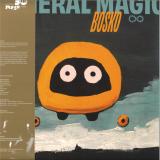
Now, we have General Magic’s second official full length comeback recording, Bosko. The new album is initially notable prior to the needle hitting the wax or the cursor identifying a track due to the artwork. Made by long term collaborator Tina Frank, this is Frank’s first analogue artwork, with a painting of a happy/nervous machine thing hovering in a landscape of no discernible identity. It’s quasi science fiction hovering amongst the potential for fun. Suited to the music? Natürlich.
Bosko sees Bauer and Pieper update and reframe their original investigations with a fresh supply of head scratching, heart racing tunes that hit the inexplicable with a wild mesh of drums, pianos, synthetic voices and all manner of immaterial sonic play. Startling sonics shock the ears on Club Duchamp which sounds like a conversation between synthetic adult ants in an environment still in development. Elfer features vocals supplied by a female-ish voice who, whilst grappling melody, has trouble executing a firm identity. Noorenhalt catapults along a mainframe of syncopation so unwieldy it feels like the voice, which is utterly alien, provides the only comfort. Seite 5 inhabits a fuzzy zone where a synthetic Horn of Jericho type ambience competes with rhythms never quite sure of who they are. Rise of the Ombré raises the spectral dread. Is this Science Fact? Absolutely nothing within Bosko is predictable.
The amount of change in the miasma of existence and the things we touch in order to make things has shifted so exponentially we are at the point where minds are starting to glaze over. All of this makes the return of the always original, always surprising, always fresh and exciting General Magic totally in tune with the artificial intelligent apocalyptic age we currently inhabit. The tools may have changed but the wonderfully warped gaze of Bosko offers a fresh new vision of perplexing funk and robotic punk.
Rivet’s new album for Editions Mego is an uplifting and joyous affair coming in the wake of tragedy and disenchantment. It is yet another rebirth from an artist willing to take a step back and reprise the current situation he is in. Mika Hallbäck has a long credible history in the Swedish underground. First recognised for his industrial techno works under the Grovskopa moniker he worked privately on more experimental works that eventually came out as On Feather and Wire, an album released on Editions Mego in 2020. After much acclaim for this bold new direction that blended electronic abstraction, pop and industrial forms into a heavy synthetic trip two tragedies struck. One was the passing of label boss Peter Rehberg and then the passing of his dog Lilo, who was as close as a companion one could have. These events led to the release of the more unsettling follow up L+P-2 (Lilo and Pita minus two) on Midnight Shift Records in 2023. Peck Glamour sees Rivet return to the reawakened Editions Mego with an album of optimism inspired by reconciliation with loss and further explorations of new mental/sonic realms.
Hallbäck defines his approach as not being married to any particular machine, instrument, process or genre. However he holds a particular affinity to sampling, of which, he says, provides the dirt and grit amongst what would otherwise be pristine, generic machine music. The contemporary crate digging method of scouring obscure download music bogs for unique sounds was his preferred research practice.
Peck Glamour is an album full of tracks brimming with the excitement of exploration. It's the results of a mind informed by punk, industrial, techno, dancefloor, disappointment, trauma and rebirth. Here the synthetic and authentic is viewed simply as the same means of human rationale and expression.
The opening, ‘Catch Up to Light’, sets the scene with ecstatic and odd fluorescent vocals sliding amongst crystalline likembe whilst synths swirl amongst the external festivities. ‘Orbiting Empty Cocoon’ is somewhat a homage to the alien sound worlds of The Orb, one which takes the listener deeper into a mind melting array of teased potential as visual elements are executed in a mask of audio wizardry and euphoric staccato rhythms, the later being a nod to Singeli music. ‘Patitur Butcher’ is more dance frontal utilising the Ghatam drum and a YouTube rip of a Chinese language lesson. ‘Plastic Bag Putain’ was made during the beginning of Russia's invasion of Ukraine and should be clear of its intent. ‘All that Heaven Allows’ is a marimba cover of an imaginary Love Parade anthem. 'Kyrie Geire’ potentially briefly fills the void left by the demise of Coil. The entire trip of Peck Glamour is sewn up with ‘We left before we came’ whereby extraneous recordings of double bass player Gregory Vartian-Foss (tuning/strumming/moving the bass) are superimposed with local field recordings to create a gorgeous bed of sounds acting as an exciting exit music to this sharp collection of cinematic ear excursions.
Back on their own imprint for the first time since 2017, Gauss returns with Latent Space EP--three tracks of smoldering electro and dub-infused techno. The title track opens with a fresh take on the duo's signature sound: weighty low-end, kinetic rhythms, and slowly shifting pads that add both introspection and scale. Subtle yet immersive, it echoes earlier explorations while carving out a more refined and spacious terrain. Backprop shifts gears into floor-focused territory--percussive and punchy, with explosive chord stabs and tight drum programming. It's raw, relentless, and engineered for full-body impact. Closing the EP is Z-1, a tense electro workout driven by syncopated drums and morphing melodic sequences. Its constantly evolving structure gives the sense of forward motion without ever breaking its glide--a hypnotic, high-velocity closer in true Gauss form.
In the smoggy orange light of a new millennium, the young Deb Demure would take the bus, once a week, from his home in crumbling Hollywood to his grandmother's apartment, nestled in the pastel pristineness of Beverly Hills. During these visits, Deb couldn't help but notice the disconnect between the glow of his grandmother's temple, and the downtrodden, alienated figures that populated the seats of the mass transit that took him there. Week after week, he would observe these characters: fading B-movie starlets, leisure-suited alcoholics and forgotten civil servants. But one fateful commute home, as the twilight waned to the purple Los Angeles night, he realized these figures were not as lost as they appeared - there was a nobility in their failure, reflective of the dignity of the city's vanishing golden era. They were survivors, in need of a voice: a spokesperson for every color of hope and hopelessness, transcendent of gender and time; Drab Majesty became Deb's musical podium for this undertaking. Raised in a music-centric household, Deb would find the time to teach himself to play his father's right-handed guitar upside down and left-handed; an unorthodox fashion from where his earliest understanding of chords and harmony were conceived. Exploring the bins of discarded vinyl in his neighborhood thrift stores, his toolkit expanded with the subterranean sonic gems of the recent past. Influences range from the virtuosic arpeggiated guitar work of Felt's Maurice Deebank and the grittier pop progressions of Red Lorry Yellow Lorry's Chris Reed as well as Steve Severin from Siouxsie and The Banshees. He also studied the harmonic oscillations and utilization of the occult power of vibratory frequency present in New Age sounds of Greek artist, IASOS. In terms of orchestration, he consciously culls from the seaside maximalism of Martin Dupont and mechanized grooves of early Depeche Mode. Like a dualistic pendulum, his vocals swing from a preistly baritone to a choir boy's falsetto reflecting the sepulchral ambiance of church visits with his grandmother. Currently the drummer for Los Angeles lo-fi rock ensemble Marriages and having honed an unorthodox home recording style, Deb sources his sounds from a repository of "mid-fi" synthesizers and other lesser-quality instruments. Following the release of his debut cassette EP, "Unarian Dances", he also shared a split 12" with synth pop forefathers, Eleven Pond. During the Spring of 2015, Drab Majesty signed with Dais Records and released his first single, Unknown to the I, as a introduction for his first initial foray into the album format, romantically titled Careless. Written over the course of 2 years, "Careless" is a compendium of songs that have outlasted a malicious burglary of his studio, his struggles with substance addiction, and most recently, the death of his beloved grandmother.
Ruben Rada played a pivotal role in the development of Uruguayan music. By blending Afro-Uruguayan traditions with rock, soul, jazz, and funk, he paved a new musical path that began in the 1960s and continues to evolve today. Throughout his career, he has consistently been surrounded by talented musicians who have been integral to his sound. This was especially true with Daniel "Lobito" Lagarde, bassist and founding member of the iconic band Totem in the early 1970s; Ricardo Nolé, keyboardist, arranger, and musical director of Rada's band in Argentina during the 1980s; and Nelson Cedréz, the drummer who has been by Rada's side since the 1990s. In 2016, these three musicians reunited to form Rada's Old Boys, releasing an album of jazz-infused reinterpretations of Rada's songs that earned rave reviews. Now, they return with Manos, a bold new album that reimagines Rada's works from every phase of his career, featuring deeply personal renditions and a special guest appearance from Rada himself on one track.